In the early 70s U.S. pop culture became obsessed with martial arts. One of the best examples of this was the television series, Kung Fu which ran from 1972-1975. The show, which was wildly popular both with audiences and critics, told the story of Kwai Chang Caine, a half-chineses, half-white man raised in a Shao Lin monastery who winds up in the American Wild West wandering the countryside seeking his father while evading agents of a Chinese nobleman who wants him dead. The show cast white actor David Carradine in the role (after rejecting Bruce Lee). And it really was wildly popular. In the redneck rural communities I was living at the time, every one of my classmates would quote favorite lines from the show and make allusions to it in various ways. While the show cast a white actor in the role of the supposedly biracial lead, since ever episode relied heavily on flashbacks to incidents in Caine’s childhood, teen, and young adult years back in China, it also provided a lot of acting roles for Asian American actors in recurring and supporting roles. Probably more so than all of American TV before then. Which doesn’t make up for the white washing, but was at least a teeny step forward.
That TV show wasn’t the only bit of pop culture effected. Action movies and television series of all kinds started introducing martial arts experts to their story lines, and soon audiences were expecting amazing martial arts fights in all of their entertainment. Even the BBC’s Doctor Who had to bow to the expectation, with the velvet-jacketed Third Doctor suddenly becoming an expert in “Venusian Karate” though embarassingly what that meant was the actor occasionally exclaiming a cliche “Hai-ya!” as he felled opponents with an unconvincing chopping motion of his hand.
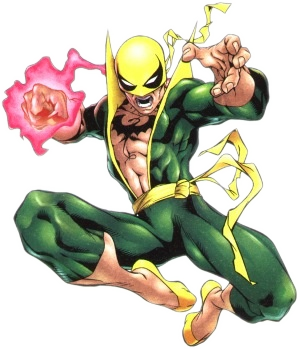
And comic books were hardly immune. Suddenly every comic company was adding martial arts experts (some of asian descent, some not) into their superhero lines. Comic titles such as Master of Kung Fu, Karate Kid (no relation to the 80s movies), and Kung Fu Fighter, and Dragon Fists were suddenly popping up in department store comics racks. Along side characters such as Shang Chi, Richard Dragon, Lady Shiva, and Karate Kid (no “the”) there was Danny Rand, aka Iron Fist: the Living Weapon.
Danny was a classic mighty whitey: a white orphan taken in by mysterious monks in a secret temple in the Himalayas, who masters their semi-mystical martial arts to a degree that far exceeds any of the natives and becomes their greatest warrior. This being an American comic, of course Danny comes to America, specifically New York City, where he tried to reclaim his family fortune (along the way discovering that his parents’ deaths on the journey may not of have an accident). His costume was a bit unusual for male superheroes of the time—ridiculously plunging necklines were usually reserved for women. The excuse for exposing all that skin was the black dragon mark on Danny’s chest. It’s not a tattoo, but rather a symbol that was burned into his flesh during a fight with a dragon, which is an important part of the ritual of becoming the Iron Fist.

Because of that inconsistency—where I would pick up, say, issue #85 of Spider-Man, then not find another issue until #89 came out—I spent a lot of time looking for clues in the stories as to what I had missed in the intervening issues, and I would write up my own versions of the adventures my favorite heroes had experienced in between. Very occasionally I tried to draw my own comics, but mostly I wrote them out more as prose stories. This skill of figuring out all the ways a character might go from point A to point Z has been useful in my own writing since.
Eventually, after my parents’ divorce, Mom, my sister, and I moved to a town large enough to have multiple book stores and an actual comic shop, where eventually I managed to purchase at relatively cheap prices many of the back issues I had missed of Iron Fist and several other titles. I was a little disappointed that some of my attempts to fill in the gaps between issues were way off, but I still loved the character. I know now (but didn’t realize back then) that one of the things that appealed to me about the character originally was that chest-baring costume. But Danny Rand’s story also appealed to me because he was an outsider, never quite fitting in anywhere. That was something I really empathized with.
Another thing that appealed to me about Iron Fist the comic (and some of the other Kung fu-ploitation properties) was the inclusion of (often mangled, I know) zen, buddhist, and taoist philosophy. Seeing other traditions underpinning moral and ethical principles, seeing good, brave, and noble character behaving morally and ethically outside of the fundamentalist Christian framework helped me reconcile my growing discomfort with the evangelical beliefs I’d been raised with. Yes, it was culture appropriation, and it was a stripped-down and distorted representation of those other religions, but it wasn’t being done to deride those beliefs. The distortion was because of ignorance and the expediency of meeting writing deadlines, not out of a hostility to the cultures themselves. While it was problematic, it still helped me find a way to escape the clutches of a homophobic denomination. And that’s a good thing.
As I said at the beginning of this post, I had had high hopes for the Netflix Iron Fist series. I’d read enough reviews when it first came out to know that the consensus of critics and a lot of fans was that the show was nowhere near as good as some of the other Marvel-Netflix shows. But I still hoped. I still think that the show would have been improved immensely if they had cast an asian american as Danny. It would have been really easy, and I think would have made the way they chose to tell his story work a bit better. The external conflict of the series is mostly about control of the corporation originally founded by Danny’s father and the father’s best friend. The internal conflict is about Danny trying to figure out his place in the world. If they had made Danny biracial, showing his father in the flashbacks as white and his mother as, let’s say, Chinese American, then that internal conflict would have had more layers. And this story desperately needed something less shallow than a badly thought out boardroom drama.
It also doesn’t help that the actor they cast as Danny seems about as talented as a block of wood. Seriously, the adam’s apple of the actor who was cast to play Danny’s childhood friend from the mystical city displays more acting talent and skill in a single scene than the actor playing Danny does in the entire series. Another big problem is pacing. The series spent about 9 episodes setting things up that could have easily been handled in one. The first episode was pretty an okay beginning of the tale, but it wasn’t until about episode 11 that things seemed to pick up. I also can’t figure out why they showed virtually no scenes of the mystical city where Danny gets his training. Let along never showing us the dragon. I mean, what is the point of telling Iron Fist’s story without showing us all that?
Maybe they’ll do better in season two.
In case you don’t know where the title of this blog post originated, here’s a music video that might explain things:
Carl Douglas – Kung Fu Fighting:
(If embedding doesn’t work, click here.)
 Font Folly
2 thoughts on “Everybody was kung fu fighting, even mighty whitey — more of why I love sf/f”