Click to embiggenIt’s Friday! It is the first Friday in April. It’s already April. APRIL! How did that happen?
Pollen counts have been high all week, and so my hay fever has been bad all week. We got a little drizzle Thursday evening, and supposed to get more Friday morning, so I hope that will clear out the air a bit and maybe bring some relief to my sinuses.
Anyway, welcome to the Friday Five. This week I bring you: the top five (IMHO) stories of the week and five videos (plus notable obituaries and things I wrote).
Freedom to read! (click to embiggen)”I saw this great, short post on Tumblr some time back that I thought I would expand into a series of posts about writing. I thought that I recorded the name of the Tumblr blog that I lifted it from, but when I went into my note a while later, it wasn’t there. I didn’t really want to steal it without attributing it, and for some reason it hadn’t Googled the quote until today.
People should probably learn the difference between “plot holes” and “things I didn’t like” or “things the franchise plans to explain in the future” or “things film makers didn’t think they needed to explicitly explain because they thought you had critical thinking skills”
—Gina at ahandsomestark.tumblr.com
I was reminded of this quote while reading some gripes about the recent Captain Marvel movie—complaints that echo criticisms of other films, books, and shows that all happen to have one thing in common: the protagonist isn’t a cishet white male.
To stick to Captain Marvel for a minute, the particular complaint is that it is supposedly a bad movie because Carol’s final battle with the bad guy doesn’t involve her defeating said bad guy without using her superpowers. Now read that again: guys who claim to be superhero fans are angry that the superhero used her superpowers to defeat the bad guy. Not only that, they claim this failure of the superhero to not use her super powers is bad plotting.
Of course, they didn’t phrase it that way. And when someone called them on it, asking them why they expect a superhero in a superhero movie to not use super powers, they twisted themselves in a knot trying to say that wasn’t what they were saying.
And you know what, they are sort of correct on that. I mean, it is exactly what they’re saying, but it isn’t what they mean. What they mean is that the moral victory that Carol achieves at the end of the film isn’t the moral victory they think she should achieve. They can’t even see what the victory is, because they are so deeply immersed in societal expectations of gender roles that they can’t perceive it.
Several times in the movie the audience is shown, as she gets fragments of her memories back, Carol climbing back to her feet after getting knocked down. That is a fairly standard part of any hero’s story, right? No matter how many times you get knocked down, you stand back up and keep fighting. The part these guys don’t understand is it isn’t just about being physically knocked down—it’s also about the guys yelling at her to stay down, telling her that she doesn’t belong there, telling her she isn’t good enough, telling her that the only worth she has is what they have given her.
Overcoming that constant message is the point.
Members of marginalized groups understand that. We’ve spent our whole lives being told that who and what we are isn’t good enough. We’ve been told that our worth comes from what they have given us. We’ve been told that only if we become like them will we amount to anything in the world. We are told to be quiet, do as we’re told, act more like them, et cetera, et cetera, et cetera.
The whole point of Carol’s arc is that she has been lied to, manipulated, and put in a position where her power is limited by the liars. She was always good enough. She was always strong enough. But she believed the liars. And her triumphant moment at the climatic battle is first the moment when she throws off the shackles and embraces the power that was always there.
An even more important moment is when the man who has been lying to her day in and day out for years, who falsely told her that the only reason she had anything was because he gave her his blood, who kept telling her she was too emotional, and that she would never be good enough if she couldn’t come down to his level and win under his rules (rules that are very specifically designed to ensure her loss). Her triumph was when she realized that her worth had nothing to do with his approval.
When she refuses to stoop to his level and blasts him in the face, that was an incredibly big deal. Because the enemy she was always facing was the abusive, manipulative, toxic system that he represented.
I understood how important that moment was because for me it reasonated with the moment in my teens when I finally realized that every time my dad had been telling me that I was broken, worthless, not man enough, et cetera, had been a lie. The moment I stood up to him, and then walked away from him was an important victory.
Millions of women who watch Captain Marvel recognize that moment because they all have had a time where they realized they don’t have to please and prove their worth to the awful, lying people and the system that has been holding them down. Their value does not derive from pleasing a man or serving the needs of men—their worth comes from within.
Her character arc is not going from powerless to powerful—her arc is about going from oppressed to free. Just because it wasn’t the arc you were expecting, that doesn’t mean it isn’t a character arc, nor a worthwhile one.
Finally, if you really think that somehow you were robbed because at the end she didn’t engage in a meaningless fist fight with the lying dude at the end, tell me why everyone in the theatre back in Raiders of the Lost Ark burst into shouts and applause when Indy was confronted by the unknown sword-wielding man and he merely pulled out his gun and shot him.
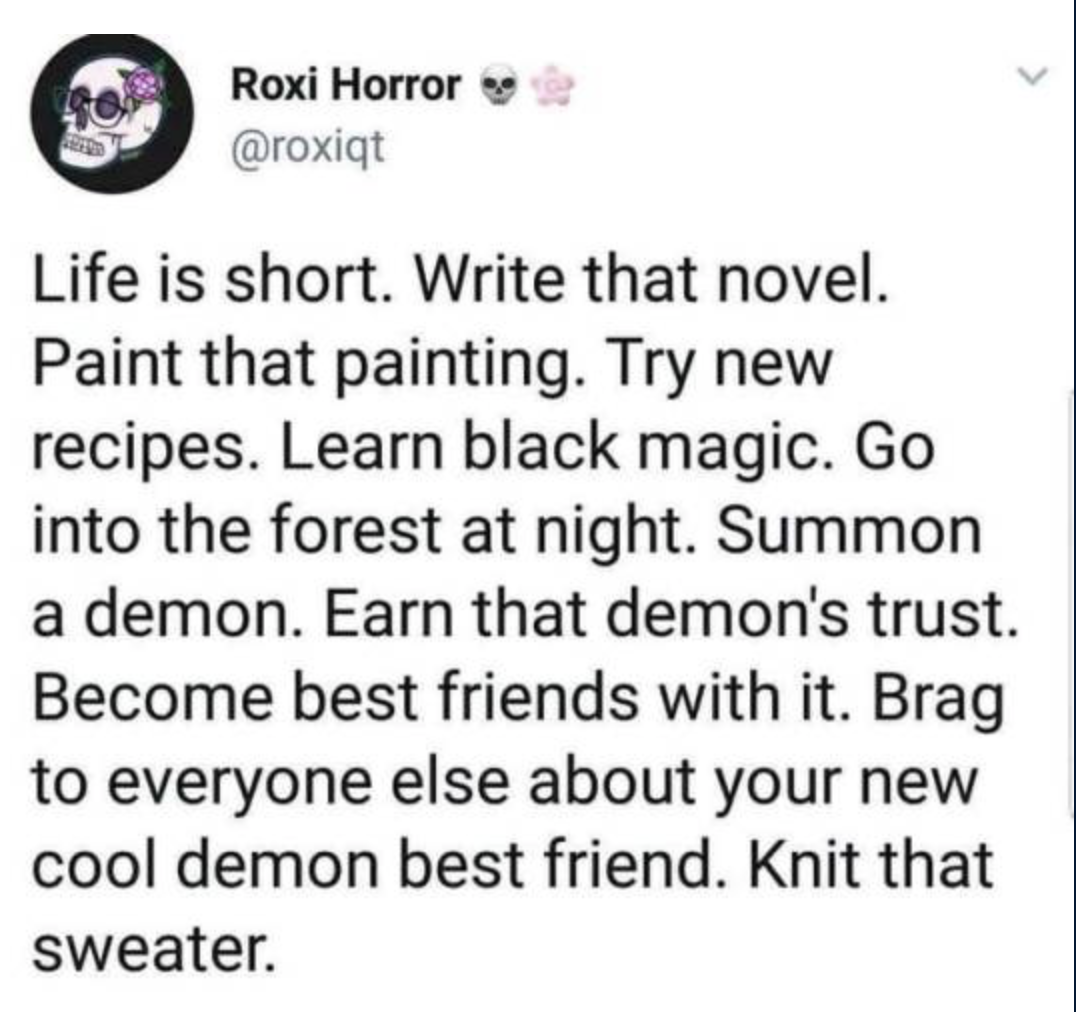
Life is short… (click to embiggen)So, I started Camp NaNoWriMo yesterday. I and a few friends have a cabin (which is basically a private chat group for up to 12 people who have set up projects). Camp NaNoWriMo is similar to the full fledged National Novel Writing Month, but it’s meant to be a bit more low-key and flexible. You get to set your own word count goal, for one. Lots of people use Camp NaNo to edit or revise a large project (such as whatever they wrote during a previous NaNoWriMo). It’s fun. I like having the private chat and having a structure for posting progress, getting and giving encouragement to friends, and so on.
Our cabin isn’t full, so if something like this appeals to you, set up a project and send me a message with your user name so I can send you an invitation to our cabin.
My particular project is an editing one, and I’m counting words as I go through scenes in the larger project. When I finish the edits on a scene, I copy it into a seperate Scrivener document to keep track of my word count. I was a little suprised at how much I got done on the first day, since it was a day at work where I don’t really get a chance to take a full lunch to spend writing, and I was feeling more than a bit out of it when I got home from work.
In other news, the 2019 Hugo and Campbell Awards Finalists have been announced. I was quite pleased to see that in every category at least one thing I nominated made it to the final ballot. The flip side of that is that there are also a lot of things with which I’m not familiar that made it onto the ballot, so I get to read a lot of new stuff soon!
I was really happy to see that Archive of Our Own—a massive fan fiction repository—is nominated in the Related Works category. It’s a little weird, because there are thousands of contributors (including me, though I have such a teeny tiny bit of stuff posted I don’t really count). Clearly if it wins, thy won’t be handing one of the big rocket trophies to every contributor. There are a couple of things in that category that I haven’t read, so I don’t yet know if AO3 is going to be my first choice for Related Work, yet.
As I said, I’m once again looking forward to reading stuff that has been nominated for the Hugos. As happy as I am to see things I nominated make the list, I also love seeing new things that I haven’t read, yet. Because, as I mentioned as part of another point last week, no one’s favorites list can encompass all of science fiction/fantasy. And that isn’t just because a whole lot of it is being published today (although with self-publishing being so much easier, and the internet making things more discoverable, there is an incredibly wide variety to choose from).
But a lot of people operate under the illusion that in times past a single fan could, indeed, read everything in the genre that had been published that year. It only seems that way if you assume that only the authors and stories you have heard of years later are who and what were being published at that time. A great example of this misapprehension is one of the flaws in a recent blog post by whacko Brian Niemeier (that I won’t link to directly, but since Camestros Felapton does a nice analysis of some of the flaws, I’ll link to his post: Did fandom cause the collapse of civilisation or vice versa? Let’s Assume Neither 🙂).
Niemeier makes the claim that “back in the day” everyone read Edgar Rice Burroughs and everyone listened to The Shadow radio show. Now, it’s true that Burroughs’ Tarzan books sold so well that he was able to form a film company and produce his own adaptations of his books, something that would be unthinkable for an author to do today. But it’s simply not true that everyone read the Tarzan books, if for no other reason that regular readers of novels and the like have always been a minority of the population. James Branch Cabell, a contemporary of Burroughs, sold more copies of his books during the nineteen-teens and -twenties than Burroughs did, yet he is largely forgotten today. There were scores of magazines publishing sci fi, fantasy, horror, and related fantastical fiction, publishing thousands of stories during that time most of which written by hundreds of authors many of whom we’ve never heard of.
While there is a huge amount of fantastic fiction to love now, there was a huge amount then, too. And I think that’s great! Because not everyone likes the same things, and the more variety there is, the more likely that there is something wonderful to discover and read for the first time, right? Similarly, the fact that many people like many things, mean that something you or I create is likely to find a receptive audience.
I am quite certain that if someone wrote a story about a conjurer who becomes best pals with a demon and they take up knitting together, someone out there will want to read it.


 Font Folly