All posts by fontfolly

Unknown's avatar

About fontfolly

I've loved reading for as long as I can remember. I write fantasy, science fiction, mystery, and nonfiction. For more than 20 years I edited and published an anthropomorphic sci-fi/space opera literary fanzine. I attend and work on the staff for several anthropormorphics, anime, and science fiction conventions. I live near Seattle with my wonderful husband, still completely amazed that he puts up with me at all.

Sunday Funnies, part 9

Another in my series of posts recommending web comics that I think more people should read:

Police Reports Illustrated is an irregular feature of the news blog for the Stranger, a Seattle alternate weekly news paper. As the title says, each feature is a comic strip-style retelling of an actual police report. Each one I’ve read has been amusing, though I realize the original humor comes from the incident in the police report. I really wish they’d collect these into their own feed. You can find earlier strips by Callan Berry on the Stranger’s blog.

arh1“Always Raining Here” by Hazel and Bell is a fun comic about two high school boys, one of whom makes a pass at the other because he’s desperate and lonely, and things get complicated from there. The comic tackles some difficult topics, such as attempted date rape, but mostly is just a story of several people trying to figure out who they are, grow up, and not make too much of a mess of things along the way.

dm100x80I’m a big fan of “Deer Me,” by Sheryl Schopfer. This artist is also a friend. I have previously described this strip as: “Three roommates who couldn’t be more dissimilar while being surprisingly compatible.” Except in a recent story line Thomas has moved out! Eeek! Currently, the strip has traveled back in time to the high school days of one of the aforementioned roommates.

In any case, if you enjoy Deer Me, you can support the artist by going to her Patreon Page!

mr_cow_logo
I’ve long been a fan of: “Mr. Cow,” by Chuck Melville… and not just because the artist is a friend! A clueless cow with Walter Cronkite dreams presides over a barnyard of a newsroom. Or just showing him reading reacting to news or hatching plans to achieve fame, or just reading ridiculous news is funny because the real news isn’t any more logical.

And if you like Mr. Cow, you can support the artist by going to his Patreon Page. Also, can I interest you in a Mr. Cow Mug?

title
And I love this impish girl thief with a tail and her reluctant undead sorcerer/bodyguard: “Unsounded,” by Ashley Cope.

The_Young_Protectors_HALF_BANNER_OUTSIDE_234x601The Young Protectors by Alex Wolfson begins when a young, closeted teen-age superhero who has just snuck into a gay bar for the first time is seen exiting said bar by a not-so-young, very experienced, very powerful, super-villain. Trouble, of course, ensues.

3Tripping Over You by Suzana Harcum and Owen White is a strip about a pair of friends in school who just happen to fall in love… which eventually necessitates one of them coming out of the closet.

Tripping Over You has several books, comics, and prints available for purchase.

12191040If you want to read a nice, long graphic-novel style story which recently published its conclusion, check-out the not quite accurately named, The Less Than Epic Adventures of T.J. and Amal by E.K. Weaver. I say inaccurate because I found their story quite epic (not to mention engaging, moving, surprising, fulfilling… I could go on). Some sections of the tale are Not Safe For Work, as they say, though she marks them clearly. The complete graphic novels are available for sale in both ebook and paper versions, by the way.

Resolutions, and how I did with the 2014 goals

Cat with a manual typewriter.When I set my goals for the year, I said I’d do monthly check-ins, and I managed it every month except November, which was swallowed up by NaNoWriMo, so that’s not too bad. Click the link to see how I did:
Continue reading Resolutions, and how I did with the 2014 goals

Friday Links

It’s the first Friday of 2015! I am working on a final blog post about my goals for 2014 and how they worked out. I’m also working on finalizing my goals for 2015. I know for many of my friends in wasn’t a great year, but personally, I’m pretty happy about 2014, and looking forward to an even better year going forward.

Anyway, here is a collection of news and other things that I ran across over the course of the week which struck me as worthy of being shared:

Old Fashioned 101: The classic American cocktail. An awesome, single-page web site explaining the proper way to make the world’s oldest cocktail.

Twitter, LiveJournal and navel-gazing. Covers some ground I’ve written about before, but much less rambly.

Thoughts on Fathers.

4 Things That Were Supposed To Happen By 2015 Because Obama Was Reelected.

In Which John C. Wright Completely Loses his Shit over Legend of Korra.

One last buzzing beehive for 2014. A nice answer to the bigoted writer who has proclaimed, “did not call for the extermination of people, but ideas.”

‘Modern Family’ gay criticism misses mark.

INDIANA CONSERVATIVES POISED TO INTRODUCE LICENSE TO DISCRIMINATE BILL.

Op-ed: We Queer Folk Have Always Been Both Black And Blue.

10 great LGBT stories from 2014.

Your biggest online security mistakes (and how to avoid them).

Ancient Trees: Woman Spends 14 Years Photographing World’s Oldest Trees.

How Amazon’s Ebook Subscriptions Are Changing the Writing Industry.

If Protesters Are Responsible For Officers’ Deaths, So Then Are The Tea Party.

Is inclusiveness becoming the new closet?

When a Gay Man Marries a Straight Woman. The stories of people interviewed are worth reading. The author’s conclusions are a bit… well, you’ll see.

AFA’s top spokesman, thinker: Make adultery and homosexuality illegal.

NASA’s Plan For An Off-World Colony: A Floating City Above Venus.

Transgender teenager, 17, leaves heartbreaking suicide note blaming her Christian parents before walking in front of tractor trailer on highway.

DAN SAVAGE: PROSECUTE TRANSGENDER TEEN LEELAH ALCORN’S PARENTS FOR ABUSE.

This Graduate Stripped Down For All The Right Reasons.

Unconditional Love: A Missing Link for Homeless LGBTQ Youth.

Gay Black Men, It’s Time to Do Away With ‘Trade’ and Down-Low Brothers in 2015. While I agree with the idea, for a complex set of sociological and psychological reasons, I think this call will be as successful as the perennial attempts to get gay men of all races to stop having downlow relationships with politicians and the like who have anti-gay public personae/agendas.

The Saddest Thing I Know about the Integers.

Your Husband Is Definitely Gay: TLC’s Painful Portrait of Mormonism – My Husband’s Not Gay isn’t so much an indication that Mormonism is homophobic as it is a sign that Mormon homophobia has taken an even subtler and more pernicious turn.

The Solar System Is Slowly Re-Arranging Itself.

Judge stops short of ordering Florida clerks to issue same-sex marriage licenses when ban ends.

The unexpected math behind Van Gogh’s “Starry Night” – Natalya St. Clair:

(If embedding doesn’t work, click here.)

A gif set from this commercial was being shared on Tumblr, and I just had to track down the video:

(If embedding doesn’t work, click here.)

LogoTV NewNowNext blog reports: Hozier’s “Take Me to Church” has become something of an LGBT anthem, especially with its video depicting a harrowing gay-bashing and lyrics decrying religious intolerance. At a live show in Paris this month, the Irish singer-songwriter was surprised when a 20-member choir infiltrated the audience and began to sing along during “Take Me to Church.”:

(If embedding doesn’t work, click here.)

I included Hozier’s heartwrenching video in Friday links some months ago, but here it is again:

(If embedding doesn’t work, click here.)

Mrs. Betty Bowers, America’s Best Christian offers the Best of 2014:

(If embedding doesn’t work, click here.)

Abba – Happy New Year:

(If embedding doesn’t work, click here.)

Eli Lieb – Lightning In A Bottle:

(If embedding doesn’t work, click here.)

My 2015 New Year’s wish for you…

Spread your wings.

Spread your wings and soar. If you don’t believe you have wings to soar, find them. You have wings. I guarantee it. They may not seem to be there, but they are. Find them.

Remember that wings are not just for soaring. Remember that wings are also for protecting others. Taking someone under your wings can mean to mentor them, but it can also mean to let your love be a shield for someone who needs it. So remember that the same hope and joy and love that allows us to soar to new heights, can also shield others from harm, despair, fear, or doubt.

Remember that wings can be a weapon. Take it from someone who, as a small boy, was tasked with feeding some very aggressive geese on his great-grandmother’s farm. Wings can be devastating weapons. Love can be an irresistible weapon, if you turn its raw power in the right direction. And sometimes we need to do more than shield people we love.

So, that’s my wish for everyone in 2015: spread your wings.

…and to all…

Happy New Year!

¡Próspero Año Nuevo!

Godt Nytt År!

Hauoli Makahiki hou!

Shana Tova!

Ath bhliain faoi mhaise!

Laimīgu Jauno gadu!

Felix sit annus novus!

The idea of ideas, part 3

I’ve written about how having an “idea” is not as important to storytelling as many think, and why specific questions about “ideas” can be so misleading as well as off-putting. As at least one commenter pointed out that while those posts show that focusing on ideas is the wrong thing to do, I don’t explain what the right thing to do is.

Except I did.

I know you’ve heard it a thousand times before. But it’s true – hard work pays off. If you want to be good, you have to practice, practice, practice. If you don’t love something, then don’t do it.
—Ray Bradbury

In the first post I said that focusing on ideas is like a carpenter obsessing over a single nail instead of getting on with the task of building a house. And that analogy has the answer, if you just stop and ask, how does a carpenter learn how to build an entire house from scratch? The answer is that there isn’t a short simple answer. You have to learn about how the tools work. You have to learn about which building materials go where. You have to learn about foundations and framing and supports and seals and scores of other things. You have to practice. You have to have someone look over your work from time-to-time during your practice and tell you whether it seems to be working. You have to build little projects and then put them to the test—see if they do the job you intended them to do and how they hold up against the elements.

It’s not a simple process. No one, not even someone as awesome as Neil Gaiman nor as wise as Ray Bradbury, can tell you in only one or two sentences exactly, step-by-step, how to be a successful storyteller. We can tell you things that work for us. We can point you in the correct direction. We can offer encouragement.

We can give you truths in a nutshell, such as, “The way to be a writer is simply this: write.” But you have to understand that those sorts of truths are like zen koans. The answers come from you struggling with the simple statement and the unspoken complications within.

We can write articles and blog posts about our process. We can point you to excellent books on writing (Building Fiction by Jesse Lee Kercheval, The Art of Fiction by John Gardner, Zen in the Art of Writing by Ray Bradbury, On Writing: A Memoir Of The Craft by Stephen King, How to Write a Sentence: And How to Read One by Stanley Fish, to name but a few). We can try to answer specific questions. But there are two very important things to remember about that. First, we’re humans trying to get along in life just like you, and time we spend giving advice to you is time that we aren’t writing or otherwise earning our own keep. Second, what any of us know took us years of trying, failing, trying again, and slowly learning how to fail less often, and you’re asking us to give you this hard-earned knowledge for free.

I got in trouble several years ago on a writer’s forum for stating one very important truth underlying all of this process. I haven’t mentioned it in a long time. That probably means its about time to bring it up: if there has never been a time in your life when you read voraciously—when getting to the end of a particular book was more important than sleeping or eating, when you rushed to get to the end of one book so you can start another, or when you read multiple dozens of books and even more short stories in a single year—then you can’t be a writer. You don’t have to read like that all of the time, but in order to understand stories you have to have been consumed by them, been enthralled by them, been so caught up with them that they seemed more real than you yourself.

There’s even neuroscience to back that up. Certain areas of the brain simply don’t fully develop if you don’t spend a lot of time reading for pleasure.

You also have to spend some time looking at some of the stories you love and analyzing how the author did it. You need to spend time looking at some stories you hate and analyzing why they don’t work for you.

You have to write. Get one word down after the other until you reach the end of the tale. Then you either set it aside (and start writing something else) for a while until you can pick it up, look at it objectively, see both the flaws and the good parts, and figure out how to do better. Doing better might by re-writing that story. Doing better might mean tossing that tale and moving on to others. You have to let readers read your stuff every now and then and find out whether it works. You have to learn which reader advice to ignore, and which to take to heart. You have to keep writing and trying to get better.

And by the way, when I said look at your work objectively, seeing both flaws and virtues, I mean exactly that. Too many look at their own work and see only flaws, and despair. Others look at their work and see no flaws at all, and think they have nothing to improve. Every work has some flaws, but every work has something in it that isn’t bad. If you can’t find both, you aren’t being objective.

This is as succinctly as I can put it without sounding like a platitude. And there is so much more I could say about each point. But all of this is really just me trying to unpack, just a little, a profound truth that that late, great Ray Bradbury like to say:

Jump, and you will find out how to unfold your wings as you fall.
—Ray Bradbury

The idea of ideas, part 2

So, I wrote about ideas in writing as building blocks of a story on a par with nails. Which was a slight oversimplification, for purposes of setting perspective. Some ideas are more important to a particular story than others, so some of them might be boards, others major support beams, and others cornerstones. The main point is that it is the entire assemble of the structure that constitutes a story.

I admit that questions about ideas are one of my pet peeves. For example, in the late 1980s I started writing a series of hard science fiction short stories about a group of scientists and grad students following up on a tremendous interstellar tragedy caused by a small-ish black hole moving at a significant fraction of the speed of light. I got asked several times, “Where did you get the idea of a black hole moving so fast? That is so cool.”

Each person that asked seemed to be quite let down when I replied, quite truthfully, “There’s a small globular cluster orbiting the Milky Way Galaxy that has jets of hydrogen shooting out of it at a significant fraction of the speed of light. The total mass of those jets is the equivalent of thousands of stars. If a small globular cluster apparently made of ordinary stars could have an event that did that, what might be happening in the hearts of large galaxies?”

Astronomers have since discovered much more dramatic things shooting out of the center of big galaxies than those hydrogen jets that originally gave me the idea. So now the idea seems even less unusual.

And they were even more disappointed if I explained that the first story was to answer a request from the editor of the shared universe fanzine where the story originally appeared. For reasons way more complicated to go into, she needed me to destroy an entire inhabited star system with certain preconditions.

To me, the story isn’t about the black hole, nor even is it about the death and destruction caused by it. The first story is about the scientific method, and the kind of people who can’t observe an unexplained thing (in this case, a gravity lensing effect where one isn’t expected) without trying to figure out what caused it.

The subsequent stories are about curiosity, and different ways people react to it. One of the recurring conflicts is between some people who are obsessed with finding answers at almost any cost, and others who don’t feel that way. If you want to engage me in a conversation about the stories, that’s what I want to discuss, not the black hole. Nor the method someone might use to attempt to protect records are artifacts from a nuclear (or worse) attack. Nor how someone would engineer a biological weapon to effect a species from an alien ecosystem which you have almost no knowledge of. All of those are just gimmicks—things I concocted to put the characters into a series of situations where I could explore questions about the pursuit of knowledge, the morality of such pursuits, and so forth.

Those concoctions are interesting, and yes, I spent a lot of time researching various odd corners of science to come up with those building blocks, but that was all in service of the story.

And in the end, it’s the story that matters. If I don’t tell the story the best I can, I have failed. Even if I come up with a lot of “cool” ideas along the way.

Stuff your eyes with wonder, live as if you’d drop dead in ten seconds. See the world. It’s more fantastic than any dream made or paid for in factories.
-Ray Bradbury

The idea of ideas

Certain questions come up again and again at writing panels, on writing forums, and in writing discussion groups. A lot of those questions are about “ideas.” Where does a writer get ideas? How do you know an idea is worth writing? How do you translate your idea into a story? And so on.

I put the word “ideas” in quotes in that first mention because I believe the people who ask these questions have a profound misunderstanding of the meaning of the word. All words have different meanings depending on the context, of course, but I’m talking about something more than that. Because not only do the people who ask these questions misunderstand the word idea, they misunderstand the entire notion of story.

A story is not a collection of unique notions and eccentric characters presented in a series of shocking situations leading to a surprising ending. Some things we call stories contain all of those things, and in very rare occasions some good stories contain those elements, but that isn’t what a story is. If you want to turn to the dictionary, you might think of a story as a narrative designed to entertain the reader or listener—but that’s at best a mechanical definition of certain types of prose.

A story is a means to transfer a dream from the imagination of the storyteller to the imagination of the reader. Another way of putting it, a story is an incantation for evoking an experience in the mind of the listener.

Specific situations, characters, confrontations, and so forth are part of the arsenal of the storyteller, but they are building materials, not tools. And they are basic building materials, at that. Think of them as nails. Does a carpenter spend a lot of time agonizing over whether a specific nail is worthwhile for this project? No, unless a specific nail is obviously damaged in some manner. Does a carpenter spend a lot of time worrying about where he will find his next nail? No, nails are the kind of supplies a construction company buys in bulk. Does a carpenter spend a lot of time worrying about how to translate his bag of nails into a finished building? No, because nailing boards together is just one tiny part of the entire process of building something, and how to do that is a fundamental skill one should master long, long before attempting to build a house.

The sorts of things that people usually mean when they ask, “Where do you get your ideas” really are as fundamental and individually unimportant as a nail. Yes, if you’re building a house you will need good nails, and they’ll need to be used properly, but no single nail being slightly imperfect, or slightly out of place should ruin the entire structure.

The true skill of storytelling is the process of assembling all of those things together. And as you learn to do that, you start to realize that the parts you were focused on so intently when you were learning the craft are not the most important part of the story. It’s not where your nails came from, or how perfect each nail is.

It’s how you use them.

Don’t think. Thinking is the enemy of creativity. It’s self-conscious, and anything self-conscious is lousy. You can’t try to do things. You simply must do things.
—Ray Bradbury

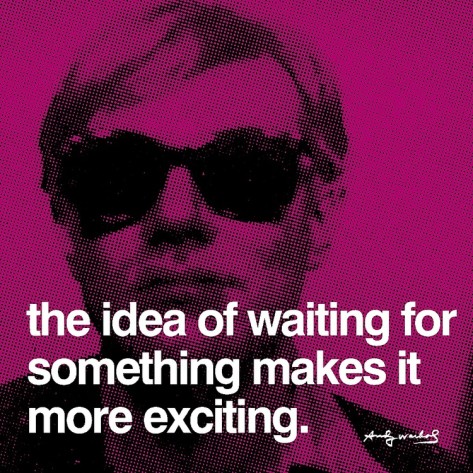
About waiting…

andy-warhol-waitingI get reminded in weird ways how old I am, sometimes. For instance, there was a discussion happening between some of my online acquaintances about Star Wars, specifically about the original movies (where young Luke Skywalker is the protagonist). I made a comment about what a freak I was considered to be by classmates because I had seen the show more than 13 times. And the comment made no sense to the people in the discussion.

So I had to explain that I was talking about when it first came out, and was only available in theatres. This was in 1977, when I was a teenager. Worse than that, it didn’t play in any of the theatres in the smallish town where I lived until about four or five months after it first came out. The closest place that had a big screen and a decent sound system where the movie was playing was more than an hour drive away—not only not in the same town were I lived, but not in the same state!

When you’re a high school student you don’t have a lot of disposable income, so the gas money and cost of tickets wasn’t a trivial expense. I carpooled (either using my old beater car or letting one of my friends drive) twelve times over the course of the first summer the film was out in order to see it. And then in the fall I went once to the truly crappy local theatre that finally got it, dragging a few friends I had never been able to talk into taking the longer trip.

Also at that time period, while home VCRs technically existed, they cost thousands of dollars and were huge, heavy things. Video rental stores didn’t become a common type of business for a few more years, when the technology got a little cheaper. And even then, the players were expensive enough that many people would rent both some movies and a machine from the store in order to have a movie night at home.

Cable television existed only in cities and larger towns. When cable first came to our small town, I was 19 or 20 years old, and it consisted of 15 regular channels, plus the premium channels of HBO or Showtime (Cinemax, Stars, and the like didn’t exist, yet). I write “or” because while very few people I knew had cable at all, most of those who did had only the 15 basic channels, and no one splurged on more than one movie channel. No one.

And, of course, DVDs literally didn’t exist, yet. Let alone the internet.

I had to wait three years before The Empire Strikes Back came out—by which time I was a freshmen in college. Then another three years after that before any of us got to see Return of the Jedi.

I saw all three of those movies, during their respective opening weeks, in the same big theatre in Beaverton, Oregon. It was like a religious pilgrimage for me, by then. I’d been hooked at 17 years old, and the passion still burned with the intensity of a billion suns when I was 23.

This is one of the reasons that, when I hear some of my friends complaining about how many months it will be before the new season of My Little Pony comes out, I don’t always give them as much sympathy as I probably ought.

On the other hand, I’m just as bad. The last episode of Justified season five aired eight months ago, in April, and I’ve been dying while waiting for season six to begin… which it will in January 2015. That’s less than 30 days from now. Inside, 23-year-old me is laughing so very hard at current me because I’m agonizing over having to wait merely months for the next chapter in a saga. And this is hardly the only series or movie that I have such lamentations about.

So, while part of me rolls my eyes at younger fans, another part of me is rolling my eyes at me, too.

Of course, we should remember that 173 years ago, back in 1841, people are said to have lined up for blocks in London waiting for a new edition of a weekly magazine called Master Humphrey’s Clock so they could read the next chapter of Charles Dickens’s The Old Curiosity Shop. Even more fun were the stories of people meeting English travelers disembarking from ocean liners in New York at the time, to ask whether Little Nell lived, since American publication of the stories was several weeks behind the British chapters.

As they say, times change, but human nature doesn’t.

Boxing Day Links

It’s Friday! The final Friday in December. It is also, depending on whether you are reading this before or after sundown, the second or the third day of Christmas. Yes, it is still Christmas! (The first day of Christmas begins at sundown on Christmas Eve, which means that the second day begins at sundown on Christmas Day, and so on. The twelfth day of Christmas is not the invention of some song writer, but rather Three Kings Day or Epiphany, in which many churches celebrate the arrival of the Wise Men at the place where Mary and Joseph and the baby were by that time.)

Anyway, on this, the final Friday of 2015, here is a collection of news and other things that I ran across over the course of the week which struck me as worthy of being shared:

My wish for the family with two dads who brought Christmas to a group of homeless LGBT youth. They had to remain anonymous, and not for good reasons…

U.S. Judge Robert Hinkle to Florida officials: Respond by Monday in gay-marriage case. And the judge appears to be losing patience with some state officials.

Florida woman in ‘Catholic Warrior’ t-shirt destroys Satanic Temple’s holiday display.

The Salt Lake Tribune Names Same-sex Marriage Plaintifs the Utahns of the Year.

This Response to Homophobic Bigots Is So On Point It Bleeds. Also, cheers for a comment: “…nobody worries more about the asses of gay men than homophobes do.”

Europa’s geysers play hard-to-see.

Fossil fish eye has 300 million-year-old rods and cones.

Why rape is so intrinsic to religion: Stories like the virgin birth lack freely given female consent. It’s telling how ready we still are to embrace them.

Gay Marriage Ban on Precarious Legal Ground.

Captive Virgins, Polygamy, Sex Slaves: What Marriage Would Look Like if We Actually Followed the Bible.

Airline passenger freaks out over crew’s ‘Merry Christmas’ greeting.

How Many Stars Did It Take To Make Us?.

Jay Thomas’ Lone Ranger Story 2014 – David Letterman, Jay treats the audience to his final telling of the “greatest talk show story of all time”:

(If embedding doesn’t work, click here.)