Category Archives: books

Book Review: The Last Policeman

Book cover of The Last Policeman
The Last Policeman, by Ben H. Winters
This book came out last year, but I just finished it recently. The Last Policeman, by Ben H. Winters, poses the question: what’s the point of solving a murder when the world is about to end?

The book is set in the very near future. The set up is that there’s a previously unknown asteroid on an eccentric orbit aimed at earth. It’s too big for any technology we have to do anything about in the time remaining. Society is slowly deteriorating as people abandon jobs to go do things they always wanted (I’m particularly fond of the sample list the narrator makes: dangerous sport, sexual fantasy, or track down that fourth-grade bully and punch him in the nose), or join religious cults, or just go on a rampage.

Our narrator, Hank Palace, is a detective in Concord, New Hampshire. He grew up in Concord (his mother worked as a dispatcher for the Concord Police when he was a child), and had dreamed of being a cop. Just barely not a rookie patrolman when the asteroid strike became inevitable, he’s been promoted to Detective as much through attrition as merit. And he’s confronted with a suspicious death that everyone wants to write off as a suicide. Hank isn’t so sure.

The author describes it as an existential detective novel. I think of it more as mid-apocalyptic noir, as Hank’s world certainly has plenty of disorder and disaffection to qualify as noir on its own. Hank walks that shadowy line charted by such characters as Sam Spade and Philip Marlowe: he knows the world is falling apart, but he’s self-destructively determined that justice will be done.

The decay of society depicted feels very real, and the characters are all well defined. The complications and red herrings never seem forced or out of place. There are mysteries within mysteries. You’ll see some of the solutions coming, though not so obviously as to be boring. And even the most surprising one, to me, when it was revealed, had that sense of, “Oh, of course! Why didn’t I realize that’s what those things meant?”

It’s also nice to see a detective story set in a smaller city, like Concord. The setting is just big enough to be a city, without the clichés or over familiarity of places like New York or LA. I also enjoyed the fact that Hank isn’t the only character determined to do the right thing, despite the futility of it all, and that those characters who get to know aren’t all doing it for exactly the same reasons.

I really enjoyed the book a lot, and highly recommend it. Since the Mystery Writers of America awarded it the 2012 Edgar award for Best Original Paperback, I must not be the only one to like it.

Which isn’t to say that it is perfect. One rather trivial set of imperfections I have to mention. It’s pretty obvious that at least some of this book was dictated using some kind of speech to text software, which left some confusing errors that didn’t get caught by an editor (assuming there was one).

For example, there’s a point when Hank is describing an emotionally stiff person. The sentence included the phrase, “like a peace offense.” I actually had to mutter it to myself before I finally realized it was supposed to be “a piece of fence.” A copy editor would have corrected the homonym, but a developmental editor would have said, “I think the word you’re looking for is ‘fencepost’.” At another point Hank is listing off some observatories, “Arecibo, Canberra, and Gold’s tone.” That last one should have been Goldstone, for the Goldstone Deep Space Communications Complex in the Mojave Desert.

But as prone to typos as I am, I can’t fault it too much on that account.

The other imperfection is external to the book. I can’t explain it without talking about the ending. I’m not going to give anything specific away, but if you don’t want even a few indications about the end, stop now.

Otherwise, click “Continue reading…”
Continue reading Book Review: The Last Policeman

Artistic license

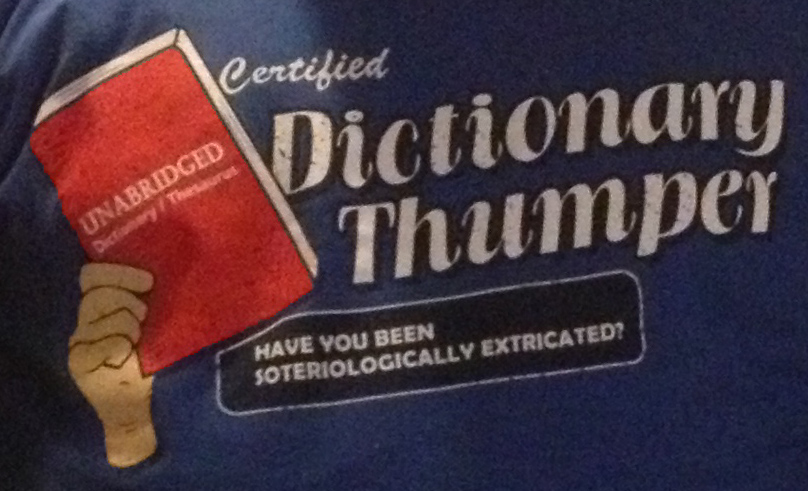
Certified Dictionary Thumper t-shirt.
A close up of the t-shirt.
Recently a couple of different friends sent me a link to that day’s Shirt-Woot. A t-shirt with a dictionary joke. Of course it’s the perfect thing for Gene.

It is rare to find a t-shirt with a dictionary joke, so of course I ordered it. But I commented to one of the friends who had sent me the link that there was one problem. There is no way that the dictionary pictured is unabridged. Look at how easily the person is holding it with only one hand. It would need to be a fairly thin dictionary to be held that way.

Seriously, look at the picture on the t-shirt. He’s not even using all four fingers! The pinkie, at least, is curled under.

Trying to hold the dictionary
Trying to hold it one-handed
I own four unabridged dictionaries. I got out the smallest of them, and tried to hold it as they are in the picture. I can hold it with one hand for a short time, but notice that I have to cup my hand under it, to support all the weight. Three fingers are on the front, but the pinkie is still helping, by stabilizing the dictionary’s weight. You can’t tell in the picture, but it was hard to hold it still, because it’s too heavy and awkward.

The friend thought I was being silly to point this out. And it is a silly t-shirt, which I was delighted to order. I’m going to wear it and let people laugh at the joke. And it’s true, it would be extremely painful to be literally thumped with a hardback book the size of one of these unabridged dictionaries.

Labeling myself a dictionary thumper is not inaccurate. I can be pedantic about the meanings and usage of words. I also get that way about syntax, which would make me more of a style guide thumper, but that joke wouldn’t work as well. People know what a dictionary is, but a style guide, not so much.

I’m nowhere near as pedantic about grammar as people expect. And I’m not pedantic about words in the way that people expect, either. Being a technical writer by profession for over two decades, I can’t begin to count how many times co-workers and other colleagues have come to me with questions about spelling and usage that fall on the fringes of what I think the heart of language is. See, folks think of grammar and usage in very stiff and absolute terms. They believe that there is always one and only one correct way to use a specific word. I’ve always assumed this comes from having been admonished in school for doing something incorrectly, so that they think of grammar as a long list of prohibitions: “Thou shalt not dangle thy participles” and so forth.

Holding the dictionary two-handed
It really takes two hands.
But there are no official lists of rules handed down from on high. Language has rules that have evolved as we’ve used it. Word meanings change over time. New social, cultural, and technological situations require new ways of describing or discussing what’s going on. And the beauty of English is that there are thousands of correct ways to construct a sentence to convey a particular meaning. “The man walked down the road” means the same thing as “He walked down the road.” Structurally those things are nearly identical, so they barely count as two ways, but we could also say “He plodded along the street.” Or we can add more details, “The man, stoop-shouldered and sun-burned, trudged beside the highway.” We can turn the structure around, “The crumbling road guided his footsteps to his destination.”

All of those are correct ways of explaining the same basic situation. But they all evoke different moods and details. What makes a particular version of each of those right or wrong is the context, which is not a matter of grammar at all.

Besides saying “Certified Dictionary Thumper,” the t-shirt includes a slogan. “Have you been soteriologically extricated?” Soteriology is a synonym for salvation, deliverance, or liberation. Extricated means to be disentangled, rescued, or released. So the slogan literally means “Have you been rescued in a liberating way?” Or more simply, “Have you been saved saved?” Which is redundant. If I were feeling the need to use the multisyllabic soteriologically, I would have chosen the slogan, “Have you been soteriologically explicated?” Since to explicate is to define something to have had something defined or explained to you.

I strongly suspect that that was the original joke, probably told to the artist by someone else, and somewhere along the line someone misheard. Explicated and extricated sounding quite similar when spoken aloud.

Of course, that just gives me more to explain if someone asks what the shirt says. Which, for someone like me, makes it even more of a win-win.