Category Archives: genre

Meta-labels and Sub-genres – loving sf/f in all its forms

https://thehopefulheroine.wordpress.com/2014/01/02/dont-judge-a-book-by-its-genre-an-intro/ (Click to embiggen)
I had two different ideas for this week’s “Why I love sf/f” post. Unfortunately, the one I had gotten furthest along in was turning into a mash-up of last week’s and the one before. The other one showed a bit more promise, and then I saw this post on the Over The Effing Rainbow blog: [Sci-Fi Month] Guest post: Aliette de Bodard – Science-fiction, fantasy, and all the things in between.

Go read it, because she says what I wanted to say, only better!

I went through a long phase where I preferred science fiction over fantasy with a bit of self-delusion along the lines that somehow fantasy was “just making any old thing up” while science fiction required an understanding of science! Likewise, I often expounded the notion that hard sci fi was superior to all others because you were constructing your what-if scenarios inside even more demanding parameters. Somehow I was able to express those beliefs at the same time that I would read and re-read any Andre Norton book I could get my hands on because I always loved them. I’m not sure why it took so long for me to recognize the cognitive dissonance between the kinds of stories that moved me most, and the sorts of stories which didn’t but which I claimed were superior.

Some of it is pure stubbornness: you express an opinion at one point, and then you feel obligated to keep justifying your original statement. But when I finally started to recognize this particular contradiction, that didn’t seem a sufficient explanation. Until I had an epiphany.

The epiphany came from an unusual source. I was watching a recording of a question-and-answer session that sex advice columnist and gay rights activist Dan Savage was having after giving a talk at a university. A young woman had a question about why guys her age would be friendly and sometimes flirty with her and other woman she knew who weren’t “model thin,” but always distancing themselves before things got beyond friendship. Yet she found older men pursuing her. She feared that the older men were desperate because of some other flaw she hadn’t uncovered, and that younger guys were merely shallow.

Dan pointed out a couple of things. One was that every week since he’d become an advice columnist he received at least a couple of letters from straight guys who confessed that they were really attracted to bigger women, but terrified to admit it because they thought it meant something was wrong with them. In an aside, he said that he got similar messages from some gay guys about their attraction to big guys. He said the thing nearly all the letters had in common was that the letter writer was either in their teens or their twenties. At that age, Dan said, guys are still very focused on winning the approval of other guys. So they are much more concerned with appearing to be interested in the things they think others expect them to be interested in.

His conclusion was that a lot of the guys she thought were sending mixed signals were doing just that. They were genuinely attracted to her, but when they recognized what was happening, they bailed because they thought they weren’t supposed to be attracted to that kind of body. So his advice was to go ahead and take men who did express interest at their word, and if they didn’t otherwise set of alarm bells, there was nothing wrong with dating them. But also, she would find when she got a bit older, that there were plenty of guys who always had found her attractive, they just had to grow up enough to stop worrying about the approval of their friends.

I realized that I had started espousing those opinions about sci fi vs fantasty, and hard sci fi vs so-called soft science sci fi, and very cerebral sci fi vs action/adventure sci fi when I was in my teens, and I hardened those opinions in my early twenties. At the time it seemed that the fans I most admired all held that opinion. And the way that libraries often classified various books seemed to reinforce that. All of the “soft” sci fi and fantasy was filed in the young adult section or the children’s section of libraries that divided things up that way. Only the hard sci fi and certain kinds of action/adventure sci fi was over in the adult sections. Clearly fantasy and so forth was for less mature, and therefore less sophisticated, readers.

Bull.

“If you’re going to break a rule, break it good and hard. My personal motto!”
—Aliette de Bodard

Especially since science fiction is supposed to be not just exploring limits, but pushing beyond frontiers into the unknown, we shouldn’t look down on things that vary from the familiar. That’s the whole point, right? It’s timid to worry about whether a story is supposed to go this way, or whether we’re supposed to like a particular kind of story, et cetera.

Isn’t science fiction and fantasy supposed to be about boldly going where no one has gone before?

Ancient Tomes and Living Fossils – how I love sf/f isn’t the only way

“Kids these days will never know the joys of oil lamps and chamber pots”Jason Sanford set off small internet firestorm with a series of Twitter comments that he then collected on his blog as: The fossilization of science fiction and fantasy literature. Some people were upset because they thought he was implying that the classics of sci fi were garbage, when all he actually said was that younger people are reading, watching, and playing newer works and there’s nothing wrong with that. He’s since added a follow-up to clarify his point which included this important bit of context:

A few years ago I was on a SF/F panel about bringing new readers into the genre. I mentioned that SF needed more gateway novels, at which point the other author on the panel snorted and said we don’t need new gateway novels … the Heinlein juveniles are still perfect.

That is the type of attitude which people should fear because it will kill our genre. But new readers not discovering SF/F through the classic authors you grew up on — that’s nothing to worry about.

His critique was not aimed at the classics themselves, but rather at older fans and pros who belittle younger people who first learned to love science fiction and fantasy by encountering newer works, or who lecture people who aren’t familiar with many works published 70 or more years ago, or gripe that “real” fandom is greying and dying off.

Reading the original post and some of the fallout left me feeling a bit guilty for ways that I have no doubt come across that way myself. I do react with great incredulity when a friend, regardless of age, isn’t familiar with a book, series of books, or movie that I consider a classic, for instance. I try to get people to watch some of the old movies or read the old books that I loved.

It also made me wonder about the series of posts I’ve been doing for Throwback Thursday the last 6+ months, the “more of why I love sf/f” posts. I started those posts as a personal antidote to the sturm und drang over the affair of the melancholy canines. Because I read a lot of sci fi blogs, and because I was determined to read all the Hugo-nominated works before filling out my ballot, I knew I was likely to spend a lot of time being outraged and otherwise upset about things people were saying about some types of sci fi. So I decided it would be a good idea to write a weekly post in which I would only talk about something I loved from the genre. Since I like having a regular deadline, I needed to pick a day, and it occurred to me that if I focused on works that were influential in my formative years, then I could post them on Thursdays and tag them as Throwback Thursdays.

So I gave myself that assignment.

These posts have been about things I loved in science fiction and fantasy. I’ve written about works that spoke to me in important ways when I was a kid. Many times I’ve mentioned how a particular story or movie or series gave me hints that someday, when I wasn’t a closeted queer kid living among anti-science and anti-gay evangelicals, life would get better. None of which is meant to imply that people who aren’t familiar with or don’t like any of the things I’ve written about are any less real fans than I am, nor that there is anything wrong with treasuring different authors or works.

Not that anyone probably has, but I think it’s important to acknowledge that I’m an old white guy, and what I experienced growing up is going to be very different for fans who aren’t guys, or white… or whose teen-age years are much more recent than mine.

It’s also important to realize that a lot of things that we loved when we were younger don’t always hold up when we’re older. Before I started the “more of why I love sf/f” posts, I’d written about reading some books by a favorite author from my teens and early twenties, and how difficult some of her books were for me to read, now. Some are fine, but some of them have definitely not aged well. And I felt really bad for not liking some of them as much as I did when I was younger.

Because I’m doing National Novel Writing Month (my project is to finish the revision on two of my fantasy novels) there will be a lot fewer blog posts of any kind from me. And those “more of why I love sf/f” posts take more time than others of similar length, because I research the work and author in question. Yes, I’m writing about things I loved, but in some of the cases they are books or shows I encountered before my teens, so I want to make certain I’m remembering them correctly.

I will resume the posts after November. And I will probably continue to focus on books and stories from my younger days. I mean, I averaged reading more than seven novels a week through most of middle school, for goodness sake! There is a lot of potential material to write about!

Storms, Brains, and Reanimated Flesh – more of why I love sf/f

The creature meets the innocent girl... © Universal Pictures
The creature meets the innocent girl… © Universal Pictures (Click to embiggen)

I don’t remember when I first saw the 1931 film Frankenstein, directed by James Whale. I also can’t remember a time when I didn’t know the basic story of Frankenstein. I don’t know for sure what my first exposure was to the myth. I remember watching more than one of the Universal Studios Frankenstein movies with my mom when I was young. I remember one particular time watching it with my mom and my sister, my sister was maybe four or five years old and kept asking questions. I was getting impatient, and Mom told me I had been exactly the same way when I had been my sister’s age.

What I do remember, very clearly, is that I always felt sorry for the monster… Continue reading Storms, Brains, and Reanimated Flesh – more of why I love sf/f

Monsters Are People, Too – more of why I love sf/f

Promotional photo for the Munsters,
Promotional photo for the Munsters, © Universal Studios and CBS.
The Munsters premiered on CBS the night before my fourth birthday. I don’t remember if we watched it from the beginning. I’m fairly certain we didn’t watch it the first season because the first few months it was up against the Flintstones, and then Jonny Quest moved to that time slot. I suspect we did watch it a few times, and for a while during season two, until Batman! premiered with its twice-a-week format one of which was against the Munsters.

Like a lot of other genre-related shows, The Munsters went into syndication fairly quickly after being canceled, and promptly gained loyal audiences outside of primetime. I suspect most of my memories of the show are from this era… Continue reading Monsters Are People, Too – more of why I love sf/f

Nuclear Dinosaurs and Tragic Heroes – more of why I love sf/f

Image from the 1954 Gojira (click to embiggen)
I don’t remember precisely when I saw my first Godzilla movie. I was probably four or five years old. When we were living in the parts of Colorado where all the TV stations we received came from Denver, one of those channels had a Saturday afternoon movie called Science Fiction Theatre (or something like that) which seemed to almost exclusively show Japanese sci fi films. So there were a lot of Godzilla, Mothra, and other kaiju films that I saw during this time.

Often when there were parts of the plot that didn’t make sense to me, Mom would explain it away as the problems with translation. She had already explained about how the movies were originally filmed in Japanese, then dubbed into English. So anything else that seemed odd or illogical was because of that. It didn’t occur to me until later that part of the process of translating it for an American audience also sometimes involved editing the film, taking out scenes or cutting them short.

Godzilla was, of course, my favorite… Continue reading Nuclear Dinosaurs and Tragic Heroes – more of why I love sf/f

Infinity In Your Mailbox – more of why I love sf/f

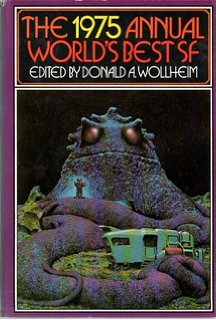
Cover of the Science Fiction Book Club edition of the 1975 edition of the Annual World's Best SF series edited by Donald Wolheim.
Cover of the Science Fiction Book Club edition of the 1975 edition of the Annual World’s Best SF series edited by Donald Wolheim.
I joined the science fiction book club at three different points in my life. The first time was when I was about 13 or 14 years old, and had no idea what I was getting myself into. My mom was not very happy when the first package of books arrived. Fortunately, my paternal grandmother found out about it before my dad did and was able to run some interference for me. So this wasn’t one of the incidents that led to a beating, but it was a close thing.

I wound up doing extra chores at my grandparents’ house to earn the money to cover it. Dad let me remain a member for a year, strictly limiting what I was allowed to order until I’d met the obligation so I could quit the club. I wound up with a bunch of books. And they were hardcover—they were cheap hardcover, but still more sturdy than the paperbacks that most of my collection consisted of before then.

The second time was the summer just before I turned 18, and at least I had a job and was earning my own money.

The book club reeled you in with the introductory packet: for a token payment of two cents, you could choose something like six books from a list. There was a little asterisk statement about paying shipping and handling, which was always more expensive than you thought it would be. But compared to paying full price for the hardcover version when they first came out, it was still a bargain. After that you received a monthly mailing, and if you forgot to return the card that said, “send nothing at this time,” you’d get whatever that month’s book was. You could choose other books out of the mini catalog that came in each month’s mailing. And again, the prices weren’t bad, even with the shipping and handling.

The killer was if you didn’t return the card in time. Because you’d receive books you didn’t want, and usually wound up paying for them because returning them was more of a hassle.

The other downsides were that generally the books were a few years old. They usually didn’t become available to the book club until the original bookstore sales had dropped off for the hard cover, and then the paperback release. The amount of money the authors received was less than for bookstore sales, though most writers who have been willing to talk about it seem to take the attitude that a sale is better than no sale.

When I was living in redneck rural communities, back before the existence of the Internet, a book club was a means to get books that you otherwise might not ever know existed.

The second time I joined, I picked every anthology that was on the list for my initial package. Which included two different years of Donald Wolheim’s Annual World’s Best Science Fiction collections. I loved those kinds of anthologies, because I got a bunch of different stories by different authors. One tale might be a space adventure, another a dark exploration of the nature or identity, another a humorous examination of the future of crime, and the next might have a wizard outwitting a god. Anything could be between those pages!

And I didn’t even have to order one of the books to get a bit of that thrilling sense of wonder. Half the fun of the book club, for me, was reading the catalog each month. Because books and authors I had not heard of—even after I had moved to a slightly larger town that actually had a book store, and not only that more than one!—each received a paragraph or two of description, along with a picture of the cover. So even if I didn’t order the book at the time, later if I saw a copy in a used bookstore, or saw other books by the author, I had a better idea of what the book would be like than I would get just from reading the cover blurbs.

Every month I received a colorful display of dozens of imagined worlds, ranging from high fantasy to gritty near future sci fi thrillers to epic space battles between empires to individual journies of discovery. And all I had to do was, every now and then, buy one of those wondrous books. It was really a small price to pay for infinity.

No wonder 14-year-old me had thought nothing of the consequences when I taped two shiny pennies to a piece of card stock, scribbled my name and address on one side, then swiped an envelope and stamp from Mom’s desk. An infinity of wonder would be mine!

Changelings on Distant Worlds – more of why I love sf/f

Cover of the 1980 paperback re-release of Dread Companion.
I can’t narrow it down more than to say that I found Andre Norton’s Dread Companion on a library shelf during middle school. The cover blurb told me it was a tale of a woman living on another planet far in the future who was hired to take care of two children who had an “imaginary” friend that was something far more sinister.

I didn’t expect that it would be about faeries in space.

The blurb was a fairly accurate description of the set-up: Kilda is a young woman trying to find her place in the world. Her father was a spacer who had no interest in settling down with the woman who got pregnant during their brief political marriage. And her mother didn’t want to be saddled with a child like Kilda who was more interested in exploring and learning science and so forth than she was in being pretty and having babies of her own… Continue reading Changelings on Distant Worlds – more of why I love sf/f

The Original Wizard School – more of why I love sf/f

Original hardback cover of A Wizard of Earthsea by Ursula K. Le Guin art by Ruth Robbins
Original hardback cover of A Wizard of Earthsea by Ursula K. Le Guin, art by Ruth Robbins (click to embiggen).
I think I was 14 years old when I found a copy of A Wizard of Earthsea on a library shelf. The novel tells the story of a boy named Sparrowhawk who lives on the island of Gont which is situated in an archipelago called Earthsea. Sparrowhawk’s aunt is the village witch, and she recognizes his innate magical talents when he is very young, so she teaches him as much as she can. When he is twelve he nearly dies saving his village from marauders using magic. Which attracts the attention of an older mage named Ogion. Ogion heals Sparrowhawk and takes him on as a student. Ogion is the person who gives Sparrowhawk his true name, Ged. Knowing someone’s true name gives one power over them in the magic of Earthsea, so people have to guard their true name. When it becomes obvious that Ged’s talents and impatience are more than the mage can handle, Ogion sends him to the island of Roke to see if he can join the school of mages, there… Continue reading The Original Wizard School – more of why I love sf/f

Homemade Rockets and Invisible Moons: more of why I love sf/f

Cover of the 1958 hardcover edition of Mr. Bass's Planetoid by  Eleanor Cameron,.
Cover of the 1958 hardcover edition of Mr. Bass’s Planetoid by Eleanor Cameron, just like the one I found in the school library (click to embiggen).
In 1970 (I was in the Fourth Grade) the oil company my dad worked for transferred us to a tiny town in eastern Utah. When my sister and I were enrolled in the public school there, we exactly doubled the number of children in the school district who were not members of the Church of Latter Day Saints. Over the next 10 months or so, as many more families (mostly from the south) were transferred to the town by various oil companies, the elementary school’s enrollment went from about 350 children to nearly 500 hundred. I’m not going to talk about the culture shock that occurred during that time, on both sides of the religious divide. But that incredible influx of unexpected kids to the school caused a lot of upheaval, including causing the school to pack up most of the books from the library to convert the library space into four classrooms. For a while, most of the library books were in storage, and a subset was rotated into the tiny old classroom which had been converted into the new library.

It was during one of those rotations that I first found a copy of Eleanor Cameron’s Mr. Bass’s Planetoid. Of course I had to check out right away because it had “planetoid” in the title! It was clear from nearly the first page that this was a sequel. Two best friends, Chuck and David, are friends with an eccentric scientist, Mr. Tyco Bass, who helped them with their homemade rocket previously. Another scientist, Prewytt Brumblydge, has stolen a sample of a mysterious metal Mr. Bass had discovered in a meteorite, and soon he is using this metal to power a machine with which he hopes to solve two of the world’s problems: the lack of safe drinking water in some parts of the world, and the need for electricity. Unfortunately, the machine has dangerous side effects that could destroy the entire planet. The boy’s learn this part from yet another scientist who happens to be Brumblydge’s former teacher, who is convinced the student is looking for the source of Mr. Bass’s mysterious metal.

The problem is that Mr. Bass is nowhere to be found… Continue reading Homemade Rockets and Invisible Moons: more of why I love sf/f

Semi-Precious Stone, Helical or Otherwise: more of why I love sf/f

Cover of the first edition paperback, World's Best Science Fiction 1969 edited by  Donald A. Wollheim and Terry Carr.
Cover of the first edition paperback, World’s Best Science Fiction 1969 edited by Donald A. Wollheim and Terry Carr.
I was either 13 or 14 years old when I acquired my copy of the 1969 edition of the World’s Best Science Fiction. As was so often the case, I picked up my copy at a used bookstore. I recognized several of the authors in the table of contents, though I don’t believe I had read any of the stories. That was the point! One book, a whole bunch of stories! Brilliant!

Once I got the book home, I read through the titles in the table of contents again, and one jumped out at me: “Time Considered as a Helix of Semi-Precious Stones.” It was just an interesting image: a helix of gemstones and the like as some sort of analogy or metaphor for time. And the author’s name, Samuel R. Delaney, seemed familiar, though I couldn’t think of any stories I had read by him.

So I jumped right to that story… Continue reading Semi-Precious Stone, Helical or Otherwise: more of why I love sf/f