Category Archives: genre

Citizen of the (two-fisted) Galaxy: more of why I love sf/f

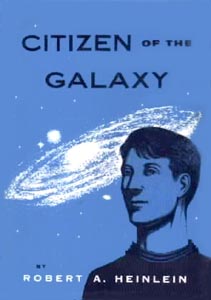
Cotg58I can’t remember the first Robert Heinlein science fiction book I ever read. My mom (who had been teased as a child because of the way she spoke) was determined that I would learn to speak correctly, and decided the best way to teach me proper grammar was to read to me from her favorite authors. So before I could talk, she would read aloud from her Agatha Christie murder mysteries and her Robert Heinlein science fiction books. Later, when I could talk, she would make me repeat back whole sentences as she read. Besides turning me into a lifelong fan of mysteries and sci fi, this project also accidentally taught me how to read long before I got to school.

While I don’t remember the first, I do remember several that I read during elementary school and into middle school… Continue reading Citizen of the (two-fisted) Galaxy: more of why I love sf/f

A Boy and His Telepathic Cat: more of why I love sf/f

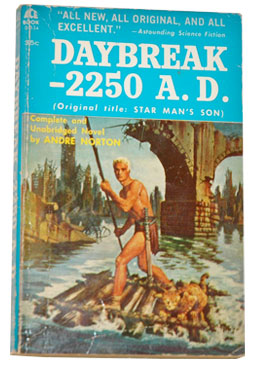
Cover of Daybreak 2250 A.D. (original title: Star Man's Son) by Andre Norton. (Click to embiggen)
Cover of Daybreak 2250 A.D. (original title: Star Man’s Son) by Andre Norton. (Click to embiggen)
I don’t remember which Andre Norton book was the first that I read. I do know that sometimes when we moved to a new town where the library didn’t have a clearly labeled science fiction/fantasy section, I would head to the card catalog and look up Norton to find out where to start. I do remember one of her books that I read over and over: Daybreak 2250 A.D..

I believe that I first read it in fourth grade. It was a hardback copy from the school library with the original title: Star Man’s Son. I found the copy with the blue and white cover and the alternate title in a used bookstore sometime in middle school. The novel is set in the mid-23rd Century, two hundred years after a nuclear disaster has destroyed civilization. The protagonist, Fors, is the son of a Star Man, who have been scouring the earth for old technological treasures, books, and the like that they are preserving as part of a plan to eventually rebuild a civilization. Fors is a mutant with silver hair and mild psychic powers who is ostracized by the other Star Men after his father dies. He has a series of adventures with his unnaturally intelligent cat, Lyra, eventually proving himself worth of carrying the distinctive star badge of his father’s people.

Th novel was originally written in 1952, and was intended for the young adult market, so the plot and setting don’t seem terribly original now. But she described Fors’s and Lyra’s world vividly enough to seize my imagination. Having a hero be a young person who is rejected by his own people for being a freak is something that most kids could related to, let alone a closeted gay nerd who loved science growing up with creationist fundamentalists. And what kid wouldn’t want to go on fantastic adventures with a kickass telepathic cat as a companion?

Despite the fact that I read it so many times, the specifics of the plot never stay with me. I remember the setting, the hero, and the cat. There were various encounters with less civilized tribal cultures, but I don’t remember any specifics. I don’t even remember what discovery he made at the end to earn his place with the Star Men.

But I loved that book!

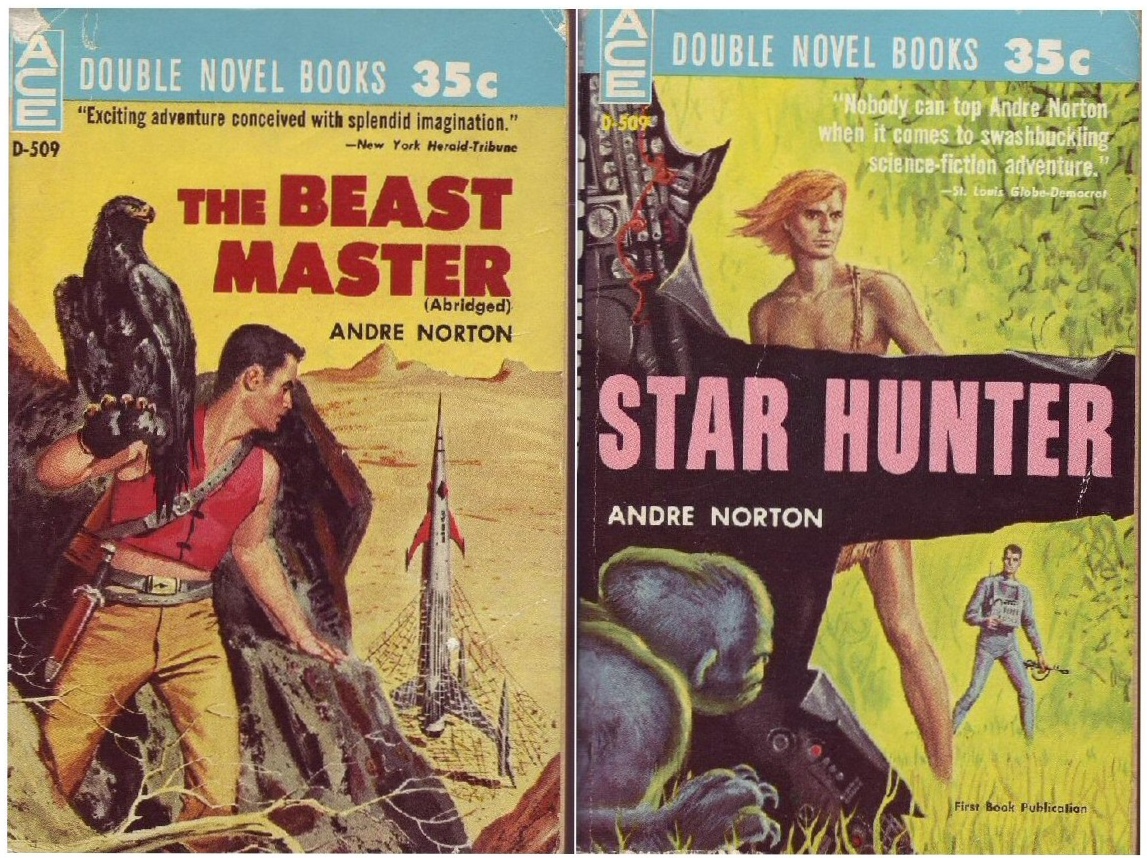
Double-book of The Beast Master and Star Hunter (Click to embiggen)
Then there were the pair of Norton books that were released as a double-book. These were an interesting idea: publish two different books back-to-back (one was literally upside-down compared to the other) and sell for the usual paperback price. This was one of the few I ever found where both books were by the same author. Others usually had one author I had heard of on one side, and a complete unknown on the other. This is not a scan of my copy. When I found mine for sale extra cheap at a used book store, it was missing the Beast Master cover completely, and had maybe half of the other one still intact. Someone had attempted a repair with book tape and some cardstock. I had never known what the original Beast Master cover looked like until the age of the internet.

It is important to note that this book pre-dated the movie of similar name by many years. And the movie bears almost no connection to the plot of the book. I understand that Ms. Norton received a licensing fee for the movie, but I don’t know whether it was meant to be an adaptation. Anyway, Norton’s novel is about a man of Navajo descent named Hosteen Storm who has a telepathic link to certain animals. Storm and his companions end up on a colony world after leaving the military. Star Hunter, on the hand, is about a young guy who discovers he has another person’s memories and a bunch of people are out to get him.

Just skimming the titles in the very long bibliography of Norton’s work on Wikipedia brings a fond smile to my face. Whether she was writing science fiction or fantasy (or the occasional historical novel), she created scores of imaginary worlds that I wanted to run away to, and gave me characters I wanted to be like. A recurring theme was the outsider who finds or makes their own niche in the world. Her stories made me believe that it didn’t matter if people called me a freak, or said I was irrelevant or unsuitable because of some arbitrary standard—what mattered was what I did with the hand fate dealt me.

That was an inclusive message I desperately needed to hear growing up. Fortunately, Andre Norton was there to show me the way.

Time Travellers Strictly Cash: more of why I love sf/f

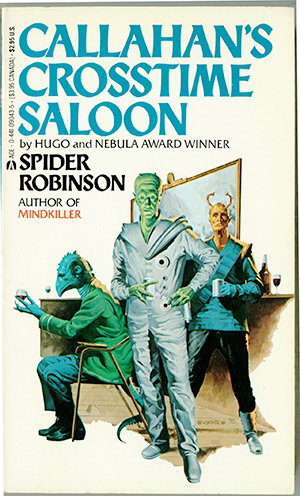
The cover of my very own copy of Callahan's Crosstime Saloon. (Click to embiggen)
The cover of my very own copy of Callahan’s Crosstime Saloon. (Click to embiggen)
When I was in middle school, I pleaded so much for a subscription to the Magazine of Fantasy and Science Fiction that one of my grandparents purchased a subscription to Galaxy Science Fiction. I suspect that they slipped into my room one day and grabbed a copy of whichever magazine I had laying around—at the time my only source of the magazine was a rack in the local drugstore, and some months they got Galaxy, some months SF & F, and other months Analog.

It was in the pages of Galaxy that I first “met” Spider Robinson, who wrote their book review column at the time. The books he reviewed were books that either had just come out in hardback or were going to be coming out soon, so they were never books I would be seeing in a while. If a book wasn’t purchased by the local public library, my only option back then was to happen upon a paperback book when the family took a trip to the larger town (across the state line) where they actually had bookstores!

Even though I often didn’t see the books he reviewed until years later, his book reviews gave me a sense of belonging to the sci fi tribe. And they were just fun to read!

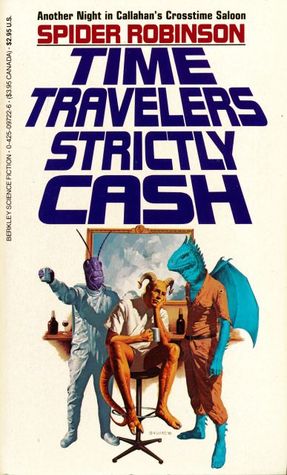
1428973Robinson wrote his own science fiction, too. I believe I read a few of the Callahan’s short stories out of order as they appeared in the magazines. It wasn’t until I was in college when I found a copy of Time Traveler’s Strictly Cash in a used bookstore that I read a bunch of them in order. I immediately became an even bigger Spider Robinson fan.

It’s hard to describe the Callahan’s stories. Most of them are set in a bar that somehow manages to attract aliens, time travelers, and various mythical creatures each lost in different ways. They were sort of like Twilight Zone episodes… except (almost) always uplifting. Originally, the Callahan stories were semi-standalone stories, most of which were published in the magazine Analog Science Fiction. The stories often illustrated the Law of Conservation of Pain and Joy (also known as Callahan’s Law): “Shared pain is lessened; shared joy, increased—thus do we refute entropy.” Robinson wrote the Callahan’s stories as ideas occurred to him, so he didn’t have a grand plan for continuity. So in the later books as he transitioned from short stories to novels things occasionally went off the rails. But even then, the stories had more than enough heart to patch over the plot holes.

He’s also written novels outside of the Callahan’s universe. My particular favorites are Mindkiller and Telempath, though he is probably more famous for the Stardancer series written in collaboration with his wife, Jeanne Robinson. He’s won three Hugo Awards, a Nebula, the John W. Campbell Award, and the Robert A. Heinlein Award for Lifetime Achievement. So I’m not the only one who likes his work.

I read pretty much every single thing he wrote from 1970s, through the 80s, and a bit into the 90s. He kept writing and still is writing. His most recent novel was published in 2008; he’s been reporting off and on about progress on his next novel on his web site, but he’s also been dealing with serious health issues (both his own and in the family), which has slowed him down.

As I said, I kept reading everything he wrote into the 90s. Around 1993 or ’94 I found myself drifting away from Robinson. Some of it was just issues in my life. I finished coming out of the closet, I got divorced, and a lot of family upheaval happened. This is also the time period when, in my opinion, the Callahan stories started going off the rails. I had also come to the conclusion that I just didn’t agree with the philosophy that seemed to underpin every story he wrote: if only people could communicate more clearly, all conflict would cease. So I stopped reading his new material. I would still pull out my old favorites from time to time to re-read.

In 2000, I read a book review by someone else (unfortunately I don’t remember who) of a new Callahan novel, Callahan’s Key. The reviewer mentioned a similar dissatisfaction that had caused him to stop enjoying Robinson’s writing around the same time I had quit. And the review said that this novel captured at least some of the old magic. The reviewer said the new novel was a joy to read.

So I picked it up. And I read it, and it did have a lot of the fun of the earliest stories. It was not, in any way, a rehashing of them, though most of the characters make an appearance (and team up to save the world, literally). It reminded me of why I had loved his writing to begin with.

I think what appeals to me most about Spider is his unabashed enthusiasm for the idea of science fiction itself. That came through in his book reviews, of course, but also in other essays, introductory material he wrote for the short story collections, but also in the stories themselves. I still remember one comment about Dune Messiah, the first sequel to Frank Herbert’s Dune: it had plot holes you could drive a truck through, but you didn’t care, because the rolling grandeur of Herbert’s vision swept you along.

And he was right.

Robinson’s work epitomizes the giddy hope for a better tomorrow that is at the heart of some of the best science fiction. That exuberant expectation of better things to come is what first drew me to the genre. I’m grateful to have had Spider has a guide and companion in my own search of that wonderful tomorrow.

Marooned off Vesta: more of why I love sf/f

125aMy dad’s idea of a vacation was to go camping and catch fish. Unfortunately, these trips not only never involved a camper, they also never included tents. We slept in sleeping bags under the stars gathered around the dying embers of the fire we’d cooked dinner on. If it was raining, the whole family would crowd inside the cab of Dad’s pickup and try to sleep sitting up all squeezed together.

I wasn’t terribly good at any “outdoorsman” sorts of skills, and Dad never missed an opportunity to tell me just what a clumsy, stupid, sissy I was whenever I did anything incorrectly. Though, for the record, he never called me anything as nice as “sissy.”

So I didn’t much enjoy those vacations.

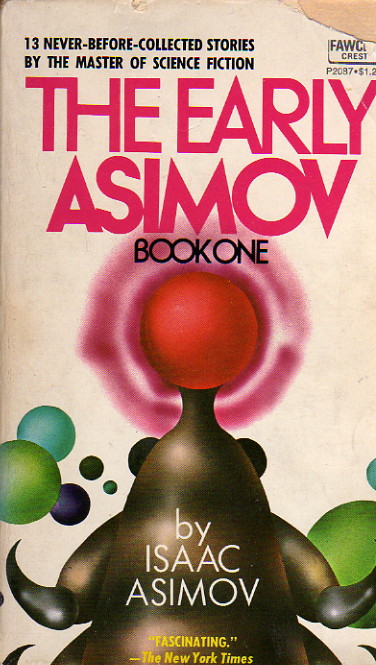
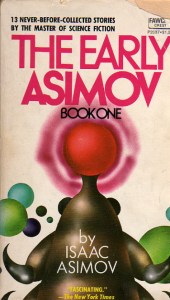
The last one we took, before my parents’ marriage took its final turn for the worse, was when I was 13 or 14 years old. Shortly before we had left on the trip, I had acquired a paperback copy of The Early Asimov, Volume 1, and had packed it along. I’m not sure why that particular book had jumped out at me in the small bookstore that we had visited with my Great-grandma on a weekend trip to a nearby town that was large enough to have an actual bookstore. My best guess is that, since Asimov was at that time the author of a monthly science essay that appeared in each issue of The Magazine of Fantasy & Science Fiction that I had recognized his name.

I remember waking up early in the morning several times on that camping trip, my parents and sister still asleep, and going to the pickup to retrieve the paperback book from my bag. Then I sat and read until Dad woke up. Just looking at the cover of my worn old copy of the book brings back memories of the early morning light, the sounds of wind in the leaves overhead, and the nearby creek.

The Early Asimov was first released as a hardcover, single volume book a couple of years before I found the paperback. It is a collection of a bunch of Isaac Asimov’s short stories from the first nine or ten years of his career; specifically stories that had not already been included in any other anthologies. But the book isn’t merely an anthology—in between each story, Asimov wrote about how he came to write the story, along with describing other stories he wrote at the time that either had never been published, or had been and were in other collections. These interludes were much more than mere introductions to the story, they amounted to an autobiography. And the story this autobiography told was how a Russian-Jewish kid from Brooklyn discovered science fiction in the magazine rack of his family’s candy store, and became a published professional sci if writer before he exited his teens.

Isaac’s personal story gave me at least as much hope and wonder about the possibilities of the future as his science fiction did. The stories themselves were entertaining and thought-provoking. Asimov clearly loved science, and he was perpetually optimistic that great things could be accomplished with the proper application of knowledge.

And he wrote good stories.

Not just a few stories. He published over 300 books. He wrote science fiction novels, of course, and collected his short stories into anthologies, but he also wrote science fact books, history books, books on literature, and so much more. I mentioned his monthly science column—he wrote 399 of those from 1958 until his death in 1992. About every year and a half he collected the last 15 to 17 of them into a book, wrote additional introductory information, and published them (Janet Todd Rubin gives a great explanation of the importance of Isaac’s science columns here: (Almost) Everything I learned about science I learned from Isaac Asimov). And then there were the many limerick collections…

But back to the sci fi:

His Foundation series, besides being the first collection of novels to be awarded a Hugo as a collection, established the concept of psychohistory: a science of applying mathematical formulas to the actions of large populations to predict various outcomes. His Robot stories were the first to posit artificial intelligences that did not turn on their masters, and he was the first person to coin the word “robotics” which has become the name of the real engineering discipline he described in the books.

And then there were his mysteries. Science fiction mysteries at first (including the Wendell Urth science fictional science mysteries), but also a series of mystery short stories set in contemporary setting (Tales of the Black Widowers, and sequels), and two straight murder novels. Though my favorite of those, Murder at the ABA which was set at a booksellers convention, isn’t entirely serious. One of the supporting characters in that one is Asimov himself, and he portrayed himself very self-deprecatingly, making his character the comic relief of an otherwise serious murder investigation.

I didn’t really know all of that at the time, but reading that book over the course of several mornings on that vacation, Isaac Asimov gave me hope that I could write science fiction and get it published, too. Hope not only that I could write and get published, but that there were people out there interested in the things I was interested in. I didn’t have to remain trapped, like the protagonists of “Marooned off Vesta” stuck with no propulsion, no radio, a limited amount of air, and a year’s supply of water. I could rig up a propulsion system from the things I had, and get to a safer place.

His writing style was described as unadorned. Some people complained that he very seldom described his characters or the settings. I think that was a strength. His stories focused on the plot. His characters were defined by their words and deeds. He described only those things that needed to be described to understand the story, leaving the rest to the reader’s imagination. Allowing the reader to imagine characters who weren’t always white, for instance.

He raised questions, and answered them with a mix of science and humor that made the future seem like a very inviting place. And his willingness in many anthologies and essays to share anecdotes of his encounters with other writers (not to mention the many stories of the times he was Toastmaster at a Hugo Award ceremony) made the world of science fiction writers and fandom seem an even more welcoming place.

He was quick to laugh, and quicker to make others laugh. Sometimes too quick. He had to have thyroid surgery at one point in his life, and when they gave him the tranquilizer before they move the patient into the operating room, he began singing and joking with everyone. When the surgeon came into the operating room, Isaac sat up, grabbed the doctor’s scrubs in both hands, and blurted out, “Doctor! Doctor! In green coat! Doctor, won’t you cut my throat? And when you’re finished, Doctor, then, Won’t you sew it up again?”

The nurses got him back down and the anesthesiologist put him under. The nurses later told Isaac’s wife that the doctor couldn’t stop laughing for nearly five minutes. When he included this story in one of his essays, he noted, “They say I’ll do anything for a laugh, but I think that making a surgeon about to take a scalpel to me laugh so hard he can’t hold an instrument may have been a step too far.”

I could easily ramble on and on about Asimov, the awards he won, the records he set, the serious science circles he moved in, and the many, many bookshelves in our house filled with his books. He loved knowledge and he loved explaining things (two traits that I know more than a little about), and he wrote in a way that encouraged you to think, to be curious, and to meet challenges with confidence and a smile.
Picnic on the Queer Side: more of why I love sf/f

We're queer, we're nerds, get used to it!
We’re queer, we’re nerds, get used to it!
I was 13 years old and had been a semi-faithful reader of the Magazine of Fantasy and Science Fiction for a few years. I think I found my first copy in a magazine rack in a drug store sometime during fourth grade. I had pleaded and begged for a subscription of my own, and one of my grandparents had bought me a subscription for my twelfth birthday—except they got me a subscription to Galaxy Science Fiction instead. Which wasn’t bad, it meant I got a magazine about the size of a paperbook every month filled with short stories, novelletes, and sometimes serialized novels. But my adventures in the pages of Galaxy magazine is a story for another blog post.

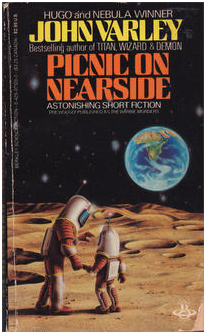
It was summer, just months before my 14th birthday, when I got hold of the new copy of the Magazine of Fantasy & Science Fiction and found inside it a story called “Picnic on the Nearside” written by John Varley. In it, the narrator, Fox, who was 12 years old and lived on a colony of the moon sometime in the future, had been in an epic argument with his mother, because he wanted a Change. He didn’t explain right away what the change was, but before that reveal, we learned that people in his society could easily alter their bodies (his mother exchanged her feet for peds/hands before going out to a party; and Fox mentioned a time he had assembled an eight-legged cat). Then Fox’s best friend, Halo, shows up as a nude woman, which finally explained what the change was. Fox and Halo had been best buds for years, and Fox worried that now that Halo was a woman, it would ruin their friendship.

Cover of the paperback edition of on of Varley's anthologies which included the story in question.
Cover of the paperback edition of one of Varley’s anthologies which included the story in question.
There are many other interesting things that happen in the story: Fox and Halo take Fox’s parents’ vehicle out on the surface without permission and get into a misadventure. But the really mind-bending part of the tale was the setting: a society where changing genders was only slightly more complicated than changing one’s clothes, and where everyone was okay with it. That was just mind-boggling!

I have to make a couple of digressions here. The first is that not all queer people are transgender, transsexual, nor transvestite. Gay boys don’t want to become women, we’re guys who are attracted to and fall in love with other guys. The proper answer to the clueless question, “Which one is the woman” is “Neither, that’s the point!” But one of the reasons young gay boys often idolize female characters in their favorite movies, books, and so forth is because the female characters are the objects of desire of the male characters. Similarly, young lesbian girls often idolize male characters in works of fiction. Young bisexuals may find themselves idolizing both, and so on.

Because there were no openly gay characters in any of movies, TV shows, books, short stories, et cetera which made up our cultural landscape growing up, one of the only ways to imagine ourselves in the worlds we longed to live in was to identify with the female characters. So on one level, “Picnic on the Nearside” offered me a more explicit way of projecting myself into that world. It was as if one of my subconscious coping mechanisms had been made manifest in the plot! Therefore, this story so intrigued me not because its imagined future would afford me an opportunity to change genders (which wasn’t what I wanted), but because it offered an escape from the expectations that boys were only allowed to do boy things, and only allowed to be friends with other boys, and only allowed to be boyfriends with girls.

The other digression is about the difference between a gender fluid milieu and a gay/lesbian culture. Varley has written a lot of stories set in the same world as “Picnic on the Nearside,” including several with the same character, Fox, as the protagonist (though the stories starring Detective Anna-Louise Bach {for example, “The Barbie Murders”} may be a bit more famous). Many of his characters change genders and have love affairs with people who have also swapped genders, but many times his imaginary gender fluid society is still very heterosexual. Fox never thinks of Halo as a potential sexual partner until they are opposite gender, for instance. Some of the couples who appear in the various stories seem to be just friends when they happen to be the same gender, then become lovers only when they happen to be opposite.

Many psychologists and sociologists now theorize that men who like to dress up as women and have sex with other men while thus dressed up are actually exploring an exaggerated heterosexuality. Having, in the online world, been sometimes emphatically propositioned by guys like that, and found myself turned off by their “flirting” that consists of trying to get me to say I will treat them the way an extremely selfish chauvinist man might treat a “slut,” I see their point. The men pursuing those scenarios are so into their fantasy of what heterosex could be that sometimes they want to experience it from the girls’ side. They aren’t turned on by the other man as a man, they are turned on by the situation of a woman submitting to a man in very specific ways.

Looking back on some of Varley’s stories, they can feel more like a mostly hetero exploration of gender roles, rather than a pan-gender exploration of sexual orientations.

There’s nothing wrong with that, and there’s a lot right with it.

A lot of the pain, fear, and bigotry directed toward LGBTQ people is grounded in very narrow and strict views of gender. It’s why homophobic men are almost always also misogynist (or at least very chauvinist). So anything that makes us question those assumptions about intrinsic differences between men and women, what roles men and women are each allowed to take in society, and the morality of those gender binaries is a good thing. And there’s no question that Varley’s tales exposed many of hypocrisies at the heart of all those assumptions.

I became a Varley fan that summer. Even more so, I became a fan of the protagonist, Fox, who went on to appear in the short story “The Phantom of Kansas” and the novel Steel Beach. Questions of gender and sexuality are at most a minor consideration in most of his stories, and I’ve come to appreciate his ability to take seemingly any speculative notion (no matter how weird) to its logical conclusion, and still tell a cracking good yarn along the way. What grabbed me that summer, while re-reading Fox and Halo’s misadventure again and again, was that there was at least one writer willing to tell stories that didn’t exclude a queer viewpoint. And there were editors who would print it, and by implication, readers other than me who wanted to read it.

And that was an amazing epiphany for a 13-year-old gay boy in the rural and very redneck Rocky Mountains.

Visions and Ventures: why I love sf/f

tumblr_nkryuujLIC1sndzdgo2_540I don’t remember a time when I wasn’t a fan of fantasy and science fiction. Which is not surprising, since my mother accidentally taught me how to read at an early age by reading to me from her favorite authors (Agathe Christie and Robert Heinlein) and making me repeat back entire sentences. Tales of the fantastic by Heinlein, Andre Norton, J. R. R. Tolkien, Edgar Eager, Edith Nesbit, Isaac Asimov, Ursula K. Le Guin, Leigh Brackett, Gordon R. Dickson, Lin Carter, and so many others fed my imagination, encouraged my curiosity, fueled my thirst for science and math, and provided a refuge from the cruelties and contradictions of life.

One might wonder how cruel an existence growing up as a white boy in mid-twentieth century America could be. When you have a physically abusive alcoholic father heading up your working class rural evangelical fundamentalist family, real life can be quite unpleasant—especially for a gay, nerdy kid who talked to himself and was more comfortable with books than kids his own age. Science fiction and fantasy promised worlds where all you needed to defeat evil was a bit of courage, a lot of cleverness, and people you could count on. Every time my dad’s job transferred us to a new town, I would quickly ingratiate myself with the local librarians and proceed to devour every science fiction and fantasy book I could find on the shelves. Not to mention mysteries and science non-fiction books.

It wasn’t just the imaginary worlds of the various stories I read that provided a refuge, but from the introductions and interstitial texts of anthologies such as The Hugo Winners, Volume n, Best Science Fiction of the Year XXXX, and so forth, I also learned of conventions, where the creators and fans of these fantastic worlds gathered to talk about their favorite books and stories, encourage each other to write more stories, collaborate in various ways, and maybe even have a fun party or banquet where awards were handed out. And that sounded so amazing. Before middle school I knew about the Nebula Awards and the Hugo Awards. I knew that the Nebulas were voted on by members of the Science Fiction Writers of America, and that you had to be a professionally published SF writer to get in. But the Hugos were voted on by the attendees of WorldCon—by fans and professionals alike. So in theory, at least, I didn’t have to wait until I’d been published to participate in those.

I’d decided to become a writer sometime around the age of five or six. I’d been making my own books out of whatever notebooks or paper I could get my hands on since before I could write. I started writing my own stories as soon as I could assemble my sloppily-drawn letters into words. I was determined to be a writer. And I hoped that someday I might be a member of that community of writers vying for a Hugo.

As an adult, I’ve been attending sci fi conventions for decades. I’ve even been a staff member at a few. I’ve had some of my own tales of the fantastic published, even though most of my published stories have been in fanzines and other small semi-pro publications. I’ve had the good fortune to be the editor of a fanzine with a not insignificant subscriber base. I count among my friends and friendly acquaintances people who have been published in more professional venues, people who have run those conventions, people who have won awards for their sf/f stories and art, even people who have designed some of the trophies. Not to mention many, many fans. I have even occasionally referred to that conglomeration of fans, writers, artists, editors, and so forth as my tribe.

All of that only begins to scratch the surface of why I find the entire Sad Puppies/Rabid Puppies mess so heart-wrenching. Yes, part of the reason the situation infuriates me is because the perpetrators are all so unabashedly anti-queer. For this queer kid, sf/f and its promise of better worlds and a better future was how I survived the bullying, bashing, hatred, and rejection of my childhood. To find out that there are fans and writers who so despise people like me that they have orchestrated a scheme whose ultimate goal is to erase us goes beyond infuriating.

But it’s worse and so much more than a bloc-voting scheme.

This is hardly the first time I’ve encountered homophobia, misogyny, and racism in the fandom. It’s certainly not the first time I’ve encountered it among the professionals! While it’s disheartening to have people sneer and make denigrating comments; and it’s chilling to be told people like me deserve extermination. The worst part is to be told that even putting characters that are like me into stories about space battles or post-apocalyptic worlds or bio-engineered futures makes those stores cease to be “real science fiction.”

If your imagination is so small that you can’t conceive of a future where gay people and women and non-white people actually exist and do interesting things—that those people can sometimes be the heroes of the tale—then I just don’t see how your speculative fiction can be very creative. If you can’t conceive of a world with gays and straights, women and men (trans* or cis), and people of all races, living and working together, you’re hardly a visionary. If you’re so afraid to share imaginary worlds with such people, you’re the exact opposite of an intrepid adventurer.


Update: Some of the Sad Puppy supporters have decided to send me messages, accusing me of blindly believing propaganda. The implication seems to be that the various organizers of the Sad Puppies have never said the things alluded to here.

Let me be clear: I’ve been reading the blogs and other postings of John C. Wright, Brad R. Torgersen, Larry Correia, and Vox Day/Theodore Beale for years, because they’ve been on their anti-SJW and anti-gay kick for a while. Everything I’ve mentioned in this post and previously I have seen myself, from their own words. That they have deleted and revised many of their old posts to obfuscate that doesn’t change anything. They can claim they didn’t say what they said, but we have screen captures and Google caches and Wayback Machine caches that say otherwise.

And even the revised posts are still clearly anti-gay: [The unraveling of an unreliable field | Brad R. Torgersen]

Four-color boy’s club…

Male superheroes in revealing costumes.
If only…
I love superheroes. I read superhero comic books sporadically as a young kid, but didn’t get into seriously following them until I was a teen-ager. Even then, I thought the costume choices artists made were a little weird. I understood why Batman’s costume was mostly black and grey and covered most of his pale skin, because his crimefighting style included lurking in shadows a lot, but if Wonder Woman could fight crime in what was basically a one-piece bathing suit, why did Superman (who had similar super powers and fighting style) need to cover everything up?

On the other hand, since Captain America’s costume included armor (in the the silver age comics the costume included chain mail on his torso!) why didn’t Batgirl take advantage of similar protection?

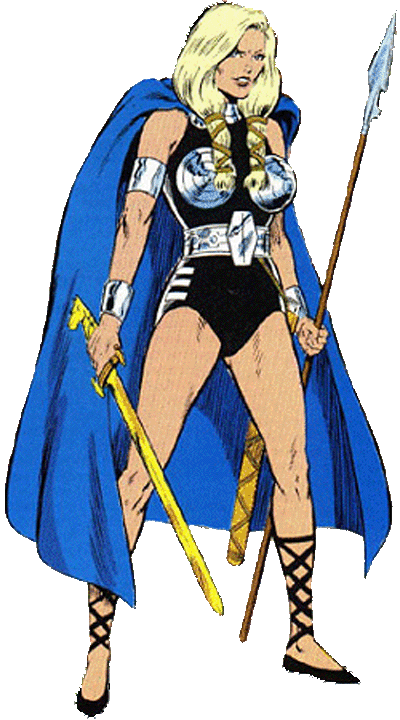
The classic costume for Marvel's Valkryie.
Marvel’s Valkyrie. Seriously?
And then, when the Valkyrie was introduced in the pages of the Defenders, she had armor… Except originally it was only her breasts that were armored, everything else was either covered with spandex or it was bare. And that made absolutely no sense at all! Yeah, she has those shiny metallic wristbands and the upper arm bands, but those look more like jewelry than body armor, right? (Saddest of all, within the story, Valkyrie was created by an evil Asgardian goddess for the express purpose of proving that women were the equal of men! Her superstrength originally only worked when fighting males. Take a guess as to how long after the character joined the superhero group before a story line saw her falsely accused of a crime and sent to a women’s prison, where the artist got to draw a lot of ridiculous women’s prison scenes…) Continue reading Four-color boy’s club…