Category Archives: life

Sleep disturbances

Kitten in a blanket.
I just want to stay under the covers.
There are some medications I’ve been put on at one time or another which list “sleep disturbances” as a possible side effect. That’s an interesting phrase, isn’t it? It conjures up images ranging from insomnia—staring at the clock in the wee hours of the morning wondering desperately if you will ever sleep—to slightly less insidious things—such as a kitten crawling into your bed in the middle of the night and waking you up briefly. Of course, anyone who has owned cats will tell you that having a cat decide that they are more important than sleep can be a nightmarish ordeal that is in many ways worse than mere insomnia.

The first time I was put on a medication which listed this side effect was for an extremely bed sinus-throat-and-ear infection I got some years ago. In addition to a standard antibiotic, my doctor described a steroidal nasal spray. He mentioned casually that sometimes patients have trouble sleeping when they first start taking this. The pharmacist who talked to me when I picked it up said that people often have sleep disturbances. The only person who actually warned me on what to expect was on online friend, who said, “Oh, no! Whenever I was put on that stuff, I had horrible vivid extremely disturbing dreams!”

I didn’t have nightmares that first night. What I had was first an extremely vivid dream in which I was trying to put up new shelves in the apartment I lived in at the time, while my late husband, Ray, was working on a quilt. And it was vitally important that we get these tasks done before someone arrived, and things just kept going wrong. I woke up with my heart pounding and feeling extremely angry at a screwdriver that kept transforming into the wrong kind of tool. It took me several minutes to untangle my thoughts and realize that I had been dreaming. It wasn’t real. It was irritating, but not scary.

And that was what they meant by sleep disturbances. Not an occasional temporary interruption of a good night’s rest, but a string of bizarre and emotionally overwrought dreams that propelled you out of bed confused and temporarily convinced that you had entered the twilight zone. In other words, something much more like being pestered by several deranged pets all night long.

The next time that a different medication with the same side effect was prescribed, my regular pharmacist asked if I had been on this particular thing before and if I knew what the label meant when it said “sleep disturbances.” With a slight sense of dread, I described the nights of weird dreams. “Yep!” she said, with a bit more cheerfulness than it deserved. “That’s usually what happens. Not scary dreams, just weird ones that leave you feeling strange and keep waking you up. Not much you can do, though they’re usually worst the first couple of nights.”

I realize that side effects can vary from person to person. And I also know that people don’t always describe the effects they feel the same way. But still, sleep disturbances didn’t really prepare me for what happened. On the other hand, my regular pharmacist was correct. Each time I’ve been on one of these meds, the bizarre dreams were worst for the first couple of days, and then became a bit more normal for the rest of the time I’m on the medication. Not complete going away, mind you, just less awful.

The same warning pamphlets usually also mention mood changes, or irritability, or lack of interest in sex as possible side effects. All of which, by my experience, are euphemisms for “Your emotions are doing to be wildly unpredictable for days!” A friend who has depression was once put on the same prescription strength nasal spray that my doctor has been fond of giving me for sinus infections lately (different than the first one I mentioned in this post), but no one warned him about possible mood-altering side effects. Or, I should say, whatever warning his doctor or pharmacist gave, did not communicate to him the possibility that his depression would be amplified to previously unplumbed depths. Fortunately, it occurred to him after several days of feeling much worse than usual to ask around. As he said afterward, it would have been nice if the warning had been clearer. Because it’s a lot easier to deal with extra depression (or other effects) if you know it’s coming.

Sometimes the sleep disturbances are just weird dreams. Unfortunately I’m a sleep walker and talker. So sometimes I have woke up in a violent rage about something, talking very loudly and angrily about someone. Usually just identified by pronoun. This wakes up my poor husband. I mention the pronoun thing because, usually the dreams that drive me to angrily leap out of bed don’t stick with me. What I mean is, by the time I’m awake enough to realize it’s a dream and answer Michael’s questions about what’s wrong, I can’t remember the details.

I’m writing about this now because currently I have a sinus infection (along with a chest cold and a nasty cough). I’m on antibiotics for the sinus infection, and since there’s a lot of mucous in my lungs, I’m also using an inhaler a couple times a day, and some prescription cough syrup (which I’m only using at bed time). The inhaler and the cough syrup both cause sleep disturbances. And I’ve had some weird dreams. I can’t decide whether the most annoying one so far was the one where my husband and I were trying to do something but our luggage kept vanishing and reappearing, or the one where it started out with us helping his father (who I am very fond of) do something, but then it morphed into helping my father (who I was not fond of at all while he was alive).

I just hope the cough gets better soon, so I can stop using the cough syrup and the inhaler. I’d rather just be dealing with the antibiotic for the rest of the week, you know?

Orlando Pulse Shooting must be remembered for the anti-queer hate crime that it was

Photo by Monivette Cordeiro, Orlando Weekly.
Nine months ago today an angry man walked into Pulse, a queer nightclub in Orlando, and murdered 49 people. According to the FBI and his own family, during the weeks and months leading up to the attack, he had become more noticeably outraged every time he saw gay men in public together. He plotted the crime carefully. He set up fake profiles on gay hook-up apps and used conversations there to find out which night clubs would have the biggest crowd. It was a carefully crafted anti-queer hate crime.

A crime that is still being prosecuted: Orlando Nightclub Shooter’s Widow Is Denied Release On Bail.

I’ve written before about why this particular crime hit so hard for queer people in general, and me in particular. I’ve also written about why it is unacceptable to argue there is nothing that we can do about this kind of crime: They used to insist that drunk driving couldn’t be reduced, either. I’ve also written about why we shouldn’t ignore the anti-LGBT hate crime aspect of this act of terror, and why the people who do so are perpetuating and enabling the hate that caused it.

And I’m not the only one: Call the Orlando shooting what it was: a homophobic hate crime, not ‘an attack on us all’.

I didn’t let myself write about the shooting on the 7th- or 8th-month’s mind1 date of the shooting because the lingering depression from election night made it too easy for me to leap into slathering rages over things. I had a very difficult time writing a post at the 6-month mark because of it. But there are reasons we shouldn’t forget: Gov. Rick Scott Honored Pulse But Never Mentioned LGBT People – Florida’s governor described the shooting as terrorism and never noted it targeted queer people.

I’ve gotten into the spiral of argument with some people that all hate crimes are crimes intended to cause terror, so it is technically correct to call it a terrorist act. And while that is true, it sidesteps the issue of just who was the crime intended to terrorize? We know that the gunman was targeting queer men. We know that because of all the angry outraged rants his family and colleagues have revealed during questioning. We know because he told his wife that he wanted to kill fags (she knew what he was planning, which is why she’s under arrest). We know because of the conversations he had on hookup apps where he would engage in conversation with gay men and ask which clubs were the hottest—where can he go to find the biggest crowds, the most popular places for gay men to have a good time?

He did not commit this crime to terrorize straight Americans. He was out to kill as many queer men as he could, and to put the fear of death into all queer people not to be out. That’s the point of this crime: to make queer people hide, go back into the closet, stop being out and open and unashamed of who we love. And if you don’t refer to this crime as an anti-queer or anti-gay or anti-LGBT crime, then you are doing exactly what the gunman wanted: you are erasing us from public life and discourse.

And if you get insistent and defensive about failing to mention that it was a anti-queer crime? That tells us, beyond any shadow of a doubt, that on some level, you agree with the gunman.

That’s not me calling you a bigot. That’s you being a bigot.

If you don’t like to think of yourself as a bigot, then you need to do something about that. A really good first step is to admit that being uncomfortable denouncing a crime as an anti-queer/anti-gay/anti-lesbian/anti-LGBT/anti-trans crime is a symptom of some level of prejudice. Which you need to let go of. Start calling this shooting what it was: a hate crime aimed at the LGBT community.

Victims killed in Pulse in Orlando this last weekend.
Victims killed in Pulse in Orlando June 6, 2016. (Click to embiggen) (Facebook/AP/Reuters/Rex)
Yes, 49 people were killed in Orlando that night. 49 queer Americans were gunned down. 49 queer people who just wanted to be out and happy and not have to hide who they were instead were murdered. 49 queer people were murdered by a man who was outraged at the idea of two men kissing in public. Remember them. Don’t erase their identities. Don’t erase their killer’s anti-gay hatred. Don’t ignore the toxic homophobia the pervades American society and fed the gunman’s hatred. Don’t help the killer erase us. Don’t.


Footnotes:

1. “Month’s mind” a practice in some traditions where family and friends gather about a month after someone’s death to celebrate that person’s life2.

2. Yes, I’m pedantic enough that I don’t like using the word “anniversary” to refer to periods of time of less than a year. I know people have been doing it verbally since at least the 1960s, and in writing since the 1980s, and I’m not normally a staunch prescriptionist regarding dictionary definitions, but this one still bugs me a little. Most of the terms that have been proposed to substitute (mensiversary, lunaversay, and uncianniversary) for this monthly commemorations strike me as silly. But knowing that there is an older, if obscure liturgical term, that I can pronounce it easily, I’m going to give it a try.

Confessions of a public restroom avoider

“If you don't like trans people using the bathroom, just look away like you do with corruption, war, poverty, environmental destruction, and homelessness.”
“If you don’t like trans people using the bathroom, just look away like you do with corruption, war, poverty, environmental destruction, and homelessness.”
Midway through my second grade year my family moved from Colorado to Nebraska. My dad’s job in the petroleum industry meant that we moved a lot (ten elementary schools in four states). I had a number of unpleasant experiences the first week at the new school. I misunderstood several things. The teachers and other school officials simply didn’t tell me about several rules. And the other kids weren’t exactly welcoming to the new kid. when I say unwelcoming, that’s putting it mildly. The second or third day there, I was cornered in the bathroom by several boys only some of whom I recognized from my classroom. They wanted to know if I was the idiot who got in the wrong line at the lunch room. I don’t remember everything that was said to me, but they communicated as only grade school bullies can that I was a stupid sissy—a freak who didn’t belong with the real boys.

The school was far more regimented than either of the previous grade schools I had attended. There were rules and assigned times for everything. We were sent to the restroom at three specific times each day, for instance. And my new bullies singled me out for taunting and humiliation every single restroom break.

I didn’t want to explain what was happening. Previous incidents of being bullied by other kids had always resulted in my dad yelling at and beating me for being a pushover. When I attempted to stand up for myself as he’d said, I got in trouble at school, which resulted in more yelling and beating. So I couldn’t let my parents know what was happening in the bathroom. And I knew I couldn’t let the teachers know, because eventually they would inform my parents.

So I stopped going to the bathroom.

I convinced my mom to let me walk home for lunch instead of eating at the school cafeteria. I don’t remember how I convinced my parents, but I did. I used the restroom at home in the middle of the day. At school, when we were marched off at our appointed times midmorning and midafternoon, I would loiter outside the restroom until we were collected and taken out to recess. Since I was eating at home, I skipped the midday restroom trip. I changed my drinking habits. I stopped using the drinking fountain at school, because if I didn’t drink water I wouldn’t need to pee as often. And so on.

I managed to avoid going into the restroom at that school almost entirely for the rest of the time we lived in that town. I still got bullied on the playground, in the classroom, and so forth. But because teachers were always nearby, the kind of bullying that happened was slightly less horrible that what could happen when a bunch of the mean boys had you trapped in a room that the adults seemed to never enter.

When we moved to a tiny town in Wyoming next, I wasn’t able to avoid the restrooms. The town we moved to didn’t have a school, so we rode a bus to a town almost an hour’s drive away. I can still remember how scared I was at what would happen the first time I went into that school’s bathroom. That school was less regimented, so I as usually able to get by with only one trip per day, and I could time it so I wasn’t using the restroom when a lot of the other boys were. Similarly with the town back in Colorado but near the Kansas border that we moved to for the last part of my third grade. And the next town, and the next.

Even when I was in high school, I learned to avoid certain bathrooms and certain times of the day. Because yes, even in my teen years, there were guys ready and eager to demonstrate to the class faggots just how despised we were, and the boy’s restroom was a place that they could do so with impunity.

I’m not trans. I don’t pretend to speak on behalf of the trans community. But I am very familiar with that cold fear that strikes like a fist in the gut when walking into a public restroom and someone looks at you in a less than friendly way. I’m a grown ass man in my mid-fifties, and there are still moments of anxiety any time I am in a public restroom and there are other people in there with me. There are little checklists that part of my brain runs through. Am I behaving the way I’m supposed to? Is this person going to interpret something I do in the wrong way?

Heck, part of me still freaks out if a straight co-worker strikes up a conversation in the restroom at the office! Making eye contact or saying anything to the wrong guys was the surest way to get bullied when I was a kid, and it doesn’t matter how many years ago that was, the conditioned reflexes are still there—the surge of stress hormones and keying up of fight or flight response happens every time.

So these bills and court fights about where or whether trans people can use restrooms at school and other public accommodations strike close to home. I get really upset that people think keep portraying the queer people as the dangerous ones in public restrooms.

Everyone needs to eat, drink, breathe, and yes, people also need to pee from time to time. We have public restrooms for that. A number of places in our country have had laws and policies that explicitly allow people to use the restroom of the gender they identify with for many years, and there has never, not once, been an incident of a trans or otherwise queer person using those policies to assault anyone in a restroom. The only incidents of people going into a restroom to harass women have been straight anti-gay people doing it to try to make headlines in order to justify these bathroom bills or to yell at a woman who doesn’t want to sign their anti-trans petition.

Seriously.

This isn’t about privacy. It isn’t about protecting women or girls. It is about making it impossible for trans people to exist in public spaces at all. It is about punishing trans and gender non-conforming people. It is about giving bigots an excuse to harass queer people or anyone who seems maybe a little queer.

It’s the day to March Forth!

“We don't know them all but we owe them all.”
“We don’t know them all but we owe them all.”
I’ve written before about an acquaintance in college who was shocked that I’d never heard the pun about this day: March Forth! It’s a date! It’s a command! It’s a date and a command!

For the last few years I’ve been observing my own March Forth tradition. I urge you all on this March Forth, to go please donate to The National Coalition for Homeless Veterans.

You can also go to this page on the NCHV website, click on the name of your state, and find a list of organizations helping the homeless in general and homeless veterans in particular in your community. Donate or volunteer.

March forth, and spread the word.

Goal-darn age…

Keep Calm & Achieve Your Goals.
When I set my goals for this year, I pledged to do monthly updates, since the years I’ve done that has resulted in better results than years I haven’t. So, how did I do in February?

My specific tasks for February were:

  • Get through the rest of the bookcases in the computer room. We made progress on the computer room, the bedroom, and the kitchen. We haven’t been sticking to a get-this-whole-bit-finished then move on schedule.
  • Figure out Writers’ Night schedule for at least the following couple of months. Done! Sorted through July.
  • Write at least four blog posts about things I like. I wrote six or seven such posts, depending on how you count.
  • Expand the list of places to find calls for submissions and write one new story. Not done.
  • Finish the current stage of the copy edit pass. Maybe half done.
  • Disconnect from the internet at least one night a week so I can concentrate on writing and editing. I hit the goal, in that every week there was at least one night when I didn’t pay attention to what was going on on the net. A couple of times I was feeling so tired and run down that I came home, ate dinner, and just crashed. So while I achieved the disconnect goal, I didn’t get the writing and editing half of it done each time.

My overall goals for the year, where I’m trying to follow the idea of replacing bad habits with better ones:

Don’t get mad, get busy. My tasks are: write about about things I love; listen to music and audiobooks more and podcasts less; spend at least half of my lunch break writing; set specific monthly writing/editing goals in each check-in; write at least one blog post a month about organizations we can donate to that are fighting the good fight.

Again, I did pretty well on this, with some weirdness because of work and illness eating away at our energy and time.

Reduce, pack, and prioritize. We now officially know that we have to find a new place to live this year. We have lots of stuff to go through and decide what to discard and what to pack.

Making more progress. I didn’t haul as much away the last weekend of the month as the previous three, though.

Take care of us. My initial tasks are related to some specific medical things that aren’t urgent, but need to be dealt with. I am going to remain vague on the details of this one.

We both saw various medical professionals this month as hoped. My hubby’s tests came out good and he has the big procedure scheduled for next month.

Submit and publish. Initial task was to organize how I’m going to find calls for submission and set reasonable targets for the novel revision/finalization.

This was the goal that suffered most from the time squeeze. Not much progress on it at all.


Finally, my specific tasks for March are:

  • At this point it’s time to just pack everything, so pack!
  • Get the new living situation sorted.
  • Make reasonable progress on writing/editing knowing that the above is going to eat up most of our available time.
  • Disconnect from the internet at least one night each week.
  • Write at least two blog posts about things I like.

Voting is our best weapon, but they’re trying to take that away, too

Voter ID laws don't effect everyone equally (click to embiggen)
Voter ID laws don’t effect everyone equally (click to embiggen)
Voter Suppression Laws Are Working. The real purpose of so-called Voter ID laws is not to prevent voter fraud. That’s how they sell it, but the real aim is to keep poor people, the elderly, and other marginalized people from voting. Voter fraud is a for all intents and purposes a myth: There have been just four documented cases of voter fraud in the 2016 election – three of them voted for Trump. The number of fraudulent votes cast are always such a tiny fraction of the total that they don’t effect the outcome of races. And we’ve known this for a while.

Seriously, during part of the George W. Bush administration, U.S. Attorneys were ordered to make finding voter fraud a higher priority than any other case they were investigating. And after a lot of time and effort was expended, they came back and told the administration what state officials who run elections have been saying for decades: voter fraud is virtually non-existent. The most common forms of voter fraud, which add up to far less than one percent of the votes cast, are relatives of recently deceased people casting an absentee ballot for the dearly departed. The next most common is a relative who has been appointed a legal guardian of an elderly relative believing (incorrectly) that the power of attorney they have been given over the relative with a diminished capacity gives them the legal right to fill out the relative’s ballot. And the third most common are people who are wealthy enough to own homes in multiple states registering in all of them and voting there under the mistaken notion that because they pay taxes in more than one place, they can vote.

The Republican party of my state several years ago famously spent more than a million dollars tracking down four voters who had voted illegally in the very tight governor’s race that year: all four of the convicted felons who hadn’t had their voting rights restored had voted for the Republican (because the Democratic governor had been the state’s Attorney General before, and the four felons held grudges against her).

A lot of people ask, “What’s so hard about showing your ID?” Which seems like a reasonable question to a person who enjoys a certain amount of privilege. The funny part is, that the people asking this know how hard it can be and you can prove it to them. All you have to do, is ask them whether they look forward to going to the DMV to renew their driver’s license. They will either brag about how wonderful it is now that their state allows people to renew on line, or they will tell you a horror story about being trapped at said office for a long period of time. While it is an inconvenience to someone who is able-bodied, has access to their own transportation, and has a work schedule that allows them to take the time to go stand in line, to anyone who isn’t in that situation, it becomes an insurmountable obstacle.

Most poor people in the U.S. work multiple jobs. They aren’t hanging around on street corners waiting for a welfare check (that’s an even bigger myth). The typical low income family has trouble finding the time to sleep and cook meals for their kids, let alone try to find enough time during one of the days a licensing office is open to go stand in line for hours. That’s if they can even get to the office. The states that have passed strict Voter ID laws also happen to be states that have fewer offices where people can get an ID. And coincidentally, they tend to only have those offices in locations convenient to affluent neighborhoods.

So you have to add many miles of travel (and the time and expense involved) to the difficulties to overcome to get an ID. That’s if the person has their own transportation. And it just so happens that the same states the have strict Voter ID laws also spend the least amount of money on public transit. Yet more barriers.

I think about the hassle my mom went through a few years ago after a move when she was trying to get her license renewed and updated with her new address. I don’t remember how many times she had to go back, but it was several. One time it was because whoever she talked to before she went in didn’t tell her the right documents she would need to prove what her new address was. I don’t remember what the problem was the next time, but then after she finally got it after her third or fourth visit, they mailed it to her and several pieces of information on it were incorrect. So she had to go back to get it corrected, and that took more than one trip.

My mom is retired, so she theoretically had the time, and she can drive herself, and the office wasn’t very far from her apartment, but she’s got a lot of health issues, and some days she just doesn’t have the stamina to sit in a non-ergonomic waiting room chair for who knows how long, right?

And then there’s the matter of the fee to get the ID. The constitution forbids poll taxes but the requirement of having state provided ID for which you are required to pay a fee is essentially a poll tax. And even if you argue that the ID serves other purposes, the fee is yet another barrier for low income and fixed-income people.

So, Voter ID laws effectively take the vote away from low income people, people with disabilities or mobility issues, and people living in certain communities. And the lawmakers who pass the laws are well aware that those populations tend to vote in favor of one party more often than the other. They want to take that vote away.

Fortunately, there is something you can do about it: Donate to and/or Volunteer with Spread The Vote (spreadthevote.org). Spread The Vote helps people get their required ID. They provide volunteers to help people collect the required documents, transportation to the apply for their ID, assistance with fees, and so forth.

If you want to help with the fight at a legislative and legal level, consider donating to Project Vote (projectvote.org). Project Vote is working to improve voter registration processes and remove the barriers to make it difficult for people to get registered and to vote.

Remembering Doug

A mutual friend once said, “The best way to describe Doug is he epitomizes oops-ishness.” And half the reason that stuck with me (besides being true) is that I simply love the coined word, “oopsishness!” I met Doug back in 1976, shortly after moving to southwest Washington from Colorado. I met him shortly after joining an interdenominational (fundamentalist evangelical) teen touring choir, as we were both placed in the same section. Doug was two years younger than I was. He was one of the first guys I had ever met who was nerdier than me–and that’s saying something!

Now, his oopsishness wasn’t just a matter of clumsiness. No, Doug took things to a much higher level. Doug wasn’t dumb, by any means, but sometimes he would be extremely oblivious. He would get himself into strange (and usually hilarious) predicaments without being able to explain afterward exactly how it happened. Which meant people who knew him wound up laughing, rolling their eyes, shaking their heads, or picking their own jaws up from the floor after some of his mishaps. You know that old silent movie scene where a character steps into what appears to be an ordinary puddle of water on a street, but plummets completely out of sight? That actually happened to Doug. It was a flooded basement at his workplace rather than a street, but it happened.

Twice in a single evening. The second time at a different basement nearby.

That hardly scratches the surface, though. No, to really understand how oopsish Doug could be, you have to hear about the Train Crossing Incident.

We’d been out gaming with friends, and Doug was giving me a ride home. I was attending community college part-time and working multiple jobs at the time, and living at my grandparents’ house. I was trying to get the funds together to transfer to a university. Anyway, my grandparents lived in a part of town that was between several mills and the port, so there were a number of train tracks that crossed roads. None of the crossings had gates, but all of them had lights and those clanging bell signals. And because none of the crossings had gates, the trains were required to sound their whistles a lot. Living in that neighborhood, by the way, is where I developed my ability to sleep through just about any noise.

We were driving along a dark road and Doug was enthusiastically telling me a story about some horrible thing that had happened to him recently. Ahead of us was a crossing, there was a train off a ways to our right, sounding its whistle, and the lights and bells of the crossing signal ahead of us were going full blast.

And I realized, suddenly, that Doug wasn’t slowing down. So I said, “Doug! There’s a train coming.”

Doug kept talking, and he’s not slowing down.

I repeated, slightly louder, “Doug! There’s a train! Stop!”

Doug kept talking. We are now close enough that I don’t know if we can stop in time, and the train is awfully close. I exclaimed, “Train! Train! Train! Stop the f–ing car!”

We crossed the tracks. The train was so close to us that as I shouting obscenities and looking out of the passenger window, I couldn’t see the headlight because it was blocked by the roof of the car, but I can count the smashed bugs on the front of the engine.

I was holding on for dear life, absolutely certain the train was going to hit us before we were past.

And then we’re on the otherside and I’m still shouting, and honestly, I don’t know how Doug could hear me over the deafining whistle, but he says, “What are you so upset about?”

“WE NEARLY DIED! DIDN’T YOU SEE THE TRAIN!?!”

I looked at him, and he’s peering at the rearview mirror, his mouth dropped open in a shocked expression, because all he can see is freight cars rushing past fairly close behind us. And then he said, “Wow, where did that train come from?”

Given the physics of the situation and how long Doug’s big ol’ four-door Oldsmobile was, I think the train couldn’t have missed the back bumper by more than an inch.

Doug stopped the car. He sat there, gripping the steering wheel and almost hyperventilating. “I didn’t hear anything. Was the signal working?”

“Yes. Bells clanging, lights flashing, train whistle blowing, and me shouting at you to stop!” I replied.

After about a half a minute he says, “Wow,” and he starts laughing as he takes his foot off the brake and we start moving again. “I don’t know how I missed that!”

I was still trying to calm down. Doug seemed sincerely shocked and insisted he hadn’t seen or heard the train or the signals, nor my first several warnings. And I believed him. It fit perfectly with many things I’d seen before. He could recall miniscule details from a movie he had just watched, or a book he had read, but swear he didn’t notice that a door which had been open a few minutes prior was now closed and walk right into it.

I used to love telling this story to both people who had never met Doug, and to folks who knew him. And the thing is, Doug loved telling these kinds of stories about himself, and did so all the time.

As funny as they are in retrospect, the experiences were often painful and terrifying to live through. And then, years later, we got an explanation.

Doug and I hadn’t lived in the same town for some years when I heard that he had become seriously sick and was trying to get on disability. I had last visited him and his wife about eight years previously, but we kept in touch via email. I pinged him to see how things were going, and soon we were on the phone. We laughed a lot, despite the subject matter being so serious.

Originally he had been diagnosed with generic peripheral artery disease, which is most commonly the result of the gradual build up of fatty materials inside the arteries. But they eventually discovered that the underlying cause was a more rare condition, one in which a person has fewer capillaries per volume of tissue to begin with. It was a congental problem he’d had his entire life, it was just getting noticeable as a medical issue as the ordinary build up of fat inside the vessels restricted things further.

In effect, his entire life every organ in his body had struggled with less than optimal levels of oxygen and nutrients because there were literally fewer tiny blood vessels, everywhere. It’s probably the reason that he always caught every virus or sniffle that went around. It also contributed to his longer than usual recovery times when he got injured. And it also meant that under lots of circumstances, his brain would be left with inadequate oxygen. And we think that one of the ways that the brain defends itself from damage in those cases, is to essentially shut down some functions temporarily, until oxygen levels return to normal.

I was getting depressed listening to him describe it, and starting to feel guilty for all the times we had shared those “Doug does something unbelievable weird or dumb” stories.

But Doug didn’t look at it that way at all. “It’s a relief, actually,” he said. “I mean, for years I kept wondering if something was wrong with me, mentally. But finding out that yeah, something is wrong, but it’s medical is a lot easier to accept. It’s not that I’ve got an intellectual deficiency, it’s that my body was dealing with this weird problem we didn’t know about. Literally, part of my brain would be starved of oxygen and shut off!”

Sadly, by the time of this diagnosis, there wasn’t much they could do. He had already suffered a lot of tissue loss not just in the muscles of his extremities, but also throughout his organs. They could slow the progression of the tissue necrosis by keeping him on oxygen, for instance, but the usual techniques for treating arterial disease such as bypass and so forth couldn’t address the underlying issue. The blocked arteries made it worse, but the capillary deficiency would still be there.

We stayed in touch mostly through the magic of the internet until his death just over six years ago. He remained his usual cheerful self throughout the last few years of his life. He always made a joke no matter how bad the news that he was sharing about the latest development was. As he said just about every time he told a story about one of his mishaps, “If you can’t laugh about it, what’s the point?”

Not your typical romantic comedy storyline

Nineteen years and one week ago, Michael and I went on our first official date.

We had known each other for a few years. Ray and I had met him at a NorWesCon a couple years before that, and then again at the next NorWesCon (where he signed up for the Tai-Pan mailing list), and then he came to a Red Dwarf Marathon Party at our place and we started hanging out a lot. Then, when Ray died, Michael was one of the friends who kept me from completely falling apart.

It hadn’t been quite three months since Ray’s death when I asked Michael on a real date. I was nervous, not about the date, because we were already friends, but I wasn’t sure how some of my friends would react to the news. The first person I told was Kehf. She put her fists up, went “Woooo! I hoped something like this was happening. He lights up when you walk into a room.”

Michael at NorWesCon (and Easter Weekend) 1998
I have a confession to make. I don’t remember many details about the first date. I know where we went. I know we talked for a long time over dinner. But I don’t remember what we talked about, what he wore, a particular thing he said that made me laugh, or any of those cliché romantic comedy details. Worse, I don’t really remember falling in love with him. What I do remember was when I realized that had already completely fallen for him. We were at NorWesCon, again. And for many, many years that convention has been happening on Easter weekend, so I had brought an easter basket and a stuffed bunny to give Michael on Sunday morning. I asked to take his picture while he was grinning with the bunny, and something about his smile hit me. You know that moment in the movie, Scrooged, where Bill Murray’s character meets Karen Allen’s character who has just stepped out of a grocery store and the door of the store smacked Bill right in the face, knocking him to the sidewalk and the Ghost of Christmas Past says, “Cupid’s Arrow right between the eyes!”? That’s what if felt like.

And the only thing I could think of was that I wanted to keep making Michael smile. I wanted that smile in my life forever.

I didn’t propose that weekend. But it wasn’t long after. We didn’t tell people, because I was still getting some weird reactions from several friends (and even worse from family) at just the thought that I was dating so soon after Ray’s death. So we made this very sober and rational plan that we would wait until at least November before moving in together. And we might have sticked to it, too. But some weirdness happened with a pair of new roommates at the house he was sharing with several (they weren’t hostile, they just had no sense of boundaries and did weird things like decide to switch rooms with him and moved all of his stuff without consulting first, and other creepy things) and I barely stopped myself from going ballistic. He was being calm and telling me I was overreacting, and I was “No! We’re getting you out of there now!”

So he moved in with me in August of ’98 and we’ve been together ever since.

I would have to go dig around in the filing cabinet to remember the date of our commitment ceremony. My then-employer changed the rules for adding domestic partners to insurance, and we had to have certain papers signed by a particular date, so the times was thrust on us. We decided to sign medical powers of attorney while we were at it, and since you need to have a notary and witnesses for that we made a small party out of it. It was fun, but wasn’t timing of our choosing. Neither to I remember the exact date we officially signed the paperwork for the state level civil unions, when they became legal.

Our wedding when marriage became legal in the state was also a date that wasn’t entirely our choosing (the very first day you could legally do it), but because of when the law passed the previous spring, and its implementation being delayed because of the anti-gay referendum attempt, and ultimately the voters getting to approve marriage by a comfortable margin, we had months to plan. And our friends threw us a great shindig. So that date I remember. It’s an anniversary, legally and otherwise.

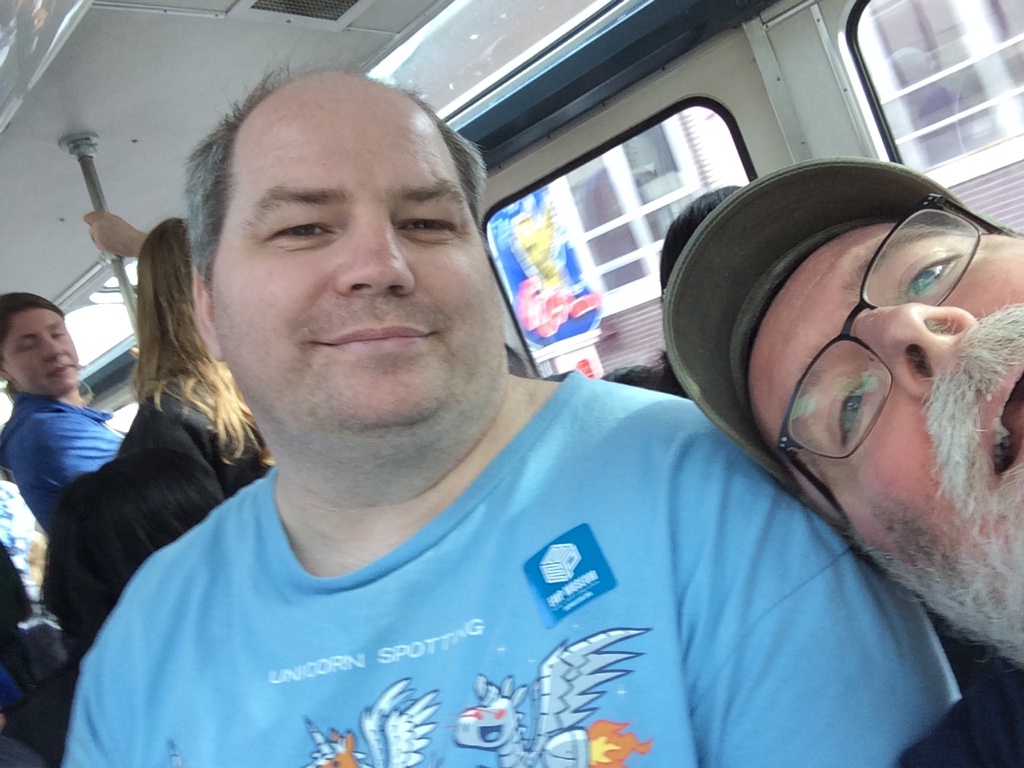
This was taken before our friend Julie tried to teach me better selfie technique. Riding the monorail during a long weekend of touristy things when Michael's brother and wife visited us somewhat recently. I don't know why he puts up with my silliness.
This was taken before our friend Julie tried to teach me better selfie technique. Riding the monorail during a long weekend of touristy things when Michael’s brother and wife visited us somewhat recently. I don’t know why he puts up with my silliness.
But while I don’t remember other details of our first date, I do remember it was February 7, 1998, and it was clearly one of the most important days in my life. We didn’t have a meet-cute. We didn’t experience a lot of hijinks or drama. I still can’t quite believe such a funny, smart, talented, wonderful man can put up with me at all, let alone love me. But he does. And clearly I’m completely and totally gone on him. Happy Valentine’s Day, Michael!

Mugging around, hanging on, and letting go

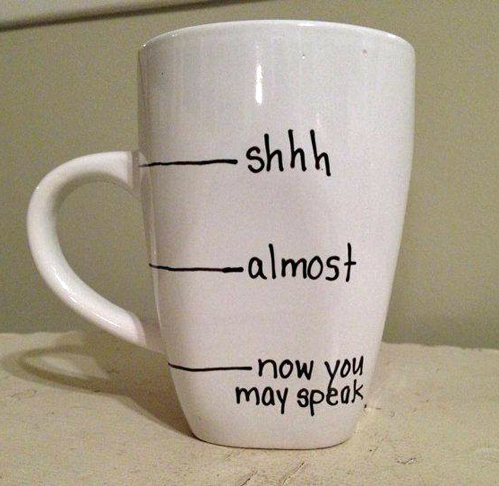
Coffee mug that says: “shhh... almost... now you may speak”
“shhh… almost… now you may speak” (click to embiggen)
I’m a coffee and tea guy. I’m also an I-need-my-favorite-mug guy. My husband, Michael, is not a coffee guy, at all. He’s okay with tea, though the amount of sugar he puts in it makes even our friends who grew up in the south and know what the phrase “sweet tea” means do a double-take. My first husband (who passed away in 1997) was definitely a coffee guy. And a how-many-mugs-can-I-collect guy. You could pick up any of the cartoon-festooned mugs in his collection and ask where it came from, and he would tell you a story about this friend who brought the mug back from Hawaii for him. Or the time he was traveling with a patient to Atlanta and he found it in a gift shop. Or the ex-who gave it to him their first Christmas together. And so on.

I come from a long line of packrats. So I have a very strong visceral reaction to the idea of throwing something away. Especially if there is any sort of sentimental attachment to it at all. So, when Ray passed away twenty years ago, when his mother, sister, and I went through all of his things to decide who would keep what and which things would go to a thrift shop, it was a very emotionally difficult time for me. I hung on to all sorts of things. And a couple of dozen of those things were some mugs. I didn’t hang on to all of his collection, by any means. For one thing, there were a several of the mugs that his mom, his sister, and one of his brothers wanted, because they reminded them of him. Those were easy to let go of, because I wasn’t disposing of them, I was sharing them with someone else who loved Ray as much as I did. But I still had a rather lot of them after that process was over.

And when I said I hung onto a couple of dozen, that’s a bit of an understatement. We had these racks mounted on the wall in the kitchen, each of which held ten mugs. There were four racks on the wall, and all of the racks were completely full. That wasn’t the entire collection. Even after several of his family members took some away. To be fair, not all of the mugs left hanging on the wall had been Ray’s. There were a couple that had been mugs I owned before Ray and I met, and there were several more that had been gifts to me from either Ray or a friend or family member which I hung onto with at least as much of a sentimental attachment as Ray had clung to his.

When Michael and I moved in together, I went through all of my stuff and all of Ray’s former things again, and had a not terribly pleasant emotional time picking more things to haul away. And that included some of the mugs and tea cups. Periodically over the years, we’ve repeated the process of going through things, getting rid of stuff we don’t use any more and/or forgot we had. It gets easier, particularly when I find something squirreled away on a shelf in a closet that I barely recognize, and can only vague describe as, “these are some souvenirs Ray wanted to keep of… something.”

The mugs have been a weird case because they’re hanging on the wall in the kitchen. I see them all the time. Unlike the boxes in closets or cupboards, I don’t ever forget they exist.

And we keep acquiring new mugs. People find funny or pretty mugs and get them for one or the other of us for birthdays or other gift-giving occasions. Or we buy them for each other. So I have to go through the mugs from time to time and decide which one or two or three to get rid of to make room for the new.

The most ridiculous part is, that most of the mugs hang up there on the wall and never get used. It’s sort of embarrassing if we have company over, and we have tea and/or coffee on offer, and somebody picks a funnyy mug off the way before I can get them one, because most likely which ever one they pick is going to be really dusty. So much so that they need more just a quick rinse to clean out. Part of that is because there were forty mugs hanging from the wall with only two people living here. But another part is that bit I mentioned at the beginning about me being an I-need-my-favorite-mug kind of guy. I almost always drink coffee from this one very over-sized purple mug of which I have written before. And I almost always drink tea from my “Queen of Everything” mug. I rinse and re-use those mugs day after day. And when, for whatever reason, I use a different mug, there is a fairly limited number of the mugs among the forty that are my go-to next favorites.

Which makes hanging onto all of the others even more ridiculous—right? There are, for instance, two Christmas themed mugs, one that Ray gave me, and one that someone else gave Ray, that are among those I’ve hung onto forever. Most years I make a point of getting down each of them around Christmas and using them at least once. One of them has and odd-shaped handle with a jingle bell built in that is a bit awkward to hold onto, and isn’t as festive to use because it’s hard to make the bell jingle. But it’s the mug that Ray gave me for, I think it was, our second Christmas living together, so the thought of parting with it is painful. The other one has a much narrower base than its mouth, and therefore is prone to being knocked over, but Ray adored it, so… Another odd one is a Valentine’s Day themed mug that Ray gave me on our very first Valentine’s Day together. It’s handle is heart-shaped, and very awkward to use. I haven’t used in it many years, with the excuse being that it is literally almost impossible to get off the rack because of how tight a fit the weird handle it. But I also wouldn’t part with it because, you know, first Valentine’s Day, right?

With the upcoming move, and the fact that I’ve lived in this place for more than 21 years (whereas Michael has lived here with me for 18½) we have a whole love of stuff that either needs to be packed and moved, or hauled away. Among the things I went through this weekend was the mugs. Among the large load that filled the back of the Subaru which I took to Value Village on Sunday was a very heavy box with at least 38 mugs and tea cups in it, plus three no longer needed racks. This left ten mugs hanging on the wall, plus my two favorites that never get hung up on the wall.

It felt really good to unload the stuff at the thrift store, and to carry out the five big bags of recycle. But I had made a comment to Michael last night that with the amount of emotional effort to pull down all those mugs, it’s kind of disappointing that it didn’t result it a space I can use for staging in the coming packing efforts. When I’ve been going through shelves and closets, afterward I’m left with space I can stack packed boxes in, and so one. But these were all on the wall—not really a usable space.

So I wrote most of this post last night while I was trying to unwind from the long day and get mentally settled so I could go to sleep. That post ended with a comment about trying to remind myself of the end goal of not trying to unpack and find room for a whole bunch of stuff we never use when we find out new home.

But this morning, when I walked into the kitchen shortly after waking up, I was startled at how different the wall looked without those other three racks full of mugs (and while I was working on the wall, I also took down and hauled away a bunch of copper jell-o molds that have just been decorative for years as I stopped making jell-o things when I was diagnosed pre-diabetic back in 2001!). The kitchen still has a lot of clutter in it. Other than the mugs, the rest of my purging this weekend was focused on the computer room and bedroom. But I was amazed at how less crowded the kitchen felt with more blank wall visible, and the immediate emotional lift I got. I am making progress, but even more, I didn’t feel any guilt about getting rid of Ray’s mugs.

Yay for letting go!

Why is it always my job to justify my existence?

“...even if [the trump voter] isn't a racist, ableist, xenophobic, misogynist sexual predator, he was fine voting for one.... [my life] would be better off without someone who places trumps showmanship over common human decency...” (click to embiggen)
“…even if [the trump voter] isn’t a racist, ableist, xenophobic, misogynist sexual predator, he was fine voting for one…. [my life] would be better off without someone who places trump’s showmanship over common human decency…” (click to embiggen)
Someone’s at it again. Telling us that the people who gladly voted for the man who swore to take away health care from millions, swore to give religious people the right to discriminate against queers, and swore to kick millions of brown people out of the country—could be persuaded not to vote that way again if only we would talk to them and listen to their side of things.

It seems so reasonable. Simple. Just talk. Listen to their side. We always argue for tolerance, right? Listen to their side of things. Maybe we’ll learn something. And once they see we’re willing to listen, they can be persuaded to see things from our perspective.

Bull.

Seriously, I’m a queer man in my late 50s. I grew up in tiny rural communities attending Southern Baptist Churches. You think I haven’t heard at least a billion times the perspective of the people who think religious freedom means a right to discriminate against me? You think I haven’t heard millions of times why queers don’t deserve civil rights protections? You think I haven’t heard millions of times how they perceive black people, brown people, people with accents, people who don’t attend the same churches as they do?

I have had no choice but to listen for decades!

You cannot talk someone who doesn’t think you’re their equal into accepting your right to autonomy. They may claim that they respect you. They may call you their friend. They may think of you as an exception to the truth they hold deep in their hearts about the inherent inequalities of different types of people. But the only thing that’s going to do is that you will be the person they trot out as proof that they aren’t prejudiced when someone else calls them on it. I know because it’s happened many times to me, personally.

Sure, when I’ve argued that queer people need to live their lives out and proud (if they can safely do so), I have cited the studies that show that actually knowing queer people makes other people more likely to support our rights. But it makes them more likely. It isn’t a magic formula that is guaranteed to change any specific person’s mind.

My evangelical upbringing is especially relevant to this particular argument. Despite making fun of a disabled person, talking about pussy-grabbing, and openly calling for violence against people who disagree, Donald got 80% of the evangelical vote. That’s better than George W. Bush every managed!

And those folks are absolutely convinced that they don’t hate anyone. They will angrily tell you just how much they love you in the same breath that they say that if your rights are protected, that will offend god so much that he will destroy America. They don’t see the contradiction between those statements. When it comes to things like women’s rights and racial issues, they just as emphatically insist that they aren’t bigots. They just know, because they think it’s in the Bible, that women are meant to be subservient to men, and that brown people are meant to be subservient to white people. If they aren’t quite willing to say that last part out loud, what they will fall back on is the separate but equal dodge on race, because god intended the races to be separate, they say.

It’s a weird theological argument: god wouldn’t have made you a woman, or a African-American, or Latino, or whatever, if you weren’t meant to fulfill certain roles in life. Maybe he sees inherent moral weaknesses in your soul. It isn’t at all logical, and most of them can’t articulate it beyond the notion that they believe it’s in the Bible. But that’s what you’re up against: god said it, god did it, god intends it. And no amount of talking or listening or being friends with people whose life experience belies that is going to shake their resolve. They may feel doubts. They may even confess to you that they realize you are a good person despite being in a category they have been taught is inherently not. But they will then shrug, say it’s god’s doing, and they’ll cheerfully vote for any candidate who affirms their ideas.

Even if that candidate also says a lot of things that completely contradict the teachings of their church. Because once they decide that a candidate is god’s choice, they can hand-wave everything away with the old “he works in mysterious ways.”

It’s an exhausting battle.

So, yes, be kind and civil. If you have the time and energy to attempt to be friends with someone, you can. But don’t kid yourself that doing so is more effective than calling your congressperson, or going to a protest, or joining a boycott, or going to town hall meetings, or donating to organizations that protect our rights. And please, don’t let the people in your life who think it’s okay to take away your rights think that you endorse those ideas.

Because you’re just empowering them to hurt others.