Category Archives: life

Judging or policing, or maybe just taking note

“Forgiveness is created by the restitution of the abuser; of the wrongdoer. It is not something to be squeeeeeezed out of the victim in a further act of conscience-corrupting abuse.” —Stefan Molyneux
Several very different sub-communities I am connected with were doing a lot of sub-tweeting about events only one of which I had in-depth knowledge of. Coincidentally, these three very different situations involving very different people were prompting these other friends and acquaintances to talk about the nature of forgiveness, acts of kindness extended to one’s enemies, and questioning people’s motives. And while all the comments were sincere and thoughtful, the very nature of both trying to compress a complex thought into one or a few 140-character statements without also explicitly talking about the situation that prompted the comment, meant people were painting with broad strokes. Forgiveness, kindness, and trust are very complicated things, obviously, but I need to tease out some nuance here in at least a couple of the comments.

I’ve been wrestling with not just the concept of forgiveness, but also other people’s expectations about forgiveness, for most of my life. When I was a kid living with my physically abusive father, and utterly dependent on him for everything, I was often told that it was my duty to forgive him. That was only in the rare cases where people agreed there was anything to forgive. Most often I received the message that I was the only one to blame for the abuse I received. But those people who at least were willing to admit that beating resulting in fractures, complex concussion, major gashes, and other things requiring medical intervention might be taking things a little too far, still insisted that I needed to forgive him. He just got carried away, they would say. His motive was parental.

In my teens, when I no longer had to live with him, the messages changed slightly. I needed to forgive him in order to let go of my resentment, which would poison me. This line gets trotted out a lot–the notion that it isn’t a matter of whether the other person deserves forgiveness, but that not forgiving them hurts the wronged person.

Bull.

There is nothing wrong, immature, or unhealthy about declining to extend forgiveness. Particularly if the person who wronged you has shown no remorse, never apologized, and never made any attempt at making amends. And especially so if they refuse to admit that the events ever even happened.

The sequence of events is:

1. Apologize
2. Repent (not the same thing as apologizing)
3. Make amends
4. Ask for forgiveness

The person who committed the wrong needs to complete the first three steps before going to step 4.

Yes, hanging on to hatred and resentment can be corrosive. But contrary to the cliches, you can let go of all the anger without actually forgiving the person. You can make the decision that you’re not going to let them haunt your every waking moment. But letting go doesn’t mean you literally forget. You’re supposed to learn from experiences, right? That includes learning to recognize the signs of a similar situation later on. You can remember without being bitter. Letting go requires neither forgetting nor forgiving.

You don’t want to know about the knock-down-drag-out level arguments I was pressed into by one of my aunts because I wouldn’t agree with her that my dad deserved my forgiveness. There were similar arguments some years later about other abusive relatives and their refusal to take responsibility for the harm they had caused. The sticking point with this aunt wasn’t really about any psychological poison festering around inside me. The real issue was that my refusal to forgive implied, to her, that I disapproved of her decision to forgive the person. It didn’t matter that I said, “You can forgive them for anything they did to you that you wish, for any reason. I’m not judging you. But you’re the one that keeps asking me to also forgive them. If they ever ask me for forgiveness, I’ll consider it.”

What I didn’t say is that if the offender had asked whether I would have given it. Since Dad went to his grave denying anything he’d ever done to us hadn’t been deserved, we’ll never know.

The word “policing” gets thrown around whenever someone expresses disappointment, disapproval, or simply confusion about another person’s decision to extend forgiveness. Policing is a real thing, and it can be infuriating. My aunt was trying to police my feelings; for years at random moments she would ask me if I had ever forgiven my dad, and when I said I hadn’t (or in later years, when I told her to stop bringing it up) she would get upset. She would plead. She would argue insistently. She would predict dire consequences.

Certainly I’ve seen other examples of policing: when people send angry tirades asking how dare you continue to be friends with so-and-so or how could you give that group a second chance, for example. When people actively try to coerce you into reacting to the situation or person the way they want, that is policing.

You know what isn’t policing? Not agreeing with you is not policing you. Choosing not to extend the same level of trust/forgiveness/kindness as you is not policing you. Telling other people that I am not forgiving the person or group or institution you have decided to is not policing you. Telling you directly that you’re a better person than me, because I just can’t do it is not policing you. Even asking you why, if I don’t think get abusive or coercive, isn’t policing you.

And if the person you are forgiving is, in my opinion, so toxic and dangerous that I don’t want to have anything to do with them, and you spend so much time with this person I find harmful that when I limit my exposure to the toxic person, I wind up spending less time with you? As long as I am not also trying to coerce you into not spending time with the toxic person, that’s not policing you either. That’s just me taking care of myself.

People are entitled to a modicum of respect until they act in a way the shows otherwise. People who have already wronged me (or people that I love, or entire communities, et cetera), have to to make amends as one of the steps toward earning my respect back. I’m not obligated to forgive them even then. While I will respect and defend your right to be more magnanimous than me and forgive someone I can’t, that doesn’t obligate me to approve.

Friendship may be magic, but it isn’t transitive… and neither is forgiveness.

Come Out and Celebrate!

“Keep Calm and Be Proud of Who You Are.”
Today is National Coming Out Day. If Ray were still alive, it would also be the day we’d be celebrating the twenty-third anniversary of our commitment ceremony (he promised to stay with me for the rest of his life, and he did).

I’ve written more than once about why I think it is important for all Queer people (by which I mean people who identify as Lesbian, Gay, Bisexual, Transgender, Queer, Intersex, Asexual, Genderqueer, Nonbinary, Pansexual, Genderfluid, Questioning, Polyamorous and their Allies) to be out about who they are. Because it can be dangerous to come out (kill the gays laws exist in many parts of the world, while here in the U.S. about 40% of homeless teens are children who were kicked out of their house by their parents for being queer or being suspected of being queer), there are some people who probably shouldn’t be out until their situation changes. But being in the closet is harmful in many ways. Studies and history has shown that the fastest way to get other people (and society at large) to accept and support queers is when queer people come out.

The more straight people who actually know queer people, the more minds are opened.

So, in case somehow it isn’t clear: I’m queer. Specifically, I’m a gay man married to a bisexual man.

Being in the closet takes an incredible emotional toll which affects your physical health as well. When you’re in the closet, you’re living in constant fear of rejection. Particularly if, like me, you grew up in a fundamentalist religious family and community. The fear of losing people you love—people who you have depended on—can be debilitating. The constant anxiety of what people’s reactions will be corrodes your soul.

The thing is, staying in the closet is no guarantee against that rejection. Someday someone is going to figure it out, not at a time when you’ve picked and prepared yourself.

Coming out was hard, and there was drama (oh, was there drama). I put up with all the wailing and the angry letters (28-page handwritten letter from one aunt outlining all of the words and topics I would not be allowed to bring up around her, explaining several times that if I brought my partner to visit we would not even be allowed to call each other honey, et cetera). But while many reacted badly to begin with, it wasn’t everyone. Another one of my aunts was the first to call to tell me she loved and supported me. She made it clear to folks on her side of the family that if they had a problem with me being gay, they would have a bigger problem with her.

If and when there is drama about your coming out, you have to treat said drama as your parents (or whoever) throwing a tantrum. They are trying to force you to pretend to be someone you aren’t for their convenience. And just as when a child throws a tantrum, you can’t reward that bad behavior. Dan Savage, the sex advice columnist and gay activist, puts it this way: the only leverage adult queer people have over parents and other family members is our presence in their lives. We shouldn’t fear losing them, they should fear losing us.

It took a few years for some of my family members to come around. I remain grateful that my mom and one set of grandparents did so before my first partner, Ray, died. He had only a short period of time of feeling welcomed into the family. Now, years later, my husband Michael isn’t just welcomed, I’m pretty sure some of them like him more than they do me. And I can hardly blame them!

A few of my relatives never became accepting before they died, and it was their loss.

There will be some surprises. Some people who you were certain before you came out would never accept you will become your biggest defenders. Some people who you thought might understand will disown you and go to their grave without reaching out. You will definitely learn which people really love you, and which only love the idea of who they think you ought to be.

The thing is, being loved for who you are, instead of the illusionary non-queer person you pretended to be, is wonderful. The sooner you are able to find those people the better. And remember the wisdom of Dr. Seuss: “Be who you are and say what you feel, because those who mind don’t matter, and those who matter don’t mind.”

And being out doesn’t just free you. Being out frees others.

HRC Celebrates National Coming Out Day 2016:

(If embedding doesn’t work, click here.)

What We Lose When We Don’t Teach LGBTQ History In Schools.

…on my mind…

Just a bit over 26 years ago I met a boy…

He was 25 years old, so not really a boy, but then I was only 29. I wasn’t completely out of the closet, yet. I regularly went dancing at a gay country bar, and I had just started singing with a newly formed lesbian & gay chorus, so I wasn’t deeply closeted, either. But as far as I knew at the time, other than one cousin none of my family knew I was gay. And only a few of my long-term friends knew.

Ray and I met online on a gay BBS system, and after lots of chatting over several weeks, had finally agreed to meet at a restaurant. I had trouble finding him, because he forgot to tell me that he’d recently dyed his hair. I wasn’t looking for a redhead.

I suspected he was a keeper when I saw the small bookcase beside his bed. I knew he was a keeper when we talked about one particular worn hardback. Not because of which book it was, but because he had a favorite book that he re-read several times a year. And talking about it made him start talking very animatedly about a lot of his other favorite books.

We’d been officially dating for a few months when he first told me that he liked to write. He hadn’t mentioned it before because I earned my living as a technical writer, and while my fiction had mostly been published in small, non-paying ‘zines, he was a little nervous about showing me his work. Turned out he’d never shown anyone his writing before. He had a bit of an inferiority complex about his education: he’d dropped out of high school after his father died to go to work to help his mom support his younger siblings. He had since gotten his GED and taken some community college classes, but he wasn’t confident in his writing skills.

I asked him if he wanted my honest opinion. I admit I was a bit nervous, too. What if I hated his work and couldn’t hide it? Fortunately, the first story he showed me wasn’t bad. It needed work. But he was happy to receive critiques and borrow some of my books about the writing process.

He kept working at it. Revising, writing, reading. He started occasionally sharing his work with other people. He even managed to get a couple of stories published in small ‘zines.

Then he got sick. When the doctors first told us he had two years or less to live, I refused to believe it. I was certain we were going to beat this. For the next few years there were lots of tests, treatments, a few scary visits to the ER, and then chemotherapy.

One night just over three years after they had told us he had less than two years to live (seven years and three months after our first date) he had a seizure and fell into a coma. I spent the next several days sitting beside his bed in an intensive care unit, waiting for him to wake up. But it wasn’t to be.

During the weeks afterward I went through his things, with help from his mother and sister. In the cabinet under the night table on his side of the bed, inside an envelope that said, “No Peeking!” I found a small package wrapped with Christmas paper, with a gift tag that said, “To Gene, Love Ray.” I didn’t open it. But the package was the size of a paperback book. And in another envelope in the same cabinet were two identical copies of a paperback anthology, along with some correspondence from the editor of the anthology.

He had sold two short stories that were included in that anthology. He’d sold them the year before, and had received copies of the book nine months before he died. And he’d never said a word to me about it. He’d wanted it to be a surprise.

He had a deadline for another anthology with the same editor coming up. I couldn’t figure out which of the stories he had on his computer he had intended to submit. I wrote to the editor and explained that Ray had died. The editor sent a very thoughtful condolence note back.

Ray had made his first professional fiction sale—two stories! —a mere six years after shyly admitting he was afraid to show his work to other people, but didn’t tell me because he wanted to see the expression on my face when I opened the package Christmas morning. I wish I’d known. I wish I’d been able to tell him how proud I was of him. I wish I’d been able to grab a Sharpie, hold the book out to him, and ask for his autograph.

Make no mistake, I love my husband, Michael. Every time I see his smile, I feel like the luckiest man in world. But I loved Ray, too. I miss him. I wish he had lived to see the repeal of Don’t Ask, Don’t Tell, to see the citizens of our state vote to give same-sex couples the right to marry, to see the Supreme Court overturn the Defense of Marriage Act, and of course to see that same court make marriage equality the law of the land.

This week Michael and I are going through our things, hauling stuff to Goodwill and so forth. We’re both packrats from long lines of packrats, so we have to do these purges every year or so. I tend to hang onto things, and I get overly sentimental over a lot of those things. I had a couple of rough moments Monday. One was when I came across the book with Ray’s stories on a shelf. Another was when I was pulling plushies from another shelf and found a small, peach-colored Teddy Bear. Only a few weeks after we started dating, Ray had to fly to Georgia for a business obligation. He picked up the teddy bear for me and a coffee mug for himself in a souvenir shop. Yes, 26 years later, I still have the “Georgia On My Mind” mug, and I still think of it as Ray’s mug.

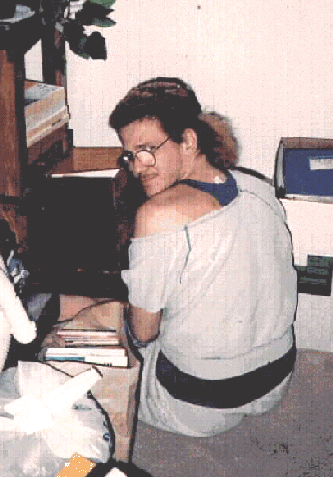
Ray unpacking after we moved into our second apartment.
If he’d lived, today would have been Ray’s 52nd birthday. That’s right, our birthdays were only two days apart. We usually wound up celebrating both birthdays together with his family, and then would celebrate just the two of us on our actual birthdays. I assume that that is the reason that I start getting a bit depressed and moody every September. I can’t think about my birthday coming up without thinking about his birthday that we don’t get to celebrate.

I would love to see his goofy grin over a cake covered with candles at least one more time.

I don’t need to watch the debate, I know which candidate thinks I have a right to exist, and which doesn’t

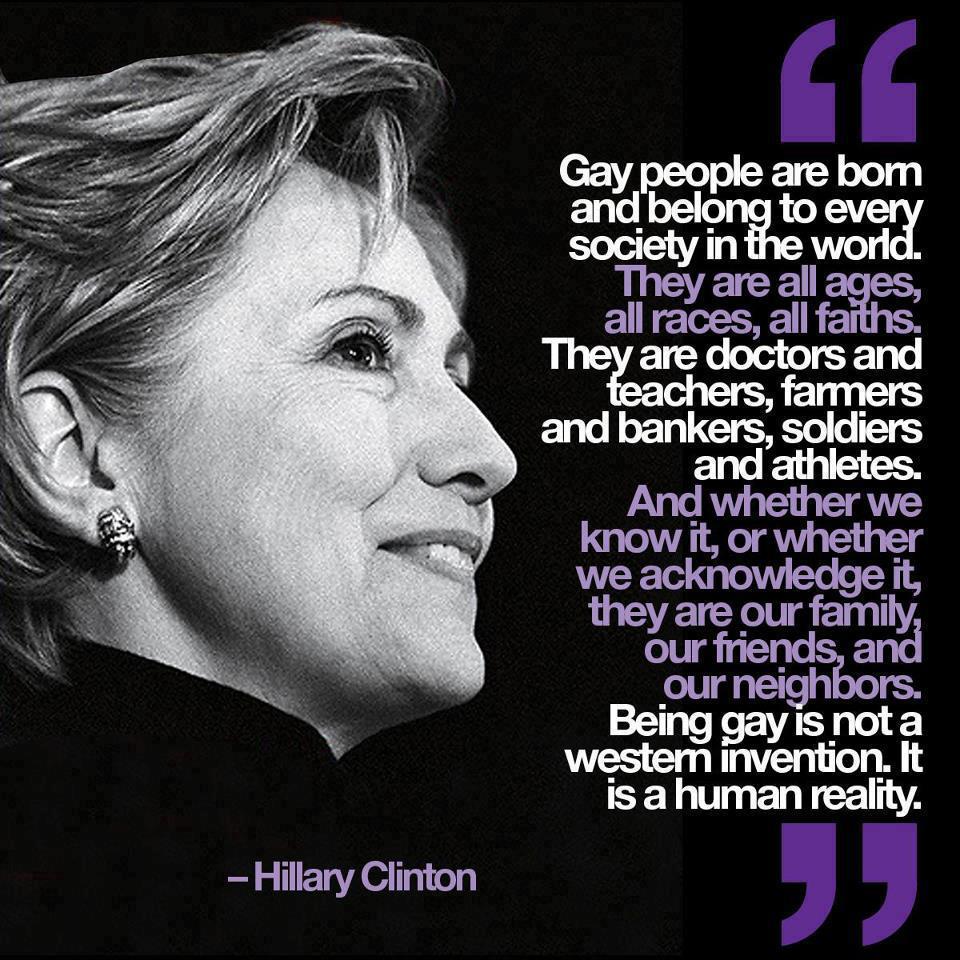
“Gay people are born into, and belong to, every society in the world. They are all ages, all races, all faiths. They are doctors and teachers, farmers and bankers, soldiers and athletes. And whether we know it or whether we acknowledge it, they are our family, our friends, and our neighbors. Being gay is not a Western invention. It is a human reality.” —Hillary Clinton
I’ve had a few people ping me to ask if I’m going to watch the first official debate between Hillary Clinton and Trump. Short answer: no. Trump has vowed to appoint to the federal bench only judges approved by the Heritage Foundation. The Heritage Foundation doesn’t just oppose gay marriage, they oppose gay rights of all levels, and still regularly call for overturned the Supreme Court decision that blocked anti-sodomy laws. They don’t just want to end my marriage, they want it to be literally illegal for someone to be queer. And if you happen to be straight or otherwise don’t consider yourself queer: they also think it should be illegal for straight unmarried people to have sex. They aren’t just anti-abortion, they think that it should be illegal for straight people, married or not, to buy birth control.

Whether you believe that a seat is going to open up on the Supreme Court in the next four years (and statistically it is extremely likely it will), there are hundreds of open appointments at lower levels of the federal judiciary that haven’t been filled because the Republicans in the Senate resist confirming anyone Obama nominates for just about anything. If Trump is elected, judges who think that being gay should be illegal (and a whole lot worse) will be appointed. The damage that alone will do to everyone’s civil rights is frightening to contemplate.

I wrote before that Hillary wasn’t my first choice this time. But you know what, she was my second choice, both this time and in 2008. Because (among other things) I remember back in the 1990s when she and her husband made Republican heads explode simply by saying that gay people deserve any legal rights at all. I hear a lot of people still giving her grief for not coming around on marriage equality until 2013, completely unaware of how far ahead of the rest of the Democratic party both she and her husband had been on the matter of gay rights for more than two decades before that. And really, if we insist on punishing politicians who were slow to come around on some of our issues, what incentive do any of them have to change their minds when we advocate for our needs?

And don’t start spouting stuff off about the third party candidates. Johnson, the Libertarian, doesn’t believe in anti-discrimination laws. Like most libertarians, he says discrimination is wrong, but he supports policies that let it happen. Johnson also wants to repeal the minimum wage. He wants to not just rollback the Affordable Health Care Act, but also eliminate Medicare. I could go on, but particularly if you were a Bernie Sanders supporter, it is criminally stupid for you to support Johnson, since literally every single one of his specific policy proposals are the exact opposite of Bernie’s. Every one.

I’ve written before about the many reasons not to support Stein. The quick answer is, she doesn’t have consistent policies, half of her policies are anti-science, and she doesn’t have the experience or political resources to put any of her polices in place if she did get elected. The truth is she’s not a serious candidate, she’s a troll.

Mathematically, voting for Johnson or Stein is exactly the same as voting for Trump. It isn’t a protest, it’s putting a bullet in the head of a lot of your fellow citizen. Also, voting for third parties in our system betrays a fundamental misunderstanding of coalitions and the electoral system.

But you don’t just have to take my word for it:

i will not be watching the debate tonight:

Virtually every election I’ve ever witnessed has been some kind of referendum on whether I’m a legal person – ever done ground work, going door to door, arguing with people why they shouldn’t vote to make you illegal? I have, and it sucks – and in that way, this election is no different.

The hate is just a lot more broadly aimed this time.

So I’m not watching the debate tonight. It’s bad enough being reminded every two to four years that about half the country is just fine voting to lock me up. This whole thing is yet another referendum on my existence, so why the fuck would I subject myself to that?

Bernie Sanders: ‘This is not the time for a protest vote’

This is time to elect Hillary Clinton and then work after the election to mobilize millions of people to make sure she can be the most progressive president she can be.

Hillary Clinton Was Liberal. Hillary Clinton Is Liberal.

According to an analysis of roll call votes by Voteview, Clinton’s record was more liberal than 70 percent of Democrats in her final term in the Senate. She was more liberal than 85 percent of all members. Her 2008 rival in the Democratic presidential primary, Barack Obama, was nearby with a record more liberal than 82 percent of all members — he was not more liberal than Clinton.

Act my age?

I see NO good reason to act my ag
I see NO good reason to act my age!
Ah, September! That most blessèd month! When the oppressive, destructive heat of summer begins to abate, the leaves on deciduous trees turn to autumnal colors, a new school year begins (at least in the U.S.), and new network TV shows premiere. The autumnal equinox has come. My tomato plants are dying and many of the flowering plants have lost their blooms and are going to seed. Which means that decorating season approaches!

September also means my birthday… that’s right. Today I am officially another year older.

It isn’t one of the big, decade shift birthdays. The big five-oh was a half dozen years ago, and the bigger six-oh is still a few years off. But for some reason as this one approached, it was feeling more like a major turning point than usual. Maybe I was being a little bit psychic and knew that we’d find out just before the birthday that our building was going up for sale and there might well be very big changes in our living situation by the end of this lease period.

Or maybe my subconscious knew that my first birthday after Dad’s death would churn up feelings. Which would be understandable if we had had a normal parent-child relationship. But since he virtually never called or otherwise acknowledged my birthday (sometimes my stepmother would send a birthday card — at least once she made him sign it), is surprising. To be fair, I almost never sent a card on-time to him on his birthday, even though it was only six days after mine.

What usually happened is at some point in September I’d make a little promise to myself that this year I would buy and mail him a card by my birthday. And then I wouldn’t think about it again until several days after my birthday—sadly what would happen is I would realize I barely had time to get a birthday card in the mail to my grandmother, which would remind me that Dad’s birthday was a few days before her and that meant it was already too late to get a card to him by his day. So the few years he did get something from me, it would arrive a few days late.

Of course, because he’s gone, I probably won’t be asked a dozen times if I’ve heard from him. That has been a common occurrence on every birthday and major holiday for decades: relatives asking if I’ve heard from my Dad, then reacting with varying degrees of sadness, surprise, and disappointment to my reaction to the question. It didn’t seem to matter what my reaction was, whether I simply said, “no” or if I was a bit more forthcoming, “Naw, I haven’t talked to him in, uh, six years?” They were always dismayed. Even the few times when I could say, “I got a card in the mail” didn’t go over well.

I get it. These are relatives who go to the trouble to call all their siblings, children, nieces & nephews, et cetera on their birthdays and such. That’s why they’re contacting me to wish me a happy birthday, after all. My mom’s side of the family has always been big about birthdays and anniversaries. So I get why they’re always at least surprised.

It’s nice to be wished well and reminded that I’m loved. Which I have been.

So far what I’ve done to celebrate is get together with friends to go see a cool movie that opened on Friday: the remake of the remake of The Seven Samurai. Appropriately enough, the first American remake, The Magnificent Seven with Yul Brynner, Steve McQueen, James Coburn, Robert Vaughn, Charles Bronson, and Eli Wallach premiered in theatres just a couple weeks after I was born. It was a movie that was shown on TV many times during my childhood, and it seemed like everyone I knew loved it as much as I did. So when I saw a remake was coming out with Denzel Washington, Chris Pratt, Vincent D’Onofrio, and a bunch of other stars, I knew I had to go see it.

It was fun. It was great to meet friends for dinner, drinks, and a movie. Saturday Michael took me out to dinner at my favorite restaurant. Today we’re getting together with one of my gaming groups to do some Victorian sci fi adventuring. I have also taken Monday off from work, and I’m planning to pretend tomorrow is Sunday and watch the football game that my DVR will be recording while we’re gaming today.

I don't know how to act my age. I've never been this age before.
I don’t know how to act my age. I’ve never been this age before.
I’ve gotten some cool presents, which are always fun. Two different people got me wonderful socks. I love comfy, colorful socks! I’ve also gotten a hand knitted scarf, an old movie I love, cool figurines, my very own Tardis key, brilliant purple ink, some books. Getting anything is always great! I can’t show off the big present from my husband, yet. He had me try it on and pick out which model I wanted on Friday, but we had to order it and wait for it to be shipped.

Whenever I write a birthday post, I always feel like I should end with some words of wisdom. This year I’m feeling even less wise than usual. It has not been a pleasant year for, well, anyone that I know. I’ve been having a particularly difficult time not breaking the “Don’t be a dick” rule, myself—I’ve outright busted it several times, and that’s all on me. It feels like a year of broken things, especially connections.

So I guess this year’s advice is this: try. Try to be kind. Try to be forgiving. Try to pick up the pieces when you can. You never know which conversation with someone will be your last, so try not to let it be one you’ll regret.

Misleading definitions of middle-ground, or the return of the false equivalency

Two men, one in a gay pride t-shirt, the other with a cross on his tie. Guy with cross hits the other guy on the head with a stick. Gay guys asks him to stop. The other guy says, "Why, that's anti-gay bigotry!"
An oldie but a goodie from D.C. Simpson’s retired ‘I Drew This’ strip. Context note: a pink triangle use to be a more common gay pride emblem than a rainbow. © 2005 D.C. Simpson. (Click to embiggen)
Lately a lot of people on the conservative end of the spectrum have been calling for more compromise. For instance: “If you can’t be friends with someone just because you don’t agree on everything, something’s wrong.” And then there was, “Religious people no longer feel safe in social spaces. Maybe we could meet halfway?” But my favorite was, “LGBT people and Christians seem locked in their different and opposing camps. Where can we reach a meeting point of common ground?”

Let’s start with the first one: why should disagreements keep us from being friends? It depends entirely on the disagreement. My husband and I have been together for 18 years, and we love each other very much. We are also both very geeky nerds who are both fairly well informed on a variety of topics ranging from astrophysics to the old Donald Duck comic books. You can bet there are things we disagree about, and sometimes our discussions get very spirited. In 2008 you should have heard us debating whether to support Obama or Clinton in our upcoming caucus meeting, for instance.

If you think that I don’t deserve equal rights before the law, if you vote for measures to take my civil rights away, if you vote for candidates who have prayed openly that gays deserve death (almost the entire Republican Congressional Caucus just months ago), if you insist in the face of overwhelming medical evidence that being non-heterosexual is a matter of choice or mental illness, you aren’t my friend. And it isn’t even a matter of me not wanting to be your friend: you aren’t being a friend to any queer people by doing those things.

There are some medical studies that ultra-conservatives frequently misquote that draw a causal link between the discrimination and pervasive prejudice against queer people and negative health outcomes. We’ve known since George H.W. Bush’s surgeon general released the first of many other studies that there is a causal link between societal prejudice against queer people and teen suicide (about 1500 queer and non-gendering conforming children and teen-agers commit suicide every year because they are bullied, told that being queer is a sin, et cetera). Discrimination kills.

It’s not just the actual gay bashers who harm us, it’s the anti-gay attitudes and misinformation. Also, nice conservatives who claim that they don’t hate anyone, but also say that queer people don’t deserve legal rights, that our identities are sins, et cetera, create an atmosphere that encourages and excuses the violence.

So, no, when what we disagree about is our right to exist and live our lives as we wish, we can’t be friends. No one should feel obligated to cozy up to people who are actually hurting you. You can be civil to one another, but we’re not going to be friends.

I confess that I find it very hard to keep a straight face when religious conservatives claim that society is no longer a safe place merely because they’re no longer allowed to discriminate against other people, or to spout off their bigotry without someone disagreeing with them. For literally centuries society hasn’t been a safe place for queer people, or for people who don’t subscribe to the dominant religion, or for people who are the wrong ethnicity, et cetera. People were bashed, and lynched, and denied a place to live, denied health care, and so forth—often with the blessings of laws passed by conservative religious people. And you don’t feel safe because people disagree with you?

If people are actually threatening you, that’s bad. I am very sorry, and when I hear that kind of talk I do speak up. But the simple fact is that no one on my side is proposing laws to take away your rights. No one on my side is calling for laws to criminalize your sexuality. And some of the people who are currently asking for compromise and middle ground are the same people (literally in two very specific cases that I could name) who were actively trying to prevent hate crime laws being enacted, or trying to prevent civil union laws being enacting (a decade ago), or voting for candidates who literally were calling for gay men to be put into so-called quarantine camps (in the ’90s).

They are the same people who this year are trying to enact the anti-trans bathroom bills.

Me saying that you’re being a bigot when you call my sexual orientation a sin is not the equivalent of you supporting laws making it illegal for some people to go into public restrooms. Nor is it the equivalent of making it a crime for my husband and I to have sex even in the privacy of our own home. So the middle ground isn’t where you get to actually discriminate against me, and I have to listen respectfully when you express opinions that those laws and their rationales are right.

If you want to end the war between queer people and religious people, here’s what you do: stop attacking queer people, stop rationalizing discrimination, and stop defending the people who attack us. Because we aren’t actively attacking you. What you are perceiving as attack is a little thing called self-defense. We’re just trying to ward off the constant and pervasive and insidious grind of anti-gay rhetoric disguised as pro-family or traditional values.

If you don’t want to be called a bigot, stop being one. There are millions of religious people—people in your religion, whichever it is—who don’t believe that queers are evil demonic beings.

I am friends with religious people. I am friends with conservative people. We don’t agree on everything. We can get into very spirited debates about some of the things we disagree about. But they don’t tell me that I don’t have the right to live my life as an openly queer man. They don’t tell me that it should be illegal for me to live my life as an openly queer man. They don’t tell me that it should be legal for me to be fired, or denied housing, or denied services, or denied medical care, et cetera, et cetera, et cetera. They aren’t sending queer children off to conversion therapy to be tortured. They aren’t demanding that books and movies should have warning labels merely for including any queer characters at all. They aren’t telling me that children should be protected from even knowing of the existence of queer people. They don’t tell me that “I don’t hate gay people—it isn’t your fault that you’re mentally diseased.”

To be friends, there has to be mutual respect. If you think that god is going to destroy this country for treating me equally under the law, you don’t respect me, and you’re not my friend. And yes, there is something wrong with that situation, but it isn’t me.


Re-posting this link from a recent Friday Links post, because it’s very relevant: On Peace Between Christians and GBLT People.

Normal is an illusion

Myth: “People with mental health problems are different than normal people.” Fact: “We all have mental health, just as we all have physical health.”
The first time I experienced mental health therapy was under duress. I was in middle school, and one of the many times I was bullied that year had resulted in me being injured to a degree that the school nurse said I needed to be taken to the hospital. This ultimately led to the administration deciding that the only logical response to how often I was being bullied by other students was to threaten me, the victim, with expulsion unless I got therapy. And my ability to remain enrolled was contingent on the therapist reporting that I was making adequate progress. Whatever that meant.

The therapist spent all of our time together making me describe and then analyze specific incidents of bullying, trying to identify which of my behaviors had provoked the bully, then trying to teach me to act like a normal boy. I don’t think she ever used the phrase “normal” to my face, but she certainly did when explaining things to my parents. Just as school officials and teachers repeatedly told my parents in parent-teacher conferences and the like that these incidents would surely stop if I would just learn to act more like the other boys.

This experience did not instill much confidence that therapy was meant to help me.

Throughout my teens I was dragged into therapy several more times for various reasons. There was concern for a while that my migraines might have a psychological cause, for instance. Another time, I got into an argument with one of my Aunts because I refused to agree with her that I felt traumatized by my parents’ divorce, which eventually led to an ultimatum from Mom to start seeing a therapist. So I saw this guy once a week for a few months, though what the therapist wanted to talk about was very confusing and didn’t seem to have much to do with my feelings about my parents’ divorce (I was thrilled to no longer be living with a physically abusive man). It was many years later that I learned that my mom’s insistence that I see the therapist was related to the secret prayer meetings she was having with other church ladies because she was afraid I was gay.

Again, not an experience to inspire me with confidence.

Then there had been the continuing spectacle of watching my sister being diagnosed with various contradictory mental illnesses, going in and out of mental health facilities over decades. One of the early rounds for my sister happened while I was still a teen living at home, and Mom decided that we needed full family counseling. At least that therapist told Mom after a few sessions that it would be better use of the limited amount of time Mom and her insurance could afford to focus on my sister’s issues.

Many years later I sought out therapy on my own, and that time I found it helpful. Of course, it was the first time I had a therapist who didn’t treat either my being gay nor my love of science fiction/fantasy as a symptom (seriously—but that’s a story for another day). That alone was a big improvement. And it was the first time I had made the decision to seek help. I sought help because I was concerned I was turning into an abusive person, like my dad. I didn’t want to become him.

But it also helped me get over the lingering sense of distrust I had for the idea of mental health treatment. My bad experiences weren’t proof that mental health treatment is hooey, they were proof that prejudice and bias can happen anywhere, even in a profession that thinks of itself as objective.

No two people will experience the same illness the same way. What works for one person won’t necessarily work for another. Even more important, what works for a person for a few months or years, may not work as well later. We just have to do our best, try to adapt, and most importantly, try not to beat ourselves up over things.

Having lived with, loved, and otherwise been close to people with various mental health issues, I am very aware of the importance of getting treatment, getting the right treatment, and getting support and affirmation from your friends, family, and community. It’s hard to know, sometimes, how to be supportive. There isn’t a simple, one size fits all approach.

Try to be there. Listen if they want to talk. Don’t push. Let them know you care. Be willing to give them space. And take care of yourself: if you get stressed out and frazzled on their behalf, you aren’t actually helping.

Love them. Love yourself.

Fumble Fingers yet again

oopsI was trying to restore a bunch of deleted paragraphs in a post about therapy and related topics, which seems to have also published the post before it was ready, and that sent out notices to people which will point back here. Now the post is done and published here!

Zoinks! Trying to break some verbal habits

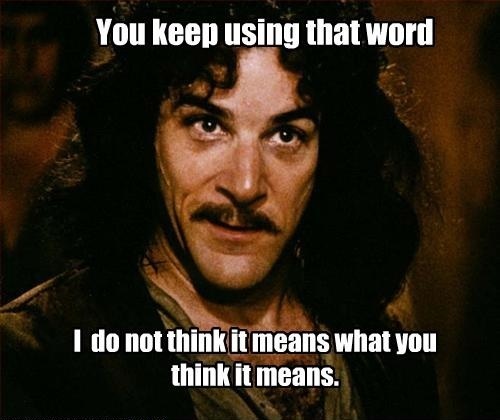
“You keep using that word. I do not think it means what you think it means.”
I don’t remember when I first heard “duuuuuude!” As a word intended to communicate anything from, “Hello, friend!” to “I agree!” to “Don’t panic” to “I can’t believe you just said/did that! What were you thinking?” and a million things in-between. Before I looked up the linquistic history of the word, I had hazarded a guess that it was late in high school, which would put it roughly in the year 1978-79. And while that particular sense of the word seems to have arisen in several different American subcultures in the 50s and 60s, it didn’t really begin the move into pop culture until the early 80s, so it was more likely in college (which began as several years of attending community college part-time while working to save up for university, before three more years there) where I acquired the habit.

I know in the 90s I used the word with friends and acquaintances of both genders. One butch lesbian friend was very fond of using “Dude!” to mean, “You can’t be serious!” for instance. So even though I knew that the word originally meant (back in the 1800s) a foppish young man who dressed in overly-fashion-conscious clothes and affected a sophisticated manner, and then later had morphed to describe a man from the city visiting the western countryside who was unfamiliar with physical labor and the necessities of life on the range, I thought of it as a gender-neutral term.

But it’s not… Continue reading Zoinks! Trying to break some verbal habits

Nostalgic Regret and Convenient Amnesia

"We live in a world where losing your phone is more dramatic than losing your virginity" ... "My phone is an expensive and important material object and not a useless social construct put in place to shame and commodify women" (Click to embiggen)
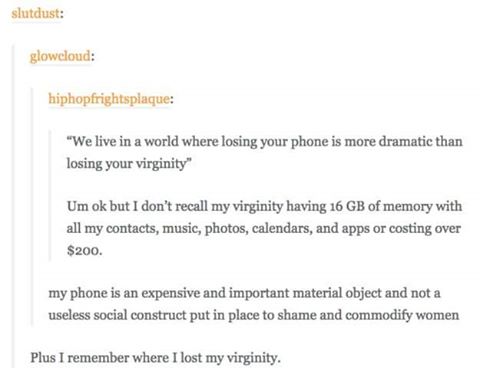
“We live in a world where losing your phone is more dramatic than losing your virginity” … “My phone is an expensive and important material object and not a useless social construct put in place to shame and commodify women” (Click to embiggen)
Several years ago I listened to a Stephen Fry podcast in which he talked about one of the dangers of being a columnist/ essayist/ person who writes a lot: something he called The Milkman’s Cheery Whistle. It was how, after writing for a very long time, one might find oneself short of ideas with a deadline looming, and resort to writing a musing on some thing you remember fondly which is no longer around—a nostalgic regret. For example, a lament that early mornings in residential neighborhoods no longer include the sounds of a milkman cheerfully delivering dairy products to the front doors of customers. Isn’t it sad that everyone, including the author, buys their milk at a local supermarket by simply walking in and buying it when needed, rather than getting that personal touch of a horde of people employed to get up at ungodly hours in the morning and drive around neighborhoods leaving orders in little insulated boxes on your doorstep?

One of the reasons this is a danger is not just because it represents lazy writing and lazy thinking, but because it encourages regressive thinking in the readers. Focusing on the loss of the Milkman’s Cheery Whistle ignores the reasons things have changed. It’s more efficient and cost effective (and safer) to deliver perishable food in quantity to central distribution sites (stores), for instance. Focusing on such nostalgic regret also ignores the less cheerful truths about the past. Nostalgic regret is ultimately about ignorance.

The good old days weren’t simpler, and they certainly weren’t inherently better. For example, throughout most of history child abuse was not only legal, but condoned and even encouraged. In the U.S. it wasn’t until 1962 that the first law requiring health professionals to report suspicions of child abuse was passed in any state, and it wasn’t until the mid-70s that such laws were common. As one of my teachers told me, when he contacted me decades later feeling a need to apologize: a teacher was more likely to lose their job and become completely unemployable for reporting his or her suspicions than any parent was to suffer consequences in child abuse cases.

Nostalgic regret is sometimes about absolving oneself of any guilt from having benefited from societal systems of discrimination. For example, take people claiming now that no one was talking about racism “back in the day.” What they actually mean is that the law and society at large condoned and encouraged racism which benefited some at the expense of others. Laws required “colored people” to use separate drinking fountains, restrooms, and public schools. Lynchings weren’t mysterious events committed only by Klansmen in hoods—in the 1930s white Americans were still proudly posing for newspaper photographers beside the bodies of lynched African Americans, and not just in the south! Most people don’t realize that the NAACP was still campaigning to get anti-lynching laws passed in the 1950s.

So of course, if you were a white person living in the 40s or 50s, no black person would say anything about racism within your hearing. They didn’t want to be the next “uppity” person of color to be executed by a mob!

Nostalgic regret is also about a particular kind of need to feel superior to others. In the screenshot I’ve included at the top of this post, for instance, someone tried to make yet another comment about how kids these days are focused on trivial things instead of something the commenter thinks is more important. In this case, worrying about smart phones instead of protecting one’s virginity. Except what is virginity? It’s a social construct—an ill-defined line in the sand primarily used to define woman as property and prizes belonging to men. An arbitrary distinction purporting to measure innocence. A social contrivance to artificially define natural desires and natural acts as a set of magical experiences which are evil if they occur outside certain prescribed circumstances designed to shore up the hegemony of straight men, or a sacred revelation if they are performed within those prescribed boundaries.

I’ve been told that this isn’t merely an artificial distinction. But certain married men argue that just getting blowjobs isn’t sex (and by implications, isn’t cheating on any vows of fidelity they may have made to their spouse). Certain men who claim to be straight argue that all sorts of sex acts committed with other men aren’t actually sex, because if those acts were, then the men would have to admit they maybe they aren’t straight. And I have heard all sorts of sexual acts emphatically described as not “real sex” by those guys, believe me!

If we’re going to talk about virginity at all, we can call it what it actually is: inexperience. Far more rational to understand that a single action can’t take you from being an innocent person to a “man of the world” or whatever. Far more important than shaming people about a natural biological and social activity (don’t get me started on all the scientific proof that sex in humans and certain other species serves many useful and important other purposes besides reproduction), would be to teach people the importance of treating one another with respect, of setting boundaries about people who don’t treat you with respect, and how to deal with the emotional rollercoaster of relationships.

And as far as worrying about your smart phone: well, they are expensive pieces of equipment (and when they seem not to be expensive, that’s usually just a shell game for the even more expensive contract a phone company has gotten you locked in to), not toys. They are portable computers which usually contain a lot of valuable information—information which could be misused by unscrupulous people for many nefarious purposes. In modern society, they are a necessary tool to keeping one’s life, health, and employment intact. They are valuable in many ways, and often not just to the owner, but to people in the owner’s life. Not worrying about a lost phone would be a pretty irresponsible act.

And yes, may well have far more impact on someone than a single act of inexperienced intimate contact with someone probably nearly as inexperienced.

Perspective—fully-informed perspective and consent—is far more important than nostalgic regret.