Category Archives: life

They used to insist that drunk driving couldn’t be reduced, either

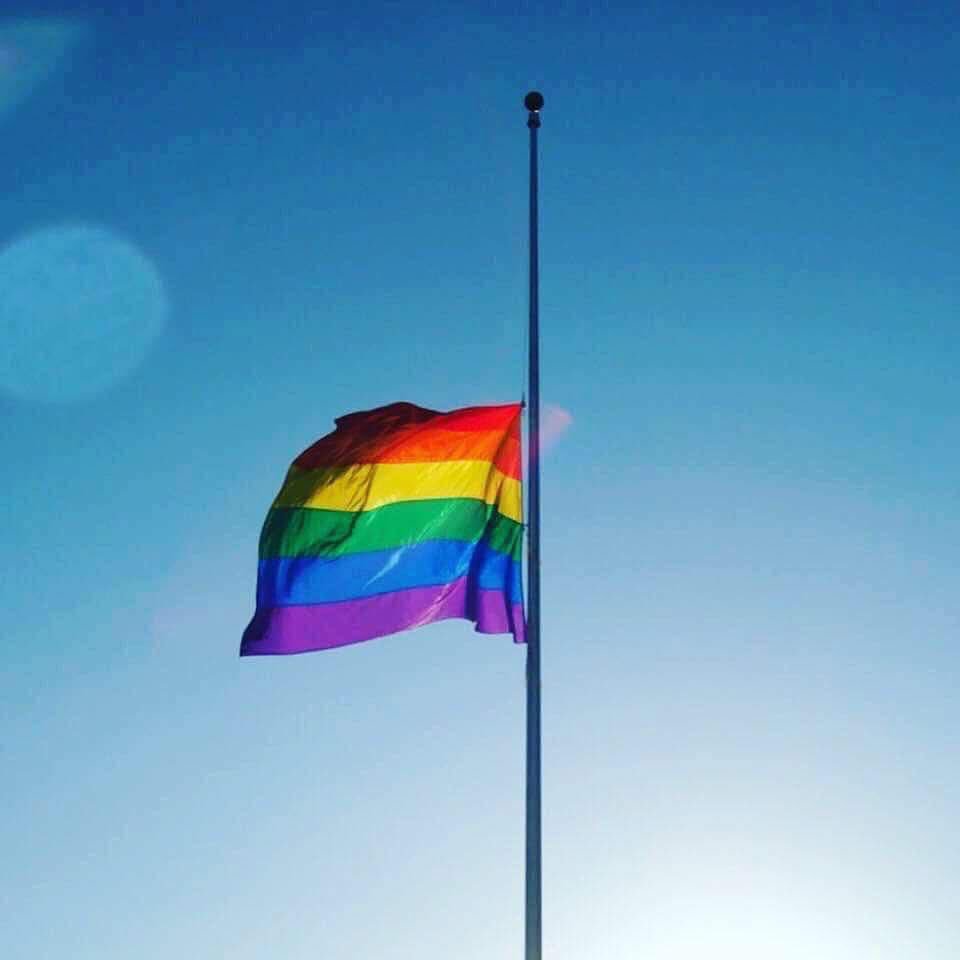
BryanFuller_2016-Jun-12It didn’t take long after people started reacting on social media to the news the at least 50 people were killed in an Orlando, Florida gay nightclub (and at least 53 were seriously injured) by a lone gunman before the arguing started. I made the mistake of sharing a comment about one very specific gun law that actually would have applied to this gunman’s purchase of the weapons used in the crime just a week or so ago, and commenting about who blocked the bill. And I was immediately accused of calling for the total ban of all guns everywhere, and reminded how badly prohibition worked with alcohol and drugs.

It’s a common argument. There are some problems with it. And those problems are most easily illustrated by looking at the topic of drunk driving. See, I’m old enough to remember when people actually argued that nothing at all could be done to reduce the number of deaths due to drunk driving. People have a fundamental right to imbibe alcohol, it was argued. People will find a way to get alcohol, look what happened during prohibition! The only person at fault is the “nut behind the wheel,” it was asserted, and no law is going to deter an irresponsible person! Just as no law or policy or other external force could prevent stupidity.

Editorials were written making the argument that while the traffic fatalities that resulted from the misuse of alcohol were tragic, no meaningful solution could be enacted—certainly not through the law!

I know, because I wrote one or two such editorials.

The first scientific paper drawing a connection between alcohol use and motor vehicle collisions was published way back in 1904 (it’s a little weird to realize that automobiles have been around that long). A much more rigorous study conducted in Sweden in 1932 is generally regarded as the first to definitively show that alcohol impaired drivers were more likely to have accidents leading to significant property damage, injury, or death than sober ones. But even as more studies piled up, the “nut behind the wheel” argument still prevented anything more than token laws that in many states treated driving while intoxicated about as severely as failure to use a turn signal.

In the mid-sixties several events managed to crack the public’s obstinance enough to recognize that automotive design and road design also significantly contributed to traffic fatalities. Congress created the National Highway Safety Bureau (later renamed the National Highway Traffic Safety Administration) and gave it the mission to research the causes of highway fatalities and recommend solutions. Most of Congress and the public expected the Bureau only to bring back recommendations for safety regulations of the vehicles and roads, but the science made it clear that more would be required.

During the 70s, due to recommendations from the Bureau, a series of regulations were enacted improving both the safety of the cars and the roads. There was also a concerted effort to educate the public on two areas: seat belt use, and not driving after drinking. Various studies later found that the education campaigns alone didn’t have much effect. The improvements in vehicle construction and changes to road design did not reduce the number of fatalities annually, though the rate of fatalities as a percentage of total number of miles driven annually did go down. Population growth meant the more people were driving, therefore more miles total driven each year. Bottom line: the first decade of safety improvements had only a minimal effect.

Between 1982 and 1997 is when things took off. Congress made a lot of federal highway money dependent on states enacting more uniform laws about such things as the blood alcohol level that qualified as legally impaired, minimum age for legally purchasing alcohol, and bringing real penalties to bear for the drivers who were caught. Education and treatment programs were mandated, and regulations about the sale and serving of alcohol to individuals were enacted. All of these actions, along with activism and education campaigns from groups like Mothers Against Drunk Driving, combined to do what the PSA campaigns of the 70s alone couldn’t do: the public’s attitude about drunk driving (as measured in surveys) changed, and (more importantly) the number of alcohol-related crash fatalities went down about 10% by 1990.

This prompted the non-profits and government agencies working on the issue to set a goal of reducing the number by another 20% by the year 2000—a goal we hit in 1997! Something that we said we couldn’t possibly do, and for all the same reasons that we are currently told are why absolutely nothing can be done about mass shootings and gun violence in America.

Is a total reduction of alcohol-related crash fatalities by 30% a complete elimination of the drunk driving problem? No. But if we could have fewer multiple-victim shootings next year instead of more, that would be a good start.

I am not proposing a ban on all gun sales. I never have. I’m a former NRA member, myself, for goodness sake! And no serious proposals I have seen have called for that, nor for anything even close to that. The big problem we have right now is that the moment any of us say anything about trying any of the measures which have already been demonstrated to work, people start howling at us about prohibition.

I was told yesterday that the 50 queer latinx lives snuffed out in Orlando yesterday were less important than the right of a dealer to sell an assault rifle to someone on the FBI’s terrorist watch list. I was told that me being angry about an industry lobbying group blocking even one reform bill that would have applied exactly to yesterday’s murder case was rude. I was told that pointing out that the NRA is more concerned with protecting the profits of the gun manufacturing industry than promoting responsible gun ownership was rude.

When I was challenged, I did get rude, yes. Fifty queer people were murdered yesterday in what was actually a quite preventable crime, and I’m not allowed to ask that maybe a measure supported by 90% of the population in the country should be given a try?

Fifty queer people were murdered, and yes, I’m taking it a little more personally than some of the earlier shootings. Maybe it’s a failing on my part that I didn’t get as angry before. But just because I’m taking it personally does not mean that I don’t have a point. We can tweak regulations and close loopholes without destroying freedom—we did it to reduce drunk driving, we can do it to reduce gun violence. Just because there isn’t a single, elegant solution doesn’t mean that we can’t do anything.

But we have to be allowed to actually try.

Who’s offended? Why?

Promote QUEER Visibility. Queer Nation.
“Promote QUEER Visibility. Queer Nation.” (Click to embiggen)
I’ve seen a couple of different discussions going around Tumblr about the use of the word Queer to describe members and/or allies of the LGBT/ LGBTQ/ LGBTIQ/ et cetera, et cetera, et cetera community or communities. Some people advise against it because some of the LGBT people are offended by the word. Some people insist the word doesn’t apply if the person being described falls into (or appears to fall into) a specific one of the L, G, B, or T categories. And some people insist that the only people offended are those who want to exclude one portion of the community or another. I find it simultaneously amusing and exasperating to see that this debate still iterating 24 years after I most dramatically confronted my own resistance to the term.

I’ve written before about how, after divorcing my wife and months of counseling and so forth I decided I needed to do something definitive or symbolic about coming out, so I went to a National Coming Out Day march. I didn’t realize until I got there that it was sponsored by Queer Nation, which was controversial for both their radical attitude but mostly (among the LGBT people I knew at the time) just for insisting on using the word “queer.” I marched, because, damn it, it was National Coming Out Day and I was doing it!

For a variety of reasons that don’t bear repeating at this juncture, my late partner, Ray, and a bunch of our friends saw me marching (actually, we were doing the Queer Hokey Pokey at that point) past a restaurant in the gayborhood. For a while I got teased mercilessly by those friends who despised Queer Nation. And while discussing why I wasn’t embarrassed to have marched with Queer Nation, I went from being ambivalent about that word, to saying, “I am going to call myself Queer if I want to, and fuck you if you don’t like it!” to one friend who was getting in my face about it.

I had been teased and bullied just as much as he had with that word (and many others) as a child. So I understood the reasons that friend (and many other people) didn’t want to embrace the term. But I had also been teased and bullied with a lot of other synonyms for “homosexual” including “gay.” And some of my friends who were girls or young women during those years had been harassed and bullied with the word “lesbian.” So if we could use those two words to describe ourselves proudly—hell, the official name of the Seattle Pride Parade at the time was the “Lesbian, Gay, Bisexual, Transgender Pride Parade, Freedom Day March and Rally”—then why couldn’t we use the word “Queer?”

Another reason I happen to prefer the term Queer is because of intersectionality and bi-erasure. I’m gay. I’m a man who loves other men. I am not bisexual, despite having once been married to a member of the opposite sex (no, seriously, I mean it!). My husband is a man who is married to me, a man. We’ve only legally been married a bit over 3 years, but we’ve been together for more than 18 years. People assume my husband is gay. He is not. He is bisexual. Saying that he is gay, at least to me, feels as if it is erasing part of his identity. And I love all him, not just half of him, so I take it kind of personally.

I have a rather large number of friends who are bisexual who have married members of the opposite sex. People assume they are straight. They aren’t. Some of them have told me they aren’t terribly bothered by that assumption, but some of them really chafe under the label. I have friends who have transitioned after marrying a partner who was opposite sex when they married, and they’ve stayed together since. Calling either of them gay or lesbian again, at least to me, feels like I’m erasing part of their identity or history. I have a few polyamorous friends who present as straight, and describe themselves as mostly straight… but who sometimes have threeways with their primary partner and one of the partners of their primary who happens to be of the same gender.

And then there’s one straight friend who once told me, “Describing myself as a straight ally doesn’t feel true, because I think I have a queer perspective—and I feel a closer connection to LGBT people—even though I don’t want to have sex with another guy.”

And as I mentioned recently, in the ’90s everyone in the LGBTQ community who wasn’t a cis white male seemed to be offended if we tried to use “gay” as an umbrella term for the whole bunch. So, for the record, I’m a cis white (and old and fat) same-gender-loving man who identifies as queer, uses queer to encompass the whole community (including allies who consider themselves part of the community), and I don’t intend to stop. I mean, yeah, if you tell me that you, specifically don’t like the term, I will try not to call you that… But I refuse to stop using the term in front of you. Because it is who I am.

We’re here, we’re queer, and we’re FABULOUS!

Memorials, reposting

I noticed this morning on the Washington Post web site that Valerie Strauss has republished the article she’s been publishing for a few years now on both Veteran’s Day and Memorial Day: Why Memorial Day is different from Veterans Day. And while I am all for any effort to prevent people from turning every single even moderately patriotic holiday into a variant of Veteran’s Day, I have a quibble.

She leaves out the fact that before the first official federal observation of a Memorial Day, at Arlington National Cemetery back in 1868, there was another holiday observed in many parts of the country—long before the Civil War—called Decoration Day, which was a day to have family reunions and celebrate the lives of all of our deceased family members. And my Grandmother was someone who observed that version faithfully her whole life, long before the official creation of the modern Memorial Day with the Uniform Monday Holiday Act of 1968.

I tried to simply reblog the earlier entry, but apparently because it has been reblogged by myself before, WordPress won’t let me. So I’ll republish the entire thing below. If you don’t want to read about me and my mom crying at Grandma’s grave, you can skip to my post about my absent-minded coffee cup issues from earlier today: A cup, a cup, a cup, a cup, a cup… boy! instead.

Anyway, for Grandma (originally posted on Memorial Day 2014):

Memorial, part 2

copyright 2014 Gene Breshears
Flowers for Grandma’s grave.
Grandma always called it by the older name, Decoration Day. As I’ve written before, the original holiday was celebrated in many states as a day to gather at the grave sites of your parents, grandparents, et cetera, to honor the memory of their lives. It was often a time of picnics and family reunions. At least as much a celebration of their lives as a time of mourning. The connection to military deaths didn’t happen until 1868, and particularly in the south, was often seen as a pro-Union, pro-war, anti-southern celebration.

I didn’t understand most of those nuances when I was a kid. The modern version of the holiday, celebrated on the last Monday in May, didn’t even exist until I was a fifth-grader, when the Uniform Monday Holiday Act went into effect.

Grandma observed it faithfully. Every year, as May rolled around, she would begin calling distant relatives and old family friends. Grandma knew where just about every person descended from her own grandparents was buried, and she made certain that someone who lived nearby was putting flowers on the graves of those relatives by Memorial Day. She took care of all the family members buried within a couple hours drive of her home in southwest Washington.

She was putting flowers on the grave of my Great-aunt Maud (Grandma’s sister-in-law) seven years ago on the Friday before Memorial Day when she died. My step-grandfather said he was getting in position to take a picture of her beside the grave and the flowers (there are hundreds and hundreds of photos of Grandma beside graves with flowers on them in her photo albums) when she suddenly looked up, said, “I don’t feel good!” and pitched over.

One weekend she had blown out the candles on the cake celebrating her 84th birthday. The following Friday, while putting flowers on Great-aunt Maud’s grave, she died. And one week after that a bunch of us were standing at her graveside. It was just down to a few family members, and we were at that stage where you’re commenting on how pretty the flowers that so-and-so that no one had heard from in years were, when someone asked, “Isn’t grandpa’s grave nearby?”

Grandpa had died 23 years earlier, and was buried in one of a pair of plots he and Grandma had bought many years before. And after Grandma re-married, she and our step-grandfather had bought two more plots close by.

Anyway, as soon as someone asked that, my step-grandfather’s eyes bugged out, he went white as a sheet, and said, “Oh, no!” He was obviously very distressed as he hurried toward his car. Several of us followed, worried that he was having some sort of medical issue.

Nope. He and Grandma had been driving to various cemeteries all week long before her death, putting silk-bouquets that Grandma had made on each relative’s grave. Aunt Maud’s was meant to be the next-to-the-last stop on their journey. Grandpa’s silk flower bouquet was still in the trunk of the car. My step-grandfather was beside himself. He’d cried so much that week, you wouldn’t have thought he could cry any more, but there he was, apologizing to Grandma’s spirit for forgetting about the last batch of flowers, and not finishing her chore—for not getting flowers on Grandpa George’s grave by Memorial Day.

The next year, several of us had the realization that without Grandma around, none of us knew who to call to get flowers put on Great-grandma and Great-grandpa’s graves back in Colorado. None of us were sure in which Missouri town Great-great-aunt Pearl was buried, let alone who Grandma called every year to arrange for the flowers. Just as we weren’t certain whether Great-great-aunt Lou was buried in Kansas or was it Missouri? And so on, and so on. One of my cousins had to track down the incident report filed by the paramedics who responded to our step-grandfather’s 9-1-1 call just to find out which cemetery Great-aunt Maud was in.

copyright 2014 Gene Breshears
Flowers from us, Mom, and my Aunt Silly on Grandpa’s grave.
Mom and her sister have been putting flowers on Grandma’s and Grandpa’s graves since. Our step-grandfather passed away three years after Grandma, and he was buried beside her.

Some years before her death, Grandma had transferred the ownership of the plot next to Grandpa to Mom. So Mom’s going to be buried beside her dad. Mom mentions it whenever we visit the graves, and I don’t know if she realizes how much it chokes me up to think about it.

We had put the flowers in place. We had both taken pictures. Mom always worries that she won’t remember where Grandpa’s grave is (it’s seared in my head: two rows down from Grandma, four stones to the south). Michael helped Mom take a wide shot picture that has both Grandma’s and Grandpa’s spots in it.

I thought we were going to get away with both of us only getting a little teary-eyeed a few times, but as we were getting back into the car, Mom started crying. Which meant that I lost it.

Grandma’s been gone for seven years, now. But every time we drive down to visit Mom, there is a moment on the drive when my mind is wandering, and I’ll wonder what Grandma will be doing when we get there. And then I remember I won’t be seeing her. It took me about a dozen years to stop having those lapses about Grandpa. I suspect it will be longer for Grandma. After all, she’s the one who taught me the importance of Those Who Matter

A cup, a cup, a cup, a cup, a cup… boy!

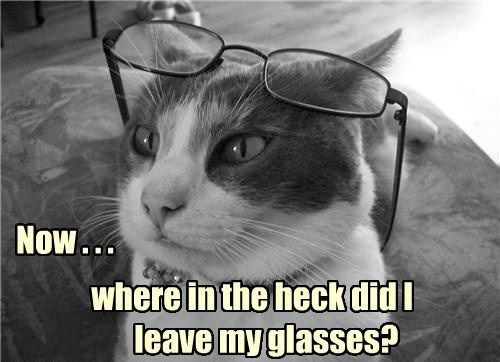
"Now, where in the heck did I leave my glasses?" This is a frightening accurate representation of the author.
“Now, where in the heck did I leave my glasses?” This is a frightening accurate representation of the author.
Absent-mindedness manifests in many ways. For instance, my coffee cup. When I was younger, I would often lose track of my current cup. I would spend time looking for it, and then conclude that maybe I was simply mis-remembering having poured a cup at all. I’d grab a mug from the cabinet, fill it up, head back to whatever I was working on. About a third of the time I’d sit down with the cup and hear a clink as I tried to set the second on top of the first mug, which I was absolutely certain hadn’t been in that spot on the desk just five minutes before. But there is was, half full.

Other times I would work for a while, then get up to retrieve a book from another room, or run to the bathroom, or something similar, and I’d find the first mug, sitting in an odd location, half full and gone completely cold. Some days I’d wind up with three or more mugs scattered around the house.

I was only able to reduce the occurrence of that problem by adopting the practice of using only my favorite mug for coffee. If I couldn’t find the coffee near me where I expected it, I’d keep searching until I found that mug.

Of course, it isn’t always coffee. I currently have a second favorite mug, and I use it for tea. If I decide to make tea, I go find my Queen of Everything mug, pick out a tea bag from my rather frightening collection, turn of the electric kettle portion of my coffee maker, and then make a cup.

Sometimes I get in the mood for tea and forget that I still have a half a cup of coffee sitting around somewhere. I usually find it a bit later, and half the time I don’t even realize it until I pick up the mug, take a sip expecting tea, and I get room temperature coffee instead. Never mind that my favorite coffee mug is mug bigger, is a different shape, and a completely different color from the tea mug. When I’m in the middle of something, I don’t notice any of that.

But that isn’t the end of it. Some afternoons or evenings, I’ll have a craving for some soda. So I’ll grab a can of La Croix, or a bottle of Dry Soda, or some other low- or no-sugar sparkling drink, open it, and drink half of it before I realize that I already have a half-finished mug of tea or coffee… and sometimes half a mug of each.

And then there are the evenings I decide to make myself a cocktail, or have a glass of wine. Yes, some times I have had the embarrassing moment when I reach for my beverage, and realize that within reach of me there is a half-full cocktail glass, a half can of soda, a half bottle of iced tea, a half mug of coffee, and a half mug of tea. Not often, but some nights…

“The Java Jive” (Ink Spots, 1940):

(If embedding doesn’t work, click here.)

A cup, a cup, and a cup…

My favorite coffee mug in it's natural habitat: a bookshelf within reach of my favorite chair.
My favorite coffee mug in it’s natural habitat: a bookshelf within reach of my favorite chair.
So I drink a lot of coffee. And when I’m at home on a work-from-home day or a weekend, I typically make a pot in the morning, fill up my mug, drink only some of it before I decide it needs a warmup, so I top it off. How many cups of coffee do I drink, then? Is it one long cup, or is it twelve? Except my cup is rather large, so how do we count by the cup or by the cup?

It has long amused me that coffee pots still measure the amount of coffee in the carafe by a measuring cup. One cup of liquid equals half a pint, which means 1/16th of a gallon. But at no time when I have own a coffee maker, have I ever drank coffee from a drinking cup that holds just one measuring cup’s worth of coffee. Most people drink from a coffee mug that holds nearly two measuring cup’s worth of coffee in a single serving.

l to r: A coffee mug of the size most people seem to use, a classic teacup, and then my favorite coffee mug.
l to r: A coffee mug of the size most people seem to use, a classic teacup, and then my favorite coffee mug. (Click to embiggen)
My current favorite home mug is bigger still. It’s the purple one in this picture. The little teacup in the middle is the kind of cup that the coffee pot manufacturers seem to think that people still use for drinking coffee. The mug on the left is one of my old favorites. At one time it was my office mug. I brought it home because a co-worker was weirded out that a man liked to drink coffee from a mug that said “The Queen of Everything.” Never mind that I was an openly gay man, it still freaked at least one person out. So it was a mug I often drank coffee or tea from at home for years after that. Until I found the large purple one.

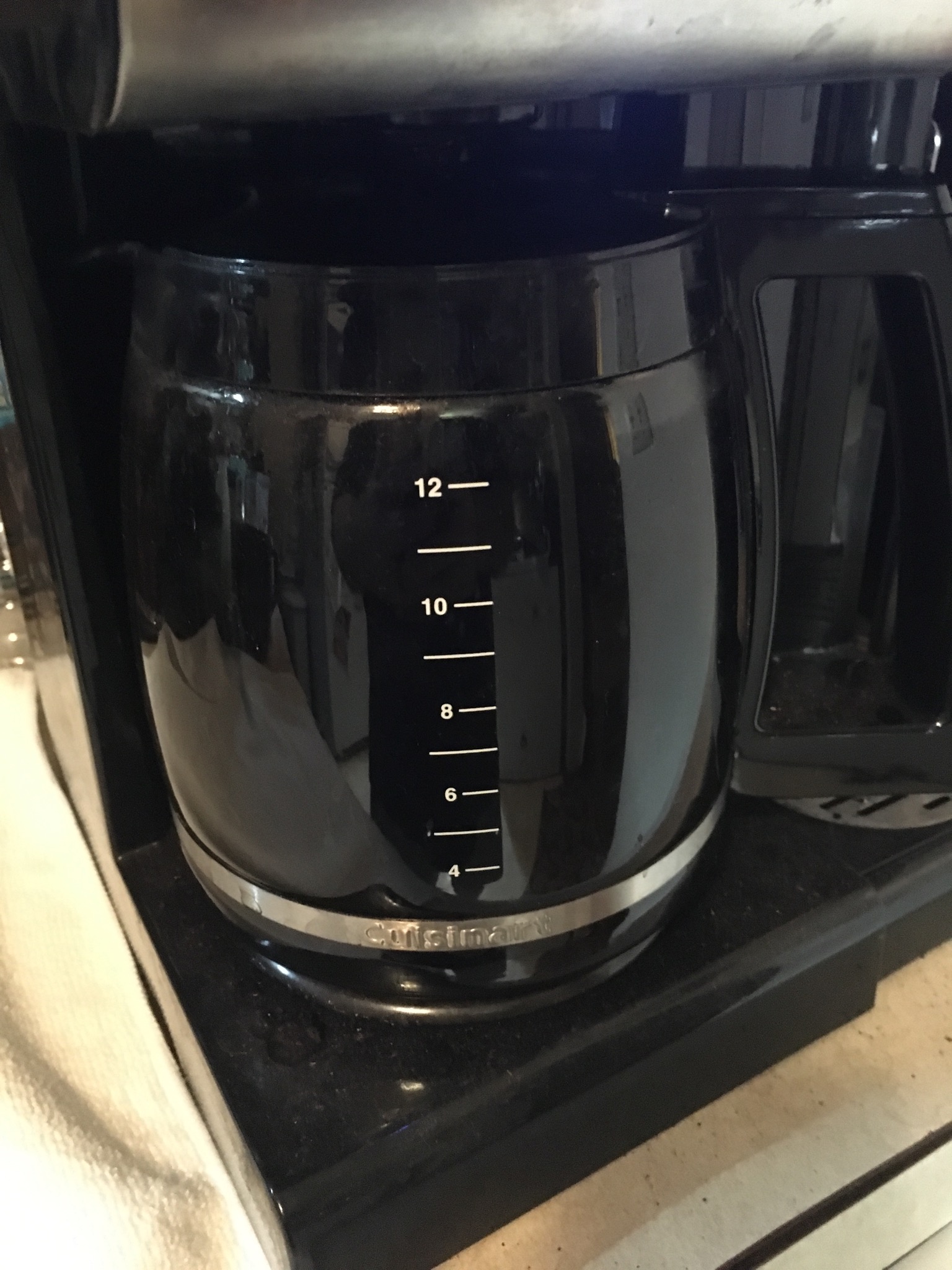
The coffee pot right after making a full put. Not that the liquid goes up the the 12 mark.
My current coffee maker includes a carafe which claims to hold 12 cups of liquid. And it certainly looks like a huge amount of coffee when I first make a pot in the morning. Twelve measuring cups is three quarts, and three quarts of coffee seems like a lot. Right?

You would expect that anyone who would drink 12 cups of coffee in a single day would be vibrating, I suppose. Maybe even vibrate so fast that I open a portal to an alternate universe and pass right through. All that caffeine in one person is bound to make one at least a bit manic. I remember a historian once mentioning that one of the prominent figures of the Enlightenment recorded in his journals (in which among other things he kept careful account of his household expenditures) of some weeks drinking 40 cups of tea a day. The historian said, “No wonder all those guys wrote so much and discovered so much. You try drinking 40 cups of tea and see whether you’re up all night having all sorts of exiting ideas bouncing around your head!”

I filled up my favorite mug exactly once, and look how the coffee level has dropped!
However, when I pour coffee out of the carafe to fill my favorite mug, note that the coffee level has dropped down to just below the 9 mark. So my favorite coffee cup holds three cups of coffee. Which means that if I drink the whole pot, while one could say that I drank 12 measuring cups of coffee, it’s only actually four refills of my coffee mug. So, do I drink 12 or 4 cups in a single day?

Well, there’s at least one more complication I haven’t told you. Periodically over the course of the day, whenever I notice that the carafe is less than half full, I pour about three cups of water (using an aluminum pitcher I keep nearby for reasons) into the reservoir and kick-off a new percolation cycle, letting the machine top off the pot. I confess that when I do this, I don’t grind fresh coffee beans, I just let the new hot water go through the grounds that I put in in the morning. This probably makes me a freak or a loon in the opinions of some hard-care coffee fanatics. I usually only do this twice in a day.

So, that would indicate that I actually drink about 18 measuring cup’s worth of coffee a day, right?

Well… the truth is, I usually stop in the early evening, and there is usually still coffee in the pot at least up to the 4 cup line when I do. So let’s call it 14 measuring cups again. That’s enough to completely fill my bit mug four times, and nearly a fifth afterward.

I’ve left out one more wrinkle that applies to work-from-home days. When I first get up on a work-from-home day, I do my meds and some of the other morning routines quickly, including making coffee, so I can drive my husband in to his place of work. As a treat for myself, I grab a small can of coffee drink, either a Starbucks Double-shot Lite, or there’s another brand that has a Salted Caramel flavored coffee drink in a small aluminum can. Both types claim to have the equivalent of two shots of espresso in the drink.

I pour one of these cans into a travel mug, which fills it a bit over half full, then top it off with coffee from the pot. That’s my “latte” for the drive in. I usually drink about half of it in the trip. When I get back home, I pour the remainder into my big purple mug, and top it off with hot coffee. The Starbucks’ can holds 6.5 ounces. The other brand’s can holds 7 ounces. Let’s just call it one more cup. Except it’s supposed to be two shots of espresso, so should we call it two cups?

Just how much coffee do I actually drink?


P.S. Please don’t chime it to say that coffee isn’t good for your health. The studies that most people think showed that were all conducted over 50 years ago, and newer studies show no correlation between coffee drinking and any of the health effects people attribute to them. None. Deeper analysis of the raw data from the earlier studies has revealed that the researchers completely failed to notice that there was an extremely strong correlation between being a heavy coffee drinker and being a heavy smoker. There was also a very strong statistical tendency for men to drink more coffee per day than women. And oddly enough, all the health issues that people now blame on coffee because of these badly quoted studies are also illnesses that one is more likely to have if one is either male or a smoker.

When the data from the old studies is re-analyzed to compare only smokers to smokers, non-smokers to non-smokers, men to men, and women to women, all statistical correlation between the amount of coffee someone drinks and any negative health effects vanished.

It ain’t the coffee that you need to be worrying about.

Who is excluding who, now?

images (3)When I was a child, none of the words I knew to describe being a non-heterosexual were good words. Pussy, sissy, fag, queer, dyke, homo—they were all insults. Homosexual was both clinical and pejorative, at least the way everyone I ever heard use it said it. It was clinical, all right, and it was clear the people saying it thought it described a terrible sickness. The least insulting was gay. Which isn’t to say that it wasn’t hurled as an insult, it’s just we were also told it was what those people preferred to be called. Though even the people who admitted that much were pretty angry about it. I actually had more than one teacher in school talk about how terrible it was that those perverts had stolen a word that used to mean not just happy, but a particularly carefree and whimsical kind of happy, and then used it to describe their sad, loveless, deviant lives.

And a lot of those words got used on me.

Throughout grade school I didn’t think that the sexual part applied to me. I knew that I said the wrong things and acted the wrong way, so that’s why everyone (except the nicer teachers and nicer church leaders) called me a sissy and a crybaby and so on. I wasn’t tough enough or whatever, but there was nothing sexual going on.

By the time I was in middle school and puberty had come roaring into my life I realized that all of those people had been on to something. And it terrified me. The worst thing I could imagine happening to me was for someone to get proof that the words fag, queer, homo, and gay described me in more than merely a metaphorical way.

So in my mid-twenties, the fact that I was finally able to say aloud to a friend, “I think I might be gay” was a giant leap. Overcoming the aversion that I felt to all of those words, equally, had been a titanic struggle lasting more than a decade. Over the next few years I was able to say I was “gay” a bit more confidently. I didn’t cringe inside if someone called me “gay,” at least if it wasn’t in an angry tone of voice.

I was actually starting to feel all right with the label by my thirties.

Which was when I started getting yelled at about it, again—but not by straight bigots. No, the people who were angry about my use of the word were lesbians. “How dare you call me that word!” and even more viciously, “How dare you assume that you can use that word as an umbrella term to include all non-heterosexual people!”

I was literally yelled at a few times, before I developed the habit of saying “lesbian and gay.” And almost right away people started growling at me not to leave out the bisexuals or the trans people!

I’m not exaggerating when I say that some of my fellow non-heterosexual got angry and yelled. It was clearly very important to them.

So I just about died laughing a few days ago when I saw some trans activists in my twitter stream angrily assert that it was people like me—cisgender, white, gay, and male—who were the ones that had excluded lesbian, trans, and bi people from the “clearly superior umbrella term, gay.”

No.

We didn’t exclude them. They were the ones who angrily and emphatically told us that we couldn’t use “gay” to describe them. During the late 80s and 90s, just as I was starting to get mostly all right describing myself as gay, I was being told that doing so was exclusionary. I was the bad guy for wanting to have a simple term than encompassed all of us.

It was during that time that Queer Nation came into being. Queer Nation was one of many groups formed to make a more aggressive push against homophobia and specifically homophobic violence at the time when both the violence and the media’s negative portrayal of homosexual people was escalating. The AIDS crisis wasn’t just killing us in vast numbers, it was fueling even more hatred than we’d experienced before (which is saying something!) Just one of Queer Nation’s goals was to take back the word “queer”; to make it a label we embraced with pride instead of an insult.

I was, at the time, ambivalent about that. So were a lot of the gay, lesbian, and bi people I knew. At the time, I was only slightly acquainted with a couple of trans people (or so I thought, but that’s a story for another post), so I wasn’t sure how they felt about it. I certainly understood why some folks were leery of the notion…

Then I decided I needed to participate in a National Coming Out Day march. And I only discovered after I had arrived at the assembly point (and made arrangements to meet friends on the Hill near the end point) that it was sponsored by Queer Nation. It was later, while being teased by some of those friends, that I moved out of the ambivalent stage to being vehemently in favor or taking back the word queer.

I’m queer. I’m a cisgendered white man who sleeps with other men. I’m also a queer nerd who loves Star Trek and Star Wars (and I bet I can still beat anyone who cares to challenge me on a trivia contest based on the original Star Wars: A New Hope) and Lord of the Rings (alas, I am no longer fluent in Quenya and Sindarin, Tolkien’s fictional elvish languages). I’m a queer geek who majored in Mathematics at University and have worked for decades in the telecommunication software industry. I’m a queer Taoist who is a both a recovering Baptist and recovering atheist. I’m a queer man very happily married to a bi man. I’m a queer writer who is still dismayed at how many of my earlier published works didn’t pass the Bechtdel test (but hope I’ve gotten better). I’m a queer godparent and uncle who squees over baby pictures and keeps cheering on the mostly straight romances on my favorite shows. I’m a queer man who watches football as faithfully as my favorite sci fi and mystery series.

I’m a queer, fat, old, white-bearded guy who welcomes any gay, lesbian, bisexual, trans, asexual, non-binary, poly, straight ally, pansexual, aromantic, and any other kind of human who thinks all of us deserve equal dignity and rights regardless of gender, orientation, and so on, to join me under this umbrella term. And if you prefer another label, that’s fine, but please don’t try to claim that I have ever excluded you. Okay?

Anti-trans bigot demonstrates that bullies are cowards… (duh!)

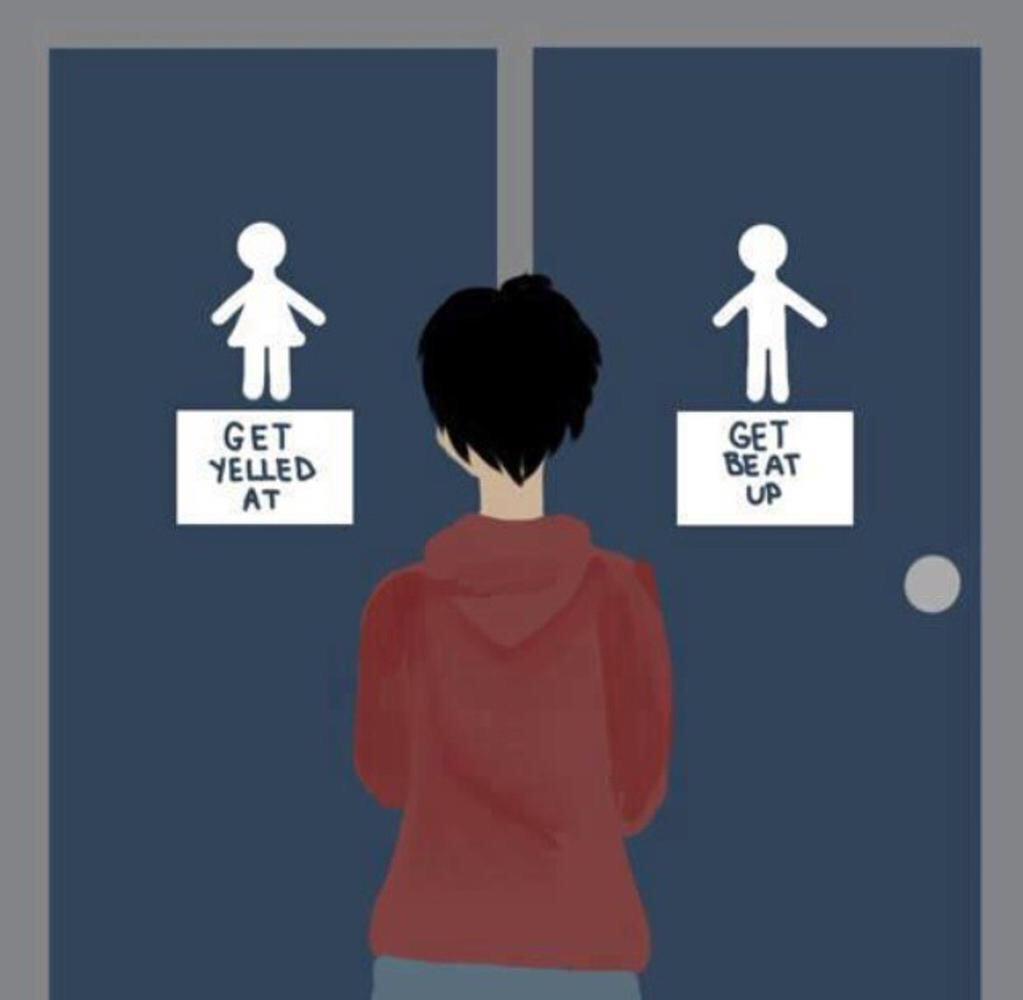
Click to embiggen. (I have found this image on dozens of articles and blog posts about trans issues, but never with an art credit. If you know who made this, please let me know so I can at least credit them!)
So, professional bigot Travis Weber (spokesperson for the Family Research Council) was on Chris Matthews’ show on MSNBC last week to speak in favor of the North Carolina law that makes it a crime for trans people to use a public bathroom that doesn’t match the gender on their birth certificates. The other guest was Jennifer Boylan, an English professor and writer who happens to be trans.

No matter how hard Matthews tried, he couldn’t get Weber to say which bathroom Boylan should use. He’s there to defend this law that insists Boylan shouldn’t use the women’s room, but Weber can’t bring himself to say it while she’s sitting right there. It’s almost funny.

I was going to say a lot more about this, but another blogger already hits all the points I want to make:

…[he] can’t bring himself to answer the question. Not with Boylan sitting there—not with Boylan empowered to respond to him directly, personally, publicly, and immediately. Watch as Weber’s bigoted “convictions” and “sincerely held religious beliefs” wilt in the presence of one of the people he’s trying to stir up bigotry against.

And:

Those ridiculous lies [they told about same-sex marriage] won ’em some battles — they carried the day before the Washington State Supreme Court — but they didn’t win ’em the war. Because their lies couldn’t survive us. They couldn’t survive us getting out there and speaking for ourselves, they couldn’t survive the scrutiny of decent and reasonable people, they couldn’t survive our lawyers, and they couldn’t survive satire and ridicule…. The [anti-trans] haters are winning some battles right now, and that sucks, and their hateful rhetoric makes an already dangerous world for trans people even more dangerous. But their “wins” are putting trans people in the spotlight. Trans people are speaking for themselves, disproving the lies, and joining in or leading the joyful mocking of the haters — just as the fight against same-sex marriage put same-sex couples (some half or wholly trans) in the spotlight. We spoke for ourselves, we mocked the haters, we gathered supporters, and we won the war.

I’m not arguing for complacency—we won the fight for marriage equality because we got out there and fucking fought it. We’re gonna have to fight this fight too. And we are fighting it and we are going to win. We are winning.

I didn’t identify the blogger before the quote because a lot of trans people of my acquaintance believe (incorrectly) that Dan Savage is anti-trans.

Regardless of what you think of Dan, this time he is definitely right on this one. The anti-trans bigots are using exactly the same arguments they have used against queer people before to justify denying us marriage rights, to justify sodomy laws, and so on. They claim we are monsters and predators and a threat to children. They raise false alarms and generate panic over things that have never actually happened. And yes, they are winning some battles. North Caroline is one place they have won.

But at the same time, they are losing the war. This bills are bringing more trans people forward. And as the panicked cis-hets see and meet real trans people, see the stories of real trans kids and their families, they are realizing the rhetoric is all lies. A CNN/ORC poll published today found that 57% of Americans disapprove of the North Carolina anti-trans bill. But even more important, only 48% of Republicans support such bills. Now, only 48% disapprove, and somehow 4% aren’t sure, but think about that: less than half of all Republicans approve this latest Republican hot-button issue. Wow.

Oh, and the same poll found that only 49% of North Carolina residents support the law.

It reminds me of one of the most telling stories that happened during the marriage equality fight. Before the Supreme Court ruling, one of the states was debating a marriage equality bill. And the relevant committees of both the upper and lower house of the state legislature scheduled public hearings that same day. So many people showed up wanting to speak and both hearings, that the committee chairs decided it would best to combine the hearings. So they moved both committees to a bigger room.

One Republican legislator who had been staunchly opposed to the bill switched his vote after that hearing. He said because they were in a different auditorium, he wasn’t in his usual spot up near the center of the front, but was off to the side, where it was easy to become distracted by the crowd and not pay attention to the citizens speaking. He said watching the gay and lesbian couples who were waiting their turn to speak interacting with each other and their children was a revelation to him. His whole life, he said, he had thought of gay people not as people, but as sexual acts. He didn’t believe they were actually in love. Watching them, he finally realized that queer people are just people. And that the couples were in love just the same as he and his wife. That they weren’t asking for special privileges. They just wanted the same legal protections for their families that straight people take for granted.

Just from watching them interact with their partners and children in the audience seats of an auditorium. That’s all it took.

We must fight. Make no mistake. And those of us who happen to be cis have to fight just as hard for the rights, dignity, and visibility of our trans brothers and sisters as we fought those previous battles. We have to remember that no one is free until everyone is.

But if we fight, we can win. We will win.

http://mediamatters.org/embed/210426

(If embedding doesn’t work, click here to watch the clip from Matthews’ show.)

Reading in public

Guys who read books on public transport are such a turn on.
(Click to embiggen)
I want to be very clear that I love ebooks and audiobooks. Being able to carry around a whole shelf full of books in my pocket is one of my favorite parts of living in the future. Not having to decide (quite so often) which old books to relegate to a back shelf, or get rid of altogether just because we’ve brought a bunch of new books home is a good thing, too. We both still buy hardcopy books, and there are currently a few piles of them in the bedroom that haven’t found a home on the shelves somewhere in the house, but it’s a slower process since both of us buy a lot of books digitally, now.

One thing I miss, now that smart phones are ubiquitous, is seeing what other people are reading on the bus. Seattle is a city of bibliophiles and other literary people, and for most of the 30+ years I’ve been riding public transports in Seattle, I could always count on seeing interesting books on my commute. Sometimes I might see someone reading a book I love, and I’d find myself grinning—hoping they were having as much fun with the book as I did. Other times I would see a title I had never heard of, and find it intriguing enough to look up more information on the book when I had a chance. Other times I would see someone reading a book that I despised, and I would wonder what sort of person would read that.

There are still people reading hard copy books on the bus, of course, just nowhere near as many as there used to be. Now instead of seeing a dozen books or so on my morning commute, there are a dozen or so people staring at their phones or iPads or Kindles.

Which still warms the cockles of my heart, because I love reading, no matter what form it takes.

And I’m certainly not going to give up reading (and some mornings writing) on my iPhone. Among the downsides of reading a hardcopy book on the bus is the time spent digging it out of my backpack, and then later needing to stop reading far enough before my stop to put the book away and get my pack zipped up and situated. There was also the need to decide whether to pull out my book or my notebook and a writing implement. And the frustration after I chose when I discovered I didn’t seem to be in the right headspace to concentrate on that book, or to write.

With the phone, I can slip it out, fire up a book, and start reading. If I want to make a note, or get another idea I want to write down, it’s just a couple of swipes and taps with my thumb to switch to a writing app, write it down, then get back to the book.

Of course, there is a bit of the paradox of choice that the phone amplifies. Occasionally I just can’t decide which of the many choices that are on the phone to read. Which of the several books (because I’m always in the middle of more than one) to pick up, or should I open one of my news apps and catch up on the world?

Having all those choices doesn’t usually paralyze me, but I do often dither for at least a few minutes. So maybe I’m only kidding myself when I say I get a bit more reading time in now that I’m not fumbling with getting the book out and putting it away again.

But I don’t think so. For one thing, with the phone, I can become obliviously lost in the book right up to my stop, then jump up, slip the phone into my pocket as I’m moving to the exit, and get off the bus.

A rose, some memories, and a goofy grin

A bud from a branch I had to trim off one of our roses late last week has finally started to bloom (© Gene Breshears)
When Ray and I moved to Ballard 20 years ago, I’m not sure I would have believed you if you’d told me I’d still live here two decades later. We had stayed in our previous two apartments less than three years each, for one thing. And Ray had been given an estimate of two years left to live about 19 months prior to the move. Not that I believed it, mind you. I refused to accept that he wasn’t going to get better, somehow. For one thing, I was older. I was the one who had chronic medical conditions when we met. So I was convinced that it would be him who outlived me.

The previous two places we had lived had not had any sort of yard. They were like the archetypical city apartment, in that regard. So when we’d found a place with a small lawn and a couple of flower beds that would be ours, Ray had been ecstatic. Particularly since there was already a rose bush in one of the beds.

The rose had clearly been there a for many years, with the thickest canes being nearly three inches thick. When we moved in in February, the rose was just leafing out, with no sign of buds, yet. But it wasn’t long before enormous red roses were appearing on it. We took some pictures and shared with friends who knew a bit more about roses. More than one person guessed it was a Mr. Lincoln, a fairly well-known red rose. Later that summer, when I was digging down deep around the roots of the red rose (we were trying to excise wild deadly nightshade, which grows as a weed up here), that I found the original stamped metal tag that had come with the rose whenever it had been planted, which identified it as a Patrician. It’s a red rose that was specifically bred to emulate a Mr. Lincoln, though it is supposed to be a bit hardier.

That same spring Ray came home from a shopping trip one day with a new rose to plant at the other end of the same bed. It was labeled a Maid of Honor, which was not a rose I had heard of. I learned much later that the name Maid of Honor does not represent a recognized cultivar of a rose, but is rather a name that sounds like it ought to be a real rose breed which gets slapped on various pink or yellow roses sold by, shall we say, less than scrupulous distributors.

We didn’t know that, at the time. We planted it, took care of it, and we were both a little shocked at just how quickly it sent canes shooting up for the sky. We would get these enormous pink blooms, often in clusters above the eaves. The next spring I remember quite clearly one Friday finding a new cane that had grown to about 8 inches in length. By the next Friday, that same cane was more than 6 feet tall.

To say that it was an aggressive climbing rose might be an understatement.

So I have learned that I have to be a bit aggressive in trimming our pink rose. Not just in the fall, but throughout the growing season, as side branches soon block off the walkway, and the tall branches hang down into the driveway.

Ray died before our Maid of Honor reached its third spring. Another rose that we found that same year, a pale lavender rose whose labeled breed I have forgotten, lived only a couple more years after Ray did. But the Maid of Honor, and the original Patrician, continued to go strong.

A couple of years ago, I apparently got too aggressive at trimming the Maid of Honor, because the root stock started sending even more rapidly growing canes up. Roses don’t breed true via seed, so when you buy one at a nursery, what you get are several canes grafted off of an original (or more likely, a graft of a graft of a graft… et cetera… of an original) and onto a hardier breed of rose. Usually a wild rose or tea rose. So if you get new shoots from the root ball, they are a different kind of rose, altogether.

The root’s flowers on mine are very tiny white blossoms that almost don’t look like roses once they open all the way. It’s branches grow even fast than the pink ones, but they never get quite as thick as a pencil, so while they are very long, they droop and wind around the thicker, stronger pink branches (and anything else they can reach).

Our building is getting painted right now, and I’ve been having to trim both the white and pink branches multiple times because the rose keeps getting up around the eaves or into the porch railing. Late last week I trimmed a new tall branch, and it had a single bud near the end. So I trimmed it some more and stuck in in the vase where I had some flowers (some that I had bought myself, and some that friends brought over when they heard the news about my dad).

Sometime while I was sleeping last night, the bud began to open. So I took a picture.

Every time I stop and look at any of the buds from the Maid of Honor, I think about of Ray. Who loved to smell those pink blooms, give me a goofy grin, and ask me if I agreed that it was pretty.

Not all illness is visible

May is Mental Health Awareness Month - National Alliance on Mental Illness (www.nami.org)
May is Mental Health Awareness Month – National Alliance on Mental Illness (www.nami.org)
May is Mental Health Awareness Month, so you can find a lot of blog posts recounting various experiences trying to get diagnosed, find a treatment or method of coping that works for that person, and so on. I read a couple of those posts on Sunday and thought, “I should write a post linking to the National Alliance on Mental Illness’s awareness page.”

But you know me, I have to give it some personal context. So I started a blog post that was supposed to be a brief overview of some of my experiences watching a few loved ones try to get diagnosis and treatment, and the varying levels of support they found. The next thing I knew, I had nearly a thousand words ranting about some of my own bad experiences with the inappropriate application of therapy, beginning with the time in middle school I was threatened with expulsion unless I went to therapy because I was continually the victim of bullying.

Which is exactly the opposite of what I wanted to write about, since this is Mental Health Awareness Month, not Gripe About Homophobic School Administrators Month, right?

So, here’s a great (and more appropriate) post by a musician I follow: My Medicated Case for Psychiatrics, to read instead.

When you can get the treatment you need, it’s wonderful. Perhaps equally wonderful is have friends and loved ones who support you along the way.

So let’s all try to be the kind of friend who helps, supports, and affirms, okay?