Category Archives: life

Onion arguments and thorny questions

"When you talk like that, I'm tempted to ring for Nanny and have you put to bed with no supper."
“When you talk like that, I’m tempted to ring for Nanny and have you put to bed with no supper.” (Click to embiggen)

I almost put a link to this fun post from Rachael Acks in last week’s Friday Links, but I also wanted to say some more about it, so I hung onto it. Which is silly, because I can put something in Friday Links and write about it either afterward or before, obviously. Anyway, first the link:

Reasons why I will not be replying to your argument

At the top of the post she says, “This post has been made for my own later use. Others are welcome to use it as well.” The idea being rather than argue with certain types of comments, remarks, concern-trolling, et cetera, just send a link to this post. If you want to give the person a bit more of a clue, reference one of the numbered paragraphs by number.

The last several days I’ve encountered several situations where number 2 and 2i apply:

2. Something you have said indicates to me that you lack the necessary factual grounding in order to have this argument, and I am completely uninterested in doing the background research for you.
i. If you are interested in paying me to do the research for you, for example by way of writing an annotated bibliography that you can peruse at your convenience, we can discuss my hourly rates.

Which reminded me of Foz Meadow’s excellent description of a “onion arguments” which she has referenced a few times, including in her post last year, Hugos & Puppies: Peeling The Onion:

When it comes to debating strangers with radically different perspectives, you sometimes encounter what I refer to as Onion Arguments: seemingly simple questions that can’t possibly be answered to either your satisfaction or your interlocutor’s because their ignorance of concepts vital to whatever you might say is so lacking, so fundamentally incorrect, that there’s no way to answer the first point without first explaining eight other things in detail. There are layers to what’s being misunderstood, to what’s missing from the conversation, and unless you’ve got the time and inclination to dig down to the onion-core of where your perspectives ultimately diverge, there’s precious little chance of the conversation progressing peacefully.

And it isn’t just in arguments. I had recent exchange in social media about my current bout of illness, which I had summed up by saying that I was on my third round of antibiotics, and I really hoped they worked because I was tired of all the blood tests, x-rays, et cetera. The other person said maybe I should see a doctor. Which made me reply, “Who do you think prescribed each round of antibiotics and all the blood tests?” Which they still didn’t understand why I couldn’t say exactly what I had and when I would be well. Which led me to assume that this person has had the great luck of never having an illness which wasn’t quickly diagnosed, and didn’t completely grasp how prescription drugs are sold, et cetera.

Foz also explains the reasons why this sort of situation can be so frustrating:

[Y]our interlocutor thinks they’ve asked a reasonable, easy question, your inability to answer it plainly is likely to make them think they’ve scored a point. It’s like a cocky first-year student asking a 101 question and feeling smug when their professor can’t condense the four years of study needed to understand why it’s a 101 question into a three-sentence answer. The problem is one as much of attitude as ignorance: having anticipated a quick response, your interlocutor has to be both willing and interested enough to want to hear what might, at least initially, sound like an explanation of a wholly unrelated issue – and that’s assuming you’re able to intuit the real sticking point straight off the bat.

And that’s how we get drawn into endless spirals. Which aren’t usually worth our time. Unfortunately, sometimes it happens with people we actually know and love (or at least like a great deal and would like to keep in our lives), and it can be difficult to figure out how to navigate the situation without everyone getting upset.

Particularly if when either you or the other person suggests some variant of, “Maybe we can agree to disagree on this?” but it is met with, “Thanks for invalidating my feelings!” or something similar.

When it’s a friend, unfortunately, we can’t just hand them a link to Rachael’s post referenced at the beginning of the message. The really sobering part is realizing how many times someone should probably have referred me to said post…

Confessions of a nerd

I had taken this test before, but recently found a link to it and took it again:


I am nerdier than 73% of all people. Are you a nerd? Click here to take the Nerd Test, get geeky images and jokes, and write on the nerd forum!

I was struck by how dated some of the questions were, then I found the Nerd Test 2.0 on the same site and took it, and it was a bit better:


NerdTests.com says I'm a Cool Nerd God.  Click here to take the Nerd Test, get geeky images and jokes, and talk to others on the nerd forum!

But still terribly dated. For instance, the second test mentions owning computers with more than a gig of memory. Really? Smart phones have that much memory, now. Therefore, all sorts of non-nerds own at least one computing-type device that falls into that category. I get that when the test was written, that threshold was a big deal, but what sort of nerd doesn’t think about how quickly technology becomes obsolete, and therefore would try to design a test so that it could still be relevant in a year or three?

In the sketch, four Yorkshiremen tell ever more ludicrous tales of how poor and disadvantaged they were as children, then another insists that was luxury compared to theirs...
In the sketch, four Yorkshiremen tell ever more ludicrous tales of how poor and disadvantaged they were as children, then another insists that was luxury compared to theirs… (click to embiggen)
The tests also mention owning computers with less than 512K of memory, which would imply that one owned a computer some years ago when home computers were less ubiquitous. But my first thought when reading the question was, “512K? Luxury!” (And yes, I am alluding to the old Monty Python Four Yorkshiremen sketch)

Seriously, the first computer I ever owned only had 1K of memory… and no persistent storage.

But I have nerdy/geek friends who weren’t even alive in 1983 when the Timex Sinclair was a thing, so using it (or even the 512K range) as a means to measure one’s nerdiness smacks more of ageism than actual nerdiness. It’s true that I have sometimes bragged about the fact that the only programming class I ever took involved writing our programs with punch cards. Hey! Fortran was cutting edge at one time!

But most of my point about that is: my whole adult life I have made a living in the computer industry and at different times my job has included coding or scripting (which aren’t the same thing, but they both involve algorithmic thinking), but I’ve done it all without taking formal classes in any of the languages that I have ever been required to use on the job. I’m not really bragging about how early I got into computers, because that is simply a product of how old I am. Since I had no control over when I would be born, that’s out of my control. I usually bring it up to say that the important thing about any skill is your ability to learn new stuff as you go and don’t be afraid to try something just because you’ve never done it before.

While things like a Nerd Test can be fun, there’s an awful lot of gatekeeping implied in many (most) of the questions (and we’ve had more than enough gatekeeping going on around here!). That doesn’t even get into the whole conflation of nerd and geek and dork!

I’m a nerd. I get really enthusiastic and pedantic about the things I love. And a lot of those things have to do with math, science, technology, science fiction, and fantasy. But you can be nerdy about words, or knitting, or art supplies, or bow hunting, or vintage cars, or—well, anything! One of my friends has been nerding out the last year or so on cocktail making, for instance. I have friends who nerd-out about cellos. It’s all good, and we don’t need to keep score.

I’m attending NorWesCon this weekend. We skipped the last couple of years, and I’ve really missed it. I’m looking forward to spending a lot of time hanging out with many different kinds of nerds, and being a big ol’ nerd myself.

It’ll be fun!

Names, labels, deadnames, signs, and portents

if-your-mother-wife-or-sister-dies-could-you-be-pu1I’ve written a few times about my name. The tl;dr version: when my parents named me, they gave me a first name that I shared with my dad, paternal grandfather, a great-great-uncle, and a first cousin-once-removed who all lived in the same small town where I attended middle school. Which led to me asking (then demanding) that I be called by my middle name, which was shortened and that I legally changed to my first name as an adult.

That version of the story puts the emphasis on the annoyance and confusion of sharing a first name that doesn’t have culturally acceptable diminutives. Certainly that was a big part (in seventh grade in very redneck America it is no fun having school teachers and administrators regularly call you “Paulie” in front of the other kids; especially if you’re already the kind of guy who gets called sissy and much worse). But it was more than just about a preference. And it was more than a whim.

I’m used to hearing the concept of the deadname when discussing transgender issues. Being deadnamed may be the most common microagression trans people deal with. I became quite familiar with the phenomenon long before I met my first trans friend. I had more than one relative tell me that Gene was not my real name. One insisted that the people who really loved me would never call me by anything other than my birth name. One uncle said he’d call me whatever he damn well pleased, and if I had a problem with that, he’d smack me around until I agreed.

Many years later imagine my utter mortification the first time I slipped and deadnamed a trans acquaintence… to his face. It really was a slip. And in my defense, it had been years since I had seen him, pre-transition, I had been told by another friend only recently what his new name was, and I hadn’t expected to run into him at the social event in question. But I still felt as if I were the scum of the earth a millisecond after the name left my lips.

But to get back to the original decision to change my name: there was also an element that the identity of “Paul Eugene” (which is what a lot of people called me to distinguish from all the other Pauls around all the time) simply didn’t feel like it fit me. In retrospect, I think it is no accident that I became most adamant about changing my name after the hormones of puberty made it absolutely clear that I was not straight. My sexual orientation wasn’t the only way I didn’t conform to the expectations of my family and peers. I had been a sci fi nerd for longer than I could remember—much more interested in reading than sports, I scandalously believed in evolution and that the universe was billions of years old despite being raised in an evangelical fundamentalist church, and my favorite subjects in school were all the things other kids hated.

Not everyone resisted my requests. My maternal grandmother switched right away, and was quick to correct other people. My Aunt Silly, who had grown up hating her given first name and long insisted on being called by her middle name was another instant champion of my cause. Surprisingly, my dad (who had resisted a little bit at first) completely switched sides when his brother-in-law threatened to smack me if I objected to what he called me.

Recently, when I inherited a subset of my maternal grandmother’s vast photo collect, I was struck by the fact that on the backs most of my childhood photos, Grandma had always written my name as “Paul Gene.” As a child that’s what she called me, but given her accent and the idiosyncratic way she pronounced a lot of words, I had always assumed that she was just squeezing the middle syllable of Paul Eugene so tight that it disappeared. Nope. Maybe she was being a little psychic. I don’t know. But I also saw that she had gone back through some of the pictures and crossed out the “Paul.” On a couple of them she wrote, much later when her handwriting had become shakier than it had been when the picture was first taken, “he changed his name.”

I think Dad’s original resistance was half just being stubborn and controlling, and half irritated because he’d grown up being called “Paulie” and hating it so I ought to toughen up and take it. And it was very clear, when the uncle said he’d call me what he wanted and smack me if I didn’t like it, that Dad’s anger was very much of the “no one can beat my kid but me” variety. Many years later, you could tell when he was mad at me because he would deadname with extra emphasis on the “Paul” syllable. 

I changed my name legally decades ago, and my maternal grandmother reacted to the news with a very enthusiastic, “Good for you! Gene fits you better, anyway.”

It wasn’t a totally unexpected reaction: Grandma always had my back.

So I try to abide by other people’s requests regarding names and pronouns, et cetera. And continue to be embarrassed when I mess up. Even though I do mess up, I will always defend their right to their identity. Not just because I know how it feels to be deadnamed, but also because I know how good it felt when Grandma defended me.

The Incredibly Slowly Shrinking Writer

img_0019I’ve never had the kind of body anyone would call heroic. Even back in middle school when I was active (and generally not terribly good) in various sports. Back then I was usually short for my age (other than a brief exception in 7th grade when I shot up to what would turn out to be my full adult height, but within two years all but two of my classmates were taller than me, again), and was usually painfully scrawny. Then, in my twenties, Still the same height I’d been since the age of 14, I started gaining weight and generally started to look like many generations of short, round, bald, hairy men on my Dad’s side of the family. Yes, bald. my hairline starting receding around the age of 15.

Despite having more than a bit of a belly, for most of my thirties and forties I had excellent blood pressure and more than excellent cholesterol numbers. That was probably helped by the fact that for most of my adult life I’ve walked, a lot. I currently live about five miles from the location of my office, and most nights after work I walk home, rather than take the bus. Even when I’m feeling sick, I walk a couple of miles to get to a bus stop along the way.

Every male descendant of my paternal great-grandfather with whom I am in contact developed adult onset diabetes by their mid-forties. A few in their thirties. And some of them didn’t follow doctor’s advice when diagnosed, and suffered various awful complications. So fifteen years ago (at age 41) when I received the official pre-diabetic diagnosis, I vowed to take it seriously. I went to the nutritionist my doctor recommended. I mostly followed the diet—for fourteen years. We got so used to following it, that recently when the new consult changed it, my hubby and I keep forgetting we’re allowed to buy beef, now.

About ten months ago, my blood sugar went really bad, after hanging in the “higher than optimal, but still not diabetic” range, and I finally gave in and let the doctor start me on insulin. At least I made the it into my mid-fifties before it fully hit! The initial treatment is to start at a very low dose and start edging up as you get used to checking your blood sugar regularly and learn how your body reacts. Standard procedure is to see the doctor two weeks after starting to get evaluated.

Now, after only two days on insulin, both I and my husband noticed that I was much more energetic. I hadn’t noticed a long slow drag to my overall energy level and feeling of well-being over the previous few years. The most dramatic discovery though happened at that first follow-up visit. I had lost about 11 pounds in two weeks.

My regular pharmacist had been telling me during the previous couple of years while we tried various non-insulin medications, that in her experience, when the patient found the right treatment, lots of things improved, including the patient’s weight. I hadn’t believed her.

In the months since, I have been steadily having, at odd intervals, to tighten my belt another notch. My work slacks got so baggy I gave in a few months ago and bought a couple pairs of smaller pants. I’ve even had to adjust the wrist band for the iPod Nano that I wear as a watch. I never thought I had fat wrists, but apparently there was some to lose there, too. I had to change which finger I wear my grandfather’s ring on, because it fell off the old finger. My wedding ring, which was a very tight fit for the last few years, isn’t in that danger, yet, but it slides off without much effort now.

Make no mistake, I have a lot of weight still to use. When I look  in the mirror, I still look just as fat to my own eyes as ever. But I hit another milestone today: I am on the last notch on this belt. Counting from the dent in the leather from the spot I was at for years, I’ve tightened this belt five times, now. It may be time to buy some smaller pants, again.

My new diet is still low carb, but I’m no longer doing the glycemic load calculation, where I get to have more carbs if I eat high fiber foods. Because doing that doesn’t keep my blood sugar down. The other change is that I’m allowed to eat fat again. I’m eating a much higher fat diet than I did for fourteen years, and only now am I losing weight. Also, my cholesterol never got bad, but it had left the unbelievably good range during that time I was pre-diabetic. But now that I’m on insulin, my cholesterol numbers are back to incredibly good. And remember, I’m eating more fat, now.

I’ve been feeling down a lot for the last two months because of these flu- and cold-like symptoms that would never completely go away. Yesterday, after another ten days on antibiotics (for the opportunistic bacterial ear-nose-throat infection on top of whatever the viral thing is) I finally felt better than “meh” after longer than I care to admit. I’m not feeling great, just okay.

But realizing this morning, when I tried to tighten my belt that I was actually having to pull it slightly past the last notch before it felt tight, that certainly was a great feeling!

Confessions of a cluttering packrat

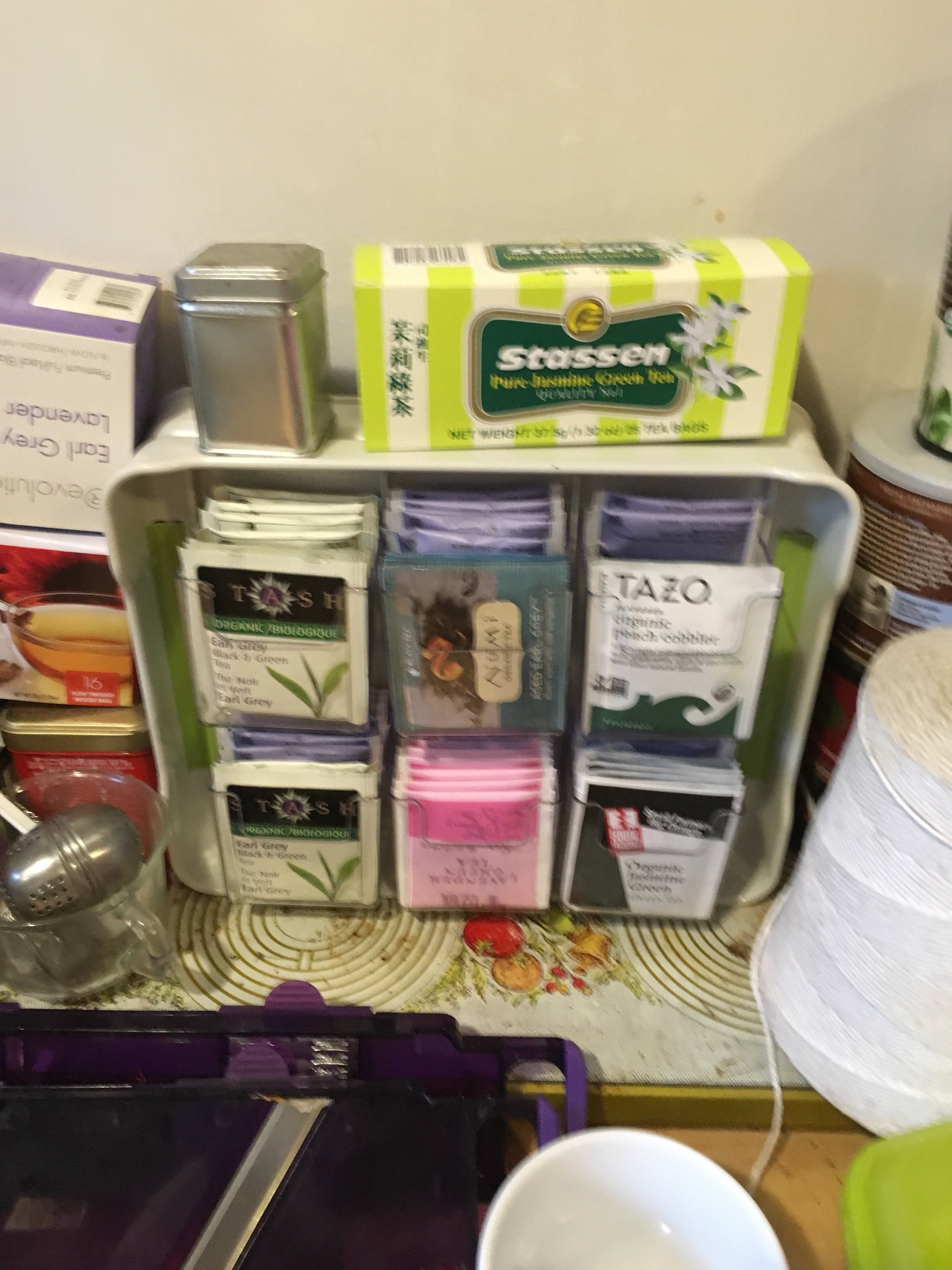
Fuzzy phone picture I took shortly after moving about 14 boxes of tea into this organizer.
I have mentioned many times that I am a packrat, son of packrats, grandson of packrats, great-grandson of packrats. On top of that, my husband is also a packrat son of packrats… so I hang onto things. I save things that other people would give away/take to Goodwill/throw away because “we might need that some day!”

It’s the reason we found multiple old microwave ovens hidden in the closets of my maternal grandmother’s house after she died. It’s the reason that clearing out the first bedroom in grandma’s house filled up the beds of three of my cousins’s pickup trucks more than four times each for trips to thrift stores and the dump. And it’s the reason that any time I replace an old appliance or gadget or household item with a new one, I hear that phrase, “you might need that some day!” in my Grandma’s voice. I essentially have to have an argument with Grandma’s ghost every single time I even contemplate discarding an item.

And Grandma’s ghost is stubborn!

Another eccentricity I have is They’re All My Favorite syndrome. For instance, I like tea. I admit to being a cultureless American who grew up on Lipton tea bags, I have made real tea with loose leaf teas, but 99.8% of the time I make tea from tea bags. And I have favorites. I love Numi Aged Earl Grey, for instance. And Stash Double Bergamot, and Stash Earl Grey Green & Black, and Revolution Earl Grey Lavender, and Numi Jasmine Blosson Green Tea, and Stash Lemon Ginger Green, and Twinnings Darjeeling, and Revolution Peach Ginger Black, and Revolution Dragon Eye Oolong, and Revolution Jasmine Blackberry Oolong, and Twinnings Orange & Cinnamon Spice, and let’s just admit that absolutely any blend that has Bergamot or Lavender in it will be bought by me and tried at least once, so there are always about ten Earl Greys of one sort or another…

And don’t get me started on Bigelow Raspberry Royale that used to be carried in all the grocery stores around here but I have to order it online—when it is in stock, which isn’t often!

The problem is, I love all of these teas, and I buy boxes of the teas, but I have tended to buy teas faster than I drink them. I take some boxes in to work, but I drink the free office provided coffee in the morning, switching to tea in the afternoon. Because I really need the strong caffeine hit of the coffee! Making tea with a kettle on the stove, particularly since most of the time I’m only making it for one, has always been more of a hassle than making a pot of coffee in the morning and reheating it as needed, or grabbing something premade out of the fridge if I want something other than water.

And for various health reasons, I’ve been cultivating a habit of drinking a glass or mug of plain water whenever I head into the kitchen looking for something to drink. As in, I don’t allow myself to pour some coffee or grab a bottle out of the fridge until I’ve drank water.

I have almost bought myself an electric tea kettle many times, but then feel guilty because the house is already cluttered everywhere, and do we really need another appliance that has only one purpose?

The last time our coffee maker died, my husband talked me into buying the model that had a separate tea maker. All it really is is a second separate water reservoir and separate heating element and so on that makes hot water that you can dispense in a cup in the separate location from the coffee pot. So now I make tea much more often.

Unfortunately, this had the effect of making me start buying even more tea. Thankfully, some weeks back my friend J’wyl sent me a link to a tea bag organizer thing that was selling pretty cheap on Amazon. Another friend she shared the link with bought it right away and waxed rhapsodic about how much it cleaned up his big pile of tea boxes. So I bit the bullet. I shared the picture at the top of this post with them the day after I moved tea bags out of boxes and disposed of about 14 boxes. I wish I’d taken a picture of the pile of empty boxes.

You can see in the picture I did take that I couldn’t get all of the tea bags into the organizer. For one thing, the larger Revolution bags don’t fit (and if you don’t keep them in their airtight resealable ziplock foil bag, they lose a lot of their flavor fairly quickly). But it does help. The compartments only hold about 12 bags each. The are another six compartments on the back side, so it holds about 144 tea bags, which I realize is a lot. Most of the teas I buy come in boxes of 18-24, so it would be nice if the compartments were a little bit bigger, but it is definitely an improvement over the pile of boxes. Particularly since a box that only has a couple of bags in it takes up just as much space as the brand new, completely full box.

It is a teeny, tiny step against the clutter. But an improvement!

Chariots of the Who? – part two

The cover of the 1973 paperback edition, as the drivel became a blockbuster.

I posted a bit of a ramble about how I first encountered the book Chariots of the Gods? back in 1971 and how by 1972 the book had infected the collective consciousness enough that multiple evangelical pastors were feeling the need to preach sermons against it. The first U.S. paperback edition was published either just before or during my fourth grade in elementary school. At that point, in the U.S., the book had not yet become a bestseller. So the ancient alien ideas, and specific references to Erich von Däniken’s hack history theories about how aliens had influenced the course of human history were just trickling into my life.

I promised a weird tale involving phosphorescent chalk and lime green three-piece suits, and that’s coming, I promise! So, fast forward to 1973… Continue reading Chariots of the Who? – part two

Chariots of the Who? – part one

Cover of the 1970 first American published paperback edition. Click to embiggen.
It’s all Solarbird’s fault. In the linked post, she plots possible family tree of the original Battlestar Galactica mythology, including a reference to Chariots of the Gods?, and in the course of typing a short comment about when Chariots… the book came out, and the weird in-roads it made into pop culture, I realized there’s at least one weird section of my evangelical fundamentalist Southern Baptist childhood I’ve never written about: the years that evangelical revival preachers felt compelled to make regular sermons deconstructing Chariots of the Gods.

It’s a strange tale involving a hack writer’s bad grasp of history and half-baked sci fi sensibilites, rural American evangelicals’ even shakier grasp of history and science, a Mormon community invaded by mostly southern oil worker families, the tent revival epidemic of the 1800s, black lights and phosphorescent chalk, one queer sci fi nerd, and a three-piece suit the color of lime sherbet. It’s a bit convoluted… Continue reading Chariots of the Who? – part one

The official name of the holiday is Washington’s Birthday Observance

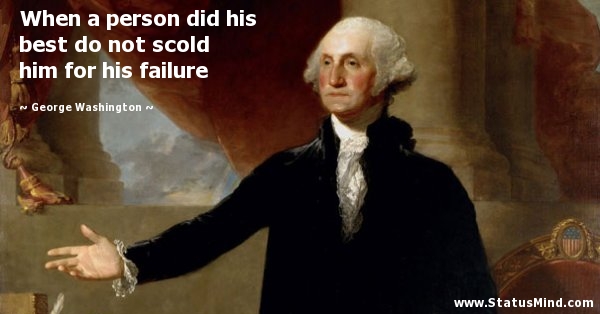
"When a person did his best, do not scold him for his failure" —George Washington
“When a person did his best, do not scold him for his failure” —George Washington
I know I start to sound like Sheldon Cooper from Big Bang Theory when I say this sort of thing, but the holiday we’re celebrating today is not named “Presidents’ Day,” it is “Washington’s Birthday Observance.” I’ve written before about how the myth that the holiday is President’s Day got started and why it is so persistent. I’ve also written about the reasons why there has never been a federal holiday dedicated to Lincoln.

But especially because of those racist reasons that have prevented a Federal holiday recognizing Lincoln, I think it’s important to remember that this holiday is not Presidents’ Day, unless you’re in one of the 10 states that have a state holiday this day which is called President’s Day (my state isn’t one of them). Five states still recognize a state holiday for Lincoln (Illinois, California, Connecticut, Missouri, and New York), though schools and state offices often remain open on that day.

And don’t get me started on the fact that because Washington’s Birthday Observance happens on the third Monday of February, George’s actual birthday, February 22, never lands on his Federal holiday. For shame!

The day about hearts and stuff

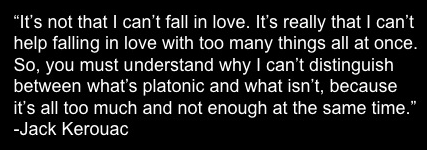
“It’s not that I can’t fall in love. It’s really that I can’t help falling in love with too many things all at once. So, you must understand why I can’t distinguish between what’s platonic and what isn’t, because it’s all too much and not enough at the same time.” - Jack Kerouac
“It’s not that I can’t fall in love. It’s really that I can’t help falling in love with too many things all at once. So, you must understand why I can’t distinguish between what’s platonic and what isn’t, because it’s all too much and not enough at the same time.” – Jack Kerouac
I tried to put together some new thoughts on Valentine’s Day, the way people react to it, including how some people are hurt by it, but found that I’ve already said it before, and not sure anything is gained by rehashing it. Besides, a friend said most of it much more concisely:

“For those alone today, I didn’t find my one until I was 30. She was 50. There’s no ticking clock on finding the right partner.”
—Deep Triviality

I’ll just add that there are many kinds of love. That you can love and be loved without being in a relationship. That you can find love and be loved by more than one person. That a lot of love is discarded or missed by some people because they assume that the relationship escalator is true and that all relationships have to ride that thing to the exact same destination.

And don’t believe the myth that you can’t love others until you learn to love yourself. Sometimes, it works the other way around. Sometimes, letting someone you love into your life is what helps you find the lovable in yourself. Love isn’t always symmetrical and mutual. And it doesn’t have to be.

We’re celebrating a friend’s birthday with a group of mutual friends today. Because love is love.

Powerless, again

@CuteCatPictures
@CuteCatPictures
I was asleep when I heard the buzzing. It took a while for me to realize that it was a phone. Specifically my husband’s phone. My phone usually spends the night in the computer room, plugged into my Mac Pro tower to recharge and sync and so forth. Michael’s phone usually in on a charger on a shelf in one of the bookcases in another room. Anyway, by the time I woke up enough to realize it was my husband’s phone, it had stopped.

I looked at the nearby clock. It was just a bit after 3 a.m. I could hear Michael still awake up in the computer room. For a second I debated whether the phone had actually been ringing. Then it started buzzing again. I scrambled to my feet, grabbed the phone, and saw the name of his oldest sister. I knew it had to be bad news.

It was. There was a house fire not long after midnight at Michael’s mother’s house back in Oklahoma. The fire had completely engulfed the house. At that point, no one knew where his mom was, nor whether Michael’s youngest brother (who had moved back in with their mom a while back) had been home. Worse: one of our nieces (age 14) and one of our nephews (age 12), the children of Michael’s youngest sister, were supposed to be staying with their grandma for the weekend.

The firefighters were still trying to get the blaze under control so they could safely start looking for bodies.

A few hours later we got the news that all four of them had been home, and none of them had survived the fire.

Definitely bad news.

When you hear news like that, you want to be able to help. We feel like we should be able to do something. Everything we can do feels inadequate. We wonder how it could have been prevented. If we were directly involved in the lives of the people, we wonder what we did wrong. What we could have done differently.

I’m in a weird position on this. I never met any of the four people who died. I exchanged some messages with this brother-in-law on Facebook. I’ve had similar exchanges and a phone conversation or two with the mother of the niece and nephew. While I have met and love my husband’s other siblings and his father, the others have remained acquaintances—not helped by the fact that we’ve never gone back to visit. Just to be clear that it’s through no fault of theirs.

Except his mother… well, we’re not supposed to speak ill of the dead, so I’ll just say the one and only communication I ever received from her was enough to make me glad we live 2000 miles away. My husband’s family has a bit more dysfunction than most, to be honest. And every time that I assert my family is just as messed up, he always manages to come up with a story that is hard to top.

As my husband said to some friends offering condolences last night, to say that feelings are conflicted right now is putting it mildly.

It’s a sad situation. Powerless to avert all tragedies, the best we can do sometimes is love and support the survivors.