This is not a topic to be neutral on…



This is not a topic to be neutral on…

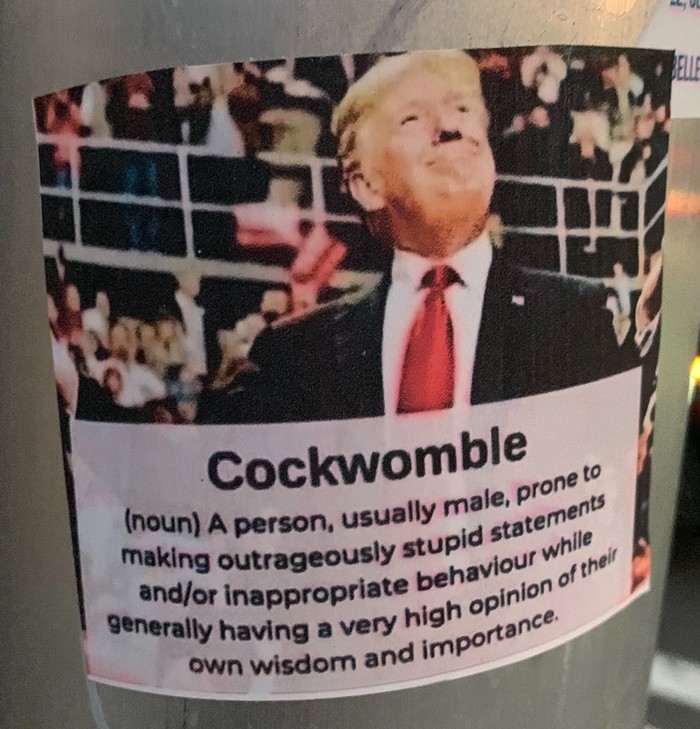
Vote!
If you get to the polling place to vote and they say your name isn’t on the list, calmly say, “I demand my legal right to cast a provisional ballot.”
If you have already voted, check that your ballot has been received.
Remind others to vote. You can volunteer to drive someone to a polling place, but remember, you can’t talk about who you’re voting for, or try to talk others into voting for your favorite candidates at the polling place.
If every vote didn’t matter, the Republicans wouldn’t be trying so hard to stop us from voting.
Vote!

“History isn’t something you look back at and say it was inevitable, it happens because people make decisions that are sometimes very impulsive and of the moment, but those moments are cumulative realities.”
—Marsha P. Johnson, trans and gay rights activist who may have thrown the first brick at Stonewall.
We don’t know which way things will break tomorrow. Oh, we know some things. The pussy-grabber will declare himself a winner and claim that any news to the contrary is because of voter fraud. We also know that we’ll have an unprecedented voter turn-out (because early voting has already matched or exceeding all voting from four years ago in many places).
Four years ago, I was not prepared for Hillary to be one of those candidates who won the popular vote but lost in the Electoral College. I knew that Trump would be a disaster. I knew things would be horrible. I cried.
It wasn’t despair. Oh, yes—I was extremely sad and more than a bit afraid, that’s true. But mostly I was disappointed and angry. I was angry that people who claimed to love me were crowing in celebration after he won. That some were repeating the most racist and homophobic wishes of his base. I was angry at the enablers of evil who still, four years later, argue that voting for a third party candidate doesn’t make them responsible for every bad thing—including every single U.S. COVID death—that has happened since that evil, incompetent man was inaugurated.
Four years later I’m still disappointed and angry at a lot of my fellow citizens. Angry at the people who told me I was overreacting four years ago. Disappointed that even though worse things than I was predicting back then have happened again and again, many of them still scold me for encouraging people to vote Blue No Matter Who. Angry at the cynical people who have capitalized on the moronavirus and his destructive, evil, nihilist administration. Angry at the media for acting as if this is all just a game between equally valid viewpoints.
I’ve had a small number of people tell me to stop being angry. Calm down, they say. Reason can win out, if you just give it a chance, they say.
And they are wrong. I’ve known that they are wrong since I was in elementary school. Because one of the masterpieces of science fiction/fantasy taught me this profound truth:
“Stay angry, Little Meg,” Mrs. Whatsit whispered. “You will need all your anger now.”
—From A Wrinkle In Time, by Madeleine L’Engle
Evil is not conquered by politely asking it to discuss things reasonably. Evil is conquered by people unwilling to back down, be cowed, or be silenced.
I first read Madeleine L’Engle’s A Wrinkle In Time in the fall of 1969, when I was nine years old. I know because I remember the enthusiastic conversation I had with my first third-grade teacher. It just so happens that about four months before that, the Stonewall Riots had taken place in New York City. I didn’t learn about Stonewall until many, many years later. But one of the queer people who rose up that night to fight back against the police brutality that gay, lesbian, and trans people had endured for decades was Marsha P. Johnson. Ever since I learned about her, Marsha has been one of my heroes. And though I suspect she never read A Wrinkle In Time, I think she would agree with Mrs. Whatsit.
“We want to see all gay people have a chance at equal rights , as straight people in America. We believe in picking up a gun, and starting a revolutionary if necessary.”
—Marsha P. Johnson
Whatever happens tomorrow—even if Biden wins, and the Dems increase their majority in the House, and the Dems flip the Senate, and if we take majorities and gubernatorual races in states that have previously been red—it isn’t the end of the fight. It’s just the beginning.
I’m staying angry. I’m ready to do what it takes to carry the fight forward and win it.
Are you with me?





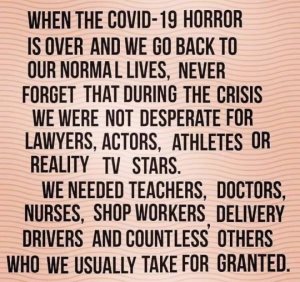
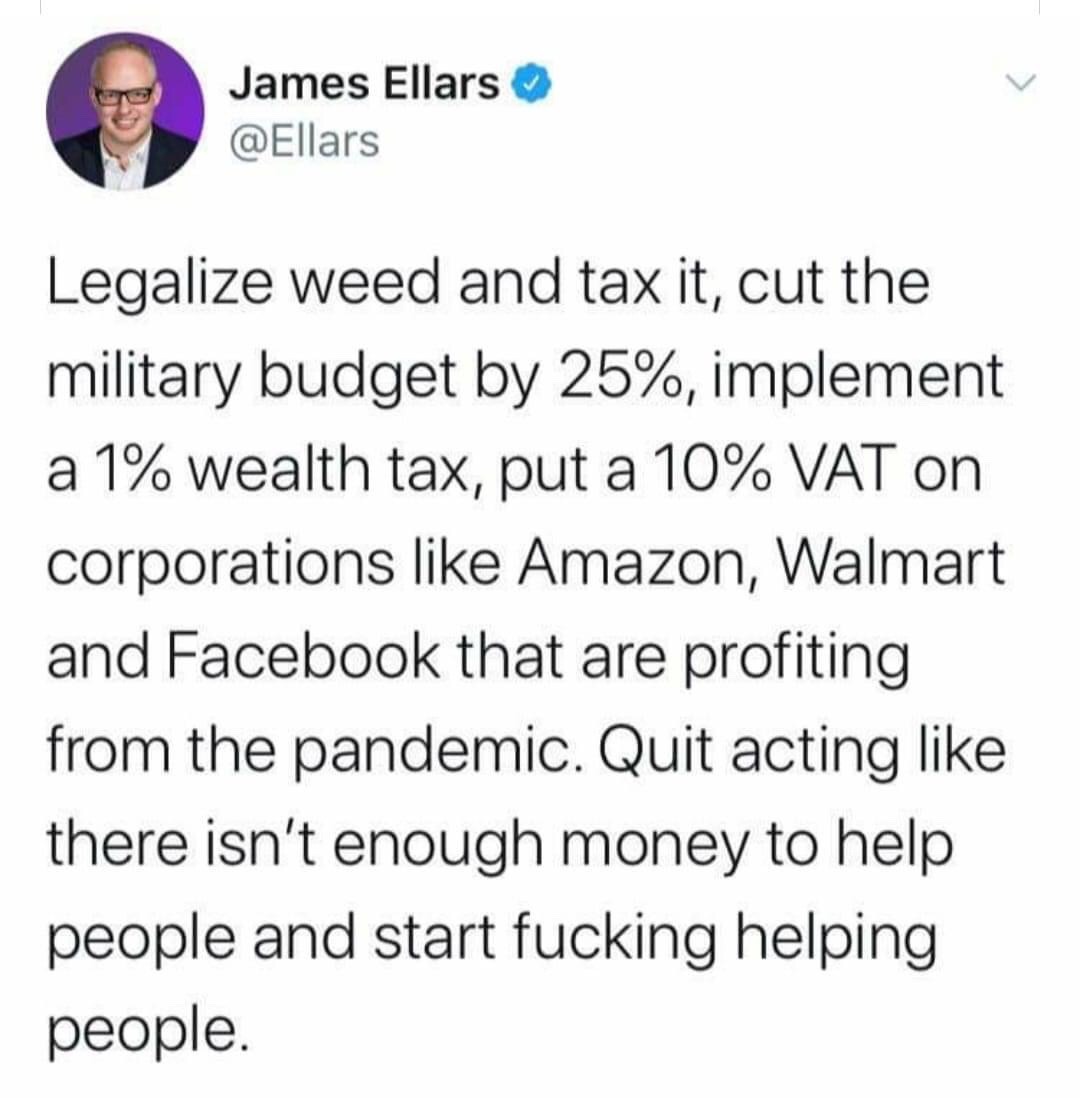






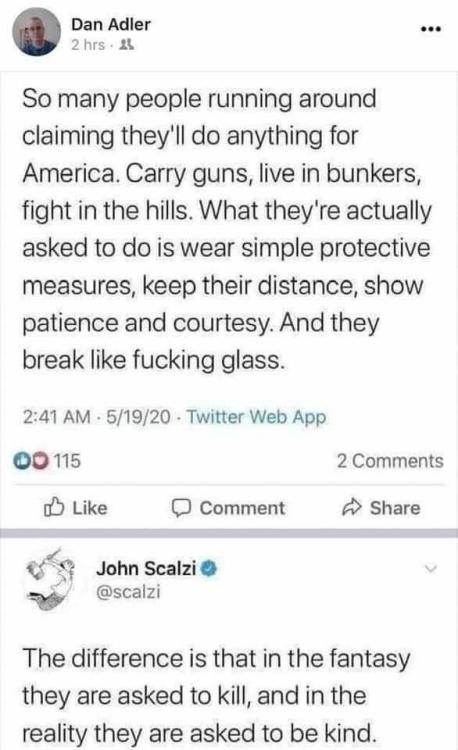
In the aforementioned Weekend Update I compared some of my conversations with trump supporters as feeling as if I am banging my head against a brick will. I did not specify that most of the trump supporters in questions are family members or people I have otherwise known since I was in high school. They are people that I love. Many are people who I once admired. Which is why, no matter how many times my attempts to talk to them haven’t gotten anywhere, I can’t seem to make myself completely abandon hope of reaching them.
And since I used the word “confessions” in the title of this post, I must also admit that I know there was a time when I was the brick wall that others were banging their heads against. Since I was able to change my perspective, I keep hoping they can, too.
One of the reasons, I believe, that everyone from the pundits to mainstream journalists to ordinary non-rightwing citizens are always flabbergasted because they don’t understand the culture of what I often call christianists: people who claim to be Christian (many evangelical, but not all) who instead of embracing the peace and tolerance messages, use them as a negative weapon against groups who adhere to different political and/or moral beliefs.
The person who doesn’t understand the christianist viewpoint might advance an argument that our current policies regarding health care and employment forces thousands of people into homelessness each year, leading to unnecessary illness, suffering, and death. They would expect that argument to have some sway with the christianists, but it doesn’t. Why? Because among other things christianists believe that suffering in this lifetime is nothing compared to the fate of one’s eternal soul. If a person suffers in this world, it’s either because they are being punished by god, or because they are being tested. If a good and faithful person dies, no matter what the circumstances, they will get a reward in heaven. The other people, well, it’s their own fault for not getting right with god while they had their chance.
And such thinking seems completely irrational to people outside that subculture. Rational people when presented with an opportunity to reduce suffering and avoidable deaths would try to do something about it, right? This leads some observers to refer to this branch of christianity as a Death Cult. A better description, I think, would be an After Death Cult. Because an eternity of rewards in heaven is the goal, while toil, tribulation, torment, and death are all small prices to pay in comparison.
That isn’t the only difficulty in reasoning with them. That other bit is implied in that part about how troubles in life are punishments from god. Once you accept that notion, it’s small logical hop to rationalizing that if you are the one causing trauma, you’re just doing god’s will. Which is how you justify calling yourself a servant of the Prince of Peace while you are stockpiling assault rifles and fantasizing about the day you get to kill all the unbelievers you want. And that how you get books/movies such as the Left Behind series (which is essentially snuff porn) being bestsellers to the evangelical and related groups.
I mentioned my own experience being on the other side of this mental divide. There was a period in my pre-teens/early teens where I became obsessed with the Biblical book of Revelations and its description of how the world would end. I found books and articles on it. I re-read Revelations itself making extensive notes and charts—connecting news stories and such that I found to specific parts. If the Left Behind books had existed at the time, I would have been all over them. One day, my paternal grandfather stopped me while I was in the middle of explaining some parallel I saw between some news article and some item in Revelations. Grandpa said, “That book isn’t in the Bible to give us a mystery to solve. Jesus himself told us that no one would know it was happening before it does. I believe it’s in there to motivate us to love our neighbors, even when we don’t like them.”
I don’t remember exactly what I said in reply. I didn’t think he was completely wrong, but I thought there was some value to studying the end times.
He turned my Bible back to the gospels, specifically the sermon on the mount. “We are suppose to live our lives so that we are so full of kindness and love, that other people will want to be like us. Armageddon isn’t going to be a victory parade. All wars are tragedies.”
And that got through to me.
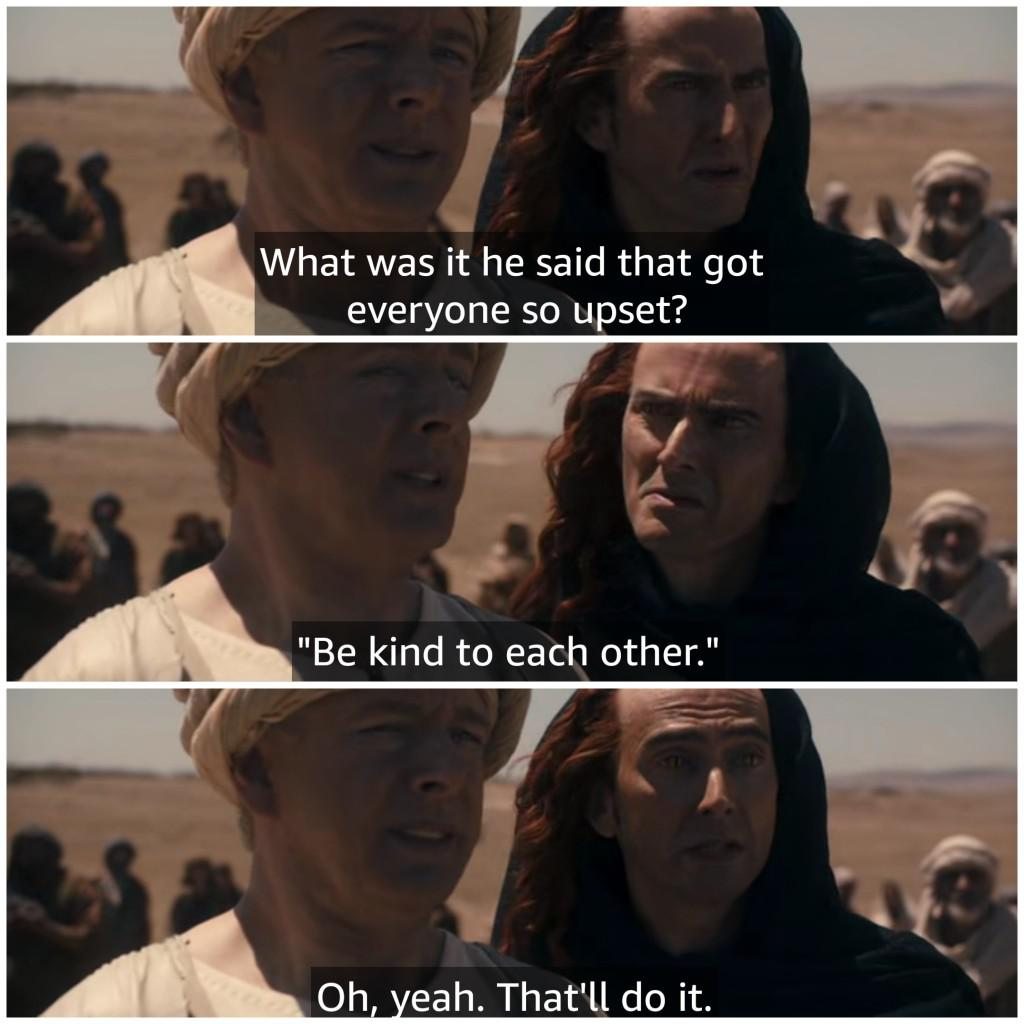
It got a completely different reaction from the christianists I know. They considered it, especially that scene, blasphemy. Why? Because of those three lines of dialogue in that meme: “What was it he said that got them so upset?” “’Be kind to each other.’” “Oh, yeah. That’ll do it.” Boiling it down to that absolutely incensed some people!
Which is really peculiar since these are the same people who say that every single word of the Bible is literally true. Because that part I mentioned above, the Sermon on the Mount. It’s the centerpiece of Jesus’ teachings in the Bible. It is the longest single bit of his teachings we get. It takes all the ideas he had told before and extends them. And what does he preach that day? That people should be kind to each other, even to those who don’t deserve it. Nay! Even more to those that don’t deserve it than to those that do. That’s all of his teachings in a nutshell.
It’s not blasphemy at all, it’s a distillation of the rest of the story.
And the fact that they don’t understand that is really all you need to know about why they twist the teachings of love and peace and tolerance into cudgels to rationalize cruelty and injustice in society.
Even though I am an introvert, this current situation has made me acutely aware of just how much regular contact with friends has, in the past, contributed to my ability to cope. We’ve been able to mitigate that in a couple of ways. Every month we have continued to have Writers’ Night, for instance, we’ve just been doing it virtually in a voice chat on my Discord server. Even those months when no one has anything new to read (and it is difficult being creative when you’re dealing with all this very justified anxiety), just getting to hear familiar voice and chat has been a blessing.
My gaming group had been meeting on Discord for much longer (some of the players live about an hour and a half drive north of my place, one lives nearly a five hour drive south) than the pandemic. Previously once or twice a year some of us would make a road trip out of game day, so we could play in person, but we’d been pulling it off online fairly well. Again, it’s a time I get to chat and laugh and otherwise spend time with some dear friends, and I’m really appreciating it.
I’ve been quarantining since mid-February (before the first identified case in the U.S., but while the threat was in the news, I woke up one morning with a cough — by the time the cough went away just a bit over two weeks later, the corporate overlords had issued the directive that everyone who could work from home should do so as much as possible), but there are still aspects of it that surprise me.
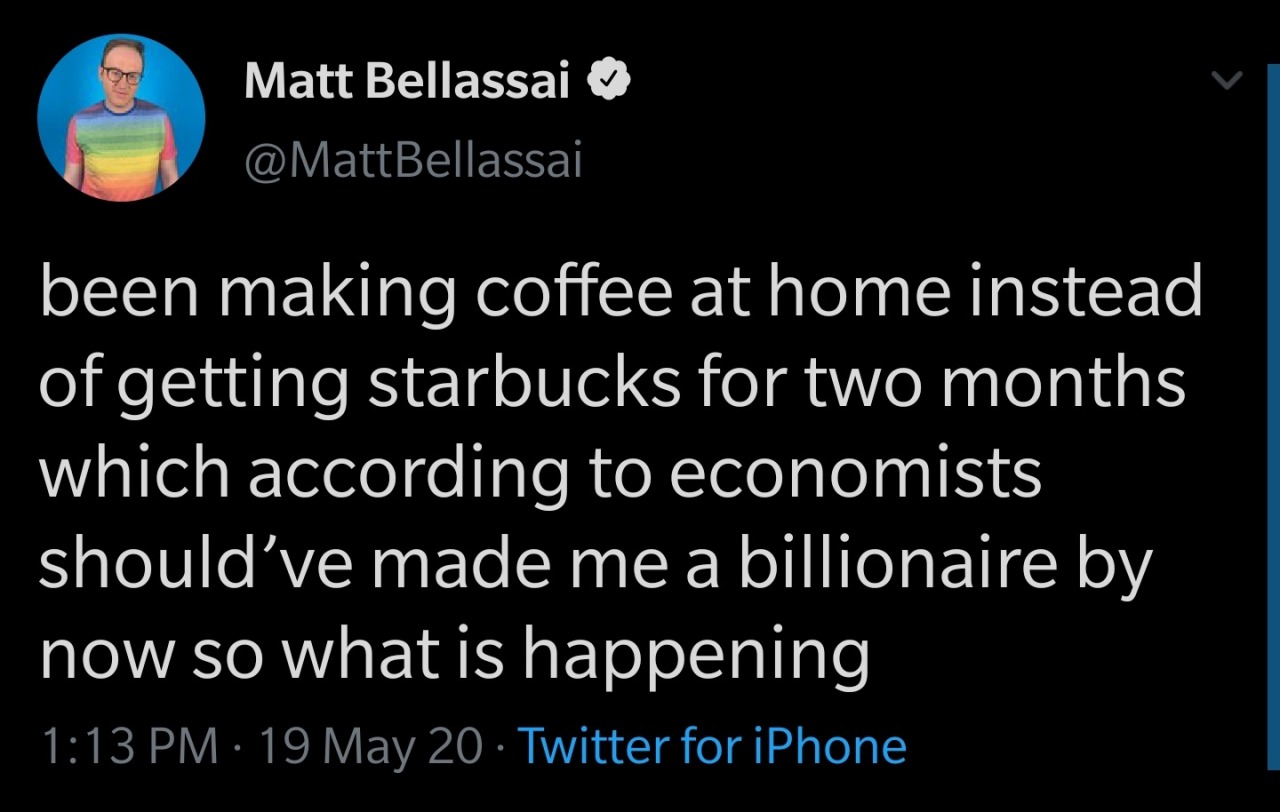
For instance, how fast I go through a bag of coffee beans.
Before the quarantine I only made coffee at home on the weekends and on work-from-home days. I was only scheduled to work from home twice a week, so that meant at least three days a week that I was exclusively drinking the company coffee. In theory, that should mean that I’m using up coffee beans almost twice as fast as before, right?
Nope.
I was going through coffee almost three times as fast. When i mentioned that to an acquaintance online a few months ago, they pointed out that (at that time) my husband was also at home full time, and I wasn’t taking that into account.
I hadn’t laughed so hard in months. Seriously.
My husband doesn’t just not drink coffee. My husband positively loathes coffee. (Which doesn’t stop him from buying me big lattes to deliver to me if we’re at a convention together and I’m staffing a table or something, but that’s another topic).
I wound up in a discussion about coffee with a group of coworkers about two months ago and thats when I actually thought about it and realized something that I should have noticed but just hadn’t. When I’m in the office I drink at minimum one mug of coffee or one mug of tea every hour (and there are a couple of hours in most day where I’d slip an extra mug in for reasons). Typical mug holds 8 ounces of coffee, that’s 64-80 ounces of caffinated beverage per office day.
But at home I would usually make one pot of coffee, and that was it. That’s only 60 ounces of coffee on those days. Similarly, I usually only made a single pot per day on weekends.
I think part of the reason I was able to get by on only 60 ounces a day on work-from-home days is because they were usually less stressful. Even on infuriating days, the fact that I could step away from my desk and step outside on my veranda made the stress easier to manage.
Now what I typically do is make a pot on the morning of the first day of work, then some point in the afternoon I make a second pot, and drink as much as half of it. One the second work day of the week, I first reheat and drink the leftover from the second pot (a notion I know makes a lot of people shudder, sorry), then I make a fresh pot and finish it off.
And I think the reason is that being able to step out on the veranda or whatever is no longer a novel or special thing. So the stresses of work (more than some of which have gotten worse during the pandemic) just pile up exactly the same way as they used to only do when I was stuck in the office.
And if I’m feeling frazzled on the weekend and reach the end of the coffee pot early in the afternoon? Guess what? I make a second pot on those days, too.
So, before the pandemic, working from home two days a week and then making coffee at home on the weekend, I was usually making four pots of coffee a week. Now I’m making at least 9 pots a week.
I’m trying to mitigate this is some ways. Some months back I stopped making coffee on Sundays at all, switching to making tea in my infuser pot (this also gave me a regular opportunity to run the coffee carafe and other washable parts of the coffee maker through the dishwasher instead of only doing just a perfunctory rinse each day). Tea is still a caffinated drink, but it’s generally lower in caffeine, so that helps me back off the weekly total a bit. I’ve also sometimes stopped myself from making a second pot and instead turned on the electric kettle to switch to single cups of tea made from bags.
I can’t cut it out completely, because I’m sure you’ve seen the memes that say that coffee is a warm, delicious alternative to hating everyone in the morning? Well, sometimes, “hating” is a euphemism for “murder” — so, don’t even think of suggesting that I give up the coffee altogether… because I know how to hide a body.
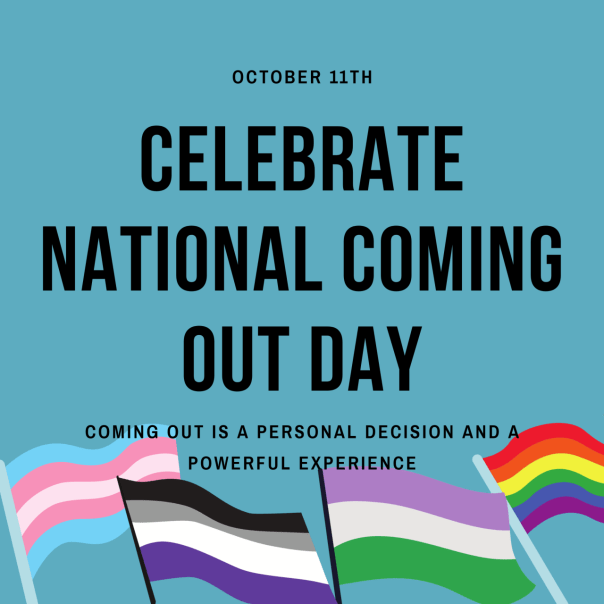
Today is National Coming Out Day. If Ray were still alive, it would also be the day we’d be celebrating the twenty-seventh anniversary of our commitment ceremony (he promised to stay with me for the rest of his life, and he did). My (very-much alive) husband Michael and I don’t have any anniversaries that are close to this date, but this is the twenty-first National Coming Out Day we’ve lived together.
I’ve written many times about how important it is that queer people (lesbian, gay, bisexual, pansexual, asexual, nonbinary, trans, aromantic, genderfluid, two-spirit, questioning, intersex, and so no) be out if they safely can be. Studies show that being closeted has several deleterious effects on one’s mental and physical health. When you’re in the closet, you aren’t being yourself. You are pretending to be someone who others wouldn’t guess was part of the LGBT. When you’re in the closet you’re in a constant state of anxiety—the very real fear that if some people knew your secret, they would reject you, shun you, or maybe even physically assault you.
That takes a toll.
Studies have also shown that the more LGBT people that a straight person knows, the less likely they are to harbor bigoted beliefs toward the community. And queer young people who have out role models in their community are far less likely to attempt suicide.
So there are many, many good reasons to get out.
There are reasons to be wary of being out. For instance, 40% of homeless teens are homeless precisely because they have been kicked out or driven from their homes when their families found out they were queer. And there are bigots in every community who pose financial, social, and physical threats to queer people. So I understand why staying in the closet sometimes feels like the safer option.
But I have to say from personal experience, that not living with that constant burden of fear is such a relief. Now, the relief don’t always come right away, because sometimes the people closest to you — even those that you are absolutely certain will be okay with learning this about you — don’t react positively. When I came out, several friends and relatives I thought would at least be tolerant absolutely flipped out. Two that I was certain had just been waiting for me to admit it categorically denied that they had ever suspect at all — and one of them insisted that the mere fact that I thought they knew already was somehow proof that I had been brainwashed into thinking I was gay.
On the other hand, there were family members and friends who I had thought wouldn’t take it well who turned into my fiercest defenders against the other.
The sad fact is that you aren’t going to know who will stand by you until you come out.
But the flip side of that is, the ones who reject you? The ones who through the worst fit when you come out? They never loved you. No matter how much they insist that they did, the truth is that they didn’t love you, they loved the straight person they imagined you to be. And their rejection demonstrates that their love had always been conditional.
Coming out was scary. But once the initial difficulties blew over, I made an amazing discovery: since I was no longer expending all that energy pretending to be something I wasn’t and scared to death people would find out I was pretending, I had a whole lot more time and energy to spend on the things I love. And the more time I spent doing the things I love, the more new people who were ready to accept me for who I was came into my life.
If it is safe for you to come out, you should. You’ll find that standing proud in the opne, being true to yourself, is so much better than hiding in the dark!
And once we put the Easter decorations away things would look mundane on the outside of our place until it was time for the Halloween decorations to come out.
The process fell apart the year Ray died. He passed just a couple weeks before Thanksgiving. I wasn’t going to decorate for Christmas at all, until I woke up one night with this overwhelming certainty that Ray would be very unhappy with me for not decorating, and I figured out how to put up a few things without pulling out the many, many, many large storage containers full of Christmas decorations (I was quite certain if I started looking at them I’d break down crying and might not be able to stop). I didn’t decorate for Valentines Day or the others afterwards.
Michael and I were dating by the following Halloween, and I put some of the Halloween decorations up. He helped me decorate for Christmas that year, and I think I only cried about two dozen times while getting decorations out and putting them up.
It took a couple more years before I pulled out any boxes of decorations other than Halloween, Thanksgiving/Harvest, and Christmas. And I usually didn’t go all out for the others, only pulling a few decorations out of the boxes for the others. Since Michael was less invested in everything but Halloween and Solstice, I had less motivation to dig boxes out of the basement and hang things up.
When we got the notice that we would have to move out of the place I’d lived in for nearly 22 years (we got the notice barely a week before Christmas, but it was a five-month notice, so it wasn’t undoable), one of the first things we did was go through a bunch of the decorations and get rid of anything that was questionable. The silly string of light up Easter Eggs was about 24 years old and had spent at least a month each time the were put up hanging in sunlight, so it wasn’t really a surprise when we examined the wires that the were obvious stress signs on the insulation.
We started moving into the new place Easter weekend and got mostly unpacked by July of that year. When October came around, I had no Halloween decorations at all. We also have significantly less storage for such things at the new place, and after reducing 34 boxes/tubs of Christmas decorations to 8 smaller boxes, I didn’t relish going overboard on the other holidays.
I picked up some cute window clings to put in the front windows (though since we’re not on the ground floor I’m not sure anyone but me can tell what they are), a jack-o-lantern thing to hang on the front door, but I couldn’t find any LED pumpkin lights or the like for the windows. If I had lights in the windows, they would be visible to folks on the ground. But I couldn’t find any.
I happened to mention it on Twitter. And for unrelated reasons a few days later I was dropping some things off at the home of my dear friend Kehf (I don’t remember what the things were–since her housemates include two other equally long term friends and my goddaughter, it could have been almost anything). The important part is that Kehf surprised me by handing me a string of pumpkin lights that were exactly what I had been looking for. “I noticed these in the store after seeing your tweet and picked them up for you.”
So I had lights in the windows for the next three Halloweens and it was great.
About mid-September I had the foresight to look check the decorations to see if any ought to be retired (the window gels lose color as they are exposed to sunlight)… and I couldn’t find the pumpkin lights. As mentioned above, we don’t have a big storage unit, so it shouldn’t be that hard to find them, but there you go.
Some of the window gels definitely need to be retired, so when I found some new ones I liked while I was out shopping, I bought them. And I bought some silly Bat lights for the veranda (they are on stakes that can go in the planters and use a battery pack and timer chip)… and I noticed some LED pumpkin lights that were quite inexpensive and grabbed them.
That weekend (still back in mid-September) I put up some of the Harvest-themed gels, intending to not put out the Halloween decorations until after my birthday at the end of September. Which turned into last weekend…
…and I couldn’t find the new pumpkin lights. Nor the old ones. So the bat lights went up, and the new gels and the older gels that were still okay… but no pumpkin lights.
Tonight, while I was putting away some of my birthday presents that I’ve left out where I can look at them fondly, I found the new pumpkin lights. So I’ll be putting them up this week.
Who wants to take a bet that I’ll find the old ones when I take down the Halloween stuff and put up the rest of the harvest decorations?
 The rain has returned to Seattle, which also means that my hay fever has kicked into high gear. Since I have moderate-to-severe allergic reaction to every single pollen, spore, and mold there is, hay fever season last most of the year. But there are certain times when I can count of sudden worsening of symptoms, and one of those is when the rain come back in the fall after the relatively dry period that usually lasts from about July 12th until the end of August/early September.
This year the coming of the rain meant the end of hazardous air quality from the smoke plumes from wild fires everywhere, which means that as my lungs were clearing and my cough was subsiding, the sinuses became painfully clogged and sneezing fits became the norm.
Just before that smoke came in and turned September into a new kind of hell, I had picked up some spot-color flowers to plant in some of the pots out on the veranda, because all the dianthus, violas, and pansies that had been growing in some of the pots had died off. Most of my planters are full of lavender, but most of them are going to seed, so there was suddenly not much color out there. But I didn’t get the plants in before the air quality turned really bad, so I set them up where I could water them and waiting for the rain to come clear us out.
I mentioned this elsewhere and was asked (for not the first time) why I grow a bunch of flowing plants on my deck when I’m allergic to all those pollens.
The amount of pollen produced by the number of flowers I can personally grow is negligible compared to the pollens put out by the thousands of trees and millions of flowering plants growing throughout and around the city. Since I’m going to have the hay fever regardless, I might as well have some pretty flowers to look at when I feel like it.
And I like seeing bumblebees going from flower to flower. I even get hummingbirds feeding on the flowers!
There is a challenge with the smaller spot colors in that we also get a lot of squirrel activity on the veranda. This was true even before I added a squirrel feeder to the mix. They like to bury things in the flower pots and later try to dig them back up.
The bird population coming to the feeder has finally gotten back to what it was two summers ago before a juvenile Cooper’s Hawk starting hanging around our deck and eating the little birds. The hawk only lingered in our neighborhood for a month, but it ate a lot of bird during that time! The small bird population has taken a while to bounce back. We have so many juncos, sparrows, chickadees, and finches coming to the feeder that I have to refill it every day.
That may change, because Tuesday afternoon I looked out in time to see another juvenile Cooper’s Hawk was perching on one of the drain pipes from the roof. Before I could take a picture one of the local crows divebombed it and it flew off. It was distinctly smaller than the one from two years ago, so it is probably a male.
I don’t know if it’s going to start hunting in the neighborhood and we’re going to have another mass die off of the little birds. The crow might have sent it packing. On the other hand, it may be a bit stubborn.
I guess I’ll have to wait and see.
 Font Folly