Category Archives: life

Grandma’s cranberry salad

One of the best parts of my childhood was growing up with a collection of truly kick-ass grandmothers. I say collection because in addition to my two grandmothers, all four of my great-grandmothers were still alive when I was a teen-ager (one lived until I was in my thirties).

My Great-grandma I. taught me how to make egg noodles from scratch, (which is the first step to making the World’s Best Chicken Noodle Casserole {which she also taught me how to make}), and that measuring cups are only guidelines. My Great-grandma S.J. taught me how to crochet, how to make biscuits from scratch, and how to listen in on the neighbors’ conversation on a party line (if you don’t know what a party line is, google it). Great-grandma B. taught me how to make ice tea with so much sugar, it was amazing the stuff would actually pour (and there is a secret, it’s not just about adding more and more sugar, although that’s an important part). I could go on, and on.

But during this time of year there are a couple things I regret never learning from my various grandmothers: I never learned Great-grandma S.J.’s heavy-cream-and-molasses sweet potatoes (I’ve found and tried some recipes, but so far, none come out right), and I never learned how to make Grandma P.’s frozen cranberry salad. I have recreated a close approximation, but it also isn’t quite right.

Every holiday when I get together with that side of the family, someone laments the absence of Grandma’s cranberry salad. I’m not the only one who has attempted to recreate it. Every version I’ve tried has been tasty, but it isn’t the same.

The funny thing is, that unlike most of the other dishes each of them was known for, this one wasn’t a really old recipe. Great-grandma S.J. once told me she’d learned how to make divinity from her own grandmother, for instance. It’s the reason she couldn’t write the recipe down, she’d have to show you. That had been the case with her homemade biscuits. When I make her biscuits I throw ingredients together and mix. If the consistency isn’t right, you add more of one of the ingredients, depending up how the consistency is wrong. It’s hard to describe. You have to experience it.

Grandma P.’s cranberry salad was something she started making when I was an adult. She’d seen it on a cooking show, she said, and just gave it a try. We know it involves canned cranberry sauce (the chunky kind), whipped cream, canned mandarin oranges, and some kind of jell-o. After that, none of us are sure. Or, more truthfully, we had contradictory memories. Some of us insist it had coconut, but others are certain it had marshmallows, for instance.

The thing that I don’t want to say to any of the family: I bet all of our contradictory memories are right. It fits right in with Grandma’s style of cooking. “Oh, I don’t have any shredded coconut? Hmmm, oh here’s some marshmallows, maybe they will be good…”

And probably the real reason it never tastes right, is because it’s missing the most important ingredient. The one we can never replace…

Not forgotten

Fifteen years ago today I had to sign some papers.

Then a couple of nurses turned off the monitors, removed the respirator tubes, and turned off the rest of the machines.

I held Ray’s hand, and said “Good-bye.”

I’d been crying off and on for hours—days, technically (though I’d only slept a couple hours out of the previous 59-ish, so it seemed like one really long, horrible day).

I don’t remember if I cried again. My last chronologically-in-order memory is taking hold of his hand that one last time. My memories for the next few months are like a collection of shattered glass pictures.

He promised me he would stay with me for the rest of his life. And he did.

Grateful, not resentful

Many years ago, when I was either still attending university or during that first couple years after, while visiting my mom for one of the holidays, she handed me a manila envelope. “I was cleaning some things out, and I found these papers. I don’t know if they’re important, but it’s old school things I thought you might like.”

My mom is one of the people from whom I inherited my own packrat tendencies (which I have been fighting most of my adult life), so I knew if I looked at them while she was watching and decided they weren’t worth keeping, that she would retrieve them and hang onto them for years. So I always took whatever weird stuff she offered me and waited until I got home to review it.

The envelope contained about 20 sheets of paper. Two were report cards from different grades. Neither was an official end-of-term report card. Both were midterm “advisory” report cards. “Your child’s grade will probably be this if work does not change.” Most of the other papers were even less archive-worthy. Most contained no person information at all: announcements about an upcoming parent-teacher night, for instance.

But there were a couple that were revelations. There was a letter to my parents explaining that our family qualified to have a charity pay for my first pair of eyeglasses back in grade school. There were some papers related to a free lunch program during another part of grade school.

Until I read those papers, I had had no idea. I remembered, during those particular grades, that about once a month Mom would hand me a sealed envelope which I had to take to the school office, where I would be given lunch tickets for myself and my little sister. I thought everyone’s parents had to fill out a couple forms for lunch tickets. And I guess I just assumed there was a cheque in there, somewhere.

I knew that there were things we couldn’t afford. But other kids’ parents were also frequently saying, “We can’t afford that” or “When you get a job and can pay for it yourself, you can have a fill-in-the-blank.” So I didn’t think much about it. It never occurred to me that we were poor.

Of course, we couldn’t be poor! Poor people lived in shacks or in ghettos. We lived in ordinary parts of each of the small towns we moved to as my dad’s work demanded. We owned a car and a pickup truck. Poor people didn’t have jobs, or didn’t have regular jobs, anyway. They were always begging or looking for work. Or if they were “bad, lazy poor people” they were always waiting for their next Welfare cheque. My dad had a job. He’d been working for the same company for as long as I could remember, so we couldn’t be poor. We just weren’t rich, that’s all.

Certainly by the time I was in High School I had a much better idea of the broad spectrum of economic status that families inhabited. I understood that most of my childhood my dad had been “working class” rather than true middle class. But I also knew that the old lower, middle, and upper class division of economic status was a gross oversimplification.

And somehow, I had never figured out that we had taken assistance. I think the shock was mostly because of how hotly my dad frequently ranted about the evils of people who depended on charity. The almost stereotypical way he sneered at programs like welfare and food stamps because they “took money from hard working people.”

That attitude, which was frequently echoed by other adults in my community—especially at church social functions—had always seemed weird to me. During Sunday School lessons or the Sunday sermon, we would be taught that Jesus expected us to feed the hungry, clothe the poor, and take care of the sick. Yet at the church potluck, people who actually took handouts were talked about almost as if they were in league with the devil.

Why the resentment? Everyone needs help some time. There should be no shame in needing a hand of any kind (I hate that cliche about hand-up vs handout) once in a while. The proper response to getting a little help is gratitude. And the proper response when you have been the one helping, is to tell the person, “if you want to pay me back, just promise when you see someone else who needs help, you’ll offer what you can.”

Resentment and condescencion corrupt and destroy the soul, leaving only emptiness behind.

Gratitude and charity do the opposite.

So, go feed your soul.

Get me to the church on time!

One of my favorite scenes in the movie Jeffrey is where a priest, played by Nathan Lane, explains to the protagonist that the protagonist’s ideas about god came from the album cover of the original cast recording of My Fair Lady. He further claims it’s where most gay men got their notions about god.

My Fair Lady Original Cast AlbumHis reasoning is: most parents in the 50s and 60s had a copy of the album*, most gay kids went through at least a phase of listening to musical soundtracks (and even if they didn’t, they all at least saw the cover art), most kids didn’t realize that the man in the clouds on the cover art manipulating the stars like puppets on strings was supposed to be George Bernard Shaw (the man who wrote the play upon which the musical was based), they believed it was god. “It was your parents’ album. You were little. You thought it was god!” Then he goes on to explain that god doesn’t run the world like that.

Part of why that scene cracked me up is because I did go through a phase of listening to the soundtracks of musicals—musicals that in many cases I had never seen. I’m not completely sure why my folks owned several sound track albums, but they did. I do know that my mom had a tendency, if she saw a movie adaptation of a musical, to buy the original broadway cast album instead of the movie album. Anyway, My Fair Lady was one of those albums that I listened to a lot as a kid, but I had never seen the show.

I wound up making up my own version of what happened between the songs. I also imagined my own versions of the choreography and costumes, guided by whatever photographs were part of the album cover, or in some cases, versions of the songs I’d seen on TV. There were a lot of musical variety shows on the air when I was a kid, and stars of movies and broadway shows would often be guests on the variety programs, and might perform a version of (or parody of) a scene from the musical, with regulars from the variety show filling in for various characters.

So in my head, the song “Get Me To the Church On Time” was not primarily about the wild last night of partying that Eliza Doolittle’s long-widowed father wanted to have before he married in the morning. I didn’t know enough of the play to know the context, for one. I think the album only identified the character as “Alfie” so I had no way to know he was supposed to by Eliza’s father. The lyrics talk about having a whopper, and kicking up a rumpus, but somehow I thought it was about celebrating the marriage itself—partying because he was overjoyed to be getting married, rather than a last night of debauchery because he would never be having fun again.

It was also about all the people around him, friends and strangers alike, joining in on the joy and exaltation.

It’s that imagined version of the song and dance that kept popping up in my head last Tuesday night as I saw that Marriage Equality was winning at the ballot box. It was that image of friends, family, neighbors, and complete strangers shouting “hurray!” that came to mind as I thought of the hundreds of straight people who manned those phone banks—calling strangers and patiently explaining that the law explicitly exempted churches and religious institutions from performing same sex marriages (not that the law needed it, it’s already established in other laws and court decisions; churches can choose to turn away opposite sex couples for whatever religious reason they want, too). The thousands of straight people who donated to the campaigns. The thousands of straight people who urged neighbors, co-workers, and family members to give equality a chance. The hundreds of thousands of straight people who voted that way.

Depending on which statistics you believe, gays and lesbians make up somewhere between 3 and 10 percent of the population. There’s no way we could have voted this in for ourselves. There’s no way we could have handled all of the ground game: the canvassing, the pamphleting, the phone banking, and so on.

It was my imaginary version of “Get Me to the Church on Time” that was playing in my head when straight friends told me, “I thought of you and Michael while I was filling out my ballot.” It was the soundtrack to the images I saw on TV of the straight couples joining in the party at the campaign headquarters on the news.

It’s what comes to mind when I re-watch the tearful speech of the straight, Republican state senator explaining why she was voting for the law that kicked this off last spring. Or when I read stories of the way, the last few years, many straight couples have taken a moment in their wedding ceremonies to acknowledge that they have friends and loved ones who are denied the right to choose to enter this important institution, and asking their guests to join the fight for equality.

Yes, part of the reason there were tears in my eyes on Tuesday night when I saw the news that marriage equality had won in Maine, and then in Maryland, and that it was leading in my home state of Washington was because I’m looking forward to finally getting to marry (rather than “domestically partner”???) Michael. But that was only part of it.

The rest of those tears of joy was the realization that a majority of my fellow citizens–not just my fellow homos, or my friends, but a bunch of people who don’t know me–has our back.

Thank you.

And I hope you all get invited to a lot of weddings, because you deserve to celebrate with us.

UPDATE: I started this the morning after Election Night. Because of craziness at work, I didn’t finish it until a day later. And I didn’t see this column by Dan Savage on the same topic until Thursday night. His is definitely worth a read.


* Remember, Jeffery is a comedy, it’s not a real statistic.

One size fits none

Sometimes when I’m explaining to someone what I like about my computer, or my phone, or a particular software product, or [fill in the blank], someone feels compelled to explain to me why I’m wrong to like it. And sometimes they get very emphatic.

Of course, sometimes if someone mentions certain software product (such as a much-used word processor that my various jobs have forced me to use {and co-workers have assumed I must be an expert at} for more than twenty years) which I happen to loathe, I often get very emphatic about exactly why I loathe it. Including a long rant about a fundamental feature that has been buggy since at least the version released in 1989 (yes, really) and is still buggy in all the same ways in versions released this year. And, yes, I am a little confused as to why anyone would enjoy using the product. So I probably come across as emphatically trying to explain to them why they’re wrong to like it.

I have to remind myself that one size never fits all. Because something meets my needs doesn’t mean it will meet your needs, and vice versa.

Which means I have to let them choose what they want. And I will.

As long as they always do the same for me.

Why I hate hay fever, reason #5792

While driving home last night, I was just thinking that my allergy prescription dose from the previous night must be wearing off when Michael mentioned that his sinuses had started going whacko. He was attributing it to the change in weather.

Most of last week was very wet, with rain every day. Parts of Friday, all of Saturday, and most of Sunday were quite a bit drier, but only relatively. We had some sun breaks, and what rain there was came in very light, occasional showers. Sunday night we got the deluge.

Radical shifts in air pressure or humidity sometimes cause my sinus passages to either get tender or to close up temporarily, regardless of the pollen, mold, or spore count. And while most people living in the northern hemisphere with ordinary hay fever are free and clear by this time of year, I’m not. Pollen counts are so low as to almost be nonexistent, and fern spores are tapering off. But November is toadstool and mushroom season, which means fungus spores are just ramping up.

In addition to my usual prescription, I took a bit of over-the-counter stuff before going to bed. I awoke in the middle of the night with the sinuses in super-hyper congested mode, along with the itchy eyes. So I took another type of over-the-counter stuff and managed to go back to sleep.

This morning I broke down and raided my pseudo ephedrine supply. Can I say, by the way, I hate that meth heads and meth lab runners have turned thousands of innocent sinus-problem sufferers into suspects, forcing us to show ID, sign extra paper work granting the state, the feds, and the pharmacy companies permission to examine and share information about our purchase history of what used to be a cheap, over-the-counter nasal decongestant? Which is rationed by those same forces, now?

I’m sorry, the usual substitutions don’t work anywhere near as well for me. So at times like this, where everything above my jaw line hurts, aches, and stings, I just don’t understand how restricting law-abiding people from buying a legal medication (a practice which has had zero effect on the illegal trade of the substance that said medication can be used to manufacture) makes any sense.

Now excuse me while I pack some extra tissue into my backpack before I leave for work…

Nightmares

I have trouble with scary movies. At least certain types of scary movies. They give me nightmares, and I’m the kind of person who, while having a nightmare, climbs out of bed, running around waking up everyone I can find, frantically trying to explain the horrific danger we’re facing and how we have to come up with a plan to deal with the threat now.

I love certain types of scary movie. I could watch the 1931 Dracula, or the ’31 Frankenstein or ’35 Bride of Frankenstein, or the ’32 Mummy over and over and over again. Give me a classic Godzilla any time!

Sometimes while explaining this, I’ve had friends ask how this can be true, when they know I have written some pretty creepy and horrific stuff. Or, as a friend very recently put it, “How can you love Fringe so much? It presents a lot of things far worse than many scary movies you’ve refused to watch!”

Part of the issue is control. If I’m writing the scary stuff, I’m in charge. I can save whoever I want. I can make the bad guy lose when I want and how I want.

To a lesser extent, watching a scary movie (or series) at home on TV or iPad is different in part because I have some control. I can pause or stop the movie when I want. More importantly, if I’m not immersed in the big screen setting without the theatrical sound system it’s easier for me to remember I have control. I’m not trapped in the center of a row of strangers in a dark room. And sometimes just looking away isn’t enough.

There’s also familiarity. Forbidden Planet was one of the first movies to trigger this reaction when I was about five or six years old (it’s the one my Mom still tells stories about), but now, it’s one of my favorite movies of all time. I know how it ends. I know what the monster is and what its limitations are. None of that was true the first time I saw it.

And in Fringe‘s case, there is an additional salvation: there have been very, very, very few scary movies ever made which any character who is even one-tenth as smart as Walter is on the good guys’ side.

Because what’s missing from most nightmares is a hero you’re confident will win the day.

Let the punishment fit the crime

Three of my best friends have been hosting a Halloween party for about 20 years. They always have a theme to the party, which guides their decorations, party games, and usually their own costumes.

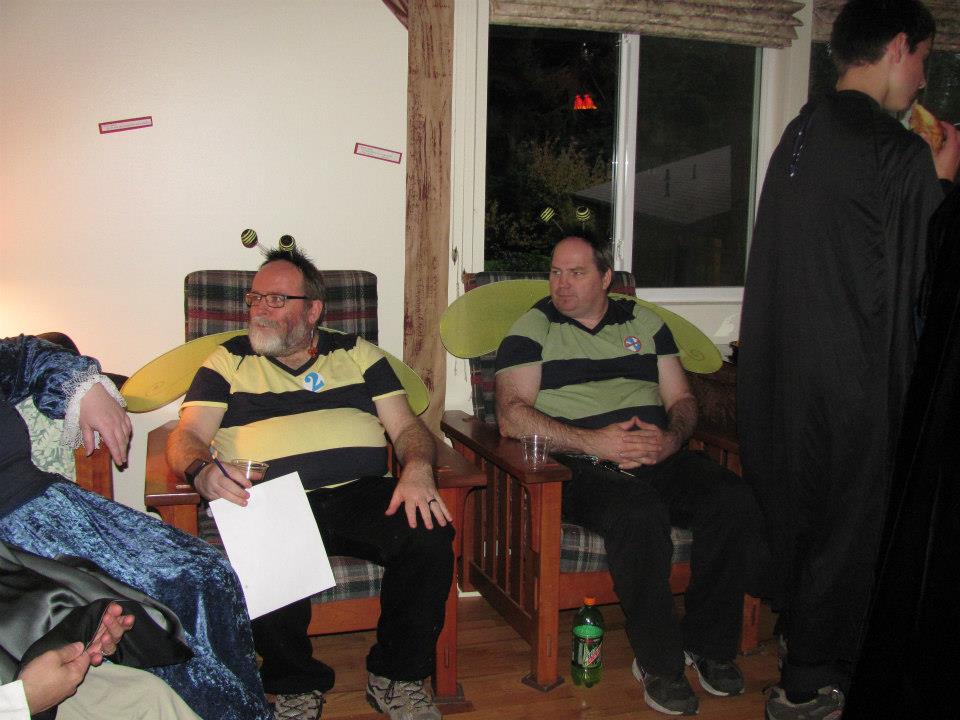
Sitting at the partyMany of us who attend regularly create our costumes based on the theme. For example, the year the theme was Your Worst Nightmare, I came dressed as a gay republican. Not that a gay republican, per se, is my worst nightmare, but me BECOMING one comes pretty close. On the other hand, the year they set Egypt as the theme, Michael and I came dressed as a pair of aliens, carrying a clip board with a work order written in hieroglyphics. So while neither of us believe any of that ancient astronauts nonsense, we are not above using it for a silly costume joke.

This year’s theme was Shakespeare. There were several people there dressed as specific characters from Shakespearean plays, others were in Elizbethan dress, and a number of us were there as jokes.

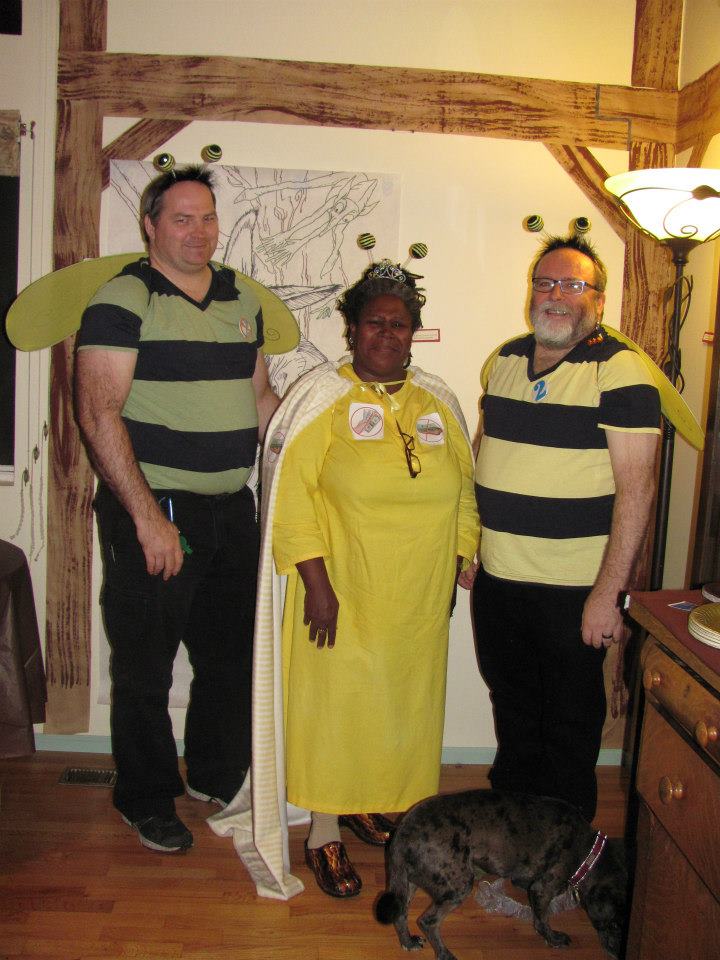
Michael and I were each dressed in yellow-and-black striped shirts, black pants, silly antennae on our heads, and yellow wings. I wore a lapel button with a large, friendly-looking “2” on it. Michael wore a button with the same friendly-looking “2” except with a red circle and slash through it.

.

.

.

.

.

Two silly menSo I was 2, and he was not-2.

.

.

.

.

.

And we were both bees.

.

.

.

.

.

.

.

And it’s hard to get more Shakespearean than having a choice between the 2 Bee and the Not-2 Bee, right?

We were told we would be PUNished for our bad joke costume. We were told our Punishment would almost certainly involve hives. There were many other silly puns flung about, but I have forgotten most.

But we weren’t the only bees there. One of the other guests came as the Neither A Borrower Nor A Lender Bee.

(If I manage to get pics from any of the people who took them, I’ll add them to the post.)

The only part of our costumes that didn’t come together is we didn’t recruit a third person for the silliness, because Michael would then have dressed him in blue suit, fedora, and a flesh-colored featureless face mask, just like the DC Comics character known as The Question.

Because then we would have the 2 Bee, or Not-2 Bee, and that is The Question.

Dream dilemma

I had a somewhat disturbing dream, in which I was out shopping with my mom, and she occasionally made references to a book I had given her as one of her presents the previous Christmas. Except she wouldn’t mention the title, she kept referring to it simply as, “that book you got me.”

And the conversation got a bit weird and emotional. Finally, she pulls out the book, and it’s a book of quotations. But specifically a book of gay and lesbian quotations. For a second, in the dream, I was very confused, and then I realized that I had accidentally swapped the tags on two books I had been wrapping up for different people. I had intended to give Mom a book about the writing process or something, and this was supposed to go to someone else. Continue reading Dream dilemma