Category Archives: literature

Outgrown?

Teen-ager leaning against a "You must be this tall to go on this ride" sign.
At a Six Flags theme park. I was 19 years old.
One of my unpublished goals last year was to re-read a bunch of books by one of my favorite authors from my middle school years. One of her books I have re-read again and again and again over the years since, but there were a lot of her other books that I remember liking quite well that I haven’t read since my late teens.

While several of her books are grouped as series, she didn’t write them in chronological order. She would write stories about the children of characters from her earlier books, for instance, and then decide to go back and write a story about some of the original supporting characters before any of those second or third generation kids had been born. So I was also going to try to read the series in the order of the events depicted within the stories.

The first one was easy to read… Continue reading Outgrown?

Confessions of a Re-blogger, part 2

I know a lot of people I follow on Tumblr have already reblogged this post Seanan McGuire put up this morning, but it hits on topics I have talked about, so:

Responding to this question: kerrykhat asked: What do you do when there’s an author you absolutely adore in a short story anthology, but there’s also an author that you don’t want to give money to under any circumstances?

Well, first, I remind myself that all the authors in that anthology have already been paid, and that the majority of anthologies never earn out or make any additional revenue for the authors inside. It’s a small thing, but it salves my conscience. Beyond that…

Let’s say there are three authors whose careers I monitor. Jan, who is an absolute favorite, whom I would follow to the ends of the earth. Pat, who stepped on my foot once at a con and didn’t say sorry, and who I consequentially avoid whenever it doesn’t inconvenience me. And Robin, who actively lobbies for causes I find repugnant, and flat-out says that my friends and family are perverts and freaks of nature for loving the people that we love. Now let’s say that there’s a new anthology containing all three people.

This is a problem for me, obviously. I want to read Jan’s story. More, I know Jan makes a lot of money from anthologies, and since I want Jan to keep getting those invitations, I don’t want to pirate the story. I’m okay with giving a little money to Pat; there’s no hatred there, just mild annoyance. But what about Robin? Robin’s an asshole and a bigot and I am really uncomfortable with the idea of forking over a penny.

This is my solution, which obviously is not perfect:

I buy the anthology. And then I take an exacto knife, and excise as much of Robin’s story as I can, slicing carefully one page at a time to prevent damaging the spine. If I’m lucky, Robin’s story doesn’t share any pages with the stories around it, and I can get the damn thing completely out. And then I mail that story to the publisher of the anthology, with a letter explaining that they almost lost my money because of Robin’s presence.

I am not advocating censorship. Authors are people too, and they’re going to live their lives as they see fit. But I am saying that you have a right to live your life as you see fit, too, and that if people are going to put an author who says your life is wrong in an anthology, you have a right to comment on it.

Also: please don’t yell at authors who share an anthology with Robin, because odds are they had no input at all on who got invited. We’re all just trying to put food on the table however we can.

I think this is a great idea. I may have to go find some anthologies to buy paper copies of just for this purpose, now…

Note: I can’t take credit for the above idea. Neither should anyone conclude from my re-blogging this that she agrees or endorses anything I may have previously blogged about authors who I refuse to give money to and that I discourage other people from giving money to because of their decades of advocacy against gay rights.

My endorsement of her suggestion is simple that, an endorsement of her idea of one way to support writers you like, while still commenting on those who contribute to oppression.

(I endorse her other writing, too. You can follow Seanan McGuire’s blog here, learn about her books here and buy them here.)

Too close to home

SuperStock.com
Not all natural habitats are equal.
My current “pocket book” is a memoir by a gay man who, like me, was raised in a very evangelical fundamentalist family. I’d read reviews of the book when it first came out, and they all emphasized his humorous recollection of often painful situations. Then just before Christmas, the author was a guest on a podcast I listen to, and the host mentioned the book again, repeating the hilarity of his approach to the topic.

And I was just wrapping up another book and thinking I would need to download a new e-book to my phone to be the next “pocket” book. So guess what book I bought?

I didn’t start reading it right way. Once I finished my previous book, I started listening to audiobooks of various holiday favorites during my usual read on the bus time. So I just started reading it this week.

So far, it’s been too painful to be funny.

Continue reading Too close to home

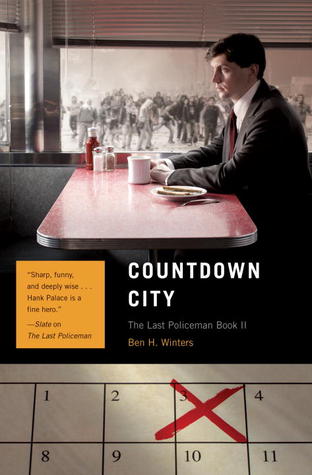
Book Review: Countdown City

Cover are for Countdown City.
Countdown City, by Ben H. Winters (book 2 of the Last Policeman trilogy).
Countdown City is a mid-apocalyptic noir. When I reviewed The Last Policeman, I mentioned that I was a teeny bit disappointed, after reading it and loving it so much, to find out the author was working on not one, but two sequels, because I thought the ending of the first book was perfect.

I’m no longer disappointed.

The quick set-up: we’re just 70-some days away from the earth being struck my an asteroid that’s too big and was discovered too late for us to do anything about it. Society has been crumbling for some months, and our hero, Henry Palace, a former police detective in Concord, New Hampshire, is now out of work and living in a world without electricity or much of anything else, where a very militarized police force is in charge of distributing the small amount of food and goods still available.

And the woman who babysat Hank and his sister back in the days after their parents’ death while they were living with an inattentive grandparent, is begging him to find her missing husband. In a world where people are running away to do crazy things before the end, and other people are willing to kill for a stash of coffee beans, she wants him to find a missing person.

The author described the first book as existential detective novel. I continue to prefer my description as a mid-apocalyptic noir. The first book asked the question, what’s the point of solving a murder when the world is about to end. This book poses the question, what do promises and commitment mean when there is no tomorrow?

The answers this book gives, like the answers before, may not surprise you, but by the time you reach those answers, having watched what Hank does to find those answers, you believe them.

If you don’t want the slightest hint about the ending, stop now. Other wise, click the Read More below:

Continue reading Book Review: Countdown City

Presence (stage, screen, or otherwise)

I’ve recently read two different proposals for a gay version of the Bechdel Test. The Bechdel Test is described in a comic strip by Allison Bechdel back in 1985. It is usually described as a simple way to gauge the active presence of female characters in Hollywood films and just how well rounded and complete those roles are. The test is in three steps, 1) There must be at least two named women, who 2) talk to each other, about 3) something besides a man.

It is frightening how many movies and TV shows fail the test. Having just watched, over the course of a month, the first five seasons of Supernatural, for instance, I can report that not a single episode out of those 65 episodes passes the test. To be fair, since I’ve also watched a few later episodes out of order, I can report that one recent episode in which Felicia Day reprises the role of a lesbian hacker played in an earlier season very nearly passes the test. Nearly.

While the results of applying the Bechdel Test to your favorite shows can be depressing, it is even worse if you try to apply a similar test about gay characters. If you transliterate the Bechdel Test into a test of how gays are treated in storytelling, it might look like this proposal:

  1. Are there at least two gay/lesbian/transgender people?
  2. Do they talk to each other? Or even do more than shock horror kiss?
  3. Do they talk about anything other than sex/being gay/shopping/cats?

With extremely rare exceptions, only movies made by queer writers/directors and explicitly aimed at a gay audience pass the test. Most fail at item number one. And most of the few who pass would fail if you changed it to say “is there one out gay/lesbian/transgender character.”

I insist on the “out” part because, I’m sorry, characters such as Dumbledore in the Harry Potter stories don’t count. He is never identified within the books or the movie as being gay. It isn’t even really hinted at in a meaningful way within the story. Having the author tell people during a book tour (and then only after having been confronted umpteen million times about the lack of gay characters), that one character who is portrayed as completely asexual throughout the books doesn’t count. Because this is about recognizing the existence of gay people, not compounding the closet.

Of course, Brokeback Mountain fails this test, because the only gay characters who appear are all deeply and tragically closeted. Which was true to the historical period, but also integral to the fundamental point of the story. Because of that historical reality, I find this other version I found a bit more useful:

  1. The movie includes two gay characters who interact in some way,
  2. Do not offer sassy advice to the protagonist,
  3. And are not dead by the end credits

At least with this test, Brokeback Mountain doesn’t fail until the third bullet.

The point of the original Bechdel Test wasn’t to assess whether a movie treats female characters equally, or whether there are stereotypes, or even whether or not it is misogynist. All it does is establish a baseline that the writers have actually imagined the women in the story as being full-fledged human beings, with lives and feelings and interests of their own. It’s useful not so much as a way to judge a specific movie or story, but to make us think about the presumptions of story telling.

Movies and books and stories are full of a variety of fully realized male characters, who range from good to nasty, from important to silly. And even most of the throw-away male characters have hints of a life and personality of their own that isn’t defined by the protagonists or their family. Where as the default position for female characters are to be the sister, wife, ex-girlfriend, or mother of one of the characters who is actually doing something in the story.

And let me just say, it’s disturbing, as a writer, to go apply the Bechdel Test to your own work and discover just how many of your own stories fail it!

So, the two versions of the Gay Bechdel Test aren’t quite the same as the original. Both have at least one step that focuses solely on clichés rather than just establishing whether the writer has actually developed a personality and backstory for the characters. So I think I prefer this version:

  1. The movie/story contains one identified gay, lesbian, or transgender character,
  2. Who has a conversation with any other character,
  3. About something other than sexuality*.

With the corollary that under sexuality we include topics that are typically (and lazily) considered a subset of “queerness.” So if all they talk about is gay rights legislation, or AIDS prevention, or who uses which bathroom, those count as a failure, too.

Not that we need to be the stars, or that we need to appear in every story, but we’re part of reality, and there are far more of us than there are people capable of dodging dozens of machine gun bullets while driving a car at very high speed through a crowded place without hurting anything other than a single vegetable cart, while reloading their gun and explaining the intricacies of a multinational conspiracy.

And we see thousands of them in movies all the time.

A good day to die

Readers can be like addicts. Once they fall in love with a fictional character, they want to read more, and more, and more about the character. A good-selling series of books can set a writer for life.

But it can be something of a gilded cage.

When Arthur Conan Doyle was a struggling young physician, he found himself sitting for rather long stretches between patients. So he started writing stories during his down time, and would sell them to various magazines of the time. He soon found that he had a knack for mysteries, not always crime stories, but stories in which there was a puzzle for the characters (and the readers) to solve. One day Conan Doyle started writing a long story about an independent detective. He based this detective on one of his medical school teachers, Dr Joseph Bell.

Bell was an early advocate of what would now be called forensic diagnosis. He told his students to pay more attention to physical clues about a patient’s illness. Close observation and deduction he said, were more important that what the patient told you. To demonstrate his method, he would have people pick out strangers in a crowd or on the street, and just by looking at the person (how they were dressed, wear patterns on their clothing, the presence or absence of callouses on various portions of hands, and so forth) deduce their occupation and recent activities.

Sherlock Holmes was a man who used Bell’s methods to solve crimes. A Study in Scarlet was published first as part of a Christmas Special (though it has no Christmas theme) in 1887. It was republished as a standalone book the next year. Sales were good enough to justify a second edition, more expensively bound, to be produced the next year. Conan Doyle was commissioned to write a second novel, The Sign of the Four (he was republished the next year in various journals throughout the empire, often with the slightly modified title The Sign of Four), which became an even bigger hit.

Conan Doyle was commissioned to write a series of short stories starring Sherlock Holmes for The Strand magazine, and they were published monthly from June 1891 through July 1892. As he neared the end of the series of 12 tales, Conan Doyle was finding himself growing tired of Sherlock. So he planned to kill him in the twelfth tale. Conan Doyle made the mistake of mentioning this fact at a dinner party at his mother’s home. His mother was upset, not so much about her son killing the character, but she felt the way he planned for Holmes to die (mauled to death by a vicious guard dog as Holmes and Watson rescued a young woman from a particularly disturbed couple) was entirely too ignoble for such a hero. She made him promise that Holmes would not die in the story. So, Conan Doyle changed the ending of the “The Adventure of the Copper Beeches.”

The stories were so popular, that people were literally lining up outside the offices of the Strand on publication day to get a copy. Holmes was not the first literary character to evoke this response. Many years earlier (1841) people had lined up in anticipation of the final chapters of Dickens’ The Old Curiosity Shop. The Strand commissioned more stories. Conan Doyle couldn’t really turn down the money, but he was getting even more tired of Holmes. So he kept completely mum about “The Final Problem,” in which Holmes is killed by Moriarty. Moriarty dies along with him.

“The Final Problem” has a lot of problems. Its internal logic is laughable (Holmes must disguise himself lest the killers find him, but he travels with Watson who is completely undisguised, and Watson booked their train, boat, and second train passages in his own name). Moriarty had never appeared in any story before this one, and there is absolutely no hint of his existence. That later prompted the producers of at least one television series that tried to follow the stories faithfully to insert Moriarty as the mastermind who supplied the plan to the robber in “The Red-Headed League,” just to get the character on the scene and in the viewers’ minds.

Conan Doyle never thought of his Holmes stories as serious literature, or of much importance. Which is why at different times he has Dr Watson refer to himself as “James” instead of “John.” In the original Moriarty story, the Professor’s first name is not mentioned, though the Professor’s brother, Colonel James Moriarty is mentioned by name. Later stories to feature Moriarty refer to him as James Moriarty. There are many other contradictions.

When Holmes was killed, the public was shocked. Some people dressed in full mourning clothes. People wrote Conan Doyle, pleading with him to bring back Holmes, and so on.

For years Conan Doyle ignored the pleas. Then, while visiting friends in the country, when one friend told about a local legend of a ghostly dog, Conan Doyle said it would make a wonderful basis of a Holmes story, but he could never write it since he’d killed Holmes. One of the other friends suggested the idea that the story could begin with Watson explaining that he had sworn never to tell this tale while certain innocent persons were alive, but now he could. So the story would be set before Holmes’ death in 1892, but could be published in 1902. And thus The Hound of the Baskervilles came to be.

The pressure to bring back Holmes increased (and the amount of money both American and British publishers were willing to offer for new Holmes stories skyrocketed), so in 1905 he relented. In “The Adventure of the Empty House” Watson is shocked (in 1894) to discover that Holmes is alive, having faked his own death in order to lure Moriarty’s confederates into mistakes so that the rest of the criminal organization can be dismantled. Thirteen stories are included along with “The Adventure of the Empty House” in The Return of Sherlock Holmes, featuring adventures that supposedly occurred after the time of Holmes’ faked death, but before the publication of his return.

Conan Doyle wrote a fourth Holmes novel, which marked the return of Moriarty, though this story is set in time before “The Final Problem.” Conan Doyle remained adamant that Moriarty’s death in “The Final Problem” was not faked. He wrote another 26 short stories about Holmes until his death in 1930.

Readers always wanted more.

So I wasn’t terribly surprised to read that the author of the Sookie Sackhouse/True Blood series is getting a lot of grief for announcing that the next novel is the finale, ending the series once and for all. I have never read the stories, nor seen the insanely popular HBO series. So I wasn’t aware that she had originally planned to kill one of the main characters and end the series in the ninth book some years ago.

Sometimes a story has run its course. Sometimes it’s time to tell a beloved character good-bye.

Even though I sympathize with her fans, I hope Charlaine Harris is happy with how she’s ended things, and goes on to tell whatever other stories she likes.

Not all reasons are reasonable

Several years ago I was browsing in a bookstore.

Now that I think of it, a lot more of my personal anecdotes probably ought to begin with that line than usually do. But I digress…

I picked up a paperback that had an interesting title. The back cover description gave the impression that the book was a parody of noir detective novels such as The Maltese Falcon or The Big Sleep, but with demons and faeries and werewolves and the like. I’ve been a fan of both science fiction/fantasy and detective stories for longer than I can remember, so this could be right up my alley.

Except, as I said, the description made it seem like a parody. Sometimes parodies are great. Sometimes they are just mediocre. And sometimes they are nothing more than mean-spirited dreck.

The back cover also had a photograph of the author. And the photograph was not encouraging. Everything about the stern-faced man’s pose, expression, and even hairstyle typified a kind of fan or writer I had met far too many times throughout my years in the fandom. They espoused a philosophy of social darwinism that holds most of the human race in contempt. Their idea of humor always involves belittling others while drawing attention to their own superior command of vocabulary, or (alleged) facts, or logic.

The only thing I enjoyed less than having conversations with them was reading anything they wrote. So I was quite certain this guy’s idea of a parody would be all about the mockery, with a healthy slathering of self-importance and self-congratulation at his clever turns of phrases.

The very brief author bio included beside the photo mentioned martial arts.

Every one of those aforementioned unpleasant fans who had been martial arts enthusiasts had been misogynist homophobes who were constantly explaining to people that they weren’t racist, but…

I put the book back on the shelf.

Several years later, through a series of coincidences including recommendations from friends who were the opposite of the kind of person I had inferred the author to be, I found myself downloading some sample chapters of the audiobook version of the first book in the series.

I enjoyed the sample. I found the main character very engaging and I wanted to know how the story ended.

So I bought the entire audiobook and listened to it. It was nothing like I expected the book to be, based on my reading of that back cover.

I was still buying books from the Science Fiction Book Club at the time, and they had some omnibus editions collecting the first seven books in the series into a few volumes, so I bought those. They arrived about a month or so before I was laid off at my previous place of employment.

One day, between contracting gigs, I started reading the first book—a few very short days later I had read all seven that I owned. I couldn’t put them down.

I needed to get more.

Since then, I’ve had the pleasure of seeing the author in person, even spoke to him very briefly in an autograph line. I spoke with his wife for a teensy bit longer. Between reading his books and short stories, reading some of his commentary, hearing him talk about his life and writing, and seeing him interact with his wife, it’s clear that my assessment was completely wrong. For one thing, those douchebags I had incorrectly lumped him with would never, even with a gun pointed at their head, willingly hold hands with their wife in public—let alone do a sneaky-pinky lock with a sidelong glance and a wink while being interviewed on stage

Which shouldn’t be surprising. I had based my assessment on a photograph and a single phrase in the author bio. The stories aren’t parodies, either. So that description from the back of the paperback was just misleading. As many are.

I could laugh the whole thing off as a very amusing case of forgetting the adage about judging books by their covers. But it isn’t that simple.

The assessment came out of personal experience. I can’t count the number of guys I’ve met—mostly in fannish circles, but not exclusively—who shared that particular combination of beliefs and attitudes. In person, the attitude usually manifests fairly quickly. And they usually just as quickly place me into one of the categories of people they hold in contempt. Of course, since they seem to hold most people in contempt, that isn’t surprising.

They aren’t just unpleasant to be around. Whether they are active in politics or not, they spend a lot of their time trying to convince people of the validity of those social darwinist ideas I mentioned above. That means they advocate policies that threaten me and people I love (not to mention society as a whole). So I have really good motivation to identify people with those attitudes, if for no other reason than to minimize the amount of time I have to spend with them.

We make decision like that every day, without even thinking. While walking down the street, or up a grocery aisle, standing in line at the bank, or selecting a seat on a bus, we assess people on a variety of superficial characteristics, then act accordingly. That gut reaction, that ability to put together a bunch of nonverbal cues to identify people we should be cautious around is a valuable survival trait.

But, having spent my entire life fighting for respect and acceptance in a world that rejects gay men (or any one who doesn’t confirm to certain gender expectations), I understand the dangers of misjudging people.

The reasons behind our gut reactions aren’t logical; they don’t conform to the rules of deductive reasoning. That doesn’t mean they are always wrong. Even if they did conform to the tenets of logic and rational analysis, they wouldn’t always be right, either.

The best we can do is keep as close an eye on ourselves as we do strangers we meet throughout our life. When we recognize a mistake, we can correct it, and learn to be a bit less hasty in the future. And when we’re right, we can feel a little less guilty about the times we weren’t.


Head spaces, part 2

There’s a particular TV show that I like, but don’t watch often. There are certain lazy tendencies in the writing that rub me the wrong way, such as treating technology as magic whenever convenient for the plot. There are other aspects of the show I really enjoy, so I tend to let episodes accumulate on the TiVo, saving them for times when I’m in the mood for some mindless action and adventure.

There’s another show which also uses technology in improbable and impossible ways that I watch faithfully each time a new episode comes out. One of the diffences between the shows is that the second one states its premise upfront, and then tries to stay consistent with that. Yes, what they’re doing is impossible, but it’s the same impossible everytime, and the stories revolve around the question of how people might behave if computers happened to work this way. The first show just plays fast and loose without any thought about whether they’re contradicting something they did in a previous episode.

Neither show is packaged as science fiction. The first one definitely isn’t sci fi. It’s a cop/action show whose writers don’t understand or care about what computers and crime labs really can do and what they can’t.

I have seen discussions on science fictions forums where some fans have objected to the inclusion of the second in a list of sci fi shows currently airing, primarily because the show doesn’t claim to be set in the future, and acts as if all the things they’re doing are possible with our current technology. But the show postulates the existence of a computer that can do things currently impossible, and then it explores what might happen if that were so. That’s the epitome of science fiction.

I can only enjoy the first show if I’m in the right head space. I have to be in the kind of mood where I can give my inner critics the night off, kick back, and just watch a group of interesting characters run from one dangerous situation to another. I have to be in a “I don’t care if it’s wrong” head space.

The second show puts me into its head space. Regardless of whether this is wrong, what might things be like if it were?

That’s not just good science fiction. That’s good fiction. The goal of a story teller should be to draw people into the story. Make this imaginary situation or world so enticing that the reader has to step inside to see what it’s like.

The other kind of story is like mass produced snack food. If it’s there where we happen to be and when we’re hungry (or bored or at least not feeling too full to eat), we’ll pick it up and munch away. But later we may not even remember what it was we ate.

The other kind doesn’t just pull us away from whatever we were doing to check it out, but it leaves us thinking afterward. Like an extremely good meal, we want to linger in the head space of the story after it’s ended.

And that’s the best kind of head space.

Birds black as coal

I’ve never been particularly good at symbolism—at least not in my own writing.

When symbolism happens in my stories, it is entirely subconscious. I remember some years ago another writer commented on one of my stories that she was deeply envious of the symbolism I’d pulled off. When she explained it to me, I looked at the story and realized that the repeated symbolic occurrence of pastiche/patchwork was there beginning in the first paragraph and continuing to the final scene. But I hadn’t planned it or even been aware that I was doing it.

Even back in school I always had issues with the notion of symbolism in literature. I remember reading one time that snow is always symbolic of death, so if a birth scene happens during a snowstorm, the scene isn’t about the beginning of a new life, it’s about the inevitability of death. Or it foreshadows a premature death of one of the characters. Or something.

And my immediate thought was, “what if the person just happened to be born in December or January?” I was foolish enough to raise that question in class. I was told not to be ridiculous; literature is totally under control of the writer, so things should never happen due to chance. No good author would set a birth during a snowstorm without meaning to allude to death, you see.

Which seems more than a bit artificial. Sort of like saying that a painter can never use the color yellow except in a painting about joy. Yellow symbolizes joy or delight or summer, right? So an artist can never depict a sad person under a lemon tree? And why does yellow symbolize joy? When a book is very old, the paper pages turn yellow with age. Or someone’s skin turns yellow while experiencing certain health issues. Why can’t yellow symbolize decay?

The answer is that, of course, yellow can symbolize either, depending on how it is used. Or it may not symbolize anything. Sometimes a lemon is just yellow, right?

Similarly, crows and ravens usually are assumed to symbolize death, but in the real world crows can be aggressive, clever, or clownish. I’ve witnessed more than one incident of crows skirmishing with seagulls over the contents of a public trash receptacle. It’s impossible to walk around certain parts of town without witnessing such an occurrence with some frequency. If a story I read mentioned one, it would evoke a lot of memories. Depending on how it was described, it might symbolize petty squabbling between family members, or disproportionate responses, or scarcity of resources. And while death can certainly result from petty disagreements or competition, it doesn’t have to. Crows fight with other birds over dropped food and so forth. It’s just something that happens.

Symbolism can add verisimilitude to a scene or story. The reader doesn’t even have to consciously be aware of the meaning of the symbols in order for them to work. But paying too much attention to them, as either a writer or a reader, can be a distraction.

As an author I can choose the setting, period, and characters of my story. I decide which details to describe, and which to leave unmentioned. But that includes the ability to include details not because they have a traditional literary meaning, but because they sometimes happen in the real world in the setting which I have chosen for the story. I shouldn’t include details that don’t serve the story. However, they should be included only because they serve my story, not in accordance to some academic prescription.

Break neck

I just finished Jim Butcher’s latest book in the Dresden series, Cold Days, and it was a wild roller coaster ride, as they always are.

The structure of a Dresden novel is pretty simple: open with the classic “into pot, already boiling,” then keep turning up the heat, throwing ever more dangerous/painful/insurmountable problems at the protagonist, raising the stakes again, and again, until a final couple of battles, and a solution that you feel you should have seen coming, but usually didn’t (or if you did, you hoped you were wrong).

They’re fun reads. And it’s a good story-telling method with a long history. Most people meet Freytag’s Pyramid in beginning creative writing classes. Gustav Freytag developed the pyramid to illustrate a classic Greek five-act play. Few modern stories follow his pattern, collapsing several of his stages together. The basic outline: protagonist confronts problem, struggles with it through a series of events of rising dramatic tension, which comes to a head, then is resolved, and the reader gets some sense of closure.

The Dresden stories take a high octane action adventure approach to the story, with the escalation of the stakes happening faster and faster. It’s kind of like being strapped to a missle, and not knowing for certain where you’re going, and whether everything will blow up when you get there.

I’ve written a few novella- and novellete-length stories using that break neck pace, and it’s kind of fun. I’ve not successfully pulled it off in a novel, yet. In a novel you need several subplots, and I like giving the reader that sense of closure on each one. That means some of the tension gets relieved earlier in the story, instead of just continuing to pile on. Or writing an extremely long and complicated climax. And my novels are complicated enough, already.

And it just occurs to me, that may be why there are almost always two really big battles at the end of most Dresden books. I may have to try re-reading a few and charting out the sub plots.

Purely for academic purposes, of course. And to hone my craft. Not because I just read one fantastically fun story and the next one won’t be out for at least a year. It’s not like I’m addicted.

I can stop re-reading them any time I want…