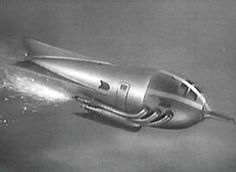
A silver rocket from the classic Flash Gordon serials.It’s that time of year, again, where I’m waiting for the Hugo Packet to arrive so I can start reading things that have been nominated for the award. And while several categories have again been piddled by the Rabid Puppies, I am still looking forward to the experience. Particularly since I learned an important lesson last time: the point of the awards is to recognize excellence. I’m not obligated to read stories to the end—as I always have as a small-press editor, where part of my mission is to help the writer improve the story if necessary. These stories have been nominated because, allegedly, they are great stories. So, this year I’ll give each story three pages to hook me. If by that point I’m not feeling interested enough to keep reading—regardless of whether the story was on anyone’s slate—then it goes under No Award on my ballot.
If I am enjoying it, I’ll keep reading. The only stories that will go above No Award will be the ones that kept me hooked until the end. Then I’ll rank those and move on to the next category.
It may be a very busy few months, since only one of the novels that were nominated is one I’ve already read. It’s easy enough to read five each of short stories, novellas, and novelletes in the time frame, and graphic novels usually go relatively quickly, but the novels take a bit more time!
With this new rule, I suspect that I’m going to enjoy the process this year a bit more than last year. Because the reason I care about any of the awards is because I love science fiction and fantasy. I don’t just love it, I frikkin’ love it. I have written before about how I can’t remember a time when sf/f was part of my life, because even when I was a small baby my mom read aloud to me from whatever book she was reading at the time, and she is one of the world’s geekiest Agatha Christie and Robert Heinlein fans.
Thanks to her, my childhood was full of a lot of science fiction. For a few years we faithfully watched episodes of Flash Gordon on channel two every morning, for instance. And our regular trips to the library (and used book store, when we lived in towns big enough to have one) usually resulted in several fantasy or science fiction books coming home with us.
It was one of those used bookstore runs when Mom found a copy of Dune in paperback. That book always sticks out in my memory because it was the first time that Mom was reluctant to tell me details about the book while she was reading it. It was also the first book that Mom told me I would have to wait until I was older. I know she really liked it, because it never once went into the pile of books she was thinking of trading in when we were preparing to visit a used book store. The fact that it was forbidden but also apparently really good instilled more than a bit of longing.
But it was rare for her to restrict my access to books. She never seemed to worry that I might not understand most books. If I asked to read one of her books, she’d let me, and she was always willing to discuss the story. There were times when I would try one of her books and I’d call it boring, though sometimes it was probably more because I actually was a bit too young to be tackling that particular book.
I loved browsing in the science fiction sections of the library or bookstores. Looking at the cover art, which was sometimes a bit weird and confusing, but always otherworldly. Each one seemed to beckon, promising strange and wondrous adventures if I would brave those pages.
Science fiction was always about possibilities, to me. I never felt that some sci fi wasn’t for me. I always felt welcome. Science fiction, particularly the way Mom enthused about it, was about making the world a better place. About going to new worlds, or creating new inventions, or learning what it would be like to live with aliens—or elves, or dragons. Do I wish more of the sf/f available in the 60s and early 70s had been more inclusive? Yes. Just as I wish more of present day sf/f was inclusive of people of color, queer people, et cetera. We’re getting better, but still have a ways to go before the representation matches the real world.
Whenever I pick up a new science fiction book, especially if it’s one that’s been recommended by a friend, I get a flash of that feeling of wonder and anticipation; the sense of strange adventures beckoning. For a moment, I’m that little boy in the bookstore, clutching a story, and about to plunge into something wondrous!
Cover, Astounding Science Fiction, July 1954. The prevalent belief, at the time, was that the vast majority of readers were men. What does that tell us about the intention of this artwork? (Click to embiggen)I get tired of having to defend my wish that stories include diverse casts of characters. Not just because I’m a gay man who wishes that my favorites shows, books, and stories would include people like me, but because I remember what it was like being a queer child and having no idea that there was anyone else in the entire universe like me. And therefore, I can empathize with other children who aren’t straight white cis males who never see people like themselves as the heroes of any story, and thus grow up not thinking that they have a place in this world.
But as I’ve said before, it isn’t just about having characters that various readers in your audience can relate to. It is also a matter of portraying a believable world. The real world has people of different genders, races, sexual orientations, and so on. It is simply unrealistic that a random sampling of any fictional world is going to consist solely of white, cisgendered, straight people. Especially the overwhelming majority of them male.
And there’s one other aspect, but award-winning sci fi/fantasy author, Saladin Ahmed explained it in a succinct set of tweets:
Ahmed is referring to the likely fanboy reaction to this article: J.J. Abrams says Star Wars will get an openly gay character. And the word “likely” is wholly unnecessary, as I’ve already seen angry reactions to the article around the net.
As he said, the people who object when a non-white person is cast in lead role in a movie that isn’t about race issues, or queer characters are included in a story, and so on, always argue that it’s just furthering a political agenda to include any non-white, straight characters. Especially when it comes to queer characters, they angrily ask, “Who cares who is having sex with who?”
Well, obviously, if you’re getting angry, you do.
But let’s go back to the original Star Wars trilogy, for a moment. I was in a very crowded theatre on opening weekend for Empire Strikes Back, and when Leia declared, “I love you!” then Han replied cooly, “I know!” there were whoops and lots of exclamations of, “YES!” from all over that theatre. Three years later, at the first showing of Return of the Jedi, when Leia and Han have their big kiss at the end, there were even louder cheers and clapping. So a lot of people did care about who was in love with who, who was kissing who, and so on.
I want to repeat that: fanboys cheered and applauded a kiss near the end of a special effects-laden space opera adventure story.
So, they did care and they still do care about who is in love with, who is kissing, and yes, who is wanting to have sex with who.
It goes back much further into the history of science fiction and fantasy than Star Wars, of course. The reason that those earlier examples almost never included any same sex relationships is not because there weren’t any queer writers or readers of science fiction, it was because everyone was closeted. They weren’t closeted because they wanted to be, but because they often had to be. Remember, until the Supreme Court ruled in 2003 that intimate consensual sexual conduct was a fundamental freedom protected by the Constitution, same sex activity was a criminal offense in many places.
We have always been here. For instance, in the 1920s and 1930s, Edgar Pangborn wrote a lot of pulp stories in the mystery, fantasy, and sci fi genres which featured very passionate male “friendships.” The relationships were never overtly gay, but clearly were meant to imply it. He wrote those stories under a variety of pen names. He didn’t start publishing stories under his real name until the 1960s.
Jim Kepner was the publisher of one of the first magazines advocating for gay civil rights, ONE Magazine, beginning in 1953. But before that, operating under the fan name, Jike, he was an active member of the Los Angeles Science Fiction Society. During the 1940s he published a sci fi fanzine called Toward Tomorrow. Within that ’zine, and in other fanzines, he was only one of several fans who wrote speculatively of how society might evolve to include greater gender equality, racial equality, and acceptance of various sexual orientations.
A page from a science fiction fan zine from the 1940s, with Tigrina (Lisa Ben); not to mention Ray Bradbury. Courtesy ONE Archives/USC. (Click to embiggen)Another member of the Los Angeles Science Fiction Society back then, Edythe Edye operated under the fan name Tigrina. In 1947, using the pseudonym Lisa Ben, she founded Vice Versa, the first lesbian magazine published in the U.S.
In 1953, when straight author, Theodore Sturgeon, explored gay themes positively in the short story “The World Well Lost,” it caused at least one editor to try to organize a blackball system to prevent it, or anything like it ever being published. The blackball scheme didn’t work. The story was published. Some people liked it, some didn’t. Sturgeon and other writers occasionally returned to the subject over the next couple of decades.
It was far more common, yes, for queer characters to be portrayed negatively. In some works, you could tell how far into the depths of evil a character had plunged by how much bisexual or homosexual activity they engaged in—Dune’s Baron Harkonnen being a prime example. My point is that queer fans and writers and artists have been around for as long as science fiction and fantasy have existed. The argument about whether or not we should be allowed to participate or be portrayed has been around just as long.
Queer people have been around for as long as people have existed. They will exist in every fantasy and science fiction world. Whether they can safely live openly in those societies will vary, just as it does now in the real world, and has varied in different historical periods. If your fictional world doesn’t include us, it is unrealistic. If your fictional world doesn’t include us, you either really suck at world building or you suffer from heterosexism. If you claim you can’t include us until the right storyline comes along, you may be in denial about how much homophobia (subconscious or not) you harbor.
Not every story will include romance, obviously. I have discussed with some folks the fact that in my current series of fantasy novels, while there are several characters I know who are bisexual or pansexual, most of them aren’t obvious. There is at least one clearly identified gay couple, and several clearly identified straight characters, but that’s it2. So, I’m a queer writer who isn’t sure I’m representing queer characters enough. Therefore, I’m not saying that writers who don’t have a lot of obviously gay characters in their work are bad people.
I am saying that if you have absolutely none at all, that is just as much of an “agenda” as anything certain people accuse queer people of pushing when we ask for inclusion. Whether consciously intended it, or not, that’s at the very least enabling an anti-gay agenda.
Footnotes:
1. Yes, that is an anagram of lesbian, and she did it intentionally.
2. There are shapeshifters in my universe, and at least one shapeshifter who has appeared prominently could be interpreted as a trans character. There are other characters in the world that are definitely transgender, but haven’t yet appeared in a story3.
3. I’m not advocating quotas. As Mr Ahmed said above, quotas are bad for art, but so is monotony.
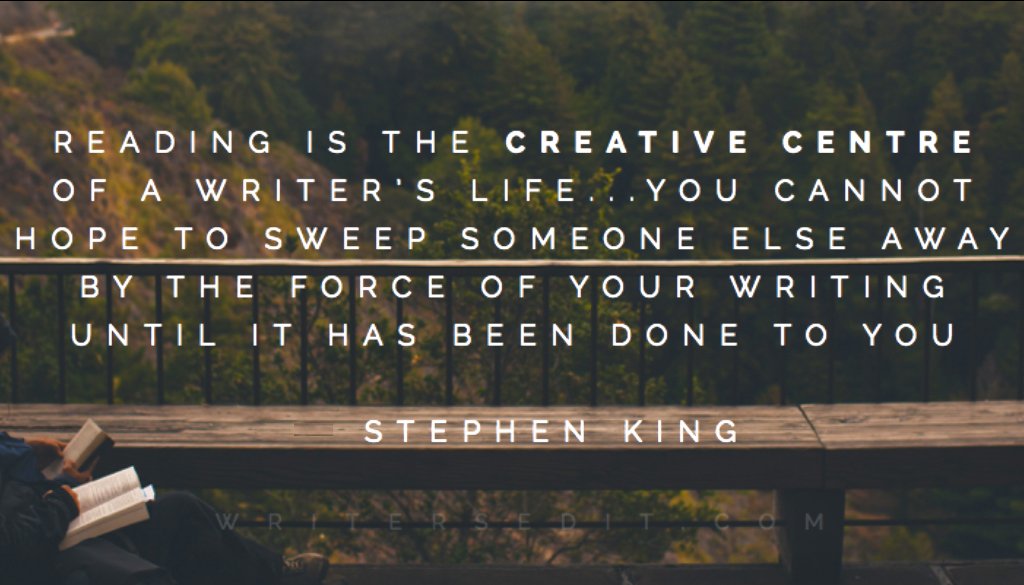
“Reading is the creative center of a writer’s life… you cannot hope to sweep someone else away by the force of your writing until it has been done to you.” – Stephen King (click to embiggen)Last week they started emailing the Hugo nominating PINs (personal ID numbers) to those of us who have memberships to WorldCon. Mine arrived Friday night. During last year’s voting period I started a list of stories and such that were being published last year I thought were good enough that I’d want to nominate this time around. It’s a fairly short list because most of the reading I did last year was stuff that had been published in previous years. So I need to do some more research and reading!
To nominate you need to have either an attending or supporting membership to last year’s WorldCon (Sasquan, in Spokane), to this year’s WorldCon (MidAmeriCon II in Kansas City), or to the 2017 WorldCon (to be held in Helsinki). If you already have one of those, your PIN is either coming in email, or will be included in your snail mailed Progress Report II (if you chose that for updates rather than email). Check your spam folders if you think you should have gotten it and it hasn’t arrived. They are still mailing them out, though, so don’t send a panicked message to them, just yet.
A lot of people are putting up their “oh, by the way, I had this stuff published this year that could be nominated, if you happened to have read it and enjoyed it.” I only had one short story published, and in an APAzine at that, last year. But I do blog about science fiction and fantasy here a bit, and I suppose that means technically I could be nominated in the fan writer category. *wink* Hey! A guy can dream, right?
More seriously, as I work on my nominations, I’ll try to put together a list of some things I think folks should check out.
In completely unrelated news: The Ali Forney Center, which provides support, nourishment, and shelter to homeless LGBT youth in New York City, is trying to raise money to purchase the church of anti-gay hate-spouting preacher, David Manning. The church has been ordered into foreclosure for non-payment of over a million dollars in utility bills (on top of other fines and debts). I forgot to mention when I posted this earlier, that Manning’s church has been officially designated a hate group by the Southern Poverty Law Center. Anyway, as of this morning, they had reached 49% of their goal in just three days. The foreclosure auction is later this month. If you can donate to this opportunity to turn hate into love, please do!
I, being a smart aleck, had to butt in with, “This (queer) nerd boy would buy every Slave Poe action figure I could find! Oops… Did I say that out loud?”
The problem with even well-meaning smart asses throwing in such jokes is that our comments can undermine the serious point that Vivian was originally trying to make about double standards and the male gaze, with some commentary on the small wave of nerd rage that happened when an official Star Wars tie-in novel featured a gay protagonist earlier this year, and similar splash of nerd rage that happened when the trailer came out showing a Stormtrooper pulling off his helmet and revealing black actor under the mask.
So, to be clear: back in Return of the Jedi when they put Leia in that slave costume on a leash when she was taken prisoner by Jabba the Hutt it was a sexist action intended as fan service, and entirely unlike the way any of the three male heroes also taken prisoner in that same sequence were treated. And it made very little sense, internally. Seriously, Jabba is a giant slug, he’s not human, and it makes no sense for an alien (particularly a non-humanoid alien) to find any human body erotically attractive. I’ve seriously seen some clueless fans argue because another alien woman was shown in a similar role in an early scene (when she refuses Jabba’s advances, she’s thrown to the monster in the pit where the entire party takes great glee in watching her die), that this proves Jabba had some sort of fetish for the humanoid female form.
Bull.
Jabba is fictional. Jabba didn’t make the decision to put either woman in a slave girl costume to be leered at. Human filmmakers made that decision. Male human filmmakers made that decision.
Just as when authors and show-runners claim that they would love to include queer characters, but the right story just hasn’t come to them are either deluding themselves or outright lying (they can make the decision which characters to include in their stories), filmmakers who claim that Slave Leia was because of Jabba’s kinks are simply shoveling BS.
If Jabba had a kink for naked humanoids, there’s no reason it should have been limited to female humanoids.
So if the idea of Luke being the prisoner in a scanty slave costume after Jabba catches him upsets you—if you find yourself constructing arguments that it would be inappropriate because Return of the Jedi wasn’t a gay porn film, and that it’s just not the same as putting Leia in a scanty outfit—you’ve just stumbled across a great big internalized misogynist double-standard. Congratulations!
For the record, when I was 22 years old sitting in that dark theatre after waiting in line for 10 hours to see Return of the Jedi and the first scene with the other alien woman on a leash in a scanty costume appeared on the screen, my first thoughts were, “Why would Jabba put a woman from another species in that costume? Why would whatever species she is fetishize barely concealed breasts just because humans do?” Not that I was necessarily that enlightened back then. I recognize that even as a deeply closeted queer guy, I didn’t see the costume the same way 90-some percent of the other guys in that crowded theatre were. But that’s the thing, without hormones clouding my vision, I could see the incongruity for what it was.
So I hope my comment didn’t detract from the message of the original tweet. Besides, I wasn’t joking. I’ve already said publicly that I am searching for the Finn and Poe Honeymoon Suite Playset, among other things. When a friend pointed out that there was a place taking orders for a Poe Dameron body pillow I have to admit I felt immediate temptation. If there is a Slave Poe scene in one of the sequels, and if they made action figures of him in that costume, I’d buy it so fast!
Harrison Ford as Han Solo in the original Star Wars. (Click to embiggen)I was a high school student in the small town of Longview when Star Wars first came out. I saw it on opening night, thanks to a couple of older friends who were even bigger science fiction fans. They drove me down to Beaverton, Oregon, (which was the closest place with a full-sized wide screen and Dolby sound at the time) on opening night, insisting that I’d love this film I had never heard of.
They were right. A lot of people loved it.
It wasn’t really original. The movie was a loving homage to the pulp magazine adventure stories and serial movies of the 30s and 40s. It didn’t have anything profoundly new philosophically to say. The special effects were better than we were used to seeing, but otherwise it just told an old-fashioned story. You knew who the good guys and the bad guys were. The heroes were confronted with a series of obstacles to overcome, and they worked hard to win the day.
In that way, it was an oasis in the desert. Over a decade before the movie came out, “legitimate literature” had embraced the modernist school. Narrative (storytelling) was considered “unrealistic” and “naïve.” Modernist writers abandoned plot and character development for style and grand themes. Resolution was replaced with ambiguity.
That listless ambiguity had infected a lot of pop culture. To be fair, in the U.S. at least we had good reason to be despondent. The economy had tanked. Inflation was out of control, lots of people were out of work, and even more were under-employed. We had finally admitted what a pointless quagmire the war in Viet Nam had become, so closely on the heels of the national embarrassment of the Watergate scandal and the ouster of President Nixon (itself following not the long after Vice President Agnew had resigned and pled guilty to tax evasion charges). And victories of the civil rights movement seemed to have produced more backlash than noticeable improvements in the lives of ordinary people.
By 1977 most of popular culture had been tainted by modernist angst. Many of the films and novels of the day accentuated style, mood, and setting, and had endings that left the audience wondering what had happened. Star Wars brought plot, heroes, and villains back in style. And none too soon, in my opinion. There’s something comforting and satisfying about a story that begins with a problem, builds to a climax, and resolves things in the end.
Not to say that some of the other types of stories aren’t fun from time to time.
Star Wars was the perfect combination of fun, adventure, struggle against a seemingly unbeatable foe, and triumph. With space ships and blasters and energy swords thrown in for good measure. It’s not really science fiction, because the attempts it makes at science are laughably wrong. It follows the conventions of 30s science fiction in that regard. It’s space opera, following the rules of epic fantasy with the accoutrements of science fiction. And there’s nothing wrong with that.
The Empire Strikes Back was a much darker story, and as a middle chapter in a continuing tale, its ending wasn’t triumphant. But it still told a really good tale. There were resolution of some issues, character arcs advanced, and the open issues were daunting problems, but with a hope that they could be resolved. It was a superior movie to Star Wars in every way, but was still firmly built from the foundation laid by the previous movie. Return of the Jedi was fun—flawed, but fun. It wasn’t as good a move as Empire, but it still worked, and it paid off in at least an acceptable way on all of the cliffhangers of the previous films. Don’t get me wrong, some of the pay-offs were fantastic, I’m just admitting that not all were perfect.
Star Wars (which I hate referring to as “Episode IV – A New Hope”) still remains an especially bright shining beacon in my personal firmament. It made me love the idea of science fiction and fantasy in movies, again. It gave me a new celebrity crush (if you were a queer boy watching the first film and didn’t swoon for Han Solo I don’t know what’s wrong with you!). It gave me characters to aspire to be like: Obi Wan, Luke, Leia (yes, Leia! Seriously! Go watch those scenes with Leia and Darth, or the moment she takes the blaster away from one of the men, shoots open a vent cover, and says, “Someone has to save our skins. Into the garbage chute, fly boy!” and tell me she isn’t bad ass!)…
I love Star Wars. I loved it so much that the first summer it was in theatres, I drove to a theatre in another state 13 times to re-watch it. Not to mention seeing it at a local theatre, later watching it on cable, and eventually on tape again and again. It was a life changing experience.
But I must admit that the modernists were right in some ways. The traditional narrative form is seldom the way real life works out. The difference between real life and fiction is that fiction has to make sense. In real life, we don’t always get the clear-cut endings where the heroes defeat the villains and go on to live happily ever after:
The friend who drove that night when I first saw Star Wars, 38 years ago, is dead. James Curtis Bruce died from complications of AIDS at the age of 36.
Another friend, who drove us down to see the opening of Empire, has also passed away. Lawrence Lee Church died of an anueurysm at the age of 34.
I had admired and looked up to both of them as “big brothers” during a very important part of my life. Jim was a lot like the character of Han Solo, while Larry had more in common with Yoda.
I miss them both.
Sometimes we all wish that life was more like a good, fun movie.
After re-editing his own movies to change the order of the shot, Lucas was spotted in 2012 wearing a Han Shot First t-shirt on the set of Indiana Jones and the Kingdom of the Crystal Skull. (Click to embiggen)In the original version of the first Star Wars movie, Han Solo is confronted by an alien named Greedo pointing a gun at him. They have a conversation about the bounty on Han’s head, and how Greedo is here to collect the money Han owes. Han surreptitiously unholsters his own gun under the table, and when Greedo threatens to kill Han if necessary to take his ship as payment, Han kills Greedo.
It was a great scene, shows us a lot about Han’s personality, and was one of the many great homages in the film to scenes from classic Westerns and Noir Detective films.
Then, in later editions, George Lucas re-edited the scene so that Greedo shoots and somehow from nearly point-blank range misses. Then Han shoots after. And thus a meme was born and soon adored a million t-shirts. In more than one interview Lucas claimed that he had always meant that Greedo shot first. Or that Greedo was squeezing the trigger and Han was reacting to that as much as the verbal threat, and so on. But it made no sense to anyone. It seemed clear to everyone that Lucas was trying to make Han seem like more of a stand-up hero or something.
Despite those many interviews with Lucas, the original shooting script explicitly says that Han shoots before Greedo has a chance to make good on his threat. And George was himself seen wearing a Han Shot First t-shirt on the set of Indiana Jones and the Kingdom of the Crystal Skull in 2012. I always felt the decision to edit was extremely stupid, and thus felt vindicated by both the script and Lucas’ t-shirt shot. (You can argue that he’s embraced the controversy, or was being ironic, or maybe some fan had given him the t-shirt and he was wearing it to give Harrison a laugh on the set—whatever.)
I felt as if this particular thing had been settled a long time ago, until recently I happened across a reference to the Han Shot First “controversy” on the blog of a Sad Puppy supporter. At first he seemed to be making the case that Lucas’ decision to re-edit the scene was in response to pressure from the forces of political correctness (side note: I need to find that web browser plug-in that changes all references in articles to Political Correctness to “treating people with respect,” since the only thing that causes folks to accuse other people of being PC is when they are called out for failing to treat others with respect). But then the blog went on to claim that Social Justice Warriors prefer the second edit. He claims that he has been told (I think the actual term was “screamed at by SJWs”) that he’s an immoral person for thinking that Han shot first.
For the record, I am clearly a Social Justice Warrior supporter, and I have always argued (sometimes vehemently) that Han Shot First. And every feminist, pro-equality fan that I know personally who has ever expressed an opinion about the original Star Wars movie has also insisted that Han Shot First, and often just as vehemently as I do.
And Han shooting first isn’t an immoral choice!
He’s being held at gunpoint. Greedo makes it clear that if Han puts up a fight, he’ll kill Han. He threatens to take Han’s ship, which is his livelihood. When Han says “over my dead body” Greedo indicates he’ll really enjoy killing Han. BANG!
It’s a clear and unequivocal threat to Han’s life. He’s not just threatened with deadly force, it’s right there pointed at him. So he reacts with deadly force of his own. Is it the way Ghandi or Buddha or Mother Teresa would have handled it? No. Is it the way Sam Spade (or any other character Humphry Bogart played in many noir movies) would have handled it? Absolutely! It shows us that Han is a person that will do whatever it takes to protect himself and what’s his. It shows us he thinks on his feet. It shows us he has good survival instincts. It shows us that he can appear charming if necessary, but is more than capable of killing an opponent and carrying on.
And more importantly, it sets things up so it is both a genuine surprise when Han flies in to the rescue at the end, while at the same time making it believable that he would find a way to fly in through all that ship to ship fighting and get where he needed to be to save someone that he’s decided is a friend.
I can be the kind of person who believes that non-violent solutions are better than resorting to senseless violence, and at the same time recognize that in some circumstances, violence may be the least worst option. So, yeah. Han shot first. And it was a right thing to do. It doesn’t make him a saint. But not all heroes are. And we can cheer for flawed heroes when they do the right thing.
Go read it, because she says what I wanted to say, only better!
I went through a long phase where I preferred science fiction over fantasy with a bit of self-delusion along the lines that somehow fantasy was “just making any old thing up” while science fiction required an understanding of science! Likewise, I often expounded the notion that hard sci fi was superior to all others because you were constructing your what-if scenarios inside even more demanding parameters. Somehow I was able to express those beliefs at the same time that I would read and re-read any Andre Norton book I could get my hands on because I always loved them. I’m not sure why it took so long for me to recognize the cognitive dissonance between the kinds of stories that moved me most, and the sorts of stories which didn’t but which I claimed were superior.
Some of it is pure stubbornness: you express an opinion at one point, and then you feel obligated to keep justifying your original statement. But when I finally started to recognize this particular contradiction, that didn’t seem a sufficient explanation. Until I had an epiphany.
The epiphany came from an unusual source. I was watching a recording of a question-and-answer session that sex advice columnist and gay rights activist Dan Savage was having after giving a talk at a university. A young woman had a question about why guys her age would be friendly and sometimes flirty with her and other woman she knew who weren’t “model thin,” but always distancing themselves before things got beyond friendship. Yet she found older men pursuing her. She feared that the older men were desperate because of some other flaw she hadn’t uncovered, and that younger guys were merely shallow.
Dan pointed out a couple of things. One was that every week since he’d become an advice columnist he received at least a couple of letters from straight guys who confessed that they were really attracted to bigger women, but terrified to admit it because they thought it meant something was wrong with them. In an aside, he said that he got similar messages from some gay guys about their attraction to big guys. He said the thing nearly all the letters had in common was that the letter writer was either in their teens or their twenties. At that age, Dan said, guys are still very focused on winning the approval of other guys. So they are much more concerned with appearing to be interested in the things they think others expect them to be interested in.
His conclusion was that a lot of the guys she thought were sending mixed signals were doing just that. They were genuinely attracted to her, but when they recognized what was happening, they bailed because they thought they weren’t supposed to be attracted to that kind of body. So his advice was to go ahead and take men who did express interest at their word, and if they didn’t otherwise set of alarm bells, there was nothing wrong with dating them. But also, she would find when she got a bit older, that there were plenty of guys who always had found her attractive, they just had to grow up enough to stop worrying about the approval of their friends.
I realized that I had started espousing those opinions about sci fi vs fantasty, and hard sci fi vs so-called soft science sci fi, and very cerebral sci fi vs action/adventure sci fi when I was in my teens, and I hardened those opinions in my early twenties. At the time it seemed that the fans I most admired all held that opinion. And the way that libraries often classified various books seemed to reinforce that. All of the “soft” sci fi and fantasy was filed in the young adult section or the children’s section of libraries that divided things up that way. Only the hard sci fi and certain kinds of action/adventure sci fi was over in the adult sections. Clearly fantasy and so forth was for less mature, and therefore less sophisticated, readers.
Bull.
“If you’re going to break a rule, break it good and hard. My personal motto!”
—Aliette de Bodard
Especially since science fiction is supposed to be not just exploring limits, but pushing beyond frontiers into the unknown, we shouldn’t look down on things that vary from the familiar. That’s the whole point, right? It’s timid to worry about whether a story is supposed to go this way, or whether we’re supposed to like a particular kind of story, et cetera.
Isn’t science fiction and fantasy supposed to be about boldly going where no one has gone before?
I’m hardly the first person to write about the challenges of being a fan of problematic material. And I have written a lot about at what point a particular writer’s or artist’s beliefs and actions in real life make it difficult to enjoy their creations. Because of events at the World Fantasy Awards ceremony earlier this week, a lot of people are talking about this topic right now. Plenty of people are weighing in on the specifics there–I’m not going to talk about that.
Instead, I want to talk about how this topic came up in relationship to one of my own posts earlier this year about some of the science fiction and fantasy I love.
I had specifically written about Isaac Asimov, a Grandmaster of Science Fiction who wrote a lot of both sci fi and science fact. One of my readers correctly pointed out that while Asimov’s writing was award-worthy, his personal behavior quite often wasn’t. A self-described “dirty old man,” Asimov was known for getting handsy with women and making sexual suggestions or “jokes” in public settings. This has been excused by some by saying that he was a product of his time. Yet both Mister Rogers and Charles Schulz were born in the same decade and were therefore products of the same time, and they knew not to grope strangers without permission!
The only thing that “a product of his time” really means here is that women who complained about that kind unwanted attention got even less support and sympathy from society at that time than they do now.
So, he was a problematic person. I don’t find his writing to be particularly misogynist nor exploitive. Yes, it was mostly as sexist as any other fiction written in the 1930s-1980s. One of the most common critiques leveled against his writing in that regard is that he tended to avoid any romance in his stories altogether; which means at least wasn’t making the women prizes for the men all the time. On the other hand, he did occasionally write stories with women as protagonists, which is more than you can say about many of his male contemporaries in the genre.
Just because I’m not offended by his writing doesn’t mean that others can’t be, nor does it mean that anyone is under an obligation to like his writing.
His groping and inappropriate comments were not the only issues the previous commenter mentioned. Isaac Asimov got married when he was 20 to a woman of whom his parents approved. Isaac cheated on his wife, Gertrude, frequently, eventually causing them to separate. At which point Asimov immediately began living with one of the women he’d been having an affair with. Three years later Gertrude and Isaac finally divorced, and two weeks later Isaac married Janet O. Jeppson, the women with whom he’d been living since separating from Gertrude.
There are people who say that Isaac continued to cheat on Janet just as he had with Gertrude. There is a very big problem with this claim: no one but Janet and Isaac knows whether his flings and dalliances after the marriage to Janet were cheating. They may have had an open relationship (which most non-monogamous couples don’t admit to, because society is even less accepting of polyamory and monogamishness than they are of philanderers).
We know that Gertrude did not agree to an open relationship, because she made that very clear on more than one occasion. Asimov was definitely in the wrong during his first marriage. So he was definitely a cheater as well as a sexual harasser during that time. But if Janet agreed to an open relationship, then it wasn’t cheating. Period.
That doesn’t negate his other failings, but we can’t presume to know what agreement Isaac and his second wife had or didn’t have, absent word directly from her.
Human relationships are messy. Society makes the mess worse, because people are expected to figure out their sexual needs and relationships with inadequate information while weighed down by gigantic amounts of societal baggage, a great deal of which is false. Thanks to myths such as the Relationship Escalator, the One True Soulmate Fairytale, and the Marriage=Adulthood Fallacy, people get married when they aren’t ready to other unprepared people who are not compatible (in many ways).
In my experience that often goes double for the kind of person who has the temperament to be a writer of any kind, and triple for those who are drawn to sf/f. Where a social awkwardness and arrested development is all too common.
People are imperfect. All people are imperfect. That means each and every one of us it imperfect. Sometimes we like things that contradict some of our own ideals. Sometimes we like people who don’t live up to all of our ideals.
Everyone is aware that their friends and loved ones are imperfect. The part we tend to overlook is: everyone who likes us does so in spite of our flaws. None of us live up to all of our own ideals all of the time, let alone live up to the ideals of our loved ones. In a relationship, we cut each other slack because we feel that other things outweigh the imperfections.
Which is where I come back to the original question. When you discover that the person who created something you love wasn’t very lovable, how much does it color your evaluation of the art or story? That’s going to vary from person to person. For me, the incredible sense of wonder I got the first time I read Asimov’s “The Last Question” is simply too big to dismiss. The sheer volume of science and history of science and a love for science that he packs into each essay in collections such as Only a Trillion, The Tragedy of the Moon, Of Time and Space and Other Things, or Quasar, Quasar Burning Bright will always make me glad we live in such an amazing universe. Whether I’m reminded of the hilarity and humanity of his mysteries, such as Murder at the ABA, or the understandability of his in-depth science books such as The Collapsing Universe and The Genetic Code, I keep thinking that if any other person had written one-tenth of what he did, they would be considered one of the greatest.
I cringe when I think of how he behaved toward women. I wish that the same brilliance which illuminated his writing had also informed his treatment of some of the people he met.
But I remain a fan of his work. And I understand if other people decide to give it a pass.
Jason Sanford set off small internet firestorm with a series of Twitter comments that he then collected on his blog as: The fossilization of science fiction and fantasy literature. Some people were upset because they thought he was implying that the classics of sci fi were garbage, when all he actually said was that younger people are reading, watching, and playing newer works and there’s nothing wrong with that. He’s since added a follow-up to clarify his point which included this important bit of context:
A few years ago I was on a SF/F panel about bringing new readers into the genre. I mentioned that SF needed more gateway novels, at which point the other author on the panel snorted and said we don’t need new gateway novels … the Heinlein juveniles are still perfect.
That is the type of attitude which people should fear because it will kill our genre. But new readers not discovering SF/F through the classic authors you grew up on — that’s nothing to worry about.
His critique was not aimed at the classics themselves, but rather at older fans and pros who belittle younger people who first learned to love science fiction and fantasy by encountering newer works, or who lecture people who aren’t familiar with many works published 70 or more years ago, or gripe that “real” fandom is greying and dying off.
Reading the original post and some of the fallout left me feeling a bit guilty for ways that I have no doubt come across that way myself. I do react with great incredulity when a friend, regardless of age, isn’t familiar with a book, series of books, or movie that I consider a classic, for instance. I try to get people to watch some of the old movies or read the old books that I loved.
It also made me wonder about the series of posts I’ve been doing for Throwback Thursday the last 6+ months, the “more of why I love sf/f” posts. I started those posts as a personal antidote to the sturm und drang over the affair of the melancholy canines. Because I read a lot of sci fi blogs, and because I was determined to read all the Hugo-nominated works before filling out my ballot, I knew I was likely to spend a lot of time being outraged and otherwise upset about things people were saying about some types of sci fi. So I decided it would be a good idea to write a weekly post in which I would only talk about something I loved from the genre. Since I like having a regular deadline, I needed to pick a day, and it occurred to me that if I focused on works that were influential in my formative years, then I could post them on Thursdays and tag them as Throwback Thursdays.
So I gave myself that assignment.
These posts have been about things I loved in science fiction and fantasy. I’ve written about works that spoke to me in important ways when I was a kid. Many times I’ve mentioned how a particular story or movie or series gave me hints that someday, when I wasn’t a closeted queer kid living among anti-science and anti-gay evangelicals, life would get better. None of which is meant to imply that people who aren’t familiar with or don’t like any of the things I’ve written about are any less real fans than I am, nor that there is anything wrong with treasuring different authors or works.
Not that anyone probably has, but I think it’s important to acknowledge that I’m an old white guy, and what I experienced growing up is going to be very different for fans who aren’t guys, or white… or whose teen-age years are much more recent than mine.
It’s also important to realize that a lot of things that we loved when we were younger don’t always hold up when we’re older. Before I started the “more of why I love sf/f” posts, I’d written about reading some books by a favorite author from my teens and early twenties, and how difficult some of her books were for me to read, now. Some are fine, but some of them have definitely not aged well. And I felt really bad for not liking some of them as much as I did when I was younger.
Because I’m doing National Novel Writing Month (my project is to finish the revision on two of my fantasy novels) there will be a lot fewer blog posts of any kind from me. And those “more of why I love sf/f” posts take more time than others of similar length, because I research the work and author in question. Yes, I’m writing about things I loved, but in some of the cases they are books or shows I encountered before my teens, so I want to make certain I’m remembering them correctly.
I will resume the posts after November. And I will probably continue to focus on books and stories from my younger days. I mean, I averaged reading more than seven novels a week through most of middle school, for goodness sake! There is a lot of potential material to write about!
I don’t remember when I first saw the 1931 film Frankenstein, directed by James Whale. I also can’t remember a time when I didn’t know the basic story of Frankenstein. I don’t know for sure what my first exposure was to the myth. I remember watching more than one of the Universal Studios Frankenstein movies with my mom when I was young. I remember one particular time watching it with my mom and my sister, my sister was maybe four or five years old and kept asking questions. I was getting impatient, and Mom told me I had been exactly the same way when I had been my sister’s age.




 Font Folly