Category Archives: science fiction

Weekend Update (8/21/2015): Bad Statistics and Hugos Tonight!

qVU3FO8o_400x400First, congratulations to the Helsinki Worldcon Bid Committee! They’re hosting WorldCon 2017 in Helsinki! So at least one of the votes being counted at WorldCon this weekend went the way I voted. Woo hoo! Onneksi olkoon! Congratulations!

In other updates to things that I’ve included in recent Friday Links posts, a lot of people I follow have been posting a link to a Vocativ post about how very, very white the winners of the Hugo Awards have been over the years: Science Fiction Is Really, Really White. The article has graphs and some statistics and seems legit, right?
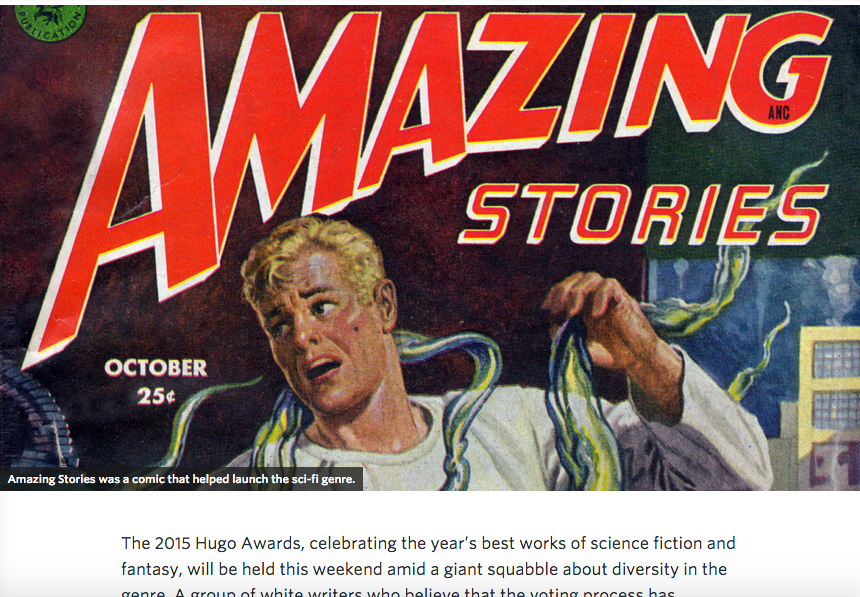
Screenshot of the graphic, caption, and a bit of the article.
The first thing that made me wary about simply retweeting the link is something really minor: the caption on the picture that they illustrate the story with. “Amazing Stories was a comic that helped launch the sci-fi genre.” No. Amazing Stories was a magazine that printed literary stories founded in 1926 by Hugo Gernsbeck. It was not a comic book. While it is often credited with launching the pulp version of the genre science fiction, so that part is true, but it wasn’t a comic.

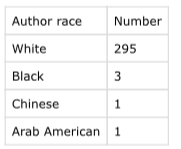
Bar graph as originally published.
Now, ordinarily that would be a quibble, but this article is about statistics, so seeing in the caption that they have already gotten a fact wrong made me a teeny bit apprehensive. Then we get to the most dramatic graph, and I think, “That can’t be right.” What about Saladin Ahmed, author of Throne of the Crescent Moon, Best Novel nominee in 2013? Shouldn’t there be a bar labeled “Arab” with at least 1 person it it?

This only just barely qualifies as data...
This only just barely qualifies as data…
Amusingly, I started this post early this morning, then had to go to a nearby clinic for some scheduled medical tests, and while I was sitting in the waiting room, Mr. Ahmed’s tweet commenting on being erased from the data came through my feed. Since then, one of Vocativ’s editors sent out a tweet that they’re correcting the article. The bar graph now does list one Arab-American. That’s a bit better, but that’s the thing. Now how do we trust them about the other 295 authors they claim are white? You might think that clicking on the “Get data” link under the graph would give you a spreadsheet of all the nominees, right? Nope. You get a spreadsheet, all right, but it just says “White 295, Black 3, Chinese 1, Arab American 1.”

This may seem really petty and nitpicky, but here’s the thing: if you are trying to make a statistical argument to back up a claim, you have to get every fact right. And you have to give us confidence that you are likely to get every fact right. There is a big argument to be had about what we mean by race. Race is a social construct with no basis in biological science, so there will be lots of people who will want to nitpick the data if we did have a big spreadsheet that listed all 300 nominees. I suspect that the graph now is close enough to correct to still illustrate the point that the Hugo Awards have hardly been a paragon of diversity. Even more importantly, the ludicrous charge that the Hugos have been being somehow secretly controlled by a liberal cabal that has imposed political correctness onto the ballot for many years is demolished by facts such as this.

But to the next person who wants to compile something like this: quadruple check your results before publishing!

Hugo Awards Announced Tonight!

The award are tonight! From the official Hugos website:

The 2015 Hugo Awards Ceremony is scheduled for Saturday, August 22, 2015 at 8 PM Pacific Daylight Time in the INB Performing Arts Center in Spokane, Washington. The Hugo Awards web site will once again offer text-based coverage of the 2015 Hugo Awards ceremony via CoverItLive, suitable for people with bandwidth restrictions. For those with the bandwidth for it, Sasquan will also offer live video streaming of the 2015 Hugo Awards ceremony via UStream. In addition, Sasquan will present “The Road to the Hugos”, a livestreamed Internet pre-and-post Hugo broadcast featuring hosts Stephen Schapansky and Warren Frey of Radio Free Skaro, as part of the coverage, starting one hour before and ending one hour after the ceremony.

Here’s the link for the text coverage of the ceremony.

And the link for the live video stream of same.

And the link for the Radio Free Skero livestream pre- and post-shows.

I predict:

  • No Award will take maybe two categories, causing cheering from some and more threats from the Überpuppy,
  • At least two nominees from one of the Puppy slates will walk home with a Hugo,
  • Some people on both sides will claim victory,
  • Some people on both sides will claim it is a defeat for all that is right and just in the world,
  • Regardless, science fiction will survive!

I plan to have a mini Hugo Watching Party here tonight.

Now matter what happens, please offer congratulations to the winners and please console any nominee (and I mean anyone) who does not get a trophy. Similarly, offer condolences to anyone you know who is disappointed that their favorite in any category didn’t win.

And for the future: if you are a fan, read and watch good science fiction and fantasy (however you define it) and support the writers and artists who make it. If you are one of those writers or artists: in the immortal words of Neil Gaiman, I urge you to make good art.

Ad Astra!

Computerized Clods and Squeamish Scoundrels: more of why I love sf/f

Lost in Space, 20th Century Fox Television & CBS Broadcasting
Lost in Space, 20th Century Fox Television & CBS Broadcasting (Click to embiggen)
The first episode of Lost In Space aired on CBS in September of 1965, and I was glued to my set. It debuted less than two weeks before my fifth birthday, so I don’t remember a lot about my feelings about the first episode. If you aren’t familiar, the show follows the adventures of the “space family Robinson” (Professor John Robinson, his wife Dr. Maureen Robinson, their grown daughter Judy, and younger children Penny and Will; their pilot, Major Don West, and their robot called B-9 in the early episodes) who were sent off to be the first colonists of the Alpha Centauri system, except their ship is thrown off course due to the bumbling actions of the stowaway/saboteur Dr. Zachary Smith, who ends up trapped on the ship when it takes off.

Lost In Space is not remembered as being serious science fiction, or even as a serious series. Though this is primarily because of the second and third season. The first season was intended as a serious action adventure series giving a science fictional spin to the early 19th Century novel, The Swiss Family Robinson, which had itself been inspired by the 18th Century novel, Robinson Crusoe. Like those novels, the early episodes focused on the crew as castaways trying to survive in a hostile environment. Some of the sci fi notions of some first season episodes were pretty silly by modern standards, but mostly because they were attempts to adapt the sort of complications that might appear in a western series or a contemporary slice-of-life series and put a spacey spin on it… Continue reading Computerized Clods and Squeamish Scoundrels: more of why I love sf/f

Thinking Machines and Thoughtless People: more of why I love sf/f

Hardcover copy of the original version of David Gerrold's When Harlie Was One.
Hardcover copy of the original version of David Gerrold’s When Harlie Was One.
I was thirteen or fourteen years old when I found the copy of When Harlie Was One in the public library. The book jacket described an intelligent machine that has to prove he is a person or be shut down. It sounded really cool. This was during a period in my life where I was literally reading at least one entire book every day. I visited the library constantly, turning in a pile of books I’d finished every few days and checking out more. I read during every free moment. I even read while I was walking to school or while walking home. Yep, I was that kid, walking down the sidewalk with my nose stuck in a book. Books weren’t my only friends, but they were my best friends.

Thinking back, I’m sort of surprised that particular public library in that tiny town had this book. It had only been published a year or two previously. Most of the science fiction they had was stuff that had been around for much longer. Of course, When Harlie Was One had been nominated in the best novel category for both the Nebula Award and the Hugo Award (it won neither) not long before the library acquired it, so maybe that’s why the librarian who ordered new books picked it. I don’t know… Continue reading Thinking Machines and Thoughtless People: more of why I love sf/f

Dark Prophecies and Evil Half-brothers – more of why I love sf/f

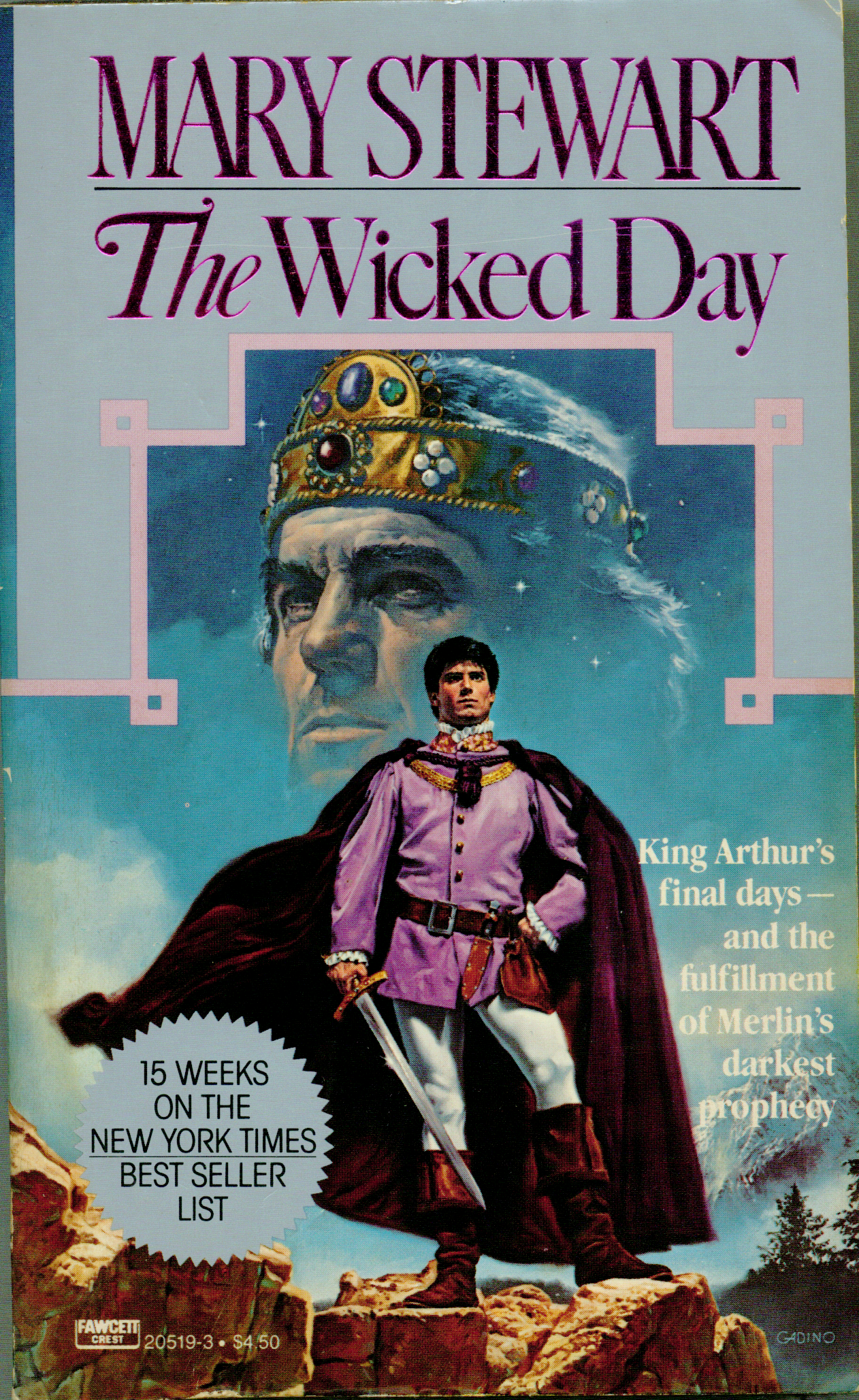
A scan of my own copy of The Wicked Day, by Mary Stewart, purchased back in 1983. (Click to embiggen)
In the last two weeks I have written about the first three books in Mary Stewart’s Merlin series. The first three books are first-person narratives told from Merlin’s point of view, while the fourth book is told in third-person, mostly from both Mordred and Arthur’s points of view. Part this choice was necessitate by the fact that the crucial parts of Mordred’s story happen after the death of Merlin, so Merlin can’t narrate it. And if you’re familiar with the classic Arthurian legend, you know that both Mordred and Arthur die at the same time, so neither of them could be the narrator.

Even within the third-person narrative, Stewart shifts perspective. The opening of the book is told in an omniscient viewpoint, the narrator revealing the thoughts and feelings of all the characters. While the bulk of the book is subjective, in some chapters the reader is privy to Mordred thoughts but sees all the other characters through his eyes only. In other chapter’s we are in Arthur’s perspective. Then at the end, she moves t a more objective viewpoint, though not fully omniscient. Anyway, I’m spending so much time talking about this viewpoint stuff, which you might be inclined to think of as the mere mechanics of writing, because in a completely different sense, The Wicked Day is all about viewpoints. Several important plot points turn on the fact that one or more characters is operating on incomplete or completely mistaken understanding. And the theme is about perspectives… Continue reading Dark Prophecies and Evil Half-brothers – more of why I love sf/f

Aging Enchanters and Sinister Plots – more of why I love sf/f

The cover of The Last Enchantment by Mary Stewart
I couldn’t find a nice large image of the same cover art as my copy on line, so spent a while trying to scan the gold paperback. The best image I got was this one, even though you can see my hands and iPhone reflected in the cover. (Click to embiggen)
Last week I wrote about the first two books in Mary Stewart’s Merlin trilogy and how they became the standard against which I measure all Arthurian stories. The third and fourth books in the series came along some time later, and consequently influenced me in very different ways.

Before I get into that, I want to remind you that voting for the Hugo Awards ends tomorrow. If you are a Sasquan (WorldCon 2015) member and haven’t completed your ballot online, do it now before the servers get bogged down with the rush. The ballot is here. If you aren’t a member, you can still buy a supporting membership to become a voter, but since processing a membership might take a while as more traffic hits the servers, time is running out!

At the time The Last Enchantment was published, in 1979, it was usually referred to as the last book in the Merlin Trilogy… Continue reading Aging Enchanters and Sinister Plots – more of why I love sf/f

Dreaming of better tales

The Hugo trophies handed out at the 21st World Science Fiction Convention, also known as Discon I, held in Washington, D.C., 1963.
First, another reminder that voting for the Hugo Awards ends on Friday. If you are a Sasquan (WorldCon 2015) member and haven’t completed your ballot online, do it now before the servers get bogged down with the rush. The ballot is here. There is still time to buy a supporting membership to become a voter, but since processing a membership might take a while as more traffic hits the servers, you want to do that soon!

I have had two topics I’ve been trying to finish a blog post on today, one kept turning into yet another a kvetch about the Sad/Rabid Puppies bloc-voting scheme, and the other is just not quite finished (which I’m kind of sad about, as it features both another Tolstoy quote and a digression on statistics). And then I read Aaron Pound’s blog post, 2015 Hugo Voting – Roundup and Review and his first few paragraphs more calmly say some of the things I was trying to say, and I figure why not just point people to his better post (and if you haven’t read his blog before, take a look around while you’re there!).

And I have to quote my favorite bit:

The worst thing that could have happened to the reputations of many of the Puppy-promoted authors is that people would read their work, and once they were placed on the Hugo ballot, that is exactly what happened.
– Dreaming About Other Worlds blog

Anyway, don’t forget to vote! And remember that buying a supporting membership to WorldCon supports not just the Hugos, but the conventions themselves! (And I’ll try to finish up the Tolstoy/statistics post in time to post this week!)

Finland! Finland! Finland!

The Hugo trophy handed out at the 15th World Science Fiction Convention held in London, England in September of 1957.
In his novel, Anna Karenina, Leo Tolstoy wrote, “All happy families are alike; each unhappy family is unhappy in its own way.” A lot of people think that Tolstoy was making a cynical comment about happiness, but the idea that the novel explores and demonstrates is actually that there are many, many different things that can go wrong in one’s life to make one unhappy (and you only need one of those things to happen), whereas the only way to be truly happy is to avoid each and every one of those misery inducers. I have some philosophical disagreements with the second half of that. But what got me thinking about all of this was trying to describe to a friend why I believe that specifically the Sad/Rabid Puppies are doomed to fail, based on my observations over the years of groups ranging from the anti-gay National Organization for Marriage to the Westboro Baptist Church to Jerry Falwell’s Moral Majority, and before that Anita Bryant’s anti-gay Save the Children, and way way before that Falwell’s proselytizing against racial equality de-segregation.

That’s because, while unifying social justice advocates is like herding cats because they are each outraged in their own way, haters are easy to predict because they are only happy when the people they hate are unhappy.

But I think more than enough pixels have been spilt explaining all of that. Today, let me remind you that voting for the Hugo Awards ends on Friday. If you are a WorldCon member and haven’t completed you ballot online, do it now before the servers get bogged down with the rush. The ballot is here. There is still time to buy a supporting membership to become a voter, but since processing a membership might take a while as more traffic hits the servers, you want to do that soon! George R.R. Martin posted a nice summary of why, if you love science fiction and fantasy, you should “ vote NOW.”

Both Michael and I completed our ballots this weekend. The system allows you to go back and change things if you want, and there are two categories I keep changing my mind about. I’m not certain whether or no I’ll post my final ballot. I can sympathize with arguments for either option. I’ve already said enough in my Hugo Ballot Review series of posts for a bunch of the categories to give everyone a good guess.

I should also mention that if you are a WorldCon member this year (supporting or full attending), and if you purchase an advanced pre-supporting membership for 2017, you can vote in the site selection for 2017. That deadline is August 10, but you can’t vote online. Rules require the committee conducting the vote to allow each of the groups that are bidding to host the con to audit the ballots and for ballots to be signed. So you need to do it soon enough for your ballot to arrive in the mail by August 10th (not be postmarked by August 10, but to arrive at their P.O. Box, which this year is in Pennsylvannia).

The pre-supporting membership will automatically become a supporting membership for whichever of the bidding committees win the site selection vote, so you will be a supporting member in 2017 (and if it winds up in a city near you or that you’ve always wanted to visit, it’s cheaper to upgrade your supporting membership to full membership). This also means you’ll be able to nominate and vote in the 2017 Hugos.

If you want to vote in the 2016 Hugos, you can buy a supporting membership to WorldCon 2016 (being held in Kansas City). If you do all of this, then you can nominate and vote in the Hugos every where from now on simply by buying a pre-supporting membership in the future WorldCon as soon as the e-mail comes out telling you that site selection voting for the 2018 has opened (and the next year, and the next). And you will get that email because it goes out to everyone who is a supporting or attending member for each current WorldCon. The pre-supporting memberships are usually slightly cheaper than what a supporting membership costs once the site selection vote is over.

Once you get on that train, it’s a simple matter of buying each pre-supporting membership as soon as they are announced, and then you can both nominate and vote in each year’s Hugo Awards. And while everyone is reminding everyone to vote, the only way to reduce the odds of future bloc-voting schemes succeeding is to get a much higher percentage of the people who will vote in the Hugos, to also participate in the nomination process.

I don’t want to unduly influence anyone’s voting in the site selection, but I was amused, after my husband and I had each independently filled out or ballots, we revealed to each other our reasons for voting as we did. I voted for Helsinki as my first choice because I think that Finland deserves to have a WorldCon (and I’ve always been fond of Finland because of one teacher’s aid I had in high school who was Finnish). Michael also thought Finland should get it because they have been passed over before, and added that if he wins the Lotto and we decide to go, it would be a fun part of Europe to see. We both voted for Montreal and Shizuoka (Japan) as our second and third choices because, as I put it, if finances suddenly come together for attending in 2017, Japan or Quebec should have more pleasant weather in August than Washington, D.C.

Neither of us want to go to D.C. in August.

And if Helsinki wins, all of us can put this song on continuous loop:

(If embedding doesn’t work, click here!)

Enchanted Caves and Bastard Princes – more of why I love sf/f

7608611906_f2c36c6e6e_zI’ve mentioned before that it’s my Mom’s fault that I am a fan of both science fiction and mysteries. From the time I was a baby, she would read aloud to me from whatever book she was reading (and when I got to the point I was trying to talk, she would cajole me into repeating back words and phrases and eventually whole sentences, which is how I learned to read at least a year before I was sent off to school). Since her favorite authors were Agathe Christie and Robert Heinlein, they made up a large proportion of what she read. But that’s a slight oversimplification. Because she read other books, too. The Christies and the Heinleins resonated with me in a way that the gothic romances she was also fond of did not. With one exception.

Mary Stewart wrote romances that weren’t always classified as romance. They were mysteries as well, and she integrated the two elements in a way where the solving of the mystery illuminated the character development as the characters fell for each other. So you’ll find some places classify her old books as thrillers, or mysteries, or romances, depending on the whims of the reviewer. Paperbacks my parents each bought tended to get taken back to used book stores to be traded in for store credit unless they were deemed worthy of multiple rereads. So there were only a couple of Stewart’s romances (most originally written in the 50s) that stayed on our bookshelves for years. One particular that I remember reading myself after pulling it off Mom’s shelf several times to look at the cover, was Stewart’s romance/thriller The Moon-Spinners.

I think I was in fifth or sixth grade when on a shopping trip Mom stopped at the used bookstore… Continue reading Enchanted Caves and Bastard Princes – more of why I love sf/f

Hugo Ballot: My final take before voting closes

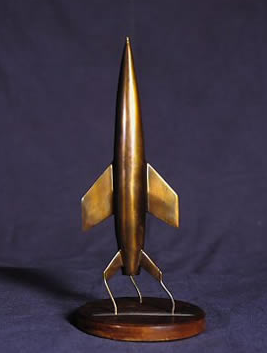
The Hugo trophy handed out at the 67th World Science Fiction Convention in  Montréal in 2009. Designed by Dave Howell. This is the only Hugo trophy that I have personally touched. (Click to embiggen)
The Hugo trophy handed out at the 67th World Science Fiction Convention in Montréal in 2009. Designed by Dave Howell. This is the only Hugo trophy that I have personally touched. (Click to embiggen)
This was going to be merely the next in my own journey of reviewing the Hugo nominees before casting my ballot. I have attempted to read all the nominees with an open mind, rather than cast a No Award vote for anything that had made it onto the ballot due to the bloc-voting scheme of the Sad Puppies and Rabid Puppies. Links to my previous reviews are included below… Continue reading Hugo Ballot: My final take before voting closes

Timebomb from the Stars – more of why I love sf/f

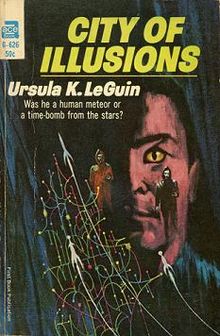
The cover of my paperback version is a bit more tattered than this image I found (Click to embiggen).
I think I found my copy of Ursula K. LeGuin’s City of Illusions at the used book store that was in a town thirty miles away from the town I lived in for most of middle school. I know that I owned it before my folks split when I was 15. I don’t recall exactly where I acquired it, but I do know why I wanted to book: the character on the front of the cover had cat’s eyes, which I thought was really cool.

I don’t think this was the first sci fi novel I read that featured such a character. There are are so many sci fi books with characters that look mostly human, but have eyes like a cat or a bird of prey. But it was the eyes that really grabbed me.

The story begins with the man on the cover being found in the woods without any memory, not even a language, no clothes, and no clues as to who he is. The people who find him aren’t certain he’s human, because of the eyes, but they take him in, name him Falk, and teach him. We learn that this is Earth of a distant future, once part of an interstellar federation of some sort, conquered by aliens, and now severely de-populated and isolated from the rest of interstellar society. The aliens technically rule the world, but they keep to themselves in a single massive city.

Falk eventually sets out on a quest to try to discover who he is. This allows the author to show the reader other parts of the world before Falk finally is taken captive by the alien overlords who tell him he’s one of only two survivors of a crashed spaceship from another world. They introduce him to the other survivor, and offer to restore his memory—though it will mean erasing his current personality. Falk agrees, and the novel switches to the point of view of the restored personality, who doesn’t know what Falk knows about how the humans on earth are treated. The aliens want Falk to go back to his own people and tell them how they are running earth as a garden, keeping the humans happy.

Eventually the original personality is able to awaken Falk’s memories, which also means that he winds up with two personalities trying to work together.

I’ve left out an important detail: just about everyone seems to be telepathic, Falk, all the humans he meets, and the aliens. Telepathy was how the old Federation came to be, because no one can tell a lie in psychic communication. Except it turns out the alien invaders can. Falk and the restored original personality realize the aliens aren’t going to let him go if he remembers the truth about Earth, so he has to steal a spaceship and escape to his homeworld where he may be able to convince them to attempt to liberate Earth. There’s a cute telepathic trick that Le Guin uses at a crucial point in the climax, and the story ends on wit Falk on his way to his homeworld, but without the certainty that Earth will be liberated.

The novel straddles several categories of science fiction. The world is a post-apocalyptic world, even if the apocalypse happened a thousand years ago and a new, stable set of societies have developed. There’s also the aliens subjugating humans genre. And the isolated protagonist who has to discover who he is.

The novel is one of three loosely connected books (the others being Rocannon’s World and Planet of Exile) in which Le Guin was working out a single future history, in which humans have been seeded on many worlds, and they have diverged in various ways, but still consider themselves one race. This is where it encompasses another idea that was more popular in Golden Age science fiction: humans aren’t native to Earth, but were seeded there hundreds of thousands of years before our time.

Some of her much more famous later books, The Left Hand of Darkness, The Dispossessed, and The Word for World is Forest are sequels, in a sense, to these books. They all allude to the common history of these three, in any case, so a lot of people lump them all (along with a few others and some short stories) into a single saga called The Hainish Cycle. Le Guin herself has rejected the label, in part simply because the collective works don’t tell a single story. Another reason is that in the first three books she was trying to figure out how to do a future history, rather than having drafted a coherent future history as a grand backstory to it all. So there are contradictions and variances in the histories of all the books.

The City of Illusions is one of those stories that sticks with me in weird ways. I remember Falk, his struggle to discover himself, and especially the way that Le Guin portrays the two people living inside one head phenomenon at the end. I remember the notions and paradox of telepathic lying. But I forget things like what the aliens are like. I forget what any of the other human societies that Falk visits during his adventures are like. That’s not a bad thing. The story is, on one level, about isolation and discovery. And that part really resonated for me at that age. Some of her other ideas from this book I find myself incorporating into my own stories without consciously realizing where they came from. Which I think means that Le Guin conceived them and executed them well: they’ve become part of the fabric of how I think things would actually work.

Years later, I have read many other Le Guin books, and I own her translation of the Tao Te Ching, a holy book that figures in this novel’s plot. Which I think means that once I finish reading this last Hugo novel, I need to add City of Illusions to this year’s queue for a re-read.