Category Archives: writing

The idea of ideas

Certain questions come up again and again at writing panels, on writing forums, and in writing discussion groups. A lot of those questions are about “ideas.” Where does a writer get ideas? How do you know an idea is worth writing? How do you translate your idea into a story? And so on.

I put the word “ideas” in quotes in that first mention because I believe the people who ask these questions have a profound misunderstanding of the meaning of the word. All words have different meanings depending on the context, of course, but I’m talking about something more than that. Because not only do the people who ask these questions misunderstand the word idea, they misunderstand the entire notion of story.

A story is not a collection of unique notions and eccentric characters presented in a series of shocking situations leading to a surprising ending. Some things we call stories contain all of those things, and in very rare occasions some good stories contain those elements, but that isn’t what a story is. If you want to turn to the dictionary, you might think of a story as a narrative designed to entertain the reader or listener—but that’s at best a mechanical definition of certain types of prose.

A story is a means to transfer a dream from the imagination of the storyteller to the imagination of the reader. Another way of putting it, a story is an incantation for evoking an experience in the mind of the listener.

Specific situations, characters, confrontations, and so forth are part of the arsenal of the storyteller, but they are building materials, not tools. And they are basic building materials, at that. Think of them as nails. Does a carpenter spend a lot of time agonizing over whether a specific nail is worthwhile for this project? No, unless a specific nail is obviously damaged in some manner. Does a carpenter spend a lot of time worrying about where he will find his next nail? No, nails are the kind of supplies a construction company buys in bulk. Does a carpenter spend a lot of time worrying about how to translate his bag of nails into a finished building? No, because nailing boards together is just one tiny part of the entire process of building something, and how to do that is a fundamental skill one should master long, long before attempting to build a house.

The sorts of things that people usually mean when they ask, “Where do you get your ideas” really are as fundamental and individually unimportant as a nail. Yes, if you’re building a house you will need good nails, and they’ll need to be used properly, but no single nail being slightly imperfect, or slightly out of place should ruin the entire structure.

The true skill of storytelling is the process of assembling all of those things together. And as you learn to do that, you start to realize that the parts you were focused on so intently when you were learning the craft are not the most important part of the story. It’s not where your nails came from, or how perfect each nail is.

It’s how you use them.

Don’t think. Thinking is the enemy of creativity. It’s self-conscious, and anything self-conscious is lousy. You can’t try to do things. You simply must do things.
—Ray Bradbury

NaNoWriMo achievement unlocked again!

Winner-2014-Web-Banner
I’m not finished with the novel. In fact, I figured that 50,000 words would be about half of the total novel. But I have a good, solid start on it. I will need to shift much of my attention over to the final edits to the first novel so I can publish it, not to mention a Christmas Ghost story that must be ready to read in just three weeks (eeek!).

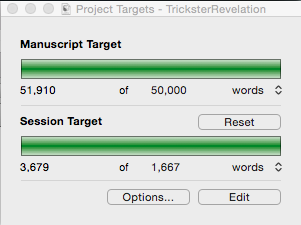
I love this little project targets widget in Scrivener!
But right now, I’m very happy with how much I’ve written and how far the first draft of the third novel in this series has moved. Yay!

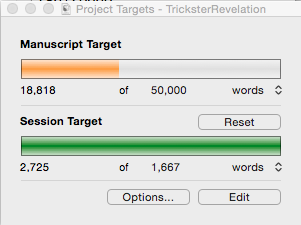
This is the first time I’ve used Scrivener’s Project Targets widget. It’s very cool. You set the word count target for the entire project, and Scrivener keeps track of it in the top bar. When you only have a few words written, the bar is red. As the bar grows, it changes to orange, then yellow, then yellow-green, turning a darker and darker green until you reach the goal. The lower bar is for shorter term goals you set. You can reset that bar any time you like, except that it always resets at midnight. Which works nicely with National Novel Writing Month (NaNoWriMo), since writing every day and trying to average 1667 word a day is the goal.

Screen Shot 2014-11-01 at 6.22.05 PMI tweeted screenshots of my project targets over the course of the month, so here’s one of the earliest ones, when the upper bar representing the whole month was still in the red, and that particular day I was just getting into the orange.

November isn’t quite over, yet, and I haven’t reached the end of the novel, so I plan one continuing to work on this for a another day before I switch to the Christmas ghost story.

I also need to post an update on my yearly goals. I haven’t since early October, because everything was focused on NaNoWriMo this month. But I have not forgotten them!

Right now, I’m feeling very happy about the writing.

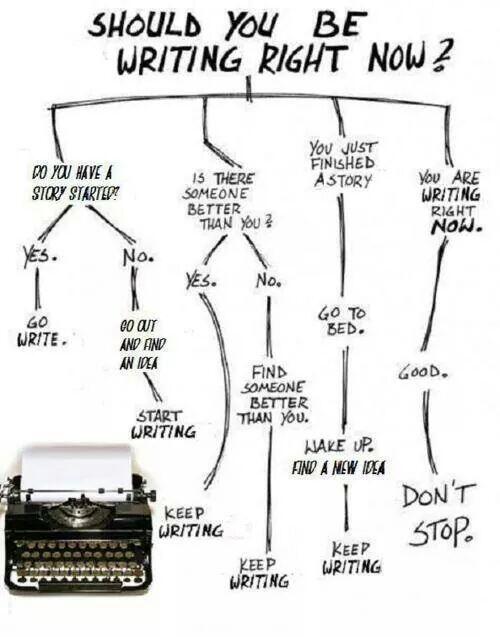
Writing, writing, don’t stop!

My progress just before midnight, the 11th day of NaNoWriMo.
When I started this year’s NaNoWriMo (National Novel Writing Month), I knew there would be days where I made very little progress. Events on our schedule included an all-day editorial work party, hosting Writers’ Night, an all-day roleplaying game session, and the Thanksgiving holiday, which involves an overnight trip out of town.

Last year had a similar schedule, so I made an effort on those weekend days that we didn’t have anything planned to me extra productive. And it worked out. I exceeded the goal by about 8500 words. I didn’t reach the end of the story, but I got of writing in.

This year, the first being on a Saturday (and with us having no conflicts), I was at 6,595 words by the end of the first weekend. That’s nearly double the number of words number you’d have at the average words per day necessary to hit the target of 50,000, so I felt that was a good start. I only got a few hundred in on the next day, but Tuesday through Thursday, I exceeded the daily goal each time.

Friday evening was when the gout and hay fever had both taken a significant turn for the worst. I wound up taking a long nap after finishing my work day, and was in a bad head space after, so hardly got any writing done.

Then the weekend was full, and as mentioned in yesterday’s post, I was battling pain in my foot all weekend, so I my productivity continued to suffer.

But, Monday night I managed to exceed the daily goal a little bit, and last night (as you can see in the graphic) I blew past it by more than a thousand words.

So, I’m still on track to hit 50,000 by the end of the month. Even though I have a few days with very little writing time available.

Still, I feel good. Wish me luck!

November Writing Challenge: NaNoWriMo

I'm doing NaNoWriMo again!
I’m doing NaNoWriMo again!
Last year, inspired by Cafe Aphra‘s Alternate NaNoWriMo, I set up a NaNoWriMo profile, set a goal of finishing my novel that was already in progress (The Trickster Entanglement), and set a word count goal of at least 1,000 words a day. This was a deviation from the official NaNoWriMo rules at the time:

  • Write one 50,000-word (or longer!) novel, between November 1 and November 30.
  • Start from scratch.
  • Write a novel. We define a novel as a lengthy work of fiction.
  • Be the sole author of your novel.
  • Write more than one word repeated 50,000 times.

Once I had my profile set, I discovered the NaNo Rebels forum on the NaNoWriMo site, which was an officially sanctioned way of doing more-or-less what I planned to do.

This year, NaNoWriMo has officially loosened the rules a bit, striking the “Start from scratch” rule and replacing it with, “Don’t count anything you wrote before November 1 in your word count.”

Even though all of my previous participations in NaNoWriMo have been at deviance with the rules, I’m actually a little disappointed in that rule change. Because I’ve always thought that the original goal of trying to write a novel in a month was a great exercise. The only reason I hadn’t done it before was because before the first NaNoWriMo ever, I’d already been in situations at work where I wrote more than 50,000 word in less than a month. I didn’t feel I needed to learn that lesson, but rather needed to get better at finishing things I’d already started.

That’s why when I participated before last year, I would set myself a goal I usually called GeneStoFinMo (Gene’s Story Finishing Month), where I’d try to finish a bunch of stalled short stories. I had varying degrees of success.

Last year was completely different. I attribute part of it to having only one story I was focused on. Another part of the difference was I did post word counts on the site regularly. And I had at least a couple of writing buddies I was competing against. Or we were egging each other on. Or something.

In any case, wrote 58,000 words, very nearly finishing the novel last November. I used both Camps NaNoWriMo this year to tackle revising and finishing that novel and a related project. I contemplated the goal of using this November to complete implementing the rest of the editorial comments I’d received on a previous project, but I’d been revising and editing and so forth all year. I felt like I needed to do something different.

So this year my goal is to write at least the first half of the next novel in my fantasy series. I say half, because my guess is the final product will be about 90,000 words. I am setting the word count goal of 1667 words a day. So, yes, I want to hit at least 50,000 by the end of the month. I have written several scenes that might be in the book. But I’m not sure. So the plan is to start from a totally blank file at midnight on October 31, and see where the words take me.

If, by chance, you are participating in NaNoWriMo this year and would like to be writing buddies, my NaNoWriMo name is Fontfolly. Please add me, say hello, and I’ll add you back.

Let’s get writing!

They don’t all have to be heroes, but…

ZoeHellerQuoteSo one of the new shows I’m watching this year is a very soap opera-ish murder mystery that has a season-long story arc. And despite the heavy use of flashbacks, I enjoyed the premiere, so I let my Tivo keep recording it, but I didn’t watch the next several of episodes because I was busy, and I devoted what TV time I had to other shows. But I kept reading good things about the show from people I like.

I squeezed the second episode into my schedule, and I found the characters and the story still engaging, despite some quibbles with the cases-of-the-week that were being used as a means to propel the longer story and make the show appeal to people who might be less invested in big story arcs. But I didn’t watch the other episodes already on the TiVo right away.

Suddenly there seemed to be an explosion of people raving online about how much they liked where the show was going, so the next time I had a few hours, I got caught up. The story is still very intriguing, the dialog is snappy and believable, and the characters are getting fleshed out. The problem? I hate just about every one of them.

Just a handful of episodes into the first season, they have managed to make every character that is more than a walk-on extremely self-serving, detestable, or utterly loathsome.

To be fair, for decades it’s been the practice of soap opera-style shows to give every character major personality flaws and some sort of secret. But it’s a technique originally resorted to by writers who had to create episodes about the same cast of characters five times a week, fifty-two weeks a year, for dozens of years. Which means it can be most charitably described as an act of desperation.

As soon as one raises the question of likability in literary circles, someone will present the counter-argument that characters who are perfect in every way—always cheerful, and always lovable—are unrealistic and boring. The sort of reader or viewer who wants characters to be likable is characterized as unsophisticated, vapid, or even mentally deficient. But the only mental deficiency in question here is the sort of person who thinks the only alternative to making every character wholly repulsive is for characters to be unbelievably good.

In fact there is a wide spectrum between entirely abhorrent and absolutely flawless. In other words, not every character has to be a hero, but if the spotlessly pure character is unrealistic and boring, so are the characters who lack any redeeming qualities whatsoever.

Nobody is perfect. Everyone makes mistakes. Everyone lets their worse instincts get the better of them sometimes. Everyone has some personality quirk or habit that at the very least annoys someone else. Every person has done something in their life of which they ought to be embarrassed or ashamed. I understand all of that, and I get that sometimes you want to tell a story about the things we hope people will regret later. I do.

Lord knows I love a good villain, and my protagonists are never what anyone would call perfect people, but at a minimum characters need to be relatable. I don’t want to despise, pity, or disdain every single character. Give me something to admire about at least one of the characters. Give me a hint that some of them might be redeemable.

Give me someone to root for.

Literary Crimes

maxresdefaultWhen I was 14 I started writing a mystery novel with perhaps supernatural overtones. I’d been writing stories for as long as I could scribble more-or-less recognizable words on paper, though by 14 I was typing on a big heavy typewriter at a decent clip.

My protagonist was a 12-year-old boy—for plot purposes I felt it was important to begin the story in the summer between his sixth and seventh grades at school. He lived in a small town that was an amalgam of all the small to medium-sized towns I’d lived in thus far.

My habit at the time was to write until I couldn’t think of what happened next (or my folks yelled at me to stop making all that clattering typing noise and go to bed). The next day I would read what I had written so far, and usually I could start typing away, writing the next scene and the next and so on.

So one afternoon, when I had several chapters finished and wasn’t sure what to do next, I re-read what I’d written thus far. It was all going well until I hit the last scene I’d written the night before… Continue reading Literary Crimes

(Un)real Characters

2bad57a909fd53708036ef02ae3ba068So I was scanning through my usual news sites a couple of weeks ago and saw a headline about the Guardians of the Galaxy that caught my eye. I’d already seen the movie the previous week, and had enjoyed it even more than I had anticipated. So I definitely went into the article with a bouncy fanboy attitude. The author talked about how the movie was better than he had expected, mentioned a few of the pros and cons of the overall story and construction, but then settled in to his main thesis: the characters audiences seemed most drawn to in the film were Rocket, the genetically-altered and cybernetically-enhanced raccoon, and Groot, a walking, (barely) talking tree—and the writer thought this was a bad thing.

He thought it was bad because those two characters are computer animated images, rather than being portrayed by human actors. He admitted that they were voiced by human actors, but “when pixels move us to tears more readily than actual people, that’s a problem.”

My pedantic side immediately wanted to post a comment that, since most theatres have made the switch to digital projection, every character in every movie people see in theatres are pixels rather than real—not to mention all the movies and series that people watch on TVs, computer monitors, phones, and tablets now. Even before digital movies, old-fashioned film wasn’t real people either, it was images projected on a screen by shining light through celluloid tinted with various chemicals.

All of that is missing a more fundamental point. None of the characters in films, plays, television series, et cetera, are real. They are all fictional characters being evoked by a combination of tricks and techniques of storytelling and acting.

I realize that I’m a bit biased, here. I have been a fan of comics from an early age. I grew up laughing at and following the adventures of Bugs Bunny, Daffy Duck, Yogi Bear, and dozens of other cartoon characters. I have edited and published a science fiction fanzine that features talking animals, the occasional human, and all sorts of aliens for nearly twenty years. I’m currently engaged in writing a series of fantasy novels set in a world populated by talking animals, dragons, ghouls, kitsune, and any number of other non-human creatures. For the last few years, I have awaited the unveiling of a new season of My Little Pony: Friendship Is Magic with as much anticipation as a new season of Doctor Who or White Collar.

So maybe I’m just a bit too far out from normal to be commenting on this. However, the author of that particular article is someone I’ve read before. He’s the regular movie reviewer for a news site I read just about every day. I’ve seen many of his previous movie reviews, some of which I agreed with, some that I haven’t. Like many movie reviewers, he approaches his critiques from a literary rather than visual arts point of view. He always talks about plot, themes, narrative flow, viewpoint, characterization, and dialog.

So it’s a little strange that someone who approaches movies from such a strong literary perspective can’t understand the true appeal of any character. Readers have been meeting, getting to know, and coming to love imaginary characters for as long as fiction has existed. Characters like Anne of Green Gables, Oliver Twist, Huck Finn, Sara Crewe, d’Artagnan (and his comrades Athos, Porthos, Aramis), Robin Hood, et cetera have been engaging readers for generations. For much of their history, those characters have been less than even pixels: people have read words on paper, and conjured the face, voice, and being of the character entirely in their imagination.

Yes, illustrated books, live theatre, and various recorded forms of movies and series have also breathed life into those imaginary characters, but those are all simply different forms of conveying and evoking the idea of the character in the minds of each of the viewers. It is still, ultimately, about the imagination of the audience embracing the story and the characters within it.

As a writer, I deal with imaginary characters constantly. My head is full of a mad assortment of characters, some of them characters I have created for my own stories, others are characters I have come to love (or love to hate) through stories created by other people. When I’m writing a story, my job is to try to evoke in the reader the story that I have imagined. An important part of that process is evoking characters that the reader will, at least temporarily, imagine as if they were real. And more importantly, will have feelings toward as if they were real.

That’s the entire point of art, to engage the audience, and make a connection between hearts and imaginations. And it doesn’t matter whether I’m telling a story verbally, in text, on stage, with painted images, or computer rendered animation. It doesn’t matter if the characters are named Jenny Nelson or Buffy Summers or Zoe Washburne or Applejack.

What matters is the story.

For at least a few minutes, can I make you care about what happens to these characters? Can I make you interested in how they got into the situation they find themselves in? Can I make you wonder what’s going to happen next? Can I so engage you that you can’t look away until you know how things turned out for the character?

Getting the audience engaged with the characters is never a bad thing. And if you think that some fictional characters are less “real” than others simply because of the medium through which the audience’s imagination is being engaged, then you don’t understand storytelling.

At all.

Confessions of a creative fool

(Click to embiggen)
(Click to embiggen)
“Nothing is created without passion.” I’ve read it in interviews, read it in writing books, or heard it in panel discussions dozens of times: the successful artists or writers are the ones who feel an overwhelming passion to create this piece or tell this story. Google “passion to create” and you’ll turn up hundreds of articles and blog posts about finding your passion and channelling it. Also scores of articles about how passion alone isn’t enough.

It must be the truth, because so many people are saying it, right?

Well, not really…

Continue reading Confessions of a creative fool

I am the king of typos

FB_quote_23-e1379605544254I make typos. A lot. It is amazing the number of people who believe there is a strong correlation between intelligence and typing accuracy. And that’s what we’re talking about, here; it often isn’t spelling that is at issue. There is no such connection.

Now, it’s not that I don’t think correct spelling is important, I do. No one gets more irritated at me that I get at myself when I make a typo, trust me. As much as it may amuse or exasperate you, I am ten times as angry at myself when I find them or have them pointed out. Plus humiliated. I want to spell things correctly.

And most of the time I do. And sometimes it is not spelling correctly that’s the problem…

Continue reading I am the king of typos

Summer camp!

2014-Participant-Facebook-CoverI had so much fun (and got a lot of work done) with April’s Camp NaNoWriMo, that I have signed up again for July. And this time I have a bunch of friends joining me. Some had to be bullied convinced to join the fun, but I’m hoping they enjoy it as much as I did last time.

My project this time is looping back to my previous novel. I’ve received editorial comments on the completed manuscript from several editors and readers. Now I need to edit, fix, and otherwise finish it so that it is ready to publish.

While resisting urges to work on the just finished first draft of the second book, or a little side project, or the next book, or…

My friend, Mark, who’s been doing NaNoWriMo longer than I, set up a “cabin” (which is mostly just a private message forum) and invited a passel of our friends to join in. Everybody has different kinds of projects planned. I look forward to teasing and encouraging and assisting each other through this month of creativity!

I’m scheduling this post to publish midday on the first, which means some of you will be reading this while I’m under sedation having a not terribly pleasant medical procedure. Or maybe by now I’m home recovering, saying silly things to the crazy friend (and cabin mate) who has kindly volunteer to drive me back while I’m under the effects of the drugs. Or driving my poor husband crazy. Or maybe I’m just going to sleep it off.

So I’m not sure how much progress I’ll make in the opening 24 hours of Camp NaNoWriMo. But it doesn’t matter. Full speed ahead!