Once again, I’m going to participate in Camp Nanowrimo. Camp is similar to the full-fledged National Novel Writing Month, except they’re much looser on the rules (not that the full rules are that restrictive). Camp Nanowrimo is for doing things such as editing/revising a novel (which you may have written during a previous NaNoWriMo, for instance), or working on a smaller project as perhaps a way to practice for trying to write a full 50,000+ word story in 30 days at a subsequent NaNoWriMo.
I’ve used it in the past to do editing, plotting, and revising. Currently, I’m planning to finish off an editing project, which I have described rather facetiously. Though I’ve been so unproductive working on my novel in progress, that I’ve also been thinking of knocking out a few very short stories I’ve been noodling on for a long time first. We’ll see how I feel after work tomorrow!
Why do this as part of Camp Nanowrimo? It’s helpful to me to have a defined goal, with a clear end date and some mechanism for measuring progress. More importantly, a mechanism for reporting progress so I have motivation not to goof off. In most of my previous Camps and Nanos, I’ve managed to remain focused and accomplish at least most of my goal more quickly than when I’m just trying to meet my own monthly tasks.
I enjoy bantering with my writing buddies, including cheering them on when they make progress, or racing with someone to see who can hit a higher word count on a particular day.
So, I’ve invited a bunch of my past writing buddies to be cabin mates (a cabin is a group of participants who share a private message forum and can easily keep track of each others’ progress on the cabin web page). I think we’ve got a good group.
I was catching up on some podcasts last week, specifically going back through episodes that I had started but not finished. I was listening to Cabbages & Kings, which is a sci fi/fantasy podcast that focuses on books and other written stories, with a focus on the things readers love about the experience of reading. In that specific episode the host, Jonah Sutton-Moore, was discussing queer romance in sf/f with Carl Engle-Laird who is an editor at Tor Books and is bisexual. It was a good episode, but I was shocked when Engle-Laird said that he had only recently learned about the Tragic Queer Trope/Cliché, and specifically that he had learned about it after he had already selected two books for publication in which the only queer character in the story dies. He says something along the lines, “I had just learned about this cliché and the pain it causes so many people, and I was about to publish two books that fit it and realize there’s trouble coming my way.”
The host of the podcast shared a similar story, about how he had reviewed a book in which the two main characters, who happen to be lesbian, overcome the obstacles of the plot and apparently live happily ever after. In the review he had expressed some surprise at how many rave reviews he’d read of the book before reading it himself. Not because the book wasn’t good, he didn’t see that it was a breakout book as so many reviews described. People reading his blog had to tell him that what felt groundbreaking about the book was the fact that the queer characters not only lived to the end of the book, but actually got a happy ending.
I’m not shocked that the straight host of a sci fi podcast was unaware of the prevalence of the phenomena described at TV Tropes as Bury Your Gays and Gayngst, or a bit more honestly explicitly at places like Another Dead Lesbian or The Curse of the Tragic Lesbian Ending and so on. I was disappointed, but not shocked.
It was the queer editor not knowing about this cliché that shocked me.
And I want to be clear, this isn’t meant to be a slam at either the podcast host nor his interviewee. I’ve been listening to this podcast for months, I like it (heck, I nominated it in the fancast category for the Hugos this year!), I listened to several more episodes after the shocking moment (and I’m all caught up again!), and will continue to recommend it.
But I’m still always disappointed when people in the business are unaware of just how unwelcoming to queer people most pop culture is in general, and sci fi/fantasy is in particular.
I realize that it is hard for non-queer people to grasp this, since they are so used to seeing themselves reflected in every show. Any time I’ve talked about a specific instance of “Bury Your Gays” with non-queer friends, their first reaction is always to explain to me that other people die in the book/movie/series. It isn’t that queer characters should never die. The problem is that nearly every queer character depicted in a relationship in pop culture either dies, or is left alone, bereft, and grieving over the death of the only other queer character in the story at the end.
All. The. Time.
That’s on the rare occasions that queer characters in relationships are included at all. Most often, queer characters simply aren’t in the stories. In those rare cases where queers are included, they are unattached romantically without any plot line other than to be the funny/eccentric sidekick to a straight character, or they die. And quite often it is a senseless death that exists for no reason other than to shock the viewer and give one of the surviving characters a reason to grieve and motivation to accomplish their goal.
One of several infographics at jcwelker.com/post/141225630214/vandelrio-nonadraws-this-is-my-final-projectIf you think I’m exaggerating, here’s a couple of statistics for you. According to GLAAD, out of the 881 regular characters appearing in all of the primetime network shows during the fall of 2015, 35 of them were lesbian or bisexual women. We are now just a bit over 80 days into 2016, and since January 1, eight of those fictional women who love women have been killed on screen. That’s nearly one quarter (22.85%) of all the women who love women that have been allowed to appear on television screens this year killed.
Imagine, for a moment, if in the last three months 22% of all the regular characters on every single show on network TV had been killed off on screen. That’s 194 characters, almost 2.5 a night. Seriously, if regular characters were being killed off on every television show at that rate, people would be up in arms. They would be sending angry messages to networks executives asking why there is so much more violence in every show. The Daily Show and/or John Oliver would have some epic comedic rants about the murderous spree that all of the network producers had gone on, and those rants would be viral on Youtube.
Right?
If one quarter of all regular characters on network television shows were killed off every 80 days, then every show would have effectively a complete cast turnover every television season. And that makes no sense for a continuing story over multiple seasons, so no show-runners in their right minds would do that.
Fictional murders, senseless deaths on screen, et cetera are not random acts of violence. They are decisions that show runners and writers and network executives make. People are making the decision to kill off queer characters at a much higher rate than any other category of fictional character. Just as a lot of us have called bullshit on writers, producers, and executives who claim they can’t add a queer character to an existing series or franchise until the “right story” comes along, it is at best self-delusion when the decision-makers try to claim that it is just a coincidence that they kill off queer characters at such a high rate.
It is sometimes argued that the only reason that we notice when queer characters are killed off is because there are so few of them to begin with, therefore each loss is especially keenly felt. But that ignores the disproportionate rate of the deaths. Yes, if a quarter of all characters appearing in regular recurring roles in all shows were killed every 80 days, we could argue that the only problem is how few queer characters there are. Even if that were the only reason, the lack of representation itself would still be a problem, as I’ve argued before: Invisible no more: rooting out exclusion as a storyteller.
The truth is that both the lack of representation, and the excessive rate of disposal of the few examples of representation we ever get are symptoms of a deeper problem. Author Junot Diaz summed up the real issue best:
You guys know about vampires? You know, vampires have no reflections in a mirror? There’s this idea that monsters don’t have reflections in a mirror. And what I’ve always thought isn’t that monsters don’t have reflections in a mirror. It’s that if you want to make a human being into a monster, deny them, at the cultural level, any reflection of themselves. And growing up, I felt like a monster in some ways. I didn’t see myself reflected at all. I was like, “Yo, is something wrong with me? That the whole society seems to think that people like me don’t exist?”
There is an agenda to deny us representation—to pretend we don’t exist at all if possible, or to make certain we are perceived as monsters, freaks, or tragedies if we must be acknowledged. Whether a particular storyteller consciously agrees with that agenda or not, whenever you leave us out, or kill us off without thinking about the message it sends, or sit by silently while someone else does those things, you are serving that agenda.
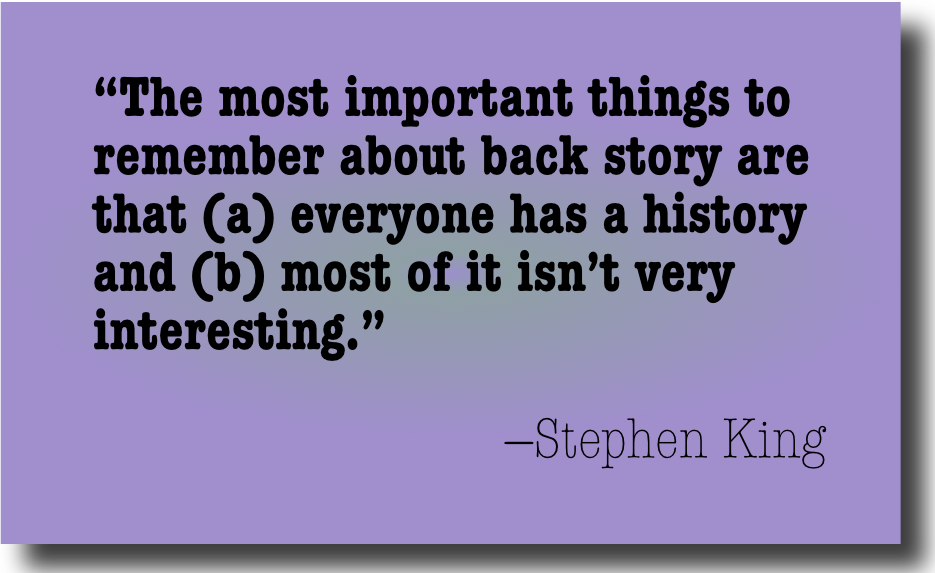
Click to embiggen.There’s a lot of really good advice out there about beginnings in fiction: how to write a good opening line, common traps to avoid, and so on. Unfortunately most of those articles and blog posts focus on the actual first sentence or paragraph, rather than the bigger question of where to begin the story. Because life seldom has clear-cut beginnings and endings, authors have to decide where to start and where to stop.
Years ago a friend shared an article from Writer’s Digest that referenced the old Krazy Kat newspaper comic strip, which had a running gag involving one of the characters getting hit in the head with a brick. The article said that the place to begin your story is the moment your protagonist his hit in the head metaphorically by the problem or conflict or riddle which forms the basis of the plot. The moment when the character realizes this is a big problem. The moment when the character discovers that this isn’t just going to be another day in her life.
I read a lot of amateur fiction, fan fiction, and rough drafts of other people’s work. And I’ve noticed that lots of people don’t understand that. They start the story long before the brick. They may still start the story when something disruptive happens in the character’s life, but it’s more like a moment that they character stumbled on a door step, days or weeks or months before the brick.
The worst are stories that end with the brick. We meet a character who is in a difficult situation. We meet some of the other characters in the protagonist’s life. Things happen and the situation gets worse. We see the character struggle with the issue, trying to figure out what’s really happening. The character attempts to get out of the bad situation a few ways, and either fails entirely or achieves a temporary relief that leads to a worse situation. And then there’s a big dramatic, shocking moment… and the story just stops. We’ve finally reach a point where the story has gotten really interesting, and the writing snaps the book closed and snatches the story, metaphorically, from our hands.
I just finished a story like that, where the character suffers through a lot, persevering through an unjust imprisonment and enduring various indignities, making a teeny bit of headway with one of the other prisoners, and then finally learning a little bit about one (and only one) of the mysteries the writer had been teasing us with for the entire story, and then that was it—an previously unseen character whose existence had been hinted at appears, causes a lot of damage, rescues the other prisoner and leaves. We get a denouement in which the protagonist is released, receives an apology of sorts from some of the authorities and goes. We never know what happened to any of the specific people responsible for the imprisonment, we never learn why a lot of the things that happened to the character happened, et cetera.
That’s not an ending, that’s an abandonment!
I know that someone will defend the author’s decisions by saying that we don’t always get all the answers in real life, and that bad people don’t always get what we think they deserve, and so on. But this isn’t real life. It’s fiction. The difference between real life and fiction is that fiction has the make sense. The author is free to tell and omit what he or she wants, yes, but never forget that it is a sin to waste the reader’s time. You may not want to tell the story about the mysterious character who rescues one of the others in the end for whatever reason. But by structuring the rest of the story this way, the author has teased the reader. Worse than that, the author has misled the reader. The author has laid out a lot of intriguing questions, sprinkle in some enticing tidbits, clearly implying that those breadcrumbs would lead to something interesting. And then the author didn’t deliver.
It’s a bait and switch.
Don’t get me wrong: leaving some things open-ended for the reader to debate and wrestle with is all right. But the conflict introduced the beginning needs to be resolved (by the protagonist’s own actions) at the end. Not solved, necessarily, but resolved. I failure to solve the problem is a resolution, after all.
This particular “story” isn’t actually a story, it’s the backstory to a story the author didn’t write. At least the way it is structured. It’s like. Sci fi story I read a long time ago in which a journalist is approached by a crackpot claiming people are being replaced by robots. The journalist doesn’t believe the guy at first, then various things happen that make it seem there might be something sinister going on, then the crackpot suddenly changes his tune, insisting he was mistaken and off his meds. The story ends with the journalist laying in bed, unable to sleep, something makes him check his wife for a heartbeat. And the final line of the story is that he can’t hear a heart beat in her chest, just a mechanical whirring!
It might have even ended with more than one exclamation point.
That wasn’t an ending, that was a beginning. Because the interesting tale isn’t that people don’t believe dangerous things are happening around them. The most interesting conflict is: what do you do when you find out your loved one has been replaced by an android?
Go back to the brick. Crackpots spout nonsense at people all the time. You don’t have to be a journalist to have some stranger come up to you and make extraordinary claims. Just stand at a bus stop on a busy bus line for a few hours and it will happen a lot. If you are a journalist, it must be even more common place. So that wasn’t a brick, it wasn’t even a stumble. It was business as usual. The brick was finding out the crackpot was correct. The story scould have begun with, “Everything fell apart night John discovered his wife had no heart. He had been chuckling to himself just before hand. A crazy man had contacted him, insisting he had proof of a conspiracy. John had known it had to be a delusion, despite all the evidence and the strange incidents that happened with the cars with darkened windows and mysterious sounds behind closed doors. He had only checked as a joke. It would make a funny story to share at the next cocktail party. But then he put the stenthoscope to her sleeping chest…”
And then you go from there. You don’t need all the back story. You can fill in details later, if needed. Fit the facts the reader needs to understand in dialog, that sort of thing.
Find the brick. Hit your character in the head. And then show us what she does about it!
“The writer cannot make the seas of distraction stand still, but he [or she] can at times come between the madly distracted and the distractions.” – Saul Bellow via AzQuotes.com (Click to embiggen)Any time I pause to do something which I think will only take a few minutes, I run the danger of the one thing leads to another curse. It happens to me all the time! Most especially when I’m trying to write. I’ll stare at the scene that I’m trying to finish, for instance, pause to reach for my coffee or tea and as likely as not the cup isn’t there where I expect it be.
So I’ll get up and go looking for the cup. Which may simply be sitting on the kitchen counter, where I left it while I was refilling it from the coffee maker, and was distracted by something else. Or it might be up in the bathroom, because right as I was refilling it I decided I should make a pit stop, and I carried the cup with me where I sat it beside the sink and then forgot about once I was done. Or maybe it’s in the microwave, because an hour previously my nearly full beverage had been too cold to be appetizing, so I took heated it up, and then forgot about it.
If it is in the microwave, it has probably cooled back down, so I’ll hit the button to reheat it, and head back to my computer determined that this time I will notice when the microwave dings and come right back. Which means that I’ll sit at the computer staring at the screen, but I’m not really thinking about writing, I’m listening for the ding of the microwave. And I’ll go retrieve the drink this time…Continue reading Confessions of the badly, madly distracted→
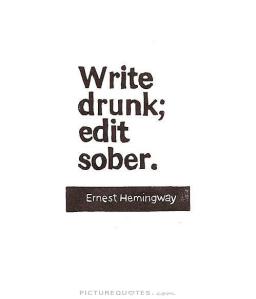
Write drunk; edit sober. – Ernest Hemingway (Click to embiggen)Now that National Novel Writing Month (NaNoWriMo) has come to an end for another year, a lot of people are looking at large piles of words which they have assembled and are contemplating the task of editing. At least I sincerely hope they are1! Editing can be a daunting task. And let’s be honest, it is hard work.
But, getting the rough draft together is no mean feat. And it’s whole lot easier to revise something once you’ve got a rough draft than it is to create the first draft to begin with6.
Now, some people operate under the mistaken notion that by editing we mean going through the story line by line to correct spelling and get the punctuation right. No, that’s copy editing. And you do that at the very end. Which isn’t to say that you oughtn’t fix any spelling errors, typos, and so forth that you notice during the first editing pass, but that isn’t what editing is. It’s not even the most important part of editing.
Storytelling isn’t about creating perfectly structured sentences with perfectly spelled words and having every comma at just the right spot. One reason why that isn’t nearly as important as many people think is because there are a lot fewer rules of grammar than most people believe. There are wrong ways to use a comma, yes, but there are an infinite number of completely different but still right ways to use (or omit) one as well. A lot of the “rules” that people have learned aren’t rules at all. They aren’t even, often, good guidelines. They are preferences in some case—and outright myths in others.
Writing isn’t a simple algorithmic function. A story needs to live and breathe. A story has a mood, sometimes that mood changes as the tale moves along. Some parts of a story move more quickly than others. You may have a rapid fight scene with a lot of angry posturing and taunting between the opponents, followed by a more leisurely description of the aftermath, when the conquering heroine comforts the person she rescued. And you control pacing by varying things like length of sentence, length of paragraphs, choices of punctuation, and so on.
No style guide, no matter how good, can tell you how to structure a sentence to be brassy and defiant. You have to let the context be your guide.
But before you get to copy editing, you need to revise, restructure, and clean up your story. In my day job as a technical writer we have several terms for different types of editing. And the one you need to concern yourself with first is what we call a developmental edit. This is where you look at things such as the structure of the story, the plotting, the pacing, the characterization, the tone, and the overall reading experience. This is something that is very hard to do to your own work if you haven’t been writing for a long time, but it’s something you can learn, and just like writing, you learn it primarily by doing. But you also have to study.
Pick up some good books about structure and narrative7, and read at least one all the way through before you pick up your manuscript at start the edit pass. I admit, at least half of the reason I give this particular piece of advice is to give you some time away from your story. You need some emotional distance in order to look at your work objectively8.
Then you need to look at the story first as a whole. What is your central conflict that drives your main character’s actions? Does this conflict run like a thread from the beginning to the end of the story, or does it get tangled and cut off midway through, and another conflict entirely take over?
What about the emotional arc of each of your characters? This is another way of looking at the theme of the story. Why should the reader care about the things that happen to your leads and supporting characters? What is at stake and how do they feel about it? In what way do they change? Or what prevents them from changing?
Does the order of events make sense? Are you missing connecting scenes? Do you need to have a few characters spell out their motives a bit more?
Is the pacing of the story overall consistent with the plot? Does the pacing of individual scenes match the mood, purpose, and context of that scene?
Do your sub-plots compliment the main plot, or are they distractions? Does each sub-plot line up with the emotional arc of at least one character?
There’s a lot to work on. And at some point you’re going to have to let someone you trust (and by trust, I mean, they will give you their honest opinion) read what you’ve got to see how they react to it. So long as you remember Neil Gaiman’s advice: “Remember: when people tell you something’s wrong or doesn’t work for them, they are almost always right. When they tell you exactly what they think is wrong and how to fix it, they are almost always wrong.”
Before you do that, you should try the trick of reading it aloud in an empty room. You will be amazed when you read a scene aloud to yourself at all of the things that are wrong with it which you never noticed while reading it silently.
Editing is work, but it has rewards. There will be moments during the editing process when you’re just sloughing through, and start wondering if it’s worth it. And there will be other moments that inspiration will strike and you’ll find yourself writing new bits or revising existing bits that feel as exciting as the best moments of the first draft.
Just remember: the goal is to tell the story the best that you can. Never forget that.
“Write drunk; edit sober.”
—Ernest Hemingway
Footnotes:
1. A writer I follow on Twitter re-tweeted another writer who said, “An agent recently told me that every December 1 she receives hundreds of unsolicited, awful, unedited manuscripts. Don’t be that person.” So, obviously, there are people who don’t realize that a rough draft needs edit and re-write passes2.
2. This shouldn’t surprise me. As the editor of a non-profit amateur publishing project for more than 20 years I frequently received unsolicited manuscripts from people who were absolutely aghast when we asked for re-writes. “Can’t you do that?”3.
3. And I’ve written before about people who have never written a thing in their lives and are convinced that their life experiences would make a great book—and then find out that I’m a writer. They are always shocked that I’m not willing let them tell me their anecdotes so that I will write it up for them for a promise of a small percentage of the proceeds?4
4. Though my favorite was still the woman who, after listening to my explanation of the project at our table in a Dealer’s Den of a sci fi convention, asked if we she could dictate her stories to us and we just write it down. I referred her to services that will do that and she was appalled that someone would actually charge to type her stories for her. “I’m doing the hard part! I thought it up!”5
5. See, it isn’t just artists who have to contend with this!
6. Even though there are times while working on the rough draft that you probably despaired of ever finishing, there were also times when the words just seemed to fly from your fingers. You didn’t always know what was coming next, but right that moment, inspiration was driving you, and it was fun.
“Quantity produces quality. If you only write a few things, you’re doomed.” –Ray BradburyWhen I was planning this year’s National Novel Writing Month (NaNoWriMo) project, I set myself a goal of writing at least three or four pep talk style posts about the importance of not giving up and/or about some writing tricks and tips that seemed appropriate as I moved along. I did write about three such posts before November began, aimed at convincing people who were considering giving it a try, or who had considered it before but thought they couldn’t do it to take a shot.
But my plan didn’t quite work out. Part of the issue was that about the time when a lot of people might need a little encouragement to keep going, I got bogged down in some of my own issues, and my previous fast pace slowed way down.
Today, shortly after noon, I crossed the 50,000 word finish line. Though I haven’t quite finished the story I set out to write, so I’m going to keep working and see just how high a word count I can rack up before the end of the month. But there is still a week left, and some topics have come up in my conversations with writing buddies on Twitter and similar forums.
The biggest one is the old cliché about quality vs. quantity. It manifests in various ways. One friend said that because he didn’t think a lot of what he wrote this month is moving his original plot along, that the word count is some sort of cheat. This misses the point of a rough draft: it’s all right to have a lot of bad stuff that needs to be revised, rewritten, or deleted later. It’s a lot easier to clean up a mess of words and sharpen it into a good story than it is to write the work from a blank page. Fill up the pages (virtual or otherwise) with all the ideas, and then clean it up later.
We all wish that what we did was sit down at the keyboard, typed the story from the beginning until the end, and then when we re-read it afterward, discovered that it was a complete masterpiece, perfect in every way. That isn’t reality, for anyone, no matter how talented or experienced. Yes, as you practice and improve, a lot more of your rough draft is good stuff that needs little clean up, but the only way you get to that point is to spend a long time writing far-from-perfect stuff. Improvement comes from doing things mostly wrong, trying something slightly different next time, and over time learning how to recognize the good stuff when you produce it, and how to discard the not-good stuff.
You have to produce a whole lot of bad art or writing before you can make good art. No matter how bad your writing is, some of it is going to be better than other bits. Keep practicing, and the ratio of bad-to-good will improve.
So don’t despair. Don’t give up. Don’t get down on yourself. At this stage, you’re not making a final product. The old joke is that making a sculpture of a noble horse is easy, you take a big rock and knock off all he pieces that don’t look like a horse. At this point you’re assembling as much rough draft as you can, so later you can cut away all the pieces that don’t look like a final story.
“Quantity produces quality. If you only write a few things, you’re doomed.”
—Ray Bradbury
I wrote recently about why having queer characters in books, particularly science fiction, isn’t about pandering or finding a good reason to include us, but rather simply of matter of not excluding us. The real world has queer people (a lot more than most people think), and there is no good reason that fictional worlds wouldn’t have just as many of us.
There’s an interesting post going around Tumblr that gathered together this series of facts (originally tweeted by Andrew Wheeler @wheeler) about some current or recent works of fiction based on historical characters. The historical facts are verified, I’m not merely repeating. I include a bit more context on each than Wheeler was able to fit in a short series of Twitter posts:
Leonardo da Vinci was almost certainly gay, but the series Da Vinci’s Demons portrays him as (barely) bisexual who seems to be exclusively attracted to women.
Alexander the Great was gay, and was known to be gay to the extent that the greek historian Plutarch wrote extensively about the moral way Alexander behaved toward the various men he had loved. The great love of Alexander’s life was a man, Hephaestion. When Hephaestion died, Alexander mourned him for months, refusing to eat for days, and nearly killed himself. The only movies that have ever included Hephaestion doesn’t even hint at the relationship, let alone even showing them kiss.
Alan Turing, the genius who decrypted Enigma among other things during World War II, has sometimes been described as the greatest gay hero of the modern age. He was convicted of indecency (and forced to take drugs to repress his libido) because he confessed to being in a long term relationship with his boyfriend. In the recent movie which tried to portray him as a hero, he is instead caught with a male prostitute and portrayed as a loner who had no love in his life.
The epic love of Achilles and Patroculus is a keystone of the legends of the Trojan war, but in the recent movie Troy they’re portrayed as simply buddies.
John Nash, the mathematician, was sexually active with men throughout his life, getting arrested a few times for it. He was married twice, though both relationships were problematic, and it’s unclear how many of the issues in the second marriage were due to his struggles with mental illness as opposed to his frequent same sex dalliances. A Beautiful Mind omits the first marriage and child completely, and also completely erases the same sex liaisons, which due to the arrests, played a significant role in the tragedies of his real life.
This list focuses on men because Wheeler’s point was that television and movie executives are extremely squeamish about showing men being seductive or explicitly romantic or in any way physically intimate with other men. But it isn’t just “Hollywood” that has that problem.
Lots of people cite the Marvel Comics character Deadpool as an example of a bisexual character. The creators of the character frequently claim that he is bisexual, but the kindest way you can describe those claims is that they are being very bad writers by telling us rather than showing. The more accurate description is that it is a queer-baiting lie. Oh, yes, Deadpool makes all sorts of sexual jokes toward other men, and he seems to be particularly obsessed with Spiderman, but that is all we ever see in the stories: jokes. Deadpool has never ever been shown actually in a relationship with another man. He has had a lot of romantic relationships with women in the comics; loves of his life that have died tragically and so forth, but not one single man.
Slightly better is DC Comic’s John Constantine, who in the comics had at least one significant same sex romantic relationship (in additional to several opposite sex romances), and said same sex relationship was integral to the plot of one of the longer story arcs. He’s also been portrayed flirting with men, seducing other men, and so forth. All well and good. Until we get to the television series (which, alas, was canceled last year after only 13 episodes), where there isn’t even a hint of his bisexuality, and the producers and writers said off-screen that he was not bisexual.
And don’t get me started on the epic amount of queer-baiting the creator and producer of the Teen Wolf television series has been doing for six years!
So, to sum up: when we call for diversity in books and movies and television shows, we aren’t asking to be pandered to. We aren’t asking you to shoehorn something into the story. We’re asking you to be realistic. We’re asking you to write believable stories.
Appendix: This blog post, in which a writer explains why he is re-writing some really old sci fi stories by swapping genders and such as his NaNoWriMo project provides some other good points about erasure in fiction: Get Bent – Why Bother?
I’m participating in NaNoWriMo, again!As I’ve mentioned several times, I’m participating in National Novel Writing Month (NaNoWriMo) once more. But I realized that in the several posts leading up to this week, I haven’t explained what it is. So, first, from the official website:
National Novel Writing Month (NaNoWriMo) is a fun, seat-of-your-pants approach to creative writing.
On November 1, participants begin working towards the goal of writing a 50,000-word novel by 11:59 PM on November 30.
There are rules, but I’ve always participated as a Rebel. But last year they dropped the one rule that kept making me a rebel.
Write one 50,000-word (or longer!) novel, between November 1 and November 30.
Start from scratch.
Write a novel. We define a novel as a lengthy work of fiction.
Be the sole author of your novel.
Write more than one word repeated 50,000 times.
It used to be that you were supposed to begin with a total blank page (or empty word processor file) and not type any words of the actual novel before November 1. Now the new rule is that you only count the words you actually write during November in your total. So since I was usually working on finishing or revising an existing piece, I was a rebel.
Now I’m not. Except that I still feel like a rebel, dang it! I’m just a rebel who happens to be following the rules this time.
I meant to post this earlier in the week, but kept getting caught up in other things. One of the coolest things about NaNoWriMo the last few years is that the makers of Scrivener, which is in my not-so-humble opinion the best writing software out there, make a special trial version available free for the duration of NaNoWriMo plus seven days. So if, at the end of the month, you decide you don’t want to buy the software, you can still export your work to a format that is readable by ordinary word processors.
You can download this special trial and a custom NaNoWriMo Novel template here.
The NaNoWriMo template is like the ordinary novel template, except that it contains links to free video tutorials, and it contains a macro that will output you novel in a scramble plain text form if you are paranoid about uploading your piece to the word-count verifying function later in the month.
Scrivener is not merely a word processor. The folks who make it (and it’s a very tiny company of, last time I checked, three people) describe it as a complete writing studio, or a content generation system. Scrivener has projects rather than single files. you can add scenes or chapters, move them around, view them in a summary mode where they look like index cards, and so on. Each project also has a research binder where you can save all your notes and scribblings and other supporting information. It’s all kept in the project, but won’t appear in the final product when you publish the manuscript in all the supported formats (include epub, of course).
One of my favorite features is that, from within the Research binder, you can select an “Import web page” function. Paste the URL of the page in question, and Scrivener will go out, copy all the text, images, links and so forth, and make it a “page” in the research binder or your project file. It’s not a link, it’s a complete copy. So if the web page goes away, you still have all the information from the page. This is really handy when you’re doing research on the web.
Scrivener is an awesome program that I’ve been using for years, and on top of all this content management and publishing functionality, it only costs US$45. That’s full price. If you download the NaNoWriMo trial (either Windows or Mac version) and set up a NaNoWriMo account, at the end of the month you can buy it for a 20% discount, no matter whether you finished your 50,000 words or not.
If, however, you do finish the 50,000 words and upload and get verified, they’ll send you a code that lets you buy Scrivener at half price. When I first started using the older version a few years ago, after just a week of the free trial I decided that the full price was a bargain, and I’ve never regretted it.
I’ve only used the Mac version. I have a couple of friends who regularly use the Windows version and they like it a lot. I should also mention that I have at least two friends who use both, and they both agree that the Windows version isn’t quite as slick as the Mac version. But the company is only a handful of people, so I can understand. Also, I know that the Mac version leverages a lot of functionality which Apple bakes into the operating system which simply isn’t there in the Windows OS (just because the companies have different philosophies on how to do things).
I really love Scrivener. They don’t yet have an iOS version, but I use a function they have to synch a project to an external folder, and I synchronize it to Dropbox (it will also sync to iCloud drive, and Copy and a lot of other cloud services), and then I edit individual scenes on my iPad using a word processor for iOS called Textilus. There are a lot of other word processors for iOS, and if you already have one, if it can read RTF files, you can do this, too.
There are some other special offers for NaNoWriMo participants, including two other writing tools I’ve never used: Ulysses (Mac and iOS) and Storyist (Mac, iPad, iPhone). There are trial versions available of the Mac versions, and discounts offered after completing NaNoWriMo.
The only tool other than Scrivener on the sponsor offers page that I’ve used is Aeon Timeline, which I have found very useful for charting out the events of the world I have created for my series of fantasy novels.
Anyway, whether you’re doing NaNoWriMo or not, if you’re a writer, I can’t recommend Scrivener enough. You can get the NaNoWriMo trial version at the link I shared above, or if you don’t want to be bothered with NaNoWriMo, but the tool sounds interesting, their ordinary 30-day trial version is here.
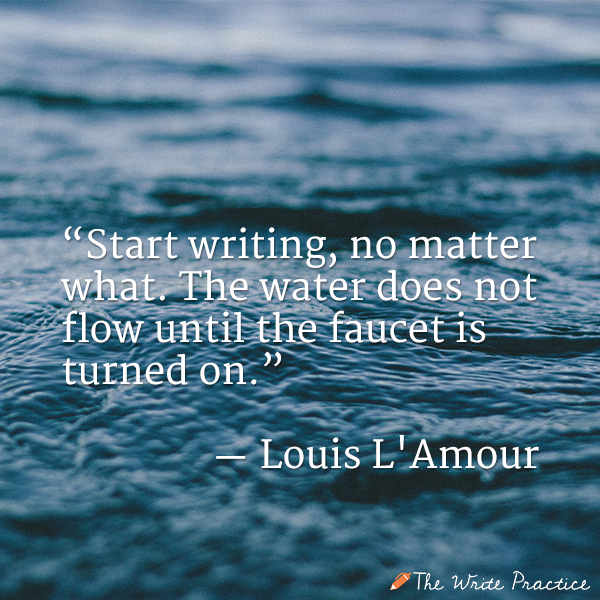
“Start writing, no matter what…” (Click to embiggen)I’m getting ready to do National Novel Writing Month (NaNoWriMo) again, which means that I’m also attempting to recruit people to join in the challenge. I was one of those people who for years encouraged other people to do it without doing it myself. I would refer to the time that I wrote a 75,000 word technical manual from scratch, all the actually writing done in only a couple of weeks, and point out that I already knew that I could rack up a big word count. And I’ve had fiction published, lots of short stories, novelettes, novellas, and novel-length pieces.
But word count isn’t what it’s all about. It’s also about setting some goals (maybe very crazy goals) and pushing yourself through it. There’s something kinda magickal about getting to the end of the month after having written so much, commiserating with others trying the same thing.
My last couple of pep talks have been about just making yourself sit down and plow through, learning not to get paralyzed by the need for perfection, or fear that it isn’t good enough, and so on. A big part of writing is, indeed, a matter if putting down the next word, and the next, and the next, until you reach the end. In fact, for a project like NaNoWriMo, that’s what most of the month will be about.
But even though lots of famous writers say the same thing: all that matters is the next word, that isn’t really all that matters.
Before there can be a next word, there has to be a first word, doesn’t there? Getting started is more than just typing a word. If you are doing a novel, or a play, or writing a script for a comic, or writing a memoir, you need to have some definition of the story, and you need to have a starting point.
Novels don’t necessarily need the same sort of quick hook opening sentence that a short story does. Because the reader knows they’re going into a longer story, they will probably give you more than just the opening sentence to grab their attention. But the opening does still need to be a hook. And not just for the reader. It needs to hook you. Before you can hook yourself, you need to have an idea what the story is.
While I have listed myself on the NaNoWriMo web page as a Planner rather than a Pantser (someone who jumps in and writes “by the seat of their pants”), I’m not big on elaborate plans and outlines before I write. My novel, The Trickster Apocalypse started as an opening scene that just came to me when I was supposed to be writing a story I had promised another ‘zine editor. Even when I’d finished writing a 3,000 word beginning that night, I didn’t think it was a novel. It was after I’d written a few more chunks that big that I figured out what it was.
Other times I’ve started with something like this: “Cheating death and the consequences thereof. M and J each seek ancient artifacts and forbidden tomes for very different purposes. L dies.”
Occasionally I put together much more elaborate outlines or charts. My charts have gotten a bit easier to make and edit since I bought Scapple, a program made by the fine folks responsible for Scrivener. But usually I don’t do that until I’ve gotten a few tens of thousands of words into the story.
If you have a basic conflict: something your protagonist wants but there’s something in her way, you can take the classic reversal of fortune approach. Two steps forward, then one step back. As in: 1) A woman wants to be a concert pianist, 2) then she loses an arm, 3) luckily she meets another aspiring pianist with only one arm, 4) but it’s the same arm… It’s really easy to do, though it can get a little tiresome if you keep it only internal. Which is why it helps if you have supporting characters with their own thwarted desires.
But the important thing is to have a beginning in mind, even if it is a beginning that you know you will have to revise later. Once you are started, there are millions of ways to find the means to put down the next word, and the next.
But you have to start!
Start writing, no matter what . The water does not flow until the faucet is turned on.
—Louis L’Amour
It’s nearly time for National Novel Writing Month (NaNoWriMo), which I’m participating in again. That means that I am encouraging (read: recruiting, nagging, pleading, conniving…) anyone that I can to take a shot at it. Last week I riffed on a quotation from Ray Bradbury, Overthinking is the enemy of creativity to talk about some of the most common ways we can self-sabotage creative efforts.
I dismissed one of the usual excuses, that what you write isn’t good enough, by pointing out that no first draft is perfect. Which is true, but incomplete. The only way that anyone can learn to be a better writer is to write. That means writing badly. A lot. Just like the only way a baby can learn to walk is to try, and fall down, then try again. It is a slow process of slowly getting less bad until we reach a point where we literally don’t remember what it was like not knowing how to walk.
When I said last time that humans are natural storytellers, that was also true and also incomplete. Yes, humans tell stories to ourselves and each other in order to make sense of the world, to communicate, to persuade, and to commiserate. You have years of experience doing that. But if you are a typical person, most of your experience is storytelling through the spoken word—usually face-to-face. Your narrative depends on a lot of nonverbal supplementary material. You sit down with friends and explain about your day, for instance. You may imitate the voice of one of the other people involved in your tale. You might gesture with your hands. Your facial expression changes to convey emotional context. Your tone of voice varies. You slow down at some points and speed up at others in order to draw out suspense of convey a sense of urgency. You will pause dramatically.
And you have none of those tricks available when you write.
What many people never fully grasp is that, while written language is based upon spoken language, they aren’t actually the same language. It’s because spoken language has all that non-verbal stuff going along with it. It has all those non-verbal communication tricks that we learned the same way a baby learns to walk: by observation followed by trial and error. Which means we do it without thinking. But we don’t know how to convey all that with words on screen or on paper.
That’s one of the things we have to learn in order to become a writer. How do we tell our story compellingly without those non-verbal bits? How does sentence length correspond to verbal pacing? Are compound-complex sentences the equivalent of a long aside, building up dramatic tension while providing hints of what is to come so that the listener anticipates where it it going, yet does not become impatient? And what of fragments?
All of that is hardly scratching the surface. It isn’t just about technique. It isn’t just about vocabulary. It isn’t just about structure, or theme, or scene setting, or characterization. It is all of those things, yes, but the whole is also more than merely the sum of the parts.
The only way to learn how to do that is the same as any other skill: observation followed by trial and error. That’s why you need to read as well as write. You can’t simply think about your story ideas. Or talk about them with other people. You have to sit down, just you and the blank page (and it doesn’t matter whether the page is paper or pixels), and write it. Then later, read what you wrote. And let someone else read what you wrote to see how they react to it. And read other stuff by other people. Then sit down again and write again. Revise, rewrite from scratch, write something else for a while to take your mind off of it. All of those things are part of the learning process.
What isn’t part of the learning process is explaining to other people why you don’t have time. What isn’t part of the learning process is playing video games because you aren’t feeling it just now (except when it is, but that’s another post for another time). What isn’t part of the learning process is whining to your friends that you don’t have any ideas.
It’s tough. I know. Though, full disclosure, I don’t really remember just how tough it is. I literally tried to write my first book when I was six years old. Which was 49 years ago. By the time I was ten I was in the habit, every month, of reading the new issue of The Writer magazine at the public library from cover to cover. I checked out books about writing. I copied out whole sections of the books and articles that made the most sense to me so I could re-read the bits later after I turned the books back in to the library. From the fourth grade on I spent so much time in my bedroom banging away on the typewriter writing short stories, attempting novels, and so on, that sometimes my father threatened to burn all my books and take the typewriter and all writing implements away so I would be forced to go be a “normal boy.”
Now I routinely sit down at the keyboard with only a vague notion of what I’d like to write about, and an hour or so later I have over 1,000 words of a relatively decent essay on learning to write by trial and error (that includes the time it took to find the Le Guin quote, open Affinity Designer, and create the graphic to go with this post). Or I sit down at the keyboard looking at a big hole in my plot, click the plus icon in Scrivener, and a few hours later I’ve written a new scene or three which have at least pushed the story forward. Yet, I still can’t write quite as well as I’d like. But I know I write better today than I did last week. And better last week than I did a year ago. A better last year than I did five years ago, and so on.
I got here the same way every writer does: I wrote, it wasn’t as good as I wanted it to be, so I wrote again.
You can do it, too. Don’t give in to the excuses or self-doubt. Don’t compare yourself to other writers. Just sit down, look at that blank page, and then fill it up!
All I can say is, it took me about ten years to learn how to write a story I knew was something like what I wanted to write. In the sixty years since then I’ve learned how to do some more of what I’d like to do. But never all.
—Ursula K. Le Guin
 Once again, I’m going to participate in Camp Nanowrimo. Camp is similar to the full-fledged National Novel Writing Month, except they’re much looser on the rules (not that the full rules are that restrictive). Camp Nanowrimo is for doing things such as editing/revising a novel (which you may have written during a previous NaNoWriMo, for instance), or working on a smaller project as perhaps a way to practice for trying to write a full 50,000+ word story in 30 days at a subsequent NaNoWriMo.

!["The writer cannot make the seas of distraction stand still, but he [or she] can at times come between the madly distracted and the distractions." - Saul Bellow](https://fontfolly.net/wp-content/uploads/2016/01/quote-the-writer-cannot-make-the-seas-of-distraction-stand-still-but-he-or-she-can-at-times-saul-bellow-74-24-32.jpg)



 Font Folly