Tag Archives: culture

Is it worth the outrage? – part three

tumblr_mzq7ewA3w91qk4s2co1_1280A couple of years ago I set myself a personal goal to “Reduce the Outrage.” I modified it and combined it with another last year, and carried it over again this year1. I’ve been sick off-and-on2 for about nine weeks, which means I’m cranky and prone to overreact a lot of the time. In one of the social/cultural spheres I inhabit, certain events are underway which increases the number of things being said about topics in which I have a lot of personal investment. Add to that the histrionics of the U.S. presidential campaign season, and it is really easy for me to find myself in an outraged state.

I’ve written before about letting oneself become outraged in unproductive ways, becoming resentful rather than doing something constructive, for instance. And I’ve quoted before the old proverb, “Resentment is like drinking poison and then waiting for the other person to die.”

The whole reason I set those goals about reducing outrage is because unproductive outrage is toxic and self-destruction and does no good to anyone.

But anger is a symptom of pain, and it is just as self-destructive to ignore pain. Finding something to do to alleviate the harm isn’t always easy. Root causes of many problems are beyond our control. I’m a writer; language is my primary toolset for tackling many problems. Unfortunately, analysis is something of an obsession with me, so I will over-analyze things and easily fall into a toxic spiral of writing, revising, ranting, revising, trying to be reasonable, revising some more—feeling increasingly frustrated and more outraged at every step.

I’ve been stuck in one such spiral for about two weeks.

Then, through a series of fortuitous clicks (reading one article, clicking a link in it, reading the referenced blog post, clicking a link in it, et cetera), I came across this post from Steve Saus4 from last May that said one of the things I’ve been thinking about so much perfectly: And you shall know them by their works. It says it so well, and more importantly, so succinctly, that I’m just going to quote the whole thing here:

There are two sides in our current culture wars.

But don’t decide which side is which by their names.

You will know them by their actions.

One side works so that everyone should have an opportunity to do something – get married, be nominated for an award, pee in whatever bathroom, be on television.

The other side already can – and has – done all those things. That side works so that only their group can get married, be nominated for an award, pee in a bathroom, or be on television.

Forget the labels for a second.

Are you working to give more people the same chances and opportunities… or to deny chances and opportunities to someone else?

It all comes down to that. Are you working to give people opportunities, or are you trying to keep opportunity out of their hands?


Footnotes:

1. A post has long been brewing about my failure to post monthly goal reports the last two months of last year, and how I’m handling my goals this year.

2. Or maybe it’s continuously and those stretches of several days when I thought I was well in between the symptoms were just pauses in the illness. We’re not sure.3

3. Adding to the uncertainty is the fact that my husband has been sick much of the same time, though frequently our symptoms are out of synch. So when I’ve been feeling almost recovered, he’s been at his worst.

4. Steve Saus is a writer, editor, and publisher who blogs at Idea Trash. A blog which has now joined my regular reading list.

Clickbait, clickbait everywhere, and not a byte to think

clickbait-will-shock-you-meme-698x698Clickbait is everywhere. It could be argued, of course, that anything posted by any of us who blog or tweet or comment is clickbait. We post it because we want it to be read, right? But when I say “clickbait” I mean headlines that are intentionally provocative and sensational, usually misleading, or at least failing to deliver what is promised. Neil Gaiman tweeted a particularly amusing clickbait headline that uses both him and George R.R. Martin to lure you to the web site: Is Neil Gaiman in town to help GRRM with edits on THE WINDS OF WINTER? And the opening paragraph of the story (which absolutely does not tell you anything about either Neil, George, nor the next Game of Thrones book) even admits that the story is nothing but clickbait. As Neil’s tweet observed, “At least it’s a clickbait headline that has the decency to squirm and grin and admit it…”

Other clickbait is less honest. Such as just about any headline about Apple. A lot of people have been griping about how underhanded Apple is being, or how they’re punishing users for going to cheaper alternatives with the “Error 53” stories. Some of the headlines cram entire editorials and a half dozen inaccuracies in the one headline, such as “Apple remotely bricks phones to punish customers for getting independent repairs.” Only one word in that headline is not an outright lie. Yes, only one.

But why are phones from Apple giving some users an Error 53 and refusing to work? What could possibly be the cause? Oh, if only there was some explanation… oh wait, there is:

“We protect fingerprint data using a Secure Enclave, which is uniquely paired to the Touch ID sensor,” said an Apple spokesperson in response to complaints from users. “When [an] iPhone is serviced by an authorized Apple service provider or Apple retail store for changes that affect the Touch ID sensor, the pairing is re-validated. This check ensures the device and the iOS features related to Touch ID remain secure. Without this unique pairing, a malicious Touch ID sensor could be substituted, thereby gaining access to the secure enclave. When iOS detects that the pairing fails, Touch ID, including Apple Pay, is disabled so the device remains secure.”

I tracked down this information, but I didn’t have to, because I already knew the answer as soon as I saw the first headline. I knew because I actually read about the new features of my phone when they added Touch ID two years ago. They described the security feature, and how the Touch ID sensor was paired with the security chip. And this information wasn’t buried in fine print somewhere. They actually talked about it in the keynote speech where they introduced the iPhone 5s, for goodness sake! Plus it is on the iPhone section of the Apple web site. They have videos about the Touch ID feature up that include all of that information.

It was obvious immediately when I read the first Error 53 story what was going on: if you change the home button, it isn’t the same one that was paired with the security chip, so it will stop working.

This is not Apple punishing third party vendors or being underhanded. Even iFixIt, a site infamous (and very disliked by Apple Corporate) for putting up detailed instructions on how to fix things yourself without going to Apple says it makes sense that the phone’s operating system should try to detect tampering and react in some way to protect the users’ data. They don’t think completely disabling the phone is the best outcome, but admit that something along this line should happen.

I do agree with the suggestions some have made that what the phone should do is simply disable Apple Pay and the TouchID features when this mismatch is detected, rather than disable the whole phone.

To get back to that sample headline, here are the inaccuracies: Apple isn’t remotely bricking any phones. One of the events that will trigger the phone to do a self-diagnostic is upgrading the iOS software, which is why some of the phones aren’t getting the error right away. It’s all happening internally, not a remote command being issued by Apple. The error isn’t just happening when unauthorized dealers do the work. iFixIt reports a couple of cases of this happening after authorized dealers made the repair, and in some of those cases it was subsequently fixed by the authorized repair place re-doing the repair. There is a very clear and understandable security reason why the system should check for any tampering related to Touch ID in general (since most users use that to protect all their personal data on their phone), and Apple Pay in particular (since the user’s money and banking information are involved).

What would deserve outrage was if the iPhone didn’t do anything in these circumstances. Not the other way around.

But writing accurate headlines about Apple doesn’t generate the clicks.

Confessions of a godless (-ish) homo devil

World Net Daily's graph of just how godless some cities are
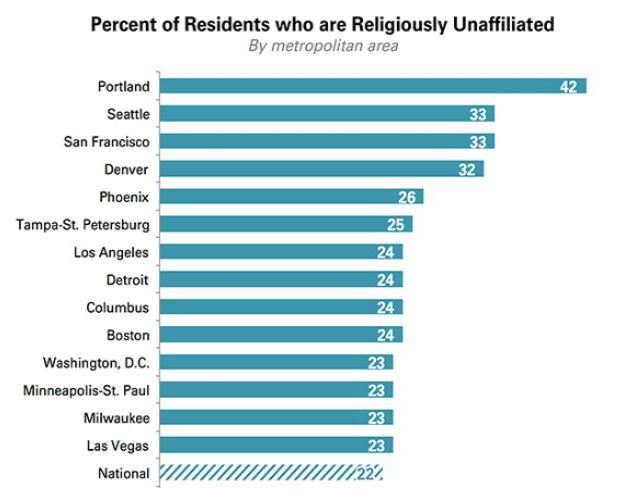
World Net Daily’s graph of just how godless some cities are (click to embiggen).
World Net Daily has the headline (here’s the DoNotLink if you want to see it): “These are the most godless cities in America,” and I was a bit disappointed to find that my beloved home, Seattle was merely tied for second, falling behind Portland, Oregon. The World Net Daily and the American Family Association has made the determination of godlessness based primarily on the percentage of inhabitants who describe themselves as “religiously unaffiliated” in a recent survey. A whopping 42% of Portland residents say they are religiously unaffiliated, with Seattle and San Francisco tied for second at 33%, followed by Denver at 32% and Phoenix at 26%.

I have a few quibbles. At several points the original AFA press release and WND story conflate “religiously unaffiliated” with atheist. Even though other parts of the story make the distinction that only about 15% of of the nation’s population identifies as atheist. Conflating unaffiliated with atheist is simply wrong. I, for example, am not atheist—I’m taoist. But on a survey like this, depending on exactly how the question was phrased, I would almost certainly pick the religiously unaffiliated option because I don’t belong to any church or temple or similar organized religious institution.

I realize, since I’m:

  • a big homo,
  • have been a firm believer in the separation of church and state since at least the age of 10,
  • believe in science,
  • usually vote Democrat,
  • support pro-choice candidates and policies,

…et cetera—that the AFA would of course classify me as godless. But I suspect they would classify my queer friends who regularly attend Christian churches (decidedly liberal ones) as godless, as well.

My point, however, is that there are people who believe in god, and even believe in the same god the AFA claims to believe in, who would describe themselves as religiously unaffiliated because people like the AFA have done everything in their power to redefine Christianity to mean hating gays and people who support them to the point that they’re driving people from their congregations.

The original article also asserts as one of the harms of all this godlessness the following: “religious groups, spiritual environmentalists, and secularists… sometimes must cooperate with each other to address the region’s pressing economic, environmental and social issues.”

Horrors! People must cooperate with other people who may not agree with them on some other things to get things done? Say it ain’t so! Too bad we have all this cooperation going on! If we didn’t, we might have the insanely high infant mortality rates, childhood poverty, and teen pregnancy rates like the more godly cities in the Bible belt have. You just gotta love that strong religious culture, right?

I’ve known plenty of misogynist, racist, and/or homophobic atheists, just as I know a lot of Christians who are feminist, pro-queer, pro-equality, and otherwise in favor of most of the things of which scolds like the AFA disapprove. So we can’t use religious affiliation to unerringly predict someone’s stance on public policy issues. And as I observed a couple weeks ago (Confesses of a recovering evangelical), most of the religious right isn’t terribly devout. They’re far more motivated by their conservatism, which manifests as a reactionary opposition to change. And they don’t really pay that much attention to anything that the Jesus actually said, as evidenced by their breathless enthusiasm for military intervention, condemnation of any unarmed people of color who have the audacity to get wrongfully killed by police, and so on.

It’s why Bill O’Reilly was able to say with a straight face that Jesus promoted charity, but not to the point of self-destruction. Except, of course, since Jesus’ whole reason for coming to earth was to get killed on the cross for the sake of imperfect humans, he was indeed promoting charity not just to self destruction, but to literal self sacrifice.

The World Net Daily story is also interesting in that the comment sections is overflowing with homophobic comments, because of course no place can be godless without us homos there egging the nonbelievers on, apparently. Just like Pastor Manning who is insisting today that the foreclosure auction ordered on his church building because of more than one million dollars in unpaid utility bills has nothing to do with money. No, he claims, it’s an illegal plot of the sodomites to silence him. (By the way, the Ali Forney Center has raised more than 58% of their goal to attempt to participate in that foreclosure auction. If you can donate to this opportunity to turn hate into love, please do!)

Amazingly, New York City doesn’t make it onto the AFA’s list of cities with a higher unaffiliated percentage than the national average of 22%. I guess “New York Values” aren’t completely unholy, after all. Equally amazing, Las Vegas barely exceeds the national average of godlessness! Who knew?

Another commentary on ships

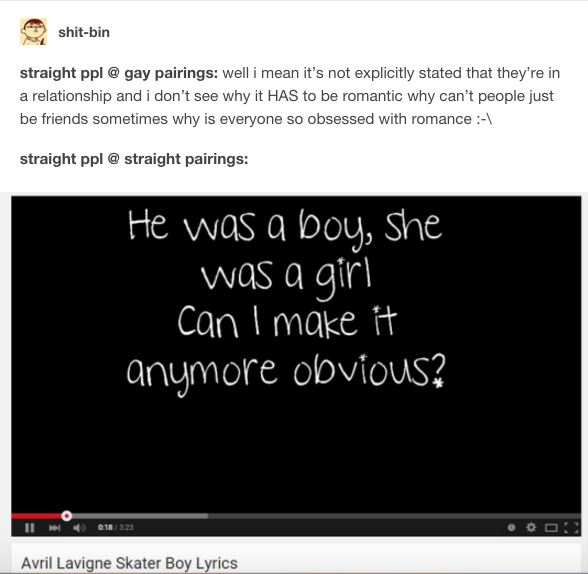
A blog post that appeared on my Tumblr dashboard. Click to embiggen.

A lot of Tumblr is about reblogging and liking stuff other people have posted. Or more realistically, reblogging stuff someone you follow reblogged from someone the follow who reblogged it from someone else, ad nauseum, that someone else posted.

A certain amount of commentary happens, though the tools aren’t really designed to foster conversation. But that’s another topic for another day.

The post, also shown in the screenshot above, came to my dashboard by one of those multi-reblog chains, and it much more succinctly demonstrates the point I expounded on in Invisible? Refusing to see what’s already there… which I also alluded to a few days ago in Confessions of an incorrigible shipper.

The original post was put up last July, as seen here.

Whether you call it a double standard, unacknowledged straight privilege, heterosexism, or homophobia, it’s all the same.

“Finn heroically saving him…”

I was skimming twitter during a break yesterday and saw a string great tweets:

https://twitter.com/VanguardVivian/status/684509058137763841
https://twitter.com/VanguardVivian/status/684509274253455360

I, being a smart aleck, had to butt in with, “This (queer) nerd boy would buy every Slave Poe action figure I could find! Oops… Did I say that out loud?”

The problem with even well-meaning smart asses throwing in such jokes is that our comments can undermine the serious point that Vivian was originally trying to make about double standards and the male gaze, with some commentary on the small wave of nerd rage that happened when an official Star Wars tie-in novel featured a gay protagonist earlier this year, and similar splash of nerd rage that happened when the trailer came out showing a Stormtrooper pulling off his helmet and revealing black actor under the mask.

So, to be clear: back in Return of the Jedi when they put Leia in that slave costume on a leash when she was taken prisoner by Jabba the Hutt it was a sexist action intended as fan service, and entirely unlike the way any of the three male heroes also taken prisoner in that same sequence were treated. And it made very little sense, internally. Seriously, Jabba is a giant slug, he’s not human, and it makes no sense for an alien (particularly a non-humanoid alien) to find any human body erotically attractive. I’ve seriously seen some clueless fans argue because another alien woman was shown in a similar role in an early scene (when she refuses Jabba’s advances, she’s thrown to the monster in the pit where the entire party takes great glee in watching her die), that this proves Jabba had some sort of fetish for the humanoid female form.

Bull.

Jabba is fictional. Jabba didn’t make the decision to put either woman in a slave girl costume to be leered at. Human filmmakers made that decision. Male human filmmakers made that decision.

Just as when authors and show-runners claim that they would love to include queer characters, but the right story just hasn’t come to them are either deluding themselves or outright lying (they can make the decision which characters to include in their stories), filmmakers who claim that Slave Leia was because of Jabba’s kinks are simply shoveling BS.

If Jabba had a kink for naked humanoids, there’s no reason it should have been limited to female humanoids.

So if the idea of Luke being the prisoner in a scanty slave costume after Jabba catches him upsets you—if you find yourself constructing arguments that it would be inappropriate because Return of the Jedi wasn’t a gay porn film, and that it’s just not the same as putting Leia in a scanty outfit—you’ve just stumbled across a great big internalized misogynist double-standard. Congratulations!

For the record, when I was 22 years old sitting in that dark theatre after waiting in line for 10 hours to see Return of the Jedi and the first scene with the other alien woman on a leash in a scanty costume appeared on the screen, my first thoughts were, “Why would Jabba put a woman from another species in that costume? Why would whatever species she is fetishize barely concealed breasts just because humans do?” Not that I was necessarily that enlightened back then. I recognize that even as a deeply closeted queer guy, I didn’t see the costume the same way 90-some percent of the other guys in that crowded theatre were. But that’s the thing, without hormones clouding my vision, I could see the incongruity for what it was.

So I hope my comment didn’t detract from the message of the original tweet. Besides, I wasn’t joking. I’ve already said publicly that I am searching for the Finn and Poe Honeymoon Suite Playset, among other things. When a friend pointed out that there was a place taking orders for a Poe Dameron body pillow I have to admit I felt immediate temptation. If there is a Slave Poe scene in one of the sequels, and if they made action figures of him in that costume, I’d buy it so fast!

Of course Han shot first!

After re-editing his own movies to change the order of the shot, Lucas was spotted in 2012 wearing a Han Shot First t-shirt on the set of Indiana Jones and the Kingdom of the Crystal Skull.
After re-editing his own movies to change the order of the shot, Lucas was spotted in 2012 wearing a Han Shot First t-shirt on the set of Indiana Jones and the Kingdom of the Crystal Skull. (Click to embiggen)
In the original version of the first Star Wars movie, Han Solo is confronted by an alien named Greedo pointing a gun at him. They have a conversation about the bounty on Han’s head, and how Greedo is here to collect the money Han owes. Han surreptitiously unholsters his own gun under the table, and when Greedo threatens to kill Han if necessary to take his ship as payment, Han kills Greedo.

It was a great scene, shows us a lot about Han’s personality, and was one of the many great homages in the film to scenes from classic Westerns and Noir Detective films.

Then, in later editions, George Lucas re-edited the scene so that Greedo shoots and somehow from nearly point-blank range misses. Then Han shoots after. And thus a meme was born and soon adored a million t-shirts. In more than one interview Lucas claimed that he had always meant that Greedo shot first. Or that Greedo was squeezing the trigger and Han was reacting to that as much as the verbal threat, and so on. But it made no sense to anyone. It seemed clear to everyone that Lucas was trying to make Han seem like more of a stand-up hero or something.

Despite those many interviews with Lucas, the original shooting script explicitly says that Han shoots before Greedo has a chance to make good on his threat. And George was himself seen wearing a Han Shot First t-shirt on the set of Indiana Jones and the Kingdom of the Crystal Skull in 2012. I always felt the decision to edit was extremely stupid, and thus felt vindicated by both the script and Lucas’ t-shirt shot. (You can argue that he’s embraced the controversy, or was being ironic, or maybe some fan had given him the t-shirt and he was wearing it to give Harrison a laugh on the set—whatever.)

I felt as if this particular thing had been settled a long time ago, until recently I happened across a reference to the Han Shot First “controversy” on the blog of a Sad Puppy supporter. At first he seemed to be making the case that Lucas’ decision to re-edit the scene was in response to pressure from the forces of political correctness (side note: I need to find that web browser plug-in that changes all references in articles to Political Correctness to “treating people with respect,” since the only thing that causes folks to accuse other people of being PC is when they are called out for failing to treat others with respect). But then the blog went on to claim that Social Justice Warriors prefer the second edit. He claims that he has been told (I think the actual term was “screamed at by SJWs”) that he’s an immoral person for thinking that Han shot first.

For the record, I am clearly a Social Justice Warrior supporter, and I have always argued (sometimes vehemently) that Han Shot First. And every feminist, pro-equality fan that I know personally who has ever expressed an opinion about the original Star Wars movie has also insisted that Han Shot First, and often just as vehemently as I do.

And Han shooting first isn’t an immoral choice!

He’s being held at gunpoint. Greedo makes it clear that if Han puts up a fight, he’ll kill Han. He threatens to take Han’s ship, which is his livelihood. When Han says “over my dead body” Greedo indicates he’ll really enjoy killing Han. BANG!

It’s a clear and unequivocal threat to Han’s life. He’s not just threatened with deadly force, it’s right there pointed at him. So he reacts with deadly force of his own. Is it the way Ghandi or Buddha or Mother Teresa would have handled it? No. Is it the way Sam Spade (or any other character Humphry Bogart played in many noir movies) would have handled it? Absolutely! It shows us that Han is a person that will do whatever it takes to protect himself and what’s his. It shows us he thinks on his feet. It shows us he has good survival instincts. It shows us that he can appear charming if necessary, but is more than capable of killing an opponent and carrying on.

And more importantly, it sets things up so it is both a genuine surprise when Han flies in to the rescue at the end, while at the same time making it believable that he would find a way to fly in through all that ship to ship fighting and get where he needed to be to save someone that he’s decided is a friend.

I can be the kind of person who believes that non-violent solutions are better than resorting to senseless violence, and at the same time recognize that in some circumstances, violence may be the least worst option. So, yeah. Han shot first. And it was a right thing to do. It doesn’t make him a saint. But not all heroes are. And we can cheer for flawed heroes when they do the right thing.

What you like, what other people like…

How to be an adult: eat what you like to eat, don't eat what you don't like, and mind your own damn business about what other people eat.
How to be an adult…(Click to embiggen)
I was rather amazed at a conversation that went past one of my social media streams: one person said, “What? You mean candy corn is supposed to look like real corn???” and another said, “I had no idea! Why had no one ever told me?” and a third said, “This changes everything I thought I knew!” And all three were people who said they loved candy corn and always had.

I was too busy being flabbergasted that someone who was smart enough to operate a keyboard, was apparently an adult, had survived many years of having to defend their love of this strangely polarizing candy, had never realized that the little candies are essentially caricatures of kernals of corn (sweet corn, maize, et cetera). Seriously? How can you never at least ask, “Why is it called ‘candy corn’?”

mystery-seed-104-2Okay, to be fair, I realize that there are people who go through life without ever seeing seed corn or feed corn. They may have seen corn on the cob and actually eaten it, but otherwise the only time they’ve seen corn is processed corn kernels cut-off the cob by a machine, then canned or frozen before being cooked and served. And those cut kernels don’t look like a full kernal of corn. It’s similar to the time when I was talking to someone about popcorn and discovered that they had never realized that the seed in popcorn were actual dried corn, the same plant (though a different cultivar or subspecies) as is canned and sold as corn. Or the time that I had to explain to someone what the phrase “seed corn” meant—they had never known that the vegetable they were eating were actually the seeds of the corn plant!

I don’t know what it is about candy corn that gets some people up in arms. I’m not saying that I don’t understand that some people like it and some don’t. What I don’t understand is why some people dislike it so much that they make other people feel defensive about liking candy corn.

I don’t happen to be one of the great fans of the candy. I don’t dislike it, but it doesn’t really do anything for me. When I was a kid, I liked the color and the shininess of the candy. It probably helped that it was a seasonal thing that was only available around Halloween time. But I would gladly let me sister eat nearly all of it herself and not feel that I was losing out. Yes, that means one of my sisters is one of those people who absolutely adore candy corn.

I sometimes take comfort in that fact that people can get militant about something like candy. Because when I read about things like this: Hate group (World Congress of Families) looks to criminalize gays on global scale my initial reaction is a combination of fear and depression. Then I realize that a lot of their supporters are just being as irrational as the folks who hate on candy corn. Which isn’t to say that none of this hatred is real: Dallas Police Seek Public’s Help In Solving String of Brutal Anti-Gay Attacks or Trans Woman Run Over With SUV In Possible Hate Crime Is 17th Murdered This Year or Study finds LGBT people not reporting hate crimes because they happen so frequently.

The kind of irrationality that makes people trash others over candy is part of the reason that folks either stand by silently while nutjobs at the World Conference of Families spout off their hate, or why people can look at death and rape threats hurled about by GamerGaters and make the ridiculous claims that there are two sides to the argument.

Hint: if a group is resorting to death threats, rape threats, doxing, and bomb threats, that isn’t an argument. It is a crime. That “side” is the perpetrator. Period. The other “side” are victims. Period. If you claim that it is a “side” then you are an accessory after the fact to a crime. Period.

And you’re being ridiculous and childish. As childish as someone getting angry at people over a candy preference.

And it’s so silly. It isn’t like we’re talking about something truly important.

Indigenous Peoples Day

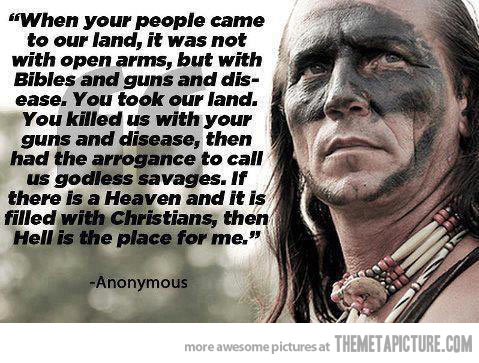
native-american-quote-indianSeattle, where I have lived for thirty years, is one of many cities in the U.S. that have declared October 12 Indigenous Peoples Day. In Seattle the ordinance declaring the new name for the holiday was signed into law 364 days ago, which means that today is the first time we’re officially celebrating it here. There are a lot of good reasons we should consider getting rid of Columbus Day: Christopher Columbus was a lost sadist. There shouldn’t be a holiday in his name and Columbus a problematic historical character: unreliable navigator, relentless self-publicist, chaotic colonial administrator, and probable mass murderer. Which makes many ask Why is Columbus Day still a U.S. federal holiday?

When I was a kid, I don’t remember any of the school districts I attended giving us the day off. Columbus Day was a day we talked about the very white-washed version of his “discovery” of the Americas. I used to work with a man who was born on Columbus Day, and what he loved most about it was that where he went to school it was a day off, so he and his friends always got to go to the movies or something similar on his birthday.

94842cae33908dd208ad90a2a0b1df5fAny problematic figure can represent a teaching opportunity, of course: Ángel González: I’ll be raising a glass to the adventurer whose legacy shows how Hispanic culture and the United States are inseparable, in glory and in shame. And it must be noted that simply changing a holiday’s name doesn’t necessarily solve real problems: It’s been a year, but improvements for Native American services are off to a slow start.

And of course some people wonder Why Do We Celebrate Columbus Day and Not Leif Erikson Day?

I have neither a clever nor wise conclusion to this. I think it is sad that there are people who defend Columbus Day, and not at all surprising that many of them are the same ones who bitch about so-called illegal immigration with absolutely no self-awareness of the irony of what Columbus and other European colonists did to Native Americans. But I do believe that names matter, just as truth and understanding matter. So, count me as one of the people who thinks the federal holiday’s name, at the least, should be changed.

Doesn’t my artistic license cover that?

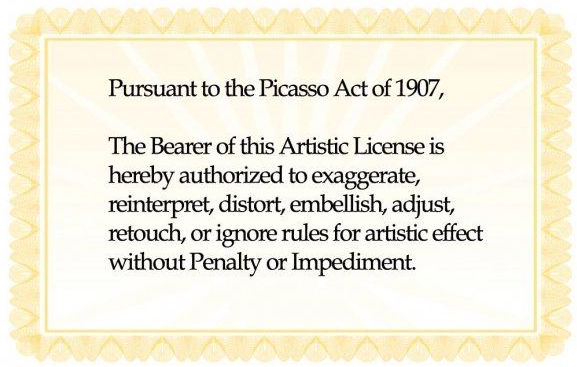
Mythphile.com (Click to embiggen)
Several times over the years I’ve gotten into discussions with co-workers (who are also technical writers) about the differences between writing fiction vs technical documentation vs other kinds of non-fiction, and why many of them believe you can’t be good at both kinds of writing. The usual feeling is that the requirements of most organizations needing technical writing are so regimented that they stamp out any possibility for creativity. The people who make this argument believe that technical writing is merely describing and presenting facts in the correct order, whereas fiction writing requires an artiste.

Others argue in the opposite direction. Once you learn basic spelling and grammar, they claim, fiction writing is just about making things up. It’s not possible to get anything wrong. If you accidentally contradict yourself, well, it’s your story, change it! They believe it’s much more difficult to learn and understand all the parts of a device or program or process and then explain it in a concise way.

Both arguments are exactly wrong. And both contain as much truth as falsehood.

A writer’s job—whether she is a novelist, technical writer, journalist, or historian—is to take an idea or vision they have in their own head, and use words to evoke or transfer that same knowledge to the mind of the reader. That process, the meeting of minds, is ultimately the same whether you are describing how to configure a clustered server application, an adventure in a distant galaxy, or the process to make your great-grandma’s chicken noodle casserole.

There are specifics in each of those scenarios that are different, but they all use the same skills. And non-fiction is never as straight forward as people think. This is why you end up with situations, such as the Stonewall movie I’m feeling trepidatious over (and wrote about yesterday). If you’re trying to tell someone about a series of actual events, you still have to make narrative decisions about where to begin, how much background information to include and when, which events to include and which to leave out, and where to end it.

German drama critic, Gustav Freytag, suggested this method of analysing the structure of stories in 1863
German drama critic, Gustav Freytag, suggested this method of analysing the structure of stories in 1863. (englishbiz.co,uk Click to embiggen)
For a novel or movie based on a historical event, that also means choosing viewpoint characters, constructing an emotional arc you think will resonate with the audience, and arranging events to follow that arc to reach a satisfying conclusion. Real life seldom happens in a neat, precise order that perfectly follows Freytag’s Triangle.

So you have to make compromises. You fudge the timing of events to make a more dramatic and satisfying story, perhaps. This is what we actually mean by “artistic license.” In order to tell the story in a way that moves people, you take a few liberties. In the 1995 movie about the Stonewall Riots that I mentioned yesterday, for instance, they take an event that happened in 1966 and drop it into 1969. The sip-in was an event organized by the Mattachine Society, the non-radical gay rights organization that had been around since 1950. Lots of states had laws against bars serving gay people—specifically in New York at the time, a bar could lose its license if it simultaneously served drinks to more than one gay person. A single openly gay person at a bar was okay, but two (such as a couple on a date!) was a big no-no. So this group of very respectable-looking people went from bar to bar, made a big announcement that they were gay, and asked to be served. They had to go to a bunch of bars before someone refused to serve them, at which point they could file a lawsuit, whose ultimate aim was to get the regulation thrown out in court as a violation of the Constitutional rights of association and assembly. Which they did.

None of the people involved in the sip-in had anything to do with the Stonewall riots later on. And the Stonewall Inn was not one of the bars where they tried to get served at. The makers of the 1995 movie, for whatever reason, decided to have the heroes of their movie being the guys that also stages the sip-in, and had them do it a month or so before the riots at Stonewall. It doesn’t really make much sense, and it certainly isn’t how it happened. The filmmaker was probably trying to come up with a way to show that his fictionalized versions of the real people who spontaneously rose up in the riots were actively fighting for their rights before that night. It was a way to show them as being active, aware participants in history, to give them agency in the plot. Because, apparently, deciding as an unarmed person to physically fight back against a bunch of armed police officers isn’t active enough!

I think that’s going to ultimately prove to be what’s happening with that brick-throwing scene that everyone is up in arms about in the trailer. The movie maker, having decided to tell the story through his fictional character who is not based on any specific participant in the riots, and who was crafted specifically to be an archetypical everyman, needs to do something active to show agency, and to move the audience to see him as the hero of his personal narrative. That doesn’t necessarily excuse it, but it would explain it.

It is a tough problem. When I was doing an edit pass on the first book in my Trickster series, I realized that I had spent so much time weaving all of the subplots together (and all the jokes—the word apocalypse may be in the title of the first book, but I am writing light fantasy!) so that all the characters get to the big climactic battle and have their emotional arcs culminate, I had turned my main protagonist (and one of the supporting protagonists) into a soccer ball. They were each propelled by events from one part of the plot to the next, seldom showing any agency. They each made decisions along the way, but I had wound up writing those scenes in such a way that each was always reacting to events outside his control. Fortunately it didn’t take a lot of revision to recast some of those scenes to make it clear that there were actual choices being made. I added one scene to give the main protagonist a more active role in shaping the end result of the plot. I think it worked.

As a storyteller, I know why these decisions about how to make a compelling tale out of historical events happen. Your hope is that the overall effect is to illuminate the past, show how far we’ve come, and introduce people unfamiliar with the topic to the struggles of the people involved. If not done right, you might still please the audience, but you’ve muddled things up, erased the real heroes, and sold the viewer a pretty but awful lie.

Please don’t ask me to applaud mighty whitey

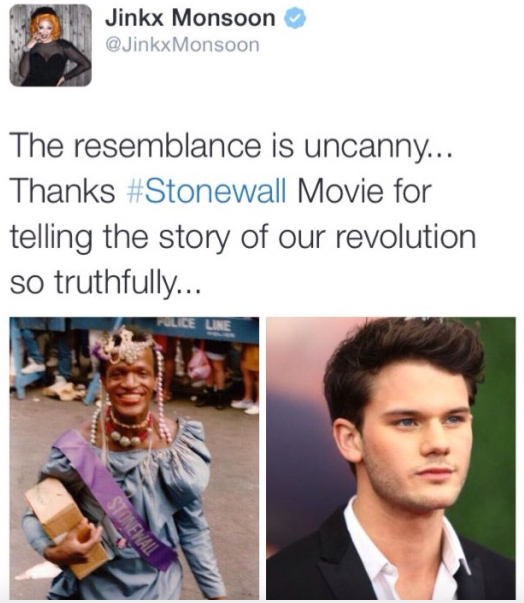
Marsha P. Johnson (on the left) was an African-American transwoman/street queen who actually participated in the Stonewall riot and was seen by several witnesses smashing a police car with a brick near the beginning. Later she was a co-founder of the Street Transvestite Action Revolutionaries. The actor on the right is apparently portraying the first brick-thrower in the new Stonewall movie.
Marsha P. Johnson (on the left) was an African-American drag queen/street queen who actually participated in the Stonewall riot and was seen by several witnesses smashing a police car with a brick that night. Later she was a co-founder of the Street Transvestite Action Revolutionaries. The actor on the right is portraying the only brick-thrower seen in the trailer for the new Stonewall movie. (click to embiggen)
I have a confession to make. When I first saw the trailer for the new Stonewall movie set to come out next month, the white-washing and cis-washing were not the first things that jumped out at me. At least not directly.

If you aren’t familiar with the controversy: the trailer for the new movie focuses on a white, cisgendered young man as the viewpoint character, and more specifically, causes some people to infer that he is the one who threw the first brick and starts the Stonewall Riot on that June night in 1969. The Stonewall Riots being the event usually credited with starting the modern gay rights movement. This is a problem because, while no one knows for certain who threw the first beer bottle, we do know is that the first person seriously fighting back that night was a butch lesbian who got away from the cops (and was chased down, beaten, and dragged back) while resisting being put in the paddy wagon (it was probably Stormé DeLarverie, though some witnesses claim that it was someone else). A transwoman of color, Miss Major Griffin-Gracy, also fought back, was clubbed unconscious, and was one of the few actually taken to jail that night. And no one disputes that it was Marsha P. Johnson (who was at the bar that night with friends to celebrate her birthday) who smashed one of the police cars with a brick… Continue reading Please don’t ask me to applaud mighty whitey