Tag Archives: fantasy

Ancient Tomes and Living Fossils – how I love sf/f isn’t the only way

“Kids these days will never know the joys of oil lamps and chamber pots”Jason Sanford set off small internet firestorm with a series of Twitter comments that he then collected on his blog as: The fossilization of science fiction and fantasy literature. Some people were upset because they thought he was implying that the classics of sci fi were garbage, when all he actually said was that younger people are reading, watching, and playing newer works and there’s nothing wrong with that. He’s since added a follow-up to clarify his point which included this important bit of context:

A few years ago I was on a SF/F panel about bringing new readers into the genre. I mentioned that SF needed more gateway novels, at which point the other author on the panel snorted and said we don’t need new gateway novels … the Heinlein juveniles are still perfect.

That is the type of attitude which people should fear because it will kill our genre. But new readers not discovering SF/F through the classic authors you grew up on — that’s nothing to worry about.

His critique was not aimed at the classics themselves, but rather at older fans and pros who belittle younger people who first learned to love science fiction and fantasy by encountering newer works, or who lecture people who aren’t familiar with many works published 70 or more years ago, or gripe that “real” fandom is greying and dying off.

Reading the original post and some of the fallout left me feeling a bit guilty for ways that I have no doubt come across that way myself. I do react with great incredulity when a friend, regardless of age, isn’t familiar with a book, series of books, or movie that I consider a classic, for instance. I try to get people to watch some of the old movies or read the old books that I loved.

It also made me wonder about the series of posts I’ve been doing for Throwback Thursday the last 6+ months, the “more of why I love sf/f” posts. I started those posts as a personal antidote to the sturm und drang over the affair of the melancholy canines. Because I read a lot of sci fi blogs, and because I was determined to read all the Hugo-nominated works before filling out my ballot, I knew I was likely to spend a lot of time being outraged and otherwise upset about things people were saying about some types of sci fi. So I decided it would be a good idea to write a weekly post in which I would only talk about something I loved from the genre. Since I like having a regular deadline, I needed to pick a day, and it occurred to me that if I focused on works that were influential in my formative years, then I could post them on Thursdays and tag them as Throwback Thursdays.

So I gave myself that assignment.

These posts have been about things I loved in science fiction and fantasy. I’ve written about works that spoke to me in important ways when I was a kid. Many times I’ve mentioned how a particular story or movie or series gave me hints that someday, when I wasn’t a closeted queer kid living among anti-science and anti-gay evangelicals, life would get better. None of which is meant to imply that people who aren’t familiar with or don’t like any of the things I’ve written about are any less real fans than I am, nor that there is anything wrong with treasuring different authors or works.

Not that anyone probably has, but I think it’s important to acknowledge that I’m an old white guy, and what I experienced growing up is going to be very different for fans who aren’t guys, or white… or whose teen-age years are much more recent than mine.

It’s also important to realize that a lot of things that we loved when we were younger don’t always hold up when we’re older. Before I started the “more of why I love sf/f” posts, I’d written about reading some books by a favorite author from my teens and early twenties, and how difficult some of her books were for me to read, now. Some are fine, but some of them have definitely not aged well. And I felt really bad for not liking some of them as much as I did when I was younger.

Because I’m doing National Novel Writing Month (my project is to finish the revision on two of my fantasy novels) there will be a lot fewer blog posts of any kind from me. And those “more of why I love sf/f” posts take more time than others of similar length, because I research the work and author in question. Yes, I’m writing about things I loved, but in some of the cases they are books or shows I encountered before my teens, so I want to make certain I’m remembering them correctly.

I will resume the posts after November. And I will probably continue to focus on books and stories from my younger days. I mean, I averaged reading more than seven novels a week through most of middle school, for goodness sake! There is a lot of potential material to write about!

Storms, Brains, and Reanimated Flesh – more of why I love sf/f

The creature meets the innocent girl... © Universal Pictures
The creature meets the innocent girl… © Universal Pictures (Click to embiggen)

I don’t remember when I first saw the 1931 film Frankenstein, directed by James Whale. I also can’t remember a time when I didn’t know the basic story of Frankenstein. I don’t know for sure what my first exposure was to the myth. I remember watching more than one of the Universal Studios Frankenstein movies with my mom when I was young. I remember one particular time watching it with my mom and my sister, my sister was maybe four or five years old and kept asking questions. I was getting impatient, and Mom told me I had been exactly the same way when I had been my sister’s age.

What I do remember, very clearly, is that I always felt sorry for the monster… Continue reading Storms, Brains, and Reanimated Flesh – more of why I love sf/f

Monsters Are People, Too – more of why I love sf/f

Promotional photo for the Munsters,
Promotional photo for the Munsters, © Universal Studios and CBS.
The Munsters premiered on CBS the night before my fourth birthday. I don’t remember if we watched it from the beginning. I’m fairly certain we didn’t watch it the first season because the first few months it was up against the Flintstones, and then Jonny Quest moved to that time slot. I suspect we did watch it a few times, and for a while during season two, until Batman! premiered with its twice-a-week format one of which was against the Munsters.

Like a lot of other genre-related shows, The Munsters went into syndication fairly quickly after being canceled, and promptly gained loyal audiences outside of primetime. I suspect most of my memories of the show are from this era… Continue reading Monsters Are People, Too – more of why I love sf/f

You don’t have to add diversity—just stop erasing it!

CRXl2fVUsAAXDr3Yesterday, in reaction to a recent episode of the Cabbages and Kings podcast, I concluded by suggesting that if we can’t find stories which include people like ourselves, that one of the solutions is to write the stories ourselves. As the cliché goes, if you want a job done right you have to do it yourself. That isn’t to say that only queer writers should write queer characters, nor that only women should write women and girls as protagonists, nor that only people of color should write stories with people of color in the lead. My point is more of an outgrowth of the oft-repeated advice of many different writers that if you can’t find the kind of story you want, you should write it.

Part of the reasoning behind that advice is that no one sees the world quite the same way as you, so no one else can tell your stories. Another part is, if you want to see something there are bound to be other people who want to read that kind of story too. And even more, there will be people who don’t know they want to read that kind of story until they find yours. Then they will want more… Continue reading You don’t have to add diversity—just stop erasing it!

Applause from the wrong side

images (1)I was listening to the recent episode of the Cabbages and Kings podcast, Seeing Yourself In The Narrative and found myself nodding emphatically in agreement when the guest, Cecily Kane, observed that “when dudes write fanfic, it isn’t called fanfic.” In the podcast she was referring to a certain Hugo-winning novel from a couple of years ago. I’ve previously linked to an article Laurie Penny wrote, Whose wankfest is this anyway? The BBC’s Sherlock doesn’t just engage with fan fiction – it is fan fiction that makes a similar point.

Everyone claims that they evaluate a book, or movie, or other work of art based on the quality of the work, and not the identity of who made it. But that isn’t true. A woman writes a Star Trek-inspired story in which characters who were not involved romantically on screen are, or the characters cross-over with the characters of another fictional series, and it’s relegated to fanfic archives and looked down upon by serious people. A guy who has had several science fiction novels published writes a Star Trek-inspired story in which the fictional characters cross-over into the real world and discover a strange relationship between the real and fictional world, and it’s awarded a Hugo.

Knowing who did it changes our perception of the quality and importance of the work. Even though we don’t like to admit it.

For example, I have justified my enthusiasm for a movie or television series that everyone else I know thinks is terrible—and that I agree is badly written and/or poorly directed—simply because a particular actor or actress was in it. Similarly, there is an author (who I have written about before) whose activities promoting anti-gay laws and fundraising for anti-gay organizations caused me to pledge long ago that I will never again buy anything that he has written; and when asked my opinion of his stuff, I mention the reasons why I boycott him.

That’s a bit different than the blanket sort of de-valuation that either Kane or Penny were discussing in the above linked items.

And it isn’t just who produces it that matters in the way the powers that be evaluate a work of fiction. Even more important then who is writing it is who we (which is to say, the collective consciousness) believe is the intended audience. Red Shirts wasn’t dismissed out of hand as fan fiction not merely because it was written by a guy, but even more because it was perceived as being aimed at the dude-bros of geekdom. Many things in the story were crafted to appeal specifically to the guys who love space battles and love arguing about whether Han Solo or Captain Kirk would come out triumphant in various arenas of competition.

I want to pause for a moment and point out that I liked Red Shirts, just as I like BBC’s Sherlock. I’m a guy who grew up watching the original Trek series (during it’s original primetime run 1966-69) as well as reading Sherlock Holmes stories. Because I’m also a queer guy, I don’t entirely match the target audience, but I’m close enough for it to resonate. My point isn’t that those sorts of work are inherently bad. It’s that other work which is at least as good (if not better) gets relegated to various ghettos of the arts not because those works are inherently less worthy, but because they are perceived as being intended for the “wrong” audience.

If you have a girl or a woman as your lead character, your story won’t be marketed as serious science fiction or fantasy or mainstream fiction. Instead it will be channeled into Young Adult, or Romance, or some other “specialized” category. Heaven forfend that you have a queer protagonist! That is going to be perceived as a niche work at best.

How do we fix this? The first step is, if you really love science fiction or fantasy, make an effort to find works that don’t fall into that so-called mainstream audience. When you find something that you think is good, buy it, recommend it, look for other things by the same author and buy those as well. If you’re active on Goodreads, post positive reviews of these discoveries. If you bought the book from an online source that lets you rate and review works, write a review. All of those places have algorithms for recommending works to other people, and most of the algorithms are more likely to recommend a work if it has a lot of reviews.

If the work is published in a magazine, whether it be a paper publication or online, write in to say how much you liked the particular story. Let the people who published it and the person who wrote it know that you liked it! If they know there is an audience for that sort of story and that sort of protagonist, you’ll see more of that kind of thing.

If you find yourself wishing there was more work that has a particular kind of protagonist or is set in a particular kind of world, consider writing it yourself. Sometimes the only way to get more good art that includes us is to do it ourselves. And that’s okay. Because no matter how unusual you may think it is, I guarantee you that someone else out there is looking for it, too.

Infinity In Your Mailbox – more of why I love sf/f

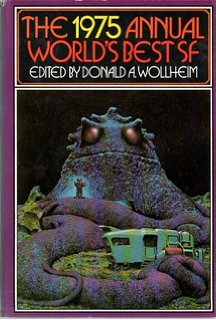
Cover of the Science Fiction Book Club edition of the 1975 edition of the Annual World's Best SF series edited by Donald Wolheim.
Cover of the Science Fiction Book Club edition of the 1975 edition of the Annual World’s Best SF series edited by Donald Wolheim.
I joined the science fiction book club at three different points in my life. The first time was when I was about 13 or 14 years old, and had no idea what I was getting myself into. My mom was not very happy when the first package of books arrived. Fortunately, my paternal grandmother found out about it before my dad did and was able to run some interference for me. So this wasn’t one of the incidents that led to a beating, but it was a close thing.

I wound up doing extra chores at my grandparents’ house to earn the money to cover it. Dad let me remain a member for a year, strictly limiting what I was allowed to order until I’d met the obligation so I could quit the club. I wound up with a bunch of books. And they were hardcover—they were cheap hardcover, but still more sturdy than the paperbacks that most of my collection consisted of before then.

The second time was the summer just before I turned 18, and at least I had a job and was earning my own money.

The book club reeled you in with the introductory packet: for a token payment of two cents, you could choose something like six books from a list. There was a little asterisk statement about paying shipping and handling, which was always more expensive than you thought it would be. But compared to paying full price for the hardcover version when they first came out, it was still a bargain. After that you received a monthly mailing, and if you forgot to return the card that said, “send nothing at this time,” you’d get whatever that month’s book was. You could choose other books out of the mini catalog that came in each month’s mailing. And again, the prices weren’t bad, even with the shipping and handling.

The killer was if you didn’t return the card in time. Because you’d receive books you didn’t want, and usually wound up paying for them because returning them was more of a hassle.

The other downsides were that generally the books were a few years old. They usually didn’t become available to the book club until the original bookstore sales had dropped off for the hard cover, and then the paperback release. The amount of money the authors received was less than for bookstore sales, though most writers who have been willing to talk about it seem to take the attitude that a sale is better than no sale.

When I was living in redneck rural communities, back before the existence of the Internet, a book club was a means to get books that you otherwise might not ever know existed.

The second time I joined, I picked every anthology that was on the list for my initial package. Which included two different years of Donald Wolheim’s Annual World’s Best Science Fiction collections. I loved those kinds of anthologies, because I got a bunch of different stories by different authors. One tale might be a space adventure, another a dark exploration of the nature or identity, another a humorous examination of the future of crime, and the next might have a wizard outwitting a god. Anything could be between those pages!

And I didn’t even have to order one of the books to get a bit of that thrilling sense of wonder. Half the fun of the book club, for me, was reading the catalog each month. Because books and authors I had not heard of—even after I had moved to a slightly larger town that actually had a book store, and not only that more than one!—each received a paragraph or two of description, along with a picture of the cover. So even if I didn’t order the book at the time, later if I saw a copy in a used bookstore, or saw other books by the author, I had a better idea of what the book would be like than I would get just from reading the cover blurbs.

Every month I received a colorful display of dozens of imagined worlds, ranging from high fantasy to gritty near future sci fi thrillers to epic space battles between empires to individual journies of discovery. And all I had to do was, every now and then, buy one of those wondrous books. It was really a small price to pay for infinity.

No wonder 14-year-old me had thought nothing of the consequences when I taped two shiny pennies to a piece of card stock, scribbled my name and address on one side, then swiped an envelope and stamp from Mom’s desk. An infinity of wonder would be mine!

The Original Wizard School – more of why I love sf/f

Original hardback cover of A Wizard of Earthsea by Ursula K. Le Guin art by Ruth Robbins
Original hardback cover of A Wizard of Earthsea by Ursula K. Le Guin, art by Ruth Robbins (click to embiggen).
I think I was 14 years old when I found a copy of A Wizard of Earthsea on a library shelf. The novel tells the story of a boy named Sparrowhawk who lives on the island of Gont which is situated in an archipelago called Earthsea. Sparrowhawk’s aunt is the village witch, and she recognizes his innate magical talents when he is very young, so she teaches him as much as she can. When he is twelve he nearly dies saving his village from marauders using magic. Which attracts the attention of an older mage named Ogion. Ogion heals Sparrowhawk and takes him on as a student. Ogion is the person who gives Sparrowhawk his true name, Ged. Knowing someone’s true name gives one power over them in the magic of Earthsea, so people have to guard their true name. When it becomes obvious that Ged’s talents and impatience are more than the mage can handle, Ogion sends him to the island of Roke to see if he can join the school of mages, there… Continue reading The Original Wizard School – more of why I love sf/f

Mortality, Im- and Otherwise: more of why I love sf/f

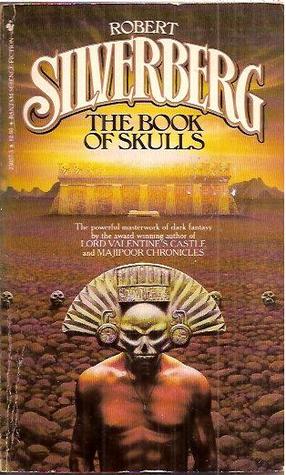
Cover for one of the paperback editions of The Book of Skulls by Robert Silverberg. (Click to embiggen)
I was 16 when I found the Book of Skulls in a used book store. The cover blurb talking about four young men on a quest to find a mysterious cult and obtain immortality. I’d read some of Silverberg’s short fiction in both Galaxy magazine and The Magazine of Fantasy & Science Fiction and had generally enjoyed it. Plus it had a cool cover.

The novel is told in rotating first-person viewpoint from each of the four characters: Eli, the Jewish bookworm; Ned, the flaming homosexual; Timothy, the rich boy; and Oliver, the farmboy/jock. They are students at the same college who have formed somewhat unlikely friendships. Eli, who has a gift for languages, found and translated a book about the mysterious Brotherhood of the Skull and their secret of immortality. The book says that four people must present themselves together, and work together to endure the trials of the Brotherhood. Even if they succeed, only two will gain mortality. The other two lives are forfeit: one must willingly commit suicide, and the other must be sacrificed by his fellows… Continue reading Mortality, Im- and Otherwise: more of why I love sf/f

We are all Hugo…

Ambassador Kosh, Babylon 5 © PTN Consortium.
I promise that after today there won’t be anything about the recent sci fi fandom kerfluffle on this blog until Friday links. Absolutely none. However, there are several interesting conversations happening in the immediate aftermath which I want to share and make at least some comment upon.

Since we now have the rest of the nomination results, it is possible to see what works would have been on the ballot if not for the slates. Here is one such guess: Alternate Timeline Hugo Awards. This list includes some very interesting things that I wish we had had a chance to vote on.

The next headline isn’t entirely accurate. While George disapproves of any slate voting scheme, the purpose of his reviving his Hugo Losers party and this year handing out his own awards was to try to protest the deep schism and animosity: George R.R. Martin Holds Additional Ceremony After the Hugo Awards to Protest ‘Sad Puppies’. Years ago Martin founded the original Hugo Losers party, where people who were up for a Hugo that year could get together and tell each other they should’ve won… to wallow a little, yes, but also to commiserate, laugh at themselves and each other, et cetera. He let other people take over organizing it for years, but this year because of all the animosity flying around from every direction, decided to take it back. He rented a bar, invited anyone who has ever lost to the party. This year’s winners were also invited, but had to wear a conehead if they stayed. George had a bunch of trophies made, which he called Alfies, in honor of the late great Alfred Bester, and handed them out to people who would have been on the ballot, based on the nominating numbers, if you remove the slates. He handed out a few additional ones of his own choosing. By all reports, people had a good time.

Why We Need Queer Escapist Lit. I get tired of having to defend wanting to see characters that are like me in my favorite genre. But we have to keep doing it.

The false narrative that a lot of people on both “sides” of this issue often fall into is the idea that people of color, women, and queer people have only recently begun reading and/or creating sci fi/fantasy. This helps explain a big part of why that’s wrong: We’ve Always Been Here in the Fandom. Why the WIRED article on the Hugos misses the mark.

Equally problematic is that the frame of reference of people on one side is so utterly disjoint from the frame of reference of people on the other side, that a lot of our attempts to debate have merely resulted in us talking past each other. Hugos & Puppies: Peeling The Onion.

“When it comes to debating strangers with radically different perspectives, you sometimes encounter what I refer to as Onion Arguments: seemingly simple questions that can’t possibly be answered to either your satisfaction or your interlocutor’s because their ignorance of concepts vital to whatever you might say is so lacking, so fundamentally incorrect, that there’s no way to answer the first point without first explaining eight other things in detail.”

There are other differences, of course: On the SF/F genre and a-holes.

“We all have conservative friends and acquaintances who aren’t a-holes, and we don’t seem to have a big problem with them unless they’re crazy bigots like [Vox Day]. We have a problem with a-holes.”

On the Hugo Awards controversy, Sad Puppies, and why there are no winners here.

“…I haven’t voted in several years, when I did I voted for stories that I loved (plus, to be honest, stories written by my friends)—as do most readers. If readers deliberately voted for stories about gay characters and people of color, perhaps it’s because [those stories] speak of “alienation,” which a great many readers of science fiction happen to have experienced (readers of science fiction tend to be natural outsiders).”

This may be my favorite read today: How the 2015 Hugos proved against all odds that SF is becoming more international and more diverse. There is just so much here to like. She links to some of the same posts I have above, but also to a whole lot of others. She pulls long quotes from people and does some analysis and rebuttal. One of my favorites is in response to a Sad Puppy supporter who agreed to be interviewed for one of the news site’s stories, but didn’t want his name used:

“In many ways this quote by the unknown puppy clearly illustrates the attitudes that already became obvious in Brad Torgersen’s infamous “Nutty Nuggets” post. A lot of puppies don’t just want works they don’t like to be excluded from the Hugos, they deny works they don’t like the right to exist period. They don’t want these works to be published, they don’t even want them to be written at all.”

She segues away from the Puppies and spends most of her post talking about the works that did win. I especially like this point:

[B]oth Hugos in the two fiction categories that actually were awarded went to translated works by non-anglophone writers, which is a first in Hugo history. Coincidentally, both are also the first Hugo wins for their respective countries of origin… I’m happy that they won, because their wins show that the Hugos are becoming a more truly international award. And yes, it’s problematic that a white Dutchman and a Chinese man, two writers who have nothing in common apart from the fact that English is not their first language, are both subsumed under the header “international SF”. But given how Anglo-American dominated the Hugos and WorldCon have traditionally been, it’s still a great step forward.

I’m skipping a lot. Her full post is really worth that read. I hope you give it a look.

Those of us who love science fiction and fantasy are going to be talking about this a lot over the course of the next year. Both the Sad and Rabid Puppies are vowing to be back. Vox Day, leader of the Rabids, is specifically threatening to leave a “smoking hole” where the Hugos once were. So the rest of us are going to have to make sure we participate in both the nomination portion and voting portion of the process next year.

Because the avalanche may have already started, but contrary to the Vorlon proverb, in this landslide, each pebble has a vote, and we can make them count.

Weekend Update (8/21/2015): Bad Statistics and Hugos Tonight!

qVU3FO8o_400x400First, congratulations to the Helsinki Worldcon Bid Committee! They’re hosting WorldCon 2017 in Helsinki! So at least one of the votes being counted at WorldCon this weekend went the way I voted. Woo hoo! Onneksi olkoon! Congratulations!

In other updates to things that I’ve included in recent Friday Links posts, a lot of people I follow have been posting a link to a Vocativ post about how very, very white the winners of the Hugo Awards have been over the years: Science Fiction Is Really, Really White. The article has graphs and some statistics and seems legit, right?

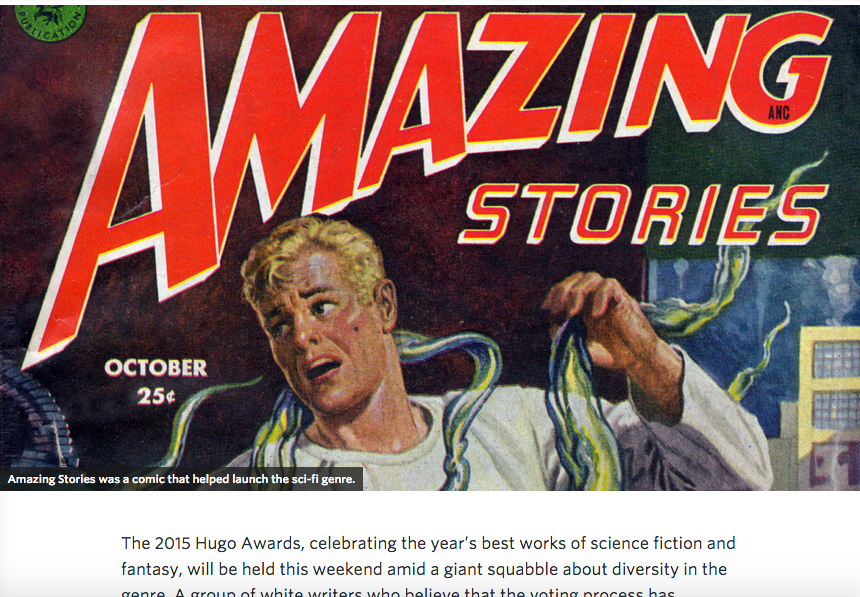
Screenshot of the graphic, caption, and a bit of the article.
The first thing that made me wary about simply retweeting the link is something really minor: the caption on the picture that they illustrate the story with. “Amazing Stories was a comic that helped launch the sci-fi genre.” No. Amazing Stories was a magazine that printed literary stories founded in 1926 by Hugo Gernsbeck. It was not a comic book. While it is often credited with launching the pulp version of the genre science fiction, so that part is true, but it wasn’t a comic.

Bar graph as originally published.
Now, ordinarily that would be a quibble, but this article is about statistics, so seeing in the caption that they have already gotten a fact wrong made me a teeny bit apprehensive. Then we get to the most dramatic graph, and I think, “That can’t be right.” What about Saladin Ahmed, author of Throne of the Crescent Moon, Best Novel nominee in 2013? Shouldn’t there be a bar labeled “Arab” with at least 1 person it it?

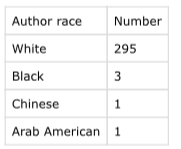
This only just barely qualifies as data...
This only just barely qualifies as data…
Amusingly, I started this post early this morning, then had to go to a nearby clinic for some scheduled medical tests, and while I was sitting in the waiting room, Mr. Ahmed’s tweet commenting on being erased from the data came through my feed. Since then, one of Vocativ’s editors sent out a tweet that they’re correcting the article. The bar graph now does list one Arab-American. That’s a bit better, but that’s the thing. Now how do we trust them about the other 295 authors they claim are white? You might think that clicking on the “Get data” link under the graph would give you a spreadsheet of all the nominees, right? Nope. You get a spreadsheet, all right, but it just says “White 295, Black 3, Chinese 1, Arab American 1.”

This may seem really petty and nitpicky, but here’s the thing: if you are trying to make a statistical argument to back up a claim, you have to get every fact right. And you have to give us confidence that you are likely to get every fact right. There is a big argument to be had about what we mean by race. Race is a social construct with no basis in biological science, so there will be lots of people who will want to nitpick the data if we did have a big spreadsheet that listed all 300 nominees. I suspect that the graph now is close enough to correct to still illustrate the point that the Hugo Awards have hardly been a paragon of diversity. Even more importantly, the ludicrous charge that the Hugos have been being somehow secretly controlled by a liberal cabal that has imposed political correctness onto the ballot for many years is demolished by facts such as this.

But to the next person who wants to compile something like this: quadruple check your results before publishing!

Hugo Awards Announced Tonight!

The award are tonight! From the official Hugos website:

The 2015 Hugo Awards Ceremony is scheduled for Saturday, August 22, 2015 at 8 PM Pacific Daylight Time in the INB Performing Arts Center in Spokane, Washington. The Hugo Awards web site will once again offer text-based coverage of the 2015 Hugo Awards ceremony via CoverItLive, suitable for people with bandwidth restrictions. For those with the bandwidth for it, Sasquan will also offer live video streaming of the 2015 Hugo Awards ceremony via UStream. In addition, Sasquan will present “The Road to the Hugos”, a livestreamed Internet pre-and-post Hugo broadcast featuring hosts Stephen Schapansky and Warren Frey of Radio Free Skaro, as part of the coverage, starting one hour before and ending one hour after the ceremony.

Here’s the link for the text coverage of the ceremony.

And the link for the live video stream of same.

And the link for the Radio Free Skero livestream pre- and post-shows.

I predict:

  • No Award will take maybe two categories, causing cheering from some and more threats from the Überpuppy,
  • At least two nominees from one of the Puppy slates will walk home with a Hugo,
  • Some people on both sides will claim victory,
  • Some people on both sides will claim it is a defeat for all that is right and just in the world,
  • Regardless, science fiction will survive!

I plan to have a mini Hugo Watching Party here tonight.

Now matter what happens, please offer congratulations to the winners and please console any nominee (and I mean anyone) who does not get a trophy. Similarly, offer condolences to anyone you know who is disappointed that their favorite in any category didn’t win.

And for the future: if you are a fan, read and watch good science fiction and fantasy (however you define it) and support the writers and artists who make it. If you are one of those writers or artists: in the immortal words of Neil Gaiman, I urge you to make good art.

Ad Astra!