Tag Archives: fantasy

There wolf! There castle! why sf/f doesn’t have to be serious

Peter Boyle as the monster, choking Gene Wilder while Marty Feldman and Teri Garr partake in an impromptu game of Charades. (© 20th Century Fox)
I was fourteen years old when the movie Young Frankenstein was released. The small town where I lived had only one theatre, and it showed two movies each week. One played Monday through Thursday, I believe, and the other would play Friday through Sunday, sometimes with a matinee Saturday afternoon (but not always). No matter how sold out any show was, it didn’t stay past its scheduled three or four day run.

And I was, as far as I could tell, one of the few kids in my class on the Monday morning after the movie had shown, who hadn’t seen it. If the film was shown on network television in the next couple of years, I didn’t manage to see it. After my folks divorced and my mom, one sister, and I moved 1200 miles away, one of my new friends mentioned that Young Frankenstein had been re-released to theaters and was playing downtown. Back in the days before ubiquitous cable, movies on tape or disc, or the internet, movies were often re-released into theaters.

When I mentioned that I’d never seen it, my friends were aghast. The next thing I knew, we were piling into someone’s car and driving to the theatre. I loved the movie. I loved it so much, that I couldn’t stop talking about it. I kept telling anyone who would listen to me about the grandson of Victor Frankenstein, Frederick, who insists that his last name is pronounced Frohnkensteen, and is ashamed of his crazy grandfather’s work; but upon finding said grandfather’s journal becomes obsessed with bringing a dead man back to life, and the zany misadventures that follow.

My mom thought it sounded fun. And so a night or two later, I found myself standing in line at the theatre once more, this time with my mom and little sister.

The movie has more than a few jokes based on sexual innuendoes, which it didn’t even occur to me might not be appropriate for my eleven-year-old sister, let alone what Mom might think of it. And both of them were laughing at all the same places I was, so everything was going fine. Until we reached the point where the Creature kidnaps Frederick’s fiancé, Elizabeth.

And then, panic started to set in. Because what happens next is that the Creature and Elizabeth have sex (in a scene that is a casebook example of pop culture’s long entanglement with rape culture). During which Elizabeth falls in love with the Creature because he has an enormous “schwanzstucker.”

Mom was a Bible-thumping Southern Baptist. Yes, she was also a science fiction fan, but her open-mindedness only went so far. And I had brought her and my little sister to a movie where a central turning point of one of the subplots is a woman falling in love with a stranger because of the size of his penis.

I was quite certain that I was going to wind up being grounded for life. Obviously Mom was going to be very upset. And I should have realized that she would be and mentioned the scene as soon as she suggested we go see the movie! I sunk down in my seat, bracing for an angry outburst.

The scene with the Creature began, and I just sank down lower in my seat. Then when the sex happens (the movie was rated PG, so you don’t even see either character get undressed, it’s only implied that the Creature unzipped his pants), and Madeline Kahn, who played Elizabeth starts singing in an exaggerated operatic style, “Oh! Sweet mystery of life at last I’ve found you!”

Mom started laughing. I looked over, and she wasn’t merely chuckling. She was guffawing loudly, covering her mouth to try not to disturb the rest of the audience (many of whom were laughing, but not that hard) and doubling over like she was going to fall out of her seat. A minute or two later her laughter subsided and she was wiping her eyes. She leaned over and whispered, “We probably shouldn’t have brought your little sister to see this!”

My sister asked mom what was so funny, and mom started laughing again.

A day or so later Mom had a slightly more serious talk with me about the importance of evaluating shows and books and such I might let my sister see as to whether they were appropriate, but she wasn’t angry. She said the only other thing she was disappointed in about the show was that we couldn’t immediately re-watch the original Frankenstein and Bride of Frankenstein right afterward.

Some time later a pair of the friends who took me to the film the first time re-enacted the “Need a hand?” “No, thanks! Have one,” scene when Mom was around, and she asked them to do it again. And they started to, but it morphed into a re-enactment of the scene in the blind man’s cottage instead. For the rest of the evening we were quoting funny lines from the film at each other. I think it was that evening that Mom explained her view of all the ways that the original Frankenstein and Bride of Frankenstein had alluded to love, romance, and even sex. Though we stayed away from any mention of the Creature’s schwanzstucker.

It should come as no surprise that two of the friends who were so aghast that I had never seen Young Frankenstein were the same pair who, a couple years later, dragged me to my first performance of The Rocky Horror Picture Show. All the sexual situations in Young Frankenstein are hetero and heteronormative, but there was still a strain of the transgressive running throughout. Young Frankenstein didn’t have the same effect on my own self awareness as Rocky Horror, but that doesn’t mean it wasn’t an important landmark in my understanding of the possibilities of science fiction and fantasy.

And I wasn’t the only nerd to think so. The year after it was released, Young Frankenstein won the Hugo Award for Dramatic Presentation. And the Science Fiction Writers of America awarded Mel Brooks and Gene Wilder a Nebula Award for the screenplay. The film also won four Saturn Awards. The film displays a great deal of fondness for the Universal Frankenstein films (there’s even a line of dialog about how the village elders have endured all of this five times before, though that’s a miscount since the Universal series actually has six movies: Frankenstein, Bride of Frankenstein, Son of Frankenstein, Ghost of Frankenstein, Frankenstein Meets the Wolfman and House of Frankenstein). Young Frankenstein was a humorous parody, yes, but it also served as both a deconstruction and homage at the same time.

And it’s a funny film! And that’s nothing to sneeze at.

Little things can make or break your story

“The best writing is re-writing.” — e.b. white

The other night I assembled an Aviation cocktail for the first time. It’s a drink my friend, Jared, likes, so I texted him a picture of my first attempt. It’s made with gin, maraschino liqueur, crème de violette and lemon juice. I’d followed a recipe out of a bar book. When I commented that it didn’t taste as good as I remembered, he suggested his own recipe, which differed from the book very slightly. Specifically, he suggested 1/2 an ounce of lemon juice rather than 3/4 as the book. That was the only difference.

I tried it, and that tiny change made a major difference in the taste. And not in the way I had expected. The drink tasted slightly less sweet with a bit less lemon. Two of the ingredients are very sweet, whereas lemon juice is generally more tart, so I don’t know if it was just a contrast change in the mix or what, but the tiny adjustment made a big improvement.

I’ve been struggling with the revision of my novel, The Trickster Apocalypse for a while. After working on the first draft for a long time, regularly reading chapters to my monthly Writers’ group, I had revised and assembled the whole thing, and gotten three people to agree to read it all the way through. There had been some common comments from all of them regarding some frustration with the protagonists or inconsistencies in their characterization.

So I’ve been re-reading and revising. I recently shared two new scenes and one heavily revised one with two of the readers and my group, and there was a consensus that these little revisions changed their perception of the main plot and one subplot significantly.

I’ve described the novel as “a light fantasy in an epic fantasy wrapper using anthropomorphic tropes to tell how reluctant and unlikely heroes try to avert a prophesied apocalypse.” As a light fantasy, certain things happen in the story because they’re funny. It was easy, especially when I was working on the first draft and reading it to others in a serialized fashion, to pepper in jokes throughout. People laughed when they read the scenes, so that seemed like a good thing, right?

But when someone read the whole thing in un-serialized circumstances, a couple of the jokes late in the book subverted the emotional arc of at least one of the protagonists. It’s not that I can’t have jokes late in the book, but I can’t show one character’s emotional journey from reluctant to get involved to taking a stand in a big showdown if I keep showing ways that he is trying to dodge responsibility. A scene that would have been funny and in character in chapter four doesn’t work in chapter seventeen, after the reader has watched the character start growing beyond that.

The scene is funny, which is good in a light fantasy, but any scene in a novel needs to either advance the plot, establish or resolve a conflict, illuminate a character, show how a character has changed, reveal new information to the reader, or hit an important emotional beat. It’s not that the scene has to go, but every scene, particularly jokes about the protagonist’s character need to move the things forward, not back.

I should have realized during an earlier revision phase a couple of these developments were actually throwbacks to earlier versions of the character. I didn’t in part because in a couple of cases the jokes were working so well, I wanted to keep them in. When people repeat the classic writing advice to “kill your darlings,” it isn’t because your favorite lines or sequences are always bad, it’s because that sometimes, because some bit is a favorite, it blinds us from noticing that it’s wrong for this scene or this stage of the story.

Removing a single misplaced joke can change the taste of the entire tale.

Geek Girl Con

S0, my hubby and I are attending our first GeekGirlCon, which is held at the Washington State Convention Center. It’s a sci fi con, dedicated to welcoming and celebrating girls, women, young women in geek/sci fi/fantasy culture.

And it’s fun!

First impression while we were in line to get our badges was that the crowd is much more like a pony con than a traditional sf/f convention. Fewer guys. A lot more kids. Not that there aren’t a lot of guys of all ages, here, but we’re in the minority. Which is the point, and not at all a bad thing.

There’s a Do It Yourself Science area that’s set up for kids to sit down and do science projects. Every time I’ve walked by today, it’s been pretty full. I first learned about it a couple months back when the GeekGirlCon mailing list sent out a link for people to donate to pay for the supplies and such in the area. You know I jumped on that. We need more science-literate people in future generations!

I’m writing this blog post in Introvert Alley, which is a room the set up for people to have a quiet, dark place to retreat to if you need it. It’s nice. I can still hear the con outside, but we’re clearly in another space. I had to adjust the brightness of my iPad screen several times before it felt right in here. Now I wish every con had someplace like this. When I feel the need for this sort of thing at some cons, I just head back to our hotel room. But since this place is about a fifteen minute drive from our house, and downtown hotels are never cheap, we don’t have that option.

The Exhibitor Hall (or dealer’s den) is huge. We did one long methodical sweep through it, only stopping at a couple of booths. I was pulled to one by a 1954 Hermes 3000 typewriter. The author whose table it was at, Eva L Elasigue, had typed some poetry on it. We geeked out about manual typewriters a bit, then I asked her about her book. She said it was mythic space opera, “think, Les Mis meets Cowboy Bebop.” No, I’m one of those queer boys who hates Les Mis. I know, sorry, it’s just too grim for me. But I understand the pathos and appeal it has for a lot of people. And I absolutely love Cowboy Bebop. And Cowboy Bebop’s noir-ish vibe certainly could go well with a Les Mis sensibility. So, as I told her, based on the pitch alone I had to buy the book: Bones of Starlight: Fire On All Sides.

We hadn’t walked far from her table when we hit one of those traffic jams that happen in crowed dealer’s rooms, so I opened the book, and read a few sentences. Yeah, I could totally hear a Cowboy Bebop soundtrack playing as I read. I got through the rest of the first page in starts and stops every time we had to wait while walking. I like it already and have high hopes for the rest of the book.

I’m seen several people I know, but other than Joi, it’s all been from a distance through the crowd, so haven’t talked to any of them, yet.

Michael reminded me that he hadn’t eaten before we left, so we tried to walk to a restaurant 600 feet away, but I managed to get turned around and go the wrong direction for at least that far before I figured out where we were. We’d exited the convention center from a side I’ve never been on before, and thanks to some construction projects happening outside (I think for the new light rail station), I couldn’t see any landmarks I recognized until we’d gone a block and a half the wrong way. We got to the place eventually, and the way we both inhaled our meals, clearly he wasn’t the only one who needed to eat.

I had trouble finding the room the next panel I wanted to see was in. By the time we did, the room was full with a guard at the door telling people the room was full. But the next panel I want to see is there, so I now know where it is and I can go get there early. I hope.

When I do check twitter, I’m trying to just skim over all the deplorable stuff. I much prefer the bright future I see on display here to the rationalization and rape apologetics that the Republicans are trying to pass off as political discourse this week.

Longing, Loathing, and Locution — how you love in sf/f isn’t the only way

Cora Buhlert argued very convincingly this week that there are Three Fractions of Speculative Fiction. She identifies them as the Traditionalists, the Anti-Nostalgics, and the Character Driven1.

Traditionalist fans want sci fi that is heavy on the engineering and explosions and light on the characterization. Rightwing politics in space is all right, but they’d prefer the stories not focus on issues that matter to women, people of colour, or LGBT people. Literary fiction is right out.

Anti-Nostalgic fans want speculative fiction that is sophisticated, literary, and eschews old paradigms. They vehemently reject anything nostalgic. They think the only worthwhile stories are the ones which break new ground and redefine the genre. Many of them give lip service to wanting diversity, but they heap condescension on all non-white, non-male, non-straight writers except one or two favored tokens.

Character Driven fans want sf/f that is heavy on characterization. They aren’t opposed to Big Ideas, but emotional arcs, moral dilemmas, and the effects of technology on human lives should drive the plot, to the point that sci fi tropes can exist as mere set dressing. They are especially fond of protagonists and settings which have previously been neglected in classic sf (women, characters of color, LGBT characters, disabled characters, non-western european settings, non-Anglo cultures).

I think these are fairly good definitions of three of the big categories of science fiction and fantasy enthusiasts. Though there will be some overlap, and of course no classification system is going to neatly encompass everyone. For instance, I have emphatically argued that Babylon Five (which I loved) is not science fiction at all, but rather techno-fantasy. It is an epic fantasy which wraps itself in all of the trappings of space opera, but gets some extremely basic science that is fundamental to its main plot laughably and embarrassingly wrong. When I was in the heat of such an argument, I’m sure that I looked to all outside observers like a pure Traditionalist there. Whereas anyone who has read my fiction would likely place me in the Character Driven group.

I also agree with Buhlert that the struggle between the Traditionalist and Anti-Nostalgics has been raging in various incarnations since at least the 1930s. Her examples are: the Campbellian SF versus Pulp Adventure SF, the exclusion of the Futurians from the ’39 WorldCon, the New Wave versus the Campbellians (which had become the old guard by then), the rise of and resistance to Cyberpunk. With each wave, elements that had been new and different and championed by the Anti-Nostalgics were co-opted by the Traditionalist (along with some of their fans), until some other upstarts came along.

There are at least two other fan wars that were primarily Traditionalist vs Anti-Nostalgics that I’d like to throw into the mix. In the early 70s fans who had subscribed to (and later contributed to) magazines for years looked with disdain on fans who never read the monthly ‘zines, and only read novels and anthologies (which were reprints of selected works from the ‘zines). In the later 70s, when comic book fans started coming to sci fi conventions, there was another backlash against these newbies and their “picture books.”2

But not all of the upstarts have been Anti-Nostalgics. When Star Trek fandom blossomed spontaneously, rather than from within existing sf/f fandom, there was a strong backlash, with elements of both the Traditionalist and Anti-Nostalgics looking down on these Trekkies, who weren’t just newbies unfamiliar with classic sf and traditional fandom, but were far more likely to be women! Trek was just the first of many waves of Media Fans (new fans brought into the fold primarily by movies and television)—Doctor Who, Star Wars, Battlestar Galactica3, anime, Buffy the Vampire Slayer, Twilight—that have each faced resistance and rejection from established fandom when they first arrived.

A lot of these Media Fans fall into the Character Driven category. And just like the Anti-Nostalgic waves before them, most of them have, after being resisted by Traditionalists, su sequently been at least partially assimilated—to the point that the stereotypical attacker of a Fake Geek Girl is a guy who speaks Klingon, has a collection of Star Wars figurines, and will attempt to exclude the girl by asking super obscure comic book questions.

But even more than that, each new wave of the Media Fans tends to have more women, particularly young women and girls, more people of color, more queers, and other marginalized groups than the existing fandom as a whole. I believe the reasons for that is that movies, television, and hit young adult books4 are readily available to more demographic segments of society, and find enthusiasts from all of those walks of life. Established fandom isn’t very welcoming of the newbies, especially non-male, non-white, non-straight newbies. The subsets of the previous waves that have assimilated into existing fandom winds up skewing male, straight, and white. Which perpetuates the problem.

The queers, women, and people of color continue to be fans of sf/f, but more and more they find welcoming communities on the web and outside the established fandom, some times creating their own conventions and meet-ups.

And it’s not just because the existing fandom is all actively racist, misogynist, and homophobic. It’s a combination of lots of subtle things. When the vast majority of the staff of a convention is white, and you’re not, you don’t feel welcome. When the vast majority of existing fans keep telling you that you must read certain classics, which are full of straight white male protagonists, with plots that are full of misogynist and colonial subtext, you don’t feel that this fandom is for you. Heck, when the existing fans won’t talk about anything published less than thirty years ago, and you’re younger than the books they keep talking about, you don’t feel invited7.

The most recent fannish dust-up, the Affair of the Melancholy Canines, is mostly a subset of the Traditionalist reacting to the kind of fiction the Character Driven fans like getting more than token representation in certain awards short lists, as well as the inclusion of non-white, non-male, non-straight writers and editors on those lists in more than small token numbers. The Melancholy Canines also claim that they’re pushing back against the sort of literary fiction the Anti-Nostalgics want, but the funny thing is that the Anti-Nostalgics hate all the same books and authors as the Canines. And if you read some of the posts that Buhlert links to, you’ll notice that they heap rather a lot of condescension on the writers who happen to be women or people of color.

I’m hopeful that this time, maybe, the section of fandom that welcomes (and is eager to both create and consume) sf/f that’s inclusive of all genders, gender identities, races, abilities, et cetera continues to grow and make inroads throughout fandom. It isn’t guaranteed. Previous waves haven’t been successful in changing the complexion of established fandom, after all.

But I’m not giving up. This queer fan is staying right here. I’m going to keep writing the kinds of characters and stories I like. I’m going to keep reading the good stuff I can find. I’m going to try to do a better job of promoting all of the interesting newer stuff I’m reading, as well.

“I want to write about people I love, and put them into a fictional world spun out of my own mind, not the world we actually have, because the world we actually have does not meet my standards. In my writing I even question the universe; I wonder out loud if it is real, and I wonder out loud if all of us are real.”
― Philip K. Dick


Footnotes:

1. I am attempting to paraphrase Buhlert here, but my own perceptions may be skewing her point. If you don’t like anything I say here, blame me.

2. The current incarnation of the Anti-Nostalgics is very snobbish and literary, whereas the primary argument against both the non-magazine subscribers and the comic book fans were that they weren’t perceived as reading as broadly nor as seriously as the Traditional fans. Both sides have been snobbish in various ways. The comic fans argued that graphic stories (even though comics had been around for decades) were a new and more experimental art form than the unillustrated word on paper, for instance.

3. Original series. By the time the reboot series had happened, enough fans of the old series had been incorporated into the fandom community that the new series was embraced by most, and their fans tolerated by the rest.

4. It seems to me that Young Adult series have become the new gateway books. Back in the 50s and even still in the 60s5, the Heinlein juveniles were the introduction to sf for many. Though certain older fogies6 still insist on panels at conventions that Heinlein’s works are great gateways, the truth is most of his work (the juveniles in particular) have not aged well.

5. Which is when I was a child finding Heinlein books in school libraries.

6. By which I mean, older than me.

7. I’ve published on this blog a series of “why I love sf/f” posts that focus on books, short stories, shows, writers, and magazines I read as a kid and teen-ager and how they influenced me as a fan (and a writer). So I’m not saying that nothing printed more then a decade ago is worth anyone’s time. I haven’t written about everything I read back then, because not all of it was good. Even for the works I really loved, sometimes had problems I didn’t recognize back then, which I’ve commented on (the children’s book that had two antisemitic scenes which flew right over my head as a child, and shocked the heck out of me when I rediscovered the book in my thirties, for instance). The issue is that when established members of the community tell you (explicitly or not) that only people who love those particular books can be part of the community, well, when the young fan finds themselves cringing at the blatant homophobia, the racism, the misogyny (or at least total lack of any portrayal of many types of people who live in the real world), the message seems clear that we aren’t welcome in the community.

Characters (and stories) are more than the sum of their parts

plastic-male-mannequins-4I was reading this blog post: Constantine or when the imitators eclipse the original about why an adaptation of a classic might be well done, but still seem derivative (and not of its source material). It reminded me of once when I read someone’s post about being disappointed about a Theodore Sturgeon book from the fifties, because it seemed to be a rip-off of the X-men. So I explained that it was the other way around: the original X-men comic book was created more than a decade after the Sturgeon works in question, and the same reason many people called Sturgeon’s stories classics, meant that lots of stories written since then have incorporated (and in many cased improved upon) his original ideas.

Once I noticed the phenomenon, I started seeing it everywhere. A story that had first introduced a particular concept or literary technique is hailed as a classic or breakthrough, but a decade of more later when hundreds of stories, movies, television episodes, et al have been influenced by it, the original pales by comparison.

I think Buhlert, the author of the above linked blog post, is correct that this phenomenon is a big part of why the recent television adaptation of the comic book character John Constantine flopped. But I also think there is more to it than that. I complained at the time that the showrunners had explicitly stated that this John Constantine, unlike the character in the comic books, was definitely not bisexual. And I don’t think the decision was a bad one because I think adaptations ought to slavishly follow the original. Nor do I think the decision was bad merely because as a queer person myself I take queer erasure personally.

It was a bad decision artistically because it was a symptom of a bigger problem. The people adapting the character and the character’s story failed to understand the essence of the character. Constantine isn’t merely a mystical version of a noir detective. While the character appears to dwell in that aesthetic, there is a significant difference. The archetypical noir protagonist is alienated and filled with existential bitterness, striving against random uncaring fate. Noir protagonists (and noir story lines) lack hope. Noir protagonists are frequently doomed because they are manipulated by others, traditionally a femme fatale.

The art style of Hellblazer, the comic series that starred Constantine, was very like a film noir. And Constantine’s cynicism looks an awful lot like the typical noir protagonist to the casual observer. But Constantine wasn’t alienated. Alan Moore, who created Constantine, once said that he was aiming for a character who knew everything and knew everyone; a character who was charismatic and never at a loss for what to do. That made Constantine, in several important aspects, the opposite of a noir protagonist. Constantine doesn’t struggle against random, uncaring fate—he often struggles against supernatural forces that are emphatically intentional in their disruption of mortal life—not at all random.

Constantine cares about people; he’s not alienated, he’s connected. And while manipulation happens in Constantine stories, it is usually Constantine doing the manipulation, rather than being the victim of manipulation. His cynicism comes from observing, again and again, that people he cares about always die. The noir protagonist’s cynicism, on the other hand, is usually the result of being betrayed or failed again and again by people they trust.

For example, in one issue of the comic, the King of the Vampires kills a man that Constantine had hooked up with the night before. When the King asks Constantine if the dead man was a friend, Constantine’s reply is, “He’s dead now, so he must have been.”

Sidenote: It has been said that noir’s roots are irrevocably American. I agree with Buhlert’s assessment that Constantine is quintessentially British, and that he works best in a British setting. And even when his stories don’t have a British setting, he is better when being writing by a British author (in my humble opinion). The showrunners’ decision to move Constantine to the U.S. certainly didn’t improve the chances they would catch the essence of the character.

To get back to my main point: You can have a straight character who has all of those characteristics, but the same sort of shallow misunderstanding of the character which leads someone to say, “we can drop his queerness” also led them to miss all the other things that made Constantine different from the noir archetype. When you combine that with the phenomenon that much of urban fantasy has adopted the aesthetic of the original Hellblazer comics, it just increased the likelihood that what they produced would come out as a bland copy of something we’ve seen a thousand times before.

Highly illogical canines and the 2016 Hugo awards

“Highly Illogical — Vulcan for Dumbass.
I wrote a lot less about the Hugos this year than last. I participated in the nominating process. I was greatly disappointed that having so many new nominators didn’t prevent the Rabid Puppies from bloc-filling several categories again. And I read (or tried to read in some cases) everything that was nominated which I hadn’t already read in time to fill out my ballot. Saturday night, I was very happy to see that the horrible things the Puppy slate-voters forced onto the ballot didn’t win. I was also happy that there were fewer categories that we had to No Award this year.

Not writing about it so much this year was intentional. One benefit of that was that I had fewer vitriolic comments come in on this blog that I had to delete rather than approve. I was a lot less anxious about what the results of the voting would be than I was last year. I’m not sure how much of that was because last year the Hugo voters overwhelmingly rejected the Puppy slate, rather than a result of actively avoiding writing and thinking about them as much.

I am quite certain that at least part of the reason I was less emotionally distraught going in was that I didn’t force myself to read all the way to the end of every entry in short story, novella, and novelette this year. I gave each entry three pages to hook me, and if they didn’t hook me by then, I stopped and put them beneath No Award on my ballot. Reading some of that awful stuff—stories that would have been rejected for poor composition, lack of plot, or gapping logic holes by most of the fanzines I’ve ever been associated with—and getting outraged at the knowledge that such poorly crafted material had displaced more deserving works was a big part of why I was so upset last year.

The works that won this year are great and quite deserving. A couple of them were even things that I nominated, so that was fun.

There was some drama at WorldCon, at least some of it related to the proponents of the Puppy cause. But I also hear that a lot more very cool stuff happened.

I don’t think I want to get into that. And a bunch of what I would like to say has already been said by other people: Abigail Nussbaum observes in Sunday, August 21, 2016 The 2016 Hugo Awards: Thoughts on the Winners,

“The one thing I keep learning, again and again, as I study this award is that, much as it frustrates me, much as it throws up shortlists that disappoint me, much as it often seems stuck in a middlebrow rut, the Hugo is always what it is. It doesn’t take thousands of new voters to keep the Hugo true to itself, because the people who vote for it every year will do that job themselves. With something like half the voters we had last year, we still managed to send the same message: that we have no patience for astroturf; that we have no time for writing that embarrasses the paper and ink used to print it; and that this is an award that can be gamed, but it can’t be stolen. This year’s Hugo voters had no trouble telling junk from serious nominees; they saw the difference between the nominees being used as shields by the puppies and the ones that truly represent their literary tastes and politics. And even more importantly, in the best novel and best novella categories in particular, Hugo voters recognized some of the finest and most exciting work published in this genre in years.”

One place where I disagree with Nussbaum is about the nature of the drop-off in voting numbers this year compared to last, after last year had such a dramatic surge of new voters. Last year’s number of voters was 5,950, which was a big leap from the 3,587 ballots cast in 2014. This year, the number dropped down to 3,130, which is in the ballpark of the 2014 number. However, as many people pointed out, 2014 had an usually high number of Hugo voters. In fact, from 1976 through 2010, the average number of ballots cast each year was about 1100.

So to argue that the voting numbers this year have dropped back to the level before is a bit shaky. Yes, last year after news broke of the Puppy assaults on the award, a couple thousand more fans than usual purchased WorldCon supporting memberships. Based on all the blogging and how they voted, those extra memberships were people coming to vote against slate voting, or at least the worst of the slates. But that the numbers didn’t leap that high this year doesn’t mean those extra fans all gave up. I know of six people who voted for the first time ever last year because of the Puppies, and who also voted this year. That isn’t a scientific sample by any means, but 3130 votes is a lot higher than the pre-Puppy typical number.

Also, last year wasn’t the first year that the Puppies ran their campaign, it was simply the first year that they managed to take over entire categories on the ballot with their bloc voting scheme.

She’s right that it is harder to get people to do something they’ve never done before consistently, but I don’t think that all of us who had never voted before last year are going away.

Then over at WeHuntedTheMammoth.com we have: Fake sci-fi boys cry salty tears over Puppies defeat at the Hugo Awards, which observes:

“[Theodore “Vox Day” Beale] is trying his best to spin the defeat as a victory (“we have the SF-SJWs exactly where we want them at this point in time”) but even the fake sci-fi boys on Reddit’s gamergate hangout KotakuInAction can see what happened. And they are indeed sad little puppies about it.”

The Reddit conversation in question links to this wonderful Guardian article: Hugo awards see off rightwing protests to celebrate diverse authors which observes:

“Another attempt by the Sad and Rabid Puppies groups to hijack the science fiction award goes to the dogs, as authors and titles not in their campaign take top prizes.”

And past Hugo-nominee Saladin Ahmed had a couple of good observations on Twitter:

https://twitter.com/saladinahmed/status/767220842338148357
https://twitter.com/saladinahmed/status/767222048477315072

The Hugos went to some very deserving works. The Fifth Season by N.K. Jemisin (which won Best Novel) was one of the best books I’ve read in the last couple of years; it’s hard to describe, but it is a book about a world where apocalypse events happen with great regularity, but it is also funny and hopeful even while commenting on the nature of inequality. And “Cat Pictures Please” by Naomi Kritzer (which won Best Short Story) was the a truly delightful take on Artificial Intelligence while being a comment on the human condition. I could keep going on, because oddly enough, my first choice in most of the categories of the ballot were also the winners. They were all really good. To read a good run-down of who won, you can check out this blog: The 2016 Hugo Awards or Fandom 2 : Puppies 0:

“To sum it up, in spite of canine interference, women won or co-won Hugos in nine of seventeen categories. All four fiction categories were won by women, three of them women of colour (plus a man of colour winning as translator). So inspite of the rabid puppies doing their worst, we still have one of the most diverse list of winners ever. And even though a couple of IMO puppy hostages finished under “No Award”, we also puppy hostages winning. Actual puppies, however, lost and lost badly.”

And I could repeat all the arguments I and others have made before of how the claims of the Sad and Rabid Puppies are highly illogical, but you’d have more fun reading the Guardian’s Book Blog where Damien Walter reads and reacts to some of the Puppies’ favorite authors, Hugo awards: reading the Sad Puppies’ pets:

“[T]he Sad Puppies don’t want any of their books to end up on bestseller lists or TV screens. It’s the same frustrating paradigm that British MP Michael Gove hit upon when he said that people were sick of experts, or what Donald Trump plays upon when he rails against “professional politicians”. We’re seeing the Dunning-Kruger effect played out on a mass scale, and the Sad Puppies are just a speck in that wider problem.”

Okay, the Puppies will be with us for years to come, just as we have never gotten rid of white supremacists nor men who want to take the right to vote away from women. But over time, the movements wither. As we’re seeing right now with the upsurgence of the Teabaggers and other Trump supporters, hate can rear its ugly head again. But in the long run, light dispels darkness and love beats hate. All this anger about people other than straight white dudes winning every single award is the dying gasp of a shrinking fraction of the population.

Vox Day and his ilk will keep trying to whip up trouble as long as he thinks it will help him sell books. But I think history is clear that he is going to be appealing to a smaller and smaller group of people. And as Mr. Spock once observed: “Without followers, evil cannot spread.”

Fortunately, there are people actively working to spread good. Alexandra Erin points out that the point of conventions or Hugos and any other awards is about connections and feelings of genuine admiration: WORLDCON: Comedy tomorrow, Hugos tonight. And once again George R.R. Martin hosted the Hugo Losers Party and handed out awards to people and publications that would have made the ballet without the slate voting: Alfie Awards.

Skillful Men of the Medical and Chirurgical Profession – more of why I love sf/f

Nathaniel Hawthorne wrote The Scarlet Letter in 1850.
Occasionally I find myself in the position of having to defend labeling some books or movies or television shows as being part of the science fiction/fantasy genre. For instance, a few years ago, during the early seasons of Person of Interest, someone said I shouldn’t call it sf because it was just an action adventure with a computer. But the Machine (which is the only name they ever give it) isn’t a computer, it is an artificial intelligent program that runs on many machines and is able to correlation data from many feeds and accurately predict people who are going to be victims or perpetrators of serious crime. That’s science fiction. Particularly when it is discovered the Machine has found ways to bypass some limits imposed on it by it’s designers, and even arranges to have a new cluster of computers set up in a new location and transmits itself there, and then has its old location dismantled so that people who know about it can’t destroy it—well that’s exhibiting freewill and more! (Things get really interesting in later seasons when a second, less benevolent AI is introduced)

Similarly, I’ve seen people argue that The Green Glass Sea by Ellen Klages isn’t really science fiction because it’s a historical novel set in 1943 telling a coming-of-age story of an 11-year-old girl growing up in Los Alamos where her father works on the secret project to build an atomic bomb. Whereas I think the nerdiness of a girl in the 1940s who is building her own radio from parts salvaged at the junk yard, combined with the way the novel explores how the government’s pursuit of this new technological advantage uproots children and disrupts their lives (exploring how new technologies impact society and people in nonmaterial ways has long been a significant part of sf), more than qualifies it.

But the granddaddy of all sf/f novels that people don’t realize is science fiction has got to be Nathaniel Hawthorne’s The Scarlet Letter.

I can hear you protesting, “But the Scarlet Letter is a Gothic morality tale about Puritan scandal and consequences and forgiveness set in the Massachusetts Bay Colony that they made us read in school. It can’t possibly be science fiction!” That just means you aren’t looking at it from the perspective on 1850, when it was written. Your argument that it isn’t sci fi is similar to someone saying, “Twenty-Thousand Leagues Under the Sea isn’t sci fi because supermarines are real!” Submarines didn’t exist when Verne wrote his story of Captain Nemo and his fantastic undersea ship powered by a mysterious electric force.

Similarly, in the Scarlet Letter the character of Chillingsworth (who is secretly the long lost husband of poor Hester Prynne who is saddled with the shame of having had a baby born too long after the presumed death of her husband to be legitimate) is a great example of a science fictional mad scientist. His methods of subtle torture as he secretly experiments on Reverent Dimmesdale (while pretending to be trying to cure his illness) was very science fictional. There are no herbs known that will “corrupt the soul” as the text colorfully describes it. Certainly nothing that would force a man’s greatest fears and secrets to manifest as physical scars that spell out his greatest sins on his flesh!

When described that way, people think of Chillingsworth’s “dark medicine” as some kind of magic, like B-movie depictions of voodoo or the like (complete with colonial cultural misappropriation, but I’ll get to that). But when Hawthorne wrote it, he meant it as what we would today call science fiction. He and many other educated people at the time believed that the sorts of effects he described could be accomplished by the proper application of chemistry and biology, we just didn’t know how, yet!

Just as many scholars refer to Mary Shelley as the either the mother or grandmother of science fiction (never forget: the author of Frankenstein was a teen-age girl who wrote a story which invented sci fi on a dare in 1818), they also sometimes refer to Hawthorne as the grandfather of sci fi. Hawthorne’s more obviously sci fi type stories, such as “Rappacinni’s Daughter,” “The Artist of the Beautiful,” or “Dr Heidegger’s Experiment” usually featured a mad scientist type character, rushing in to the dark corners of the universe where angels and sensible people hesitate to tread. But his more famous bits of gothic tragedy also have these elements. The House of Seven Gables has a hypnotist and posits a notion of inherited sin—that committing particularly heinous acts will warp you in ways that will somehow be passed on to your children. If science had known of the mechanism of DNA at the time when Hawthorne wrote, he surely would have had some learnéd person in the narrative talk about the theory of corrupted chromosomes, for instance.

Which brings us back to The Scarlet Letter, and the medical experiments that Chillingsworth secretly subjects Dimmesdale to as part of a plan to exact revenge on the man.

The Scarlet Letter was unusual in Hawthorne’s time for feature a female protagonist. And even more, for portraying the fallen woman as a sympathetic character, more worthy of the reader’s love and respect than any of those who stand judgment over her (and her child). Especially more worthy that her long missing husband, who instead of proclaiming his identity upon returning, forgiving his wife Hester for doing what she had to do to survive while he was off studying herbs and potions with vaguely described Native Americans, and raising Pearl as his own child, embarked on a truly mad plan to exact revenge on the father of Hester’s child.

I saw movie adaptations of The Scarlet Letter before I read the book. A copy of the book was part of a set of classics that a relative had given me for a Christmas present, but I didn’t try to read it until after watching one of the movies on TV. When I did, I found a lot of the contents had been glossed over in the movie. The movie made Chillingsworth’s actions seem more like just some slow acting poison, whereas the book made it clear Chillingsworth was doing something far more subtle and medically revolutionary.

Meanwhile, Hester refused to give in to the public shaming, but to sew her own scarlet letter A on her clothing and support herself by sewing. She also tends to the sick and destitute in the community, so much so that many begin to say that the A she wears doesn’t stand for Adulterer, but Angel and Able. That was a revolutionary idea: that a woman could take her destiny in her own hands and assert her independence. It was radical in 1850 when Hawthorne wrote it, and it would have been even more revolutionary in the mid-seventeenth century when the action of the novel is set.

The Scarlet Letter painted a portrait of how someone shunned and ostracized by their community–even someone condemned by the religious leaders–could be a noble and good person, contributing to society and ultimately rising above the false morality of that community. That was an important lesson for this queer kid growing up among Baptists and rednecks.

Lost Friends in the Dreamlands – more of why I love sf/f

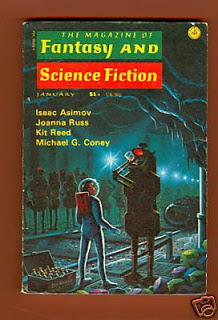
My Boat by Joanna Russ was published in Fantasy And Science Fiction Magazine, January 1976, cover by David Hardy.
“My Boat” by Joanna Russ was published in Fantasy And Science Fiction Magazine, January 1976, cover by David Hardy. (click to embiggen)
By January of 1976, I was midway through my freshman year in high school, living in a tiny town in northwestern Colorado. My parents had been separated for a few months and their divorce was underway. My physically and verbally abusive father wasn’t living with us any more, which was a plus, but everything from our finances to our daily routines were far less certain and predictable. I had had a big break-up of my own that no one knew about—because we were both extremely closeted boys in a very redneck town so of course we had been keeping it a secret. And another boy who had been one of my most consistent bullies throughout middle-school had recently coerced me into an even more covert non-consensual relationship. So to say my life at the time was a bit of a nightmare would not be inaccurate.

I still had a subscription to The Magazine of Fantasy and Science Fiction, thanks to my grandparents, and each time a new issue arrived in the mail, I would retreat to my room with it and stay up way past my bedtime devouring every page. These were the circumstances under which I first read the short story, “My Boat” by Joanna Russ… Continue reading Lost Friends in the Dreamlands – more of why I love sf/f

Hugo Ballot 2016: Why I’m not reviewing this year

A scene from the 1938 serial, Flash Gordon's Trip to Mars, © Universal Studios.
A scene from the 1938 serial, Flash Gordon’s Trip to Mars, © Universal Studios.
Last year as I worked my way through the nominees for the Hugo Awards, I posted reviews of most of the categories. It was my first time voting, and it was the first year that the Sad/Rabid Puppies had managed to completely take over several categories of the ballot with their bloc voting scheme. This year, the new people running the Sad Puppies presented it as a recommendations list, compiled openly from suggestions from readers of their blog. Since most categories had too many nominees for members to just copy and paste the slate, they wound up having no more or less success than any other recommendation list.

The Rabid Puppies stuck with their bloc voting scheme, though this year their notorious racist/homophobic leader, Vox Day, tried to be clever, putting on his list some authors who have been critical of the Puppies in the past, but who also were likely to be nominated by a lot of regular Hugo voters. Since no matter what happens, Vox always claims that the outcome was a victory and that all of us fell into his trap, I assume that when a couple of these big name authors win he’ll be crowing afterward. And if they don’t win, he’ll say this proves that the Hugo voters are part of an evil cabal who refuse to give any award to anyone he recommends. Or something.

Anyway, this year the voting process for me was a lot less stressful than last year. Last year I tried to read every nominee, regardless of whether it was on one of the slates. I wanted to be able to say with a clear conscious that I gave every work a fair chance and only deployed the No Award option when it was deserved. Which meant I forced myself to slog through some truly awful, extremely poorly written stories. And that gets to be depressing after a while.

A friend asked why I was doing that rather than what she did: she started each story, but if by the third page or so it hadn’t hooked her so that she wanted to keep turning the pages, she stopped and put the title under No Award. “The awards are supposed to be for excellence, after all.” I don’t know why I hadn’t thought of that. If a story isn’t good enough to hook me, then it doesn’t deserve my vote. Simple!

That made this year a whole lot easier. I mean, seriously so, so very much easier. Because once again, most of what the Puppies nominated did not pass that test. Yes, No Award was my top pick in more than one category.

The Retro Hugos were a bit more fun. The regular Hugos recognize works published in the previous calendar year. So the stories and other works we’re voting on for the 2016 awards all had to be published in 2015. The Retro Hugos are for works published many years ago, in years when there was a World Science Fiction Convention, but no awards were given. It’s an optional award that can be held at a WorldCon that is either 50 years, 75 years, or 100 years after one of the years when no awards were given. MidAmeriCon II, this year’s WorldCon, took nominations and is taking votes for works of science fiction published in 1941.

Why that was fun for me is because, first of all, a huge number of the short listed works are stories/books/movies with which I was already very familiar. Heck, I have copies of three of the five shortlisted novels on my own shelves! A bunch of the short stories, novellas, and novelettes are in anthologies that I have on my shelves. I own on DVD three of the movies (one is a serial) nominated in Dramatic Presentation, Long Form, and four of the shorts nominated in Dramatic Presentation, Short Form!

Also, Raymond A. Palmer was a golden age editor who deserves to be way more well-known than he is, and so it was fun to vote for him in the Best Editor, Short Form category!

Anyway, this year’s Hugo Ballot and Packet are disappointing in that so much bad stuff was pushed onto it by the Rapid Puppies, and I remain irritated thinking about all the good stuff published last you that ought to have made the ballot but didn’t because of the bloc voting. We absolutely have to pass the E Pluribus Hugo rule change this year, so that bloc voting becomes harder to do in the future.

The Rabid Puppies piddled all over this year’s Hugo Ballot, again. Like Men’s Rights Advocates, GamerGaters, Trump voters, and other angry (mostly) white (mostly) men who claim they are being oppressed any time that people who don’t look like them manage to achieve more than marginal representation, they’re going to keep causing trouble. But as I and many others pointed out last year, their malicious posturing brought a whole lot of fans who are queer, feminist, and people of color into the Hugo voting process who weren’t involved before. While each of those groups may make up a minority of the total fandom populations, I know that collectively we outnumber the Puppies.

Science fiction is the fiction of the future. Even its dystopian and post-apocalyptic sci fi is, ultimately, about hope for a better tomorrow. Love trumps hate and hope trumps resentment. And no one can take the hope for the future from me.


ETA: If you’re looking for who actually won, go here: Here are the winners of the 2016 Hugo Awards – Once again, slated works were largely outvoted.

Someone who loves the same books as me…

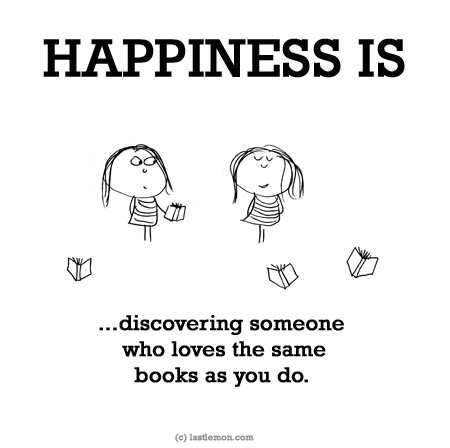
“Happiness is discovering someone who loves the same books as you do.” lastlemon.com
“Happiness is discovering someone who loves the same books as you do.” lastlemon.com (Click to embiggen)
This was a very busy weekend. Seattle’s Pride Parade was Sunday, the Locus Awards Banquet was on Sa turday, and there were many other things we either needed to take care of or wanted to do. I’ve never attended the Locus Awards weekend, before. I actually hadn’t really realized it was a thing, despite having followed the Locus fanzine for years, and having each year looked forward to seeing which books, stories, zines, and so on would win the award.

I should pause here, in case you don’t know what the Locus Awards are. Locus (The Magazine of The Science Fiction & Fantasy Field) was founded back in 1968 as a fan produced news magazine and to promote a WorldCon bid. The ‘zine has continued for decades since, printing news about fannish and pro activities in the SF/F realm. In 1971 Charles N. Brown, the founding editor, decided to have the readership nominate and vote on deserving works in the field, in order to help the Hugo awards. Think of it as an organized recommendation list. Readers and contributors to the zine recommended books and stories and editors and so forth, and voted on them. The Locus awards has different categories than the Hugos, and since you don’t have to have a membership at WorldCon to participate, in theory the awards may draw on a more diverse crowd.

What I like about them is that they have multiple novel categories. While the Hugos just have Best Novel of the Year, the Locus Awards separate Science Fiction novels from Fantasy, and also have a separate category for Young Adult novels and first novels. Anyway, the recommendation list that is generated in the process alone is a wonderful resource for finding good things you would have otherwise not heard of.

Even though I have been reading the list of winners every year for a long time, it somehow never occurred to me that there was an award banquet, and even more important on a personal level, I didn’t know that the banquet has, at least for the last several years, been happening right here in Seattle. I found out because a woman mentioned it at a panel at NorWesCon, and handed out fliers.

The event is like a miniature sci fi con. There are a couple of Readings by pros the night before the banquet, followed by a party, then on Saturday morning there are a couple of panel discussions. There is an autograph session and a bookseller is there ready to sell you books by the authors who are signing, and there is the banquet. In addition to the awards, there’s several silly activities that have grown up as traditions around the event, such as a Hawaiian shirt contest (Charles Brown, Locus’ founding editor, was famous for his fondness of loud Hawaiian shirts).

We both have been having worse than usual hay fever lately, so neither of us have been sleeping well, and we both wound up taking naps Friday afternoon after work that lasted late enough that we skipped the Friday evening activities. Saturday, we made it to the event and had a great time.

First, no one told me that there would be free books. Apparently the publishers of books that make the shortlist often send boxes of the books to the event. So those (and other books) are set out in little piles on each banquet table. And a bunch more are on a give-away table in the back. We brought home free books whose retail prices definitely exceeded the cost of tickets to the event!

It was also just a fun event. There were a lot of familiar faces there (since I’ve been attending Northwest sci fi conventions for nearly three decades), but it was a smaller crowd, and a much higher percentage of the attendees were pros.

The event also overlaps with the first week of the Clarion West six-week summer writing workshop, and we wound up sharing our table with three of the students from the workshop. They were really nice, and were a diverse group: one guy was from Chicago, a woman was from Wales, and another guy was from India.

I knew our new acquaintances were “my kinda folks” when the young woman from Wales picked up one of the books in the free pile and said, “I should not pick up a new book that is this thick when I have no free time for the next several weeks” then, a second later she gasped and said excitedly, “It has a map!” and the other two immediately stopped their banter to add comments about how books with maps are temptations one can never resist.

I had been about to make a similar observation. Having written about it before: “Some of my favorite books have maps…”.

Whenever I go to a con, I come back feeling excited in new ways about my writing. Some of it is from hearing authors at panels talk about their own troubles and triumphs writing. Some of it is from learning new things or finding new stories that inspire me. Some of it is because I almost always wind up sitting in a corner somewhere with my laptop or iPad or a paper journal working on one of my stories in progress, and being out of my usual routine makes me look at the plotholes and so forth differently.

But a big part of it is simply the joy that comes from meeting other people who love the same kinds of books I do. Shared joy multiples. Chatting with another person who loves something you love, explaining to each other which bits made you squee and so on, increases that wellspring of delight inside you.

That remembered elation can help carry you over the rough spots in your next round of revision.