(click to embiggen)I was astonished, after I had been out of the closet for a bit, to look back on my previous life and realize how much of time and energy had been spent living in fear. Fear of being found out. Fear of being rejected by family and friends. Fear of being physically assaulted. Fear of living a life without love. Fear of dying alone. Fear of what would happen if the preachers were correct and a lake of eternal fire awaited me.
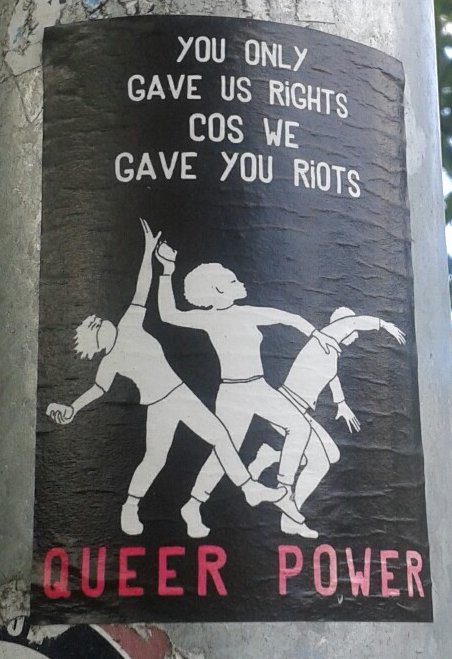
“You only gave us rights because we gave you riots. Queer Power” (Click to embiggen)All of those fears were based on real experiences. My dad’s most angry beatings were all accompanied with him calling me worthless, a faggot, and a cocksucker. And for several years I didn’t know what those last two words meant. The kids at school who bullied me (which often involved physical attacks) always called me a sissy or pussy while doing it. The teachers who verbally bullied me called me a sissy or faggot while doing so. In high school, a classmate I knew well was jumped by a group of jocks who were convinced he was gay (he wasn’t—years later he’s married to a great woman and they have two wonderful kids and we still chat online) and was in the process of being beaten up until a group of us found them and broke it up. Another classmate who I didn’t know very well was beaten so badly he was kept in the hospital for a few days. Again, it was because a group of guys at school thought he was gay (he was—last I heard, he and his partner of several years were living in Boston). A couple of other classmates who were outed in embarrassing ways were kicked out of their homes by their parents, and wound up living with relatives far away. One of my uncles (the same one who insisted that I was such a sissy because my parents let me own an action figure) said he would kill any of his sons if they turned gay.
So it wasn’t just anxiety. It wasn’t all in my head. The danger was real.
(click to embiggen)And because I’d been raised Southern Baptist, and I was the kind of nerdy kid who read the Bible all the way through on my own at least twice, I spent many, many hours begging god to take these feelings away from me. I spent a lot of time studying the guys that never got called out like I did, trying to figure out how to act more like them.
And while for many queer kids the world is a more tolerant place than it was for me in the 60s and 70s, thousands of teens in the U.S. are still thrown out on the streets every year by parents whose religion teaches it is better to drive the kid out than to “encourage their lifestyle.” Hundreds of children and teens still commit suicide every year because of bullying by people who suspect they are queer.
All the bullying, anxiety about being rejected, and so forth affects us. Studies show that most adult queers bear at least some of the neurological markers of PTSD—just like domestic abuse survivors. Coming out and finding communities that accept us doesn’t make that go away. We are always on the lookout for the next potential threat.
This is another variant rainbow flag that’s been around longer than the More Colors Flag.There were always moments when I would get angry because of the way I was treated. But particularly when I was a young kid, anger was never useful. I was physically unable to stand up to the bullies (for instance, the middle school bully who was enough bigger than me that he held me upside down for many minutes while his buddies kicked and spit on me).
Over the course of several years anger began replacing fear. There are many moments I can point to, but one that sticks out came in my early 20s. I was sitting in a church pew in a church where the musical ensemble I was directed had performed several songs for to support a revival meeting. The visiting preacher had delivered an unusual message for a revival: he had talked about unity and finding common ground among fellow Christians who didn’t always agree with us on every detail. It was conciliatory, rather than a fiery call to fight evil, which was a much more typical revival tone.
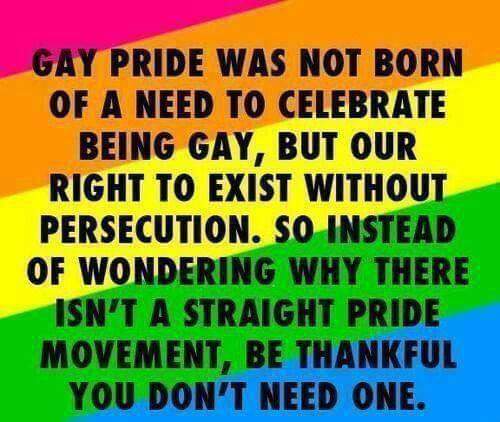
“Gay pride was not born out of a need to celebrate being gay, but our right to exist without persecution. So instead of wondering why there isn’t a straight pride movement, be thankful you don’t need one.”And then one of the pastors from the local church gave the closing prayer. That how I found myself with head bowed and eyes closed and suddenly shaking in fear as the pastor thank god for sending the scourge of AIDS to wipe out the evil homosexuals from the face of the earth. Oh, he went on and on about it. And because as far as I knew I was the only homo (very closeted) in that room, I half expected people to pull me aside for an intervention afterward. Or maybe that I would be jumped and beaten to within an inch of my life somewhere.
I realized some time later that the pastor wasn’t targeting he was arguing with the visiting pastor, using the passive-aggressive platform of a public prayer. But over the following days and weeks, as I realized that no one was targetting me, I began to get angry. And the more I thought about how that pastor had used a prayer to spew such hate, the more angry I became at the entire system.
That may have been the final nail in the coffin of my membership in the Baptist denomination—if not all of Christianity together.
“The only choice I made was to be myself.”There are many people who will tell you not to become an angry, militant advocate for anything. They will urge you to try to find middle ground, to compromise, to make peace with those you disagree with you. The problem is that there isn’t an acceptable middle ground between the propositions: “I want to live” and “you deserve death.” And the people who thank god for AIDS, who tell parents to kick their queer children out on the street, who argue that transitioning treatments are not medically necessary, and who argue we shouldn’t have marriage rights (which legally include the right to make medical decisions for one another and so forth)—they are all implying, if not outright saying, that queers deserve death.
Seriously, the only middle ground is that some queers deserve death. How is that a morally acceptable position for anyone?
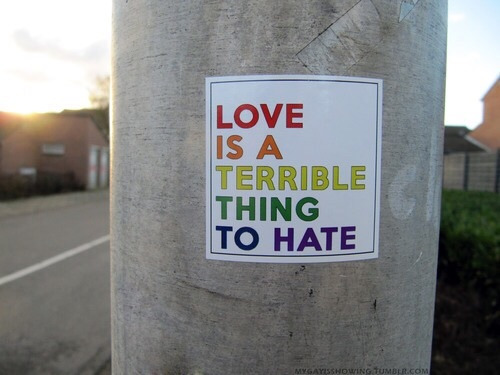
“Love is a terrible thing to hate.”So, yes, I am frequently an angry, militant queer. But all of the people on the other side are arguing in favor of murdering at least some queer people (or, I suppose you could argue that they are simply willing to allow some or most of us to die). That means that what I feel is righteous indignation. And if you don’t feel it at least a little bit on behalf of those kids bullied to death, the murdered trans people, and so on, well, I’m sorry to say, that means you’re on the side of the hateful murderers. I’m sure you have some rationalizations for why your position isn’t that, but you’re wrong. If you don’t believe our outrage is justified, then you’re not one of the good guys.
If that realization makes you unhappy, well, you have the power to fix it. Come over to the Light Side. Join the fight for justice, love, and life.
(click to embiggen)A few years ago one of the large anti-gay political action groups sponsored a protest march that was supposed to be in favor of “traditional” marriage. All of the signs and banners carried by participants in the rally were extremely anti-queer, and not one single sign was actually in favor of any kind of marriage. Now, because we monitor these things, I was one of literally thousands of queer and queer-allied people online who hijacked the hashtag of the anti-gay folks to post pro-gay memes and comments. There were so many of us queers and allies posting pro-queer rights comments, that we overwhelmed the bigots’ message, at least on social media.
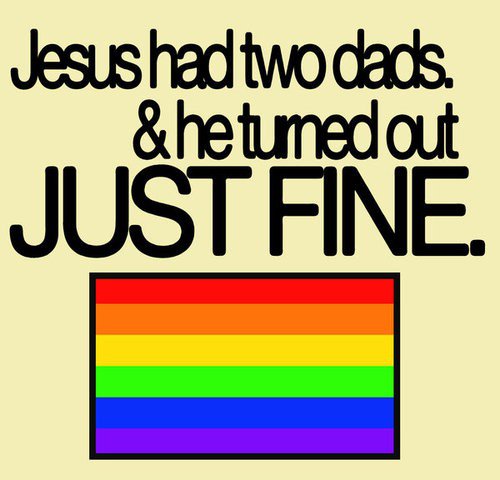
I received a lot of interesting replies. One person was particularly upset with me for sharing a meme similar to the one at the top of the post that talked about Jesus and his two dads. “Can’t you disagree without the blasphemy of saying god had a sexual relationship with Joseph?”
I responded by pointing out that the meme doesn’t mention sex, it simply affirms the Biblical texts which referred to Jesus as both the son of Joseph and the son of God. Then I said that the only blasphemy I saw were people trying to force some of their religious views into law, penalizing people who weren’t part of their flock. There were a couple of back and forths, but I had already promised myself that any bigots who chimed in would get two replies of me trying to clarify or whatever, and then after that my only reply to any further comments would be “Bless your heart.” So the discussion petered out.
blasphemy noun, Profane talk about something supposed to be sacred; impious irreverence.
I’m sorry, but I really was merely taking the Bible literally: the text calls Jesus the son of Joseph in some places, and the son of god in others. In fact, it refers to him as the son of Joseph more often than it calls him the son of god. The oldest surviving copies of the gospels never call him the son of god. And then there’s the whole genealogy in one of the gospels, showing how Jesus is descended from King David–through his father, Joseph!
So if it is profane to talk about Jesus having two dads, the profanity starts in the Bible.
If we’re going to get upset about any sex involving god, what about the nonconsensual impregnation of Mary? I mean, looking at the text, it’s pretty clear that god roofied Mary, then sent “the Holy Spirit to overshadow” her and conceive the child. I say nonconsensual because while an angel appears to Mary before it happens to tell her it is going to happen, at no point does the angel ask if she agrees to this thing. And really, Mary was almost certainly a teen-ager, confronted by a powerful otherworldly being who tells her that an even more powerful being is about the knock her up. With such a power differential, is the concept of consent even possible?
I’ve seen the arguments made, sometimes by people who claim to take the Bible literally, that this is just a standard divine intervention trope: Eqyptian and Greek mythology, for instance, are full of stories of gods having sons from mortal women. As if “everyone else is doing it” is a moral precept?
Among the many problems with people of various conservative types of Christianity imposing their beliefs on others through the force of law, is that even their own holy book isn’t very clear on these points. The person they have named their religion after, Jesus Christ, never once said anything about gay people, one way or the other. And believe me, there were gay people there in Galilee and Judea. If being gay was such a big sin, you would think he would mention it.
There are only six verses in modern English translations of the Bible that appear to refer to homosexuality directly. However, the four in the New Testament have only been that way since a re-translation in the 1920s. In the oldest versions of the text we have in the original languages (Arameic and Greek), the words were gendered references to temple prostitutes in two passages, the third is a reference to two separate sins (cheating on one’s spouse after making a monogamous committment, and having sex with someone before you have married). The fourth, meanwhile, no one knows. The Apostle Paul made up a greek word that occurs nowhere else in any ancient greek document my combining two existing words meaning bed and lewdness.
Honesty, given how opposed to marriage of any kind Paul was (he thought it was a waste of time and energy that would be better spent evangelizing), this might have been a word he coined to refer to those men who “so burned with lust” that they couldn’t concentrate on god’s work unless they married and had an outlet for the aforementioned lust. If so, then Paul was calling heterosexual marriage an abomination, not gay sex.
As to the old testament passages: modern Christians have no problem ignoring the other parts of Leviticus they don’t like (the prohibitions on bacon and shrimp, for instance), so it is difficult to take them seriously on this. Further, I’ve read more than one argument written by Jewish Rabbis that those texts should never be discussed out of context of the rest of the books (including a lot of commentaries and documents that were not absorbed into the Christian Bible), and are probably referencing some specific issues at the time of writing with men visiting temples of other gods and partaking of temple prostitutes. So it is more likely those verses are admonitions against idolotry and sex with someone other than one’s spouse after making a monogamous committment.
Please note I am paraphrasing. Wrestling with the Torah is a lifetime commitment of its own, and the fact that the church I was raised in has co-opted a not-terribly-well-done translation of the Torah doesn’t make me an expert.
Holy books, no matter whose holy books we are talking about, were written by humans. You can believe that they are divinely inspired if you wish, but the words were written by imperfect humans, using imperfect language, which is being read centuries later by other imperfect humans with imperfect understandings of languages that have changed during those centuries. Just to narrow it back down to the bible, that book itself contains many stories of people who were absolutely convinced that they knew what god wanted them to do, who turned out to be wrong. It also contains stories (go read an annotated version of the Saga of Sampson for one of the most entertaining) of people who were believed to be immoral or otherwise unsuitable for god’s work by all the godly people around them, who were actually the ones doing god’s work.
As my Bible professor in my university days was fond of saying, “The text keeps telling us that we can’t find all of the answers in the text. We have to think and develop compassion and a sense of justice on our own. And that’s a lot of work.”
If your argument that people who are gay, lesbian, bisexual, asexual, pansexual, trans, nonbinary et cetera don’t deserve equal rights is to quote your holy book without applying compassion, testing the situation against the notion of justice, and just thinking about whether you are even holding yourself to a similar standard, then you aren’t doing the work. You are failing your fellow humans. You are failing at your own religion.
And you are failing to regard the life and well-being of some of your neighbors with reverence. And that is true blasphemy.
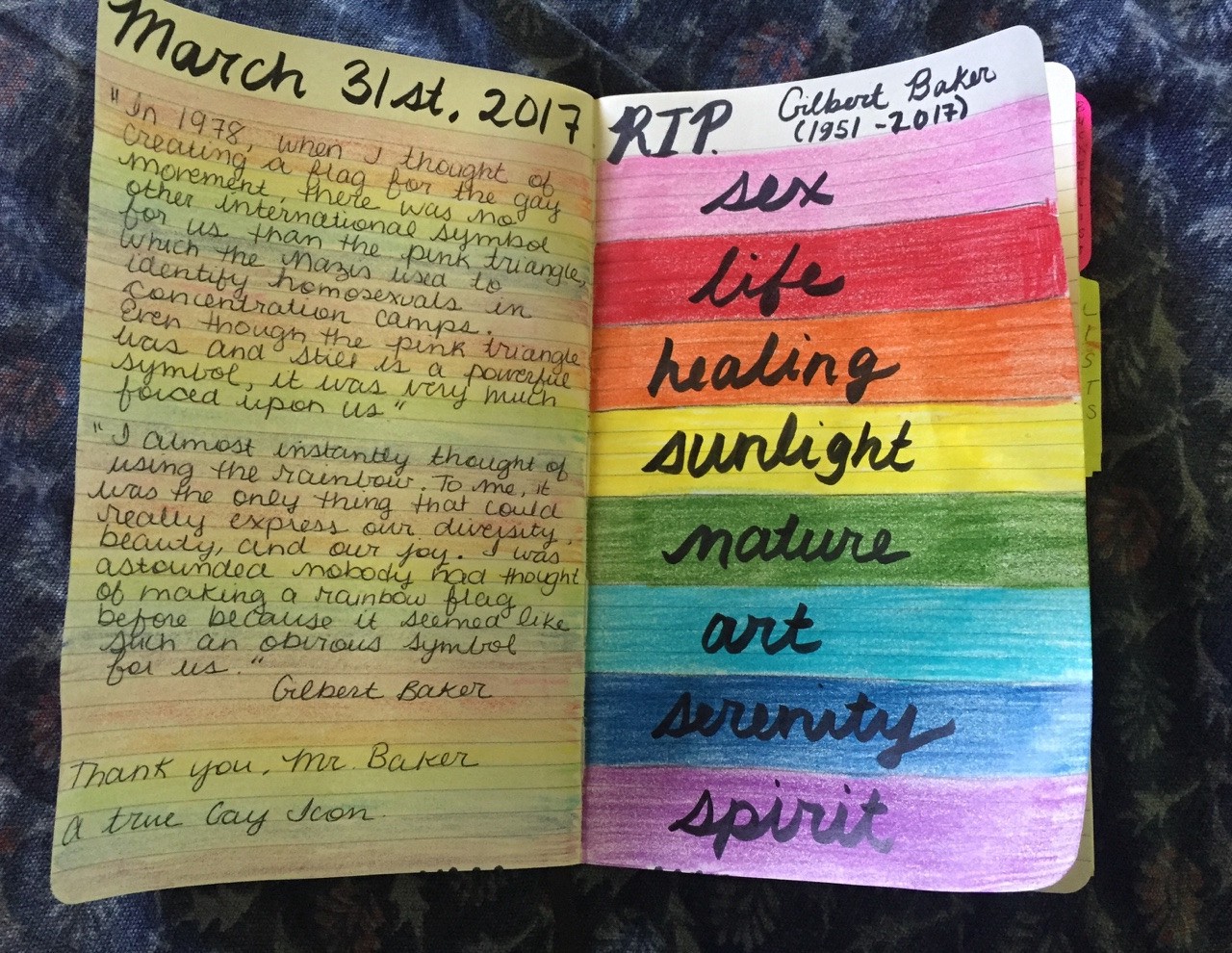
A quote from Gilbert Baker, the creator of the Rainbow flag. (click to embiggen)
“In 1978, when I thought of creating a flag for the gay movement, there ws no other international symbol for us than the pink triangle, which the Nazis had used to identify homosexuals in concentration camps. Even though the pink triangle was and still is a powerful symbol, it was very much forced upon us.
“I almost instantly thought of using the rainbow. To me, it was the only thing that could really express our diversity, beauty, and our joy. I was astounded nobody had thought of making a rainbow flag before because it seemed like such an obvious symbol for us.”
—Gilbert Baker, 1951-2017
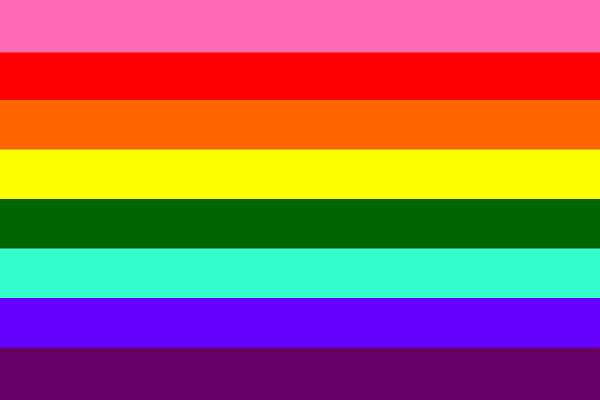
The original Pride flag designed by Gilbert Baker in 1978 has 8-stripes. Colors were removed and changed originally due to fabric availability.Gilbert Baker was born in Kansas in 1951. From an early age he was fascinated with fabrics and color. He attributed this early interest to the women’s clothing store which was owned by his grandmother. Even with that family connection, though, in small town Kansas in the 1950s no one thought a boy should learn to sew. In 1970 the 19-year-old Gilbert was drafted into the army, where he was trained as a medic and stationed in San Francisco, where he treated soldiers who had been wounded in Vietnam.
In 1970 there was a thriving queer community in San Francisco. Gilbert found other people like himself, and managed to serve out his tour as a medic without getting caught (being gay was a court martial offense), so he was honorably discharged. But having found a community, he chose to stay. He bought a sewing machine and taught himself to sew. He hung out with a lot of other artists. He designed fabulous drag costumes. And he also began designing pro-gay and anti-war protest banners for a variety of marches and rallies. Soon he was known as “the banner guy.”
When Harvey Milk was elected a city supervisor, becoming the first openly gay man elected to public office in the U.S., he had worked with Gilbert a few times in relationship to those rallies and protests. And so when Milk thought that the community needed a new symbol to unite around, he asked Gilbert to create it.
Note that Milk asked him to create a symbol, not necessarily a flag. But Gilbert said he settled on a flag very quickly, because a flag represents sovereignty. “A flag,” he said, “proclaims that gays are a people, a family, a tribe.” He chose the rainbow as the basis of the flag because it represented diversity—of race, gender, age. “Plus, it’s a natural flag — it’s from the sky!”
Recreation of the second version of Baker’s original rainbow flag for the ABC miniseries When We Rise. Photo Credit: Ron Koeberer via ABC.The Gay Freedom Day Committee provided money, and the Gay Community Center provided working space. Gilbert Baker and approximately 30 friends gathered together with over a thousand yards of cotton fabric and a lot of bottles of dye, and carefully created fabric in eight colors: hot pink, red, orange, yellow, green, turquoise and violet. Gilbert also worked with Fairy Argyle, who was known as the Queen of Tie-Day, to create a square of blue fabric that had tie-dyed stars on it, to evoke the field of stars on the U.S. flag. Gilbert sewed two different flag designs in 1978, the first was the 8-stripe rainbow, the second one looking like the American flag, but with the tie-dyed stars and rainbow stripes.
The two flags were first hoisted into the sky above San Francisco’s U.N. Plaza as part of the Gay Freedom Day Parade on June 25th, 1978. Gilbert’s longtime friend, Cleve Jones, described the day as having the perfect amount of wind to make the flag furl, but not be unpleasant on the ground: “It was just stunning.”
The 7-stripe version.Five months later, Harvey Milk was assassinated, and the community was thrown into mourning. Thousands gathered that night in the Castro, that marched to city hall where they held a candlelight vigil. In the following days, people began asking for rainbow flags. To meet the sudden demand, Gilbert worked with the Paramount Flag company to mass produce flags. They used a then stand available rainbow fabric with only seven stripes: red, orange, yellow, green, turquoise, blue, and violet. The Freedom Day committee wanted larger flags for the next Pride Parade, and Gilbert went to work, dropped the hot pink stripe from his larger hand-sewn flags in part because the dye was difficult to obtain, and no one was manufacturing stock hot pink fabric.
And the next year he dropped another stripe. Some say that the turquoise was dropped because when the flags were hung vertically from city light poles the middle stripe wasn’t visible from other angles. Gilbert said that turquoise and indigo fabric was difficult to obtain, so he switched to a navy blue stripe.
I’ve written before that the rainbow flag was not immediately embraced by everyone in the LGBT+ community. In fact, it was considered more a regional thing until a court case in 1989, when a West Hollywood man had to sue his landlord for the right to fly the rainbow flag from his apartment balcony.
In 1994 Gilbert supervised the creation of the first mile-long rainbow flag to commemorate the 25 anniversary of the Stonewall riots. The flag was cut up afterward to make smaller flags. Some sections were sold as a fundraiser, others were distributed to Pride Parade committees in other cities. In 2003, the 25th anniversary of the creation of the rainbow flag, Gilbert was commissioned to create another giant flag. This one was one and a quarter miles long and was carried in the Key West, Florida Pride event. It was eventually cut into 100 slightly less giant flags and again distributed to various cities around the world.
Gilbert often described himself as the Queer Betsy Ross and was sometimes asked to give his blessing to some variants designed by others (such as the Victory Over Aids Flag, which used a lighter violet and had a black stripe to symbolize our mourning for those who have died of complications of AIDS). It is worth noting that except when he was directly commissioned, Gilbert didn’t make money from his creation. In his later years he struggled financially. But the one interview I saw where someone asked him about it, he said it would have been wrong to try to trademark the design. How could it be a symbol of our tribe if it legally belonged to one person?
After 2003, Gilbert started lobbying for a return to the original 8-stripe version, so far to little avail. When Barack Obama was elected President, Gilbert hand sewed an 8-stripe version as a gift to Obama, and during the Obama administration that flag was displayed in the White House.
Shortly before his death, Gilbert Baker redesigned the rainbow flag yet again…Gilbert redesigned the flag one more time before he died. The election of Trump prompted him to add a 9th stripe, lavender for diversity or resistance. He sewed 39 by hand before his death, and they were used in the following San Francisco Pride Parade.
When I was first coming out of the closet in the late 80s, pink triangles were the symbol I saw around the Seattle queer community. You could find pink triangle buttons and key chains and bumper stickers and so forth in every store in the gayborhood. There were rainbows, as well, but the pink triangle outnumbered them. Then in the 90s, when suddenly there were rainbows everywhere, especially at pride, there was a bit of a backlash. I heard more than one person grumble about rainbows everywhere.
But I think Gilbert was on to something. The pink triangle was forced on us by oppressors; it was also most often used to identify gay men in the concentration camps—therefore many lesbians felt the reclaimed symbol didn’t include them. There is something joyful about the bright colors of the rainbow flag. The different colors side-by-side can signify that diversity Gilbert talked about: different races, different genders, different generations of queer people.
And I confess that as long as anti-gay religious wingnuts have conniption fits about us supposedly stealing the symbol from god, I’m going to take a bit of delight in raising my own rainbow flag. And it isn’t just about sticking it to the haters. Rainbows appear in the sky after a storm. They are beautiful and ephemeral and otherworldly. It’s difficult to look up at one in the sky after storm clouds have cleared and not feel at least a bit of wonder.
As queers we encounter a lot of storms in life. We may be bullied as kids. We may face discrimination and even physical assault as adults. We achieve a small victory, and then face a conservative backlash. In my lifetime there have been campaigns to pass laws to bar us from certain professions, even as courts and civil rights laws open some doors for us. The AIDS crisis killed tens of thousands, and it wasn’t just Republican politicians who laughed at our suffering during the 1980s. But every tempest and onslaught that we weather makes us a stronger. We have setbacks, but we fight on, moving ever forward.
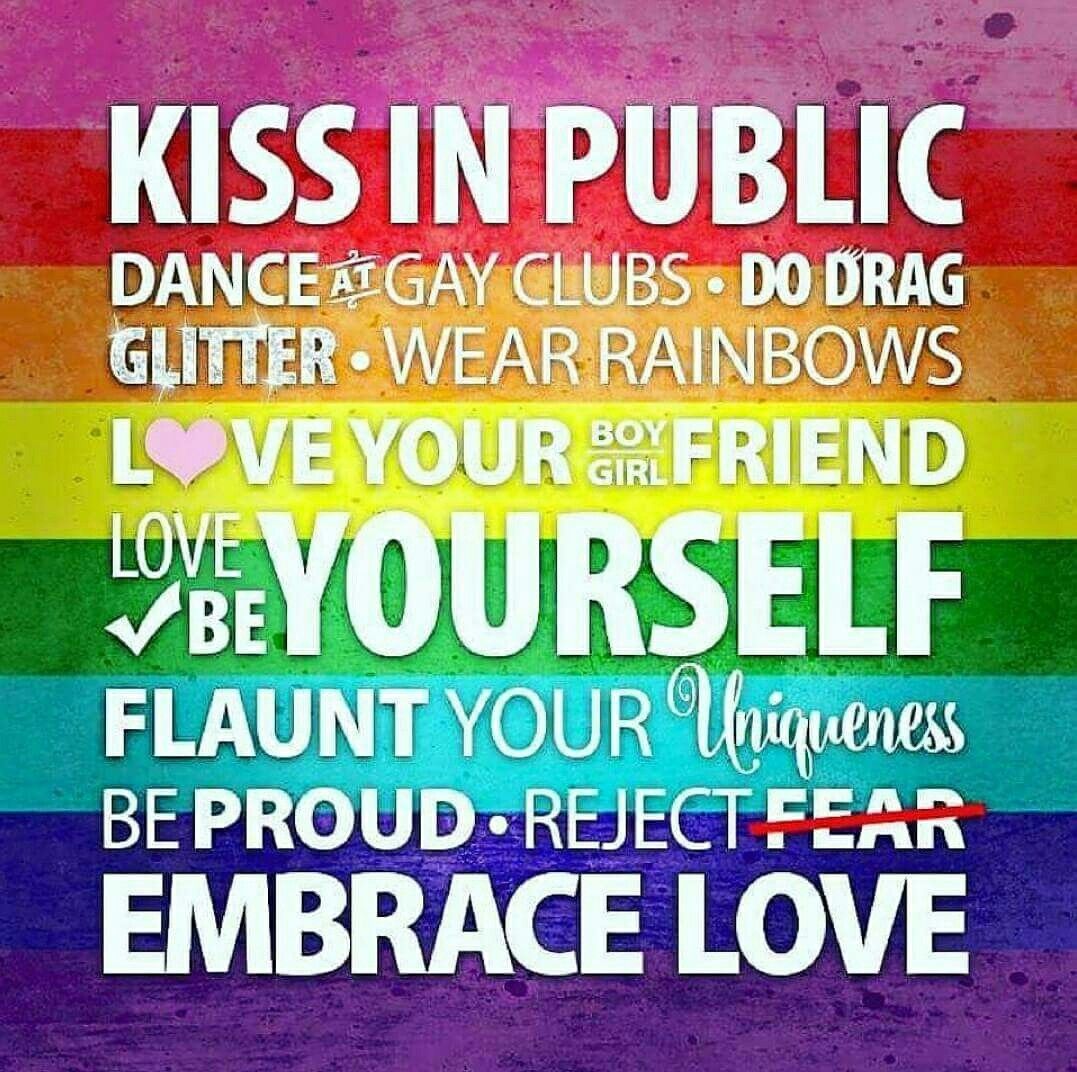
(click to embiggen)Pride Month hadn’t even started before complaints about why we even have Pride started crossing my various news and information streams. There are many, many reasons I can give, but the most important one is simply visibility. We still live in a society where queer kids are bullied by their own parents, thrown out on the streets at the encouragement of their churches, and told again and again that who they are and who they love is shameful and abnormal. And those messages don’t come just from overt bigots who spew anti-gay hate. That message also comes from so-called allies and even from other queer people who disparage those queers who dress outrageously or otherwise flaunt their uniqueness.
A couple months ago Newsweek used this picture to illustrate a story entitled, “The Street Skirmishes, Bar Brawls and Drunken Violence of American St. Patrick’s Day”The funny thing is that they never say such things about participants of St. Patrick’s Day parades. Even though a typical American Pride Parade is far less rowdy and has far less public drunkenness than the typical St. Patrick’s Day parade. Pride events have a whole lot less sexuality than typical Super Bowl commercials. Pride events have a lot less nudity than, say, Seattle’s annual Fremont Solstice Parade. But because the sexual innuendo and nudity in those other events are aimed at straight people, the outrageous costumes are being worn by straight people, and intoxicants are being publicly consumed by straight people, it seldom gets the same kind of coverage in the news, and certainly doesn’t provoke the public tut-tuting on social media that Pride events do. Remember that the original St. Patrick’s Day parades were political marches protesting discrimination against Irish people in America. When was the last time you heard of someone being fired for being Irish?
A person crossed my social media this week (I presume because I reblogged a bunch of pride comments and memes on my tumblr) to admonish me for provoking normal people by celebrating the freaks of the queer community. They claim that they aren’t at all homophobic, yet they use the same tactics and the same language as the rabid bigots. Just like the bigots, they say that being visible is flaunting our sex lives. They say we are freaks. As a certain famous man from Galilee once warned us to beware of people who claimed to be our friends: “by their fruits shall you know them.”
Since I promised that this would be an adventure in dictionaries, let’s look at that word, freak. I call your attention to the following excerpt from the Shorter Oxford Dictionary’s definition:
4 Something fanciful or extravagant; (more fully freak of nature) an abnormal or irregular occurrence, an abnormally developed person or thing, a monstrosity. b A person regarded as strange because of their unusual appearance or behaviour.
This so-called ally is hardly the first person to call me a freak. One of my uncles used to refer to me as an over-educated freak as early as age 9, for instance. It was one of the mildest insults my eighth grade Reading and Literature teacher called me. Other teachers and school administrators told my parents that the bullying I experienced was impossible to stop as long as I failed to act like a normal boy.
What was the behavior they were referring to? Was I showing up at school wearing bondage gear or dressed as a drag queen? No, of course not. The sorts of behavior that was called out were things like:
I would rather read a book by myself than play sports
In elementary school when most boys hated the girls in class, I got along great with them
I knew more about cooking than I did about horsepower and gear ratios
My favorite TV shows were things like The Carol Burnett Show or The Partridge Family or The Mary Tyler Moore Show instead of Gunsmoke or The Streets of San Francisco
My favorite books were mostly science fiction
In middle school I treated girls I talked with as friends, rather than as objects of desire (and didn’t understand for a long time what the difference was between the way I interacted with girls and the way most of the other boys did)
I liked to draw and write fiction
I laughed at the wrong things
I liked to wear clothes that were interesting colors
Some of that list will not strike many people as gender nonconforming, particularly the science fiction bullet. But you need to understand that before 1977 and the advent of the original Star Wars movie (when I was a junior in High School), normal boys did not like sci fi.
The first Freedom Day Marches didn’t happen until I was in fourth grade, and they were not being covered on news stations and the like until several years later. All the bullying and teasing I got for being a sissy or a freak or “not a normal boy” was deeply rooted in homophobia that was hateful and destructive long, long before the first Pride. So don’t tell me that Pride causes homophobia. Anti-gay hatred was around for centuries before Pride.
And kids like me—kids who could never figure out why the way we talked or the way we walked or the things we found interesting were wrong—were subjected to that hatred and bigotry without appearing in public in fishnet stockings or elaborate make-up. We were bullied and mocked and scorned and ridiculed because our behavior wasn’t the usual expected of our gender. I was bullied because I didn’t understand why it was unusual for a boy to think that a pair of burgundy pants was cooler to wear than plain blue jeans. I was bullied because I thought a girl’s ideas were more interesting than what was hidden by her clothes. I was bullied because I would rather sing along (and dance or pretend to be a member of the band) to the radio than play cops and robbers.
Not all queer kids are gender nonconforming (but studies show that at least 75 percent of boys who were consistently identified as “sissies” during childhood will come out as gay as adults), just as not all queer male adults are into show tunes. But the scant number of queer athletes who have come out of the closet, as well as the large numbers of “straight acting” and “non-scene” gays, have been free to do so because the nonconforming or freakish queers decided not to take the hate and loathing lying down. The freaks decided to stop being ashamed of who they were and who they loved. The freaks decided to stop pretending to be non-freaks.
I’m not a drag queen and I don’t wear fetish gear to Pride. I wear my purple hats and various rainbow or unicorn-adorned t-shirts year round. I’m unashamed of my fabulous rainbow parasol and my purple earrings. But I cheer and clap for the people who do dress in drag or other outrageous clothes at Pride. I support their right to be there and be out and dress however they want without being harassed. Just as a woman wearing certain clothes in public doesn’t make it all right for someone to harass or sexually assault her, neither do queer and trans people wearing whatever they’re comfortable in make it right to exclude or denigrate them.
If my love of bright colors, glittery earrings, and silly t-shirts makes me a freak, I’m proud to join that fanciful and extravagant legion of the out and proud. If you’re going to call me a freak, fine, but that’s Doctor Freak to you, and don’t you forget it!






 Font Folly