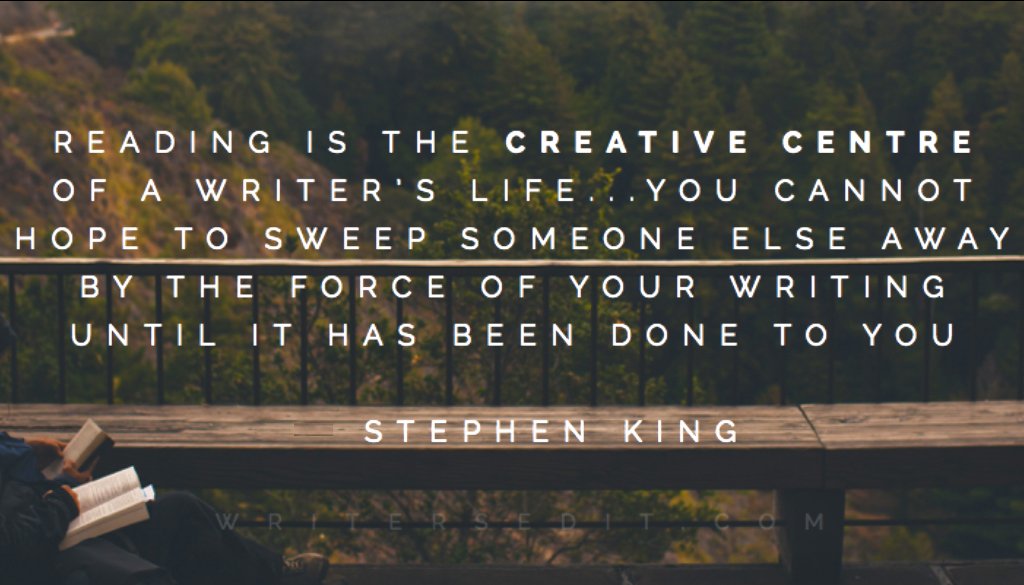
“Reading is the creative center of a writer’s life… you cannot hope to sweep someone else away by the force of your writing until it has been done to you.” – Stephen King (click to embiggen)Last week they started emailing the Hugo nominating PINs (personal ID numbers) to those of us who have memberships to WorldCon. Mine arrived Friday night. During last year’s voting period I started a list of stories and such that were being published last year I thought were good enough that I’d want to nominate this time around. It’s a fairly short list because most of the reading I did last year was stuff that had been published in previous years. So I need to do some more research and reading!
To nominate you need to have either an attending or supporting membership to last year’s WorldCon (Sasquan, in Spokane), to this year’s WorldCon (MidAmeriCon II in Kansas City), or to the 2017 WorldCon (to be held in Helsinki). If you already have one of those, your PIN is either coming in email, or will be included in your snail mailed Progress Report II (if you chose that for updates rather than email). Check your spam folders if you think you should have gotten it and it hasn’t arrived. They are still mailing them out, though, so don’t send a panicked message to them, just yet.
A lot of people are putting up their “oh, by the way, I had this stuff published this year that could be nominated, if you happened to have read it and enjoyed it.” I only had one short story published, and in an APAzine at that, last year. But I do blog about science fiction and fantasy here a bit, and I suppose that means technically I could be nominated in the fan writer category. *wink* Hey! A guy can dream, right?
More seriously, as I work on my nominations, I’ll try to put together a list of some things I think folks should check out.
In completely unrelated news: The Ali Forney Center, which provides support, nourishment, and shelter to homeless LGBT youth in New York City, is trying to raise money to purchase the church of anti-gay hate-spouting preacher, David Manning. The church has been ordered into foreclosure for non-payment of over a million dollars in utility bills (on top of other fines and debts). I forgot to mention when I posted this earlier, that Manning’s church has been officially designated a hate group by the Southern Poverty Law Center. Anyway, as of this morning, they had reached 49% of their goal in just three days. The foreclosure auction is later this month. If you can donate to this opportunity to turn hate into love, please do!
Earlier this week the writer/director of Star Wars Episode VIII re-tweeted this cartoon drawn by Jeffrey Winger (jeffreywinger.co.vu). Click to embiggen.The first time I saw the original Star Wars I didn’t consciously have a strong feeling about the apparent love triangle being set up between Luke, Leia, and Han. I was frankly a bit surprised when some of my friends started talking about it. I mean, yes, there was the cute scene when Han realized that Luke was developing a crush, and he asked, “Do you think a princess and a guy like me–?” But he was so obviously teasing Luke. Clearly he wasn’t actually interested in the princess, right? I mean, what other possible interpretation could you have to that indulgent, slightly condescending smile?
And Han, being a much more experienced man, also, to my mind, knew that there was never any chance that a guy like Luke could win the princess, either. That was the other meaning of that smile. And during the dozens of times I re-watched the movie over the next three years, I was still convinced that there wasn’t going to be a serious conflict between Luke and Han trying to win Leia’s heart.
I was definitely in the minority. Lots of people expected, if there was a sequel, that a love triangle would figure heavily in the next movie.
I would like to be able to argue that I had somehow perceived some hint of the revelation that was going to come along later that Leia was Luke’s twin sister. But that wasn’t it. It wasn’t until after I first saw The Empire Strikes Back, that I realized what had been going on in my subconscious. Empire remains my favorite movie of the series for a lot of reasons, but after the first showing I had very mixed feelings about one subplot.
I was still deeply closeted at that point, but I was quite aware that I had a crush on Harrison Ford (or at least all the characters he played), while I had also very strongly identified with Luke, but didn’t have the same kind of feelings for Mark Hamill. I realized that my subconscious had been rooting for a romance, all right, but one between Luke and Han. Which in 1980, when Empire was released, was absolutely impossible in a mainstream film. Heck, even the most radical art house films seldom portrayed mutual same sex romances. They might show a homo obsessed with another man, but it was unrequited and tragic and depressing.
But that was what my subconscious saw precisely because we never saw it on the screen. I’ve written before about why queer people read same sex attraction into all sorts of characters in movies, television, and books. Because if we didn’t imagine them, we never got them. The unrelenting message of culture and media is that queers don’t exist, queers don’t matter, queers don’t love, and if they dare to, they deserve whatever horrible things befall them.
That’s why it’s homophobic when straight people roll their eyes or demand to know why we “do that” to characters who aren’t explicitly identified as gay. It isn’t necessarily malicious or intentional, but being annoyed that we dare to imagine such relationships perpetuates our erasure and is condescending at best.
But to get back to Empire, the movie did such an excellent job of portraying the complex emotional relationship between Han and Leia, that by the time of Han’s famous, “I know” answer just before he was frozen in carbonite, I was cheering for them. Of course they were in love! They were perfect for each other! At least that’s what one part of my heart said. Meanwhile, another part was mourning the loss of the love between Han and Luke that I’d hoped for, even though I knew it wouldn’t happen in a mainstream movie.
But once I got over my disappointment, I was totally on the Han and Leia train, and was happy to see them decades later (“You still drive me crazy”) as a realistic older couple who have had their ups, downs, and a falling out but still caring for each other in The Force Awakens.
I don’t only ship same sex couples. The first two seasons of Buffy the Vampire Slayer I was totally a Willow/Xander shipper. I so wanted Xander to pull his head out and realize that Willow loved him. At different times in the series, yeah, I was elsewhere. I’ve written Xander/Spike fic (and if I ever finish my WIP there’s also some steamy Graham/Riley action and hot Gunn/Buffy action in there). I adore well written Buffy/Spike fic. For a while I was a Xander/Scott shipper, but have often been completely onboard both the canon Xander/Anya and Willow/Tara relationships. I realize if you’re not familiar with the show that you won’t know that half of those are opposite sex couples. In another fictional universe, I remain an unapologetic Parker/Hardison/Spencer One-true-threesome shipper!
But yes, I saw the chemistry between Finn and Poe during my first viewing of The Force Awakens, and given how many millions of other fans saw it, it clearly isn’t an unreasonable inference. I get that other people see the Rey/Finn pairing, and I’m not saying I wouldn’t be able to enjoy that, but I would really, really like for a galaxy filled with aliens of all shapes and droids and so forth the acknowledge that queer people exist, too. (Also, hey! Why can’t we have a Finn/Poe/Rey triad? Polyamory is real, too!) That’s why I enjoyed reading Rian Johnson Gets It, where I first saw the cartoon I linked above.
As Chuck Wendig said in a post I’ve linked to before regarding people who were angry he put gay characters in an official Star Wars novel:
“…if you’re upset because I put gay characters and a gay protagonist in the book, I got nothing for you. Sorry, you squawking saurian — meteor’s coming. And it’s a fabulously gay Nyan Cat meteor with a rainbow trailing behind it and your mode of thought will be extinct. You’re not the Rebel Alliance. You’re not the good guys. You’re the fucking Empire, man. You’re the shitty, oppressive, totalitarian Empire. If you can imagine a world where Luke Skywalker would be irritated that there were gay people around him, you completely missed the point of Star Wars. It’s like trying to picture Jesus kicking lepers in the throat instead of curing them. Stop being the Empire. Join the Rebel Alliance. We have love and inclusion and great music and cute droids.
Also, I was really pleased with this: when a fan recently asked Mark Hamill on line if Luke was bisexual, Mark replied, “His sexuality is never addressed in the films. Luke is whatever the audience wants him to be, so you can decide for yourself.”
Harrison Ford as Han Solo in the original Star Wars. (Click to embiggen)I was a high school student in the small town of Longview when Star Wars first came out. I saw it on opening night, thanks to a couple of older friends who were even bigger science fiction fans. They drove me down to Beaverton, Oregon, (which was the closest place with a full-sized wide screen and Dolby sound at the time) on opening night, insisting that I’d love this film I had never heard of.
They were right. A lot of people loved it.
It wasn’t really original. The movie was a loving homage to the pulp magazine adventure stories and serial movies of the 30s and 40s. It didn’t have anything profoundly new philosophically to say. The special effects were better than we were used to seeing, but otherwise it just told an old-fashioned story. You knew who the good guys and the bad guys were. The heroes were confronted with a series of obstacles to overcome, and they worked hard to win the day.
In that way, it was an oasis in the desert. Over a decade before the movie came out, “legitimate literature” had embraced the modernist school. Narrative (storytelling) was considered “unrealistic” and “naïve.” Modernist writers abandoned plot and character development for style and grand themes. Resolution was replaced with ambiguity.
That listless ambiguity had infected a lot of pop culture. To be fair, in the U.S. at least we had good reason to be despondent. The economy had tanked. Inflation was out of control, lots of people were out of work, and even more were under-employed. We had finally admitted what a pointless quagmire the war in Viet Nam had become, so closely on the heels of the national embarrassment of the Watergate scandal and the ouster of President Nixon (itself following not the long after Vice President Agnew had resigned and pled guilty to tax evasion charges). And victories of the civil rights movement seemed to have produced more backlash than noticeable improvements in the lives of ordinary people.
By 1977 most of popular culture had been tainted by modernist angst. Many of the films and novels of the day accentuated style, mood, and setting, and had endings that left the audience wondering what had happened. Star Wars brought plot, heroes, and villains back in style. And none too soon, in my opinion. There’s something comforting and satisfying about a story that begins with a problem, builds to a climax, and resolves things in the end.
Not to say that some of the other types of stories aren’t fun from time to time.
Star Wars was the perfect combination of fun, adventure, struggle against a seemingly unbeatable foe, and triumph. With space ships and blasters and energy swords thrown in for good measure. It’s not really science fiction, because the attempts it makes at science are laughably wrong. It follows the conventions of 30s science fiction in that regard. It’s space opera, following the rules of epic fantasy with the accoutrements of science fiction. And there’s nothing wrong with that.
The Empire Strikes Back was a much darker story, and as a middle chapter in a continuing tale, its ending wasn’t triumphant. But it still told a really good tale. There were resolution of some issues, character arcs advanced, and the open issues were daunting problems, but with a hope that they could be resolved. It was a superior movie to Star Wars in every way, but was still firmly built from the foundation laid by the previous movie. Return of the Jedi was fun—flawed, but fun. It wasn’t as good a move as Empire, but it still worked, and it paid off in at least an acceptable way on all of the cliffhangers of the previous films. Don’t get me wrong, some of the pay-offs were fantastic, I’m just admitting that not all were perfect.
Star Wars (which I hate referring to as “Episode IV – A New Hope”) still remains an especially bright shining beacon in my personal firmament. It made me love the idea of science fiction and fantasy in movies, again. It gave me a new celebrity crush (if you were a queer boy watching the first film and didn’t swoon for Han Solo I don’t know what’s wrong with you!). It gave me characters to aspire to be like: Obi Wan, Luke, Leia (yes, Leia! Seriously! Go watch those scenes with Leia and Darth, or the moment she takes the blaster away from one of the men, shoots open a vent cover, and says, “Someone has to save our skins. Into the garbage chute, fly boy!” and tell me she isn’t bad ass!)…
I love Star Wars. I loved it so much that the first summer it was in theatres, I drove to a theatre in another state 13 times to re-watch it. Not to mention seeing it at a local theatre, later watching it on cable, and eventually on tape again and again. It was a life changing experience.
But I must admit that the modernists were right in some ways. The traditional narrative form is seldom the way real life works out. The difference between real life and fiction is that fiction has to make sense. In real life, we don’t always get the clear-cut endings where the heroes defeat the villains and go on to live happily ever after:
The friend who drove that night when I first saw Star Wars, 38 years ago, is dead. James Curtis Bruce died from complications of AIDS at the age of 36.
Another friend, who drove us down to see the opening of Empire, has also passed away. Lawrence Lee Church died of an anueurysm at the age of 34.
I had admired and looked up to both of them as “big brothers” during a very important part of my life. Jim was a lot like the character of Han Solo, while Larry had more in common with Yoda.
I miss them both.
Sometimes we all wish that life was more like a good, fun movie.
Go read it, because she says what I wanted to say, only better!
I went through a long phase where I preferred science fiction over fantasy with a bit of self-delusion along the lines that somehow fantasy was “just making any old thing up” while science fiction required an understanding of science! Likewise, I often expounded the notion that hard sci fi was superior to all others because you were constructing your what-if scenarios inside even more demanding parameters. Somehow I was able to express those beliefs at the same time that I would read and re-read any Andre Norton book I could get my hands on because I always loved them. I’m not sure why it took so long for me to recognize the cognitive dissonance between the kinds of stories that moved me most, and the sorts of stories which didn’t but which I claimed were superior.
Some of it is pure stubbornness: you express an opinion at one point, and then you feel obligated to keep justifying your original statement. But when I finally started to recognize this particular contradiction, that didn’t seem a sufficient explanation. Until I had an epiphany.
The epiphany came from an unusual source. I was watching a recording of a question-and-answer session that sex advice columnist and gay rights activist Dan Savage was having after giving a talk at a university. A young woman had a question about why guys her age would be friendly and sometimes flirty with her and other woman she knew who weren’t “model thin,” but always distancing themselves before things got beyond friendship. Yet she found older men pursuing her. She feared that the older men were desperate because of some other flaw she hadn’t uncovered, and that younger guys were merely shallow.
Dan pointed out a couple of things. One was that every week since he’d become an advice columnist he received at least a couple of letters from straight guys who confessed that they were really attracted to bigger women, but terrified to admit it because they thought it meant something was wrong with them. In an aside, he said that he got similar messages from some gay guys about their attraction to big guys. He said the thing nearly all the letters had in common was that the letter writer was either in their teens or their twenties. At that age, Dan said, guys are still very focused on winning the approval of other guys. So they are much more concerned with appearing to be interested in the things they think others expect them to be interested in.
His conclusion was that a lot of the guys she thought were sending mixed signals were doing just that. They were genuinely attracted to her, but when they recognized what was happening, they bailed because they thought they weren’t supposed to be attracted to that kind of body. So his advice was to go ahead and take men who did express interest at their word, and if they didn’t otherwise set of alarm bells, there was nothing wrong with dating them. But also, she would find when she got a bit older, that there were plenty of guys who always had found her attractive, they just had to grow up enough to stop worrying about the approval of their friends.
I realized that I had started espousing those opinions about sci fi vs fantasty, and hard sci fi vs so-called soft science sci fi, and very cerebral sci fi vs action/adventure sci fi when I was in my teens, and I hardened those opinions in my early twenties. At the time it seemed that the fans I most admired all held that opinion. And the way that libraries often classified various books seemed to reinforce that. All of the “soft” sci fi and fantasy was filed in the young adult section or the children’s section of libraries that divided things up that way. Only the hard sci fi and certain kinds of action/adventure sci fi was over in the adult sections. Clearly fantasy and so forth was for less mature, and therefore less sophisticated, readers.
Bull.
“If you’re going to break a rule, break it good and hard. My personal motto!”
—Aliette de Bodard
Especially since science fiction is supposed to be not just exploring limits, but pushing beyond frontiers into the unknown, we shouldn’t look down on things that vary from the familiar. That’s the whole point, right? It’s timid to worry about whether a story is supposed to go this way, or whether we’re supposed to like a particular kind of story, et cetera.
Isn’t science fiction and fantasy supposed to be about boldly going where no one has gone before?
I’m hardly the first person to write about the challenges of being a fan of problematic material. And I have written a lot about at what point a particular writer’s or artist’s beliefs and actions in real life make it difficult to enjoy their creations. Because of events at the World Fantasy Awards ceremony earlier this week, a lot of people are talking about this topic right now. Plenty of people are weighing in on the specifics there–I’m not going to talk about that.
Instead, I want to talk about how this topic came up in relationship to one of my own posts earlier this year about some of the science fiction and fantasy I love.
I had specifically written about Isaac Asimov, a Grandmaster of Science Fiction who wrote a lot of both sci fi and science fact. One of my readers correctly pointed out that while Asimov’s writing was award-worthy, his personal behavior quite often wasn’t. A self-described “dirty old man,” Asimov was known for getting handsy with women and making sexual suggestions or “jokes” in public settings. This has been excused by some by saying that he was a product of his time. Yet both Mister Rogers and Charles Schulz were born in the same decade and were therefore products of the same time, and they knew not to grope strangers without permission!
The only thing that “a product of his time” really means here is that women who complained about that kind unwanted attention got even less support and sympathy from society at that time than they do now.
So, he was a problematic person. I don’t find his writing to be particularly misogynist nor exploitive. Yes, it was mostly as sexist as any other fiction written in the 1930s-1980s. One of the most common critiques leveled against his writing in that regard is that he tended to avoid any romance in his stories altogether; which means at least wasn’t making the women prizes for the men all the time. On the other hand, he did occasionally write stories with women as protagonists, which is more than you can say about many of his male contemporaries in the genre.
Just because I’m not offended by his writing doesn’t mean that others can’t be, nor does it mean that anyone is under an obligation to like his writing.
His groping and inappropriate comments were not the only issues the previous commenter mentioned. Isaac Asimov got married when he was 20 to a woman of whom his parents approved. Isaac cheated on his wife, Gertrude, frequently, eventually causing them to separate. At which point Asimov immediately began living with one of the women he’d been having an affair with. Three years later Gertrude and Isaac finally divorced, and two weeks later Isaac married Janet O. Jeppson, the women with whom he’d been living since separating from Gertrude.
There are people who say that Isaac continued to cheat on Janet just as he had with Gertrude. There is a very big problem with this claim: no one but Janet and Isaac knows whether his flings and dalliances after the marriage to Janet were cheating. They may have had an open relationship (which most non-monogamous couples don’t admit to, because society is even less accepting of polyamory and monogamishness than they are of philanderers).
We know that Gertrude did not agree to an open relationship, because she made that very clear on more than one occasion. Asimov was definitely in the wrong during his first marriage. So he was definitely a cheater as well as a sexual harasser during that time. But if Janet agreed to an open relationship, then it wasn’t cheating. Period.
That doesn’t negate his other failings, but we can’t presume to know what agreement Isaac and his second wife had or didn’t have, absent word directly from her.
Human relationships are messy. Society makes the mess worse, because people are expected to figure out their sexual needs and relationships with inadequate information while weighed down by gigantic amounts of societal baggage, a great deal of which is false. Thanks to myths such as the Relationship Escalator, the One True Soulmate Fairytale, and the Marriage=Adulthood Fallacy, people get married when they aren’t ready to other unprepared people who are not compatible (in many ways).
In my experience that often goes double for the kind of person who has the temperament to be a writer of any kind, and triple for those who are drawn to sf/f. Where a social awkwardness and arrested development is all too common.
People are imperfect. All people are imperfect. That means each and every one of us it imperfect. Sometimes we like things that contradict some of our own ideals. Sometimes we like people who don’t live up to all of our ideals.
Everyone is aware that their friends and loved ones are imperfect. The part we tend to overlook is: everyone who likes us does so in spite of our flaws. None of us live up to all of our own ideals all of the time, let alone live up to the ideals of our loved ones. In a relationship, we cut each other slack because we feel that other things outweigh the imperfections.
Which is where I come back to the original question. When you discover that the person who created something you love wasn’t very lovable, how much does it color your evaluation of the art or story? That’s going to vary from person to person. For me, the incredible sense of wonder I got the first time I read Asimov’s “The Last Question” is simply too big to dismiss. The sheer volume of science and history of science and a love for science that he packs into each essay in collections such as Only a Trillion, The Tragedy of the Moon, Of Time and Space and Other Things, or Quasar, Quasar Burning Bright will always make me glad we live in such an amazing universe. Whether I’m reminded of the hilarity and humanity of his mysteries, such as Murder at the ABA, or the understandability of his in-depth science books such as The Collapsing Universe and The Genetic Code, I keep thinking that if any other person had written one-tenth of what he did, they would be considered one of the greatest.
I cringe when I think of how he behaved toward women. I wish that the same brilliance which illuminated his writing had also informed his treatment of some of the people he met.
But I remain a fan of his work. And I understand if other people decide to give it a pass.
Jason Sanford set off small internet firestorm with a series of Twitter comments that he then collected on his blog as: The fossilization of science fiction and fantasy literature. Some people were upset because they thought he was implying that the classics of sci fi were garbage, when all he actually said was that younger people are reading, watching, and playing newer works and there’s nothing wrong with that. He’s since added a follow-up to clarify his point which included this important bit of context:
A few years ago I was on a SF/F panel about bringing new readers into the genre. I mentioned that SF needed more gateway novels, at which point the other author on the panel snorted and said we don’t need new gateway novels … the Heinlein juveniles are still perfect.
That is the type of attitude which people should fear because it will kill our genre. But new readers not discovering SF/F through the classic authors you grew up on — that’s nothing to worry about.
His critique was not aimed at the classics themselves, but rather at older fans and pros who belittle younger people who first learned to love science fiction and fantasy by encountering newer works, or who lecture people who aren’t familiar with many works published 70 or more years ago, or gripe that “real” fandom is greying and dying off.
Reading the original post and some of the fallout left me feeling a bit guilty for ways that I have no doubt come across that way myself. I do react with great incredulity when a friend, regardless of age, isn’t familiar with a book, series of books, or movie that I consider a classic, for instance. I try to get people to watch some of the old movies or read the old books that I loved.
It also made me wonder about the series of posts I’ve been doing for Throwback Thursday the last 6+ months, the “more of why I love sf/f” posts. I started those posts as a personal antidote to the sturm und drang over the affair of the melancholy canines. Because I read a lot of sci fi blogs, and because I was determined to read all the Hugo-nominated works before filling out my ballot, I knew I was likely to spend a lot of time being outraged and otherwise upset about things people were saying about some types of sci fi. So I decided it would be a good idea to write a weekly post in which I would only talk about something I loved from the genre. Since I like having a regular deadline, I needed to pick a day, and it occurred to me that if I focused on works that were influential in my formative years, then I could post them on Thursdays and tag them as Throwback Thursdays.
So I gave myself that assignment.
These posts have been about things I loved in science fiction and fantasy. I’ve written about works that spoke to me in important ways when I was a kid. Many times I’ve mentioned how a particular story or movie or series gave me hints that someday, when I wasn’t a closeted queer kid living among anti-science and anti-gay evangelicals, life would get better. None of which is meant to imply that people who aren’t familiar with or don’t like any of the things I’ve written about are any less real fans than I am, nor that there is anything wrong with treasuring different authors or works.
Not that anyone probably has, but I think it’s important to acknowledge that I’m an old white guy, and what I experienced growing up is going to be very different for fans who aren’t guys, or white… or whose teen-age years are much more recent than mine.
It’s also important to realize that a lot of things that we loved when we were younger don’t always hold up when we’re older. Before I started the “more of why I love sf/f” posts, I’d written about reading some books by a favorite author from my teens and early twenties, and how difficult some of her books were for me to read, now. Some are fine, but some of them have definitely not aged well. And I felt really bad for not liking some of them as much as I did when I was younger.
Because I’m doing National Novel Writing Month (my project is to finish the revision on two of my fantasy novels) there will be a lot fewer blog posts of any kind from me. And those “more of why I love sf/f” posts take more time than others of similar length, because I research the work and author in question. Yes, I’m writing about things I loved, but in some of the cases they are books or shows I encountered before my teens, so I want to make certain I’m remembering them correctly.
I will resume the posts after November. And I will probably continue to focus on books and stories from my younger days. I mean, I averaged reading more than seven novels a week through most of middle school, for goodness sake! There is a lot of potential material to write about!
Image from the 1954 Gojira (click to embiggen)I don’t remember precisely when I saw my first Godzilla movie. I was probably four or five years old. When we were living in the parts of Colorado where all the TV stations we received came from Denver, one of those channels had a Saturday afternoon movie called Science Fiction Theatre (or something like that) which seemed to almost exclusively show Japanese sci fi films. So there were a lot of Godzilla, Mothra, and other kaiju films that I saw during this time.
Often when there were parts of the plot that didn’t make sense to me, Mom would explain it away as the problems with translation. She had already explained about how the movies were originally filmed in Japanese, then dubbed into English. So anything else that seemed odd or illogical was because of that. It didn’t occur to me until later that part of the process of translating it for an American audience also sometimes involved editing the film, taking out scenes or cutting them short.
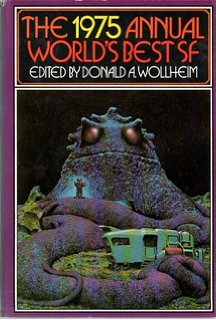
Cover of the Science Fiction Book Club edition of the 1975 edition of the Annual World’s Best SF series edited by Donald Wolheim.I joined the science fiction book club at three different points in my life. The first time was when I was about 13 or 14 years old, and had no idea what I was getting myself into. My mom was not very happy when the first package of books arrived. Fortunately, my paternal grandmother found out about it before my dad did and was able to run some interference for me. So this wasn’t one of the incidents that led to a beating, but it was a close thing.
I wound up doing extra chores at my grandparents’ house to earn the money to cover it. Dad let me remain a member for a year, strictly limiting what I was allowed to order until I’d met the obligation so I could quit the club. I wound up with a bunch of books. And they were hardcover—they were cheap hardcover, but still more sturdy than the paperbacks that most of my collection consisted of before then.
The second time was the summer just before I turned 18, and at least I had a job and was earning my own money.
The book club reeled you in with the introductory packet: for a token payment of two cents, you could choose something like six books from a list. There was a little asterisk statement about paying shipping and handling, which was always more expensive than you thought it would be. But compared to paying full price for the hardcover version when they first came out, it was still a bargain. After that you received a monthly mailing, and if you forgot to return the card that said, “send nothing at this time,” you’d get whatever that month’s book was. You could choose other books out of the mini catalog that came in each month’s mailing. And again, the prices weren’t bad, even with the shipping and handling.
The killer was if you didn’t return the card in time. Because you’d receive books you didn’t want, and usually wound up paying for them because returning them was more of a hassle.
The other downsides were that generally the books were a few years old. They usually didn’t become available to the book club until the original bookstore sales had dropped off for the hard cover, and then the paperback release. The amount of money the authors received was less than for bookstore sales, though most writers who have been willing to talk about it seem to take the attitude that a sale is better than no sale.
When I was living in redneck rural communities, back before the existence of the Internet, a book club was a means to get books that you otherwise might not ever know existed.
The second time I joined, I picked every anthology that was on the list for my initial package. Which included two different years of Donald Wolheim’s Annual World’s Best Science Fiction collections. I loved those kinds of anthologies, because I got a bunch of different stories by different authors. One tale might be a space adventure, another a dark exploration of the nature or identity, another a humorous examination of the future of crime, and the next might have a wizard outwitting a god. Anything could be between those pages!
And I didn’t even have to order one of the books to get a bit of that thrilling sense of wonder. Half the fun of the book club, for me, was reading the catalog each month. Because books and authors I had not heard of—even after I had moved to a slightly larger town that actually had a book store, and not only that more than one!—each received a paragraph or two of description, along with a picture of the cover. So even if I didn’t order the book at the time, later if I saw a copy in a used bookstore, or saw other books by the author, I had a better idea of what the book would be like than I would get just from reading the cover blurbs.
Every month I received a colorful display of dozens of imagined worlds, ranging from high fantasy to gritty near future sci fi thrillers to epic space battles between empires to individual journies of discovery. And all I had to do was, every now and then, buy one of those wondrous books. It was really a small price to pay for infinity.
No wonder 14-year-old me had thought nothing of the consequences when I taped two shiny pennies to a piece of card stock, scribbled my name and address on one side, then swiped an envelope and stamp from Mom’s desk. An infinity of wonder would be mine!
Many years ago the fanzine I edit won an award. It was not anything as prestigious or as well-known as the Hugos. It was an Ursa Major Award, a fan-nominated and fan-voted award which was consciously set up to be an anthropomorphics-fandom version of the Hugos. And because I also write stories that are published in those sorts of ‘zines, I have had one or two of my tales receive enough nominations to make it onto the ballot some years. I didn’t win, but it was an honor just to be nominated. And that isn’t just something I say to be polite, it really was an honor.
I would have been much more excited to win, obviously. I certainly was very pleased when the fanzine won the award. But, the two years my ‘zine won, there were other publications on the ballot who didn’t win, which was a disappointment for their editors, I’m sure. That’s what happens with any kind of award. Someone wins, and a bunch of people don’t.
It so happens that when you make it on the ballot but don’t win, you often find yourself receiving a lot of condolences from friends, acquaintances, and random fans on the internet which include some variant of the statement: “I can’t believe you didn’t win! I voted for you, and know several other people who did, too!”
And that is flattering. It makes you feel at least a bit better about not winning. Obviously, you received enough nominations to make it onto the ballot, so you already knew that there were people who liked your work. But something about having a person tell you directly is even more of an ego boo.
It so happens that one of the years that I didn’t have any story make the ballot, I received a lot of those sorts of condolence messages. After the award winners were announced months later, the committee that administers the award published voting and nomination statistics. Foolishly, I looked at them, only to discover that the only one of my stories published that year which was nominated received a grand total of exactly 3 nominations. I confess, that when I nominated that year I had voted for my own story (and I was fairly certain my husband had, as well). Which meant that only one person other than myself or my husband had nominated me.
But far more than just one person had seemingly sincerely told me—they had volunteered the information without any prompting from me—that they had nominated me. Which means that most of those fans told a little white lie. It wasn’t malicious. In some of the cases, the person probably had meant to participate in the nominating process but put it off until it was too late. A few of them may have been misremembering: they had nominated me, but it was the year before. Others simply were trying to be nice, having noticed that I didn’t make the ballot and assuming that I was disappointed.
When you realize something like that has happened, what can you do but laugh, shrug it off, and try to move on?



 Font Folly