Tag Archives: life

Making an exit

I’ve written before about my perpetually drunk neighbor, and his string of sometimes equally-dysfunctional roommates. The last few months I had been referring to him and his latest roommate as “Drunk and Drunker.”

When news got about that their new landlord was declining to renew their lease, I had predicted that they wouldn’t successfully vacate by the end of August. The many loud arguments heard from over there and the ever-growing pile of junk accumulating in their off-street parking lot seemed to cement that notion.

I was having flashbacks to a completely different neighbor who, some years ago when she was supposed to move out by the end of September, was so delayed that I came home on the evening of Halloween to find an enormous U-Haul truck backed just far enough into the driveway to not block the street (Yes, a month late, she spent that month sharing the place with the guy who had taken over her lease; not only that, when I talked to him the next afternoon, as he was carrying stuff into the truck, he asked me not to let the landlady know they they were still trying to get her stuff out that day). That was the Halloween where we got one, and only one, trick-or-treater. And since it was my godson, I’m not sure that counts. I totally blame the giant truck.

So I was a bit surprised when I heard people trying to maneuver a small rented truck into the harrow driveway between our two buildings this last weekend.

One of the people outside trying to call directions to the driver was another neighbor, a woman who lived above Drunk & Drunker. The other person was the sister of the perpetually drunk neighbor.

I had seen, earlier in the month, the same upstairs neighbor trying to cajole the perpetually drunk guy into calling about some apartments whose ads he had looked at. I had heard from our landlady that the upstairs neighbor had decided to spend a half hour every day trying to get the drunk guy to look at ads and call places. I knew that drunk guy’s sister and mother had both been coming over and trying to help with packing.

Not long after the truck pulled out Saturday afternoon, there was a knock at our door. The upstairs neighbor (a sweet woman who I think deserves a medal, and possibly sainthood) wanted to let us know that the rental truck had run over one of our solar decorative lights in the side flower bed. She had already swept up the glass and had the broken light in a bag that she was taking to the garbage. “I just thought someone should tell you, and I know you both come out here barefoot a lot, so you should be careful.”

I thanked her for both cleaning up and letting us know.

She repeated that she was sorry. So I pointed out that it wasn’t her fault, or her responsibility.

“I just… really like the pretty lights, too.”

There’s still a lot of junk in the parking space, but the line of lawn chairs, benches, occasional tables, and the ornamental birdbath have all been removed for the walkway in front of the apartment. The unplugged Christmas lights, the weird fake flower hanging baskets, and the ugly fake parrot have vanished from the eave. All of the familiar knick-knacks and gew-gaws are gone from their windows.

Which isn’t to say that they are bare. A new gew-gaw, which appears to be a ceramic Mr Toad of Toad Hall driving a wooden jalopy, has appeared on the sill of the living room window.

The other roommate is still there, with less than a week left to move out. And there’s still all that junk piled up in the parking space. Some of it I recognize as property of perpetually drunk guy.

So there is still plenty of evidence that my original prediction is going to be correct.
Warning: may prove harmful or fatal…

We put warning labels on all sorts of things. Sometimes people ignore them.

The only prescription allergy medicine that ever really eliminated my hay fever symptoms carried a warning about fatal heart problems that could happen if you took it at the same time you were taking certain antibiotics. A few years later, the warning list expanded to include additional prescription drugs. And then it had to be expanded, again, to include several over-the-counter medications and other substances.

Enough people ignored the warnings and had heart attacks, sometimes fatal, to cause the FDA to re-evaluate the drug. Their research indicated that most people would not heed the warnings about the over-the-counter drugs particularly. You know how some people are, “It’s not a real drug! It’s like aspirin!” So it was disapproved for sale in the U.S.

I didn’t want to have a heart attack, of course, but I really liked being free of the allergy symptoms. Several new drugs had been approved about the time that this one was removed that were supposed to do the same thing. Studies show that, for most people, the new drugs did at least as well as the old one, and a lot of people found one of them much better. Also, there hasn’t been much in the way of harmful side effects for the others.

Unfortunately, I’m not one of the people for whom any of the alternatives work as well. Sometimes I wish that I could go to the FDA and sign a waiver that neither I nor my heirs can ever sue over any problems with the drug, and keep taking it. The misery of really bad hay fever days makes the risk seem inconsequential.

During those days, I really resent the sorts of people who don’t pay attention to warning labels. Almost as if they are intentionally making life less pleasant for some of us.

At the other end of the spectrum are people who are overly-wary of warning labels. They know that some medications carry a long list of warnings, and they just don’t want to risk any of them. Part of the problem is that it is difficult to communicate risk on a small label, particularly to Americans, where mathematical education in public schools has long been inadequate. I remember one time trying to explain to someone that the odds of most of the harmful side effects of medications approved for sale in the U.S. are significantly lower than the chances of dying in an elevator accident. “Well, at least with an elevator, you have a chance to try to jump before the fall!”

I wasn’t sure whether to laugh or cry at the number of ways that retort was wrong.

Of course, risk assessment isn’t a simple matter. For instance, a lot of people like to point out that statistically stairs are hundreds of times riskier than elevators. That’s only true if by riskier you mean the number of injuries and deaths that occur in a given year, rather than the number that occur per use. One reason more accidents happen on stairs than in elevators is because people use stairs more often than they use elevators.

Things become even more murky when you find out that half of the fatalities associated with elevators are maintenance and construction workers doing some sort of repairs near an elevator shaft. Even more surprising, almost one quarter of the fatalities associated with elevators fall into the category of people leaning against closed elevator doors while waiting for an elevator, or people not looking and simply stepping into the shaft when the doors open.

Leaning against an elevator door? Really?

I understand why someone such as myself is willing to risk some possible side effects in order to escape the misery of weeks of sinus headaches, itchy eyes, and scratchy throats. But why on earth would someone lean on an elevator door?

Strangers with the same face

One of the moments this last weekend that I realized just how alien I felt in the town where I attended High School was when my Aunt Silly asked me if I liked living in Seattle. It wasn’t the question itself, nor was it even the extremely disbelieving tone of voice or her incredulous facial expression. It’s the fact that she, and several other relatives who live near her, have been asking me the same question, with essentially the same amount of incredulity, for at least a quarter of a century.

And they never accept, “Yes, I love it,” as an answer. They frown and ask, “Really?” If I try to explain, the puzzled expressions just get worse. The only times I’ve been able to get even a grudging acceptance is if I mention my work and how difficult it would be to find something similar there.

It made me think about a conversation I’ve seen unfold at work many times. In the tech industry there are always a number of co-workers who are from other countries, and sometimes people talk about the difficulties moving to a completely different culture, raising children and building a life on the opposite side of the globe from your own parents and siblings.

In the middle of a recent iteration of this topic (we were having some celebratory cake for a young man who was about to fly back home to get married) I had a somewhat shocking realization: it has been 25 years since I have seen my father face-to-face. This co-worker who flies to the opposite side of the planet once a year to visit his parents hasn’t even been alive that long.

So I shouldn’t be thinking about how odd it must be for him to go so far away to make his way in this world. Because by comparison, I’ve let more than mere physical distance separate us.

My dad and I have never been close. And I do mean “never.” I distinctly recall being scolded by both Mom and one of my grandmothers when I was four years old to make more of an effort to spend time with him. My other grandmother and an aunt have talked about how even when I was two we had problems—and not just the ordinary problems of an inexperienced parent with stubborn toddler.

How much of that was due to his abusiveness, and the co-dependent relationship that develops between a child and an abusive parent, I can’t say. But even without that issue, I think we would have had problems. In oh, so many ways, we are alike. But in others we’re completely different.

Physically we are so alike that it’s a bit spooky. For instance, once in high school (this was after my parents divorced, and I was living 1200 miles away), one of my friends saw some photos Mom had put up which included several of my dad in his teen years. My friend would not believe that the pictures were not of me wearing some costumes. He became so angry when I insisted that they were not pictures of me, that he stormed out of our house and wouldn’t talk to me for about a week. Even then, he only relented because he’d talked to Mom and she confirmed that the photos were my Dad (actually, one was of my grandfather, so the look-alike thing has gone on for a few generations).

We share a certain number of personality traits. While a lot of that might be learned behavior, some of them I think go deeper than that. Sometime in my late teens or early twenties I realized that some of his less pleasant personality traits were getting a bit too strong. I had to make some serious changes, because I didn’t want to carry on the cycle of abuse.

But in some fundamental ways we are very different, and I know that some of those differences were unsettling to him even when I was very small. My tendency to talk to myself in order to figure out problems certainly upset him. I resisted his efforts to make me conform to “boy’s toys” and the like. Not that I didn’t play with my army men and rockets, I did! But I was just as interested in “girl’s toys.” I could go from staging immense battles where the future of the entire world hung in the balance, to acting out hurt/comfort romances where my sister’s Barbie nursed Captain Action back to health after he nearly died saving my sister’s Ken from… well, I can’t remember the name of the monster toy I had.

And you won’t believe the drama that ensued—after months of him angrily telling me that I could not have an Easy Bake Oven, plus telling Mom in that tone of voice that meant someone was going to get slapped around if we didn’t listen that she wasn’t to let anyone buy me such a girl’s toy—when I opened a Christmas present from my paternal Grandparents and found my very own Easy Bake Oven.

And don’t get me started on the political arguments!

It was mostly because of the abuse, though, that I was happy to be separated from him after my parents’ divorce was final. I’m not entirely happy at just how deep that separation has become. Being 1200 miles from him also meant being 1200 miles from one set of grandparents, an aunt, a bunch of cousins, and more. I have a half sister who seems like a great person, for instance, but we’re really just long distance acquaintances.

But I’m obviously not unhappy enough about it to take a road trip and try to renew some acquaintances. I have my reasons, and maybe they are as good as I think there are. As it is, my other relatives who only live a few hours’ drive away only see me once or twice a year.

That’s probably the real source of those looks of incredulity when my aunt asks if I like living in Seattle. I’m not that far away, and yet I don’t get back any more often than as if they were half a world away. And that just doesn’t make any sense at all, does it?

A once familiar land

I spent the weekend visiting my Mom for her birthday. Just under a year ago she moved back to the town where I attended High School—a town I haven’t lived in for 28 years.

I’ve visited regularly throughout that time. My grandma lived there until her death a few years ago, along with numerous cousins and my Aunt Silly. A few years ago my sister and her two kids moved back. So I have visited for various holidays, birthdays and the like, and/or stopped in on my way elsewhere. So it isn’t that I am completely unfamiliar with the place and the changes that have occurred since I left.

For some reason this weekend left me feeling more of a stranger to that place than any previous visit.

I’m not entirely sure why. I have some suspicions. This is the first time in many years that my husband, Michael, wasn’t with me (he had stayed in Seattle to rest and recuperate). He’s never lived in that town, so I was always more familiar with the place than at least one person I was hanging out it. Being with my husband anywhere is always like we’re carrying a bit of home around with us, so no strange place feels entirely alien if he’s with me.

This was also the first visit in a long time that I didn’t at least stop at Grandma’s house. My aunt moved into Grandma’s house after Grandma died, and so I’ve continued to have a reason to visit the house. While my aunt has changed a lot about the place, it’s still Grandma’s house on Grandma’s street. I saw my aunt this weekend (she came to Mom’s for cake and ice cream), but I didn’t go by her place.

This isn’t a case of me suddenly realizing the truth encapsulated by the cliché, “you can’t go home again.” When I left to finish my college degree, I had every intention of returning to that town, or a very similar community, to settle down. But I fell in love with the city. I can’t imagine living somewhere where there aren’t multiple supermarkets open 24 hours, for instance. Let alone living without multiple theatre companies, the opera, and all the other things that come with a culturally vibrant city. And while Seattle isn’t exactly known for its racial diversity, with about two-thirds of residents being white, that’s a big difference from the 92% white demographic in Mom’s community.

Maybe it is the slow accumulation of little changes over those 28 years, making once familiar places look less and less as I remember.

But I don’t think it’s about the town changing, it’s the other way around. I’ve changed a lot, yes, and even more importantly, the world has changed.

Coming out of the closet more than 20 years ago, and realizing how little freedom to be myself I would have if I returned, played a big role in the alienation of my affections for that town. I don’t remember anyone who was living as an openly gay person when I was attending high school and community college there (there were people that everyone suspected and whispered about, of course). Now there are several gay and lesbian people living there, and at least one gay teen support group that advertises meetings and activities. But it did not escape my notice that the recent referendum to extend marriage rights to same sex couples was rejected in that community by a margin of nearly 20%.

But it’s not just about me being gay and unsure how welcome my husband and I would be if we moved there. Nor is it just the practical financial matters (there aren’t many jobs that require my skills and specializations). It’s so much more. I like not having to bite my tongue as strangers make racial comments about the president. I like walking through a parking lot and not seeing dozens of deeply conservative political, religious, and anti-science bumper stickers, and absolutely none of the other kind. I like living in a community that believes in and enjoys investing in infrastructure and schools and social services. I like living in a community that knows that a lot of its tax dollars go out to less-populated parts of the state, without resenting the people who use them.

I’ve changed. That town as changed. One can argue about which one has changed the most, but it’s not just about how far down our paths we’ve gone, but also about direction.

And I know we’re not headed toward the same goal.

No monsters needed for Monster Croquet

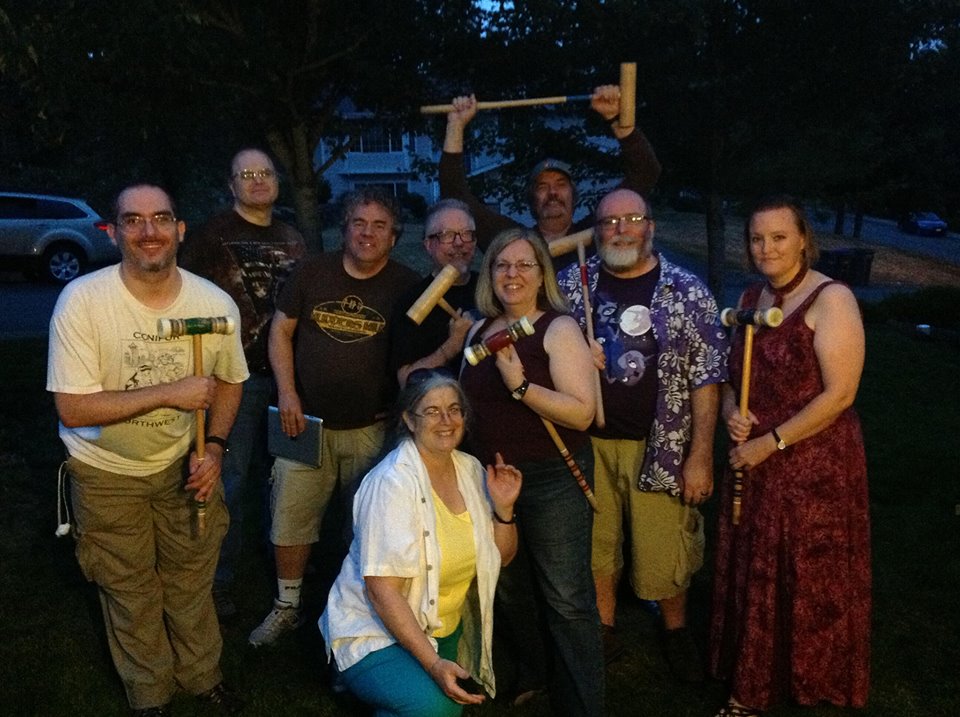
Nine people posing with croquet mallets.
The gang from this year’s Monster Croquet match (except for Lady K, the youngest player this year, who didn’t want to be in the picture with her parents are their old, weird friends)
Every summer the literary society of which I am a member has a barbecue/picnic hosted at a member’s home. And every year we play the Monster Croquet match.

I don’t know which year it was that we first played croquet at the barbecue, but I have photos of matches going back at least to 1996. That first time we were using an old set that had belonged to Auntie’s family on a yard that wasn’t flat. Like a typical Seattle-area lawn in the summer (when almost no one waters their lawn in the summer), there were odd patches of brown grass, and so forth. So most of the challenge of the game was the uneven ground and turf causes the balls to bounce, and take weird turns, or just go rolling down a hill.

Someone said it wasn’t a croquet match, but a monster croquet match. And the name stuck.

Over the years we’ve evolved a set of odd rules. David constructed a set of wooden wickets with large, easily-read numbers. We got in the habit of multiple people bringing croquet sets so there are enough mallets and balls for however many want to play.

Each year the course is different, and we take pains to make parts of the course treacherous. The uneven terrain and such proves to be a great leveler, so one’s skill level is often less important than luck. Which adds to the fun.

Sometimes the course if very different. When Julie (also known as “Julie with an e”) and Mike (also known as “Julie’s Mike”) hosted it at their new home a few years ago we knew it would be a challenge. Julie & Mike’s yard consists of an ornamental pebble stream bed, several decks, a couple of curved wooden bridges, various ornamental plants, and no grass. So we got a Nerf Croquet set and made the course go over the bridges and around the decks.

When Keith and Juli (also known as “Juli sans e”) first bought their house some years earlier, the backyard was devoid of any vegetation and was all slope. We thought that was perfect for treacherousness! But after many, many hours of grueling play, when no one had made it even halfway through the course, and the sun was setting, we realized it was too treacherous. We were debating calling the game because of darkness, when my godson (who was, I think, six at the time) finally went through the pair of wickets at the turn-around point. When he hit the turn-around stick, we unanimously declared him the winner, grateful that we could finally stop. We have often referred to that year’s match as the Death March Croquet Game.

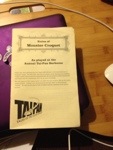
A booklet
Rules for croquet as played at the barbecue.
The rules have always been somewhat ad hoc, based on an aggragate of the collective memory of childhood croquet games, with an evolving set of modifications. Some years ago someone requested a rules reference, so Auntie and I created a rules booklet.

On the front page it says that the rules aren’t binding and can be modified midgame by consensus. Please note that consensus doesn’t mean majority vote, it means everyone has to agree. Usually the rules changes that hapen midgame are for weird situations that never come up again. Though the Notorious Incident of Wicket 12 on the Glacial Till is where we made the rule that if you miss a single wicket 12 times, you can then move on to the next as if you made it. Which we’ve since kept.

This last weekend was hosted at Juli-sans-e and Keith’s (I think this is the third time there), and having learned our lesson, we stuck to the front lawn. The wickets did a lot of criss-crossing and were not in order. And we had a pair the were several numbers apart, but physically next to each other at not quite right angles. We were starting to worry that we might have to call the game because of darkness, but everyone had made it to the turnaround and was more than halfway through, so it was nowhere near as bad as the Death March.

Then Chuck got back to the starting stake, becoming poison, and the race was on. I had been in last place for most of the game (I forgot to count, because no one expects trouble at the first wicket. But it took me a very long time to get through the first one), so I was the least threatening target. While Chuck was busy killing off everyone else, I did manage to get through three or four wickets. But I still got knocked out at the end.

It was a great way to spent a Saturday.

Cousins, part 2

Sometimes when I’m talking about my extended family, people express confusion at how many cousins I have. I have learned, in the course of these conversations, that a lot of people don’t know what the anthropological definition of a cousin is, and how many different types there are.

For a long time I was confused, as well. I had been told while growing up that my cousin, Sheila, who is the youngest child of one of my grandmother’s younger brothers, and was near my age, was a second cousin. I had also been told that the children of my mom’s cousin (themselves grandchildren of my grandmother’s oldest brother) were second cousins.

But only one of those is correct.

Most people, when asked, will usually define a cousin as “it’s like when your father has a brother, and your father’s brother has kids, those kids are your cousins.” That is correct, but is a little convoluted. And doesn’t help one understand the difference between a second cousin or a first cousin once-removed.

So, the anthropological definition of a cousin is: a person, other than a sibling, who shares at least one ancestor. A first cousin (which is what most people mean when they say “cousin”) is a person, other than a sibling with whom you share one or more grandparents. A second cousin is a person, other than a sibling, with whom you share one or more great-grandparents.

The once-removed part means that it is a cousin who is not of the same generation of descent from the common ancestor. So, for instance, the cousin I mentioned at the beginning, the daughter of my grandmother’s brother, is a first cousin once-removed. We are both descended from my Great-grandma S.J., but while S.J. is my great-grandmother, she is Sheila’s grandmother. So we are one generation out of synch. Her children are my second cousins. And if those second cousins have children, they would be my second cousins once-removed.

If that confuses you, I’ve barely gotten started.

What’s the difference between a half-cousin and a semi-cousin, for instance. Now, semi- as a prefix can mean “half” so you might think the terms are interchangeable. They refer to two difference relationships.

My Great-grandma I. married fairly young, as was common back then. She and her husband had two sons. Then her husband died. She remarried. She had several more children, the youngest of which was my Grandma P. Grandma grew up, married, and had several children, one of whom was my Mom. Grandma’s oldest brother (who was a half-brother), also married and had several children. Those children and Grandma’s children share a grandparent, making them first cousins, but because they only share one grandparent, rather than two, they could also be referred to as half-cousins (just as the previous generation are half-siblings).

My parents divorced with I was in my early teens, and he remarried. Thus I have a half-sister. My mom’s sister has several kids. The children of my mom’s sister are my first cousins, but they aren’t related by blood to my half-sister, but most everyone would agree that she falls into the definition of family. It would be even more strongly felt if we had all grown up together. So, a person who is a half-sibling of your cousin, but isn’t related by blood is sometimes referred to as a semi-cousin.

Feeling brave enough to take a guess as to what the term demi-cousin means? Demi- can also mean “half” but it doesn’t have anything to do with half-siblings.

A demi-cousin is a person, other than a sibling or half-sibling, who shares a grandparent with your cousin, but does not share a grandparent with you.

I think this one is easiest to understand if we return to the common informal definition of cousin. My mom’s sister has three children. They are all my first cousins. We share a pair of grandparents, Grandma and Grandpa P. My mom’s sister’s husband had a brother. And the brother had some children, and they are first cousins to the children of my mom’s sister. They share a pair of grandparents with my three first cousins, but that pair of grandparents are people they call Grandma and Grandpa H. I am not related by blood to the children of my mom’s sister’s husband’s brother… yet they are related by blood to my mom’s sister’s children, who are related by blood to me. So sometimes that relationship is referred to as demi-cousins.

Step-cousin is fairly straightforward, it is used to refer to someone who is a stepbrother or stepsister of a cousin. It is also used to refer to the niece or nephew of your own step-parent.

Then, of course, we have parallel cousins: a child of a parent’s same-sex sibling. And a cross cousin: the child of a parent’s opposite sex sibling.

Is your mind reeling, yet? Well, you better take a sip of a fortifying drink and buckle your seatbelt, but because we haven’t yet tackled double-cousins.

A double-cousin is someone, other than a sibling, with whom you share both sets of grandparents. In other words, imagine two brothers, James and John. James falls in love with a girl named Sue, who has a sister named Sarah. James and Sue get married, and during the course of all those social events leading up to the wedding, John finds himself falling for Sarah, so they get married. The children of James and Sue are first cousins to the children of John and Sarah, but they are cousins on both sides, therefore they are double-cousins.

That last one may sound too unlikely to contemplate, but hang onto your hat: during the 17th and 18th Centuries in England (and a ways into the 19th Century), it was thought extremely lucky to get married to a double-cousin. And it wasn’t just in England. That particular relationship has, at one time or another, figured prominently in the folklore of most cultures.

First cousin marriages weren’t just common for much of history, they were actually encouraged (I will get into why this isn’t as bad a thing, genetically, as a lot of people believe, in a subsequent post). In some cultures, parallel cousin marriages were considered off-limits, while cross-cousin marriages were not. On the other hand, some cultures considered father’s side parallel cousins particularly lucky or blessed, but not others.

I don’t have any double-cousins myself, but I did grow up living near and often going to school with: first cousins, second cousins, first-cousins once-removed, semi-cousins, half-cousins, step-cousins, and a dizzying number of demi-cousins.

Some of my demi-cousins called my Grandma P “Grandma.” Some of my second cousins called her “Aunt Gert”-as did some of the demi-cousins. Most of the demi-cousins all around referred to my step-cousins’ grandmother as “Nana.”

And generally, we just told friends and acquaintances we were cousins, and dispensed with all the demis, semis, and so forth. We might have said that it was simpler than trying to explain. I think sometimes we would forget exactly how we were related. My grandma would simply shrug and say, “We’re all just family.”

No winners at all

I’ve written once or twice about a particular neighbor in the apartment building next door…

Continue reading No winners at all

Future events such as these

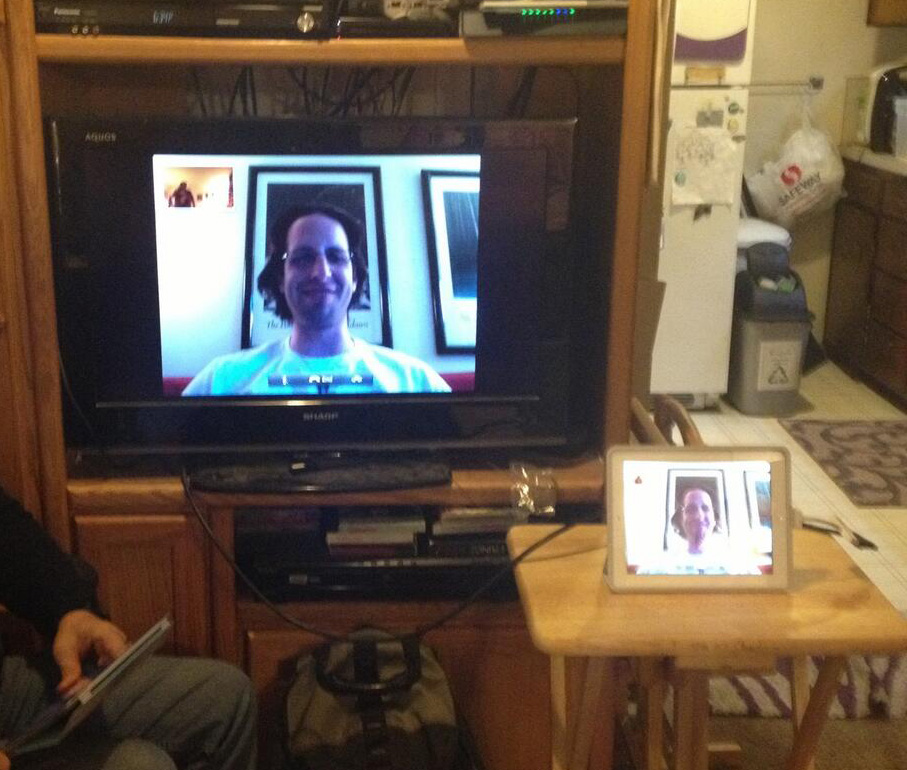
iPad connected to TV to show facetime on large screen.
Jared attending an editorial meeting via FaceTime. (Click to embiggen)
I like living in the future.

We had an editorial board meeting last night, and it being busy, crazy summertime, we almost didn’t have quorum. Fortunately, Jared was able to join us via FaceTime. We’ve done it a couple of times before, propping up my iPad so the person could see most of us. Chuck thought we should do it on the big screen, and I almost never hook the iPad up to the TV, so we did.

Now the future hasn’t quite turned out as we were promised. If I mention “flying cars” certain people will snarkily repeat a meme that’s been going around lately. The first variant I saw was, “Unless you’re 60 or older, you weren’t promised flying cars. You were promised an oppressive cyberpunk dystopia.”

That’s simply wrong, on many, many levels. The “we were promised {fill in the blank} in the future!” is a reference to things we learned during our childhood from popular culture about what the future would be like. The first appearance of cyberpunk, in any way, shape, or form, was the 1980 novel Web of Angels, by John M. Ford. Therefore, a person who is 59 now, would have been 26 years old when the first hint of a cyberpunk dystopia could have appeared in any popular culture. Twenty-six is not childhood.

The Jetsons, broadcast Sunday nights from 1962-63, reruns Saturday mornings from 1964-73.
I’m still a half-dozen years below 59, and I can assure you that my childhood pop culture did, indeed, promise me flying cars.

The Jetsons was the first show to be broadcast in color on ABC-TV. A cartoon set 100 years in the future, the show ran during primetime beginning in 1962. That’s right, it was not meant to be a children’s show. After it complete its primetime run, the existing episodes were re-run as a Saturday morning cartoon for nearly 10 years. The screen shot is a frame from the opening seconds of the opening theme song of the show. Right there, flying cars. The show depicted a fairly utopian future, with robot maids, devices that could create an entire new outfit, on your body, in seconds, and so forth.

If your childhood included any of the years from 1962-1974, you were, indeed promised flying cars. If we assume one needs to be a minimum of four years old to recall a television series, that means anyone 43 or older can legitimately claim that The Jetsons, at least, promised them a utopian flying cars future.

Jonny Quest floats in midair wearing a jet backpack.
Jonny Quest flying in a jet pack (some of his villains had flying cars).
That time period also included the iconic TV series Lost in Space, the original Star Trek, and Johnny Quest. Not to mention such films as 2001: A Space Odyssey. They didn’t all have flying cars (some had transporters—even better!), but their futures are each the opposite of an oppressive cyberpunk dystopia.

But let’s loop back to that first cyberpunk book. How many people who know what cyberpunk is have even heard of Web of Angels? Most people think of cyberpunk as beginning with either Blade Runner (1982) or Neuromancer (1984). And while Blade Runner is the greatest movie ever made, bar none, the sad truth is it didn’t do well in theaters the first time, and didn’t start developing a cult following until it started appearing on cable in late 1983. So I’m going to say that the beginning of the switch-over to cyberpunk dystopias becoming dominant in pop culture was 1984.

That means 1983 is the last year in which the flying car utopia was promised as a future to kids, so anyone who was at least four in 1983 would be the actual cut-off age, rather than 60, so that means the meme should state: “Unless you’re 34 or older, you weren’t promised flying cars. You were promised an oppressive cyberpunk dystopia.”

Movie poster from 1985's Back to the Future.
Marty McFly, trying to get back to the future…
But wait! That calculation assumes a very simple binary situation. Cyberpunk dystopias became one possible future in 1984, but it wasn’t the only one. Because in 1985 we got Back to the Future! While the movie primarily follows the adventures of our young hero, Marty McFly, trapped in the 1950s in a time traveling car, trying not to screw up his own future before getting back to his own time. At the end of the movie, Doc Brown goes 30 years into the future, and then comes back, showing off a much upgraded version of the time-traveling car. So, as my friend, Matt, pointed out, if your formative years include Back to the Future, then not only were you promised flying cars, you were promised time-traveling fusion-powered flying cars fueled by household garbage!

So, no, we were promised flying cars!


I’ve had more than one person bring up the fact that Blade Runner had flying cars. I know that. When I said that Blade Runner was the greatest movie ever? Implicit in that statement is the fact that I owned several different cuts on VHS back in the day, and I watched at least two of the tapes so many times that they wore out. I am well aware of the flying cars in Blade Runner. But as I explained on Twitter, the invalidity of the assertion of a dichotomy between flying cars and cyberpunk dystopias is worthy of a posting of its own.

It’s nice when they listen

Several years ago I was laying in a bed at the emergency room. The doctor who had triaged me was fairly certain it was my appendix. A nurse had been tasked to draw blood for some tests. So I told her what my regular doctor said I should always tell someone about to draw my blood: “My veins are troublemakers. They roll. They collapse. They move. They hide. The secret is to ignore the ones you can see, and go for Old Faithful here that you can feel, but can’t see.”

“Uh huh,” the nurse said. And proceeded to stick me about a half dozen times in that arm, move to the other arm to repeat it, move back to the first arm to try a couple more times before, in a very exasperated voice asking, “What was that advice, again?”

She got it on the next try. She apologized profusely.

A bit later, just as another nurse was giving me the pre-anesthetic prepping me for surgery (it was the appendix, and they got it before it burst, but only just), she came back to apologize again. “I just found out from one of the other nurses that your G.P. is Dr. Cahn. Dr. Cahn put himself through college and medical school working as a phlebotomist. Most doctors know nothing about drawing blood, and are always giving bad advice. I’m really sorry.”

Some years later I gave the usual advice to a lab tech about to draw my blood, and he said, “Oh, don’t worry about that!” A second later he said, “See! Got it on the first stick…” and his voice trailed off, because it was true that blood had started to flow into the first test tube right away, but it had suddenly stopped, before he could finish the sentence. He also apologized profusely for ignoring the advice, and then spent several minutes trying to follow the advice so we could get on with it.

I have lots of stories like these. Occasionally the people tasked with drawing my blood listen, but far more often, they don’t.

Once a year I see a specialist to evaluate my meds. The usual routine is that I go in for lab work, where they draw about 7 tubes (All different sizes with different color-coded tops; I used to be able to rattle off the colors, but a few years ago there was a change in the color-coding system and I haven’t quite got the new ones down). Then, three to five days later, I have the appointment with the specialist where she goes over the results, asks a lot of questions, we discuss some things, and so on. Occasionally she gives me a list of things to talk to my regular doctor about.

When I went in on Monday to get the lab work, I recited my usual advice. The woman listened to me, asked a couple of questions, then went to work. She spent a lot of time feeling around my arm before deciding she was ready to pick up the needle. It worked perfectly the first time. It was great.

I saw the doctor later in the week. I’ve been on the same meds for a long time, and everything has been nice and stable. This time there was one thing she’s a little concerned about. She immediately amended that to, “I don’t think it’s worrying, but I want to be certain we don’t need to be concerned.” So she ordered more tests, telling me to stop at the lab on the way out.

I got a different woman. I told her my advice. She laughed, “That’s what I do with everyone,” she said. “Lots of people who have the tricky veins don’t even know it. I just assume everyone has tricky veins. I never thought about calling the deeper vessel ‘Old Faithful,’ though. I like that.”

And she got it on the first try, too.

It’s nice when they listen.

Why I hate hay fever, reason #5839

Technically, this one probably ought to be titled “Why I hate MY hay fever, reason #7” or something.

Because my overeager immune system reacts to apparently every pollen, every spore, and every mold it encounters, and because I live in the Pacific Northwest on the west side of the Cascade Mountains (where winter mostly consists of lots of rain with the temperature only occasionally flirting with freezing), I have mild-to-horrid hay fever symptoms for a minimum of ten months out of the year.

And the variation from mild to horrid and back again is not predictable. Sometimes the pollen count goes down, but the symptoms get worse, for instance.

This particular reason is a consequence of all those aforementioned things:

I can’t tell the difference between the first few days of a cold or flu and just waking up on a given day.

So, Wednesday night/Thursday morning I didn’t sleep well. It wasn’t a night of tossing and turning, staring at the clock, wishing that I could fall asleep. I slept. I just woke up about every 40 minutes or so for no discernible reason. It wasn’t until the second alarm went off in the morning and I dragged myself to the bathroom that I realized that I was too fuzzy headed to actually attempt to do any work. So I called in sick, took some Nyquil, and stumbled back to bed.

Even then, I was taking the Nyquil because it felt like a worse-than-usual hay fever day and I hoped the Nyquil would make me sleep for real for a few hours. I didn’t take it because I thought I was sick. It just felt like a slightly worse than usual hay fever morning.

I vaguely remember Michael saying he was leaving for work. I blinked. I rolled over, and saw that more than six hours had passed.

I felt better only insofar as my brain was capable of thinking in whole paragraphs, rather than just simple sentences. My head, sinuses, and throat all still hurt. But it was, still, only at the “worse than usual hay fever day” stage.

I logged in remotely to work and took care of a few urgent issues. I ordered pizza for dinner, chatted with Michael, and so on. It continued to just feel like a worse than usual hay fever day, though with added time disorientation because I’d slept most of the day. I went to bed early, this time taking Nyquil before hand.

Friday I woke up still feeling like a worse than usual hay fever day. Friday is my usual work from home day, so I slept in a little as usual. The only real difference from a usual work from home day was that I took non-drowsy cold tablets.

Friday night, after we got home from dinner, Michael crashed because he was feeling worn out. But he often does that on Fridays, particularly during hot and hottish weather, because he works all week in a warehouse.

In the wee hours of Saturday morning, Michael woke me up. It wasn’t intentional, he was just feeling extra cold and trying to get the blankets that had bunched up under me. He muttered something about thinking he had a fever. My thought at the time was, “Darn! I’ll have to drive to our friend, Sheryl’s place, without Michael.” And I conked out.

Hours later, when I shuffled to the bathroom, I slowly became aware that my aching sinuses, headache, ringing ears, sore throat, and queasy stomach were not all hay fever symptoms. And the house felt cold, even though the thermometer said it wasn’t.

I thought back about when I last took any medicine that had acetaminophen or something else that would mask a fever. It had been about ten hours, so I got out a thermometer.

Fever. Not a high one, but higher than my typical low-grade fever.

Yuck.

So I called to beg off on Writer’s Night (we weren’t hosting this month). I made some breakfast. Checked on Michael, then spent a few hours trying to work up the energy to go to the store to get soup and juice and general groceries.

I only had three dizzy-ish spells in the store.

The hardest part was putting the groceries away when I got home. I really just wanted to collapse.

I sat down, intending to just rest a bit before calling to cancel gaming tomorrow.

I conked out for almost four hours.

And that pretty much brings us to now.

I don’t have a fever any more. Throat and tummy are no longer being icky. My ears are back to their normal level of tinitus. My sinuses and head still hurt more than a typical hay fever day.

But I have developed a mild cough.

Yuck.

Not that I would have necessarily done much differently if I had realized Thursday that this wasn’t just hay fever. But it’s still irritating to realize I was probably sick for two days before I knew it.

I hate hay fever.