Camp NaNoWriMo is described as NaNoWriMo Lite… but it doesn’t have to be.I was pleased with how much writing I got done with my Alternate National Novel Writing Month (NaNoWriMo) and/or being a member of the NaNoWriMo Rebels. But during the months since, I have had a hard time motivating myself to finish several of the missing or not quite finished scenes and chapters in the first draft of my novel, The Trickster Entanglement.
Then I found out my friend, Mark, was going to participate in Camp NaNoWriMo. I had heard of the Camp, but I hadn’t really known what it was. I thought it might actually me a physical meet-up. The organization that runs NaNoWriMo has sponsored such activities, like the Night of Writing Dangerously, so a weekend retreat or something similar didn’t seem unreasonable.
“Just let me finish this scene…”I made the decision to be a writer at a very early age, not long after asking my mother where books came from. Throughout my elementary school years, whenever we moved to a new town, one of the first things I would do when we visited the local public library was find out whether the library had a subscription to The Writer magazine, and/or whether they had any copies of The Writer’s Handbook, which was a book published yearly featuring a selection of articles from a year’s worth the the magazine, plus a listing of the addresses and submission guidelines for lots of different publishers.
I did it!I read a lot of articles and several books about the craft of fiction writing during my formative years. I internalized a lot of the lessons of those articles, often without remembering the context of where I learned them…
Not all natural habitats are equal.My current “pocket book” is a memoir by a gay man who, like me, was raised in a very evangelical fundamentalist family. I’d read reviews of the book when it first came out, and they all emphasized his humorous recollection of often painful situations. Then just before Christmas, the author was a guest on a podcast I listen to, and the host mentioned the book again, repeating the hilarity of his approach to the topic.
And I was just wrapping up another book and thinking I would need to download a new e-book to my phone to be the next “pocket” book. So guess what book I bought?
I didn’t start reading it right way. Once I finished my previous book, I started listening to audiobooks of various holiday favorites during my usual read on the bus time. So I just started reading it this week.
“Just let me finish this scene…”My friend, Barb, who can write circles around me, more than occasionally writes about the process of writing. She’s doing a meme this month answering questions from her followers, and she recently posted a combined answer to a question from me and one from Lyrstzha. Her explanations are great, as always, but as I read her response to the question, “The difference in process between writing a stand-alone fic and writing a whole universe?” I realized that my answer would be a lot different.
For me, there is no difference between how I write a stand-alone story or a long series of stories set in a single universe. That’s because in one sense, I never see any story as a stand-alone, even if I never write any sequels, prequels, or stories otherwise set in the same universe…
Sometimes a story isn’t about what it says it’s about.
I’ve written before about readers who contacted me about one of my stories and believing that the opinions of some of my characters are also my opinions. They don’t understand that one can convincingly write a character who has a substantially different worldview than oneself. So just because characters say something, that doesn’t mean it is the author speaking to you.
Similarly, just because the narrator says something, no matter how authoritative the narrative voice of a story may be, that doesn’t necessarily reveal to you the beliefs of the writer. The writer may be intentionally ironic, for instance, having the characters and narrator say something which the action of the story directly contradicts.
More often, the writer isn’t trying to profess any profound beliefs, he or she is just telling you a story. Where the writer’s beliefs are revealed are in the consequences that befall characters for their actions. Which isn’t to say that stories are always intended to be fables. It’s just that when we are weaving a story, the action is going to be driven by what feels right to us, what feels like would be a reasonable outcome. And what feels real or right or reasonable is going to be determined by our fundamental beliefs.
Most writers don’t think about stories from the point of view or philosophy or morals. We have an idea about a situation, or there’s a question we’re pondering, or maybe we just think it would be interesting to put a pair of characters together and see what happens.
So, for instance, a writer might have the protagonist say something like: “It’s impossible to really understand somebody, what they want, what they believe, and not love them” while discussing his or her enemies. But if the character subsequently slaughters each and every one of those enemies without mercy, and if the reward for doing this within the story is the hero being proclaimed a hero, and so forth, well, that story isn’t about learning to love your enemies. At best, it is a demonstation of one way someone might rationalize genocide, but it isn’t about learning to love.
Of course, a story isn’t just about what the writer thinks. A story is just a collection of words until an audience hears it or reads it. So even those readers who have been mistaken about what my beliefs were, or who concluded that I was sending a particular message which was never my intent, once I put the art out there, the meaning is no longer mine alone.
If story inspires a particular meaning or feeling for you, then that’s what the stroy means to you. And what the author meant shouldn’t be relevant to your enjoyment of the story.
But if you are curious about what the writer actually believes, don’t pull out lines of dialog or specific sentences. Look at the plot. What happens to characters as the results of their actions? What kind of actions lead to success or failure? And what is the tone the story takes with those actions? Sometimes a character does what everyone agrees isthe right thing and fails anyway. Does the tone of the tale imply the failure is an regrettable tragedy or or just desserts?
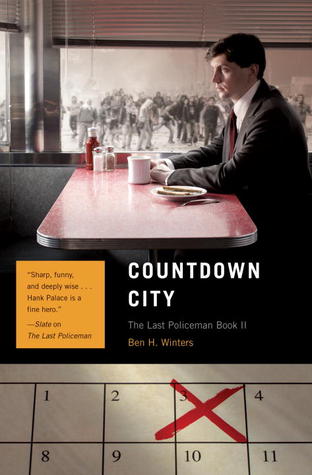
Countdown City, by Ben H. Winters (book 2 of the Last Policeman trilogy).Countdown City is a mid-apocalyptic noir. When I reviewed The Last Policeman, I mentioned that I was a teeny bit disappointed, after reading it and loving it so much, to find out the author was working on not one, but two sequels, because I thought the ending of the first book was perfect.
I’m no longer disappointed.
The quick set-up: we’re just 70-some days away from the earth being struck my an asteroid that’s too big and was discovered too late for us to do anything about it. Society has been crumbling for some months, and our hero, Henry Palace, a former police detective in Concord, New Hampshire, is now out of work and living in a world without electricity or much of anything else, where a very militarized police force is in charge of distributing the small amount of food and goods still available.
And the woman who babysat Hank and his sister back in the days after their parents’ death while they were living with an inattentive grandparent, is begging him to find her missing husband. In a world where people are running away to do crazy things before the end, and other people are willing to kill for a stash of coffee beans, she wants him to find a missing person.
The author described the first book as existential detective novel. I continue to prefer my description as a mid-apocalyptic noir. The first book asked the question, what’s the point of solving a murder when the world is about to end. This book poses the question, what do promises and commitment mean when there is no tomorrow?
The answers this book gives, like the answers before, may not surprise you, but by the time you reach those answers, having watched what Hank does to find those answers, you believe them.
If you don’t want the slightest hint about the ending, stop now. Other wise, click the Read More below:
I read fan fiction with some regularity, and it has been customary for some time at most places where one can post such stuff for the authors to include “trigger warnings.” Trigger warnings didn’t start on fan fiction sites, they were first used on forums where people discussed topics such as rape, rape prevention, domestic abuse, and so forth. The original intent was to alert people who suffer from psychological trauma that the story or commentary they were about to read contained intense and graphic description of one or more common areas of trauma. Psychologist refer to events that cause a person to relive a traumatic event a “trauma trigger.”
Now, one can understand that in a discussion dedicated to a topic such as domestic abuse, that from time to time descriptions of specific cases of abuse might come up. One can also understand that among the people who might be reading content on such a site will be people who have suffered actual domestic abuse, and they are seeking information, or recommendations, or just commiseration. So the original notion of “trigger warnings” in those sorts of places makes perfect sense.
One can also understand that in a fiction-publishing setting sometimes people will write stories which include the bad guys doing bad things to the hero, or to innocent bystanders who will need to be rescued by the hero. So if one is familiar with the notion of trigger warnings, it is understandable that one might decide such warnings are warranted on some stories.
But when you see a 700-ish word story sporting three dozen trigger warnings, one suspects that perhaps someone has lost sight of the purpose. I’m sorry, there is simply no way that in 700 words you can graphically describe that many different potentially traumatic events.
The problem is two-fold. People are worried that they’ll forget to warn someone about something, and someone will be traumatized, so they figure it’s better to be safe than sorry. On the other hand, a lot of people who don’t suffer from psychological trauma get all upset if they accidentally read something which is merely distasteful to them.
Now, I understand that people have a right to not look at anything they want. I have certainly gone on a rant or two about certain themes and topics in certain works of fiction. When I run into those topics, I may get angry or disgusted. I may literally throw the book across the room. But I do not have an actual panic attack. I do not relive an actual traumatic event.
I simply stop reading the stupid book.
That sentence right there is a great example of this phenomenon. There are people putting trigger warnings on stories merely because one character calls another “stupid” once. There are people who insist that trigger warnings are needed for one character calling another stupid once. There are people who insist that the word “stupid” is completely unacceptable in any civilized conversation—as unacceptable as reaching across the table and stabbing someone in the eye.
That is unintelligent, foolish, and utterly lacking in any understanding or sense of perspective.
In other words, that is a stupid.
Yes, it is extremely rude to call another person stupid. It is also true that one could write a scene where one character heaps a lot of abuse, including using the word stupid, on another character that could be intense enough to trigger a traumatic memory for a reader who survived an extended period of verbal and emotional abuse at some point in their past.
But if the word pops up in the dialog of a scene depicting two characters engaging in verbal banter, that story doesn’t deserve a trigger warning. What makes the other scene a trigger is not merely the inclusion of the word “stupid,” but the intensity of the entire abusive behavior of the character.
Getting back to a person’s right not to read something: such a right does not entitle you to a guarantee that you will never inadvertently see, read, or hear things that you find distasteful. You are not entitled to a world in which you only see what you want. Your fellow humans are not obligated to contort their own lives, words, or artistic expressions in such a way that your delicate sensibilities can never possibly be violated.
Courtesy dictates that we observe the niceties and comport ourselves in public and social situations in a manner that won’t cause harm or humiliation. But the obligation is to refrain from behavior and speech which could reasonably be expected to cause someone pain or embarrassment. Describing an autopsy at the dinner table can reasonably be expected to cause some people to feel nauseated, so it would be rude to do it. Telling that story of the drunken, debauched weekend you and some buddies had in college during the best man’s toast for one of those buddies, in front of parents and families of both the bride and groom, can reasonably be expected to cause embarrassment and perhaps instigate an argument between the couple-to-be, so it would be both rude and stupid to do it.
But mentioning that you are really sad that Dry Soda has discontinued their kumquat-flavored soda* in the presence of a friend of a friend who years ago had a beloved aunt die in a tragic kumquat-related accident, and mention of the fruit always makes the person break down into sobbing? It’s not at all reasonable for you to anticipate that, so you are not rude or insensitive for doing it.
And, let’s be real, here. Even if we accepted the notion that it’s reasonable to warn about a single instance of a single word, how could you possible do that? “Warning, mentions kumquats?” The warning itself would be the trigger!
* Seriously! I like the Blood Orange flavor which they brought out to replace it, but I really do miss the Kumquat Soda.
When I wrote, yesterday, about why fiction is not the same thing as lying, I may have given the impression that storytellers are in the business of imparting The Truth (the definitive article), or at the very least His/Her Own Truth when telling a story.
We aren’t.
I over-complicated things, I think, by including the anecdote about parables and a Biblical literalist of my past acquaintance. I’ll try to steer clear of anecdotes today.
First, I don’t believe in one and only one truth. Yes, in certain circumstances, such as certain types of mathematical problems, there can be one and only one correct answer, but that’s dealing with a very restricted system of factual discourse. Truth, with a capital-T, occupies a different realm than facts. There is always room for another way to look at things. There is always a circumstance that we haven’t considered—sometimes because we don’t have the necessary framework to even imagine the circumstance, yet.
When I tell a story, my first obligation is to tell the story the best that I can, while remaining true to the story. That means, among other things, not holding back. Bits of my self will be revealed in the story. A poet might say I leave a part of my soul in each story; I think of it more as my notions of what is True will be evident—not so much in the words spoken by any of the characters or even the narrator, but rather in the way that things come about. An author’s fundamental beliefs inform how the story is structured, what consequences occur, and how those consequences are framed.
I’ve written about characters whose worldview is diametrically opposed to mine, and I’ve written them convincingly enough that readers assume what the characters say is my belief. I’m not being deceptive when I do this, and it isn’t even something that I’m thinking about at the time I’m writing. Once I imagine a character, I have to write them as they would react and as they would speak. If I don’t, the character isn’t believable. And I don’t mean just unbelievable to the reader—if I stop believing in the character, I can’t write them any longer.
Most stories have more than one character, and often one or more of those characters are opposed to the others. That means that a little bit of each character’s truth has to be in the story, as well.
So even in the first draft stage, a story will contain a number of Truths, some of which contradict each other. And other than trying to remain true to the vision I had when the story first came to me, and to the integrity of each character, I haven’t been thinking about a deeper truth or meaning. I’ve been focused on the story. But there comes that ah-ha! moment, when the story comes together for me, when the story reveals a truth or two I hadn’t been thinking about to me.
But that’s just the beginning.
Once I have put the story together as best as I can and reveal it to an audience (whether I am actually telling the story, or writing it for publication), an entire new kind of truth enters the picture. Because each reader will receive the story through their own perspective, and each will find their own truths within it. They may also see and recognize the truths I saw as I wrote the story. They may see some of the truths I wove into the tale along the way. They may agree or disagree with any or all of them. But if the story works, they will also find a truth of their own in there. And it may well have little to do with any of the truths I put in or that I discovered.
Other readers will also find their own truths, and each may be very different than that found be any of the other readers.
And all of those truths are real.
And by truth I don’t mean a life-changing epiphany. Sometimes we have something like that. More often it’s something as simple and mundane as, “some people never catch a break.” Most often it’s something much more ephemeral, and hard to put into a single sentence.
It’s my story, and I poured some of my self and my truth into it, but once I tell it to you or let you read it, it’s your own meaning that you find.
When I was 18 and a member of an evangelical touring choir, we were on a weekend retreat. We’d spent the day rehearsing, having a Bible study or two, and otherwise prepping for an upcoming tour. Of course, there was also time to socialize and otherwise get to know each other. And somehow one of those conversations turned into one of the guys asking me and the other sci fi geek why we liked reading lies.
I think my first response was to talk about the value of imagining what might be possible. I thought his beef was with science fiction specifically, but it soon became clear that he thought all fiction—including things such as Romeo and Juliet—were immoral collections of lies.
“If it isn’t a true story, then it’s a lie; and we shouldn’t listen to lies!”
I called his attention to parables in the Bible, and he became offended. The Bible is true, every single word, he insisted.
“But Jesus told parables. They are made up stories to illustrate a deeper truth,” I argued.
“No,” he said. “Jesus knows everything that has happened and will happen to all the millions of people who ever lived. And he told true stories that had happened.”
I just had to shake my head and walk away. As my great-grandpa, Shorty, was fond of saying, you can’t talk sense with someone who hasn’t got any.
I was reminded of this recently when a writer made a joke about writers and politicians, and how they both tell lies for a living. I’ve always cringed when writers referred to what we do as lying, because it isn’t.
Oxford’s definition of lie begins: “an act of instance of lying; an intentional false statement; an untruth; something that deceives; an imposture.” And if you look up imposture, it’s “a willful and fraudulent deception.”
Some people might say that “fraudulent deception” is a redundant term, but they’re wrong. A lie is intended to mislead or otherwise betray your trust. A story doesn’t do that.
A story may consist of a completely fabricated series of events happening to totally imaginary people, but for a story to work there must be at least a grain of Truth in it. When I create characters in a tale, they won’t resonate with the reader unless they are believable, and a storyteller can’t make them believable without drawing on true things about human nature.
When I tell a story, I am not trying to delude you into believing something that will harm you, or steal from you, or otherwise enrich myself by diminishing you. When I tell a story, I am trying to enrich both of us. I hope, in the process of hearing/reading my tale, that you experience some happiness, and perhaps have an insight or two. I hope that I will experience the joy of creating something and sharing it with you.
This doesn’t mean that when I tell a story I start off with a message that I want to convince you of. I have, foolishly, written some tales like that, and have always regretted it.
The best stories, instead, come from a place of wonder and curiosity. Sometimes, such as in one of the collaborative projects I’ve been involved with, it’s reading someone else’s story and having one of the characters in the tale pop up in my imagination telling me what happened next. Sometimes it’s walking down the street, listening to music, and seeing something on the ground that makes me ask, “How did that get there?” Sometimes it’s two characters springing to life in my head and arguing about something.
I don’t know what alchemy happens in my subconscious to create stories. I do know that when I’m writing the first draft, one of my motivations is to discover how it ends. Sometimes I think I know how it’s going to end when I start. And sometimes I’m even right, but I seldom know exactly how I’m going to get to that ending when I do. Other times I know very precisely how it ends, and all of my writing work is trying to figure out where the story starts, and then how do the characters get to that ending.
It’s exploring and figuring out all mixed up. I often learn something or find myself looking at something which I already knew in a new way during the course of finishing the story. And when everything falls into place I experience a moment of joy. That moment of joy is something which a storyteller feels compelled to share. Which is why we tell the story, or rewrite it until it’s ready to publish, or otherwise put the story out there.
Of course every writer dreams of the day when he can live off his storytelling. If someone is willing to pay me for a story, I will take the money. But hoping to be paid for a job well done is not about taking from the reader. What I hope has happened is that I’ve given them an experience which they enjoyed, found value in, and that they think is well worth the time and expense.
And as a reader, when you pick up a book, or open a web page, or sit down to listen to a storyteller, you are asking the author to tell you a story. You know, going in, that what he or she tells you will not be factually correct and the people she or he describes are not actual specific persons who did those exact things. You know it’s a story. You want the author to make you believe in the story for a little while. You’ve agreed to go on that journey of discovery, together. If it’s a story you enjoy, if it is a story that moves you, if it is a story that made you laugh, or root for one of the characters, or cry when one of them was hurt, then the story contained some kind of truth.
And that isn’t being deceitful. It isn’t manipulating. It sure as heck is not lying.
As a writer, sometimes you want a character to be mysterious. In good writing this mysteriousness should either further the plot, or speed along one or more of your main character’s emotional arcs. Sometimes, the character just is mysterious because that’s how she or he first came to you, the writer. Whatever the case, once introduced, a mysterious character must be handled with care.
Hulk #181, Nov 1974, first appearance of The Wolverine. (Click to embiggen)Back in 1974 I stopped at the only drugstore in town and looked through the comic rack. This was my only means of buying comics, and while I was a fan, I wasn’t able to follow anything very faithfully because which comics came into the store from month to month seemed to be completely random. That I was a middle school student, with limited funds and easily distracted didn’t help.
Anyway, there hadn’t been an issue of Hulk in the rack in several months, so I had missed the previous few issues, and I didn’t know how the story line had gotten to this point, but there the Hulk was, and some strange guy in a yellow and blue costume seemed to be fighting him. Of course, I bought the issue. We didn’t learn much about this Wolverine guy in this issue. He apparently worked with the Canadian government and had been parachuted into the wilderness to try to stop the Hulk from rampaging, or something like that. Note the text in the black arrow on the cover: the world’s first and greatest Canadian super-hero!
Note that this is not an X-men comic. In 1974 the X-men were on hiatus. Their magazine was being printed, but it was reprinting stories from the 1960s, for reasons that must have made sense to an accountant, somewhere. The team had never been terribly successful before that. It would be a couple more years before the team was Re-booted (though we didn’t use that term back them), with a lot of new members and only a few of the old, and Wolverine began his off-again, on-again relationship with the X-teams.
For a long time he was a cool character precisely because he was mysterious and always seemed very reluctant to get involved with other people. It’s not exactly an original character type, but generally it worked pretty well. He’d come to help with a specific problem for reasons that weren’t always entirely clear, be gruff and business-like and morally ambiguous, betray a glimmer of affection or respect for one or two characters, then disappear for awhile, only to turn up again and repeat the process.
The problem with mysterious characters is that, if they catch the reader’s attention, the reader wants to know what’s behind the mystery. A writer may keep tantalizing and teasing readers for a while, dropping hints here and there, but you have to be careful, because there’s an extremely thin line between tantalizing and annoying to the point of wanting to take the writer by the throat and squeeze the life out of them.
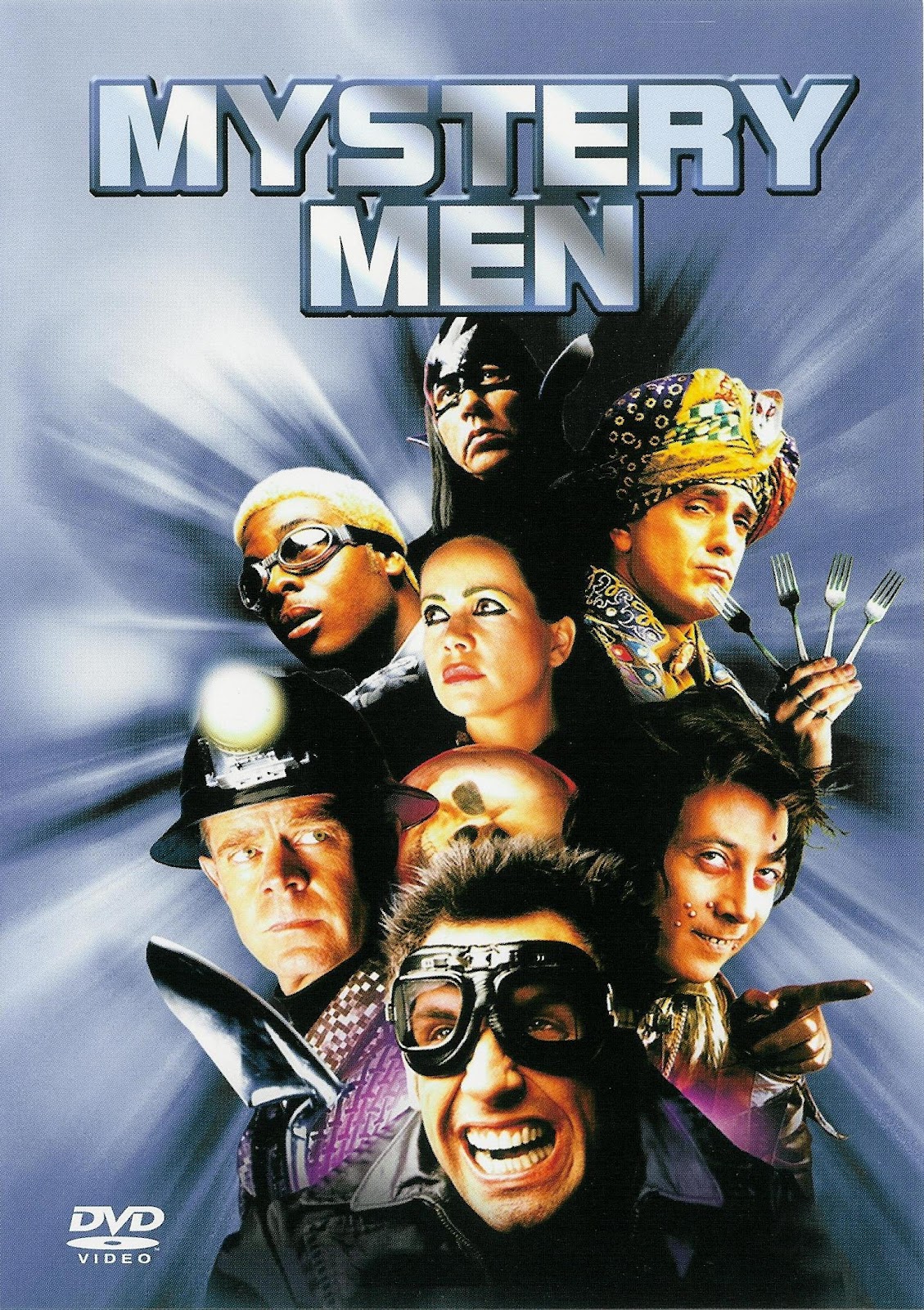
The Sphinx – so annoying, you want him to die.The latter type of annoying character was rather nicely parodied in the moveie, Mystery Men, in the person of the Sphinx. He tries so hard to be cryptic that he’s transparently shallow. His wisdom doesn’t even come up to the level of bad fortune cookies. He’s not just mysterious, he’s “well, terribly mysterious,” as the Blue Raja is at pains to tell his colleagues more than once.
You don’t want your mysterious character to turn into the Sphinx.
Mystery Men – one of the greatest movies of all time. (Click to embiggen)There comes a point where a writer decides to show the reader the truth, to whisk off the shroud of mystery and intrigue, and reveal all. This can go badly. And in the case of the Wolverine, in both comics and movies, has gone, not just badly, not just very badly, but terribly badly.
One problem is that the revelations have been contradictory. Subsequent attempts to make the revelations less contradictory pushed his backstory into pure ludicrousness. And his characterization has consequently become worse and worse. He’s a loner, except that he’s joined pretty much every team Marvel has ever published. And has picked and consistently abandoned a disturbing number of adolescent female protegés/sidekicks. He’s supposed to be a highly skilled assassin, except he’s a chaotic brawler. He’s supposed to be an honorable Samurai (with all the training in the ritualized combat/politics of same), except he’s also a savage killing machine. He’s amoral, except he’s noble and self-sacrificial.
Now, when a character is appearing in a series, and written over a number of years by different writers, this sort of thing might appear to be unavoidable. Except that it doesn’t have to be. Batman, for instance, has a much longer publishing and movie history (first appearance in comics in 1939, first movie in 1943 {a delightfully cheesy serial that I happen to have a copy of, if you want to watch the WWII era special effects and dumb cliffhangers}), but despite all those reboots, retellings, et cetera, the central core of the character has been kept intact: witnessing the murder of his parents as a child, he obsessively trains and studies, eventually becoming a dark detective and vigilante who prowls Gotham at night, foiling criminals and bringing the worst to justice. At various points they’ve wandered into the quite campy, to the darkly romantic, and other odd places, but all of the writers have managed to bring the character back to that core.
I’m working with a mysterious character in my current novel in progress. The previous novel, to which this is a sequel, also had a mysterious character—one of my two protagonists. But she wasn’t a dark, brooding person with hints of a tragic past. She’s one of the most cheerful and optimistic characters in the whole book. There were simply mysteries about her from the beginning, hints were dropped here and there, until during the big battle at the end (it’s a light fantasy with epic fantasy tropes, so there has to be a big battle!) a chunk of the mystery was revealed. It was not revealed in a big bunch of exposition. A crisis was reached, and in an act that resolved her internal conflict at the same time as saving one of her comrades (and temporarily thwarting the big bad), her true nature was revealed. I think it worked. It is currently in copy edit, and does not yet have a publication date, so I will have to wait for the readers’ verdict.
I’m a bit more nervous about the mysterious character in this one. He’s specifically hiding his identity for reasons that are both in character and important to the plot. He’s not a protagonist, he is helping one of the protagonists. Because he is specifically hiding his identity, and because his sub-plot is built around trying to protect a young woman who various people want dead, a lot of his scenes tend to be dark, grim affairs. I hope, when his identity is revealed, that the reader goes, “Oh! Oh! Why didn’t I realize that? Of course it’s ______!” rather than, “Yeah, yeah, we saw that coming a mile away…”




 Font Folly