Tag Archives: literature

Future events such as these

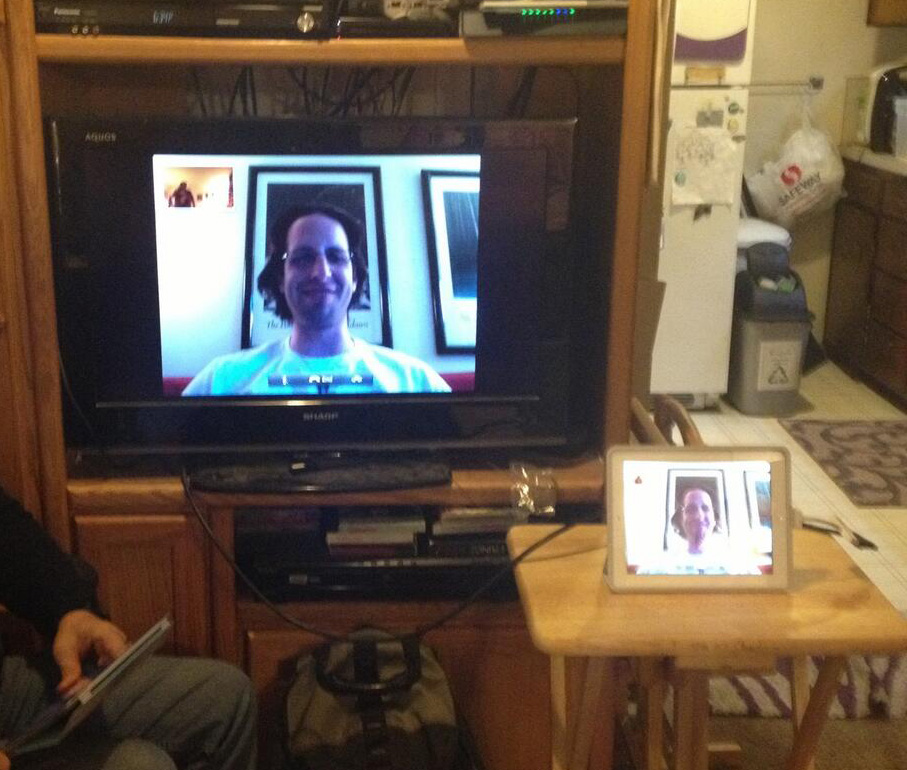
iPad connected to TV to show facetime on large screen.
Jared attending an editorial meeting via FaceTime. (Click to embiggen)
I like living in the future.

We had an editorial board meeting last night, and it being busy, crazy summertime, we almost didn’t have quorum. Fortunately, Jared was able to join us via FaceTime. We’ve done it a couple of times before, propping up my iPad so the person could see most of us. Chuck thought we should do it on the big screen, and I almost never hook the iPad up to the TV, so we did.

Now the future hasn’t quite turned out as we were promised. If I mention “flying cars” certain people will snarkily repeat a meme that’s been going around lately. The first variant I saw was, “Unless you’re 60 or older, you weren’t promised flying cars. You were promised an oppressive cyberpunk dystopia.”

That’s simply wrong, on many, many levels. The “we were promised {fill in the blank} in the future!” is a reference to things we learned during our childhood from popular culture about what the future would be like. The first appearance of cyberpunk, in any way, shape, or form, was the 1980 novel Web of Angels, by John M. Ford. Therefore, a person who is 59 now, would have been 26 years old when the first hint of a cyberpunk dystopia could have appeared in any popular culture. Twenty-six is not childhood.

The Jetsons, broadcast Sunday nights from 1962-63, reruns Saturday mornings from 1964-73.
I’m still a half-dozen years below 59, and I can assure you that my childhood pop culture did, indeed, promise me flying cars.

The Jetsons was the first show to be broadcast in color on ABC-TV. A cartoon set 100 years in the future, the show ran during primetime beginning in 1962. That’s right, it was not meant to be a children’s show. After it complete its primetime run, the existing episodes were re-run as a Saturday morning cartoon for nearly 10 years. The screen shot is a frame from the opening seconds of the opening theme song of the show. Right there, flying cars. The show depicted a fairly utopian future, with robot maids, devices that could create an entire new outfit, on your body, in seconds, and so forth.

If your childhood included any of the years from 1962-1974, you were, indeed promised flying cars. If we assume one needs to be a minimum of four years old to recall a television series, that means anyone 43 or older can legitimately claim that The Jetsons, at least, promised them a utopian flying cars future.

Jonny Quest floats in midair wearing a jet backpack.
Jonny Quest flying in a jet pack (some of his villains had flying cars).
That time period also included the iconic TV series Lost in Space, the original Star Trek, and Johnny Quest. Not to mention such films as 2001: A Space Odyssey. They didn’t all have flying cars (some had transporters—even better!), but their futures are each the opposite of an oppressive cyberpunk dystopia.

But let’s loop back to that first cyberpunk book. How many people who know what cyberpunk is have even heard of Web of Angels? Most people think of cyberpunk as beginning with either Blade Runner (1982) or Neuromancer (1984). And while Blade Runner is the greatest movie ever made, bar none, the sad truth is it didn’t do well in theaters the first time, and didn’t start developing a cult following until it started appearing on cable in late 1983. So I’m going to say that the beginning of the switch-over to cyberpunk dystopias becoming dominant in pop culture was 1984.

That means 1983 is the last year in which the flying car utopia was promised as a future to kids, so anyone who was at least four in 1983 would be the actual cut-off age, rather than 60, so that means the meme should state: “Unless you’re 34 or older, you weren’t promised flying cars. You were promised an oppressive cyberpunk dystopia.”

Movie poster from 1985's Back to the Future.
Marty McFly, trying to get back to the future…
But wait! That calculation assumes a very simple binary situation. Cyberpunk dystopias became one possible future in 1984, but it wasn’t the only one. Because in 1985 we got Back to the Future! While the movie primarily follows the adventures of our young hero, Marty McFly, trapped in the 1950s in a time traveling car, trying not to screw up his own future before getting back to his own time. At the end of the movie, Doc Brown goes 30 years into the future, and then comes back, showing off a much upgraded version of the time-traveling car. So, as my friend, Matt, pointed out, if your formative years include Back to the Future, then not only were you promised flying cars, you were promised time-traveling fusion-powered flying cars fueled by household garbage!

So, no, we were promised flying cars!


I’ve had more than one person bring up the fact that Blade Runner had flying cars. I know that. When I said that Blade Runner was the greatest movie ever? Implicit in that statement is the fact that I owned several different cuts on VHS back in the day, and I watched at least two of the tapes so many times that they wore out. I am well aware of the flying cars in Blade Runner. But as I explained on Twitter, the invalidity of the assertion of a dichotomy between flying cars and cyberpunk dystopias is worthy of a posting of its own.
The Key to the Treasure

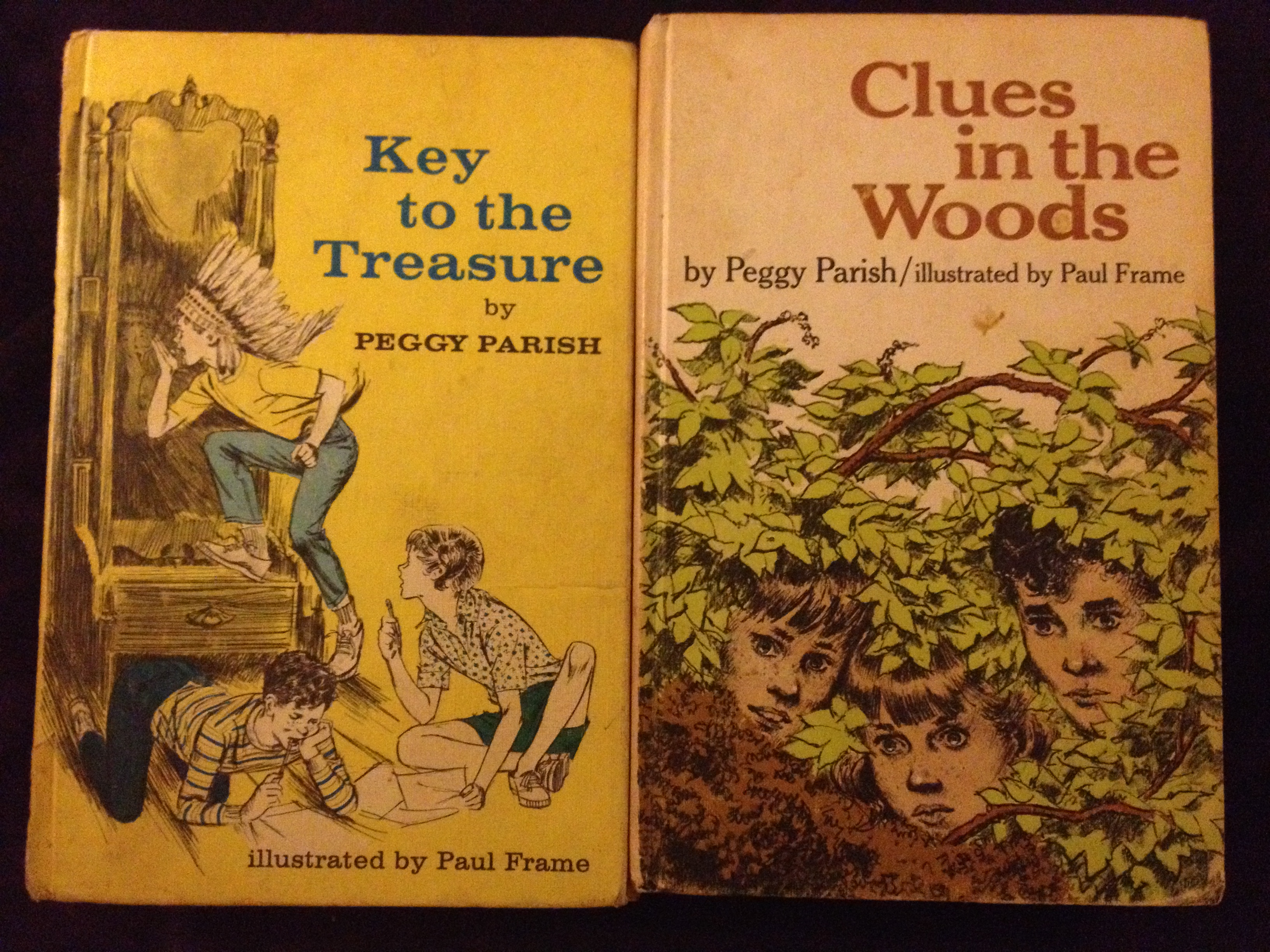
I think I was in third grade when I received my copies of Key to the Treasure, and its sequel, Clues in the Woods. The books, by Peggy Parish with illustrations by Paul Frame, were a pair of mysteries starring three siblings, Liza, Bill, and Jeb.

Hardcover copies of two books.
My old copies of these books are battered, but each still in one piece. (Click to embiggen)
My copies bear the Weekly Reader Book Club imprint. I remember reading and re-reading them many times as a kid.

I also remember, a few years later, finding another book in the series in a library. Turns out Parish wrote a total of six books in this particular series. From the descriptions of the plots, I think the book I found in the library was Pirate Island Adventure, which is actually the fourth book in the series. I remember being really disappointed by the book, primarily because the mystery solved in that book is nearly identical to the mystery in the first book.

It was probably also disappointing because the books seem clearly aimed at kids aged about 8 and under, and I was probably 11 or 12 when I found my third.

The books are currently out of print, so while I’m tempted to order the four volumes I don’t own, my choices are to spend either hundreds of dollars for old copies in “new condition,” or more reasonable prices for battered used copies.

Parish is, apparently, more famous for the Amelia Bedelia series, which I’d never heard of until I tried to track down information on these other books just this weekend.

I’ve re-read Key to the Treasure a few times as an adult (yes, including once this weekend). It doesn’t hold up too badly. The portrayal of the elderly Native America woman who had left a collection of “Indian artifacts” to the grandfather of the protagonist’s grandfather is a bit cringe worthy. And the artifacts themselves, representing a mish-mash of tribes—including the famous Gilligan’s Island Tropical Witch Doctor Tribe—is a bit more than cringe-worthy.

The dialog is a bit stilted, giving me flashbacks to my 1928 edition of a Hardy Boy’s mystery where the boys get scolded by their aunt because they got their ties messed up running home from school. Not sounding like the way real kids talked, even in 1966 when the first book was printed, but more like certain people thought children’s books should sound back then.

But I still enjoyed it. And even though I’ve read it a zillion times, enough years have passed since the last reading that I wasn’t certain how they were going to solve the puzzle. So at its heart the story still works.

And it passed the Lewis test. C.S. Lewis once said, “A children’s story that can only be enjoyed by children is not a good children’s story in the slightest.”

Why ponies?

I’m a fan of lots of things, and I’m used to most people not quite understanding my obsessions. Many of the other kids watched Lost In Space, for instance, while it was running in prime time during first and second grades, but didn’t understand why I still liked to watch the reruns in sixth grade. And none of them seemed to be watching Star Trek when it was on prime time, so I got a lot of blank looks if I talked about it, until years later when it became a big hit in syndication. Similarly, all the kids knew who Superman and Batman were, but thought I was weird for reading the Avengers and Doctor Strange.

Once we finally moved to a town big enough to have a significant sci fi contingent (10th grade), I started feeling a little less like a freak. And when, that summer, the original Star Wars came out, it seemed for a while as if everyone was at least a bit of a freak. Though I still got some funny looks and rolled eyes when people found out that I had driven to a large screen theatre in another state 13 times just to see Star Wars on the highest quality screen and sound system I could find.

And so for the last couple of years I’ve found myself having to explain the appeal of My Little Pony: Friendship is Magic, a show originally intended for little girls.

The truth is, I resisted watching it. When I first heard about the Brony phenomenon, I thought it was mildly amusing, but more because other people were making such a big deal out of young adult men watching a kid’s cartoon. Then one of my friends started showing episodes to my husband while we were all at a comics con together, and though I tried not to watch, I couldn’t resist.

The answer to “why ponies?” is simply that the scripts were well written. Yes, Lauren Faust, the producer for this relaunch of My Little Pony, had wanted to create a show for little girls, but specifically she wanted to get away from the sexist assumptions of most toys and shows aimed at little girls. She wanted a story that treated girls as humans, not little princesses who are only interested in dolls. So the six main characters, all female, are written as six young adults with diverse interests and occupations. We have an athlete, a baker, an animal caretaker, a farmer, a designer/seamstress, and a librarian. The emphasis, in the first season, at least, was less on outlandish mystical villains (though, yes, there are a couple of those) and more on personality conflicts, misunderstandings, and mundane misadventures.

More importantly, the writers don’t generally talk down to the audience. Instead of writing stories that will appeal only to children (or what some adults think would appeal to children), they write character-driven stories.

It reminds me of a theme I read again and again back in the days when I regularly read Writers Digest and The Writer magazine: a good children’s story was a good story, period. Every established children’s author or editor of children’s publications has tons of stories of meeting aspiring writers who have the mistaken notion that writing for children is a good place to start, because children’s writing is easier, because children are simple, right?

Children are people, they just don’t have as much experience as adults. Yes, there are areas of the brain that don’t reach full development until mid-to-late twenties, there are topics that children may not have the emotional maturity or context to handle easily, and there are topics that society generally agrees aren’t appropriate to share with children. Their priorities and perspectives are different, but they aren’t stupid and they aren’t simple-minded. Their stories, therefore, shouldn’t be dumbed-down versions of adult stories.

And that was certainly the case in the first couple seasons of the show.

Another thing I like about the show is the utter lack of cynicism within the stories and so far as I can tell in the execution of the series. It’s just a fun, often joyful experience.

I understand why some people don’t like the show. I understand why some people think it is strange that adults follow the show, organize conventions to talk about it, and so forth. But then, I also think that more people should ask just what the appeal is to so many otherwise intelligent adults of the by-the-numbers, totally unchallenging, practically sleep-written Law & Order franchises.

Come on! What’s with that?

Presence (stage, screen, or otherwise)

I’ve recently read two different proposals for a gay version of the Bechdel Test. The Bechdel Test is described in a comic strip by Allison Bechdel back in 1985. It is usually described as a simple way to gauge the active presence of female characters in Hollywood films and just how well rounded and complete those roles are. The test is in three steps, 1) There must be at least two named women, who 2) talk to each other, about 3) something besides a man.

It is frightening how many movies and TV shows fail the test. Having just watched, over the course of a month, the first five seasons of Supernatural, for instance, I can report that not a single episode out of those 65 episodes passes the test. To be fair, since I’ve also watched a few later episodes out of order, I can report that one recent episode in which Felicia Day reprises the role of a lesbian hacker played in an earlier season very nearly passes the test. Nearly.

While the results of applying the Bechdel Test to your favorite shows can be depressing, it is even worse if you try to apply a similar test about gay characters. If you transliterate the Bechdel Test into a test of how gays are treated in storytelling, it might look like this proposal:

  1. Are there at least two gay/lesbian/transgender people?
  2. Do they talk to each other? Or even do more than shock horror kiss?
  3. Do they talk about anything other than sex/being gay/shopping/cats?

With extremely rare exceptions, only movies made by queer writers/directors and explicitly aimed at a gay audience pass the test. Most fail at item number one. And most of the few who pass would fail if you changed it to say “is there one out gay/lesbian/transgender character.”

I insist on the “out” part because, I’m sorry, characters such as Dumbledore in the Harry Potter stories don’t count. He is never identified within the books or the movie as being gay. It isn’t even really hinted at in a meaningful way within the story. Having the author tell people during a book tour (and then only after having been confronted umpteen million times about the lack of gay characters), that one character who is portrayed as completely asexual throughout the books doesn’t count. Because this is about recognizing the existence of gay people, not compounding the closet.

Of course, Brokeback Mountain fails this test, because the only gay characters who appear are all deeply and tragically closeted. Which was true to the historical period, but also integral to the fundamental point of the story. Because of that historical reality, I find this other version I found a bit more useful:

  1. The movie includes two gay characters who interact in some way,
  2. Do not offer sassy advice to the protagonist,
  3. And are not dead by the end credits

At least with this test, Brokeback Mountain doesn’t fail until the third bullet.

The point of the original Bechdel Test wasn’t to assess whether a movie treats female characters equally, or whether there are stereotypes, or even whether or not it is misogynist. All it does is establish a baseline that the writers have actually imagined the women in the story as being full-fledged human beings, with lives and feelings and interests of their own. It’s useful not so much as a way to judge a specific movie or story, but to make us think about the presumptions of story telling.

Movies and books and stories are full of a variety of fully realized male characters, who range from good to nasty, from important to silly. And even most of the throw-away male characters have hints of a life and personality of their own that isn’t defined by the protagonists or their family. Where as the default position for female characters are to be the sister, wife, ex-girlfriend, or mother of one of the characters who is actually doing something in the story.

And let me just say, it’s disturbing, as a writer, to go apply the Bechdel Test to your own work and discover just how many of your own stories fail it!

So, the two versions of the Gay Bechdel Test aren’t quite the same as the original. Both have at least one step that focuses solely on clichés rather than just establishing whether the writer has actually developed a personality and backstory for the characters. So I think I prefer this version:

  1. The movie/story contains one identified gay, lesbian, or transgender character,
  2. Who has a conversation with any other character,
  3. About something other than sexuality*.

With the corollary that under sexuality we include topics that are typically (and lazily) considered a subset of “queerness.” So if all they talk about is gay rights legislation, or AIDS prevention, or who uses which bathroom, those count as a failure, too.

Not that we need to be the stars, or that we need to appear in every story, but we’re part of reality, and there are far more of us than there are people capable of dodging dozens of machine gun bullets while driving a car at very high speed through a crowded place without hurting anything other than a single vegetable cart, while reloading their gun and explaining the intricacies of a multinational conspiracy.

And we see thousands of them in movies all the time.

Book Review: The Last Policeman

Book cover of The Last Policeman
The Last Policeman, by Ben H. Winters
This book came out last year, but I just finished it recently. The Last Policeman, by Ben H. Winters, poses the question: what’s the point of solving a murder when the world is about to end?

The book is set in the very near future. The set up is that there’s a previously unknown asteroid on an eccentric orbit aimed at earth. It’s too big for any technology we have to do anything about in the time remaining. Society is slowly deteriorating as people abandon jobs to go do things they always wanted (I’m particularly fond of the sample list the narrator makes: dangerous sport, sexual fantasy, or track down that fourth-grade bully and punch him in the nose), or join religious cults, or just go on a rampage.

Our narrator, Hank Palace, is a detective in Concord, New Hampshire. He grew up in Concord (his mother worked as a dispatcher for the Concord Police when he was a child), and had dreamed of being a cop. Just barely not a rookie patrolman when the asteroid strike became inevitable, he’s been promoted to Detective as much through attrition as merit. And he’s confronted with a suspicious death that everyone wants to write off as a suicide. Hank isn’t so sure.

The author describes it as an existential detective novel. I think of it more as mid-apocalyptic noir, as Hank’s world certainly has plenty of disorder and disaffection to qualify as noir on its own. Hank walks that shadowy line charted by such characters as Sam Spade and Philip Marlowe: he knows the world is falling apart, but he’s self-destructively determined that justice will be done.

The decay of society depicted feels very real, and the characters are all well defined. The complications and red herrings never seem forced or out of place. There are mysteries within mysteries. You’ll see some of the solutions coming, though not so obviously as to be boring. And even the most surprising one, to me, when it was revealed, had that sense of, “Oh, of course! Why didn’t I realize that’s what those things meant?”

It’s also nice to see a detective story set in a smaller city, like Concord. The setting is just big enough to be a city, without the clichés or over familiarity of places like New York or LA. I also enjoyed the fact that Hank isn’t the only character determined to do the right thing, despite the futility of it all, and that those characters who get to know aren’t all doing it for exactly the same reasons.

I really enjoyed the book a lot, and highly recommend it. Since the Mystery Writers of America awarded it the 2012 Edgar award for Best Original Paperback, I must not be the only one to like it.

Which isn’t to say that it is perfect. One rather trivial set of imperfections I have to mention. It’s pretty obvious that at least some of this book was dictated using some kind of speech to text software, which left some confusing errors that didn’t get caught by an editor (assuming there was one).

For example, there’s a point when Hank is describing an emotionally stiff person. The sentence included the phrase, “like a peace offense.” I actually had to mutter it to myself before I finally realized it was supposed to be “a piece of fence.” A copy editor would have corrected the homonym, but a developmental editor would have said, “I think the word you’re looking for is ‘fencepost’.” At another point Hank is listing off some observatories, “Arecibo, Canberra, and Gold’s tone.” That last one should have been Goldstone, for the Goldstone Deep Space Communications Complex in the Mojave Desert.

But as prone to typos as I am, I can’t fault it too much on that account.

The other imperfection is external to the book. I can’t explain it without talking about the ending. I’m not going to give anything specific away, but if you don’t want even a few indications about the end, stop now.

Otherwise, click “Continue reading…”

Continue reading Book Review: The Last Policeman

A good day to die

Readers can be like addicts. Once they fall in love with a fictional character, they want to read more, and more, and more about the character. A good-selling series of books can set a writer for life.

But it can be something of a gilded cage.

When Arthur Conan Doyle was a struggling young physician, he found himself sitting for rather long stretches between patients. So he started writing stories during his down time, and would sell them to various magazines of the time. He soon found that he had a knack for mysteries, not always crime stories, but stories in which there was a puzzle for the characters (and the readers) to solve. One day Conan Doyle started writing a long story about an independent detective. He based this detective on one of his medical school teachers, Dr Joseph Bell.

Bell was an early advocate of what would now be called forensic diagnosis. He told his students to pay more attention to physical clues about a patient’s illness. Close observation and deduction he said, were more important that what the patient told you. To demonstrate his method, he would have people pick out strangers in a crowd or on the street, and just by looking at the person (how they were dressed, wear patterns on their clothing, the presence or absence of callouses on various portions of hands, and so forth) deduce their occupation and recent activities.

Sherlock Holmes was a man who used Bell’s methods to solve crimes. A Study in Scarlet was published first as part of a Christmas Special (though it has no Christmas theme) in 1887. It was republished as a standalone book the next year. Sales were good enough to justify a second edition, more expensively bound, to be produced the next year. Conan Doyle was commissioned to write a second novel, The Sign of the Four (he was republished the next year in various journals throughout the empire, often with the slightly modified title The Sign of Four), which became an even bigger hit.

Conan Doyle was commissioned to write a series of short stories starring Sherlock Holmes for The Strand magazine, and they were published monthly from June 1891 through July 1892. As he neared the end of the series of 12 tales, Conan Doyle was finding himself growing tired of Sherlock. So he planned to kill him in the twelfth tale. Conan Doyle made the mistake of mentioning this fact at a dinner party at his mother’s home. His mother was upset, not so much about her son killing the character, but she felt the way he planned for Holmes to die (mauled to death by a vicious guard dog as Holmes and Watson rescued a young woman from a particularly disturbed couple) was entirely too ignoble for such a hero. She made him promise that Holmes would not die in the story. So, Conan Doyle changed the ending of the “The Adventure of the Copper Beeches.”

The stories were so popular, that people were literally lining up outside the offices of the Strand on publication day to get a copy. Holmes was not the first literary character to evoke this response. Many years earlier (1841) people had lined up in anticipation of the final chapters of Dickens’ The Old Curiosity Shop. The Strand commissioned more stories. Conan Doyle couldn’t really turn down the money, but he was getting even more tired of Holmes. So he kept completely mum about “The Final Problem,” in which Holmes is killed by Moriarty. Moriarty dies along with him.

“The Final Problem” has a lot of problems. Its internal logic is laughable (Holmes must disguise himself lest the killers find him, but he travels with Watson who is completely undisguised, and Watson booked their train, boat, and second train passages in his own name). Moriarty had never appeared in any story before this one, and there is absolutely no hint of his existence. That later prompted the producers of at least one television series that tried to follow the stories faithfully to insert Moriarty as the mastermind who supplied the plan to the robber in “The Red-Headed League,” just to get the character on the scene and in the viewers’ minds.

Conan Doyle never thought of his Holmes stories as serious literature, or of much importance. Which is why at different times he has Dr Watson refer to himself as “James” instead of “John.” In the original Moriarty story, the Professor’s first name is not mentioned, though the Professor’s brother, Colonel James Moriarty is mentioned by name. Later stories to feature Moriarty refer to him as James Moriarty. There are many other contradictions.

When Holmes was killed, the public was shocked. Some people dressed in full mourning clothes. People wrote Conan Doyle, pleading with him to bring back Holmes, and so on.

For years Conan Doyle ignored the pleas. Then, while visiting friends in the country, when one friend told about a local legend of a ghostly dog, Conan Doyle said it would make a wonderful basis of a Holmes story, but he could never write it since he’d killed Holmes. One of the other friends suggested the idea that the story could begin with Watson explaining that he had sworn never to tell this tale while certain innocent persons were alive, but now he could. So the story would be set before Holmes’ death in 1892, but could be published in 1902. And thus The Hound of the Baskervilles came to be.

The pressure to bring back Holmes increased (and the amount of money both American and British publishers were willing to offer for new Holmes stories skyrocketed), so in 1905 he relented. In “The Adventure of the Empty House” Watson is shocked (in 1894) to discover that Holmes is alive, having faked his own death in order to lure Moriarty’s confederates into mistakes so that the rest of the criminal organization can be dismantled. Thirteen stories are included along with “The Adventure of the Empty House” in The Return of Sherlock Holmes, featuring adventures that supposedly occurred after the time of Holmes’ faked death, but before the publication of his return.

Conan Doyle wrote a fourth Holmes novel, which marked the return of Moriarty, though this story is set in time before “The Final Problem.” Conan Doyle remained adamant that Moriarty’s death in “The Final Problem” was not faked. He wrote another 26 short stories about Holmes until his death in 1930.

Readers always wanted more.

So I wasn’t terribly surprised to read that the author of the Sookie Sackhouse/True Blood series is getting a lot of grief for announcing that the next novel is the finale, ending the series once and for all. I have never read the stories, nor seen the insanely popular HBO series. So I wasn’t aware that she had originally planned to kill one of the main characters and end the series in the ninth book some years ago.

Sometimes a story has run its course. Sometimes it’s time to tell a beloved character good-bye.

Even though I sympathize with her fans, I hope Charlaine Harris is happy with how she’s ended things, and goes on to tell whatever other stories she likes.

Even a young earth is older than you think

So, a few days ago I posted about one of my pet peeves in fantasy world-building, the writer who thinks 600-years ago is the dawn of time. A friend who read my post raised an interesting point. “If the series you’re talking about is the one I think it is, I understand that the author comes from a conservative Baptist background. Maybe she built her world, consciously or not, on the assumption of a Young Earth.”

We are talking about fantasy world-building, and an author is free to choose any premise they wish to build from. Terry Pratchett’s Discworld series assumes that the world is a disc balanced on the backs of four giant elephants who stand atop a gigantic sea turtle that swims through space, for instance. It’s one of my favorite series of books, so I certainly can’t say a writer isn’t free to use some notions of Fundamentalist Creationism as the basis for their fantasy world.

However…

If the premise is that the Literalistic1 Interpretation of the Bible describes the physical origin of your fantasy world, it is absolutely impossible for the “first witch ever to exist” to have been born a mere 600 or so years ago.

In the book of First Samuel, chapter 28, one finds the story of the Witch of Endor. The Prophet Samuel has recently died, and things are going extremely badly for King Saul. Eventually, Saul goes to a famous witch in Endor, who raises the ghost of Samuel. Samuel’s spirit proceeds to tell Saul that God is tired of Saul’s disobedience, and that Saul will lose the battle the very next day, and that Saul and his sons will be joining Samuel in the land of the dead shortly thereafter. Saul leaves, understandably dismayed and devastated. He loses the battle the next day and kills himself.

So right there, in the Bible, we see a witch who has actual magic powers to raise the dead thousands of years ago, rather than 600 years ago.

Not only that, before Saul goes to this witch, he tried turning to prophets, to a couple of scrying devices the priests kept, and to dream interpreters to find out what he should do. In an earlier incident, while the Prophet Samuel was still alive, Saul drove all the magicians and necromancers from the kingdom of Isreal, clearly implying that there were a lot of them already in existence, so even the Witch of Endor isn’t the first witch ever on the Young Earth.


1. My Old Testament Professor at University insisted (and could quickly demonstrate) that none of the people who say they take the Bible literally actually do so. Instead, he argued, they use a form of filtered literalism, where some passages are taken literally, contradictory ones are ignored2, and other sections have imposed upon them notions that are not evident anywhere in the text.

2. The story of Samuel and King Saul is a particularly amusing example of this. Later passages refer to Saul as God’s chosen leader of Israel, but in the beginning of Saul’s story, the people of Israel keep asking Samuel to ask God to give them a king. Samuel keeps telling them that God doesn’t want them to have a king. Eventually, apparently tired of being pestered, God appears to relent (though the original text makes it unclear whether it is really God who relents, or if Samuel just picks someone and tells them that God has relented), and proclaims Saul King. Then, when a foreign power assembles an army and marches toward Israel, Samuel tells Saul to gather his own army, go to a specific spot, and wait seven days, at which point Samuel would arrive (presumably with God’s battle plans), and they could begin. Seven days came and went, Samuel didn’t arrive. More days passed, no Samuel. The army was growing restless, so Saul decided something must have happened to Samuel, and he ordered the army to make prayers and sacrifices, then prepare for battle. As soon as Saul had completed the sacrifice, Samuel suddenly appeared3, admonished Saul for taking on the role of the priest, and tells him God doesn’t want him to be king any longer. But, in the very next chapter King Saul is leading the battle, Samuel is giving him instructions, Saul wins, everyone (including Samuel) rejoice in the king’s victory. Samuel tells Saul that God wants him to slaughter not just the defeated soldiers, but every man, woman, child, and even the livestock of the defeated Amalekites. While doing so, Saul decides to spare some another tribe of people living among the Amalekites4 and doesn’t slaughter every woman and child of the Kenites. Samuel throws another hissy fit, and says God regrets making Saul King, and that Saul’s kingdom will soon be torn apart. Except in the previous chapter Samuel had already said Saul was no longer king, so nothing in this chapter should even have happened, least of all Samuel advising Saul, et cetera5.

3. My professor said, “As if he had been hiding in the bushes watching and waiting for Saul to screw up.”

4. God said “kill the Amalekites,” he didn’t say to kill the Amelekites and Kenites. Seems like a reasonable distinction, right? Certainly if you think that it’s reasonable for the same God who said “Thou shall not kill” without any qualifications, turns around and orders you to murder babies.

5. Reading the entire saga of Saul and Samuel, and taking every passage literally, it is hard to interpret the whole thing as anything other than either God or Samuel thinking of new ways to dick Saul around, giving him contradictory orders, impossible orders, and downright evil orders. Saul tries to follow all of them, and gets yelled at for disobedience again and again. On the other hand, David (the shepherd who defeats Goliath in battle and eventually becomes king after Saul dies), as King never obeys anything that God’s messengers tell him to do. He blatantly disregards commandments and instructions, but again and again the priests and prophets proclaim him beloved of God and a good king.

History is longer than you think

I have complained before1 about fantasy authors whose world-building includes statements like, “the peace didn’t last long, because 400 years later…” because history isn’t just a time line, it’s also the way people perceive it. 400 years of peace would never be thought of as a brief interval, but rather the Great Golden Age or something.

Certain fantasy authors make the opposite mistake, of not understanding how long human history actually is. A particularly egregious example was a series which used as a plot point the characters needing to find a spell that was developed by “the first witch to ever exist,” and when they finally find it, it is revealed that this witch lived 600 years ago.

Bear in mind that this happened in a fantasy world where magic works and invariably that magic is invoked with drawing symbols, lighting candles, and chanting. That means that in this fantasy world there are unseen forces which respond to symbols and sounds and thoughts. That clearly means that these unseen forces could be tapped by any being capable of employing symbolism, making noise, and thinking. Presumably the first witches did this sort of thing by accident, but that’s how we learn everything in life.

These sorts of fantasy worlds always have some low level of magic use that is considered safe and does not rely about calling on demons or gods for power. There is usually some scene where a character is either being taught magic by someone else, or who is simply in a desperate situation, where simply by wishing something really hard, they are able to light that candle, or move the key, or pull that weapon which is just out of reach into their hand when the monster is dragging them to their doom. If you think logically from these situations, at least some of magic is simply mentally manipulating some form of energy that is freely available everywhere.

The earliest people who had the cognitive ability to imagine something that isn’t there were the earliest tool makers. This isn’t just a monkey picking up a convenient rock. These people had some tasks they needed doing, realized if they had an object with this kind of shape, hard enough to withstand the force when pressed this way into the that leg of mammoth, they can do this a lot faster than just using teeth and fingernails.

The first people capable of doing that weren’t technically human. They were hominids living in the Olduvai Gorge region of Africa 2.4 million years ago.

Not six hundred (600) years ago.

Not six thousand (6,000) years ago.

But 2.4 million (2,400,000) years ago.

Millions of years ago.

We’re not sure which of the different hominid species living back then made the tools we’ve found—Australopithecus garhi, Homo habilis, or Homo ergaster—but they were making choppers, scrapers, awls, and burins. That last one is especially important while thinking about the cognitive abilities of the brains that thought them up. A burin is for engraving. They were doing more than chopping, cutting, scraping, and making holes in things. They were engraving or carving shapes into wood and bone.

The tools were still very simple, so these pre-humans probably weren’t capable of really in-depth abstract thought that would seem to be required to imagine and enact the really complicated magical effects you sometimes see wizards and sorceresses throwing around in those fantasy novels, but that “pull a weapon to my hand in an emergency” level of magic, they would surely be capable of, in a magical world.

There is anatomical indication that Homo ergaster, at least, possessed verbal communication abilities much more complex than apes. We don’t know how complicated it was, but language indicates another level of abstract thinking2.

I could keep charting what we know about the development of other activities often involved in magic rituals of those sorts of fantasy stories—cave painting, carved figures, musical instruments (surely predated by a huge period of time by simply singing and chanting), and even dance3, but the point is that, if magic exists in the universe and can be manipulated by thoughts, symbols, chanting, et cetera, people will have been doing some forms of it long, long before the beginning of recorded history, (approximately 5,000 years ago—still a lot more than 600).

Even if you don’t want to think about hominid sorcerers, you have to realize that witches, sorcerers, and priests who could perform miracles exist in the very oldest written human records. So if you’re writing a magickal universe that is more or less based on ours, whether it’s a modern urban fantasy, something in a historical setting, or an alternate historical setting, some sort of magic tradition in your world stretches back much, much, much further than a mere six centuries ago.

Asserting anything else is simply dumb.

And don’t even get me started on the incredible stupidity of always having really ancient lore being far superior to anything that has come about now. Because that violates the thing that actually makes humans different than animals… but that’s a rant for another day.


1. Time doesn’t work that way. Think of today’s post as another in a series.

2. And this is just limiting ourselves to the hominids. Dolphins and whales aren’t generally thought of as tool makers, but they certainly have the raw brain power to do the thinking part. And there are other species outside the primates who use really simple tools, create games, plan and execute complicated group activities, including pulling practical jokes. This isn’t to suggest that a magic universe has to have animal mystics, but it could be an interesting alternative way to think about familiars and other animals that seem to respond to magic or enhance magic in folklore.

3. There is some fascinating work being done about the anthropology and evolution of dance (rhythmic, coordinated moving), including an interesting notion that rhythmical synchronized movement could make a group of small hominids appear to be one much larger creature, and thus not easy prey. It’s fascinating stuff. It’s very speculative, and difficult to find physical evidence to support, but still a very interesting topic to think about.

Is it worth the outrage?

Another corner of the internet is boiling over. Linking to it serves no purpose. I already wasted too much time trying to figure out what everyone is so upset about—because the guess I made when I read the first outraged post seems to be the only one that makes sense.

Resentment is an ugly thing. As the oft-quoted proverb says, “Resentment is like drinking poison and then waiting for the other person to die.” It’s toxic and self-destruction and does no good to anyone.

This goes doubly true when one is an artist of any type who spends any time at all ranting and raging about how shallow, fake, and undeserving another (more well-known) artist is. The only people who don’t see right through your jealousy are other resentful people.

Every minute you spend seething is a minute you aren’t spending on your own art. You’re never going to get any of those minutes back. So stop trying to explain how untalented that person is. Stop pointing to examples of how bad their work is. Stop thinking up clever ways to insult the people who like the other person’s work.

None of that does anyone any good, least of all you.

If you don’t like someone’s work, don’t look at/read/listen to/share it. If you think there’s too much crap in the world, stop griping and make something that isn’t crap.

There are things worth getting outraged over. I do it all the time. It’s okay to be angry about discrimination, or greed, or oppression. Those things cause actual harm to other people. Pointing out the problem may get some help to those who have been hurt. Pointing out the problem may persuade some people to change their minds and reduce the amount of bigotry and hatred and suffering in the world.

No one is harmed by a bad poem. To what little extent bad art can diminish joy or entice people to do bad things (often a very dubious claim), ranting about it just spreads the bad stuff to more people. The exact opposite of making the world a better place.

Let it go.

Go make something better. Go live something better. Go be something better.

Misdirect, don’t lie or withhold

The are times, as a writer, when you want to surprise your readers or give them a puzzle to solve. That’s clearly a major part of a murder mystery, of course, but you do it in other stories as well.

Anyone who has ever aspired to write mysteries has read about the rule of not cheating the reader. Cheating is when you completely withhold information required to solve the mystery. All information has to be available to the reader. It is okay to obfuscate it, but leaving it out entirely is a no-no.

The classic example of the wrong way is describing your detective, perhaps despondent, looking down at his feet and seeing something. He bends down, picks the something up, and then smiles as he slips it in his pocket and the narration informs the reader that this thing is the vital clue that makes everything fall into place. But the writer doesn’t tell the reader what the something is.

The proper way to hide a clue is in plain sight. I remember one mystery once had three characters talking about something, when the father comments on his daughter’s dress the night before, saying it was a nice shade of green. One of the other characters tells him the dress was red. The father goes, “Oh, well, I guess it is.” The way the scene is written it seems that the father is simply not very attentive or perhaps distracted. Later in the story, it is revealed that he suffers from a form of color blindness, and that is an important clue about an aspect of one of the murders.

I’m currently wrestling with a version of this issue in a non-mystery. My current novel in progress (which is a light fantasy) includes a mysterious masked person who has appeared a couple of times, thwarting an assassination attempt directed at a princess, preventing a sorceress from getting some information, and a few other things. In the very first scene his mask is commented upon, and an explanation for why he is hiding his identity is provided.

So I wrote a scene last week where he confronts the man behind the assassination plot. I realized midway through that I could make the scene far more creepy than it already is, but I think I would be cheating if I did.

It occured to me that I could have the masked man reveal his face to the conspirator just before killing him, and show the conspirator reacting with shock at the identity… But withholding the identity from the reader. Certainly movies, television shows, and comics have used that particular cliche many times, so one could argue it’s acceptable. But even then, usually the reaction of the character to the revealed face provides an extra clue about some aspect of the story other than the identity of the mysterious person.

Besides thinking the technique is overused in those media, I’m not sure it makes any sense for the masked man to do it. The most obvious reason, “I want you to know who defeated you,” simply doesn’t apply to this character and his relationship to the conspirators. Besides being out of character, it would also be a bit too self-consciously coy. By this point the theoretical reader is either curious about the identity of the masked man or already has a theory. A melodramatic nonrevealing reveal is more likely to annoy than fascinate, I think.

And this little mystery isn’t the main plot. If I’ve done the rest of my job correctly, what I hope the reader is more worried about by this point in the book is: whether one grief-stricken character will go through with killing some innocents to bring another character back from the dead, whether one protagonist will clear his name and rescue his nieces, whether other characters will prevent a war, and whether one villain will be redeemed.

My mystery man is important to the plot, and why he’s attempting to act incognito is totally in keeping with his personality while moving the plot along, but it isn’t the main concern.

A puzzle as a subplot can be fun for the reader. Keeping the reader guessing about a few things without annoying them is a tricky balancing act. You want to provide enough information so that your reader can guess, while leaving some doubt. You want the reader to feel almost as if he is your accomplice–as if both of you are exploring this thing together.

Doing something such as having the detective find something which you blatantly label a clue which you withhold from the reader, or the unmasking without showing the reader, is the equivalent of a stage magician declaring, “Ha! Ha! I know something you don’t know! I know something you don’t know!”

And that’s just annoying beyond belief!