1946 Retro Hugo Award Trophy (which were awarded in 1996). Designed by: Barry Workman, Mike Donahue and Shawn Crosby.Voting is open for the Hugo Awards, and I’ve been trying to read as many of the nominated works as I can before I cast my ballot. Because of a bloc-voting scheme orchestrated by the Sad Puppies and Rabid Puppies (and don’t get me started on the claims that they weren’t working together), some have argued that those of us opposed to the idea of bloc-voting should simply vote No Award above all the entries from Puppy slates. While I have some sympathy for the argument, I would feel guilty putting anything below No Award merely because it was recommended (and in some cases was written) by notorious bigots.
The awards are supposed to be about the artistic merits of the nominated pieces, right?
The WorldCon committee hosting each year’s awards traditionally assembles packets of either electronic copies of the nominated works, or excerpts (whichever the publisher will allow) to send to all voters. The Hugo Packets have not been sent out yet (but may show up any moment) so I’ve been locating the short stories that are available on-line to read (Much thanks to the Adventures in Reading blog for gathering all the links in one place; I wish I’d found this list much earlier). Other folks have been posting reviews as they read the stories.
“Researcher Dale Spender in Australia used audio and video tape to independently evaluate who talked the most in mixed-gender university classroom discussions. Regardless of the gender ratio of the students, whether the instructor was deliberately trying to encourage female participation or not, men always talked more—whether the metric was minutes of talking or number of words spoken.
“Moreover, men literally have no clue how much they talk. When Spencer asked students to evaluate their perception of who talked more in a given discussion, women were pretty accurate; but men perceived the discussion as being “equal” when women talked only 15% of the time, and the discussion as being dominated by women if they talked only 30% of the time.”
My conclusion: men think women talk too much because they think women should be silent.
This perception problem isn’t limited to gender issues. Any person in a position of power or privilege thinks that any time someone outside their group talks or is recognized more than a tiny fraction of the time that the others are dominating the situation.
It is part of the reason that someone like Senator Cotton of Arizona can go on a national news program and say, with a straight face, that lesbians and gay men should stop demanding full equality and simply be grateful that we aren’t being publicly executed by the government.
It’s part of the reason the GamerGate goons start screaming that women are taking away their fun simply by suggesting that maybe a few games might be made that don’t treat woman as objects to be destroyed and avenged or taken as a prize.
It’s the reason that rightwing politicians and the like can claim that Christians are being oppressed despite the fact that: Christian holy days are observed as both state and federal holidays; two-thirds of the justices on the Supreme Court are Catholic; the President, Vice-President, Speaker of the House, Senate Majority Leader, Senate Minority Leader, House Minority Leader (heck, 92 percent of the members of Congress) are Christian; where many states have laws that explicitly exempt Christians from anti-bullying laws and policies at schools (in other words, Christians can bully anyone they want, as long as they claim it is due to their sincerely held belief); and where not one single state has enacted laws banning Christians from getting married, or adopting children, or being teachers.
And yes, it’s part of the reason that someone like Larry Correia and his cohorts—Brad Torgerson, Theodore Beale (aka Vox Day), and John C. Wright—can see more than one or two women or people of color nominated in a single category for the Hugo Awards and start screaming that science fiction is being taken away from people like them.
“What is significant about fan fiction is that it often spins the kind of stories that showrunners wouldn’t think to tell, because fanficcers often come from a different demographic. The discomfort seems to be not that the shows are being reinterpreted by fans, but that they are being reinterpreted by the wrong sorts of fans – women, people of colour, queer kids, horny teenagers, people who are not professional writers, people who actually care about continuity (sorry). The proper way for cultural mythmaking to progress, it is implied, is for privileged men to recreate the works of privileged men from previous generations whilst everyone else listens quietly.”
Laurie Penny is talking about the BBC series, Sherlock, and quite rightly pointing out that the series itself is fan fiction. It is being produced and broadcast on a prestigious network, and very few people would say that it isn’t real story telling, but the series is a re-imagining of stories written more than a hundred years ago by Arthur Conan Doyle. It isn’t sneered upon the same way that Buffy fanfic or ElfQuest fanfic or Teen Wolf fanfic or Supernatural fanfic is in part because the source material for Sherlock is in the public domain, but also in no small part because the people writing it are a pair of middle-aged University-educated white male British citizens.
Her insight doesn’t apply only to fan fiction.
Stories—whether they be fiction or the narrative of our existence or history—shouldn’t come from only privileged voices. They need to come from all voices, including women, people of color, queers, young people, old people, prudes, libertines, people who aren’t (yet) professional, and most definitely people who actually care about continuity. That’s why those of us who aren’t part of the dominant demographic need to tell our stories. And we need to make room for others to tell theirs.
When we don’t like something that a friend likes a great deal, they may be surprised—even shocked. I know I’m often surprised when I share a book or movie or series that I think is the coolest thing I’ve experienced in years with a friend and they can’t stand it. How can they not see how amazing it is? I ask. And sometimes I ask far too emphatically and make them feel defensive.
It’s one thing when a single friend is disappointed that we don’t like something they’ve shared with us. It’s quite another when it seems the entire world thinks some book is one of the greatest novels ever written, but you think it’s mediocre at best. You wind up feeling more than just defensive. Especially when the people going on about how good it is are writers whose work you love, or teachers that you admire. You wonder if something is wrong with you. Did you miss something when you read it? Are you not quite discerning enough to recognize its nuances? Are you simply not smart enough to understand it?
Sure, we all understand that people have differing tastes. But when a specific book evokes labels like “great” and “a classic” from the sorts of people who should be good at spotting greatness, we expect to at least be able to recognize why the other people liked it more than we did. Part of the problem is, of course, that significant doesn’t always also mean engaging.
For instance, I was in middle school and high school in the 1970s, when The Catcher in the Rye was one of the most-banned books in the U.S. I read and listened to a lot of arguments about why it should or shouldn’t be banned, including descriptions of the subject matter of the novel, with debates about what it meant. When it first came to my attention, I remember trying to find a copy in both the school’s library and my local library, and coming up empty handed. The book had been described so vehemently as immoral by a teacher who happened to be the husband of one of the librarians at the public library, I decided not to put in an inter-library loan request. I didn’t want to deal with awkward questions. Being anti-censorship from a young age, this left me with the feeling that someday, when I was no longer trapped in the boonies, I would read the book for myself.
I didn’t actually get around to reading it until my mid-twenties. I was a bit underwhelmed. It isn’t a badly written book, by any means, but I’d been led to expect something mind-blowingly good and life-changing. I found it fell far short in both respects. Maybe the subject matter and style, which had been innovative and edgy when it was published in 1951 was simply too quaint by the mid-80s. Or maybe I had read too many books and stories and seen too many movies and plays that had been influenced by it.
The “Tales of Passing Time” blog posted a great description of the phenomenon:
I would rephrase that just slightly: sometimes a classic novel isn’t called a classic because it was good, but rather because it had a significant influence on the development of the art.
Sometimes a novel was the first one to introduce a particular idea, and that idea was mind-blowing and life-changing. It was so life-changing, that hundreds of novels since have taken the idea and developed it in different ways; each author putting their own spin on it. The idea becomes part of the fabric of literature after that, so that a reader born decades later will have encountered that once mind-blowing notion hundreds or even thousands of times. By which point, if we read the original, which might have contained no redeeming qualities other than this one idea, it feels derivative of all this other stuff we’ve experienced. We may intellectually know that the “classic” inspired all the other instances or variants of the idea we encountered. Emotionally, however, it strikes us the other way around, because we have already internalized the once mind-blowing idea.
The fact that the idea has become ubiquitous is a testament to the significance of the classic in question to literature and the culture in general. It doesn’t mean that everyone is going to love it’s original package.
We’re queer, we’re nerds, get used to it!I was 13 years old and had been a semi-faithful reader of the Magazine of Fantasy and Science Fiction for a few years. I think I found my first copy in a magazine rack in a drug store sometime during fourth grade. I had pleaded and begged for a subscription of my own, and one of my grandparents had bought me a subscription for my twelfth birthday—except they got me a subscription to Galaxy Science Fiction instead. Which wasn’t bad, it meant I got a magazine about the size of a paperbook every month filled with short stories, novelletes, and sometimes serialized novels. But my adventures in the pages of Galaxy magazine is a story for another blog post.
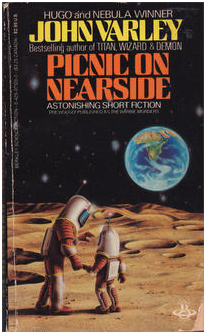
It was summer, just months before my 14th birthday, when I got hold of the new copy of the Magazine of Fantasy & Science Fiction and found inside it a story called “Picnic on the Nearside” written by John Varley. In it, the narrator, Fox, who was 12 years old and lived on a colony of the moon sometime in the future, had been in an epic argument with his mother, because he wanted a Change. He didn’t explain right away what the change was, but before that reveal, we learned that people in his society could easily alter their bodies (his mother exchanged her feet for peds/hands before going out to a party; and Fox mentioned a time he had assembled an eight-legged cat). Then Fox’s best friend, Halo, shows up as a nude woman, which finally explained what the change was. Fox and Halo had been best buds for years, and Fox worried that now that Halo was a woman, it would ruin their friendship.
Cover of the paperback edition of one of Varley’s anthologies which included the story in question.There are many other interesting things that happen in the story: Fox and Halo take Fox’s parents’ vehicle out on the surface without permission and get into a misadventure. But the really mind-bending part of the tale was the setting: a society where changing genders was only slightly more complicated than changing one’s clothes, and where everyone was okay with it. That was just mind-boggling!
I have to make a couple of digressions here. The first is that not all queer people are transgender, transsexual, nor transvestite. Gay boys don’t want to become women, we’re guys who are attracted to and fall in love with other guys. The proper answer to the clueless question, “Which one is the woman” is “Neither, that’s the point!” But one of the reasons young gay boys often idolize female characters in their favorite movies, books, and so forth is because the female characters are the objects of desire of the male characters. Similarly, young lesbian girls often idolize male characters in works of fiction. Young bisexuals may find themselves idolizing both, and so on.
Because there were no openly gay characters in any of movies, TV shows, books, short stories, et cetera which made up our cultural landscape growing up, one of the only ways to imagine ourselves in the worlds we longed to live in was to identify with the female characters. So on one level, “Picnic on the Nearside” offered me a more explicit way of projecting myself into that world. It was as if one of my subconscious coping mechanisms had been made manifest in the plot! Therefore, this story so intrigued me not because its imagined future would afford me an opportunity to change genders (which wasn’t what I wanted), but because it offered an escape from the expectations that boys were only allowed to do boy things, and only allowed to be friends with other boys, and only allowed to be boyfriends with girls.
The other digression is about the difference between a gender fluid milieu and a gay/lesbian culture. Varley has written a lot of stories set in the same world as “Picnic on the Nearside,” including several with the same character, Fox, as the protagonist (though the stories starring Detective Anna-Louise Bach {for example, “The Barbie Murders”} may be a bit more famous). Many of his characters change genders and have love affairs with people who have also swapped genders, but many times his imaginary gender fluid society is still very heterosexual. Fox never thinks of Halo as a potential sexual partner until they are opposite gender, for instance. Some of the couples who appear in the various stories seem to be just friends when they happen to be the same gender, then become lovers only when they happen to be opposite.
Many psychologists and sociologists now theorize that men who like to dress up as women and have sex with other men while thus dressed up are actually exploring an exaggerated heterosexuality. Having, in the online world, been sometimes emphatically propositioned by guys like that, and found myself turned off by their “flirting” that consists of trying to get me to say I will treat them the way an extremely selfish chauvinist man might treat a “slut,” I see their point. The men pursuing those scenarios are so into their fantasy of what heterosex could be that sometimes they want to experience it from the girls’ side. They aren’t turned on by the other man as a man, they are turned on by the situation of a woman submitting to a man in very specific ways.
Looking back on some of Varley’s stories, they can feel more like a mostly hetero exploration of gender roles, rather than a pan-gender exploration of sexual orientations.
There’s nothing wrong with that, and there’s a lot right with it.
A lot of the pain, fear, and bigotry directed toward LGBTQ people is grounded in very narrow and strict views of gender. It’s why homophobic men are almost always also misogynist (or at least very chauvinist). So anything that makes us question those assumptions about intrinsic differences between men and women, what roles men and women are each allowed to take in society, and the morality of those gender binaries is a good thing. And there’s no question that Varley’s tales exposed many of hypocrisies at the heart of all those assumptions.
I became a Varley fan that summer. Even more so, I became a fan of the protagonist, Fox, who went on to appear in the short story “The Phantom of Kansas” and the novel Steel Beach. Questions of gender and sexuality are at most a minor consideration in most of his stories, and I’ve come to appreciate his ability to take seemingly any speculative notion (no matter how weird) to its logical conclusion, and still tell a cracking good yarn along the way. What grabbed me that summer, while re-reading Fox and Halo’s misadventure again and again, was that there was at least one writer willing to tell stories that didn’t exclude a queer viewpoint. And there were editors who would print it, and by implication, readers other than me who wanted to read it.
And that was an amazing epiphany for a 13-year-old gay boy in the rural and very redneck Rocky Mountains.
There are lots of topics boiling away in the real world that I keep wanting to comment on. Some of them are about drama in sci fi fandom, some are about controversies in the community of writers, some are arguments about civil rights, some are arguments about police use of force, and so on. Each of varying importance in the scheme of things, to be sure, but all involving real people and real harm in one way or another; therefore all worthy of some consideration.
But I’m supposed to be working on some hefty writing goals for the month. And I’m supposed to be trying to spend less of my time and energy getting outraged and ranting about things. So I keep stopping myself from writing about them, and try to turn my attention back to my fiction writing.
But even then, I am confronted with some of those same issues. What are the stories I’m trying to tell, and why am I telling them this way?…Continue reading The stories I have to tell→
My uncle Joe was a metal-smoothing wizard. Most of the men on Mom’s side of the family were car mechanics of one sort or another, and Joe was good at troubleshooting engines and fast at replacing various engine components, but where he really shined was body work. He took it as a personal affront if someone suggested filling in mangled, crumpled fender with Bond-o. Joe didn’t just believe in pounding a metal fender out, he wanted to take the time to smooth the metal back into the shape it had been. He rolled and tapped it until you couldn’t tell there had ever been anything amiss, before saying it was ready for primer and painting. Watching him work on a car’s quarter panel was like watching true magic.
Joe is my mom’s baby brother and only four years older than me. As a teen-ager working in a body shop, he did a better job coaxing the crumpled car body parts back into shape than men who had been doing the job for decades. But people outside the body shop didn’t seem to value it as a talent. It was something he had a knack for, they might say. Or it was a skill you could make a decent living at. But it wasn’t really talent.
A lot of those same people insisted that I had Talent, with a capital-t. Because I was clever with words. I could think quickly on my feet, recalls enormous amount of data, construct compelling arguments, and paint vivid pictures with words. They were certain that god had given me these gifts and intended me for great things.
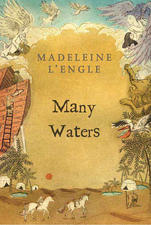
Cover of Many Waters, by Madeleine L’Engle. Sometimes called Book 4 of the Time Quintet, sometimes Book 3 of the Time Quartet….I first met the twins, Sandy and Denys Murry, in third grade in the pages of A Wrinkle in Time, by Madeleine L’Engle. I loved that book so much, that I convinced my Mom to buy me my own paperback copy, which I read again and again. The twins were supporting characters who only appear in a few scenes. The protagonist of the A Wrinkle in Time is their older, bookish sister, Meg. And most of the action of the book involves Meg, their youngest brother, Charles Wallace, and Meg’s new friend, Calvin O’Keefe. The three of them go an an adventure literally across the galaxy to rescue Dr. Murry—father of Meg, Sandy, Denys, and Charles Wallace—who has been missing for more than a year since he joined a mysterious government research project.
Many Waters is a sequel to that book, and it is the first one where Sandy and Denys take center stage.
Before I get into my review of Many Waters, I want to share one amusing personal incident: by the time I was in the fourth grade we had moved several times. For example, I had spent part of third grade not only in three different school districts, but each was in a different state. Part way through fourth grade we moved yet again. At the new school, we were assigned to read A Wrinkle in Time, and then give a book report. My report came back with a low grade in part because I had supposedly misspelled Murry, the last name of the family. I had to show the teacher in my own copy of the book (since the school copies had been taken back already and passed on to the other fourth grade classroom) that Murry is how it is spelled in the book. It didn’t occur to me until years later that this meant the teacher probably had never read the book himself. So on what basis was he grading everyone’s book reports?
It seemed as if every writer with a blog was piling on about that former MFA teacher (Ryan Boudinot) and his article last week. (I wrote about it here, The Digital Reader has a nice round up here )
This week, one of Boudinot’s former students wrote a follow-up article for the same publication, I Was the MFA Student Who Made Ryan Boudinot Cry. The follow-up agrees that Boudinot’s original comments were wrong, at least in so far as they might represent what teachers privately gripe about among themselves about their most disappointing students but should never say in public. And they were phrased unkindly.
I provide a direct link to the follow-up because it feels as if the former student is sincere in their comments. But their attempt to defend or rationalize Boudinot’s original article is both misguided and wrong.
The former student alludes to Boudinot’s acrimonious departure from the teaching job just before writing the article as a possible explanation for how ungracious the article was. Boudinot’s teaching style is excused as being the kind of “tough love” portrayed most recently in the movie Whiplash. Finally, they point out that Boudinot is reportedly a very loving father to his two kids.
None of that changes the clear, irrefutable fact that most of Boudinot’s article was pure assholery. And now that we know that even students who admire him describe his teaching style as “contemptuous,” “ruthless” and “merciless” we can safely conclude that the article was hardly an aberration.
I’ve had enough experience with various kinds of jerks, jackasses, and other abusers to recognize the pattern. Every single abusive person who has ever breathed has also had any number of people who would swear that the person actually meant well, they’re just blunt. Or their communication style is simply argumentative; if you give as good as you get, they’ll respect you. Also they clearly love their own spouse/kid/dog so much that it is simply impossible that they are the kind of mean-spirited, angry, judgmental dickhead that their recent actions might be construed to imply.
Bull.
And I say that while confessing that there have been times in my life when I was exactly that kind of jerk or jackass.
Being angry makes you do stupid things, obviously. Being angry about how one lost a job (or how one felt forced to leave) is going to leave you prone to say unwise things about that job. But the problem with this excuse is that none of his vitriol was aimed at the school or the program. The people who have agreed with him act as if he was leveling an indictment at the system that determines which students get into the program.
While it is possible to infer that underlying message, he doesn’t ever say the graduate admissions system should be scrapped—he says he wished some of his students had suffered more. He places all of the onus for students being unprepared on the students not being “serious” or “not the real deal” or not being talented.
When you’re angry with a specific person with whom you have a shared history, you will sometimes say things that you do not really mean or that you don’t believe are true because you want to hurt that specific person. Sometimes. More often, what you say is stuff you’ve believed all the time, but have refrained from saying for one reason or another.
When you’re not yelling at a specific individual who has hurt you, you never say anything you haven’t always believed to be true. Being angry doesn’t make you spout random thoughts that never entered your head before that moment. All being angry does is remove your filters. You say things you have refrained from saying not because you were trying to be kind—you refrained from saying them because you didn’t want to deal with the consequences of speaking your true opinion.
And as far as him being a good father? Maybe he is, I don’t know. But it makes me think of those virulently anti-gay politicians who suddenly understand that gay people are human, too, but only after their own child comes out. If they were a genuinely nice person, they would have had the empathy to see that when the victim of the hatred wasn’t someone they have a vested interest in. Similarly, I’m not impressed by a person who is able to be nice to his own family while he is so mean and nasty to people he no longer believes can do anything for him.
I’ve quoted before the saying, “If you meet one asshole in the morning, you met an asshole. If you keep meeting assholes again and again all day long, you’re the asshole.” If you get a bad student who isn’t interested in learning or becoming better at the craft, you got a bad student. If you keep meeting bad students again and again in ever single class you teach? You’re a bad teacher.
When I wrote that response to the ex-MFA writer’s diatribe about writing students (Wading through the elitist BS), my first draft had a lot of snarky comments which I deleted lest I muddy my own point. They also betrayed a bit of my own form of elitism. For instance, in the original article the writer listed several books (in addition to The Great Gatsby) that he believed one must have read, enjoyed, and wanted to read more of in order to be a “serious reader.” All of the books he mentioned by name are ones I most often hear about from the sort of supercilious swanker who is constantly looking for a reason to hold other people’s intellects in disdain…Continue reading Running about with lit matches→
One of my favorite news sites posted an article by Ryan Boudinot, an ex-MFA (Master of Fine Arts) teacher, about writing students. The article is an incredibly good example of both clickbait and elitist BS. And the writing blogs have reacted in a manner which is just increasing the traffic to the article, making it likely the site will put up more of the same. If you haven’t seen it, yet, here’s a link using the excellent Donotlink.com service: Things I Can Say About MFA Writing Programs Now That I No Longer Teach in One – The Stranger, which will get you to the article without increasing its search stats.
A lot of people have posted rebuttals, I provide regular links to some of the best at the end of this post. The point I most disagree with is Boudinot’s definition of “serious reader.”Continue reading Wading through the elitist BS→



 Font Folly