Tag Archives: literature

Outgrown?

Teen-ager leaning against a "You must be this tall to go on this ride" sign.
At a Six Flags theme park. I was 19 years old.
One of my unpublished goals last year was to re-read a bunch of books by one of my favorite authors from my middle school years. One of her books I have re-read again and again and again over the years since, but there were a lot of her other books that I remember liking quite well that I haven’t read since my late teens.

While several of her books are grouped as series, she didn’t write them in chronological order. She would write stories about the children of characters from her earlier books, for instance, and then decide to go back and write a story about some of the original supporting characters before any of those second or third generation kids had been born. So I was also going to try to read the series in the order of the events depicted within the stories.

The first one was easy to read… Continue reading Outgrown?

Runaway hits

http://endsexualexploitation.org/fiftyshadesgrey/ (Click to embiggen)
I was working on a post about one-hit wonders of various kinds—both the pop song phenomenon and the runaway bestselling book version of that. The impetus, of course, was the upcoming release of the movie Fifty Shades of Grey based on the book of the same name that should be more accurately titled Fifty Shades of Converted Fanfic of Predatory Domestic Abuse because it started out as a literal fanfic of the Twilight series which is a collection of godawful books with a heroine who is actually nothing more than a stalking victim suffering history’s worst case of Stockholm Syndrome.

Not that I have any strong feelings about it

Anyway, I had this post in progress, and then I took a break to skim through Tumblr where I saw a pair of short posts by Neil Gaiman that made all of the points I was making, only much more succinctly.

So I abandoned the post. But then comes news of a new Harper Lee novel-fifty-four years after the publication of her first novel, the Pulitzer Prize-winning To Kill a Mockingbird. And that made me think about the idea of a one time runaway hit in a new way… Continue reading Runaway hits

The idea of ideas, part 3

I’ve written about how having an “idea” is not as important to storytelling as many think, and why specific questions about “ideas” can be so misleading as well as off-putting. As at least one commenter pointed out that while those posts show that focusing on ideas is the wrong thing to do, I don’t explain what the right thing to do is.

Except I did.

I know you’ve heard it a thousand times before. But it’s true – hard work pays off. If you want to be good, you have to practice, practice, practice. If you don’t love something, then don’t do it.
—Ray Bradbury

In the first post I said that focusing on ideas is like a carpenter obsessing over a single nail instead of getting on with the task of building a house. And that analogy has the answer, if you just stop and ask, how does a carpenter learn how to build an entire house from scratch? The answer is that there isn’t a short simple answer. You have to learn about how the tools work. You have to learn about which building materials go where. You have to learn about foundations and framing and supports and seals and scores of other things. You have to practice. You have to have someone look over your work from time-to-time during your practice and tell you whether it seems to be working. You have to build little projects and then put them to the test—see if they do the job you intended them to do and how they hold up against the elements.

It’s not a simple process. No one, not even someone as awesome as Neil Gaiman nor as wise as Ray Bradbury, can tell you in only one or two sentences exactly, step-by-step, how to be a successful storyteller. We can tell you things that work for us. We can point you in the correct direction. We can offer encouragement.

We can give you truths in a nutshell, such as, “The way to be a writer is simply this: write.” But you have to understand that those sorts of truths are like zen koans. The answers come from you struggling with the simple statement and the unspoken complications within.

We can write articles and blog posts about our process. We can point you to excellent books on writing (Building Fiction by Jesse Lee Kercheval, The Art of Fiction by John Gardner, Zen in the Art of Writing by Ray Bradbury, On Writing: A Memoir Of The Craft by Stephen King, How to Write a Sentence: And How to Read One by Stanley Fish, to name but a few). We can try to answer specific questions. But there are two very important things to remember about that. First, we’re humans trying to get along in life just like you, and time we spend giving advice to you is time that we aren’t writing or otherwise earning our own keep. Second, what any of us know took us years of trying, failing, trying again, and slowly learning how to fail less often, and you’re asking us to give you this hard-earned knowledge for free.

I got in trouble several years ago on a writer’s forum for stating one very important truth underlying all of this process. I haven’t mentioned it in a long time. That probably means its about time to bring it up: if there has never been a time in your life when you read voraciously—when getting to the end of a particular book was more important than sleeping or eating, when you rushed to get to the end of one book so you can start another, or when you read multiple dozens of books and even more short stories in a single year—then you can’t be a writer. You don’t have to read like that all of the time, but in order to understand stories you have to have been consumed by them, been enthralled by them, been so caught up with them that they seemed more real than you yourself.

There’s even neuroscience to back that up. Certain areas of the brain simply don’t fully develop if you don’t spend a lot of time reading for pleasure.

You also have to spend some time looking at some of the stories you love and analyzing how the author did it. You need to spend time looking at some stories you hate and analyzing why they don’t work for you.

You have to write. Get one word down after the other until you reach the end of the tale. Then you either set it aside (and start writing something else) for a while until you can pick it up, look at it objectively, see both the flaws and the good parts, and figure out how to do better. Doing better might by re-writing that story. Doing better might mean tossing that tale and moving on to others. You have to let readers read your stuff every now and then and find out whether it works. You have to learn which reader advice to ignore, and which to take to heart. You have to keep writing and trying to get better.

And by the way, when I said look at your work objectively, seeing both flaws and virtues, I mean exactly that. Too many look at their own work and see only flaws, and despair. Others look at their work and see no flaws at all, and think they have nothing to improve. Every work has some flaws, but every work has something in it that isn’t bad. If you can’t find both, you aren’t being objective.

This is as succinctly as I can put it without sounding like a platitude. And there is so much more I could say about each point. But all of this is really just me trying to unpack, just a little, a profound truth that that late, great Ray Bradbury like to say:

Jump, and you will find out how to unfold your wings as you fall.
—Ray Bradbury

The idea of ideas, part 2

So, I wrote about ideas in writing as building blocks of a story on a par with nails. Which was a slight oversimplification, for purposes of setting perspective. Some ideas are more important to a particular story than others, so some of them might be boards, others major support beams, and others cornerstones. The main point is that it is the entire assemble of the structure that constitutes a story.

I admit that questions about ideas are one of my pet peeves. For example, in the late 1980s I started writing a series of hard science fiction short stories about a group of scientists and grad students following up on a tremendous interstellar tragedy caused by a small-ish black hole moving at a significant fraction of the speed of light. I got asked several times, “Where did you get the idea of a black hole moving so fast? That is so cool.”

Each person that asked seemed to be quite let down when I replied, quite truthfully, “There’s a small globular cluster orbiting the Milky Way Galaxy that has jets of hydrogen shooting out of it at a significant fraction of the speed of light. The total mass of those jets is the equivalent of thousands of stars. If a small globular cluster apparently made of ordinary stars could have an event that did that, what might be happening in the hearts of large galaxies?”

Astronomers have since discovered much more dramatic things shooting out of the center of big galaxies than those hydrogen jets that originally gave me the idea. So now the idea seems even less unusual.

And they were even more disappointed if I explained that the first story was to answer a request from the editor of the shared universe fanzine where the story originally appeared. For reasons way more complicated to go into, she needed me to destroy an entire inhabited star system with certain preconditions.

To me, the story isn’t about the black hole, nor even is it about the death and destruction caused by it. The first story is about the scientific method, and the kind of people who can’t observe an unexplained thing (in this case, a gravity lensing effect where one isn’t expected) without trying to figure out what caused it.

The subsequent stories are about curiosity, and different ways people react to it. One of the recurring conflicts is between some people who are obsessed with finding answers at almost any cost, and others who don’t feel that way. If you want to engage me in a conversation about the stories, that’s what I want to discuss, not the black hole. Nor the method someone might use to attempt to protect records are artifacts from a nuclear (or worse) attack. Nor how someone would engineer a biological weapon to effect a species from an alien ecosystem which you have almost no knowledge of. All of those are just gimmicks—things I concocted to put the characters into a series of situations where I could explore questions about the pursuit of knowledge, the morality of such pursuits, and so forth.

Those concoctions are interesting, and yes, I spent a lot of time researching various odd corners of science to come up with those building blocks, but that was all in service of the story.

And in the end, it’s the story that matters. If I don’t tell the story the best I can, I have failed. Even if I come up with a lot of “cool” ideas along the way.

Stuff your eyes with wonder, live as if you’d drop dead in ten seconds. See the world. It’s more fantastic than any dream made or paid for in factories.
-Ray Bradbury

The idea of ideas

Certain questions come up again and again at writing panels, on writing forums, and in writing discussion groups. A lot of those questions are about “ideas.” Where does a writer get ideas? How do you know an idea is worth writing? How do you translate your idea into a story? And so on.

I put the word “ideas” in quotes in that first mention because I believe the people who ask these questions have a profound misunderstanding of the meaning of the word. All words have different meanings depending on the context, of course, but I’m talking about something more than that. Because not only do the people who ask these questions misunderstand the word idea, they misunderstand the entire notion of story.

A story is not a collection of unique notions and eccentric characters presented in a series of shocking situations leading to a surprising ending. Some things we call stories contain all of those things, and in very rare occasions some good stories contain those elements, but that isn’t what a story is. If you want to turn to the dictionary, you might think of a story as a narrative designed to entertain the reader or listener—but that’s at best a mechanical definition of certain types of prose.

A story is a means to transfer a dream from the imagination of the storyteller to the imagination of the reader. Another way of putting it, a story is an incantation for evoking an experience in the mind of the listener.

Specific situations, characters, confrontations, and so forth are part of the arsenal of the storyteller, but they are building materials, not tools. And they are basic building materials, at that. Think of them as nails. Does a carpenter spend a lot of time agonizing over whether a specific nail is worthwhile for this project? No, unless a specific nail is obviously damaged in some manner. Does a carpenter spend a lot of time worrying about where he will find his next nail? No, nails are the kind of supplies a construction company buys in bulk. Does a carpenter spend a lot of time worrying about how to translate his bag of nails into a finished building? No, because nailing boards together is just one tiny part of the entire process of building something, and how to do that is a fundamental skill one should master long, long before attempting to build a house.

The sorts of things that people usually mean when they ask, “Where do you get your ideas” really are as fundamental and individually unimportant as a nail. Yes, if you’re building a house you will need good nails, and they’ll need to be used properly, but no single nail being slightly imperfect, or slightly out of place should ruin the entire structure.

The true skill of storytelling is the process of assembling all of those things together. And as you learn to do that, you start to realize that the parts you were focused on so intently when you were learning the craft are not the most important part of the story. It’s not where your nails came from, or how perfect each nail is.

It’s how you use them.

Don’t think. Thinking is the enemy of creativity. It’s self-conscious, and anything self-conscious is lousy. You can’t try to do things. You simply must do things.
—Ray Bradbury

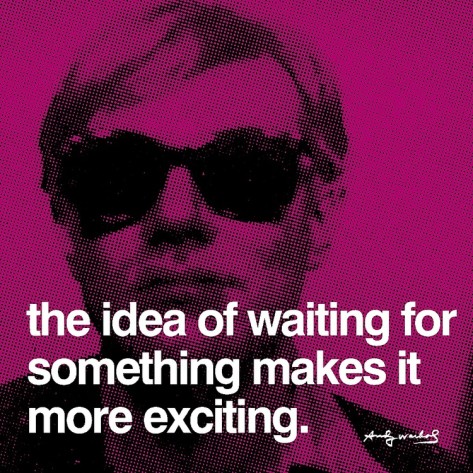
About waiting…

andy-warhol-waitingI get reminded in weird ways how old I am, sometimes. For instance, there was a discussion happening between some of my online acquaintances about Star Wars, specifically about the original movies (where young Luke Skywalker is the protagonist). I made a comment about what a freak I was considered to be by classmates because I had seen the show more than 13 times. And the comment made no sense to the people in the discussion.

So I had to explain that I was talking about when it first came out, and was only available in theatres. This was in 1977, when I was a teenager. Worse than that, it didn’t play in any of the theatres in the smallish town where I lived until about four or five months after it first came out. The closest place that had a big screen and a decent sound system where the movie was playing was more than an hour drive away—not only not in the same town were I lived, but not in the same state!

When you’re a high school student you don’t have a lot of disposable income, so the gas money and cost of tickets wasn’t a trivial expense. I carpooled (either using my old beater car or letting one of my friends drive) twelve times over the course of the first summer the film was out in order to see it. And then in the fall I went once to the truly crappy local theatre that finally got it, dragging a few friends I had never been able to talk into taking the longer trip.

Also at that time period, while home VCRs technically existed, they cost thousands of dollars and were huge, heavy things. Video rental stores didn’t become a common type of business for a few more years, when the technology got a little cheaper. And even then, the players were expensive enough that many people would rent both some movies and a machine from the store in order to have a movie night at home.

Cable television existed only in cities and larger towns. When cable first came to our small town, I was 19 or 20 years old, and it consisted of 15 regular channels, plus the premium channels of HBO or Showtime (Cinemax, Stars, and the like didn’t exist, yet). I write “or” because while very few people I knew had cable at all, most of those who did had only the 15 basic channels, and no one splurged on more than one movie channel. No one.

And, of course, DVDs literally didn’t exist, yet. Let alone the internet.

I had to wait three years before The Empire Strikes Back came out—by which time I was a freshmen in college. Then another three years after that before any of us got to see Return of the Jedi.

I saw all three of those movies, during their respective opening weeks, in the same big theatre in Beaverton, Oregon. It was like a religious pilgrimage for me, by then. I’d been hooked at 17 years old, and the passion still burned with the intensity of a billion suns when I was 23.

This is one of the reasons that, when I hear some of my friends complaining about how many months it will be before the new season of My Little Pony comes out, I don’t always give them as much sympathy as I probably ought.

On the other hand, I’m just as bad. The last episode of Justified season five aired eight months ago, in April, and I’ve been dying while waiting for season six to begin… which it will in January 2015. That’s less than 30 days from now. Inside, 23-year-old me is laughing so very hard at current me because I’m agonizing over having to wait merely months for the next chapter in a saga. And this is hardly the only series or movie that I have such lamentations about.

So, while part of me rolls my eyes at younger fans, another part of me is rolling my eyes at me, too.

Of course, we should remember that 173 years ago, back in 1841, people are said to have lined up for blocks in London waiting for a new edition of a weekly magazine called Master Humphrey’s Clock so they could read the next chapter of Charles Dickens’s The Old Curiosity Shop. Even more fun were the stories of people meeting English travelers disembarking from ocean liners in New York at the time, to ask whether Little Nell lived, since American publication of the stories was several weeks behind the British chapters.

As they say, times change, but human nature doesn’t.

Comedy reveals the truth

It’s less than a minute and a half, and well worth your time. A reminder of the real relationship between politicians, business, and the people—and also how good one particular show was sometimes capable of being.

Roseanne owns state rep on fair wages, taxes, labor rights, and plight of the middle class:

(If embedding doesn’t work, click here.)

Literary Crimes

maxresdefaultWhen I was 14 I started writing a mystery novel with perhaps supernatural overtones. I’d been writing stories for as long as I could scribble more-or-less recognizable words on paper, though by 14 I was typing on a big heavy typewriter at a decent clip.

My protagonist was a 12-year-old boy—for plot purposes I felt it was important to begin the story in the summer between his sixth and seventh grades at school. He lived in a small town that was an amalgam of all the small to medium-sized towns I’d lived in thus far.

My habit at the time was to write until I couldn’t think of what happened next (or my folks yelled at me to stop making all that clattering typing noise and go to bed). The next day I would read what I had written so far, and usually I could start typing away, writing the next scene and the next and so on.

So one afternoon, when I had several chapters finished and wasn’t sure what to do next, I re-read what I’d written thus far. It was all going well until I hit the last scene I’d written the night before… Continue reading Literary Crimes

(Un)real Characters

2bad57a909fd53708036ef02ae3ba068So I was scanning through my usual news sites a couple of weeks ago and saw a headline about the Guardians of the Galaxy that caught my eye. I’d already seen the movie the previous week, and had enjoyed it even more than I had anticipated. So I definitely went into the article with a bouncy fanboy attitude. The author talked about how the movie was better than he had expected, mentioned a few of the pros and cons of the overall story and construction, but then settled in to his main thesis: the characters audiences seemed most drawn to in the film were Rocket, the genetically-altered and cybernetically-enhanced raccoon, and Groot, a walking, (barely) talking tree—and the writer thought this was a bad thing.

He thought it was bad because those two characters are computer animated images, rather than being portrayed by human actors. He admitted that they were voiced by human actors, but “when pixels move us to tears more readily than actual people, that’s a problem.”

My pedantic side immediately wanted to post a comment that, since most theatres have made the switch to digital projection, every character in every movie people see in theatres are pixels rather than real—not to mention all the movies and series that people watch on TVs, computer monitors, phones, and tablets now. Even before digital movies, old-fashioned film wasn’t real people either, it was images projected on a screen by shining light through celluloid tinted with various chemicals.

All of that is missing a more fundamental point. None of the characters in films, plays, television series, et cetera, are real. They are all fictional characters being evoked by a combination of tricks and techniques of storytelling and acting.

I realize that I’m a bit biased, here. I have been a fan of comics from an early age. I grew up laughing at and following the adventures of Bugs Bunny, Daffy Duck, Yogi Bear, and dozens of other cartoon characters. I have edited and published a science fiction fanzine that features talking animals, the occasional human, and all sorts of aliens for nearly twenty years. I’m currently engaged in writing a series of fantasy novels set in a world populated by talking animals, dragons, ghouls, kitsune, and any number of other non-human creatures. For the last few years, I have awaited the unveiling of a new season of My Little Pony: Friendship Is Magic with as much anticipation as a new season of Doctor Who or White Collar.

So maybe I’m just a bit too far out from normal to be commenting on this. However, the author of that particular article is someone I’ve read before. He’s the regular movie reviewer for a news site I read just about every day. I’ve seen many of his previous movie reviews, some of which I agreed with, some that I haven’t. Like many movie reviewers, he approaches his critiques from a literary rather than visual arts point of view. He always talks about plot, themes, narrative flow, viewpoint, characterization, and dialog.

So it’s a little strange that someone who approaches movies from such a strong literary perspective can’t understand the true appeal of any character. Readers have been meeting, getting to know, and coming to love imaginary characters for as long as fiction has existed. Characters like Anne of Green Gables, Oliver Twist, Huck Finn, Sara Crewe, d’Artagnan (and his comrades Athos, Porthos, Aramis), Robin Hood, et cetera have been engaging readers for generations. For much of their history, those characters have been less than even pixels: people have read words on paper, and conjured the face, voice, and being of the character entirely in their imagination.

Yes, illustrated books, live theatre, and various recorded forms of movies and series have also breathed life into those imaginary characters, but those are all simply different forms of conveying and evoking the idea of the character in the minds of each of the viewers. It is still, ultimately, about the imagination of the audience embracing the story and the characters within it.

As a writer, I deal with imaginary characters constantly. My head is full of a mad assortment of characters, some of them characters I have created for my own stories, others are characters I have come to love (or love to hate) through stories created by other people. When I’m writing a story, my job is to try to evoke in the reader the story that I have imagined. An important part of that process is evoking characters that the reader will, at least temporarily, imagine as if they were real. And more importantly, will have feelings toward as if they were real.

That’s the entire point of art, to engage the audience, and make a connection between hearts and imaginations. And it doesn’t matter whether I’m telling a story verbally, in text, on stage, with painted images, or computer rendered animation. It doesn’t matter if the characters are named Jenny Nelson or Buffy Summers or Zoe Washburne or Applejack.

What matters is the story.

For at least a few minutes, can I make you care about what happens to these characters? Can I make you interested in how they got into the situation they find themselves in? Can I make you wonder what’s going to happen next? Can I so engage you that you can’t look away until you know how things turned out for the character?

Getting the audience engaged with the characters is never a bad thing. And if you think that some fictional characters are less “real” than others simply because of the medium through which the audience’s imagination is being engaged, then you don’t understand storytelling.

At all.

Confessions of a Re-blogger, part 2

I know a lot of people I follow on Tumblr have already reblogged this post Seanan McGuire put up this morning, but it hits on topics I have talked about, so:

Responding to this question: kerrykhat asked: What do you do when there’s an author you absolutely adore in a short story anthology, but there’s also an author that you don’t want to give money to under any circumstances?

Well, first, I remind myself that all the authors in that anthology have already been paid, and that the majority of anthologies never earn out or make any additional revenue for the authors inside. It’s a small thing, but it salves my conscience. Beyond that…

Let’s say there are three authors whose careers I monitor. Jan, who is an absolute favorite, whom I would follow to the ends of the earth. Pat, who stepped on my foot once at a con and didn’t say sorry, and who I consequentially avoid whenever it doesn’t inconvenience me. And Robin, who actively lobbies for causes I find repugnant, and flat-out says that my friends and family are perverts and freaks of nature for loving the people that we love. Now let’s say that there’s a new anthology containing all three people.

This is a problem for me, obviously. I want to read Jan’s story. More, I know Jan makes a lot of money from anthologies, and since I want Jan to keep getting those invitations, I don’t want to pirate the story. I’m okay with giving a little money to Pat; there’s no hatred there, just mild annoyance. But what about Robin? Robin’s an asshole and a bigot and I am really uncomfortable with the idea of forking over a penny.

This is my solution, which obviously is not perfect:

I buy the anthology. And then I take an exacto knife, and excise as much of Robin’s story as I can, slicing carefully one page at a time to prevent damaging the spine. If I’m lucky, Robin’s story doesn’t share any pages with the stories around it, and I can get the damn thing completely out. And then I mail that story to the publisher of the anthology, with a letter explaining that they almost lost my money because of Robin’s presence.

I am not advocating censorship. Authors are people too, and they’re going to live their lives as they see fit. But I am saying that you have a right to live your life as you see fit, too, and that if people are going to put an author who says your life is wrong in an anthology, you have a right to comment on it.

Also: please don’t yell at authors who share an anthology with Robin, because odds are they had no input at all on who got invited. We’re all just trying to put food on the table however we can.

I think this is a great idea. I may have to go find some anthologies to buy paper copies of just for this purpose, now…

Note: I can’t take credit for the above idea. Neither should anyone conclude from my re-blogging this that she agrees or endorses anything I may have previously blogged about authors who I refuse to give money to and that I discourage other people from giving money to because of their decades of advocacy against gay rights.

My endorsement of her suggestion is simple that, an endorsement of her idea of one way to support writers you like, while still commenting on those who contribute to oppression.

(I endorse her other writing, too. You can follow Seanan McGuire’s blog here, learn about her books here and buy them here.)