Tag Archives: memories

…on my mind…

Just a bit over 26 years ago I met a boy…

He was 25 years old, so not really a boy, but then I was only 29. I wasn’t completely out of the closet, yet. I regularly went dancing at a gay country bar, and I had just started singing with a newly formed lesbian & gay chorus, so I wasn’t deeply closeted, either. But as far as I knew at the time, other than one cousin none of my family knew I was gay. And only a few of my long-term friends knew.

Ray and I met online on a gay BBS system, and after lots of chatting over several weeks, had finally agreed to meet at a restaurant. I had trouble finding him, because he forgot to tell me that he’d recently dyed his hair. I wasn’t looking for a redhead.

I suspected he was a keeper when I saw the small bookcase beside his bed. I knew he was a keeper when we talked about one particular worn hardback. Not because of which book it was, but because he had a favorite book that he re-read several times a year. And talking about it made him start talking very animatedly about a lot of his other favorite books.

We’d been officially dating for a few months when he first told me that he liked to write. He hadn’t mentioned it before because I earned my living as a technical writer, and while my fiction had mostly been published in small, non-paying ‘zines, he was a little nervous about showing me his work. Turned out he’d never shown anyone his writing before. He had a bit of an inferiority complex about his education: he’d dropped out of high school after his father died to go to work to help his mom support his younger siblings. He had since gotten his GED and taken some community college classes, but he wasn’t confident in his writing skills.

I asked him if he wanted my honest opinion. I admit I was a bit nervous, too. What if I hated his work and couldn’t hide it? Fortunately, the first story he showed me wasn’t bad. It needed work. But he was happy to receive critiques and borrow some of my books about the writing process.

He kept working at it. Revising, writing, reading. He started occasionally sharing his work with other people. He even managed to get a couple of stories published in small ‘zines.

Then he got sick. When the doctors first told us he had two years or less to live, I refused to believe it. I was certain we were going to beat this. For the next few years there were lots of tests, treatments, a few scary visits to the ER, and then chemotherapy.

One night just over three years after they had told us he had less than two years to live (seven years and three months after our first date) he had a seizure and fell into a coma. I spent the next several days sitting beside his bed in an intensive care unit, waiting for him to wake up. But it wasn’t to be.

During the weeks afterward I went through his things, with help from his mother and sister. In the cabinet under the night table on his side of the bed, inside an envelope that said, “No Peeking!” I found a small package wrapped with Christmas paper, with a gift tag that said, “To Gene, Love Ray.” I didn’t open it. But the package was the size of a paperback book. And in another envelope in the same cabinet were two identical copies of a paperback anthology, along with some correspondence from the editor of the anthology.

He had sold two short stories that were included in that anthology. He’d sold them the year before, and had received copies of the book nine months before he died. And he’d never said a word to me about it. He’d wanted it to be a surprise.

He had a deadline for another anthology with the same editor coming up. I couldn’t figure out which of the stories he had on his computer he had intended to submit. I wrote to the editor and explained that Ray had died. The editor sent a very thoughtful condolence note back.

Ray had made his first professional fiction sale—two stories! —a mere six years after shyly admitting he was afraid to show his work to other people, but didn’t tell me because he wanted to see the expression on my face when I opened the package Christmas morning. I wish I’d known. I wish I’d been able to tell him how proud I was of him. I wish I’d been able to grab a Sharpie, hold the book out to him, and ask for his autograph.

Make no mistake, I love my husband, Michael. Every time I see his smile, I feel like the luckiest man in world. But I loved Ray, too. I miss him. I wish he had lived to see the repeal of Don’t Ask, Don’t Tell, to see the citizens of our state vote to give same-sex couples the right to marry, to see the Supreme Court overturn the Defense of Marriage Act, and of course to see that same court make marriage equality the law of the land.

This week Michael and I are going through our things, hauling stuff to Goodwill and so forth. We’re both packrats from long lines of packrats, so we have to do these purges every year or so. I tend to hang onto things, and I get overly sentimental over a lot of those things. I had a couple of rough moments Monday. One was when I came across the book with Ray’s stories on a shelf. Another was when I was pulling plushies from another shelf and found a small, peach-colored Teddy Bear. Only a few weeks after we started dating, Ray had to fly to Georgia for a business obligation. He picked up the teddy bear for me and a coffee mug for himself in a souvenir shop. Yes, 26 years later, I still have the “Georgia On My Mind” mug, and I still think of it as Ray’s mug.
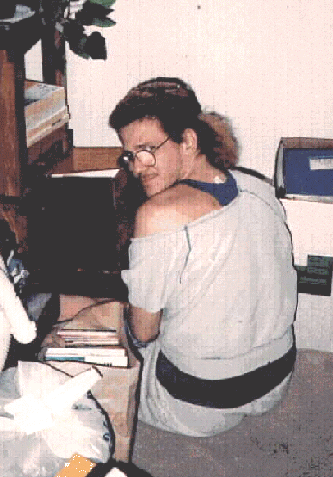
Ray unpacking after we moved into our second apartment.
If he’d lived, today would have been Ray’s 52nd birthday. That’s right, our birthdays were only two days apart. We usually wound up celebrating both birthdays together with his family, and then would celebrate just the two of us on our actual birthdays. I assume that that is the reason that I start getting a bit depressed and moody every September. I can’t think about my birthday coming up without thinking about his birthday that we don’t get to celebrate.

I would love to see his goofy grin over a cake covered with candles at least one more time.

Uniques and Reborns, Computers and Telepaths – more of why I love sf/f

Cover of Arthur C. Clarke's -The City and the Stars- (Click to embiggen)
Cover of Arthur C. Clarke’s -The City and the Stars- (Click to embiggen)
I think I was 16 when I found a battered paperback copy of Arthur C. Clarke’s The City and the Stars in a used bookstore. This was not my first Clarke novel. That had been 2001: A Space Odyssey, which I had found in a library a few years before. I wouldn’t see the movie until many years later. I had also read many of Clarke’s short stories, so I was familiar with his work and his reputation as one of the best.

I had never heard of this particular novel, but the description on the back cover was intriguing, and since he had such a reputation, I felt almost obligated to read more of his work.

The story is set a billion years in the future, in the city of Diaspar, which is the last home of mankind. Humans are effectively immortal. Individuals are “born” nearly full grown in essentially replicators, and they live in the perfect unchanging city creating art and exploring philosophy or literature or poetry for hundreds or even thousands of years, until they decide to rest, at which point their memories are transferred back to the central memory banks and their bodies un-replicated. Until some random interval later when the computer will determine they need to be reborn again.

Into this world is born our protagonist, Alvin, who has no memory of a past life… Continue reading Uniques and Reborns, Computers and Telepaths – more of why I love sf/f

Confessions of a keyboard addict

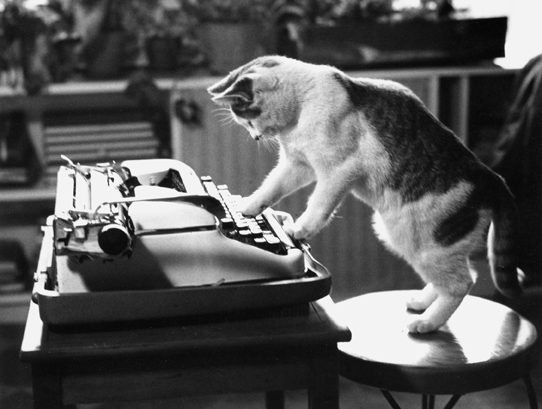
Cat with a manual typewriter.I learned to type on my mom’s Easter pink Smith-Corona Silent-Super typewriter. I was ten years old, when Mom decided that I since I couldn’t keep my hands off it, she should teach me the proper way to use it. So she set me up with her old How to Type book it wasn’t long before I was whizzing along, hitting about 60 words per minute on the little mechanical wonder.

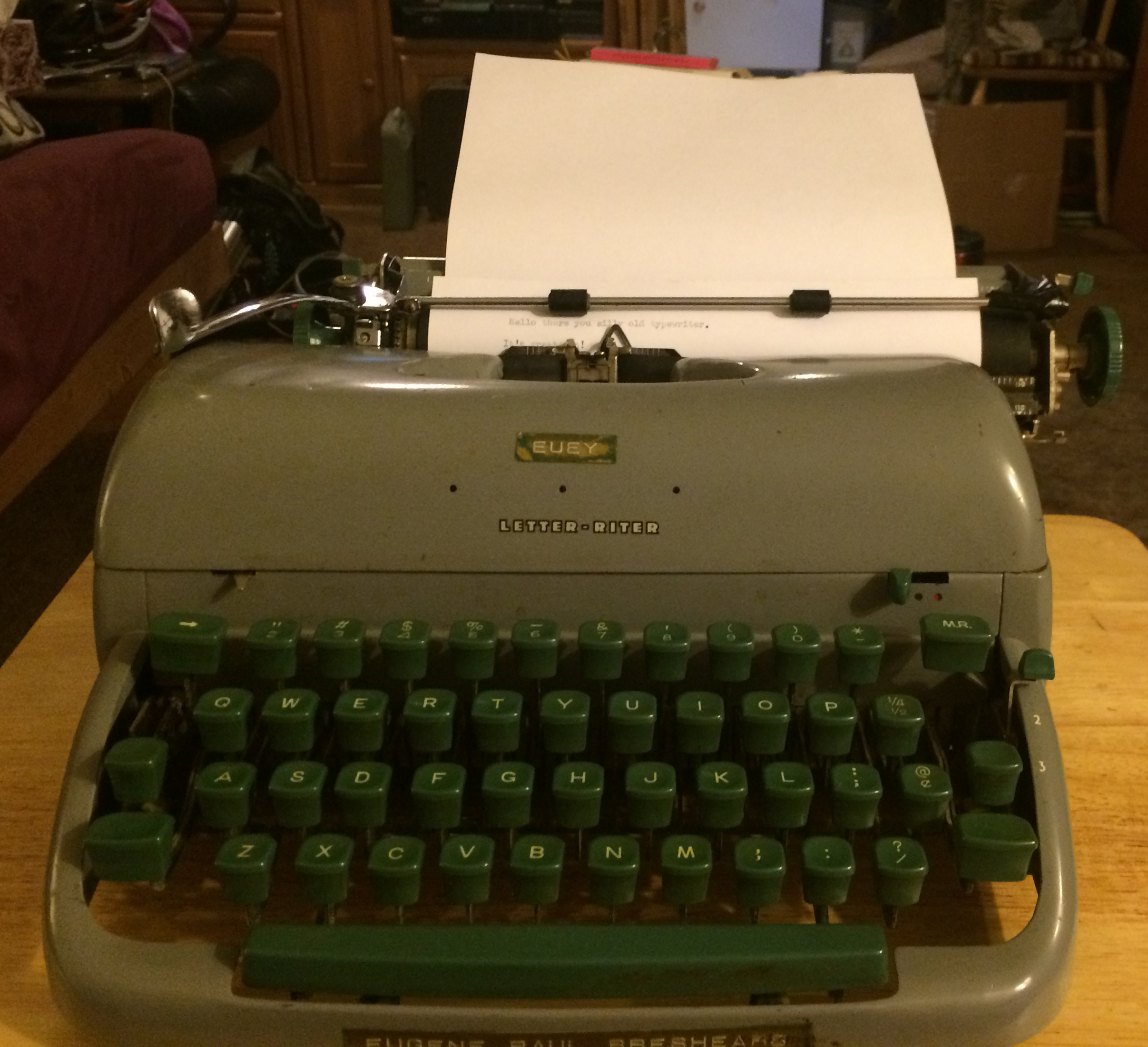
When I was twelve, my paternal grandmother gave me her 1952 Remington Letter-Riter. It was a much heavier typewriter than the Silent-Super in every way. Pushing the keys took more effort, and the typewriter was built like a tank. It also had a slightly different keyboard arrangement, more traditional than the Silent-Super. Older mechanical typewriters didn’t have a 1 (one) key. If you needed to type a 1, you’d use a lowercase l (el) instead. There also wasn’t an exclamation point. To type !, you would type a period, then backspace and type an apostrophe. There was no + (plus) sign or = (equals) sign, though it did have a key for ½ (half) and ¼ (quarter).

This is the 1952 Remington that once belonged to my grandmother, and then has been mine since about 1973 (click to embiggen).
If you click on the image, you might also notice that the symbols on the top of the number keys are different than a modern computer keyboard, as well. You got quotation marks by pressing shift-2 instead of being on its own key, while the apostrophe was shift-8, and underscore was shift-6. The @ symbol and ¢ (cents) sign were on their own key, over where modern computer keyboards usually put the quotation and apostrophe key.

This is not the Silent-Super I learned on, as Mom’s was lost under less than pleasant circumstances. This is one my hubby bought me for my birthday that I’m still restoring. (Click to embiggen)
The Silent-Super had a 1-key and exclamation point. The arrangement was otherwise the same, though the size and shapes of the keys—particularly the tab, backspace, and shift—were different. My grandmother had a newer typewriter that had a lot of special keys, such as a £ (pound currency) symbol, a ÷ (division) symbol, + and =, (greater-than) and even a \ (backslash). She was an accountant and that typewriter was aimed at financial offices. Anyway, I also occasionally typed on her machine, with its own slightly different layout, and I could got just as fast on any of them.

In high school I finally took an actual typing class, which was the first time I typed on an IBM Selectric keyboard. It wasn’t a manual typewrite. It was still mechanical in that a physical object had to strike an inked ribbon and sheet of paper to make the letters, but the force was delivered by an electric motor instead of my fingers. It was much more like a computer keyboard in that way. The amount of force to press the key was practically nothing compared to the manual typewriter. It is still the funniest thing to see when I run a Writers Round Robin event at a convention: people too young to have used a typewriter really freak out at how hard you have to press the keys to make the letters appear.

I didn’t need the typing class to learn to type, I was already proficient at touch typing, but back in the 70s you actually had to have passed a typing class to get into some journalism programs and the like when you moved on to university, so I took the class for the credit. The teacher was a little shocked with I did more than 100 words per minute on the first speed test. Since it was early in the course, I wasn’t typing real words, I was just typing groups of four letters from the home row from a slide she was showing us, something like: “jfjfj kkkk dddd jkjkj fdfd jkl; fdsa”

I told her I already knew how to type, so she grabbed a sample letter to copy and made me take the test again, this time reading the letter and transcribing it. I still was over 100 words per minute.

Over the years I’ve gotten used to various computer keyboards. The old clack-clack IBM Model M that many people still love, being just one of many. And many of them have some keys in unusual places. Some have keys that others don’t. And I take to all of them pretty quickly. I would be slightly surprised when some people complained about a couple of moved keys. It usually took me only a few minutes to acclimate to a new layout.

I was a little surprised, when my husband finally got me to use an iPod Touch, at how quickly I adapted to thumb-typing on a small keyboard where I couldn’t feel the keys at all. My favorite app for a long time was WriteRoom for iOS (it had its own automatic cloud sync back before services like Dropbox were around), and I would write scenes on the bus on my way to work each morning. One time while I was doing that, a bunch of the bus passengers all started turning around and staring at me. So much that I noticed and looked up.

It took me a couple of minutes to figure out what had happened. Somehow the settings had changed, and the iPod was making key noises through its speaker. I had my headphones on playing musc (also from the iPod), and couldn’t hear the keyclicks. I found the setting and turned it off. I said, “Sorry about that” sheepishly. One of the other passengers chuckled and said, “I just never heard anyone text that fast and that long before!” So I explained that I was actually writing a book. “On your phone?” And then I had to explain that it wasn’t even a phone.

It shouldn’t have surprised me, some years later, at how quickly I took to the iPad’s virtual keyboard. When Michael and I bought our first iPad (the iPad 2, we waited for the second model), we weren’t certain we would actually use it and not treat it as a temporary toy. So we only bought one to share. I would take it to work one day, he would take it the next, and so on. It wasn’t long before it was clear that both of us needed our own.

At the time, my employer-provided Dell laptop had become a faux laptop. The battery wouldn’t hold a charge for more than about 10 minutes (we never did get new batteries as promised, of course). So it was useless for taking to meetings. And I frequently need to take notes at meetings or look things up to answer questions, so that was a bummer. Except I started taking the iPad, instead, and I could look up some work things without even logging in a VM. But the part that surprised me was how easy I switched to typing long, detailed notes during the meeting on the virtual keyboard. I do find it slightly annoying switching between numbers, other symbols, and back to letters. Mostly because the key to move from numbers to symbols is not in the same location as the key to move from letters to numbers. But otherwise, I’m okay typing on the virtual keyboard.

I do have a bluetooth keyboard that I use if I know I’m going to do a really long typing session. My hubby gave me a nice solar-powered one a few years ago. It is really nice, but it requires me carrying around a bag, since it is bigger than the iPad.

So I’ve been looking at keyboard cases off and on. My husband has had a couple of them. I think his favorite is a fairly high end Logitech. I’ve tried his, and they’re pretty good.

My new keyboard case. Yes, the fact that the backlight could be set to purple was a selling point.
But I wasn’t convinced that I should spend the money on one for myself. But I keep wishing when I’m at conventions and similar events, that I had a more portable version of my Bluetooth keyboard. Then last week, I noticed that one of the models I’ve had in my private wishlist had come down in price a bit, and NorWesCon is coming up, so I bought it. It isn’t bad. Several reviews of it complained about the backspace being so tiny and the placement of a few other keys, but it only took me three tweets before I was hitting it correctly.

The keyboard itself feels fairly solid, but the case as a whole is a little flimsy. I suspect that if I carried it back and forth to the office in my backpack with this case that the keyboard would get enough wear and tear to account for the small number of reviews complaining about the keyboard dying after only a few months. I don’t currently plan to carry the iPad in the case most of the time. I can do the type of typing/note taking I do on the iPad at work just as easily with the virtual keyboard. It is definitely easier to type on than the virtual keyboard, and the keys feel nice enough. Not as good as my solar Logitech, but perfectly usuable.

It’s not as if I don’t already have multiple keyboards for just about every device. Because I am a keyboard addict.

Contagion from space – more of why I love sf/f

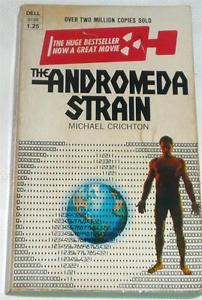
Cover of the first paperback edition of The Andromeda Strain, by Michael Crichton.
Cover of the first paperback edition of The Andromeda Strain, by Michael Crichton. (Click to embiggen)
The first time I remember hearing about The Andromeda Strain was while reading a movie theatre calendar. We were living in a small town in Utah which didn’t have a movie theatre of its own, but we were about an hour drive away from the small Colorado town where I had been born and my grandparents still lived. And often when we visited I would look at the monthly theatre calendar which was distributed free with the local weekly paper. Sometimes I would attempt to talk my parents into letting me come back on a particular weekend to go to the movie.

I think it was the fall of 1971 (I would have been eleven) when I saw the listing, and the name and very short description had me intrigued. Unfortunately, I wasn’t able to convince my parents to let me have the movie trip.

About a year later The Andromeda Strain was broadcast on network TV, probably as a movie of the week (that was a thing back then), and for whatever reason, we didn’t watch the first part of the movie. Probably it conflicted with a show my dad liked, so we watched the other show, first, then switched channels and watched the last half of the movie. So I was a bit confused, but it was still pretty exciting. The last part of the film was very tense and entertaining, even without the beginning.

The following week in school, everyone was talking about the movie. It was one of the few times that I remember kids who usually didn’t know a thing about science fiction talking about a sci fi plot.

Not long afterward, I happened across a battered paperback copy of Michael Crichton’s novel upon which the movie was based. I read it in a single sitting. One of the things that amazed me when I finished was how closely the half of the movie I saw followed the latter portion of the book. My previous experience of comparing movies to the books they were based on was that the movie often bore virtually no resemblance to the book.

The story of the Andromeda Strain is that a space probe is sent into low earth orbit and brought back down. It lands in a small, isolated town, and by the time the retrieval team arrives to pick it up, it seems that every inhabitant of the town has been killed. The retrieval team dies will communicating with their government superiors, and a Wildfire alert is activated. Wildfire is a codename for protocol government scientists have put together to respond to a biological threat from space. A team of scientists are pulled from their regular jobs and rushed to a secret underground facility. Two of the scientists go into the town in hazmat suits, find the satellite, and also find two survivors, an old man and a crying infant. The bulk of the story deals with how the scientists figure out what the infection is, and why those two very different characters are immune.

Before they have quite figured everything out, the extraterrestrial organism (which is neither a virus nor a bacterium) mutates and starts eating the plastics and rubber seals throughout the lab. This sets off an alarm and starts an automatic countdown on a nuclear self-destruct device. One of the things the scientists have determined about the organism is that it is not only immune to radiation, but will actually thrive in the explosion, and probably destroy all life on the planet. Thus we get to the tense ending where the characters are trying to stop the self-destruct and find a way to neutralize the infection.

One of the things that disappointed me about the book was that one of the most interesting characters in the movie, Dr. Ruth Leavitt, was a much less interesting man, Dr. Paul Leavitt, in the novel. I’m not sure if the character in the movie was more interesting because the actress, Kate Reid, played a very believable character, or if the character was just less interesting in the original.

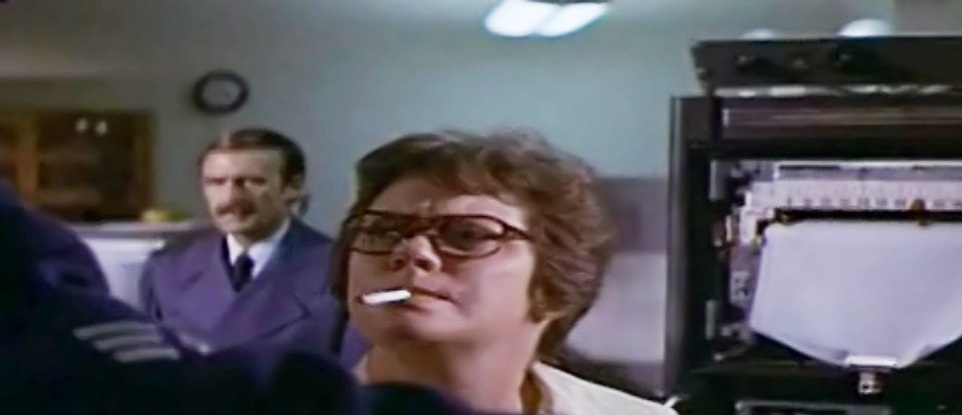
Kate Reid playing clinical microbiologist, Dr. Ruth Leavitt in the Andromeda Strain © Universal Pictures
Some time later, when I got to watch the movie all the way through for the first time, I was even more impressed with Reid’s character and the way the filmmakers used her. It was far more common for the token female character in either thrillers or sci fi films to be played by a young, glamorous actress, who was there more as eye-candy than to actually participate in the story. Leavitt wasn’t like that. There are some, I’m sure, who will argue that the filmmakers went overboard, putting Reid in those large unflattering glasses, and generally looking dowdy. But the filmmakers didn’t dress up any of the male scientists any differently. Even the casual way she smoked her cigarettes, never doing any of those delicate movie star poses that were more common when actresses were shown smoking at the time, just fit with the character’s personality.

I re-read The Andromeda Strain at least once more after seeing the movie all the way through, and I still found Reid’s version of the Leavitt character more interesting. And this was decades before I’d ever heard of the Bechdel Test!

The Andromeda Strain was a bestseller, and set Michael Crichton on the path of future success that would lead to, among other things, Jurassic Park. The movie was only a moderate success, which is too bad, because it was really well done. The science included was, for the most part, plausible at time. In fact, nothing in the film required any sort of advancement of technology beyond what we had available. Exactly how the life form could convert energy to matter was the only bit of dubious handwaving to speak of. It wasn’t the only time that the movie version of a science fiction story was better than the book, but I think it might have been the first time that I noticed it.

Chariots of the Who? – part two

The cover of the 1973 paperback edition, as the drivel became a blockbuster.

I posted a bit of a ramble about how I first encountered the book Chariots of the Gods? back in 1971 and how by 1972 the book had infected the collective consciousness enough that multiple evangelical pastors were feeling the need to preach sermons against it. The first U.S. paperback edition was published either just before or during my fourth grade in elementary school. At that point, in the U.S., the book had not yet become a bestseller. So the ancient alien ideas, and specific references to Erich von Däniken’s hack history theories about how aliens had influenced the course of human history were just trickling into my life.

I promised a weird tale involving phosphorescent chalk and lime green three-piece suits, and that’s coming, I promise! So, fast forward to 1973… Continue reading Chariots of the Who? – part two

Chariots of the Who? – part one

Cover of the 1970 first American published paperback edition. Click to embiggen.
It’s all Solarbird’s fault. In the linked post, she plots possible family tree of the original Battlestar Galactica mythology, including a reference to Chariots of the Gods?, and in the course of typing a short comment about when Chariots… the book came out, and the weird in-roads it made into pop culture, I realized there’s at least one weird section of my evangelical fundamentalist Southern Baptist childhood I’ve never written about: the years that evangelical revival preachers felt compelled to make regular sermons deconstructing Chariots of the Gods.

It’s a strange tale involving a hack writer’s bad grasp of history and half-baked sci fi sensibilites, rural American evangelicals’ even shakier grasp of history and science, a Mormon community invaded by mostly southern oil worker families, the tent revival epidemic of the 1800s, black lights and phosphorescent chalk, one queer sci fi nerd, and a three-piece suit the color of lime sherbet. It’s a bit convoluted… Continue reading Chariots of the Who? – part one

Hokey Religions and Ancient Weapons – more of why I love sf/f

"Hokey religions and ancient weapons are no match for a good blaster at your side, kid." Harrison Ford as Han Solo in the original Star Wars.
Harrison Ford as Han Solo in the original Star Wars. (Click to embiggen)
I was a high school student in the small town of Longview when Star Wars first came out. I saw it on opening night, thanks to a couple of older friends who were even bigger science fiction fans. They drove me down to Beaverton, Oregon, (which was the closest place with a full-sized wide screen and Dolby sound at the time) on opening night, insisting that I’d love this film I had never heard of.

They were right. A lot of people loved it.

It wasn’t really original. The movie was a loving homage to the pulp magazine adventure stories and serial movies of the 30s and 40s. It didn’t have anything profoundly new philosophically to say. The special effects were better than we were used to seeing, but otherwise it just told an old-fashioned story. You knew who the good guys and the bad guys were. The heroes were confronted with a series of obstacles to overcome, and they worked hard to win the day.

In that way, it was an oasis in the desert. Over a decade before the movie came out, “legitimate literature” had embraced the modernist school. Narrative (storytelling) was considered “unrealistic” and “naïve.” Modernist writers abandoned plot and character development for style and grand themes. Resolution was replaced with ambiguity.

That listless ambiguity had infected a lot of pop culture. To be fair, in the U.S. at least we had good reason to be despondent. The economy had tanked. Inflation was out of control, lots of people were out of work, and even more were under-employed. We had finally admitted what a pointless quagmire the war in Viet Nam had become, so closely on the heels of the national embarrassment of the Watergate scandal and the ouster of President Nixon (itself following not the long after Vice President Agnew had resigned and pled guilty to tax evasion charges). And victories of the civil rights movement seemed to have produced more backlash than noticeable improvements in the lives of ordinary people.

By 1977 most of popular culture had been tainted by modernist angst. Many of the films and novels of the day accentuated style, mood, and setting, and had endings that left the audience wondering what had happened.
Star Wars brought plot, heroes, and villains back in style. And none too soon, in my opinion. There’s something comforting and satisfying about a story that begins with a problem, builds to a climax, and resolves things in the end.

Not to say that some of the other types of stories aren’t fun from time to time.

Star Wars was the perfect combination of fun, adventure, struggle against a seemingly unbeatable foe, and triumph. With space ships and blasters and energy swords thrown in for good measure. It’s not really science fiction, because the attempts it makes at science are laughably wrong. It follows the conventions of 30s science fiction in that regard. It’s space opera, following the rules of epic fantasy with the accoutrements of science fiction. And there’s nothing wrong with that.

The Empire Strikes Back was a much darker story, and as a middle chapter in a continuing tale, its ending wasn’t triumphant. But it still told a really good tale. There were resolution of some issues, character arcs advanced, and the open issues were daunting problems, but with a hope that they could be resolved. It was a superior movie to Star Wars in every way, but was still firmly built from the foundation laid by the previous movie. Return of the Jedi was fun—flawed, but fun. It wasn’t as good a move as Empire, but it still worked, and it paid off in at least an acceptable way on all of the cliffhangers of the previous films. Don’t get me wrong, some of the pay-offs were fantastic, I’m just admitting that not all were perfect.

Star Wars (which I hate referring to as “Episode IV – A New Hope”) still remains an especially bright shining beacon in my personal firmament. It made me love the idea of science fiction and fantasy in movies, again. It gave me a new celebrity crush (if you were a queer boy watching the first film and didn’t swoon for Han Solo I don’t know what’s wrong with you!). It gave me characters to aspire to be like: Obi Wan, Luke, Leia (yes, Leia! Seriously! Go watch those scenes with Leia and Darth, or the moment she takes the blaster away from one of the men, shoots open a vent cover, and says, “Someone has to save our skins. Into the garbage chute, fly boy!” and tell me she isn’t bad ass!)…

I love Star Wars. I loved it so much that the first summer it was in theatres, I drove to a theatre in another state 13 times to re-watch it. Not to mention seeing it at a local theatre, later watching it on cable, and eventually on tape again and again. It was a life changing experience.

But I must admit that the modernists were right in some ways. The traditional narrative form is seldom the way real life works out. The difference between real life and fiction is that fiction has to make sense. In real life, we don’t always get the clear-cut endings where the heroes defeat the villains and go on to live happily ever after:

  • The friend who drove that night when I first saw Star Wars, 38 years ago, is dead. James Curtis Bruce died from complications of AIDS at the age of 36.
  • Another friend, who drove us down to see the opening of Empire, has also passed away. Lawrence Lee Church died of an anueurysm at the age of 34.

I had admired and looked up to both of them as “big brothers” during a very important part of my life. Jim was a lot like the character of Han Solo, while Larry had more in common with Yoda.

I miss them both.

Sometimes we all wish that life was more like a good, fun movie.

Monsters Are People, Too – more of why I love sf/f

Promotional photo for the Munsters,
Promotional photo for the Munsters, © Universal Studios and CBS.
The Munsters premiered on CBS the night before my fourth birthday. I don’t remember if we watched it from the beginning. I’m fairly certain we didn’t watch it the first season because the first few months it was up against the Flintstones, and then Jonny Quest moved to that time slot. I suspect we did watch it a few times, and for a while during season two, until Batman! premiered with its twice-a-week format one of which was against the Munsters.

Like a lot of other genre-related shows, The Munsters went into syndication fairly quickly after being canceled, and promptly gained loyal audiences outside of primetime. I suspect most of my memories of the show are from this era… Continue reading Monsters Are People, Too – more of why I love sf/f

Outgrown?

Teen-ager leaning against a "You must be this tall to go on this ride" sign.
At a Six Flags theme park. I was 19 years old.
One of my unpublished goals last year was to re-read a bunch of books by one of my favorite authors from my middle school years. One of her books I have re-read again and again and again over the years since, but there were a lot of her other books that I remember liking quite well that I haven’t read since my late teens.

While several of her books are grouped as series, she didn’t write them in chronological order. She would write stories about the children of characters from her earlier books, for instance, and then decide to go back and write a story about some of the original supporting characters before any of those second or third generation kids had been born. So I was also going to try to read the series in the order of the events depicted within the stories.

The first one was easy to read… Continue reading Outgrown?

What do you mean, “real” father?

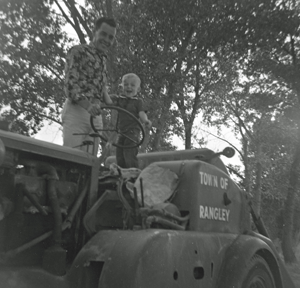
A man and a toddler stand on a half-disassembled utility vehicle under trees.
I’m the kid in this picture. The man standing beside me on the old street-sweeper is my mom’s biological father, who is not my grandfather.
I’m the first to admit that I have more than a few buttons that people can push to send me off on a long rant. One of them is the use of the term “real father” (or mother, or virtually any other familial designator), particularly when it is used to refer to someone’s biological-but-absentee relative. And sometimes I don’t just rant, sometimes I’m barely suppressing an urge to punch someone in the mouth over the use of the phrase. More than a little of the blame for that irrational reaction rests solidly at the feet of the man pictured here with a very young me. A man named Ralph.

The story can get a little convoluted, so I’m going to first sum-up, then unpack a bit as I also explain why I get so ticked-off about the use of the phrase “real father.”… Continue reading What do you mean, “real” father?