The last several weeks have not been good on the mood front.
At all.
When the iPhone was first officially announced (in 2007), I grumbled a lot. Some of my friends took issue with my grumbling, and I had to explain that I wasn’t angry at Apple, nor was I saying the iPhone was a bad idea. I was irritated at a lot of the technical press who were elaborating (incorrectly) on some parts of the news. And I was angry at the executives and processes at the company that owned my employer at the time, and another company that we were working with on a joint project.
I was angry because if they hadn’t thrown so many obstacles in our way, a phone we had been working on for a few years would have been released before the iPhone. Don’t take me wrong, the iPhone would have still leapfrogged over us, but if we’d released it when originally planned, we would have been just a competitor at a slight disadvantage. Because of the delays, the soonest we could possibly release it would make our independently developed product look like a quick attempt to copy some of the iPhone’s features.
But the story begins more than a decade earlier than that… Continue reading While we’re on the subject of smart phones…
I attended a Methodist university that had rules calling for expulsion for, among other things, being an “unrepentant homosexual.” At the time I enrolled (back in the mid-1980s), I was still struggling with my sexual identity—I was trying to convince myself that I was bi, or if not, then maybe I could live my life as asexual.
Being in the closet was a survival necessity in my day-to-day life back then. Almost everyone that I knew, whether through school, church, or just in the community, thought that being gay was inherently wrong. The state-approved high school health class text had a whole chapter on abnormal sexuality, and it described kinky straight sex, homosexuality, pedophilia, and necrophilia as simply different stages of the same psychological disease, for goodness sake!
I’d seen high school classmates kicked out of school, then sent out of town by their shamed family after rumors circulated that they had been caught having gay sex, as well.
Whether one of the colleges I was applying to had harsher anti-gay rules than another didn’t seem like a significant issue.
So, yes, I have to confess that I applied to a university fully aware that not only were my religious beliefs not very closely aligned with theirs, but several things I believed were actually violations of their rules and code of conduct.
But that’s only the beginning of the story…
When I was a kid, just about every metropolitan area in the U.S. had at least one local TV station showing some sort of monster/mystery/sci-fi/horror movie program every week. Many of them ran on Friday nights, after the local evening news ended. A few ran on Saturday evenings, and fewer still on Saturday afternoons. And something that a lot of those shows had in common is that there was a host: a person who usually was dressed up as some sort of monster or other stock character, who would introduce the show, possibly banter with a sidekick, or otherwise provide a bit of color commentary to the proceedings.
Some people operate under the impression that the first horror host was Elvira, Mistress of the Dark (no, she didn’t begin hosting until 1981). Slightly more informed people point to Bob Wilkins, who hosted Creature Features on a couple of different Bay Area channels from 1971 to 1984.
Well-informed people aware that all of them were preceded by some years by Vampira (1954-56), who later tried to sue Elvira for stealing her schtick. [Given that the actress who played Vampira had been working with the station in ’81 and was to be an executive producer of the show that became Elvira’s show, and she left in a dispute over the casting of the host, you can understand.]
A few years after Vampira’s show went off the air (it was aired live, and virtually no footage remains), Screen Gems put together a package of 52 horror films and made them available for syndication. Stations all over the country began showing their own weekly horror shows under titles such as Shock Theatre, Nightmare Theatre, Sinister Cinema, Saturday Chiller, and so on. The shows were usually broadcast on either Friday or Saturday night, after the evening news.
One reason that every station that carried the show had its own host was simply technological. In the late 50s (and for some time after), the way non-network syndication worked involved physically shipping cannisters of film (and later videotape) back and forth. It worked a lot like the non-streaming version of Netflix. A station would subscribe to the show, the syndicator would ship movies out to the subscribing stations. After the station showed the film(s), they would ship them back to the syndicator, who would ship them to another station.
My understanding is that they shipped out four or five movies at a time, and that as long as the station paid their subscription fees, they didn’t wait until the last set had been shipped back before sending the next.
In this case, Screen Gems just provided the movies themselves. Some location stations just ran them with, at most, a voice-over announcer. Other stations came up with their own shows, inspired originally by Vampira.
During the years I was old enough to be allowed to stay up and watch such things, we were living in various small towns in Utah and northwestern Colorado, and one of the stations we got was KCPX channel 4 out of Salt Lake City, where each Friday night brought us Nightmare Theatre.
For a few years it went by the name of The 10:20 Double Nightmare, because it was a double feature and it started at 10:20pm as soon as the evening news ended. I remember that phase only because sometimes my parents would let me stay up late enough to watch the first movie, but I wasn’t supposed to watch the second. By the time I was allowed to stay up as late as I wanted on Fridays, the local evening news went all the way until 10:30, and the show had reverted by to a single movie.
Nightmare Theatre was hosted, during that period, by Dr. Volapuk. Which is to say that a man wearing a vaguely Dracula-like suit and cape, and a really awful rubber ghoul mask, would come out of the shadows, introduce the movie, and make a lot of bad jokes. He would make more bad jokes at the commercial breaks. Occasionally he would impart a bit of trivia related to the movies. At the end of the show, he would give a preview of the next week’s movie, and then end with his traditional sign-off, “I, Dr. Volapuk, have been happy to be your host tonight. Remember, Volapuk spelled backwards is cup-of-love. So in your nightmares tonight, dream of me…” and then he would laugh maniacally.
No, I have no idea what all that cup-of-love business was supposed to mean.
I didn’t know, at the time, that the actor in the mask was also the guy who dressed up as Fireman Frank every morning to host the cartoon show on the same station.
Nightmare Theatre showed a lot of the old Universal Monster movies (Frankenstein Meets the Wolf Man, Son of Dracula, Werewolf of London, The Mummy’s Hand, and so on), but also a lot of the Japanese kaiju genre of moves (Mothra, Godzilla Raids Again, War of the Gargantuas).
A lot of the nerdy interest in such shows got re-focused on newer things when Star Wars came out and kicked off a bunch of higher quality films of the fantastic. Relatively cheap high quality satellite feeds and other cable television technologies replaced the old model of shipping film around, so shows such as Elvira’s Movie Macabre, Mystery Science Theater 3000, or Cinema Insomnia could be produced in one place and seen in the niche of each market. Which has put stake through the heart of most of the local horror hosts.
All those Friday nights that I stayed up to watch those movies is probably why I often still get a hankering on Fridays for some cheesy sci fi or similar films.
Wanna join me?
When I wrote about the inaccuracy of the “You weren’t promised flying cars, you were promised an oppressive cyberpunk dystopia” meme, I elided over a few things. One of which is our collective tendency to misremember and oversimplify.
The flying cars vs cyberpunk dystopia dichotomy is a great example. Given how many friends felt the need to point out to me that Blade Runner, clearly depicting a cyberpunk dystopia, also had flying cars, I’m not the only one to notice this oversimplification. Flying cars and dystopias are not mutually exclusive.
I chose to into interpret “flying cars” as short hand for “utopian future which includes flying cars,” which is why I kept referring to a “flying car utopia” throughout the post. Since “oppresive cyberpunk dystopia” was clearly presented in the original meme as a contrast, I didn’t think it was much of a stretch to assume they meant the two choices as mutually exclusive notions of the future.
The issue I focused on was the age which the meme asserted one must be to have been “promised” the one over the other. I didn’t talk about what prompted so many people to think that the age assertion was reasonable.
The clear implication of choosing 60 as the cut-off was that all that optimisim about the future was only happening in the 1950s. Clearly, such shiny hope couldn’t have existed during the 1960s, when everyone was either protesting the Vietnam war, or rioting over civil rights, or dropping out and tuning in, right?
If that’s what you think the entire 1960s was like, you’ve fallen prey to a massive rewrite of the collective memory.
For instance, the first protest march against our presence in Vietnam was in 1964, but the anti-war movement didn’t become a large scale phenomenon until 1966. Even then, it wasn’t until 1969 that a majority of college campuses had seen protests.
On the other hand, major civil rights events were happening from the mid-50s. Rosa Parks and the Montgomery bus boycott were in 1955, not during the 60s. The lunch counter sit-ins and boycotts got underway in 1958 and had given way to other activities by 1960. Yes, the Freedom Rides, Selma, the March on Washington, and the horrors of Freedom Summer in Mississippi (where local authorities teamed up with the KKK using arrests, beatings, arson, murder, and more to drive out the civil rights volunteers and prevents blacks from registering to vote) all happened during the first half of the 1960s, that’s true. But there was plenty of racial civil rights unrest in the 50s, as well.
A lot of the popular culture trends that people ascribe to the 60s didn’t really become widespread until the very end of the decade. As late as 1974, for instance, most public high schools still forbade boys from having long hair. A lot of the clothing styles people think of as 60s is really early 70s.
And what about those 70s? It was all disco fever, with people snorting cocaine between dances, or popping quaaludes while organizing their omnisexual orgies, right? Well, briefly. There is a lot of proto-disco music running from the mid- and late-60s, but the first indisputably disco songs to chart in the U.S. were in 1974. It wasn’t until ’75 that disco music really starting holding its own in popularity, and not really until ’77 that it and the associated styles were dominant. And by that point, the “Disco Sucks” movement was gaining steam, culminating in an anti-disco event that was organized at a baseball double-header, but turned into a riot in 1979. Disco’s time as a defining characteristic of pop culture was only about three-and-a-half years.
Club drugs had always included both cocaine and pills such as Quaaludes, but they definitely were most strongly associated with disco for a while. And while it was true that the enormous gay dance clubs came into being—and straight people going to those gay clubs hit its peak when disco was king—New Wave was the music scene that was most accepting of bi and gay people, not disco.
Another way to look at it: it was no accident when the creators of That 70s Show began their nostalgic recreation of what being a teen-ager in the 70s was like with the week that Star Wars was released (May 25, 1977).
My point is that the entire 1950s wasn’t an idyllic, innocent Pleasantville time. The 1960s wasn’t all strife and discord and a clash of cultures. And the 70s wasn’t all a decadent time of dancing and drugs and hedonism as a reaction to all that seriousness in the 60s. A bit of each was true throughout all three decades.
I think I was in third grade when I received my copies of Key to the Treasure, and its sequel, Clues in the Woods. The books, by Peggy Parish with illustrations by Paul Frame, were a pair of mysteries starring three siblings, Liza, Bill, and Jeb.
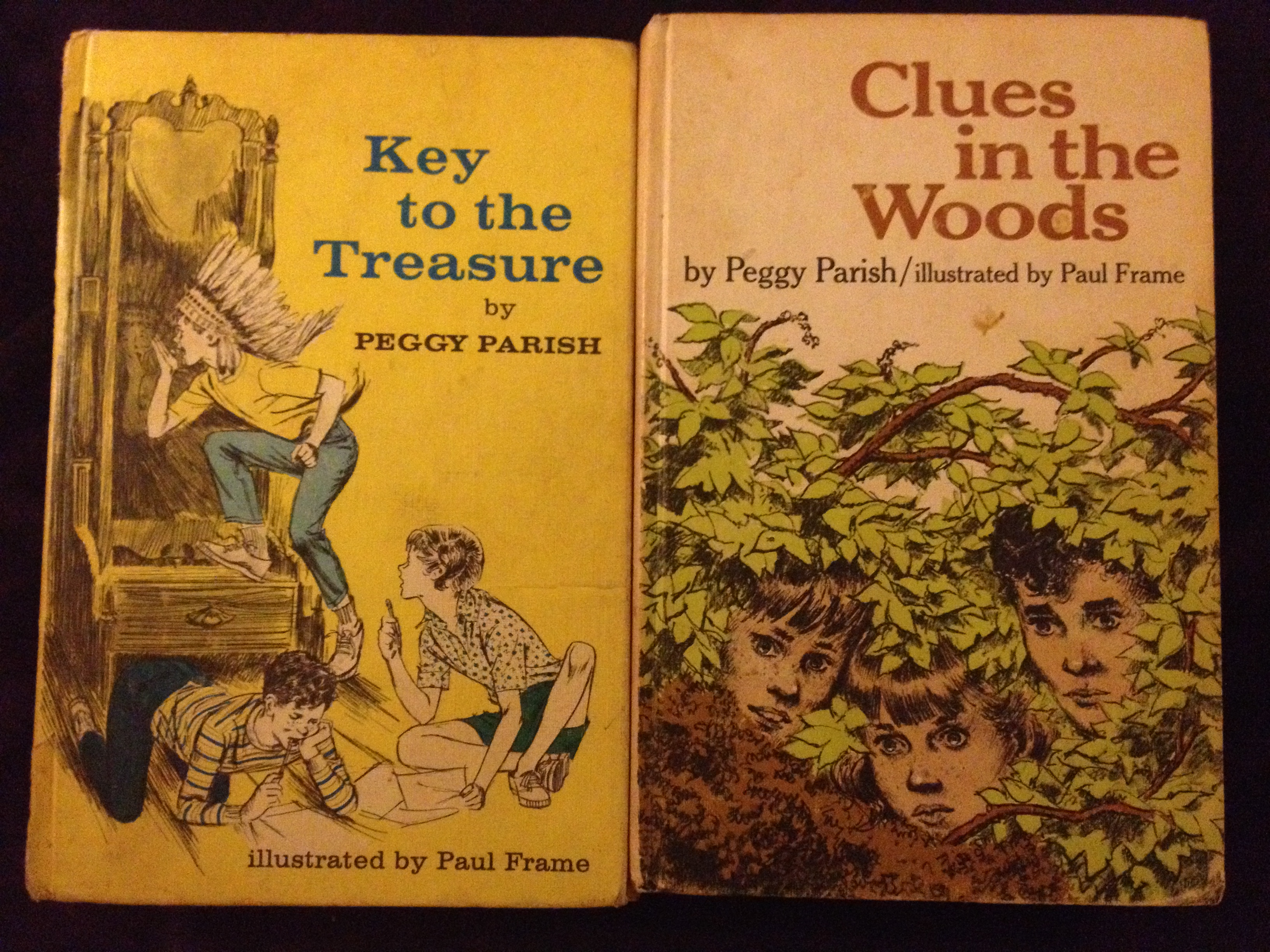
I also remember, a few years later, finding another book in the series in a library. Turns out Parish wrote a total of six books in this particular series. From the descriptions of the plots, I think the book I found in the library was Pirate Island Adventure, which is actually the fourth book in the series. I remember being really disappointed by the book, primarily because the mystery solved in that book is nearly identical to the mystery in the first book.
It was probably also disappointing because the books seem clearly aimed at kids aged about 8 and under, and I was probably 11 or 12 when I found my third.
The books are currently out of print, so while I’m tempted to order the four volumes I don’t own, my choices are to spend either hundreds of dollars for old copies in “new condition,” or more reasonable prices for battered used copies.
Parish is, apparently, more famous for the Amelia Bedelia series, which I’d never heard of until I tried to track down information on these other books just this weekend.
I’ve re-read Key to the Treasure a few times as an adult (yes, including once this weekend). It doesn’t hold up too badly. The portrayal of the elderly Native America woman who had left a collection of “Indian artifacts” to the grandfather of the protagonist’s grandfather is a bit cringe worthy. And the artifacts themselves, representing a mish-mash of tribes—including the famous Gilligan’s Island Tropical Witch Doctor Tribe—is a bit more than cringe-worthy.
The dialog is a bit stilted, giving me flashbacks to my 1928 edition of a Hardy Boy’s mystery where the boys get scolded by their aunt because they got their ties messed up running home from school. Not sounding like the way real kids talked, even in 1966 when the first book was printed, but more like certain people thought children’s books should sound back then.
But I still enjoyed it. And even though I’ve read it a zillion times, enough years have passed since the last reading that I wasn’t certain how they were going to solve the puzzle. So at its heart the story still works.
And it passed the Lewis test. C.S. Lewis once said, “A children’s story that can only be enjoyed by children is not a good children’s story in the slightest.”
When we’re kids, we have little understanding of age. We understand that some kids are older than us, and some younger. We understand that adults get to do what they want and tell us what to do. We understand that some people are old. But exactly what all those mean is very vague.
And we want simple categories. A teen-ager is anyone aged 13 through 19, right? First graders are 5 or 6, right? So how old is a parent? How old are grandparents?
I was the oldest child in my family, and my parents were teen-agers when they married. My paternal grandparents had been 20 & 18 when they married, and my dad was their oldest, as well. My mom’s parents married similarly young, and while she was their second child, they were still quite young when she was born. That’s one reason most of my great-grandparents were around as active, alert adults throughout my childhood and teens.
My middle school basketball coach had been one of my dad’s high school buddies. His oldest son was in the same grade as I was. My middle school wrestling coach, on the other hand, had been my dad’s high school wrestling coach. Yet, his oldest son was only one grade ahead of me in school.
When you’re in middle school, you understand that adults can keep having children into their 30s and 40s. You can understand that the coach’s son who was only a year older than me had two sisters, both more than 10 years older than he was, and therefore coach could be both the parent of a middleschooler and the grandparent of one or more small children at the same time. But when you’re younger, the notion that parents can be a wide variety of ages isn’t even on your radar.
I had an example closer to home. My Mom’s baby brother (half-brother) is only three years older than me. So, one of my uncles was a senior in high school when I was a freshman in high school.
A friend of mine from college had a bad habit of hitting on high school girls. It was only a bit embarrassing when we were in college, because we weren’t that far out of high school ourselves. But when he kept doing it into his late twenties, it was getting more than a little disturbing.
But I don’t have much cause to talk. When Michael and I started dating, I was 37 and he was 27. He’s ten years younger than me, the same difference I was finding disturbing when my friend was lusting after those high school girls.
Obviously, a ten-year age difference isn’t that big of a deal when the younger person is indisputably an adult, or course.
One of my great-grandmothers was a 28-year-old widow with two small kids when she married my great-grandpa… who was only 16 years old at the time! Of course, that was nearly 100 years ago, and a 16-year-old who had been working as a ranch-hand full time for several years was not considered a child. And they stayed together for the rest of their lives, very happy together.
Then we have that much-abused term, “middle-aged.” It used to mean 50-ish, or more broadly 40-60. Men were expected to have their “mid life crisis” during the 40-60 time frame, for instance. It was sometimes defined as the third quarter of a typical lifespan. Medical and mental health people have started shifting the definition up, as life expectancy increased. I noticed a lot of people shifting it the other way, referring to anyone in their 30s as middle-aged.
I keep catching myself referring to one of the neighbors as a kid. He’s coming up on thirty, he and his girlfriend have lived together next door for more than five years. He works, pays his own bills, and is otherwise a fully functioning adult. He’s one of the most responsible people I know. When he and his girlfriend moved in, he just looked way too young to be getting his own apartment, so part of my brain pigeonholed him.
I don’t want to be that old guy who calls everyone “kid” or “son” and so on. I still feel weird when a stranger calls me “sir,” for goodness sake!
Many years ago—I think it was just before Ray and I moved in together (thus, years before Ray got sick, years before the chemo, years before he died)—I called Ray to confirm when we were next getting together.
He was crying.
It took a few minutes to get the story out of him. He’d been on his way out of a store, and he stopped to hold the door open for someone. Another person ran by on the sidewalk, bumping into Ray and knocking his shopping bag to the ground, which was followed immediately by the sound of breaking glass.
Ray had just purchased some sort of glass sculpture. I don’t know what it was of. All Ray would tell me that it was “beautiful, just beautiful.” But it had been smashed to a million pieces, he said.
I asked him what store it had been, so I could go buy him another one. But that just set him off worse, because it had been a present for me. He repeated how beautiful it was, and that he couldn’t afford to buy another one, and the person who had caused it to be smashed hadn’t even stopped to say he was sorry.
Nothing I could say or do made him feel better. And there was nothing anyone could do at that point. If we were living in a Lifetime movie, maybe the person who had knocked the bag from his hands and kept running, waving dismissively when Ray called out, would have encountered us again, and there would have been some kind of amends making.
But we don’t live in Lifetime movies. Sometimes bad things happen, and we just have to live with them. Ray got over it. Life went on.
I was reminded about that incident this week when I found another present from him broken.
I don’t know how it happened, for certain, and probably never will.
It begins a few weeks back when we were having a mini heat wave. We’d had enough hot days (for our climate) in a row that we’d decided to put the window fans up. During the summer we have mounted window fans running in the kitchen, the computer room, and the bedroom. Depending on which side of the house and what time of day it is, they’ll be either blowing fresh air in, or blowing hot air out.
So the second day the fans were going, I found a print on the floor. It’s a large piece of art our friend, Sky, made a few years ago. It’s a reclining courtesan in a green and blue kimono. It isn’t mounted in a heavy frame, it’s just matted. It’s 18 inches by 22 inches, so it isn’t a huge life-size portrait, but it’s large.
It hangs in our bedroom on the south wall. After I confirmed that Michael hadn’t taken it down for some reason, I decided that it must have been knocked down by the wind. We had fans in the window on a thermostat, and we’d forgotten to turn off the standing fan when we left for work in the morning. It had been a little windy that day. I figured there must have been some inopportune gusts of wind that knocked it off.
Never mind that it is nowhere close to the window, and other similarly lightweight pieces are hanging on the wall Closer to the fan. I figured either the wind angle had been just right, or because all of the other simply matted pieces are smaller—they hadn’t had enough surface area to catch enough wind force to bring them down.
Then this week, I found something else on the floor. In exactly the same spot the picture had landed. A resin “sculpture,” about 10 inches tall, which had been on a shelf about a foot below the picture.
Ray had given me the sculpture about a year after we moved in together. It’s an odd thing: a fairy tale castle built impossibly on a pair of rock spires coming up out of the ocean. At the time Ray gave it to me, I think he said that it reminded him of something I’d written. I didn’t remember writing about that sort of castle, but I write both sci fi and fantasy, and I tended to talk to him a lot about ideas I hadn’t yet turned into a story, so maybe it was something in one of those.
But this gets us to the part of the earlier incident that I could never tell him. Ray and I had very different tastes in decorating. We both tended to like very different kinds of kitsch (and yeah, sometimes my tastes are extremely kitschy). So when he said the glass sculpture which I never got to see was “beautiful,” I knew that there was more than a slim chance that I might have thought it hideous.
This resin thing isn’t hideous, but it’s not the sort of thing I would have ever bought myself. Even for only a quarter at a garage sale. So, even with his explanation that it reminded him of something I wrote, I didn’t quite understand why he thought I would like it.
I’m quite certain some of the things I gave him elicited the same reaction. Sometimes you think someone will like something, and you’re just completely wrong.
I haven’t kept every knick knack and tchotchke Ray ever got me. His family members asked me for some of them to remember him by. I gave a few others away to friends who expressed an interest. One particular friend, Kats, suggested when I was agonizing, about a year after Ray died, over a bunch of things that I really didn’t like but couldn’t bear to just toss, that I mail them to her (since she’s as much of a packrat as I am). She said she would find them good homes. We both knew that she would probably toss most of them, and that she was prepared to lie to me if need be about how she’d kept them all. But sometimes you need a little help deluding yourself when you’re being irrational.
This castle, though, I kept. I can’t really say why, because I don’t like it for itself. Neither do I dislike it. It’s just every time I look at it, I think of Ray trying to explain to me how it reminded him of stuff I wrote. Ultimately, it reminds me of the journey we both went through trying to learn to understand each other better.
So when I found it on the floor, broken in several places, I was more than a bit annoyed. Also, confused. I had an explanation for the picture falling down two weeks ago. This was something else. It’s too heavy to have been blown over, at least inside the house. The only other thing I found disturbed was a small plush Tigger that had been near it on the shelf. And one of the fragments that broke off was embedded, at a really weird angle, into the wooden bedstead. If it fell off the shelf, bouncing off the bedstead is almost a certainty, but it just looked odd.
We don’t live in a house, but rather a triplex. On the other side of that wall is the neighbor’s kitchen. A previous tenant had a tendency to slam the cupboards a lot, and sometimes it would make the pictures shake on our side. I haven’t heard anything like that with the couple that have lived there the last few years, but if it’s happening at a time of day when we’re not around, I wouldn’t hear it, would I?
It would be simple enough to glue the castle back together if I could find all the pieces, but I can’t. On the other hand, it’s just a silly tchotchke which, truth be told, I haven’t looked at at all in the last several years except when I decide to clean up that end of the bedroom. It’s just a thing, not a person. I should just get over it and move on.
And I will. But I don’t have to like it.
Anytime a group of geeks get together, they wind up exchanging tech support horror stories. Whether one has ever worked in a tech support type job or not, if you are a geek, there have been times when you’ve wound up helping a non-geek out of a bad situation which they created for themselves through ignorance of, ultimately, basic laws of physics.
For instance, on the bus this last week, a couple with a baby in a stroller got on in front of me. It was clear they were both bus newbies. They headed back looking for some empty seats, with space for the stroller.
This was a double-length bus, which means it is a normal bus pulling, essentially, a second bus’s worth of seats. The two pieces are joined in the center by the section that bends and flexes. The walls are accordian-style rubber, the floor consists of a round section which turns as the front half of the bus goes around the corner, then starts to straighten again as the second half follows it around the corner.
They put the baby and the carriage right on the flex. A place which, as soon as the bus took a right turn, would cease to exist temporarily. Anything in that space would be crushed between a row of seats in the front half, and a single seat mounted on the rotating part of the floor.
Crushed.
So I quickly told them that that was the part of the bus that flexed, and it was not a good place to put a child. They moved back to a different spot.
A lot of people think of geeks as computer techs, but being a geek is about being fascinated with how things work. Whether it’s the mechanics of how a pair of connected vehicles behave going around a curve, or the physics of moving a heavy weight up on incline, or how electronic devices communicate with each other, it’s all a subset of “How does it work?”
In my early days in the tech industry, I worked at a small start up. My official title was a vague Coordinator position, what I actually did was supervise the production and shipping department, write and design all the technical documentation, test some of the hardware and software, help the less tech-savvy employees with computer problems, and then fill in anywhere else as needed. Which included one day a week taking tech support calls from customers while the tech support department had their weekly meeting and training session.
We produced voice messaging/auto attendent systems back at a time when most offices still had typewriters rather than desktop computers. Our systems, which ran on a dedicated desktop computer running DOS (this was years before Windows existed), would connect to a small-to-medium company’s internal phone system in various ways. And we had a lot of tech support horror stories from our customers.
There was the customer who kept turning off the “fan box” because he didn’t think the room was too hot, and couldn’t figure out why the system stopped working. He kept forgetting that the biege-colored metal box that the “TV thing” sat on was the actual computer. And I hasten to explain that this guy was president of a company with a few hundred employees. He wasn’t the employee in charge of the equipment, he just had this bad habit of wandering around in the evening after most of his employees had left for the day, turning things off to save electricity.
But one of my favorites is about fundamental physics, though it didn’t seem like it at first.
A lot of those phone systems back then (and a lot today, because a lot of those medium-office size switches are simple enough electronic systems that they work just fine decades later) use a couple of serial (RS-232) ports for programming and data exchange. You’d plug dozens or more standard phone lines in to connect all the phones, but for other things you’d use the data port. They were originally designed for someone to hook up a dumb terminal or teletype to program and monitor the phone system, because this was back when what laptops did exist often cost more than a relatively new car.
Our system could connect to those ports as well as a couple of phone ports to do all the call transferring and message taking and so forth. But often it wasn’t convenient or even possible to set up the computer running our software right next to the switch. So we recommended a particular 100-foot long RS-232 cable in case the systems had to be really far apart and you needed to run the cable around something.
The one we recommended had really good, clean signal because the individual wires were thicker than in cheap cables (wider diameter wire means lower resistance to electrical signal, for one thing), with really thick, durable insulation, so the cable wouldn’t be ruined simply by being stepped on a few times.
We strongly suggested that the systems be set up as close together as they could and to use a shorter cable, just because it was easier.
We had an experienced dealer who had sold one of our systems in a larger office with one of these systems that needed the serial connector, and they had ordered one of the 100-foot cables, because they thought they would need it. They set everything up, but when they were testing the system, things weren’t working right, and it was doing it in an inconsistent way.
The cable used had 25-pin connectors, whereas the phone system used 9-pin, but adaptors for that were usually reliable. The computer had one of each type, for a while we thought they had enabled the wrong port on the computer. Ports were tested, software was re-installed, the whole configuration process was gone through step-by-step. They finally decided that the cable was the problem, because they could make everything work with an 8-foot cable they happened to have, but the shorter cable was stretched tight across the room, right where people needed to walk, so they couldn’t use that one.
Because we had sold them the long cable, we wound up sending them a new one.
A different dealer technician went back to the site with the new cable a few days later. He walked into the room, and immediately knew what the problem was.
Whereas the 8-foot cable had been too short, the 100-foot cable was too long. So when they had installed the system, the other technician had carefully coiled up the extra 50-feet of cable, secured the coil with twist ties, and set the coiled middle part of the cable on a very large, humming box that was midway between the two system.
The very large box had “Danger! High Voltage!” labels on all sides. It was a big transformer for power for the entire building. And the technician had set a multiple-wound cable that was supposed to be carrying a low-voltage data signal, right on top of it.
For those that don’t know: a large electrical device such as a transformer will generate a cycling magnetic field. If you move a metal coil through a magnetic field, the field will induce electrical currents into the coil. If you place a stationary coil into a cycling magnetic field, the same thing happens.
Setting the coiled excess cable on the transformer sent an extra current into the cable, messing up the signal.
It would be like two people were trying to have a quiet, complex conversation, while four rock bands and a jet engine are pumping out all the noise the can, right on top of them.
I understand after the tech explained it, they then had to explain that, no, you couldn’t just open the transformer and remove the magnets, because there weren’t any magnets. The magnetic field is generated by the electricity. “But I thought you said the magnets made electricity?” Which apparently turned into something resembling the old Who’s On First Routine.
I told a story earlier this week about someone freaking out at a picture of my husband on my desk many years ago. Now I want to tell you about a completely different experience.
It was some years later. The company had grown, been bought by a giant corporation, split in two, and the division I worked for was sold off to another big company that set us up to run semi-independently. They hired some new people to fill out the most decimated departments. One of the new people hired was a young computer engineer, fresh out of college from Eastern Europe.
One day shortly after he joined our company, Eduard, the young engineer, was setting up my account in the new bug tracking system, showing me how to log in, and so forth. So he was looking over my shoulder while telling me what to do next. When we finished, he pointed to the photo frame on my desk. It was in a very similar location as the previous picture had been. Many things had changed since the previous experience with another engineer. Ray had died, and I had since met, fallen in love with, and now lived with Michael. My office was in a different building, the equipment and furniture were different.
So the man in the picture, the picture frame, the desk, and so on were all different. The only thing that was the same was that I still kept the picture at a spot where I could see it, and where other people could usually ignore it.
He asked in his heavily accented voice: “Who is… Is that your, uh, husband? Partner? I don’t know the word.”
I told him it was my hubby, Michael, and that I never knew what word to use, either. Boyfriend, partner, husband all had difficulties back then.
“Does he work in computers, too?”
I explained that he did computer support for a number of clients, and also worked for a computer refurbisher.
“How did you meet?”
I briefly told him about the science fiction convention where we’d met.
“It’s good to have things in common. I met my wife in the hiking club in college. We both love climbing mountains.”
And so I asked him a few questions about her. It was a simple, brief, very human conversation.
Over the course of the next few years we worked on a lot of software products together. Eduard and his wife had a couple of sons. He started organizing snowboarding excursions for the other employees. He bought a motorcycle and started riding it in to work (and organizing long groups rides with others on summer weekends). He rose to a management position. He was one of the smartest, nicest people I’d ever worked with. One of his best traits was that he accepted everyone at face value, more concerned about getting the job done right than worrying about whether who was the “proper” person for the job.
I can’t tell you how many engineering managers I’ve met who pigeonhole non-engineers the moment they meet them. They assume all tech writers know nothing about technology (and don’t really want to know), but only worry about things such as Oxford commons, split infinitives, and making text look pretty. With that sort, any time I made intelligent comments on specifications, or suggested workable fixes to problems, they would look at me as if I’d grown and second head and ask, “How do you know about that?”
Eduard wasn’t that way. When, for instance, we had to resurrect some old functionality in one codebase that hadn’t been used in many years, and I started explaining about how we had sampled which parts of the digital signal, he just started asking questions about the technology. It wasn’t until the end of our discussion that he asked how I knew it so well. When I told him I’d been the software tester on the project when we’d first developed the functionality, he just nodded and asked if I’d be willing to explain it to the engineers who had to re-create the functionality, and was I willing to review test plans.
Then one June Monday I was in the office, busy because I had some big deadlines looming. I had heard on the news about a late season blizzard that had struck nearby Mt Rainier days earlier, and how rescuers had had to retrieve two climbers who had gotten caught in the storm. One of them hadn’t survived.
It was quite a shock when I learned the climbers were Eduard and his wife. They were very experienced climbers. It had just been one of those times when nature reminds us just how small we are. They had had to dig in to take shelter, and as the storm raged on, Eduard had wrapped himself around his wife, using his body to shield her from the worst of the cold. He saved her, but it cost his life.
And that’s how this queer middle-aged man, from a very low-church Southern evangelical background wound up standing in a very high church, orthodox funeral mass surrounded by teary-eyed co-workers in the very unchurched Northwest a week later.
He had been raised in a culture that was much less gay-friendly than ours (which still isn’t terribly), but I had never felt the slightest hint of judgement or awkwardness from him. He had treated the discovery of my husband’s picture completely matter-of-factly, and any other conversations that drifted into family or related topics remained that way. He approached the world with an open mind and an open heart.
Because of the anniversary of the Stonewall riots, and the annual commemoration in many places with a Pride Parade, I always end up writing about gay rights or people who oppose them even more often than usual during June. But for the last few years, June also makes me think about Eduard—a straight guy with a wife, kids, and a predilection for adrenaline-pumping hobbies—who had reacted exactly the opposite as that other engineer upon seeing a simple picture of a man on my desk. Whereas the other guy had taken offense and demanded that I be punished and forbidden to have the picture in my office, Eduard had asked how we’d met.
I hold out hope for the day when Eduard’s open-hearted outlook on the world is the norm from straight guys everywhere.
 Font Folly