Tag Archives: Movies

Another commentary on ships

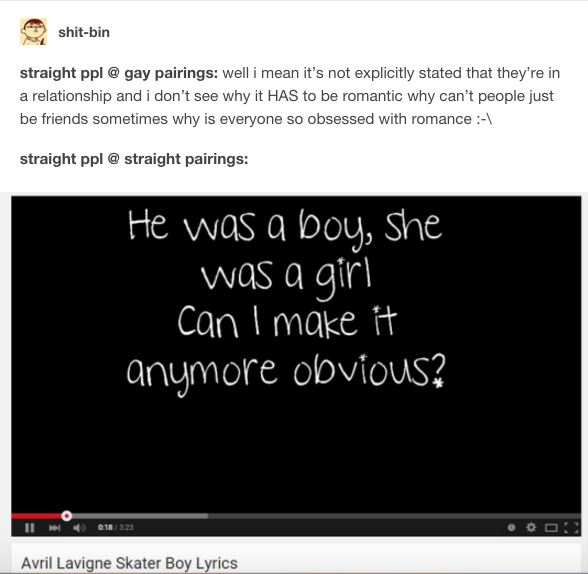
A blog post that appeared on my Tumblr dashboard. Click to embiggen.

A lot of Tumblr is about reblogging and liking stuff other people have posted. Or more realistically, reblogging stuff someone you follow reblogged from someone the follow who reblogged it from someone else, ad nauseum, that someone else posted.

A certain amount of commentary happens, though the tools aren’t really designed to foster conversation. But that’s another topic for another day.

The post, also shown in the screenshot above, came to my dashboard by one of those multi-reblog chains, and it much more succinctly demonstrates the point I expounded on in Invisible? Refusing to see what’s already there… which I also alluded to a few days ago in Confessions of an incorrigible shipper.

The original post was put up last July, as seen here.

Whether you call it a double standard, unacknowledged straight privilege, heterosexism, or homophobia, it’s all the same.

Confessions of an incorrigible shipper

Poe and Finn kiss while Rey gives Finn a congratulatory low-five (Earlier this week the writer/director of Star Wars Episode VIII re-tweeted this cartoon drawn by Jeffrey Winger (jeffreywinger.co.vu).
Earlier this week the writer/director of Star Wars Episode VIII re-tweeted this cartoon drawn by Jeffrey Winger (jeffreywinger.co.vu). Click to embiggen.
The first time I saw the original Star Wars I didn’t consciously have a strong feeling about the apparent love triangle being set up between Luke, Leia, and Han. I was frankly a bit surprised when some of my friends started talking about it. I mean, yes, there was the cute scene when Han realized that Luke was developing a crush, and he asked, “Do you think a princess and a guy like me–?” But he was so obviously teasing Luke. Clearly he wasn’t actually interested in the princess, right? I mean, what other possible interpretation could you have to that indulgent, slightly condescending smile?

And Han, being a much more experienced man, also, to my mind, knew that there was never any chance that a guy like Luke could win the princess, either. That was the other meaning of that smile. And during the dozens of times I re-watched the movie over the next three years, I was still convinced that there wasn’t going to be a serious conflict between Luke and Han trying to win Leia’s heart.

I was definitely in the minority. Lots of people expected, if there was a sequel, that a love triangle would figure heavily in the next movie.

I would like to be able to argue that I had somehow perceived some hint of the revelation that was going to come along later that Leia was Luke’s twin sister. But that wasn’t it. It wasn’t until after I first saw The Empire Strikes Back, that I realized what had been going on in my subconscious. Empire remains my favorite movie of the series for a lot of reasons, but after the first showing I had very mixed feelings about one subplot.

I was still deeply closeted at that point, but I was quite aware that I had a crush on Harrison Ford (or at least all the characters he played), while I had also very strongly identified with Luke, but didn’t have the same kind of feelings for Mark Hamill. I realized that my subconscious had been rooting for a romance, all right, but one between Luke and Han. Which in 1980, when Empire was released, was absolutely impossible in a mainstream film. Heck, even the most radical art house films seldom portrayed mutual same sex romances. They might show a homo obsessed with another man, but it was unrequited and tragic and depressing.

But that was what my subconscious saw precisely because we never saw it on the screen. I’ve written before about why queer people read same sex attraction into all sorts of characters in movies, television, and books. Because if we didn’t imagine them, we never got them. The unrelenting message of culture and media is that queers don’t exist, queers don’t matter, queers don’t love, and if they dare to, they deserve whatever horrible things befall them.

That’s why it’s homophobic when straight people roll their eyes or demand to know why we “do that” to characters who aren’t explicitly identified as gay. It isn’t necessarily malicious or intentional, but being annoyed that we dare to imagine such relationships perpetuates our erasure and is condescending at best.

But to get back to Empire, the movie did such an excellent job of portraying the complex emotional relationship between Han and Leia, that by the time of Han’s famous, “I know” answer just before he was frozen in carbonite, I was cheering for them. Of course they were in love! They were perfect for each other! At least that’s what one part of my heart said. Meanwhile, another part was mourning the loss of the love between Han and Luke that I’d hoped for, even though I knew it wouldn’t happen in a mainstream movie.

But once I got over my disappointment, I was totally on the Han and Leia train, and was happy to see them decades later (“You still drive me crazy”) as a realistic older couple who have had their ups, downs, and a falling out but still caring for each other in The Force Awakens.

I don’t only ship same sex couples. The first two seasons of Buffy the Vampire Slayer I was totally a Willow/Xander shipper. I so wanted Xander to pull his head out and realize that Willow loved him. At different times in the series, yeah, I was elsewhere. I’ve written Xander/Spike fic (and if I ever finish my WIP there’s also some steamy Graham/Riley action and hot Gunn/Buffy action in there). I adore well written Buffy/Spike fic. For a while I was a Xander/Scott shipper, but have often been completely onboard both the canon Xander/Anya and Willow/Tara relationships. I realize if you’re not familiar with the show that you won’t know that half of those are opposite sex couples. In another fictional universe, I remain an unapologetic Parker/Hardison/Spencer One-true-threesome shipper!

But yes, I saw the chemistry between Finn and Poe during my first viewing of The Force Awakens, and given how many millions of other fans saw it, it clearly isn’t an unreasonable inference. I get that other people see the Rey/Finn pairing, and I’m not saying I wouldn’t be able to enjoy that, but I would really, really like for a galaxy filled with aliens of all shapes and droids and so forth the acknowledge that queer people exist, too. (Also, hey! Why can’t we have a Finn/Poe/Rey triad? Polyamory is real, too!) That’s why I enjoyed reading Rian Johnson Gets It, where I first saw the cartoon I linked above.

As Chuck Wendig said in a post I’ve linked to before regarding people who were angry he put gay characters in an official Star Wars novel:

“…if you’re upset because I put gay characters and a gay protagonist in the book, I got nothing for you. Sorry, you squawking saurian — meteor’s coming. And it’s a fabulously gay Nyan Cat meteor with a rainbow trailing behind it and your mode of thought will be extinct. You’re not the Rebel Alliance. You’re not the good guys. You’re the fucking Empire, man. You’re the shitty, oppressive, totalitarian Empire. If you can imagine a world where Luke Skywalker would be irritated that there were gay people around him, you completely missed the point of Star Wars. It’s like trying to picture Jesus kicking lepers in the throat instead of curing them. Stop being the Empire. Join the Rebel Alliance. We have love and inclusion and great music and cute droids.

Also, I was really pleased with this: when a fan recently asked Mark Hamill on line if Luke was bisexual, Mark replied, “His sexuality is never addressed in the films. Luke is whatever the audience wants him to be, so you can decide for yourself.”

Getting nerdy as f— about things we love

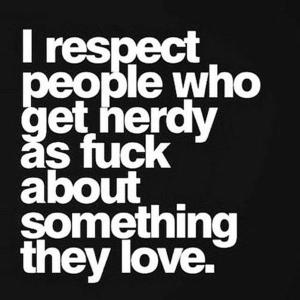
"I respect people who get nerdy as fuck about something they love."
“I respect people who get nerdy as fuck about something they love.”

I always thought I was one of the world’s biggest Star Wars fans. I was 16 years old when the first movie was released, and I saw it with two slightly older friends one of whom was a hard core science fiction/fantasy fan who subscribed to magazines and fanzines no one had heard of and was always talking about the intricacies of how this make-up artist did that thing, et cetera. Our small town in southwest Washington state had only two theatres back then and seldom got anything new, so these friends were always driving down to Portland, Oregon to see movies none of us had heard of.

They convinced me to go see this movie that they thought might be good on opening night. My mind was blown away. We hadn’t expected it to be so awesome. The next day we convinced several of our friends to caravan down in several cars to see Star Wars in a big group. They were equally as mind-blown.

We took another group of friends down a couple weekends later. Over the course of the summer of ’77, I drove myself and various friends down another 13 times to watch Star Wars again. The movie finally opened at one of our small town theatres in August, I think, and some friends who had refused to take the long drive to see it finally went with me to watch it on a fairly tiny screen. By that point, I not only knew every single line of dialog, but I could engage in trivia battles with my friends.

I organized excursions to go see each of the two sequels on opening day. For Return of the Jedi, two of my best friends and I got up at 4am to drive down to the big theatre in Oregon where I’d first seen Star Wars and Empire and we sat in line all day. I was 18th in line that morning for the first showing to the film.

I’m always a little amazed when I realize how many friends I have, now, who were too young to have experienced the movies the way I did. To them, Obi Wan, Luke, Leia, and Han weren’t cool characters in this awesome movie, they were beings of legend on a par with Santa Claus or Moses. And thus many of those friends have gone through all the phases of believing in the original tale, learning that it is a story that someone somewhere made up, becoming a bit cynical about the process of making movies and selling toys, and so on. Which isn’t to say they they don’t love the films. A lot of them revere them, and defend them as a treasured part of their childhood.

I didn’t go through those phases with this particular story. I was old enough that I could see which parts of the movie were homages to the old Buck Rogers and Flash Gordon serials, which parts of the movie harkened to Westerns, and so on. That didn’t make me love the story any less, by no means. Look how many times I drove to watch it!

I didn’t own my own copy of the movie on VHS tape until I was nearly 30 years old. It was one of the first movies I bought after finally getting my own VCR. (That’s another thing, I’m old enough to remember when VCRs were a new gadget that only really well-to-do people could afford to own.)

To this day when I watch the original movie, I find it a little jarring to see those words “Episode IV – A New Hope” appear at the top of that initial screen crawl. That wasn’t there for that entire first run of the movie. It was added when the movie was released on home video, and in the re-release to theatres just before The Empire Strikes Back came out. It doesn’t matter that for 37 years that movie has been referred to as “Episode IV: A New Hope,” my visceral reaction is, “No. That isn’t the real name. The real name of the movie is simply ‘Star Wars.'”

I’m not recounting all of this to disparage anyone else’s appreciation of the film, or to try to prove that I’m more of an authority than anyone else. I chose my opening sentence to this post with a purpose. It implies something that I now want to make explicit: I always thought I was one of the world’s biggest Star Wars fans, but I’m not the biggest. I can’t be. I have seen people very literally insist that they will cease to be friends with people if those people spoil the new movie for them.

And that’s simply insane.

Seriously, you are the sort of person who will discard another human being because they slip up and mention something about a movie?

I love Star Wars. It changed my life. It changed my view of storytelling. It set a standard that I still measure other stories against. And I’m a storyteller myself, now, who believes that storytelling is not merely fundamental to the definition of human, but that it is a transformational force which can move the world. I believe all of that, but I’m also able to understand that a plot twist is not more important than a human being. A literary surprise should not be more valuable to you than the love or affection you feel for another person.

I’ve made ludicrous statements myself, such as that I can’t be friends with someone who thinks The Phantom Menace was a good script. I’ve said things about movies or books or shows that I love and people who don’t share my enthusiasm which were insensitive at best, and outright cruel/pure assholery at worst. And then felt like a complete heel when I realized how I sounded. So I recognize that people might be being just a little hyperbolic. I realize that maybe these same people would regret it if they really did ostracize someone for “spoiling” the movie.

I hope, at least. Because here’s the thing: if you really love Star Wars that much, you should love the fact that other people love it. And maybe they don’t love it exactly the way you do. And maybe they love it so much that when they talk about it they reveal some details that you think of as spoilers, where as they think they’re just telling you it was awesome. It’s fine to let people know that you would like to be spoiler-free. And clearly, if someone tells you the ending for the malicious and intentional purpose of upsetting you, they are being an asshole and maybe you would be better off without them.

I try, myself, not to mention plot twists or reveals and the like of anything I’m watching or reading. I constantly bite my tongue about which clone is my favorite in the series Orphan Black, for instance, because merely mentioning my love of the character could spoil an important plot-twist that happens near the beginning of the second season. Even though it has been out for years, now, there are still friends I’m trying to get to watch the show, and I don’t want to ruin the joy I felt when that reveal happened.

But it’s just a story. It isn’t actually a matter of life and death. And just as we hurt people when we make disparaging remarks about things they like that we don’t, we also cause pain when we piss all over someone else’s enthusiasm. We shouldn’t do that. Especially about things they love.

I’m trying to learn not to do it. Won’t you join me?

You don’t have to add diversity—just stop erasing it! (part 2)

I wrote recently about why having queer characters in books, particularly science fiction, isn’t about pandering or finding a good reason to include us, but rather simply of matter of not excluding us. The real world has queer people (a lot more than most people think), and there is no good reason that fictional worlds wouldn’t have just as many of us.

There’s an interesting post going around Tumblr that gathered together this series of facts (originally tweeted by Andrew Wheeler @wheeler) about some current or recent works of fiction based on historical characters. The historical facts are verified, I’m not merely repeating. I include a bit more context on each than Wheeler was able to fit in a short series of Twitter posts:

  • Leonardo da Vinci was almost certainly gay, but the series Da Vinci’s Demons portrays him as (barely) bisexual who seems to be exclusively attracted to women.
  • Alexander the Great was gay, and was known to be gay to the extent that the greek historian Plutarch wrote extensively about the moral way Alexander behaved toward the various men he had loved. The great love of Alexander’s life was a man, Hephaestion. When Hephaestion died, Alexander mourned him for months, refusing to eat for days, and nearly killed himself. The only movies that have ever included Hephaestion doesn’t even hint at the relationship, let alone even showing them kiss.
  • Alan Turing, the genius who decrypted Enigma among other things during World War II, has sometimes been described as the greatest gay hero of the modern age. He was convicted of indecency (and forced to take drugs to repress his libido) because he confessed to being in a long term relationship with his boyfriend. In the recent movie which tried to portray him as a hero, he is instead caught with a male prostitute and portrayed as a loner who had no love in his life.
  • The epic love of Achilles and Patroculus is a keystone of the legends of the Trojan war, but in the recent movie Troy they’re portrayed as simply buddies.
  • John Nash, the mathematician, was sexually active with men throughout his life, getting arrested a few times for it. He was married twice, though both relationships were problematic, and it’s unclear how many of the issues in the second marriage were due to his struggles with mental illness as opposed to his frequent same sex dalliances. A Beautiful Mind omits the first marriage and child completely, and also completely erases the same sex liaisons, which due to the arrests, played a significant role in the tragedies of his real life.

This list focuses on men because Wheeler’s point was that television and movie executives are extremely squeamish about showing men being seductive or explicitly romantic or in any way physically intimate with other men. But it isn’t just “Hollywood” that has that problem.

Lots of people cite the Marvel Comics character Deadpool as an example of a bisexual character. The creators of the character frequently claim that he is bisexual, but the kindest way you can describe those claims is that they are being very bad writers by telling us rather than showing. The more accurate description is that it is a queer-baiting lie. Oh, yes, Deadpool makes all sorts of sexual jokes toward other men, and he seems to be particularly obsessed with Spiderman, but that is all we ever see in the stories: jokes. Deadpool has never ever been shown actually in a relationship with another man. He has had a lot of romantic relationships with women in the comics; loves of his life that have died tragically and so forth, but not one single man.

None.

That isn’t diversity, that’s queer-baiting.

Slightly better is DC Comic’s John Constantine, who in the comics had at least one significant same sex romantic relationship (in additional to several opposite sex romances), and said same sex relationship was integral to the plot of one of the longer story arcs. He’s also been portrayed flirting with men, seducing other men, and so forth. All well and good. Until we get to the television series (which, alas, was canceled last year after only 13 episodes), where there isn’t even a hint of his bisexuality, and the producers and writers said off-screen that he was not bisexual.

And don’t get me started on the epic amount of queer-baiting the creator and producer of the Teen Wolf television series has been doing for six years!

So, to sum up: when we call for diversity in books and movies and television shows, we aren’t asking to be pandered to. We aren’t asking you to shoehorn something into the story. We’re asking you to be realistic. We’re asking you to write believable stories.

Appendix: This blog post, in which a writer explains why he is re-writing some really old sci fi stories by swapping genders and such as his NaNoWriMo project provides some other good points about erasure in fiction: Get Bent – Why Bother?

Just call me Mr. Chicken

31I love Halloween. Seriously, I do. I love a well-done vampire story. Or a good fantasy tale with interesting witches and/or monsters.

But I’m not good with scary movies. Now I should qualify that: I’m not good with a lot of horror films, particularly the gory and/or very intense ones. I wind up having nightmares. The kind of nightmares where I wake up other people in the house because I either wake up talking very loudly, or worse: I sleepwalk around the house, intentionally waking anyone I can find, and explaining very emphatically how we’re in danger and we have to do something to defend ourselves/thwart the monster, et cetera. The more intense the movie, the more likely I am to do this for several nights in a row.

There are exceptions. I do better when it’s a movie I’ve seen before. I also do better if I watch the movie on a TV or computer instead of going to see it in the theatre. Being able to look away at familiar surroundings whenever I want without the overwhelming presences of the enormous screen and THX sound seems to help a lot. Watching it with someone I know and trust helps. I have been known to physically cling to friends (not just people I am romantically involved with) at particularly scary parts of some films.

I own a lot of movies that I classify as Halloween/horror films. And every year, I select some to watch on Halloween (and sometimes nights leading up to it). But my collection isn’t full of things many people would think of as scary. Movies that appear in my Halloween fests a lot include:

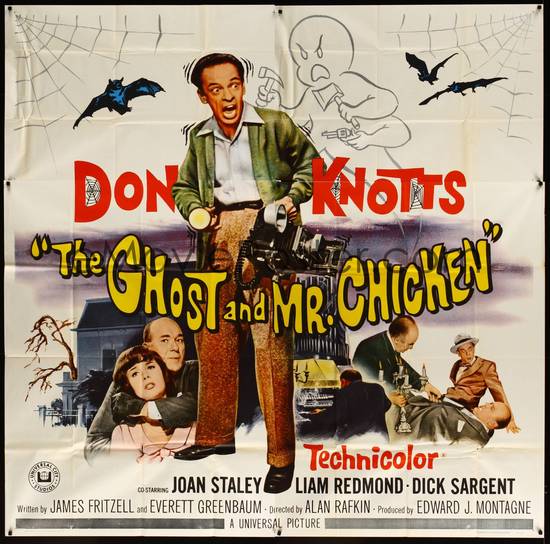
  • The Ghost and Mr Chicken
  • Elvira, Mistress of the Dark
  • The Addams Family
  • Abbot and Costello Meet the Mummy
  • Monster Squad
  • Frankenstein (the 1931 version starring Boris Karloff)
  • Bride of Frankenstein
  • Dracula (the 1931 version starring Bela Lugosi)
  • Young Frankenstein
  • The Lost Boys
  • Tremors
  • Queen of the Damned
  • Fright Night (the 1985 version with Roddy McDowell and Chris Sarandan)
  • Haunted Honeymoon
  • The Rocky Horror Picture Show
  • Arsenic and Old Lace
  • Teen Wolf (the original with Michael J. Fox)
  • Hocus Pocus
  • Edward Scissorshands
  • Ghostbusters
  • Little Shop of Horrors
  • The Man with Two Brains
  • Hellboy
  • Godzilla
  • Forbidden Planet

I could go on. A friend posted a similar list on her blog yesterday. I’m glad to see I’m not the only person who likes this kind of less-than-nightmare-inducing spooky movie.

I have all of the “Abbot and Costello meet…” cross-overs with the Universal Monsters, as well as the Universal box sets of their classic horror franchises: Frankenstein, the Mummy, Dracula, the Wolf Man. And a bunch of the Simpsons “Treehouse of Horror” episodes on disc. I only recently acquired Munster, Go Home on disc, and it was a candidate for this year’s Halloween fest.

3265dcb92ac0b5575bed9a0e0d047927Since my husband has spent so much time converting the rest of our (nearly a thousand) DVDs and Blurays into the media computer and database, I spent a while scrolling through the list looking for films that maybe we haven’t watched in a while because they were on a different shelf than the other Halloween movies. I noticed, while scrolling through the sci fi section, The Black Hole (the 1979 version with Maximilian Schell), which I haven’t watched in many years. When I said that, Michael said that he’s never seen it.

My husband has never seen it!

So I said, “Well, that’s one of the Halloween movies this year, definitely!”

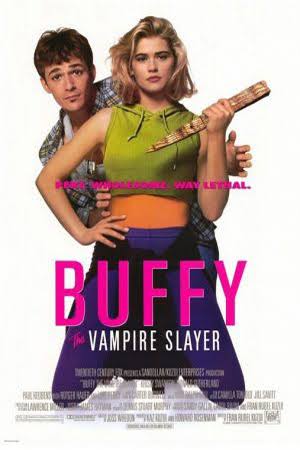
Then he asked me if I could remember when I last watched the Buffy the Vampire Slayer movie (with Kristy Swanson, Luke Perry, and Donald Sutherland), and I couldn’t remember, so we both said, “Guess that one’s on this year’s list, too!”

images (2)And, of course, the premiere of the new series starring Bruce Campbell, Ashe vs the Evil Dead is happening on Starz on Halloween. And Starz is a channel I have in our line-up, so I’d been planning all along to watch it that night.

I should mention that the Evil Dead movies are one of those cases where the gore is enough that normally I wouldn’t watch them, but I love work that Bruce Campbell does elsewhere (and was so, so, so happy when he was cast in the major supporting role in Burn Notice which went on for several seasons without getting canceled or jumping the shark before they ended it in a really good way). Plus, after being enthused at about it many, many times by our friend, Sky (who is one of those people who I know really well), in some ways I felt as if I had already seen them. So I finally watched The Army of Darkness and one of the earlier ones.

Sky was sitting on one side of me and my husband on the other. (I spent most of bloody-cabin-in-the-woods movie with my eyes covered, even then!).

I… will not be surprised if Campbell’s new series gives me nightmares. But I’ll probably watch the whole thing, regardless.

Because I love the mix of comedy and horror tropes! And did I mention that I love Halloween?

Nuclear Dinosaurs and Tragic Heroes – more of why I love sf/f

Image from the 1954 Gojira (click to embiggen)
I don’t remember precisely when I saw my first Godzilla movie. I was probably four or five years old. When we were living in the parts of Colorado where all the TV stations we received came from Denver, one of those channels had a Saturday afternoon movie called Science Fiction Theatre (or something like that) which seemed to almost exclusively show Japanese sci fi films. So there were a lot of Godzilla, Mothra, and other kaiju films that I saw during this time.

Often when there were parts of the plot that didn’t make sense to me, Mom would explain it away as the problems with translation. She had already explained about how the movies were originally filmed in Japanese, then dubbed into English. So anything else that seemed odd or illogical was because of that. It didn’t occur to me until later that part of the process of translating it for an American audience also sometimes involved editing the film, taking out scenes or cutting them short.

Godzilla was, of course, my favorite… Continue reading Nuclear Dinosaurs and Tragic Heroes – more of why I love sf/f

Invisible? Refusing to see what’s already there…

Kissing otters
Ah, love!
I was having a discussion about a movie with some friends on line, and two of us were commenting upon the possible romantic relationships between some of the characters. Because one of the pairs under consideration were two male characters who had not explicitly been portrayed as non-heterosexual, another friend in the conversation commented that he never understood why people do that.

At the time, I decided to keep the conversation light, and simply said that we saw it because it was obvious. The real answer is a lot more complicated and serious than that. I didn’t feel up to explaining the unconscious homophobia underlyng the very question, and sometimes, frankly, I’m just tired of being disappointed in people.

But the problem persists, far beyond the people involved in that conversation. And yes, it is a problem, a very real and serious problem. What is the problem, you ask? Some people say the problem is invisibility or cluelessness, but…

In this way the writer can present his cowardice, laziness, and lack of imagination, as artistic integrity. “I couldn’t write gay characters; I didn’t have any.” Hand-to-forehead; the tortured auteur.
—Andrew Wheeler, writing for Comics Alliance

It’s actually about erasure and willful blindness. As I’ll explain further…

Continue reading Invisible? Refusing to see what’s already there…

Storytelling should not be preaching

Brandon Ambrosino, writing for Vox, asks, “Why are Christian movies so painfully bad?” He’s writing specifically about the recently released movie, “Old Fashioned,” though he mentions a few other recent examples. The full article is worth a read, but I want to focus on a couple of points:

As Daniel Siedell, Art Historian in Residence at The King’s College in New York City, notes, “For [Evangelical Christians], culture is a tool, a more effective way of getting at political realities, or winning the battle of ideas in the public arena.”

Siedell uses the following analogy with his students to explain what he means.

Imagine a gorgeously wrapped gift sitting under a beautifully decorated Christmas tree. The presentation of the package, while pretty, is nowhere near as valuable as what’s inside.

Now, he says, extend that idea to Christian art. The artistic qualities of a work become the unnecessary wrapping paper. As such, it doesn’t really matter how good or bad they are.

That’s why it doesn’t matter that Old Fashioned is often very boring. It doesn’t matter that the script bursts at the seams with overwrought dialogue, or that the actors (outside of lead actress Elizabeth Roberts) offer phoned-in performances.

Ambrosino eventually disagrees with this point, but I don’t think he does so as vehemently as he should. Quality is not just the packaging. Quality is an inherent property of the entire work of art. When you think you can make a work of art and treat the artistic qualities of the work as superfluous, you are not making art. Period. I understand the mind set of the evangelicals, believe me! I was raised in that sub-culture, and once people noticed I had what they considered Talent, everything I wrote and did was evaluated through that lens of whether they felt it was proclaiming the message of Christ.

I tried to make one of Ambrosino’s points at the time: if the quality of what we produce is a turn-off, it doesn’t matter how important the message is. People will never listen to your message if they are bored by your story/movie/what have you. But it always fell on deaf ears.

Part of the problem with both my argument then and Ambrosino’s now is that we’re conceding something that we know is wrong. In order to try to make the argument that they should try to be better at making art in order to get their message across, we are buying into the fallacy that art is merely a means to deliver a message. It’s their argument:

Brian Godawa, Christian screenwriter, thinks it’s important to note that Christian films aren’t the only ones that are explicitly preachy. All films, says Godawa, “have messages to some degree or another, and writers and directors know full well they’re embodying those messages in their storytelling.”

I’ve written before that it is impossible to create art that is true to yourself without your values informing the work. That’s not the same thing as a message. I know that I’m a big believer in hope, so my stories, even when I write things I considered very dark, always have some hint of a glimmer of hope. But that isn’t the same as a message. I don’t write a story because I wish it will make other people feel the same way about hope as I do. I write stories because the stories want to be told. My own perspective will always be to look for that glimmer of hope, so I see the stories that way.

But each reader will have his or her own perspective, as well. And even though I am the storyteller, it’s their story, too. Their interpretation of what the story means (to them) is just as valid as mine.

And while I often have very strong opinions about the stories, art, and music I love; I understand that they are my opinions. I may think that your opinion about that particular piece of art is utterly wrong, but I will defend your right to express it. I may debate you about it, but I expect you to argue back.

That’s the difference between trying to send a message and letting your belief inform your artistic endeavors. I don’t consider it a failure if a reader doesn’t agree with me at the end. I don’t even consider it a failure if some readers don’t like the story at all. I especially don’t consider it a failure if a reader feels compelled to tell me just how much they hated one of the characters, or that they are angry at me about how the story ended.

Because in order to hate a character, you have to believe in the character. In order to be angry about how the story ended, you have to become invested in how it ends.

Don’t get me wrong, I love hearing from readers who tell me they liked something, or that they found a particular character adorable. Someone told me that recently about a pair of characters in one of my stories, and I just about died from pure happiness. But you know what? A few years ago when one reader wrote to tell me, in regards to a particularly ruthless character I had written about, “I don’t trust him at all!” and others wrote to tell me how much they loved the same character, I just about died from glee.

The people who are delivering messages want one and only one reaction to their story. You must agree with them. If you don’t agree with them, you have failed to learn the lesson they are so desperate to teach you.

And that’s completely backwards from how it ought to me.

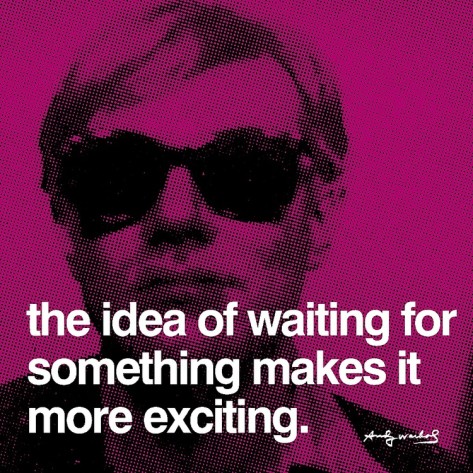
About waiting…

andy-warhol-waitingI get reminded in weird ways how old I am, sometimes. For instance, there was a discussion happening between some of my online acquaintances about Star Wars, specifically about the original movies (where young Luke Skywalker is the protagonist). I made a comment about what a freak I was considered to be by classmates because I had seen the show more than 13 times. And the comment made no sense to the people in the discussion.

So I had to explain that I was talking about when it first came out, and was only available in theatres. This was in 1977, when I was a teenager. Worse than that, it didn’t play in any of the theatres in the smallish town where I lived until about four or five months after it first came out. The closest place that had a big screen and a decent sound system where the movie was playing was more than an hour drive away—not only not in the same town were I lived, but not in the same state!

When you’re a high school student you don’t have a lot of disposable income, so the gas money and cost of tickets wasn’t a trivial expense. I carpooled (either using my old beater car or letting one of my friends drive) twelve times over the course of the first summer the film was out in order to see it. And then in the fall I went once to the truly crappy local theatre that finally got it, dragging a few friends I had never been able to talk into taking the longer trip.

Also at that time period, while home VCRs technically existed, they cost thousands of dollars and were huge, heavy things. Video rental stores didn’t become a common type of business for a few more years, when the technology got a little cheaper. And even then, the players were expensive enough that many people would rent both some movies and a machine from the store in order to have a movie night at home.

Cable television existed only in cities and larger towns. When cable first came to our small town, I was 19 or 20 years old, and it consisted of 15 regular channels, plus the premium channels of HBO or Showtime (Cinemax, Stars, and the like didn’t exist, yet). I write “or” because while very few people I knew had cable at all, most of those who did had only the 15 basic channels, and no one splurged on more than one movie channel. No one.

And, of course, DVDs literally didn’t exist, yet. Let alone the internet.

I had to wait three years before The Empire Strikes Back came out—by which time I was a freshmen in college. Then another three years after that before any of us got to see Return of the Jedi.

I saw all three of those movies, during their respective opening weeks, in the same big theatre in Beaverton, Oregon. It was like a religious pilgrimage for me, by then. I’d been hooked at 17 years old, and the passion still burned with the intensity of a billion suns when I was 23.

This is one of the reasons that, when I hear some of my friends complaining about how many months it will be before the new season of My Little Pony comes out, I don’t always give them as much sympathy as I probably ought.

On the other hand, I’m just as bad. The last episode of Justified season five aired eight months ago, in April, and I’ve been dying while waiting for season six to begin… which it will in January 2015. That’s less than 30 days from now. Inside, 23-year-old me is laughing so very hard at current me because I’m agonizing over having to wait merely months for the next chapter in a saga. And this is hardly the only series or movie that I have such lamentations about.

So, while part of me rolls my eyes at younger fans, another part of me is rolling my eyes at me, too.

Of course, we should remember that 173 years ago, back in 1841, people are said to have lined up for blocks in London waiting for a new edition of a weekly magazine called Master Humphrey’s Clock so they could read the next chapter of Charles Dickens’s The Old Curiosity Shop. Even more fun were the stories of people meeting English travelers disembarking from ocean liners in New York at the time, to ask whether Little Nell lived, since American publication of the stories was several weeks behind the British chapters.

As they say, times change, but human nature doesn’t.

(Un)real Characters

2bad57a909fd53708036ef02ae3ba068So I was scanning through my usual news sites a couple of weeks ago and saw a headline about the Guardians of the Galaxy that caught my eye. I’d already seen the movie the previous week, and had enjoyed it even more than I had anticipated. So I definitely went into the article with a bouncy fanboy attitude. The author talked about how the movie was better than he had expected, mentioned a few of the pros and cons of the overall story and construction, but then settled in to his main thesis: the characters audiences seemed most drawn to in the film were Rocket, the genetically-altered and cybernetically-enhanced raccoon, and Groot, a walking, (barely) talking tree—and the writer thought this was a bad thing.

He thought it was bad because those two characters are computer animated images, rather than being portrayed by human actors. He admitted that they were voiced by human actors, but “when pixels move us to tears more readily than actual people, that’s a problem.”

My pedantic side immediately wanted to post a comment that, since most theatres have made the switch to digital projection, every character in every movie people see in theatres are pixels rather than real—not to mention all the movies and series that people watch on TVs, computer monitors, phones, and tablets now. Even before digital movies, old-fashioned film wasn’t real people either, it was images projected on a screen by shining light through celluloid tinted with various chemicals.

All of that is missing a more fundamental point. None of the characters in films, plays, television series, et cetera, are real. They are all fictional characters being evoked by a combination of tricks and techniques of storytelling and acting.

I realize that I’m a bit biased, here. I have been a fan of comics from an early age. I grew up laughing at and following the adventures of Bugs Bunny, Daffy Duck, Yogi Bear, and dozens of other cartoon characters. I have edited and published a science fiction fanzine that features talking animals, the occasional human, and all sorts of aliens for nearly twenty years. I’m currently engaged in writing a series of fantasy novels set in a world populated by talking animals, dragons, ghouls, kitsune, and any number of other non-human creatures. For the last few years, I have awaited the unveiling of a new season of My Little Pony: Friendship Is Magic with as much anticipation as a new season of Doctor Who or White Collar.

So maybe I’m just a bit too far out from normal to be commenting on this. However, the author of that particular article is someone I’ve read before. He’s the regular movie reviewer for a news site I read just about every day. I’ve seen many of his previous movie reviews, some of which I agreed with, some that I haven’t. Like many movie reviewers, he approaches his critiques from a literary rather than visual arts point of view. He always talks about plot, themes, narrative flow, viewpoint, characterization, and dialog.

So it’s a little strange that someone who approaches movies from such a strong literary perspective can’t understand the true appeal of any character. Readers have been meeting, getting to know, and coming to love imaginary characters for as long as fiction has existed. Characters like Anne of Green Gables, Oliver Twist, Huck Finn, Sara Crewe, d’Artagnan (and his comrades Athos, Porthos, Aramis), Robin Hood, et cetera have been engaging readers for generations. For much of their history, those characters have been less than even pixels: people have read words on paper, and conjured the face, voice, and being of the character entirely in their imagination.

Yes, illustrated books, live theatre, and various recorded forms of movies and series have also breathed life into those imaginary characters, but those are all simply different forms of conveying and evoking the idea of the character in the minds of each of the viewers. It is still, ultimately, about the imagination of the audience embracing the story and the characters within it.

As a writer, I deal with imaginary characters constantly. My head is full of a mad assortment of characters, some of them characters I have created for my own stories, others are characters I have come to love (or love to hate) through stories created by other people. When I’m writing a story, my job is to try to evoke in the reader the story that I have imagined. An important part of that process is evoking characters that the reader will, at least temporarily, imagine as if they were real. And more importantly, will have feelings toward as if they were real.

That’s the entire point of art, to engage the audience, and make a connection between hearts and imaginations. And it doesn’t matter whether I’m telling a story verbally, in text, on stage, with painted images, or computer rendered animation. It doesn’t matter if the characters are named Jenny Nelson or Buffy Summers or Zoe Washburne or Applejack.

What matters is the story.

For at least a few minutes, can I make you care about what happens to these characters? Can I make you interested in how they got into the situation they find themselves in? Can I make you wonder what’s going to happen next? Can I so engage you that you can’t look away until you know how things turned out for the character?

Getting the audience engaged with the characters is never a bad thing. And if you think that some fictional characters are less “real” than others simply because of the medium through which the audience’s imagination is being engaged, then you don’t understand storytelling.

At all.