I write and draw to explain hard-to-understand things like computers.
I talk to people who make the hard-to-understand things and figure out how to explain the things to people who have to use the things. I talk to people who have to use the things to find out how they use the things. I show the people who make the things how to make the things easier to understand and use.
I figure out how to write stuff and draw stuff once but use it in many places in a way that if we change it one place it changes at all the other places. I figure out how to make the stuff we write and draw once that appears in many places change in ways that make sense in each place it is used, but not change when it isn’t supposed to.
I figure out where the stuff we write and draw is seen. I figure out how to make the stuff we write and draw be in the places it should be without us doing it each time. I figure out where people who need the stuff we write and draw will look for it. I figure out how to make the stuff we write and draw be in the place people who need it will look for it. I figure out how to keep the stuff we write and draw that most people don’t need out of their way but still easy for the people who need it to find. If figure out how to put the stuff we write and draw where we can find it quickly when we need to change it.
I make the things that makes all the stuff we write and draw do all these things. I keep the things I make working. I fix the things I make when they don’t work. I figure out why other things made by other people but that we have to use are not working, and then figure out how to make them do what we want even though they were never meant to do that.
I do things with words most people don’t know that words can do. If I do it right, the people who use them don’t even realize the words are doing the things. My job is not to make the things I do be noticed. My job is to help people who use the hard-to-explain things know how to use them without knowing they are learning.
This was hard because what I do is extremely meta. The words “information,” “arrange,” “organize,” “design” can’t be used. Even the word “itself” is unavailable, so when I wanted to write that the things we write and draw change themselves depending on where they are being seen, I couldn’t. Oh, and “tool” isn’t allowed. Anyway,
In the last two weeks I’ve gotten into at least three conversations with friends and acquaintances about names. Then a long-distance friend explained his names in response to a writing prompt, and I figured the universe was trying to tell me something.
I’ve had a bunch of different names, some given names, some nicknames, some family variants of names, and then there’s an interesting twist on the legal names. Probably best to start at the beginning.
I was reminded recently of the last time I visited Arizona. It was 1982. I was attending college1 in southwest Washington. My mom, who had remarried a couple years before, was living in Phoenix with my stepdad and the older of my sisters2.
My sister was getting married3 on Christmas Eve, so I came to visit for Christmas break to attend the wedding and have Christmas with Mom.
Every time we left the house, Mom would urge me to bring my coat. And everywhere I went, I wound up carrying my coat draped over one arm. I regretted not packing several pairs of shorts. The temperature, as I recall, never dropped below the low 60s (Farenheit)4. My Mom and Step-dad weren’t the only people wearing coats at the restaurants, movie theaters, and so on. I was sweating, but surrounded by an entire city of people practically shivering from the “cold.”
December in Phoenix, at least that year, was like June in Seattle.
On the other hand, I start complaining about the heat when the temperature gets up into the high 70s—and whining by the upper 80s—which makes friends who live in Phoenix (and Texas, southern California, Florida, et cetera) laugh5. Since for only two or three weeks in August or July does Seattle temperatures get into what most people would classify as summer-ish, my tolerance for heat is nearly non-existent.
Mom’s acclimation to Phoenix winter was particularly amusing to me, because during my childhood we lived in much, much colder places. During my junior high years, for instance, one of my morning chores during winter months was to carry an extension cord out to the driveway and plug-in the engine block heater for Mom’s car. It was actually two heaters: one built into the oil pan, the other into the coolant system. It warmed up the engine block enough to make the car start easily in the cold. On those mornings where the thermometer out on our front porch showed the temperature was colder that -10°F (-23°C), I had to string the second extension cord out to plug in the engine block heater for Dad’s pickup.
It got cold enough to justify the second extension cord at least a couple dozen times each winter.
Some years ago when on Christmas Eve I called my grandmother who still lives in that small Colorado town, she told me it hadn’t been a terribly cold Christmas thus far. “We only got to 25-below6 once or twice this week!”7
And one of my cousins who was there chimed in that the windchill factor was only “minus fifteen.”
Mom lived in that part of the country for a good 18 years, yet only a year or so in Phoenix was all it took for her to start thinking that what I considered early summer weather required a coat. Not a jacket, but a coat!
People are adaptable. We get used to the environment we’re in (physical, emotional, or cultural), adjusting our comfort levels without concious thought. Adaptability is a good thing. It doesn’t hurt, every now and then, to try to step outside yourself and look at what you’ve learned to accept as normal. In the abstract, are those really good things? Is this really where you want to be? Are you really who you want to be?
Similarly, are the people you disagree with just looking at things from a different perspective? Just because I think it’s madness to wear a coat when the temperature is in the upper 60s doesn’t mean it’s wrong. Not in the way they would be if they were huddled under an umbrella complaining about getting wet when the sun is shining and the precipitation is zero.
It’s important to distinguish between the way a person reacts to facts and the facts themselves.
1. During the long stretch of attending part-time, while living with my grandparents and working several jobs.
2. Our younger half-sister was living with my dad and stepmother back in Utah.
3. Which is a story so convoluted that if I used it in the plot of a novel, critics would universally pan the book as being totally unbelievable.
4. I have been known to be out and about wearing shorts when the temperature is 50°F (10°C)—and sometimes colder.
5. Of course, the last time I was in Texas in the summer, I noticed how many people spent those hot, muggy months inside their homes air-conditioned down to the lower 70s, riding in air-conditioned cars to sit in restaurants or churches air-conditioned down to the upper 60s, so I’m not sure they have as much to laugh about as they think.
6. That’s -25°F, or -30°C.
7. Just today my half-sister, who lives nearby, commented that the high temperature this week had been 6°, or -14°C.
About a week after we eloped a friend said, “I’m going to ask you a question that may seem weird, but I’m asking because so many people asked me the same question after I got married: do you feel different?”
My answer was, “Actually, yes, I do. It’s a little weird. Great, but weird.”
There are several reasons I didn’t expect to feel different. Michael and I have been together for nearly fifteen years, living together for 14½ of them. We already know each other’s quirks, bad habits, good habits, who is most likely to misplace his keys/wallet/watch/phone (me), or who is most likely to not check to see if his keys are in his pocket until he’s out of the house but know exactly where they are inside the house (Michael). We’ve registered as domestic partners, first with the city, and then when the state offered it, the state. We even had a small party with friends the first time. We’ve been through medical emergencies together. We’ve bought two cars together. We’ve been calling each other (and thinking of each other as) “husband” for many years.
When voters in our state approved the referendum three years ago affirming the legislature’s vote that extended all the state-given rights and responsibilities of marriage to domestic partnerships (but not to call it marriage), one of the changes was that the process of dissolving a partnership became the same as getting a divorce. When we received the official notice from the state that we had a certain number of days to dissolve the partnership under the old (much quicker and simpler) process before the new law went into effect, I remember we had a few moments of joking that if either of us wanted out, this was our last chance. It was a sobering thought, and one which I don’t think most couples entering into marriage think about as much as they ought.
So while I think the latest vote that got rid of domestic partnerships and extended marriage to same-sex couples was important, I didn’t expect to feel different. Having been through so much with Michael already—having covered all that emotional ground together—I figured the actual being married part would feel like the same old same old. I knew I would get emotional during the actual ceremony. I cry at tearful scenes in movies that I’ve seen millions of times, for goodness sake. Of course I was going to tear up a bit.
Okay, so I didn’t just cry a little bit. I cried while reading news stories of couples who had been together for many decades getting their licenses. I cried seeing the pictures and watching the videos of crowds of people congratulating strangers. I cried when they took our picture after we picked up our license. I cried when relatives and friends sent their congratulations. And I cried at our elopement. I cried a lot.
And I still get teary-eyed. While I was tidying the house on the afternoon of Christmas Eve it struck me that this is our first Christmas as a married couple. And I teared up and had to go give Michael a hug.
I know part of that is because it is new. I know another part of it is because I’ve had to fight for legal equality my whole life, and it’s still just a bit of a shock that a majority of voters in my state agreed this institution should be open to gay people, too. Related, over the last few decades I have become painfully familiar with just how many legal rights and responsibilities are utterly unavailable to couples who don’t have the flimsy piece of paper from the state saying you’re married.
A few years ago I read an editorial about how important marriage is to society. In building her argument, the author pointed to several gay rights web sites that had lists of legal rights available only through marriage and heart-wrenching stories of long-term partners being kept out of hospitals or funerals by bigoted relatives as the best source of information about how deeply entrenched the concept of marriage is in many of our customs and laws. “No one understands the value of a social or legal institution more than the people who are not allowed in,” she said.
Which brings me to the people who feel such a burning desire to keep the institution an exclusive club that only allows people of whom they approve. People don’t raise millions of dollars, compose disingenuous television commercials, and pass laws to exclude people from a mere piece of paper. They don’t amend state constitutions, try to oust judges, or fire teachers to prevent the mere public acknowledgement of the “true commitment that happened in private.” To do that sort of thing you must believe that this institution is something more important than a simple piece of paper or public declaration.
So one shouldn’t be surprised if one does feel something once you’ve managed to join that very institution.
I’ve been failing to complete this posting for several days because I can’t quite put into words the difference that I’m feeling. Searching the web, I see that in other blogs and articles it’s split about 50-50 between people who insist that nothing feels different, and those who admit that it does feel different, but they can’t quite explain what it is.
One thing I know it isn’t: the ceremony was not the culmination of our relationship. It isn’t a pinnacle. It was a high point, but it isn’t the highest we will ever reach together.
It was a wonderful and very moving day. It was and is fabulous to feel the genuine excitement from our friends. The love and support and well wishes that we’ve received have been palpable and have made me grateful to have so many wonderful people in our life. It’s the beginning of a new phase in our journey through life together. Not radically different on a day-to-day basis, but very subtly different.
I can’t fully describe all the ways I feel different. And I certainly don’t claim that the way I feel is the same way any other married person ought to feel. But I do know that I feel very, very, very lucky to have this wonderful man as my husband.
When I was a teenager, the local community college upgraded the lights for its baseball field. After the first night game, a relatively well-to-do widow who lived next to the field called to complain that the lights kept her awake. They were so bright, her curtains couldn’t keep the light out.
So a school official met with her. At her request, he came back during a game and let her show him how much of her house was impacted by the lights. The school brought in some experts to look things over.
Fairly quickly, the school offered to pay to install new windows and blinds, and to investigate whether trees could be planted on school property to shade her house, or whether a tall barrier would work better. She responded with a letter from her lawyer, explaining that the only acceptable solution was the complete and permanent removal of the lights. The letter also asserted that the additional heat from the lights made the house unbearable as summer came on.
The college countered with an offer of more remediation steps, including paying for a central cooling system. She answered by filing a lawsuit against the school and several state agencies.
Thus began a back and forth of offers and rejections. Various state officials became involved. More accomodations were offered. She countered by adding the names of specific officials to the lawsuit, and recruiting various cranks (who would all be part of the Teabagger movement if they were around today) to stage protests, storm board of trustees meetings, and so on.
When the school offered to buy her house for a specific percentage above assessed value and to pay to move her to her new home, her lawyer suggested she take it. She fired the lawyer and hired a new one, and filed more motions to the court. The state attorney general’s office recommended, with all the time and money already sunk into an attempt to get a settlement, that they not risk the expense of all the suits going to trial. They recommended the school moved to condemn her property for the construction of new facilities (they had been buying up property nearby and building new buildings, already).
The process for condemning land when needed for essential services (which, thanks to the original framers of the state constitution, includes education) is much quicker than any lawsuit. The appeals process is more limited, and the standards for filing a suit to stop condemnation are much higher than that to file an ordinary suit.
By the time I was a student at the college, and Editor of the student paper, the final appeal of the condemnation was in the works. She suddenly changed her tune. Those same cranks who had mobbed meetings and staged protests, insisting that none of the offers the school had made were an acceptable solution, now demanded that the school stop the condemnation process, buy her the new blinds, and plant a line of trees to shade her property from the field lights.
Though the drama seemed to be nearly over, I thought it might be worth a story or two. One of the other student reporters was very keen to interview the widow, so I assigned the story to him. A couple days before deadline, he told me the interview had been awkward, but he would have the story in.
The threatening phone calls started before I’d even seen the story, and long before we printed anything. I’d been a student journalist in high school before coming to college, and I’d gotten threats and harassment before. But they had been mostly from other students. This was, I think, the first time that nearly all the threatening phone calls, messages, and notes had been coming from adults outside the school. And some were very vicious, though, to be fair, none were death threats; we usually only got those in relationship to abortion and art show reviews—yes, art show reviews!
I attended the board of trustees meeting where the last opportunity for the school to back out of the condemnation proceeding took place. Dozens of people showed up to speak on the widow’s behalf. But she wasn’t there. She had never attended any of the meetings. She wasn’t incapable of leaving her house. She had hosted several strategy dinners at a restaurant just outside of town to arrange that crowd at the meeting, for instance.
Every single person who spoke on her behalf mentioned again, and again, how she was such a helpless little old lady. And they repeated the appeal for the school to do the very things they had offered to do many times before starting condemnation procedures.
One of the reasons I believe she never showed up at any public meeting was because in person she didn’t come across as a helpless old lady. The student reporter who had interviewed her said that at first she was very sweet and charming, but he must have said the wrong thing at one point, because she became hostile—not in a screaming or insulting way, he said. Her eyes went from twinkly to glaring like a predator. She made several veiled threats indicating she might be able to cause him some trouble if his story didn’t treat her fairly.
Difficult to play the helpless victim when you’re threatening people, particularly in that cold, quiet, and calculating manner.
Even if I hadn’t know that, the personality type was clear by her legal findings. Every compromise that was offered simply spawned more threats, until finally the bluff is called, and suddenly she was all for compromise. It’s classic bully behavior.
Just like Archbishop J. Peter Sartain of Seattle, who spent the summer and fall issuing statements that the passage of the Marriage Equality Referendum on the ballot would force his priests and churches to perform same-sex marriages, and urging all religious people to oppose it for that reason. And now that it has passed, he’s issued a set of instructions to the churches in his archdiocese, quoting the portion of the same law that explicitly exempts churches and ministers from performing same.
I used to feel guilty about that, since I have known many people who do. Then one friend, who suffers from rather severe holiday depression, said that she wanted to hear about other people having a good time. “Just because I can’t enjoy it, doesn’t mean I want no one else to.”
My late husband, Ray, struggled with depression most of his life, but he couldn’t stand people who talked gloom and doom all the time. He was often a very happy person, which seems to contradict the previous sentence. He usually explained depression this way, “It’s not that I’m sad or glum all the time. It’s that, no matter how happy I am right now, no matter how well things are going, there’s this constant certainty deep inside that all of it will be taken away any second, now.” Depression is not a bad mood. Depression is not being down in the dumps. Depression is not a dread that things won’t go well. It is a certainty that bad things will happen. Because “bad things always do happen to me,” or “I don’t deserve good things,” or “I always mess things up,” and so on.
In my early teens a relative on Dad’s side of the family decided to tell me in great detail how many members of Mom’s side of the family had had nervous breakdowns. Back then, “nervous breakdown” was the term medical people would use to describe to laymen various acute mental disorders serious enough to impair a person’s day-to-day functioning, usually including the symptoms of anxiety and/or depression. It was usually assumed to be a temporary event triggered by stress. But this relative (who had almost a 19th Century attitude toward mental illness) was trying to convince me that that side of the family had a congenital mental defect. This whole thing happened as my parents’ marriage was breaking down, and I realized later it was a rather clumsy attempt to get me to tell the divorce judge I wanted to be placed in Dad’s custody.
One of the instances she cited was a great-uncle who served in the Marines in WWII (in the Pacific campaign) and who subsequently had a serious breakdown a few years after the war. Now I recognize that it was a classic instance of untreated post traumatic stress disorder, not necessarily indicative of any genetic pre-disposition.
Throughout my teens and well into my twenties, I would periodically have depressive states that I couldn’t shake for days for no apparent reason. Because of some other weird medical happenings when I was 17, and because one of my siblings was diagnosed with bipolar disorder, I was evaluated. The verdict was that my issues were ordinary teen-age volatility, perhaps exacerbated by a higher-than-normal testosterone level (no one was more surprised than I at that last bit!).
Years later, when I finally came out of the closet completely, those periodic instances became much less severe. Since learning that men have hormone cycles, too (most just don’t want to admit it), I figured that those incidents had been a combination of ordinary hormones combined with all that anxiety, worry, and stress from trying to keep a big part of myself secret.
Plus, of course, I’m always deliriously (and annoyingly) bouncy and cheerful from Thanksgiving Day through New Year’s. As regular as clockwork, you could say.
After my late husband, Ray, was diagnosed with an incurable illness, as his body deteriorated before my eyes through rounds of chemotherapy and other treatments, those periodic moody periods became bad, again. And since his death, every year for a couple months—from approximately his birthday until the anniversary of his death—I’m moody and slightly more prone to feeling down.
Which is a long-winded way of saying that I understand that depression, mood disorders, or simply bad moods are neither simple nor trivial.
But I also understand that they don’t have to be the end of anyone’s story. It is often said that we can’t control how we feel. I think that’s an over simplification. We can’t completely control how we feel, but we can decide how we react to our feelings. We can find ways to channel them, to moderate them, to reinforce the ones we want to keep, and diminish the ones we don’t want.
I’m not saying it is easy. But I am saying we always have a choice. And even when the choices are between unpleasant options, there is always at least one that doesn’t involve lashing out.
So, if you don’t feel like dancing, that’s fine. Don’t dance. But also, don’t bitch at those who do.
All: “Want a plane that loops the loop!”
Alvin: “I still want a hula hoop!”
All: “We can hardly stand the wait!
“Please, Christmas, don’t be late!”
Everyone likes something shiny and new, at least sometime. Everyone wants things that they like to remain comfortable and familiar. The struggle between these opposing and seemingly contradictory desires can be used to explain just about everything that happens in the world of consumer activity, particularly in the tech industry. Though sometimes it is a bit of a stretch.
When I switched back to Apple nearly four years ago (after my switch from Apple to PC back in the late 80s), I made my plans based on those decades of previous experience in the computer world. I knew, for instance, that I didn’t like doing a major upgrade of my personal desktop more often than every three years. Because in my experience, it usually took me about a year after switching out a machine to both get familiar with the new system, experiment with both new equipment and software, and to get everything the way I liked it. Having made that investment, I wanted to then enjoy the familiarity and predictability for a couple of years before contemplating the next switch.
My husband, on the other hand, starts getting itchy for a new system a bit over a year after getting the old one. He disagreed when I told him this. So, after we’d had this discussion a few times, I started putting labels on machines when we bought them, listing the exact date they were purchased. He would say, “It’s been over two years since we replaced that—” and I would show him the label indicating that it had only been fourteen months. He would frown and genuinely be surprised that it was only that long.
It was my reluctance to change out systems so often which I used to rationalize my decision to buy a Mac Pro tower for my desktop system. My other reasons are that while I don’t like to change the system out very often, I like having the option to upgrade monitors, hard disks, and other peripherals along the way, and the Pro tower is the Apple machine most suited to that task.
It was also fun to buy a machine with two four-core CPUs and all the other high-end options.
The truth is, I didn’t need all that power. Sure, because I have this bad habit of leaving open scores of documents in dozens of programs at the same time as I work on projects, and several of those programs will be resource hogs such as InDesign, PhotoShop and Illustrator (yes, always at the same time!), the extra computing power of the pro-level machine comes in handy.
Also, during the first couple years of the switch, I would more than occasionally have to fire up the virtual windows machine to access something from the clone of my old PC, or to use one of the programs that I hadn’t obtained a Mac-replacement for, yet. The extra power made it easier and faster to run a virtual machine within my Mac environment and move data back and forth between the two.
But, even with the massive memory upgrades, larger and faster hard disks, and improved video card I’ve installed, at not-quite four years old, it’s performance is not significantly better than my nearly new laptop. Its newer 2-physical cores multi-threading i7 processor can actually beat the tower’s 8-cores on some benchmarking tests.
The laptop’s close enough in power and so much more convenient to use anywhere I’m comfy, which means the vast majority of my work is done on it. The tower is used more as a support server than a workstation. I only do things on it when I really need both the big screen and the extra graphics oomph. Even the iPad is used for more serious writing than the tower.
So, on one hand, I have a lot of sympathy for the folks who are irritated that Apple hasn’t released a significant update to the tower in a few years. On the other hand, I seriously think that when I next update my laptop, I may find that it, a docking station, and some well-chosen peripherals will meet all my needs.
Though I do still hold out hope that Apple and others will leverage the bandwidth of the Thunderbolt connection to give us a way add additional CPU and gaphics processing power to any computer. Soon.
That would be even cooler than Alvin the Chipmunk’s hula hoop.
I’ve been calling it “the Elopement,” in part because we were doing this quickly for legal purposes, and planning a more traditional ceremony and reception in the late spring/early summer when more of the people who wanted to attend could. And so we could do it properly.
Which is why, when we were thinking of a cake for the elopement, and Michael said that the ones we were looking at looked too much like birthday cakes, I had said that wasn’t a problem. In fact, I opined that for the proper elopement vibe the cake ought to say something like, “Happy Bar Mitzvah, Kevin.”
Then Michael said it was the wrong time of year, because if that was the aesthetic I wanted, then the bouquet needed to be flowers stolen from someone’s garden. And maybe looking a little bedraggled. Which made me say something about how I hadn’t decided if I should be holding flowers, to which he replied, “Are you saying I can’t hold flowers?”
“We can both hold flowers!”
I knew, because of some of the friends involved, that there would be more than a slight festive look to the house when we arrived. and there had been hints that the super simple ceremony we had told C.D. we would be happy with might not cut it with one of our witnesses. There had also been whispered conversations I almost overheard, where some friends immediately denied they had been talking about anything, so I knew people were planning some additions. I just didn’t correctly anticipate how many. A kiss after the toast/
When we arrived at the home of the friends hosting, and walked in the door with the hat boxes and such, a cello and violin began playing “Here Comes the Bride.” My godson was playing the violin, and our friend Jeri Lynn was on the cello. I should have realized there would be a surprise string section. It is entirely in character for our friends. But it did surprise me, and I started crying.
Then, of course, I saw the flowers. Lots and lots of flowers. Red roses. Big lilies. White mums. White poinsettias. And more. A big altar of flowers.
Two rows of chairs were set up facing the flowers. Four very pretty wedding-cake-shaped candies were under a beautiful glass dome. Gorgeous cut crystal champaign flutes were lined up. I could go on. But even typing this is making me get misty-eyed.
I cried a lot.
So after hugging, expressing astonishment, setting up the cakes, and getting our bouquets in water, we went off to get dressed. More friends arrived. More decorations appeared. The musicians kept playing incidental music until we were all ready to begin.
I cried more. I couldn’t actually look at Michael while I was repeating my vows, because when I did, I would cry harder and wasn’t able to talk.
I must say, a small wedding like this is especially fun because instead of a receiving line, we just turned into a hugging mob. Which was perfect.
We fed each other the wedding cake candies. We cut the cakes. There was a toast (with amendments). There was a lot more hugging.
And then we changed, rearranged the room, and sat down to play a game.
Thank you to Ieva, Kristin, Jeri Lynne, David, C.D., Valentine, Sky, Judy, Matt, Jeff, and Darrell, for being there for the happiest day of the year–and quite possibly my whole life.
Most of all, thank you, Michael, for becoming my husband.
I love you all!
The service made me cry a lot.Indulged in the felicity,
Of unbounded domesticity.
Quickly parsonified,
Conjugally matrimonified,
A first-rate opportunity,
To get married with impunity!
(Apologies to Gilbert and Sullivan for re-arranging their lyrics!)
I have also been crying a lot—tears of joy (and astonishment).
Today the law allowing same sex couples to marry went into effect in our state (having been passed by the legislature, signed by the governor, and finally approved by a 54% majority of voters {in a year where the state at 81% voter turnout, I might add}). Michael and I.
For various reasons, we didn’t go to wait in line for the office opening at one minute after midnight. We each took the day off from work and headed downtown after the sun was up and we’d had some breakfast. Since one of the reasons we didn’t want to be standing around outside on a nearly-winter night with rain in the forecast was that Michael still has the cough from our recent bouts with the flu, I let him sleep in. So we got to the county admin building at nearly noon.
I spent the morning reading news blogs and looking at the pictures of couples who had been the first in line at our county and a few others that opened early. They selected some couples to go first in line, such as a sweet pair of ladies who are in their late 70s-early 80s and had been together for over 35 years. Or the two men that age who have been together more than 40. Seeing the picture of one guy pushing his husband-to-be in his wheelchair up to the counter made me cry. There were a lot of pictures like that being posted by the various news outlets.
When we arrived, there wasn’t a big line. We were pointed in the right direction by people at several points, and getting congratulated by all these people. While there wasn’t a line, every workstation was busy with couples getting their licenses. And just as we and another couple were leaving… two more couples came in. So it was at the steady stream point by then.
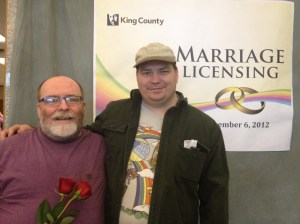
A reporter from The Stranger asked if she could take our picture and ask a few questions. Since I read their blog every day, of course I was willing to answer questions. The first picture in this post is the one she took.Us again. Why do I always stand on his right?
In addition to the regular paperwork, we were given a copy of the proclamation signed by the county executive, and various other commemorative items. We were directed out a different door than the way we’d come in, and some more volunteers were there, handing out roses and taking pictures in front of a sign commemorating the first day that marriage equality was the law. They took a few of these with my camera, then one of the others asked if we wanted one of us kissing.
For whatever reason, that was when I started crying for us. All of my tearing up, getting misty-eyed, and full-fledged crying earlier in the day had been for other people. This was the one where it finally hit me in the gut: the most wonderful man in the world has not only been living with me and putting up with me for nearly 15 years, but finally we’re going to be married. Not civilly united, or domestically partnered, or any of those other names, but married. Part of my astonishment is the simple fact that this wonderful guy actually wants to be saddled with me. I mean, yes, we’ve been together nearly 15 years (it will be 15 in February), and he’s had ample opportunity to run for the hills and hasn’t. But you have to understand, I don’t completely get why he puts up with me. Seriously, there are times I can’t stand to be around me, so I know for a fact I am not easy to live with!Fortunately, Micheal’s hat is hiding my tears.
And there were more people waiting outside. We were offered donuts. There were also people handing out business cards and promotional fliers for wedding-related services. That’s to be expected, obviously. And I’m not complaining. Thanks to the fliers I’ve found several possible places to rent for our reception that I didn’t even know existed.
There were no protestors, though. I had kind of expected some. There are always a few of those people with the old testament signs and such at events like the Pride parade, so I just figured they’d turn out for this. Then when we saw that the line was shrunk to the trickle, I thought that protestors had left. I didn’t find out until we were back home that the reporter was there taking more pictures, after the big lines were through, because there had been a rumor that a group was coming to protest. Apparently they never showed up.
While we were walking back to the bus stop, a random woman on the sidewalk saw the roses, looked at us, grinned, and said, “Congratulations!”
I’ve violated one of my rules and dived into the comments sections of some of those news sites posting the pictures. And the amazing thing is how very few haters are commenting there. In the ones I looked at, if there were negative comments at all, for every 1 negative comment there were easily 20 comments from people saying how happy the pictures make them feel, with lots of mentions of people needing to grab a tissue. And a number of people going out of their way to say things like, “I want to say for the record, that I don’t believe any of these couples has in any way diminished my heterosexual marriage.”
I thought I was emotionally overwhelmed when the Referendum passed, and when I thought about all those straight people who voted for it. But it feels more overwhelming now. I guess going in and getting the license finally is making it feel real.
We have a three-day waiting period. We’re going to have a simple ceremony with friends this Sunday. We’re calling this the Elopement. I want to get the legal stuff handled as quickly as possible, if for no other reason than that I can finally add Michael to the much better medical and dental at my work. So this is the legal thing. And I know some of our friends will be there, and it will be fun and happy.
But the real purpose of a wedding is to allow your extended community of friends and family in on it. I don’t just mean the celebration. I believe that what makes marriage sacred is not that two people have made a pledge before some deity, it is because a group of people have committed to support two people in their love. When I attend someone’s wedding, I’m entering into a covenant with them and the other attendees, affirming a particular loving relationship, but also affirming the power of love itself. It’s a commitment to the extended ties that bind all of us together in circles of mutual affection and respect.
Which is why, yes, we’re planning something bigger and a bit more formal later next year.
While Seattle is known for rain, most of the time what he actually experience is overcast days, with occasional scattered misting. We very, very seldom have downpours. Even the heavier showers tend to be intermittent and scattered.
But about once every winter I get caught in a true downpour that soaks through my waterproofed leather coat, and all the layers underneath.
Last night it happened early in my walk home. When I stepped outside the office building, it was barely drizzling. Three blocks later I pulled the hood of my coat over my head, as the hat was no longer enough. Then, four blocks further, it was as if angels in the sky above had aimed a bunch of firehoses right at me.
The first mile or so of my walk home is along our waterfront. Not right on it, a block away, so that about half the time there is a building between me and the open air. The deluge hit when I was on a two or three block section where there is nothing but lawn and train tracks sheilding me.
The wind was coming off the water.
Even in the height of summer, the Puget Sound only gets a bit less frigid than ice water. This time of year, the water is maybe a degree above freezing. So any breeze coming off of it is like an arctic blast.
Rain starts out high up in the sky as ice crystals. They warm up as the fall, turning into droplets of ice water. In really warm weather they may get all the way up to cool and refreshing, but this time of year, I suspect that they are only about a billionth of a degree above freezing when they reach a hapless pedestrian on the ground.
So I was being hammered by nearly frozen water. Each droplet sucking heat from me, while the cross-breeze was doing its best to finish the job and turn me into a popsicle.
And there wasn’t really any place for me to go to get out of the rain. What buildings were nearby were mostly office complexes. So I moved as fast as I could.
I decided, once I had reached the halfway mark, when my walking route meets up with a bus line, to take shelter in the bus shelter(!) and wait for a bus.
The thinng that worries me about this, is that this is the second deluge I’ve experienced this year. And December is tradionally a month where we dry out a bit after the heavy rains of November, before the heavy rains of January.
I’m getting a bad feeling about this winter’s weather.



 Font Folly