Tag Archives: personal

Why I hate hay fever, reason #5792

While driving home last night, I was just thinking that my allergy prescription dose from the previous night must be wearing off when Michael mentioned that his sinuses had started going whacko. He was attributing it to the change in weather.

Most of last week was very wet, with rain every day. Parts of Friday, all of Saturday, and most of Sunday were quite a bit drier, but only relatively. We had some sun breaks, and what rain there was came in very light, occasional showers. Sunday night we got the deluge.

Radical shifts in air pressure or humidity sometimes cause my sinus passages to either get tender or to close up temporarily, regardless of the pollen, mold, or spore count. And while most people living in the northern hemisphere with ordinary hay fever are free and clear by this time of year, I’m not. Pollen counts are so low as to almost be nonexistent, and fern spores are tapering off. But November is toadstool and mushroom season, which means fungus spores are just ramping up.

In addition to my usual prescription, I took a bit of over-the-counter stuff before going to bed. I awoke in the middle of the night with the sinuses in super-hyper congested mode, along with the itchy eyes. So I took another type of over-the-counter stuff and managed to go back to sleep.

This morning I broke down and raided my pseudo ephedrine supply. Can I say, by the way, I hate that meth heads and meth lab runners have turned thousands of innocent sinus-problem sufferers into suspects, forcing us to show ID, sign extra paper work granting the state, the feds, and the pharmacy companies permission to examine and share information about our purchase history of what used to be a cheap, over-the-counter nasal decongestant? Which is rationed by those same forces, now?

I’m sorry, the usual substitutions don’t work anywhere near as well for me. So at times like this, where everything above my jaw line hurts, aches, and stings, I just don’t understand how restricting law-abiding people from buying a legal medication (a practice which has had zero effect on the illegal trade of the substance that said medication can be used to manufacture) makes any sense.

Now excuse me while I pack some extra tissue into my backpack before I leave for work…
Nightmares

I have trouble with scary movies. At least certain types of scary movies. They give me nightmares, and I’m the kind of person who, while having a nightmare, climbs out of bed, running around waking up everyone I can find, frantically trying to explain the horrific danger we’re facing and how we have to come up with a plan to deal with the threat now.

I love certain types of scary movie. I could watch the 1931 Dracula, or the ’31 Frankenstein or ’35 Bride of Frankenstein, or the ’32 Mummy over and over and over again. Give me a classic Godzilla any time!

Sometimes while explaining this, I’ve had friends ask how this can be true, when they know I have written some pretty creepy and horrific stuff. Or, as a friend very recently put it, “How can you love Fringe so much? It presents a lot of things far worse than many scary movies you’ve refused to watch!”

Part of the issue is control. If I’m writing the scary stuff, I’m in charge. I can save whoever I want. I can make the bad guy lose when I want and how I want.

To a lesser extent, watching a scary movie (or series) at home on TV or iPad is different in part because I have some control. I can pause or stop the movie when I want. More importantly, if I’m not immersed in the big screen setting without the theatrical sound system it’s easier for me to remember I have control. I’m not trapped in the center of a row of strangers in a dark room. And sometimes just looking away isn’t enough.

There’s also familiarity. Forbidden Planet was one of the first movies to trigger this reaction when I was about five or six years old (it’s the one my Mom still tells stories about), but now, it’s one of my favorite movies of all time. I know how it ends. I know what the monster is and what its limitations are. None of that was true the first time I saw it.

And in Fringe‘s case, there is an additional salvation: there have been very, very, very few scary movies ever made which any character who is even one-tenth as smart as Walter is on the good guys’ side.

Because what’s missing from most nightmares is a hero you’re confident will win the day.

Let the punishment fit the crime

Three of my best friends have been hosting a Halloween party for about 20 years. They always have a theme to the party, which guides their decorations, party games, and usually their own costumes.

Sitting at the partyMany of us who attend regularly create our costumes based on the theme. For example, the year the theme was Your Worst Nightmare, I came dressed as a gay republican. Not that a gay republican, per se, is my worst nightmare, but me BECOMING one comes pretty close. On the other hand, the year they set Egypt as the theme, Michael and I came dressed as a pair of aliens, carrying a clip board with a work order written in hieroglyphics. So while neither of us believe any of that ancient astronauts nonsense, we are not above using it for a silly costume joke.

This year’s theme was Shakespeare. There were several people there dressed as specific characters from Shakespearean plays, others were in Elizbethan dress, and a number of us were there as jokes.

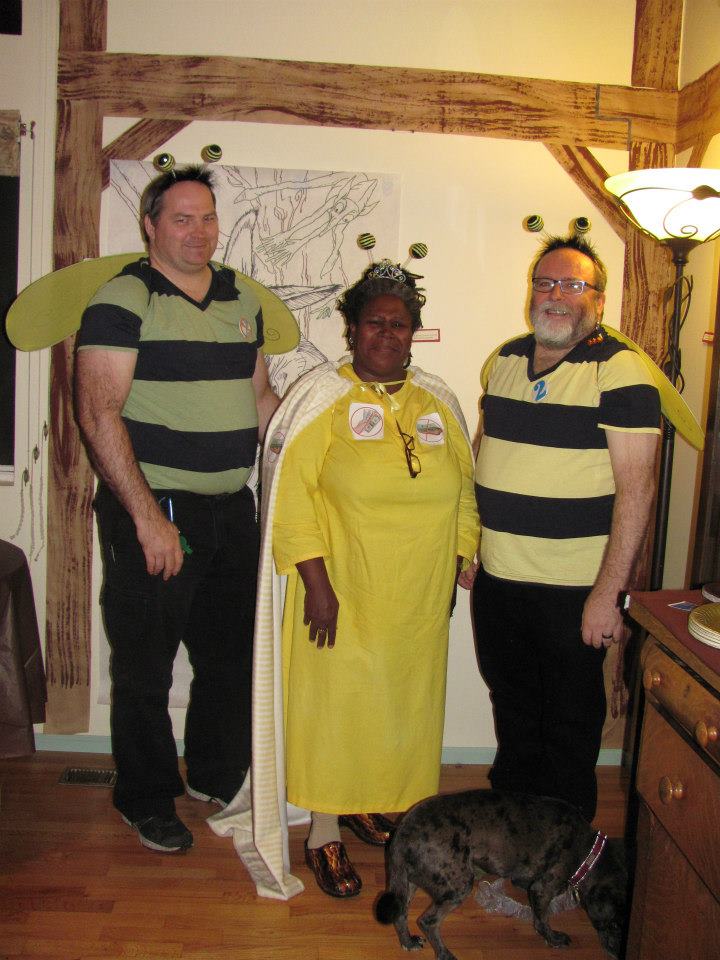
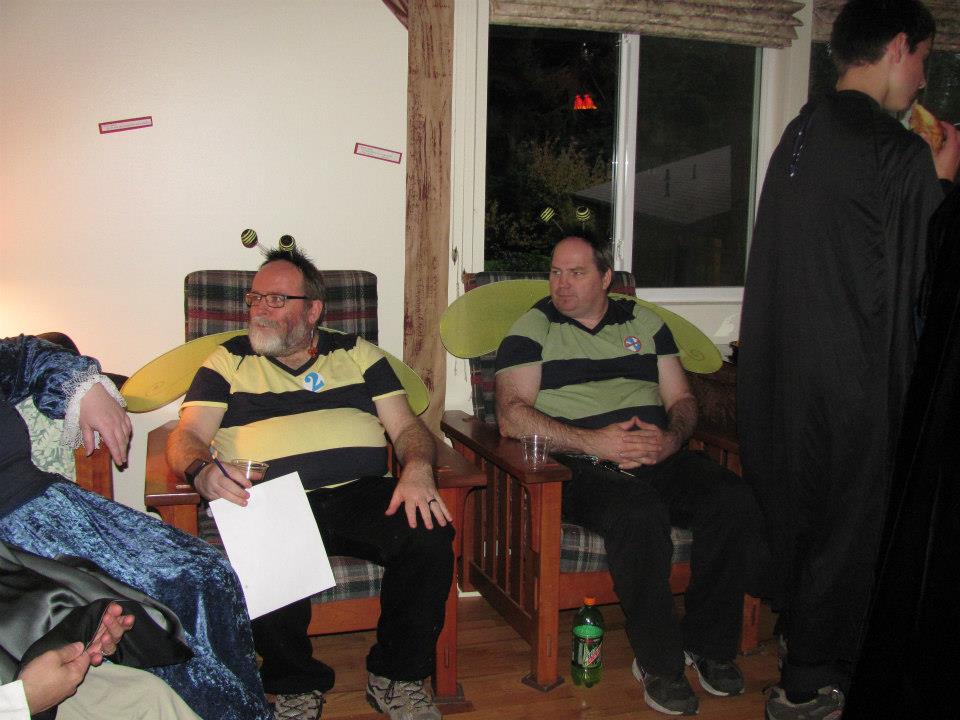
Michael and I were each dressed in yellow-and-black striped shirts, black pants, silly antennae on our heads, and yellow wings. I wore a lapel button with a large, friendly-looking “2” on it. Michael wore a button with the same friendly-looking “2” except with a red circle and slash through it.

.

.

.

.

.

Two silly menSo I was 2, and he was not-2.

.

.

.

.

.

And we were both bees.

.

.

.

.

.

.

.

And it’s hard to get more Shakespearean than having a choice between the 2 Bee and the Not-2 Bee, right?

We were told we would be PUNished for our bad joke costume. We were told our Punishment would almost certainly involve hives. There were many other silly puns flung about, but I have forgotten most.

But we weren’t the only bees there. One of the other guests came as the Neither A Borrower Nor A Lender Bee.

(If I manage to get pics from any of the people who took them, I’ll add them to the post.)

The only part of our costumes that didn’t come together is we didn’t recruit a third person for the silliness, because Michael would then have dressed him in blue suit, fedora, and a flesh-colored featureless face mask, just like the DC Comics character known as The Question.

Because then we would have the 2 Bee, or Not-2 Bee, and that is The Question.

Dream dilemma

I had a somewhat disturbing dream, in which I was out shopping with my mom, and she occasionally made references to a book I had given her as one of her presents the previous Christmas. Except she wouldn’t mention the title, she kept referring to it simply as, “that book you got me.”

And the conversation got a bit weird and emotional. Finally, she pulls out the book, and it’s a book of quotations. But specifically a book of gay and lesbian quotations. For a second, in the dream, I was very confused, and then I realized that I had accidentally swapped the tags on two books I had been wrapping up for different people. I had intended to give Mom a book about the writing process or something, and this was supposed to go to someone else. Continue reading Dream dilemma

It’s not just speech…

When I proposed to Michael, I didn’t ask him to move in with me. He had said “yes” to my proposal, but he lived and worked in a different city, and my late husband had died less than a year before, so we were both a little nervous about rushing into things. Therefore, at the time of the proposal, we agreed we’d wait a year before taking the more drastic step.

But about six months later, one of his housemates started behaving strangely, such as going through Michael’s stuff when he was away (and more creepy things). Suddenly the thought of Michael being there was completely unacceptable. I didn’t care if it seemed like we were rushing, all I could think of was that I needed to get him somewhere safe.

Never mind that he, as one friend recently described him, is “the most capable person I’ve ever known.” Never mind that his job history has included being a bouncer at a bar, or that his past hobbies included bull-riding. No matter how tough, smart, or capable he is, the thought of him being in an unsafe place made me a bit irrational.

Fourteen-and-a-half years later, we’re still together—happily so. I guess we weren’t rushing, eh?

During that time, we’ve registered our domestic partnership—first with the city, because the state didn’t allow it. Then later, once the state did allow it, with the state. Thanks to a voter-approved referendum, in our state that partnership now carries all the legal rights and responsibilities of marriage. So we can jointly own property, we are allowed to make medical decision for each other if one of us in incapacitated (assuming we don’t run into a hospital worker who doesn’t understand what the domestic partnership law means), and if one of us dies, the survivor doesn’t have to produce proof that he paid for half or more of anything or lose it to the other’s blood relatives (because it’s all by default community property).

Unfortunately, even in a state with strong domestic partner laws, there are still a lot of inequalities.

I’m older than Michael, and have some chronic health issues. It is likely he will outlive me. By chance, I also earn more money than he does. If something were to happen to me, he would be put in a financial bind. Yes, I have life insurance, so there will be a bit of a cushion, but because what we have isn’t recognized on the federal level as a marriage, he would not be entitled to survivor benefits from social security. If he remains single after my death, when he decides to retire, his benefits will be calculated solely on his own earnings.

If our relationship was legally recognized, all of that changes. He would be entitled to survivor benefits under some circumstances. When it came time to retire, he would be entitled to benefits based on my years of earning.

Before you make an argument about the sanctity of marriage, consider this: if, on my deathbed, I was to have a quicky marriage with a woman someone selects completely randomly, the ceremony and signing completed literally seconds before my death, she would be entitled to all those benefits. Never mind that we didn’t know each other. Never mind that no defininition of sacred would encompass that random person standing by my hospital bed.

Legal marriage isn’t about sanctity. Legal marriage isn’t about forcing churches to do anything. Right now, two people who have been divorced can legally marry in all fifty states (so long as they are opposite gender). If they ask a Catholic priest to perform the ceremony, he will turn them down, because the church doesn’t believe in divorce. It happens a lot. The fact that the law recognizes re-marriages has not and will not open the church to being sued. Just as a church can choose not to perform a wedding if, for example, one of the members belongs to a completely different faith.

And before you bring up that story about the “church” that got in trouble about a same sex marriage a couple years ago: 1) it wasn’t a church, it was a separate business set up by a ministry as a fundraising activity, 2) when they set up the business, they applied for an exemption from paying property taxes on a small park and pavilion that they intended to rent out for events, 3) the exemption required them to sign an agreement which explicitly said that they would run the business as a public accomodation, and that they would not refuse to rent to any member of the public on the basis of race, religion, political affiliation, creed, ethnicity, gender, or sexual orientation, 4) this agreement that they signed had to be renewed every year, and they had to, every year, re-affirm that they would not refuse to rent the park and pavilion to anyone on the basis of race, religion, political affiliation, creed, gender, or sexual orientation or the park and pavilion would cease to be tax exempt.

And then they told a lesbian couple that the couple could not rent the pavillion because they were opposed to same sex marriage and anything like it.

That’s when the one selected parcel of land lost its tax exemption. The parent ministry was not fined, it did not lose its tax exempt status. The church that many members belonged to did not lose its tax exempt status and did not face any fines or retribution. The only thing that happened was that the side business had to start paying taxes, just like any other business.

It is true that as marriage equality moves forward at the state level, people who don’t approve of it will see neighbors, co-workers, and strangers enter into legal marriages and in legal ways be treated just like the other kinds of marriage. That will include, sometimes, having to do business with these couples and treat them, in terms of publicly transacted business and such, just like any other married couple. Which will make them uncomfortable.

Being comfortable is not a legal right.

Asking the law to allow you to discriminate is not just speech. Preventing someone from renting a home is not just speech. Barring someone from the hospital bedside of their partner is not just speech. Barring some couples from tax benefits is not just speech. Encouraging parents to literally throw their gay, lesbian, or bisexual teen-agers out on the street—telling them that abandoning their own children and making them homeless is the correct, biblical thing to do—is not just speech.

Strumming

Several people I know are prepping (and some still thinking about it) for National Novel Writing Month. If you’ve never done it, but have an interest in writing, have tried writing, or are a writer, I encourage you to give it a go.

I will not be participating this year. I have a slightly different reason than I’ve given before: I have to spend a lot of time practicing ukulele if I’m going to be ready for this year’s holiday party.

Continue reading Strumming

“Family”

I didn’t talk much about why coming out is important yesterday in my National Coming Out Day post. The reasons I would usually give—about living life honestly, about the benefits of not living in fear, and so on—get dismissed by some people, who think that such honesty is somehow “shoving things in their face.”

The best answer is one I got from a news blog’s comment section four years ago. When Proposition 8 passed in California, revoking the right of marriage equality that had already been exercised by a few thousand people, protest marches were organized around the country, and a person identifying herself as Tina posted the following:

If you want to know why I am marching it is because I remember being six years old and having to sit in a hospital waiting room with my parents and my Uncle RJ while his partner of 19 years (a man I knew as Uncle Ron who taught me how to braid my hair and wear pinks and reds because they highlighted my coloring) died alone in a hospital room that only “family” was allowed into… Then, as a child, I couldn’t understand why we weren’t allowed to say goodbye to him… Now, as an adult, I still don’t get it. People are people and frankly I figure we could all use a little more love and equality in the world.

These sorts of things still happen—partners who have taken care of each other, loved each other, pledged themselves to each other, get locked out of hospital rooms, are denied access to accident reports, are barred from funerals (often by family members of the deceased who had disowned the deceased years before over the “lifestyle choice”).

As testimony given in the New York state legislature last year demonstrated, these sorts of things even happen in places where the law recognizes “domestic partners.”

Me telling you I love Michael isn’t revealing anything more about our private activities than any person’s mention of their spouse, boyfriend, or girlfriend. Strangers mention spouses in causal conversation all the time, and no one is harmed in any way.

But there is real harm that comes from the ostracism and hiding.

The trouble with required reading

A friend was complaining about how off-putting the list of required reading was for her son returning to school, and I empathized. Then several more people mentioned the same topic on Facebook, and I thought, “Well it’s the beginning of the school year, so everyone is seeing their kids’ list and remembering their own experiences back in the day.”

Then Cracked.com had an article about the ways high school destroys the reading enthusiasm of many kids, and I wondered if a new school year was the only explanation. Continue reading The trouble with required reading

Wrong in all the right ways

Every convention I have ever attended has included conversations with people who do not seem to be on the same time-space continuum as I am. This has been just as true at the journalism conferences I attended back in the day, or the evangelical mission conference I once attended, or any tech conferences, not just the sci fi, comics, gaming, or anthropomorphics conventions.

I realize that it is mostly a matter of statistics: a certain percentage of the population could be categorized as odd or downright crazy, so any situation that puts you in contact with a bunch of people in a constrained time will include some of them. There’s also likely a correlation between certain personality types and enthusiasm. In other words, the sort of person most likely to choose or agree to attend a convention dedicated to any topic may be more likely to be a few standards deviations out from the norm in some way or other.

Often after conventions I summarize some of the conversations I had with random people while sitting behind my table in the dealer’s den. I do this for entertainment value, and so have usually picked the silliest, weirdest, or just most dumb-founding. Which creates the impression that that’s all the happens.

It’s not.

Also, for some reason, there were a lot fewer of the really odd ones this time.

So, I think this time I want to focus on the more positive fun encounters:

Fan #38: Points to my t-shirt. “Hey, is that a pony? Which one?”

I lift my badge up out of the way. “It’s Derpy!”

Fan #38: “Derpy! I need a Derpy shirt! Wait, why does she have a muffin?”

Me: “Why shouldn’t she have a muffin?”

Fan #38: “No, no, no! Derpy should have a chocolate chip cookie!”

Me: “Derpy can handle either.”

Fan #38: “True. More Derpy!”

———————

Fan #9: Stops and grabs friend’s arm. “Oh! This is one of the books I was telling you about!”

Fan #10: “What? Another comic?”

Fan #9: “No, it’s stories! Science fiction and stuff.” Makes eye contact with me. “I really like your stuff. Oh! Look, that’s a new issue!”

Me: “Just published last week, actually.” I look at the other guy, who has picked up one of our zines. “Do you want me to explain how the project works?”

fan #10: “Sure…”

I gave him the usual spiel about being a collaborative project, and that we’re a non-profit with a mission of fostering creative skills, and a bit about the universe.

Fan #9, meanwhile, has pulled copies of the most recent two issues from the racks. “I’ll take these.”

Fan #10 puts the issue he’d been looking at back down, and asks his friend, “I can read these, right?”

Fan #9: “Yeah, but if you like ’em, you should pick up the whole set.”

I rang up the sale, handled the change, then pulled out one of the blind bag boxes.

Fan #10: “You’re giving away ponies?”

Me: “One blind bag with each purchase, subscription, or renewal.”

Fan #10: “So I can come back tomorrow when I have money. Cool!”

(I don’t know if he came back, since I wasn’t always watching the table)

———-

Fan #87: “There you are! I was afraid you weren’t around any more when I didn’t see you last year.”

Me: “We were here last year.”

Fan #87 is picking up the last several issues from the racks. “Really? I looked and looked.”

I pointed out where we had been, and mentioned the posters.

Fan #87: “I don’t know how I missed you. Tell me about this Omnibus…”

———-

Fan #43: “Yeah, I picked up some of your books last year, but only really liked a couple of the stories.”

Me: “I’m sorry.”

Fan #43: “It happens. I really, really like those two stories, but some of the others just weren’t my thing.”

Me: “Do you remember which ones you liked?”

Fan #43 describes two tales. I ask some questions, he answers. We determine the stories were “New Queensland Station,” originally published in issue #2, reprinted in the Omnibus, and “A Shadow’s Kiss” from Eclipse. We talk some more about what he liked about them. Eventually I suggest he might possibly enjoy “Beside Himself” from Skulduggery, and point out a sequel, “The Shadow of Azrael” was printed in a more recent issue. He decides to pick them up.

The next day, Fan #43 stops by the table. “I haven’t had time to read them all, yet, but I really loved the story in the Special Edition. Thanks for recommending it!”

Abby someone

One of my favorite scenes in Young Frankenstein is when, after the recently animated monster goes on his first mini rampage, the doctor gets Eyegore to admit that he dropped and destroyed the brain of the brilliant scientist Dr Frankenstein had hoped to revive and had taken another brain from the brain depository.

“Abby Someone… Abby Normal, I think. I’m almost certain that was the name.”

No one wants to be labeled “abnormal,” but most of us also don’t want to be described as “ordinary.” We want to be close enough to normal to be excluded from the freak category, but also to be considered above average at something. So many of us spend at least part of our lives walking a tightrope, trying to find a path through that ill-defined territory that brings both acceptance and maybe a teeny bit of acclaim.

One problem with walking a tighrope is that there isn’t any room for error. And certainly no opportunity to explore new territory.

I fell off the tightrope pretty early in life. At some point before kindergarten, my parents figured out that when I was talking (or rather, babbling incessantly) while playing by myself, that I was responding to voices that I was hearing in my head. I thought everyone heard voices like that. It was the only way I knew how to think, to have conversations with different parts of myself.

I tried explaining that, but being only—what, three years old?—didn’t have the experience, vocabularly, or conceptual framework to get the idea across. All my dad understood was that 1) I heard voices, 2) I did not think of them as imaginary friends, and 3) I couldn’t stop them.

So he told me, in no uncertain terms, that I was never, ever to let anyone hear me talking to the voices. If I did, very bad things would happen to me. The least of which were that no one would be friends with me and that I would be taken away and locked up somewhere.

Dad isn’t exactly a touchy-feely kind of guy, you know?

Now there’s neuroscience to show that talking to oneself makes several mental process work better. There’s additional evidence that imagining different trains of thought as a conversation is simply an outgrowth of a number of perfectly unexceptional mental processes. The extent to which my internal monologue splits into a couple dozen dialogues is more than a single standard deviation away from the median, but it’s not so far out as to be worrisome.

I also see relationships between things differently than most. It’s the reason I used to confuse some of my fellow orchestra and bandmates when I would say that playing the tuba was no different than trumpet, you just needed to move the root note of the scale. Reading Bass or Treble clef (or, once I took up bassoon, Alto and Tenor clef) was simply a matter of sliding the starting spot up and down, as well. Switching between bassoon, saxophone, clarinet and flute was all about transposing or rotating finger positions.

I think the one that weirded them out the most was trombone. “First position is just like all valves open because the air path is shortest.” (Though French horn was actually the hardest—I had to visuallize it as air paths, but my fingers kept wanting to treat it as one of the other valved instruments.)

None of which made me a musical genius—it was just me looking at music as a series of math problems. (Of course, there were the other math majors in college who thought my love of Differential Equations was the equivalent of performing black magic).

Seeing those transpositions and substitutions as being the same whether we’re talking about notes, numbers, labels, or commands is why I can quickly (I mean really quickly) learn new scripting or programming languages, et cetera.

Which all sounds really impressive and cool and such. But that same brain is incredibly proficient at losing my keys, or the pile of papers I just had in my hand, or what do you mean my glasses are right there? I looked five times already and they’re not… Oh, well, what do you know?