Tag Archives: sci fi

I feel a Tingle, tingle, tingle…

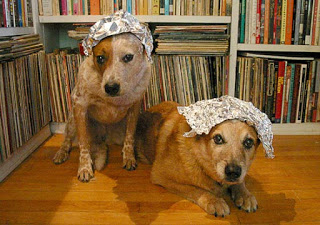
Puppies in tin foil hats
Puppies in tin foil hats (Click to embiggen)
It’s Hugo voting season again, and as I’m reading through the stories that have been nominated, I’m once again confronted with a number of choices that were placed on the ballot by the bloc-voting scheme of the Rabid Puppies. I’ve had at least one friend ask why I even care, which I suppose is a legitimate question. There are several reasons, but one of the biggies is this: it has been demonstrated that being nominated for a Hugo can have a significant impact on the sales figures for a book and/or author who was not previously really well known. In other words, folks who are mid-listers and below receive an immediate improvement in sales when they are included in the short list for the Hugos. If such a person goes on to win, there is a bigger increase in sales. And many authors have attested to the fact that when they won at a point when their career was struggling, that agents or editors who previously hadn’t shown any interest come knocking at the door.

Because no one has ever taken the equivalent of exit polls when people leave physical bookstores or log off of online stores to determine why people buy specific books, we have less hard data about the long term effects winning awards on someone’s sales. Library data indicates that books which have won the Hugo, Nebula, or Clarke awards have much higher circulation rates (more people check them out, they remain on the shelf for shorter times between check-outs, et cetera). Some marketing research seems to support the idea that when browsing, people are more likely to pick up and look at book that says “award winner” on it than those that don’t.

Which is all to say that one of the reasons I care is because getting nominated or winning the award can significantly benefit a writers’ career, particularly one that is not otherwise well known. So spiteful schemes to push works of dubious quality onto the ballot causes actual harm to the people who otherwise would have made the short list. Super spiteful schemes, like this year’s Rabid Puppy slate, which push material that the organizer chose precisely because of how bad it is, are even worse.

Which brings us to one of this year’s nominees: “Space Raptor Butt Invasion” by Chuck Tingle. Tingle (not his real name) is a niche erotica author who produces a lot of really weird erotic fiction that is clearly not meant to be taken seriously. He had never even heard of the Hugo Awards before his nomination was announced, and had to have it explained to him by an interviewer who was asking him for a reaction. His immediate reaction was to say that he despite getting nominated for an award because of it, he is definitely not in favor of bloc voting.

Tingle said his son told him he needed to look into the folks behind the puppies, especially Vox Day.
He has since educated himself on the topic. This inspired a series of Gif- and video-illustrated tweets mocking Vox Day, the racist & misogynist guy running (and profiting off of) the Rabid Puppy campaign.

Tingle also wrote a new “book” for the occasion: “Slammed In The Butt By My Hugo Award Nomination.”

That wasn’t the end of his trolling of the Sad and Rabid Puppies. He has since asked Zoe Quinn, who is hated by the puppies and their allies the GamerGaters, to attend this year’s WorldCon and if Tingle’s story should win, to accept on his behalf and give a speech about whatever she wants. So if the puppy loyalists vote for Tingle’s story, they give one of their most hated people another public forum to talk about the issues they hate being talked about: Weird porn author who was dragged into Hugo Awards mess pulls off epic troll.

He didn’t stop there. He realized that despite the fact the Vox Day has managed to use the Rabid Puppy campaign to radically increase traffic to his blog and publishing site, and to sell more books to the sorts of racist, homophobic, misogynist fans who apparently previously didn’t know how to find them, Vox had never purchased the Rabid Puppy web domain. So Tingle bought it and set it up as a site to mock Vox and to promote some of the authors that Vox has so often publickly denigrated: Chuck Tingle thwarts devilman Vox Day, buys TheRabidPuppies.com for HARD buckaroos.

sometimes devilmen are so busy planning scoundrel attacks they forget to REGISTER important website names. this is a SOFT WAY of the antibuckaroo agenda but is also good because it makes it easy for BUDS WHO KNOW LOVE IS REAL to prove love (all).

please understand this is website to take DARK MAGIC and replace with REAL LOVE for all who kiss the sky.

Tingle hasn’t just turned his unique satirical eye toward the puppies. His commentary on the transphobic bathroom laws and similar nonsense, “Pounded In The Butt By My Irrational Bigoted Fear Of Humans Who Were Born As Unicorns Using A Human Restroom” is available (as all of his delightfully weird titles are) on Kindle.

I don’t think that there is anything particularly award-winning about “Space Raptor Butt Invasion,” but Tingle’s actions are definitely award-worthy. I know I’m not the only regular Hugo vote who is considering putting Tingle’s story above No Award on my ballot because he’s been both a good sport about this, and so delightfully entertaining in his take down of the Rabid Puppy ringleader. And for a man who finds many weird ways to put the phrase “pounded in the butt” into story titles, he’s been much more civil in his attacks on Vox Day than Vox has ever been to anyone.

If you want more details on Tingle’s campaign against the bigots: Satirical erotica author Chuck Tingle’s massive troll of conservative sci-fi fans, explained.

When I first started to draft this post, I had more information and links about the Rabid Puppies and Sad Puppies, but I think that Cory Doctorow was right on the money when he recently said, “the two groups who want to kill the Hugos call themselves “Rabid Puppies” and “Sad Puppies” for fantastically tedious reasons you can look up for yourself if you care to.” Re-hashing the reasons they’ve launched these campaigns and the inconsistencies and contradictions in their arguments is tedious. We’ve all written way more about it than they deserve.

Tingle’s bizarre and hilarious response reminds me that life, reading, and storytelling are far too important to take seriously. It’s much easier to enjoy a good story if I laugh about something frivolous first than it is if I’ve been ranting about someone being a jerk.

So I’m going to go read another of Tingle’s stories, then get back to the serious work of reading and writing sf/f.


ETA: Chuck Tingle isn’t the only person who writes silly stuff that is more worth your time than the rantings of outraged people. May I humbly suggest:

Monster Mashed by Grave Robbers from Outer Space, or

John Scalzi Is Not a Popular Author And I Myself Am Very Popular
Out of Body Vacations – more of why I love sf/f

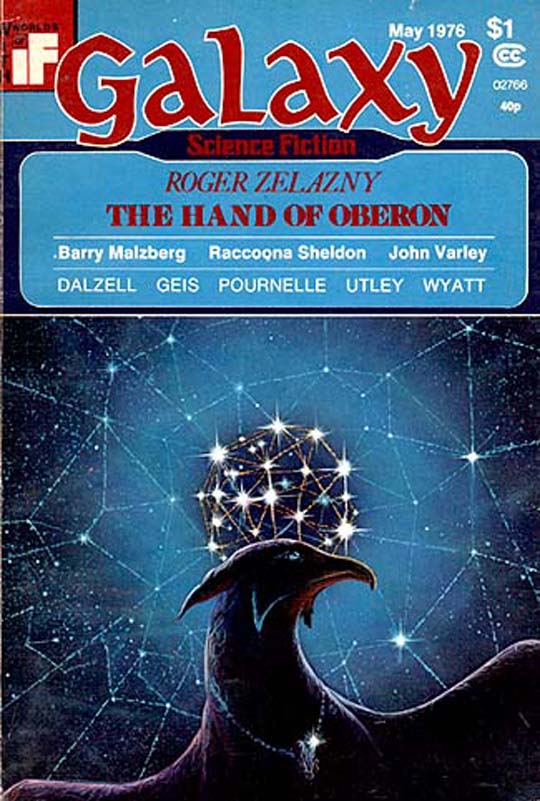
Cover of the May 1976 edition of Galaxy Magazine, which is where I probably first read Varley's “Overdrawn at the Memory Bank.”
Cover of the May 1976 edition of Galaxy Magazine, which is where I probably first read Varley’s “Overdrawn at the Memory Bank.” (Click to embiggen)
In the spring of 1976 I still had a subscription to Galaxy magazine, thanks to my grandparents, though things were not going terrible well in my life at that time, so I didn’t always get all the way through one issue before the next came in. So I might not have read it until some months, after my parents’ divorce was final, and Mom, my sister, and I moved 1200 miles away. I definitely remember owning the magazine with this cover. This issue contained the story, “Overdrawn at the Memory Bank” by John Varley.

Varley was the author of “Picnic on the Near Side” which I wrote about before, and which made quite an impression on me. This story is set in a similar world, with extensive colonies on the moon. It concerns a man named Fingal how has purchased a vacation at one of the “disneylands” which was large lunar caves that have been made to duplicate long lost environments on earth, complete with cloned wildlife. Fingal’s memory and personality are transferred from his brain into a cube, which is then implanted in a lioness so that Fingal can experience the life of a predator on the savannah.

Something goes wrong, and Fingal finds himself back in his own life sooner than expected, and strange things keep happening, such as books rewriting themselves before his eyes to become messages to him. He eventually learns that his body has someone been misplaced, so the memory cube has been put into a safety mode, interfacing with a computer which is creating a simulation of his real life. Messages come to him from a technician named Apollonia Joachim who explains that the simulation is necessary to keep his memories and personality intact until it can be returned to his body.

As the days stretch into weeks, Fingal starts taking classes in the simulation to teach himself new skills to get a better job when he does get back. Strange things happen, as the technician tries to keep him focused. In one incident, Fingal notices strange patterns in the floor tiles in his bathroom, and starts tracing them with his toe, suddenly the bathroom fills up with money. Fingal’s consciousness had somehow gotten into someone’s financial records. Apollonia warns him about losing himself again and again.

Over the months that follow, Fingal finds himself falling in love with Apollonia, and making plans for a future together.

Eventually Fingal is reunited with his body, and then learns that what felt like years to him in the simulation was only six hours, because his thoughts were moving at computer speed while connected. Ms Joachim has only been interfacing with him for a few hours, and doesn’t share his feelings.

The simulated classes he took did result in real learning, so he does have new skills and can pursue a more interesting job. Plus, of course, he gets a refund on the vacation and a lump sum settlement from the company. He’s informed that other people who suffered similar accidents have not always fared so well, and he’s the first person two survive six hours outside the memory cube’s normal limit.

Varley didn’t win an award for this particular story. He did win a Special Locus award the year this was published for having four novelettes, including this story, voted in the top ten in the Locus Reader Awards.

The story was adapted badly into a movie that changed a lot of things for no particular reason. Avoid the movie. The story isn’t action packed, but is more focused on the internal conflicts of a man unhappy with his life who is forced to stay there even if it is simulated. The notion being that if they allow his fantasies to run wild while his personality is in the memory cube, he will go mad and forget who he really is.

I enjoyed the story a lot. The notion that it’s the boring and repetitive parts of our lives that anchor our identities wasn’t terribly revolutionary, but it was interesting to see how this sort of technology might play out without any world-threatening peril giving it at artificial sense of danger. Really, who needs a bigger threat than literally losing your mind to provide a sense of dramatic tension?

One odd side note: I always get this story mixed up with another Varley tale, “The Phantom of Kansas.” They’re both set in the same fictional future world (the Kansas in the title of the second story is an artificial recreation of the midwestern plains of North America in another Lunar cave), and both stories involve stored personalities, but otherwise the plots have nothing to do with each other. The simple fact is that I think the title “Overdrawn at the Memory Bank” would have been better for the second story as it evokes a metaphor for the central plot better than the notion of a phantom. So there has been more than one occasion when I’ve pulled out an anthology, such as my hardcover copy of Wolheim’s 1977 World’s Annual Best Science Fiction, see the title of Varley’s story, turn to it expecting to read the other story, and then as I read the opening paragraphs remember that I always get them mixed up.

Oddly, I own more than one anthology that includes “Overdrawn at the Memory Bank,” but absolutely none that include the other story. I need to fix that.

Robots Aren’t People, Are They? – more of why I love sf/f

Cover for the first edition hardback of <em>The Bicentennial Man and Other Stories</em> by Isaac Asimov.
Cover for the first edition hardback of The Bicentennial Man and Other Stories by Isaac Asimov. (Click to embiggen)
I first heard of “The Bicentennial Man” by Isaac Asimov when I saw the anthology, The Bicentennial Man and Other Stories offered as a selection in the Science Fiction Book Club. I was 16, and still technically a member of the club, but most months I checked off the “Send nothing at this time” box on the card, because even the cheaper prices of the book club were a bit much for my budget. It a bit over a year later when I found a paperback copy of The 1977 Annual World’s Best SF edited by Donald Wolheim in the local used book store when I finally got a chance to read the story.

Asimov wrote a lot of short stories about robots. Most of the stories collected in his anthologies I, Robot and The Rest of the Robots dealt with various logical contradictions that robots would be placed in by various circumstances, and how the robots (and the humans working with them) would work out those conflicts between the Three Laws of Robotics, their other programming, and the situation at hand. Even in his longer novels where robots figured prominently, such as the two sci fi murder mysteries, The Caves of Steel and The Naked Sun, the robots were always motivated by pure logic. The fact that the world is not a purely logical place, and that humans are seldom covered by rationality alone, formed the framework for the conflict in the stories.

“The Bicentennial Man” centered on a single robot, dubbed Andrew by the daughter of its first owner (a Mr. Martin, identified in the story which is told from Andrew’s point of view as simply Sir). Andrew demonstrates an unusual talent with wood carving—his works of art fetching high prices when offered for sale—and develops a desire to became human. Andrew is part of a new series of robots with what Asimov describes “more open-ended architecture” in his positronic brain, which the experts believe is where his apparent artistic talent comes from. Andrew’s stubborn insistence that he can become a human worries the scientists at the world’s largest robotics company, causing them to try to buy Andrew back.

In part because of the pleading of the owner’s daughter (whom Andrew calls Little Miss), Sir refuses to sell Andrew back to the company. Later, Sir helps Andrew gain some form of legal independence as a “free robot” with the legal name of Andrew Martin.

From there the story follows Andrew’s physical and legal journey through several generations of the original family, as Little Miss grows up, grows old, and dies, and her son and grandson found a legal firm which, among other things, fights to secure Andrew’s legal rights. Andrew designs new kinds of prosthetics, which are almost indistinguishable from natural body parts. Andrew’s body is slowly ungraded to first being a more human-looking android body, to an organic one. The proceeds from the patents on the various processes to create the prosthetics (which are used medically to improve the lives of disabled, maimed, and diseased people) providing Andrew’s income and funding the legal fight.

One of his important legal victories happens when he is 150 years old, where at a dinner in his honor (celebrating his medical inventions), he is toasted as the Sesquicentennial Robot.

Eventually, as Andrew realizes that he will never persuade a human legislature to pass a law declaring him, or any robot, a human because the key difference will always be his positronic brain. Which leads Andrew to compel a robotic surgeon to perform an operation on his brain that will cause the brain to slowly decay and die. Andrew’s reasoning is that it’s the immortality that forms the final barrier between him being accepted as a human.

The story really resonated with me. And it was interesting to see Asimov explore the nature of emotions and creativity from the point of view of artificial intelligence. But more interesting was the series of legal barriers that Andrew has to go through. Laws have to be changed to allow a robot to own property, for instance. Laws must be changed to make harming a robot a crime, at another point.

The legal progression to personhood that Asimov takes us through is based on the historical legal fights for woman’s rights and racial equality. For millenia, the legal system treated women as property. Assaulting a woman was a crime, yes, but the penalties imposed always included paying a fine to the woman’s father (if she were unmarried) or her husband, because the man in her life was deemed to have been harmed by the degradation of his property.

Similarly, Andrew discovers, once he is a free robot, that since there is no owner to whom damages would be owed, the legal system doesn’t consider anyone assaulting and damaging him a crime as assault. Vandalism, perhaps, but then, who is the owner who should be compensated for the damage?

It seems ridiculous to us now that some people, simply because of their gender or the color of their skin, had once been in a similar situation: harming them wasn’t inherently a crime, it was only a crime if it caused their “owner” to suffer a loss. And especially frightening to realize that in the matter of sexual assault laws in the U.S., for instance, that as recently as the 1970s the law was still structured this way. A woman couldn’t file rape charges against her husband or sometimes even her ex-husband, because once married her consent was no longer hers to give or withold, in that regard.

Andrew’s struggle for human rights parallels, thus, every oppressed groups struggle for equality. Something that I came to appreciate more some years later, when I finally bought my own hardcover copy of The Bicentennial Man and Other Stories and re-read this particular short story again. There is even a point, during the discussion about the assault laws, where another character makes the same argument at homophobes current make against hate crime laws: they aren’t needed, because the action is already a (minor) crime under existing laws.

Asimov’s story about a robot who wants to be a human might seem, on the surface, to be little more than a retelling of Pinocchio, but we see here one of the Grandmasters of Science Fiction—a sci fi writer who first reached prominence during the “golden age” of sci fi—turning a civil rights argument into a rattling good tale of old-fashioned science fiction. Who would have thought an old, white (okay, jewish, but still) male sci fi writer who made his first professional sale in 1939 would be a social justice warrior? Don’t tell the melancholy canines!

When I read “The Bicentennial Man” I was a very closeted high school student, terrified that people would find out I was queer because I knew that strangers, friends, and even family members would see me as an abomination if they knew. So the story of Andrew, who wanted to be seen and accepted as a person certainly struck a chord. Even if his ultimate solution, dying, seemed like a terrible way to achieve his goal.

A World Full of Sisters – more of why I love sf/f

Cover of the paperback edition of the 1977 Annual World's Best Science Fiction, edited by Donald Wolheim
Cover of the paperback edition of the 1977 Annual World’s Best Science Fiction, edited by Donald Wolheim (click to embiggen)
When I was a junior in high school there was one comic book shop in the town I lived in. It was also a used book store, so I visited there a lot. I didn’t have much money, and I was still reading several comics regularly which took up most of my discretionary spending, so I spent a lot more time there browsing—trying to find the cheapest books—than actually buying.

One day at the store I happened upon a paperback copy of The 1977 Annual World’s Best SF edited by Donald Wolheim. I owned several of his earlier annual anthologies, having gotten several of them as part of my introductory new member shipment from the Science Fiction Book Club a few years previously. The paperback was in pretty good shape, having only been published about six months previous, so it was probably marked at half cover price, which meant it wasn’t in my usual price range, but I had enjoyed the earlier collections, and there was more than one author in the table of contents whose work I really loved, so I bought it.

One of the stories in this particular collection was a novella, “Houston, Houston, Do You Read?” by James Tiptree, Jr. I didn’t know, at the time, that Tiptree was a pseudonym of Alice Sheldon (I think the year I read this was the year that her true identity was revealed, after ten years of being published under the name).

I believe I had read a few of Tiptree’s earlier short stories in the various SF magazines that I followed semi-regularly. I recognized the name, at least, but didn’t have a strong recollection of what kind of stories Tiptree had written before or whether I liked them. So I wasn’t prepared for just how good this story was.

The tale concerns the three-man crew of a NASA mission sent on a polar circuit of the sun. The ship is hit by an unexpectedly strong solar flare and is severely damaged. The crew survives and eventually gets their radio repaired, but are unable to reach Earth. At first it’s because Earth isn’t where they expect it to be in relationship to their position. They eventually figure out that they are further off course than they thought, and start transmitting their distress signal in the correct direction. No answer comes.

Eventually, as they scan more frequencies, they start picking up signals, many of them conversations in English with Australian accents. This is confusing, particularly since many of the signals are coming from various parts of the solar system, indicating a rather large number of space ships. Plus Australia, as far as they knew, didn’t have much of a space program. Also, almost all of the voices on the radio sound like women.

They establish contact with one ship which detected them and has diverted from its course to rescue them. During the radio exchanges before the rescue ship reaches them, they learn that it has been hundreds of years since their mission went up. The world is anxious to meet them, they are told, because they had long been assumed to be dead.

They also learn that there has been some sort of catastrophe on Earth in the intervening years which greatly reduced the population. When the rescue ship finally arrives, the men are surprised that there is only one man in the crew of the ship. Lots of other things surprise them, too. Two of the crewmembers seem to be twins, and both named Judy, but one seems to be several years older than the other. There are several other anomalies and slips of the tongue during the weeks that the ship is returning them to Earth that make the astronauts more suspicious.

Eventually they learn that the catastrophe was even worse than they imagined: it was a plague which only 11,000 women survived; not one single man survived it. The remaining people have been reproducing for several generations by cloning. Children are raised in a communal setting. Some are chosen to receive hormone treatments to give them the musculature and size of men. The story seems to imply that the only reason this is done is for the physical benefits of the muscles and such, and it is unclear if these children choose to became essentially transmen, or if it is imposed by some sort of societal system.

The three astronauts react in very different ways to the discovery. One becomes convinced that god threw them through a wormhole so that they can “rescue” this society and bring men back in charge. Another assumes that since there’s a whole planet of women who have never had sex with a “real man” that he will become sort of a sex god to them all. The last simply hopes that they will be allowed to rejoin society and help repopulate the species (since there are some health problems due to the of lack of genetic diversity).

It turns out, of course, that none of that is to be. The actions of the three men have been being recorded and sent back home. The men were slipped drugs which supposedly made them act out their true natures. The leaders of the world agree that men are simply too dangerous to introduce back into the species. There’s a particularly moving conversation between the captain of the rescue ship and the one man who has remained rational where she points out that most of the heroic behavior the man has tried to cite as proof that men can be good was simply men protecting their own women and children from other men.

The men’s genes are going to be used. Before the three are euthanized, sperm is collected, to diversify the gene pool, but only female babies will be taken to term. Since the entire story is told from the point of view of the one man, the reader never finds out what happens after he and his companions are put to sleep.

I wasn’t the only one who thought the story was good. It won both the Nebula and Hugo award for best novella the year it was published. The story did not kick off much in the way of controversy at the time, in part because people believed Tiptree was simply a feminist-minded man. A man could write a science fiction story decrying generations of misogyny and patriarchal violence and be thought of as open-minded, and a forward thinker. A woman, on the other hand, would (and still often is) branded as a radical man-hater.

I simply thought it was an intriguing story. I was still struggling to accept my own sexual orientation at the time, and I was intimately familiar with how the cruelty of boys toward boys who weren’t manly enough was overlooked, approved, and often encouraged by a sexist society. So the notion that culture might be a better place without all that hypermasculinity was appealing, even if I felt sorry for the reasonable male viewpoint character who was going to be exterminated along with his more brutish companions.

I want to emphasize that Tiptree made the male character sympathetic. She laid out the case for both sides convincingly, and seemed to be inviting the reader to consider (and maybe fight for) solutions to the problems of toxic chauvinism other than simply wiping the men out.

It was another mind-blowing story. Another time that sci fi helped me (as a very closeted queer teen living in a small town among Christian fundamentalists) imagine a better life, particularly the notion of romantic relationships other than opposite-sex pairings. After that story, whenever I saw Tiptree’s name on an anthology or magazine cover, I knew I wanted to read it.

Adventure awaits: more of why I love sf/f

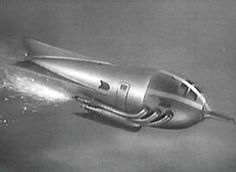
A silver rocket from the classic Flash Gordon serials.
It’s that time of year, again, where I’m waiting for the Hugo Packet to arrive so I can start reading things that have been nominated for the award. And while several categories have again been piddled by the Rabid Puppies, I am still looking forward to the experience. Particularly since I learned an important lesson last time: the point of the awards is to recognize excellence. I’m not obligated to read stories to the end—as I always have as a small-press editor, where part of my mission is to help the writer improve the story if necessary. These stories have been nominated because, allegedly, they are great stories. So, this year I’ll give each story three pages to hook me. If by that point I’m not feeling interested enough to keep reading—regardless of whether the story was on anyone’s slate—then it goes under No Award on my ballot.

If I am enjoying it, I’ll keep reading. The only stories that will go above No Award will be the ones that kept me hooked until the end. Then I’ll rank those and move on to the next category.

It may be a very busy few months, since only one of the novels that were nominated is one I’ve already read. It’s easy enough to read five each of short stories, novellas, and novelletes in the time frame, and graphic novels usually go relatively quickly, but the novels take a bit more time!

With this new rule, I suspect that I’m going to enjoy the process this year a bit more than last year. Because the reason I care about any of the awards is because I love science fiction and fantasy. I don’t just love it, I frikkin’ love it. I have written before about how I can’t remember a time when sf/f was part of my life, because even when I was a small baby my mom read aloud to me from whatever book she was reading at the time, and she is one of the world’s geekiest Agatha Christie and Robert Heinlein fans.

Thanks to her, my childhood was full of a lot of science fiction. For a few years we faithfully watched episodes of Flash Gordon on channel two every morning, for instance. And our regular trips to the library (and used book store, when we lived in towns big enough to have one) usually resulted in several fantasy or science fiction books coming home with us.

It was one of those used bookstore runs when Mom found a copy of Dune in paperback. That book always sticks out in my memory because it was the first time that Mom was reluctant to tell me details about the book while she was reading it. It was also the first book that Mom told me I would have to wait until I was older. I know she really liked it, because it never once went into the pile of books she was thinking of trading in when we were preparing to visit a used book store. The fact that it was forbidden but also apparently really good instilled more than a bit of longing.

But it was rare for her to restrict my access to books. She never seemed to worry that I might not understand most books. If I asked to read one of her books, she’d let me, and she was always willing to discuss the story. There were times when I would try one of her books and I’d call it boring, though sometimes it was probably more because I actually was a bit too young to be tackling that particular book.

I loved browsing in the science fiction sections of the library or bookstores. Looking at the cover art, which was sometimes a bit weird and confusing, but always otherworldly. Each one seemed to beckon, promising strange and wondrous adventures if I would brave those pages.

Science fiction was always about possibilities, to me. I never felt that some sci fi wasn’t for me. I always felt welcome. Science fiction, particularly the way Mom enthused about it, was about making the world a better place. About going to new worlds, or creating new inventions, or learning what it would be like to live with aliens—or elves, or dragons. Do I wish more of the sf/f available in the 60s and early 70s had been more inclusive? Yes. Just as I wish more of present day sf/f was inclusive of people of color, queer people, et cetera. We’re getting better, but still have a ways to go before the representation matches the real world.

Whenever I pick up a new science fiction book, especially if it’s one that’s been recommended by a friend, I get a flash of that feeling of wonder and anticipation; the sense of strange adventures beckoning. For a moment, I’m that little boy in the bookstore, clutching a story, and about to plunge into something wondrous!

Stark raving nerd

I didn't manage to collect many badge ribbons this year, alas. But then, I forgot to bring my ribbons to hand out, and trading is where I usually get half my ribbons!
I didn’t manage to collect many badge ribbons this year, alas. But then, I forgot to bring my ribbons to hand out, and trading is where I usually get half my ribbons!
My previous NorWesCon post covered Thursday and most of Friday, but there was a lot more to the convention. My husband had had to work the first two days of the con, and didn’t get to the hotel until Friday evening just before we gathered for dinner. He hasn’t been feeling well since his trip to Missouri last week, so he wound up back in the room trying to sleep while I hung out in the bar with Matt kibbitzing on writing until it was time to meet Sheryl and Jon for the Burlesque show. It’s been several years. The last time I attended one at NorWesCon, a friend of mine was friends with several of the performers and had been the seamstress for at least one performers’ costume. I think that might have been more than 10 years ago.

The burlesque show is essentially a series of strip tease acts, often with sci fi/fantasy themes. And usually most of the performers are women, so you might understand why I, as a queer man, don’t attend often.

But they are fun shows, and more about performance and comedy than sex, so I probably ought to go more often. Matt was carded at the door, which was amusing. Jared, who was not attending, happened to text me having just realized I was at NorWesCon and asked me to take pictures. So I teased him about the fact that I was about to watch a strip show where they didn’t allow photography and too bad he wasn’t with us. There was more teasing, of course.

After that I headed back to the room to collapse into bed. Michael was asleep when I got there, but a few hours later when I woke up with a painfully stuffed head because of allergies he was awake. Not voluntarily, by any means. He was feeling even less well. He took another shower, and we commiserated about our various symptoms. After letting some fresh air into the room and waiting for more meds to kick in, I was able to get back to sleep, but apparently Michael didn’t. Before going to breakfast we discussed how to proceed since he was feeling so sick, couldn’t get comfortable in the hotel bed, and the small shower stall wasn’t conducive to soaking (which would have helped his knee which is still recovering for the recent injury).

The upshot was that he headed back home on the train. I tracked him until he was home. He had planned, when he left, to do a long soak in the tub, but he said by the time he was back he just collapsed into bed and sleep the rest of the day.

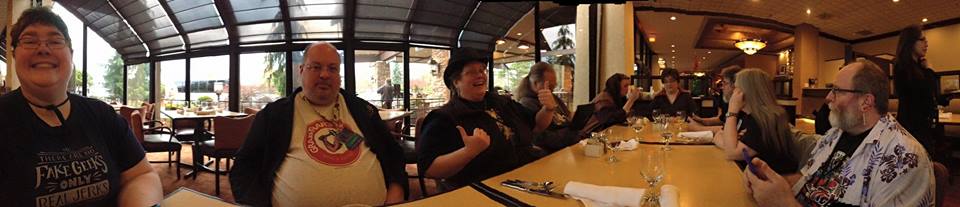
Auntie, Kehf (as Aunt Baru), Keith, Juli-sans-e, me, Jeff, and Geojlc at dinner.
l to r: Auntie, Kehf (as Aunt Baru), Keith, Juli-sans-e, me, Jeff, and Geojlc at dinner. (Click to embiggen)
So he wasn’t there when a big bunch of us had dinner and Julie and Jeff teamed up to take these panaramic pictures of us.

Geojlc, Mike M, Julie avec e, Mark trying to hide behind his hand, Auntie dressed as a Tatoinne Animal Control Officer, Kehf (still as Aunt Baru), Keith, Juli-san-e, and me again.
l to r: Geojlc, Mike M, Julie avec e, Mark trying to hide behind his hand, Auntie dressed as a Tatoinne Animal Control Officer, Kehf (still as Aunt Baru), Keith, Juli-san-e, and me again. (Click to embiggen)

After thoroughly confusing the wait staff multiple times with our orders and requests, I was sent off to my room to get my box of games and meet up and Juli and Keith’s room. We wound up playing four games of Give Me the Brain, none of which I won before deciding to call it a night.

Sunday morning I was a little slow getting up. I always have a hard time packing up the room on my own. It’s not just that two of us pack faster and can carry more per trip, it’s mostly that my husband is really efficient at this sort of thing, and keeps me focused. I have a number of friends who describe their distractabiliy as a super-power (to the point of at least one calling herself Distract-a-Girl!), but I think my brain is an entire horde of distract-a-minions. So even though I had a lot fewer things to pack than usual, it took me about three times as long to get everything out into the car and confirm I hadn’t left anything in the room.

Which made me a couple minutes late for the Why Representation Matters panel. But I’m glad I made it, not just because it was the third or fourth excellent panel that I got to see the fabulous Lisa Bolekaja in, but also because Paul Constant, whose book reviews I have been reading for many, many years was on it, and I finally got to hear his voice to place to the reviews. And it was an excellent panel.

I went to a lot of good panels, and really enjoyed all of them. Our last NorWesCon, a couple of years ago, had been less than fabulous for a variety of reasons, one of them being that, other than Auntie’s Seattle Opera Costume Department Trunk Show panel, none of the panels I went to felt worth my time (which is why I walked out of a couple). This year there were many hours where I had to choose between several panels that looked really interesting. I know the concom has been making efforts the last few years to shake thing up in programming, bring in some new blood, and so on. So that seems to have paid off. It also doesn’t hurt my perspective that I skipped two years. And this year I wasn’t a panelist, I wasn’t running a fan table, nor helping run someone else’s fan table, and otherwise had no obligations at all.

I didn’t even do my usual trick of stealth covering a volunteer shift or two in a department that is run by one of my friends.

I did hang out with my friends, though some of them less often than I would have liked. I introduced Keith to a new cocktail. I had buffalo wings just about every night. I got nicely squiffy at least one night. I did a pretty good job on my blood sugar all weekend. I picked up a pony plush, a set of pony key right charms, a sonic screwdriver earring, an Ash vs Evil Dead t-shirt, and birthday presents for two friends. I was given a Grumpy Cat as Dungeon Master t-shirt.

I met some cool new people, wrote down a lot of links to interesting web sites and have added a bunch of books to my “need to get this” list. Not to mention several new authors to follow.

For many, many years I would always buy our memberships for the next convention before we left. Three years ago, at the end of the con neither of us was certain we wanted to attend the next year, which is what led to us skipping in 2014 and ’15. I had a good time this year, but I had forgotten to ask Michael before he left Saturday what he thought. So Sunday morning I sent him a text (not certain whether he was awake or not). He replied about 20 minutes later that yes, we want to come back next year. So I’ve purchased our memberships for NorWesCon 40, and look forward to attending next year!

This, by the way, was the most awesome thing shown at the Movies and Previews panel Friday morning at the con:

It's a Mad Mad Mad Max Fury Road – Trailer from Monkey Blood on Vimeo.

(If embedding doesn’t work, click here.)

Keymasters and Gatekeepers?

Puppies in tin foil hats
Puppies in tin foil hats (Click to embiggen)
So the Sad Puppies have officially released their recommendation list. Yes, I said list, not slate. Last year’s Sad/Rabid slates were coordinated and encouraged bloc-voting. This year different people are in charge of the Sad Puppy campaign, and they gathered a big list after taking recommendations for months. In all of the fiction categories, at least, there are more than five recommendations, so you can’t slate vote it.

A few other people have written about this year’s list. In sad puppies 4: the… better behaving?, Dara Korra’ti says a lot of what I was thinking when I saw the list. I’m glad that the Sad Puppies have taken a more transparent approach. I’m glad that the list isn’t dominated by stories published in only one very small publication house owned by one of the organizers. I’m really glad that three of the recommendations in a single category are not by the same author. I am willing to give them the benefit of the doubt that the people running it this year are sincerely trying to do no more than get more of the works they like on the ballot, rather than push a political agenda. I’ve never objected to recommendation lists no matter who makes those recommendations. As Dara explains:

What I object to is their conspiracy-theory paranoia, their Not Real Fan bullshittery, their political propaganda, their insistence that people voting for things other than their list has nothing to do with actual enjoyment or quality but a cartoonish parody of a political standard they made up, and – most of all – their ballot-stuffing last year. But I do not object to them making recommendations lists.

I am also still a firm believer that at this year’s World Science Fiction Society business meeting we must ratify E Pluribus Hugo so that the particular hack that the Sad Puppies and Rabid Puppies exploited last year won’t easily happen again. And I remain slightly worried that the only reason the current leaders are being reasonable this time (and the more noxious folks are being quieter) is because they hope the rules change won’t be adopted, so they can do what they did last year again, since any rules change has to be approved in two consecutive annual meetings to take effect. I really hope that isn’t what they’re doing.

Unfortunately, since last year they were crowing that there was no way they could lose because they had taken over a couple of whole categories, then threw a hissy fit when it was pointed out that Hugo voters could No Award those categories, and then they tried to claim that’s what they wanted all along, et cetera, I have no confidence that this isn’t just a tactic to lull some voters into a sense of false security.

Alexandra Erin also shared some thoughts on the topic I found myself nodding in agreement to in Hugo Stuff: Just taking a moment to acknowledge…. The most important bit, I think is:

The fact that a small, self-entitled clique that sought to wrestle control of the award away from fandom at large was able to game the ballot formation so effectively last year came down to how low participation in the nominations historically has been. The fact that this same clique was given a thorough drubbing by fandom at large in the actual awards came down to how high participation was.

Meanwhile, in Sad Puppies Are Up + My Hugo Recs Cisrova wonders:

It may have been a mistake to post a recommended reading list with probably over a million words of content two weeks before nominations close. Unless it was a clever trick to say “aha! Sad Puppies was about the discussion, not the final list!” in which case, well played. That means that those who came over from places like File770 to leave comments and votes are now Sad Puppies.

And Cora Buhlert rounds up a few more comments and facts at Hugo Season 2016: The Return of the Puppies, and asks:

…if your followers heap abuse on everybody who dares to disagree with you, is it any surprise that a lot of people want nothing to do with you?

All that said, I am still happy about a few of the silver linings of last year’s Affair of the Melancholy Canines: lots of fans and small press writers who never participated in the Hugo voting before have joined; I met several cool people (particularly several very interesting queer and feminist writers) because of the discussions surrounding the affair; and the nominees for Dramatic Presentation, Short Form finally had some diversity.

I don’t think enough people give the Puppies credit for that last bit. In the previous nine years, at least two of the options in this category each time were episodes of Doctor Who (or a related show). The last few years the category has been three or four Doctor Who eps and a Game of Thrones episode, and maybe one other show. But last year, five different television series were represented. Now, don’t get me wrong, I’m one of the biggest Doctor Who fans out there, but there are and have been other shows that deserved a nod. Last year the ballot consisted of five different shows, one episode each. Which I think was great.

I have been reluctant to post my list of Hugo recommendations because, as Cisrova observes, with only a few weeks left until the deadline, there isn’t much time for people to actually read all the things I might recommend, and I think you ought only to recommend things you’ve actually read/watched/listened to et cetera. I’ve spent most of my spare time the last two months reading books I bought that were published last year, and reading short stories in on-line zines in order to have more things to nominate. But I figure there is nothing wrong with sharing recommendations, as long as one is clear that it is just a recommendation for things I think you ought to read or check out:

Dramatic Presentation, Short Form
(I decided in the spirit of choices, to limit myself to one episode for each series I nominated)

  • Ash vs Evil Dead: El Jefe
  • Doctor Who: The Zygon Invasion/The Zygon Inversion
  • Orphan Black: Certain Agony of the Battlefield
  • The Expanse: The Big Empty
  • Person of Interest: If. Then. Else.

Novel

  • The Discworld Series, by Terry Pratchett
  • The Shepherd’s Crown, by Terry Pratchett (in case the series as a whole doesn’t make it)
  • The House of Shattered Wings, by Aliette de Bodard
  • The Fifth Season, by N.K. Jemisin
  • Karen Memory, by Elizabeth Bear

Novella
(I’m still working on this… lots of stories I’ve read and liked are shorter than novella length)

  • The Sorcerer of the Wildeeps, by Kai Ashante Wilson
  • The Witches of Lychford, by Paul Cornell
  • Binti, by Nnedi Okorafor

Novelette

  • “The New Mother,” by Eugene Fischer

Short Story

  • “How My Father Became a God” by Dilman Dila
  • “Ashfall,” by Edd Vick and Manny Frisberg
  • “In Libris,” by Elizabeth Bear
  • “The Ways of Walls and Words,” by Sabrina Vourvoulias

Fancast

  • Cabbages & Kings
  • Galactic Suburbia
  • The H.P. Lovecraft Literary Podcast
  • The Geek’s Guide to the Galaxy
  • Flame On!

Fan Writer

  • Vajra Chandrasekera
  • Leslie Light
  • Mark Oshiro
  • Cora Buhlert
  • Alexandra Erin

Dramatic Presentation, Long Form

  • Mad Max: Fury Road
  • The Martian
  • Star Wars: The Force Awakens
  • Ant-Man
  • The Rocky Horror Show Live

Related Work

  • Geek Knits, by Toni Carr
  • Bone Walker, by Crime and the Forces of Evil

Next, I need to go through all the online zines I read and figure out which editors to nominate in short form, and figure out what fan sites (in addition to File 770) that I read regularly count as fanzines.

I’m nominating only things I’ve read/watched/listened to myself. And I plan, just as I did last year, to read everything that makes it to the ballot, no matter who wrote it or who included it on a slate or list. If I don’t like the piece, it goes below No Award; if I like it, it’ll rank above No Award—again regardless of who wrote it or recommended it.

Uniques and Reborns, Computers and Telepaths – more of why I love sf/f

Cover of Arthur C. Clarke's -The City and the Stars- (Click to embiggen)
Cover of Arthur C. Clarke’s -The City and the Stars- (Click to embiggen)
I think I was 16 when I found a battered paperback copy of Arthur C. Clarke’s The City and the Stars in a used bookstore. This was not my first Clarke novel. That had been 2001: A Space Odyssey, which I had found in a library a few years before. I wouldn’t see the movie until many years later. I had also read many of Clarke’s short stories, so I was familiar with his work and his reputation as one of the best.

I had never heard of this particular novel, but the description on the back cover was intriguing, and since he had such a reputation, I felt almost obligated to read more of his work.

The story is set a billion years in the future, in the city of Diaspar, which is the last home of mankind. Humans are effectively immortal. Individuals are “born” nearly full grown in essentially replicators, and they live in the perfect unchanging city creating art and exploring philosophy or literature or poetry for hundreds or even thousands of years, until they decide to rest, at which point their memories are transferred back to the central memory banks and their bodies un-replicated. Until some random interval later when the computer will determine they need to be reborn again.

Into this world is born our protagonist, Alvin, who has no memory of a past life… Continue reading Uniques and Reborns, Computers and Telepaths – more of why I love sf/f

Problematic conventioners, take two

Secret Masters Of Fandom unoffical beanie.
So the Mark Oshiro post has kicked off a lot of discussions all over the place. In other words, I was not the only person who linked to it and commented. One of the more interesting revelations is that one of the ConQuesT concom members was so upset that the rest of the committee refused to do anything that she resigned from the con a few months back. She posted her version of the situation here.

File770 has an extensive post, with links to several other comments and additional information, and a very long comment thread (which has remained mostly civil): Mark Oshiro Says ConQuesT Didn’t Act On His Harassment Complaints.

I’m more than a bit disappointed in how many people are still jumping to the defense of a couple of the harassers with re-treads of the “can’t you take a joke”/“But everyone knows she didn’t mean anything by it.” One version of that which has surfaced a few times in regards to the person who has a history of taking her pants off at panels is, “she does that all the time; I’m not offended by it; Therefore it isn’t offensive and there’s something wrong with you if you think there is.”

This is an old defense that has been used to excuse sexual harassment and sexual assault for decades. A woman complains that she was made uncomfortable by someone who kept commenting on some part of her anatomy, kept crowding in on her, et cetera, and people say, “Oh, so-and-so does that all the time, but he’s harmless!” By which, presumably they mean so far as they know he has never murdered anyone, or raped anyone at knifepoint. This completely ignores the fact that the leering, crowding, groping, or whatever that he does do makes the person feel very uncomfortable, unsafe, and completely obliterates any enjoyment she gets out of the activity/convention/party/panel whatever.

Similarly, the pants situation this time isn’t just about whether it is offensive for a woman to stand around wearing a pair of mens boxers as outerwear, it’s whether after dropping her pants bumping into and continuously rubbing up against another panelist who has previously indicated he isn’t comfortable with that behavior is an acceptable way to behave. Never mind whether it is conducive to a serious discussion about tolerance for a panelist to do that on stage at the panel.

To switch sides for a moment: I’ve been on the other side of the “is it offensive” debate. There are still people (they got quoted in some of the news stories after the last Hugos, for instance), who angrily insist that even including a platonic gay relationship in a story/movie/TV series is deeply offensive to them. Heck, there were calls for boycotts because a black actor was cast as a stormtrooper in the new Star Wars movie, not long after the calls for a boycott of one of the official Star Wars tie-in novels because it included a gay character. I totally understand that someone merely saying that something is offensive is not justification for utterly banning that something. For those people, seeing me simply giving my husband a quick peck on the lips before heading into a panel room completely squicks them out. And I refuse to stop being who I am just because some bigots think they have a right to live in a diversity-free world.

So, I understand that the woman who takes her pants off may be trying to make a statement about body positivity, and about women being in control of their own bodies and having a say in how they dress. I understand that I don’t have a right to veto her choices about herself. But if I happen to be on the panel with her, my lack of a veto over how she dresses doesn’t mean that I have no right to be upset if she rubs up against me, leers at me, and otherwise tries to turn me into a prop for her performative critique of societal norms. My lack of a veto over her sexuality or identity doesn’t mean I have to participate at that level.

Related to all of this, our local furry convention seems to have finally self-destructed: What really killed RF2016 was RF2011 to RF2015. Yes, I said finally. I know it isn’t nice to pile on when someone is already down, but there were very clear warning signs early (as the person, a recently resigned conchair, who wrote that post-mortem alludes to) that the concom had serious problems. The ones mentioned in the post are bad, but they were the tip of the iceberg from my experiences: as an attendee, as a dealer, as a panelist, as someone who offered to help on staff, and as someone who filed multiple reports of times the convention didn’t adhere to their own policies. The thing that actually brought them down was failing to deal with misbehaving attendees, but that was only a symptom of a deeper problem—just the most obviously expensive symptom.

These things don’t have to kill conventions, though.

Last summer, after the incident of the drunken writer contacting the local police to file a false report that one of the WorldCon guests of honor (with whom he had a political disagreement) was a dangerous person who might commit violent acts at the con, Lydy Nickerson posted a lengthy post about her own experiences as a staff member dealing with problems at conventions over the years: Harassment: What do we do? It’s really well done. She lays out a lot of real scenarios and explains the options and how to take some mitigating circumstances into account and so on. It is really worth a read.

Convention problems and problematic conventioners

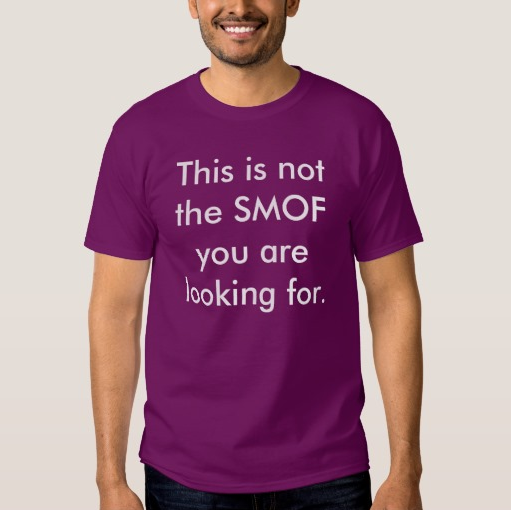
SMOF = Secret Masters Of Fandom . Shirt by the DannyBirtStore www.zazzle.com/thedannybirtstore
SMOF = Secret Masters Of Fandom . Shirt by the DannyBirtStore http://www.zazzle.com/thedannybirtstore (Click to embiggen)
Recently a lot of stories have appeared on my various social media streams about problems at sf/f conventions. Problems at conventions are nothing new, and are certainly not unique to fandom. I’ve written before about bad behavior that matches or beats any fandom convention horror story at professional trade shows and even an evangelical Bible conference I’ve attended.

At least one specific post over the weekend warrants some commentary: Mark Does Stuff – TRIGGER WARNING: For extended, detailed… | Facebook. Mark Oshiro was invited as a Guest of Honor to ConQuesT, where he and his partner were sexually and racially harassed both on and off panels, treated very strangely by con staff (including the chair) at Opening Ceremonies and the GoH dinner, and so on. It is not a pleasant story to read, and even more infuriating to see how the con staff many times assured him things would be taken care of, then months later told that no action would be taken on any of his complaints.

He concludes the tale with this explanation for why he’s going public:

Harassment is unfortunately a part of my experience at SF/F conventions. Not at all of them, but at most of them, something happens to me. I’m an outspoken queer Latinx, and it’s inevitable. However, since ConQuesT, every con staff that I’ve had to make a report to has dealt with my report quickly and fairly. At ConFusion this year, the concom dealt with my incident report in two hours. Meaning they spoke to the person and that person apologized to my face within two hours. At that point, it almost seemed comical that over half a year had passed, and both ConQuesT and Kristina Hiner did nothing at all.

That’s why I’m talking. I did what I was supposed to. I kept quiet, I trusted the system in place, and it completely failed me. I will not be attending ConQuesT this year or for the foreseeable future. (I’m going to WisCon for the first time instead!) I don’t feel safe there, and ultimately, that’s why this bothers me so much. There are people who are part of that community who were actively hostile to me, and when I reported them, the message was sent loud and clear:

We don’t care about you. At all.

It left me wondering why a convention would invite someone to be a guest of honor, then treat them this way. I can come up with a number of explanations, but even the most benign ones still leave no excuse for not dealing with the harassment incidents.

A certain number of responses (both at Mark’s original post and on various blogs reacting to it) trot out the usual blame the victim/blame no one defenses. 1) Surely if Mark had simply politely asked the harassers to stop everything could have been avoided, and 2) Con staff can’t prevent bad behavior and certainly can’t be expected to anticipate everything that might go wrong.

The first defense, besides ignoring Mark’s account that he did ask and otherwise signal his discomfort multiple times, completely overlooks the fact that speaking up for yourself, no matter how politely, often leads to even worse consequences than the original harassment. When folks are confronted about their offensive behavior, they frequently deny and escalate. One example happened in the comments of Mark’s posting (which was subsequently deleted, but not before someone took a screencap of it).

The second defense contains truth, but is also very misleading. Three of the problem people named in the post have been known to say and do those (or substantially similar) things at previous conventions. The panelist who took her pants off and kept bumping up against Mark and making weird faces even said, at the time, that she had gotten in trouble for doing that sort of thing on panels at that very convention previously! Con staff can’t predict the future, but surely they can remember problems from previous years?

I get it. I’ve worked on convention staff many times. My jobs have ranged from very low level gopher to being in charge of programming and vice-chair. I understand that the con staff is all-volunteer, always overworked, always understaffed, always juggling lots of things, and frequently doing all of this on too little sleep and without enough time. I understand that no one has time to vet every panelist. I get all of that.

And I’ve been on the other side. I’ve said and done things I realized later that I shouldn’t have. I’ve had to go apologize to people. I’ve been in situations where I should have apologized but wasn’t able to for various reasons. And sometimes when I’ve been confronted about something I said and did, instead of taking the complaint to heart, I’ve denied and gotten defensive—aggressively defensive. So, I understand and empathize with those people, too.

Some folks are defending the other panelists by trying to say it was all in good fun, or it wasn’t meant that way (whatever that means). You know, that’s exactly what bullies say when they get called out. “I was just joking around. I didn’t mean anything by it.” You can hurt people without intending to. You can make people uncomfortable without intending to. Your intent doesn’t change how the person felt while you were behaving that way. Just as saying you didn’t mean to break something doesn’t magically repair the broken thing.

If you sincerely didn’t realize what you were doing was making someone feel uncomfortable or unwanted or despised, it is all right to mention that in your apology. But the rest of the apology has to be sincere. “I didn’t realize how my actions affected you at the time. Now that I understand, I deeply regret what I said and did. It was wrong to put you in that position. I will try not to do that to you or anyone else ever again.” Something like that is a real apology and shows that you value the other person.

While the “Can’t you take a joke?” sort of reactions just confirms your utter disregard for anyone other than yourself.