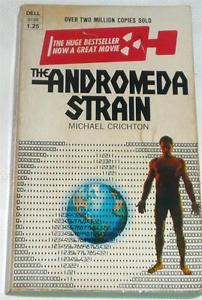
Cover of the first paperback edition of The Andromeda Strain, by Michael Crichton. (Click to embiggen)The first time I remember hearing about The Andromeda Strain was while reading a movie theatre calendar. We were living in a small town in Utah which didn’t have a movie theatre of its own, but we were about an hour drive away from the small Colorado town where I had been born and my grandparents still lived. And often when we visited I would look at the monthly theatre calendar which was distributed free with the local weekly paper. Sometimes I would attempt to talk my parents into letting me come back on a particular weekend to go to the movie.
I think it was the fall of 1971 (I would have been eleven) when I saw the listing, and the name and very short description had me intrigued. Unfortunately, I wasn’t able to convince my parents to let me have the movie trip.
About a year later The Andromeda Strain was broadcast on network TV, probably as a movie of the week (that was a thing back then), and for whatever reason, we didn’t watch the first part of the movie. Probably it conflicted with a show my dad liked, so we watched the other show, first, then switched channels and watched the last half of the movie. So I was a bit confused, but it was still pretty exciting. The last part of the film was very tense and entertaining, even without the beginning.
The following week in school, everyone was talking about the movie. It was one of the few times that I remember kids who usually didn’t know a thing about science fiction talking about a sci fi plot.
Not long afterward, I happened across a battered paperback copy of Michael Crichton’s novel upon which the movie was based. I read it in a single sitting. One of the things that amazed me when I finished was how closely the half of the movie I saw followed the latter portion of the book. My previous experience of comparing movies to the books they were based on was that the movie often bore virtually no resemblance to the book.
The story of the Andromeda Strain is that a space probe is sent into low earth orbit and brought back down. It lands in a small, isolated town, and by the time the retrieval team arrives to pick it up, it seems that every inhabitant of the town has been killed. The retrieval team dies will communicating with their government superiors, and a Wildfire alert is activated. Wildfire is a codename for protocol government scientists have put together to respond to a biological threat from space. A team of scientists are pulled from their regular jobs and rushed to a secret underground facility. Two of the scientists go into the town in hazmat suits, find the satellite, and also find two survivors, an old man and a crying infant. The bulk of the story deals with how the scientists figure out what the infection is, and why those two very different characters are immune.
Before they have quite figured everything out, the extraterrestrial organism (which is neither a virus nor a bacterium) mutates and starts eating the plastics and rubber seals throughout the lab. This sets off an alarm and starts an automatic countdown on a nuclear self-destruct device. One of the things the scientists have determined about the organism is that it is not only immune to radiation, but will actually thrive in the explosion, and probably destroy all life on the planet. Thus we get to the tense ending where the characters are trying to stop the self-destruct and find a way to neutralize the infection.
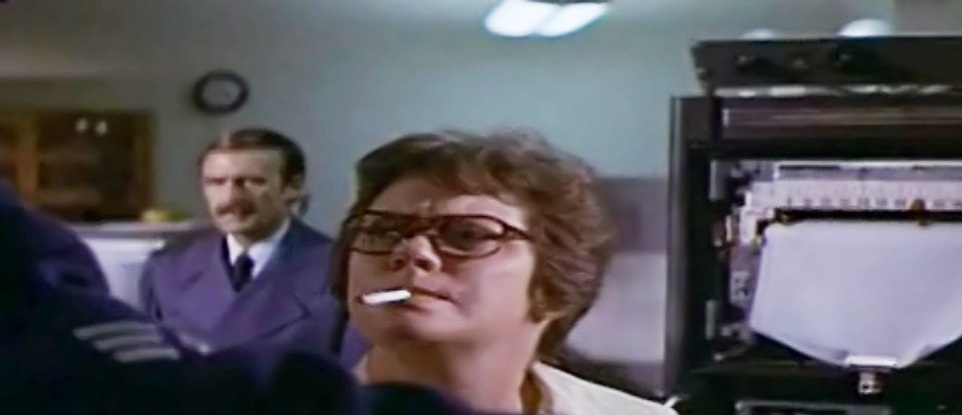
One of the things that disappointed me about the book was that one of the most interesting characters in the movie, Dr. Ruth Leavitt, was a much less interesting man, Dr. Paul Leavitt, in the novel. I’m not sure if the character in the movie was more interesting because the actress, Kate Reid, played a very believable character, or if the character was just less interesting in the original.
I re-read The Andromeda Strain at least once more after seeing the movie all the way through, and I still found Reid’s version of the Leavitt character more interesting. And this was decades before I’d ever heard of the Bechdel Test!
The Andromeda Strain was a bestseller, and set Michael Crichton on the path of future success that would lead to, among other things, Jurassic Park. The movie was only a moderate success, which is too bad, because it was really well done. The science included was, for the most part, plausible at time. In fact, nothing in the film required any sort of advancement of technology beyond what we had available. Exactly how the life form could convert energy to matter was the only bit of dubious handwaving to speak of. It wasn’t the only time that the movie version of a science fiction story was better than the book, but I think it might have been the first time that I noticed it.
The cover of the 1973 paperback edition, as the drivel became a blockbuster.
I posted a bit of a ramble about how I first encountered the book Chariots of the Gods? back in 1971 and how by 1972 the book had infected the collective consciousness enough that multiple evangelical pastors were feeling the need to preach sermons against it. The first U.S. paperback edition was published either just before or during my fourth grade in elementary school. At that point, in the U.S., the book had not yet become a bestseller. So the ancient alien ideas, and specific references to Erich von Däniken’s hack history theories about how aliens had influenced the course of human history were just trickling into my life.
Cover of the 1970 first American published paperback edition. Click to embiggen.It’s all Solarbird’s fault. In the linked post, she plots possible family tree of the original Battlestar Galactica mythology, including a reference to Chariots of the Gods?, and in the course of typing a short comment about when Chariots… the book came out, and the weird in-roads it made into pop culture, I realized there’s at least one weird section of my evangelical fundamentalist Southern Baptist childhood I’ve never written about: the years that evangelical revival preachers felt compelled to make regular sermons deconstructing Chariots of the Gods.
It’s a strange tale involving a hack writer’s bad grasp of history and half-baked sci fi sensibilites, rural American evangelicals’ even shakier grasp of history and science, a Mormon community invaded by mostly southern oil worker families, the tent revival epidemic of the 1800s, black lights and phosphorescent chalk, one queer sci fi nerd, and a three-piece suit the color of lime sherbet. It’s a bit convoluted…Continue reading Chariots of the Who? – part one→
I enjoyed the show. So did my (now late) husband, Ray. We tuned in faithfully each week, chatting about various aspects of the show as we watched. I’d been such a big fan of Kolchak: The Night Stalker that of course I was interested in this show. Ray, on the other hand, barely remembered the other series (and he wasn’t sure if it was because he was a few years younger than I, or if maybe his family simply hadn’t watched it), but he was a fan of mysteries and sci fi and “spooky stuff” so was just as interested in the concept of the show before we had even seen it.
The show’s mysteries were interesting. Sometimes very creepy, sometimes sad. There was just the right amount of human and pathos in the most serious shows to keep you hooked. And then occasionally there were episodes that were primarily funny.
They avoiding the obvious “she’s always a cold-hearted skeptic”/”he’s a passionate true believer” dynamic that he seemed implied from the beginning. Mulder wasn’t a true believer. He frequently repeated the line, “I want to believe.” As we learned about the childhood disappearance of his sister, and the mysterious circumstances surrounding it, we understood why he needed to believe that there were things happening beyond the simple, rational explanations with which so many mysteries are dismissed. And Scully, of course, wasn’t cold-hearted, and while she remained skeptical, she wasn’t close-minded.
The show did a really good job of portraying different ways that a sense of wonder (and sometimes dread) could manifest when we are confronted with situations that don’t have an obvious, simple, and safe explanation.
I really loved the show in the early seasons. I recall especially being on the edge of my seat at the end of the season two finale, barely able to contain myself waiting to learn what the answer to the cliffhanger would be the next fall. Things started to go awry, for me, during the third season, and by the fifth or sixth I was finding myself irritated by the show more often then entertained. I might have given up if not for a friend who suggested this way of looking at it: “I’ve decided to think of it as two completely separate shows happening in parallel universes. They happen to have identically named characters played by the same actors, but they are other wise unconnected. One is the quirky, cool ‘there are more things than are dreamt of in your philosophy’ mystery of the week show that I adore; and the other is the awful, poorly written, contradictory, batshit alien conspiracy/maybe we’re all crazy show that I hate—and I have to put up with the latter in order to keep watching the former.”
And that helped a lot. Don’t get me wrong, the conspiracy related to aliens was there from the very beginning, and I was onboard with watching them confront and explore that. The problem, from my perspective, was that unlike their monster of the week kinds of episodes, they never seemed to have a clear idea of what was actually happening with the conspiracy. Years later we might call their problem the “Lost syndrome,” because like that more recent show, the writers seemed to be throwing contradictory and confusingly cryptic clues at us without a clear idea of what the “real” explanation was.
I think that the show’s original creator did have an idea of what the explanation was, but either he allowed other writers who didn’t know to go off on misleading tangents that couldn’t be reconciled as simply red herrings, or perhaps he didn’t know how to keep the series going if he ever revealed the answer.
So it was with a bit of trepidation that I watched the first episode of the new mini series a few weeks ago. And I have to admit, that opener left me with a lot more dread than hope. Then the second episode was a bit better, like one of the typical mystery of the week shows I used to love.
And then we got to the third episode, “Scully & Mulder Meet the Were-monster” and I was in heaven. It was funny. And with a lot of Easter Eggs that weren’t annoying. Two actors who played stoned teen-agers who witnessed a mysterious event back in the very first season, returned to play the same characters, no longer teens, who are out in the woods huffing spray paint when they witness another event. There was a homage the Kolchak in the story, an incredible amount of humor, yet it was an incredibly dark commentary on real life at the same time. It was really, really good, and included everything I had loved about the best of the earliest episodes. And I was incredibly happy to see, online over the next several days, the number of review sites and sci fi/fantasy enthusiasts who had enjoyed the episode the same as I had.
At its best, the X-Files was about things in life—sometimes awful, tragic things—that don’t fit neatly into our preconceptions of how the world can be. More importantly, it is about the way we try to understand those things—how we confront mystery, tragedy, disappointment, horror, and betrayal—and how we cling to meaning and hope in spite of it. It’s about finding the human connection, finding the reasons to hope, finding the things to cherish, and never losing our curiosity.
And it’s also, sometimes, about really creepy monsters.
In the movie, The Night Stalker, Darren McGavin plays Kolchak, a reporter working in Las Vegas, dating a showgirl, and covering typical news stories. Until he began being suspicious about a series of deaths that seemed very similar, but which the police insisted were unrelated. First Kolchak was convinced that it was simply a serial killer who was draining all the blood from his victims’ bodies because he was insane and believed he was a vampire. As Kolchak finds more and more evidence of similar crimes going back decades, he begins to worry that the killer really is a vampire.
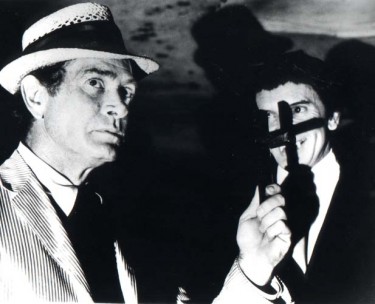
Which, of course, turns out to be the case. Kolchak witnesses a couple of attempts by the police to capture the killer. The second attempt is such an epic failure, with multiple cops killed and dozens of bullets striking the killer (played creepily by Barry Atwater) to no avail. This convinces at least one FBI agent that it is a vampire. Kolchak and his FBI buddy track down and kill the vampire.
Kolchak writes the full account of the vampire’s long career of murder and eventual destruction, proposes to his girlfriend, and prepares to move to New York City where he expects to be able to write his own ticket. Except the FBI and local police don’t want anyone to know about vampires. They kill the story (getting Kolchak’s boss fired, I believe). They substitute a more mundane tale of a serial killer with Kolchak’s byline. Then they inform him that his girlfriend has already been convinced to leave town, and tell him he’s no longer welcome in Vegas.
The story ends with Kolchak re-dictating the entire tale into his portable tape recorder while sitting alone in a sleazy motel room. He explains how all the evidence is destroyed, and that he’s exhausted his savings trying to find his fiancée, so far to no avail.
It was a sad and creepy end to a film.
The Night Stalker was a made-for-TV movie based on an unsold novel by Jeff Rice, originally titled The Kolchak Papers. Rice’s agent had more luck selling the novel idea to ABC as a movie idea than he’d had selling it to a book publisher. The movie was a surprise hit, drawing in unheard of ratings when it ran. It was so successful that the network commissioned Richard Matheson, who had adapted Rice’s book into script from, to write a sequel. A book publisher was suddenly interested in Rice’s novel, but only if they could also get a deal on the sequel. So Rice wrote a novelization of Matheson’s sequel script, and in 1973 two Kolchak books, along with the sequel TV movie, The Night Strangler were all released.
The Night Strangler came out almost exactly a year after the first movie. In it Kolchak had relocated to Seattle where he stumbled upon an immortal who was living in Underground Seattle2 who every 21 years has to kill several women in order to harvest their blood in a very specific fashion to manufacture his “elixer of life.” The sequel did well enough again that work began on a third movie. Until the network put that all aside and decided to turn Kolchak’s story into a regular weekly TV series, which debuted in September of 1974 and ran for one season.
McGavin returned to play Kolchak. In the series Kolchak, along with his editor from both movies (played by Simon Oakland), have been relocated to Chicago where they work for the Independent News Service. Each week Kolchak stumbles upon a new monster or mystery that winds up having a fantastic explanation. Unlike the original movie, Kolchak never has any credible witnesses survive to corroborate his stories, so no one ever believes.
After the two wildly successful TV movies, the network had high hopes, but the initial ratings weren’t terribly exciting. After four episodes of The Night Stalker had aired, the series went on hiatus for a bit over a month. It came back, re-titled Kolchak: the Night Stalker! with new theme music, though not any changes to the tone, setting, or cast.
Ratings continued a slow, steady decline, causing the network to pull the plug at episode 20, cutting short the original order of 26 episodes.
The series ran during my 7th grade year. We had moved by the Colorado, this time returning to the small town where I’d been born, and where one set of grandparents and one set of great-grandparents still lived. Puberty had hit the year before, and I suddenly knew exactly why I’d always felt out-of-place to the point of wondering if I was a changeling left in place of my parent’s real child by evil elves, or maybe an alien sent to study humans—I was gay. It was during this same period that I started fooling around regularly with one other gay classmate (while having a completely unrequited crush on a different classmate that as far as I know was straight). I lived in a constant state of fear of being found out, terrified of what family, friends, and the rest of the town would do if they had proof I was a fag.
I threw myself even more fervently into reading science fiction and fantasy, so of course I was a faithful viewer tuning in each week to see what Kolchak would uncover next. Kolchak was appealing in part because these incredible, usually awful, things kept happening around him, but no one ever believed him. He was in sort of a reverse closet. He wanted people to know the truth, but everyone else did everything they could to ignore, explain away, and ridicule that truth.
While I did tune in faithfully each week, I have to confess that as the series went on, each episode was a little bit less satisfying. I can’t be certain why, having not re-watched it in years, but something about seeing Kolchak not be believed week after week was much less interesting than seeing it in two movies separated by a year. Maybe it was because Kolchak was seldom heroic. He had a determination to learn the truth, yes, but clearly he would have much rather interviewed people after the fight with the monster, rather than take on the creatures himself. He was always a bit rumbled and always seemed to stumble and fumble his way into a lot of the stories and events in the series, rather than get there through dogged determination. Maybe the series just didn’t know how to walk the tightrope between mystery/horror and comedy.
Some years later Chris Carter would have more success with The X-Files, a series he admitted was inspired by Kolchak. So the week-to-week mysteries the world doesn’t want to admit exist notion could be spun into a successful show. I don’t know what about the collective consciousness of 1974 made Kolchak less appealing than the audience of the 90s would find Scully and Mulder4.
I still look back on The Night Stalker with a lot of fondness. I empathized so much with they guy who knew and believed things no one else would credit. It wasn’t just the parallels to my own queer secret, though. I was also having an ever more difficult time reconciling my love of science and history with the fundamentalist evangelical beliefs of our church and the vast majority of our neighbors. I felt as if people were constantly belittling scientific facts and scientists, blatantly ignoring evidence right in front of them and insisting on a worldview that just didn’t square up with not just my lived experience, but theirs.
Kolchak kept chasing that truth, kept examining the evidence, never letting the naysayers or conventional wisdom stop him. And that was a role model I desperately needed.
Notes:
1. I wound up completing the entirety of 5th and 6th grade, in addition to the half of 4th in that same school. This tied my previous record of Kindergarten, 1st, and part of 2nd in the Ft. Collins, Colorado school district. By contrast, 3rd grade was split between three schools, each in a different state (and if the brief sojourn in Kansas had begun a few weeks earlier than in did, 3rd grade would have been four schools in four states).
2. This movie makes the mistake of most pop culture representations of Underground Seattle do. It portrays it as if some sort of disaster buried part of the city in a single night and the survivors rebuilt on top. A dining room underground that still has dishes, silverware, and petrified food figures in the story, for instance. In actuality, Seattle decided it was tired of the routine flooding and sewer backups that happened in the part of downtown built on swamp land, and they razed a hill at the north end of town to redistribute the dirt to raise the streets in the south end. It took many months. During the transition some of the taller buildings had new doors built into the existing second or third floors at the new street level. Other buildings had additional stories built atop them. Spaces that had originally been ground floors became basements. In only a very small number of cases have any of those old spaces been kept in anything close to their original state3.
3. Many, many years ago a software company I worked for that had offices downtown rented storage space in the basement of the building next door. The basement had originally been a dance hall before the streets were raised. The solid wood dance floor was still there, and some of the fancy woodwork on the walls was still visible, but the building owners and subdivided the space into a bunch of 10 foot by 10 foot cubes with cheep plywood, and rented each out for storage. It wasn’t terribly exotic any longer. And you just walked down ordinary stairs to get to it.
4. A subject I’ll go into much more detail about next week, I think!
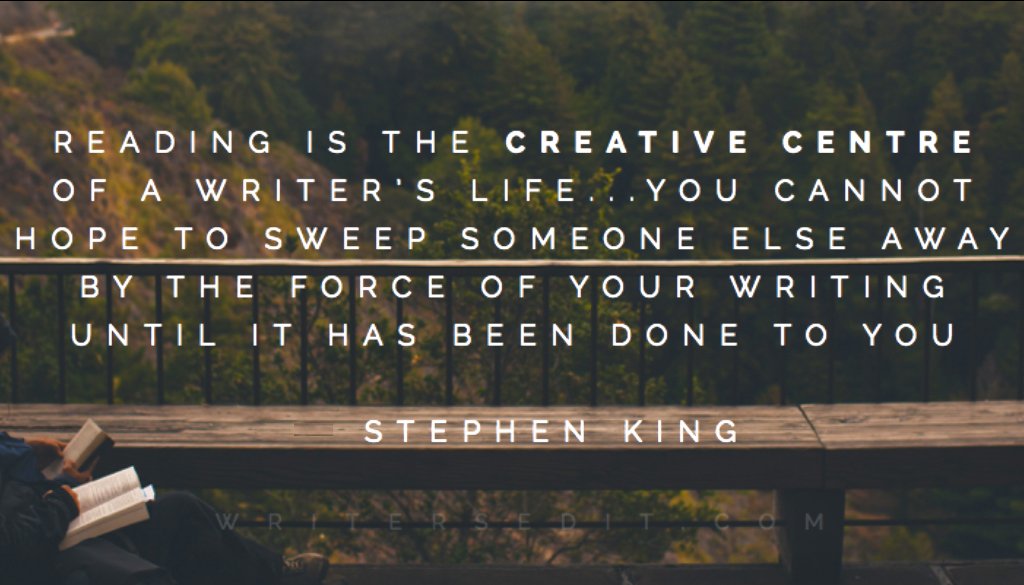
“Reading is the creative center of a writer’s life… you cannot hope to sweep someone else away by the force of your writing until it has been done to you.” – Stephen King (click to embiggen)Last week they started emailing the Hugo nominating PINs (personal ID numbers) to those of us who have memberships to WorldCon. Mine arrived Friday night. During last year’s voting period I started a list of stories and such that were being published last year I thought were good enough that I’d want to nominate this time around. It’s a fairly short list because most of the reading I did last year was stuff that had been published in previous years. So I need to do some more research and reading!
To nominate you need to have either an attending or supporting membership to last year’s WorldCon (Sasquan, in Spokane), to this year’s WorldCon (MidAmeriCon II in Kansas City), or to the 2017 WorldCon (to be held in Helsinki). If you already have one of those, your PIN is either coming in email, or will be included in your snail mailed Progress Report II (if you chose that for updates rather than email). Check your spam folders if you think you should have gotten it and it hasn’t arrived. They are still mailing them out, though, so don’t send a panicked message to them, just yet.
A lot of people are putting up their “oh, by the way, I had this stuff published this year that could be nominated, if you happened to have read it and enjoyed it.” I only had one short story published, and in an APAzine at that, last year. But I do blog about science fiction and fantasy here a bit, and I suppose that means technically I could be nominated in the fan writer category. *wink* Hey! A guy can dream, right?
More seriously, as I work on my nominations, I’ll try to put together a list of some things I think folks should check out.
In completely unrelated news: The Ali Forney Center, which provides support, nourishment, and shelter to homeless LGBT youth in New York City, is trying to raise money to purchase the church of anti-gay hate-spouting preacher, David Manning. The church has been ordered into foreclosure for non-payment of over a million dollars in utility bills (on top of other fines and debts). I forgot to mention when I posted this earlier, that Manning’s church has been officially designated a hate group by the Southern Poverty Law Center. Anyway, as of this morning, they had reached 49% of their goal in just three days. The foreclosure auction is later this month. If you can donate to this opportunity to turn hate into love, please do!
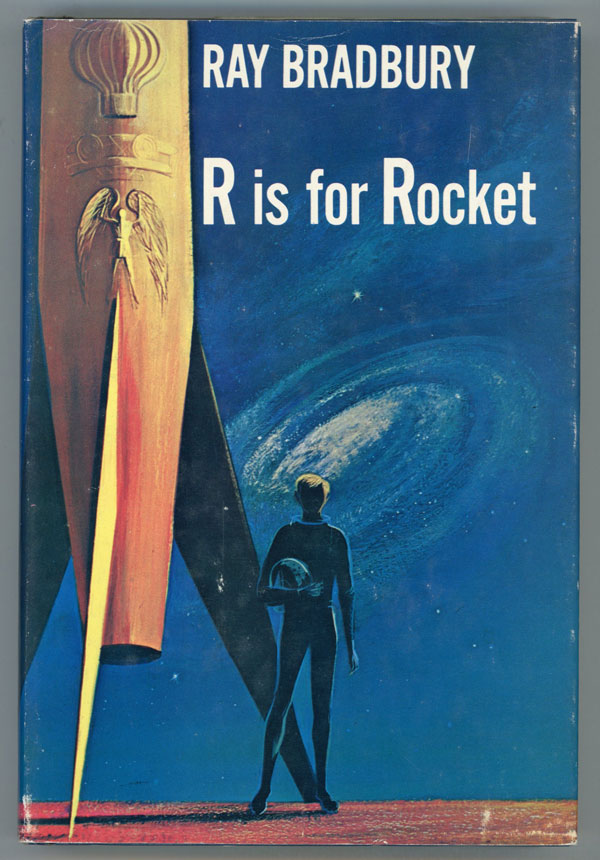
Dust jacker of the first edition of Bradbury’s collection, R is for rocket.I don’t remember when I first read a story by Ray Bradbury.
That’s not quite right. The sentence is true, but it doesn’t convey the full meaning. It’s equally true that I cannot remember a time when I didn’t know about Ray Bradbury’s incredible stories. He isn’t the only author who falls into the category. Since my Mom read to me from her favorite two authors: Agatha Christie and Robert Heinlein, since I was a baby as part of her plan to make sure I learned to talk correctly, I can’t remember a time when I didn’t know about Heinlein or Christie. And it’s more than slightly likely that Mom read some Bradbury in there at one point, so that might account for it…Continue reading I is for Imagination – more of why I love sf/f→
Earlier this week the writer/director of Star Wars Episode VIII re-tweeted this cartoon drawn by Jeffrey Winger (jeffreywinger.co.vu). Click to embiggen.The first time I saw the original Star Wars I didn’t consciously have a strong feeling about the apparent love triangle being set up between Luke, Leia, and Han. I was frankly a bit surprised when some of my friends started talking about it. I mean, yes, there was the cute scene when Han realized that Luke was developing a crush, and he asked, “Do you think a princess and a guy like me–?” But he was so obviously teasing Luke. Clearly he wasn’t actually interested in the princess, right? I mean, what other possible interpretation could you have to that indulgent, slightly condescending smile?
And Han, being a much more experienced man, also, to my mind, knew that there was never any chance that a guy like Luke could win the princess, either. That was the other meaning of that smile. And during the dozens of times I re-watched the movie over the next three years, I was still convinced that there wasn’t going to be a serious conflict between Luke and Han trying to win Leia’s heart.
I was definitely in the minority. Lots of people expected, if there was a sequel, that a love triangle would figure heavily in the next movie.
I would like to be able to argue that I had somehow perceived some hint of the revelation that was going to come along later that Leia was Luke’s twin sister. But that wasn’t it. It wasn’t until after I first saw The Empire Strikes Back, that I realized what had been going on in my subconscious. Empire remains my favorite movie of the series for a lot of reasons, but after the first showing I had very mixed feelings about one subplot.
I was still deeply closeted at that point, but I was quite aware that I had a crush on Harrison Ford (or at least all the characters he played), while I had also very strongly identified with Luke, but didn’t have the same kind of feelings for Mark Hamill. I realized that my subconscious had been rooting for a romance, all right, but one between Luke and Han. Which in 1980, when Empire was released, was absolutely impossible in a mainstream film. Heck, even the most radical art house films seldom portrayed mutual same sex romances. They might show a homo obsessed with another man, but it was unrequited and tragic and depressing.
But that was what my subconscious saw precisely because we never saw it on the screen. I’ve written before about why queer people read same sex attraction into all sorts of characters in movies, television, and books. Because if we didn’t imagine them, we never got them. The unrelenting message of culture and media is that queers don’t exist, queers don’t matter, queers don’t love, and if they dare to, they deserve whatever horrible things befall them.
That’s why it’s homophobic when straight people roll their eyes or demand to know why we “do that” to characters who aren’t explicitly identified as gay. It isn’t necessarily malicious or intentional, but being annoyed that we dare to imagine such relationships perpetuates our erasure and is condescending at best.
But to get back to Empire, the movie did such an excellent job of portraying the complex emotional relationship between Han and Leia, that by the time of Han’s famous, “I know” answer just before he was frozen in carbonite, I was cheering for them. Of course they were in love! They were perfect for each other! At least that’s what one part of my heart said. Meanwhile, another part was mourning the loss of the love between Han and Luke that I’d hoped for, even though I knew it wouldn’t happen in a mainstream movie.
But once I got over my disappointment, I was totally on the Han and Leia train, and was happy to see them decades later (“You still drive me crazy”) as a realistic older couple who have had their ups, downs, and a falling out but still caring for each other in The Force Awakens.
I don’t only ship same sex couples. The first two seasons of Buffy the Vampire Slayer I was totally a Willow/Xander shipper. I so wanted Xander to pull his head out and realize that Willow loved him. At different times in the series, yeah, I was elsewhere. I’ve written Xander/Spike fic (and if I ever finish my WIP there’s also some steamy Graham/Riley action and hot Gunn/Buffy action in there). I adore well written Buffy/Spike fic. For a while I was a Xander/Scott shipper, but have often been completely onboard both the canon Xander/Anya and Willow/Tara relationships. I realize if you’re not familiar with the show that you won’t know that half of those are opposite sex couples. In another fictional universe, I remain an unapologetic Parker/Hardison/Spencer One-true-threesome shipper!
But yes, I saw the chemistry between Finn and Poe during my first viewing of The Force Awakens, and given how many millions of other fans saw it, it clearly isn’t an unreasonable inference. I get that other people see the Rey/Finn pairing, and I’m not saying I wouldn’t be able to enjoy that, but I would really, really like for a galaxy filled with aliens of all shapes and droids and so forth the acknowledge that queer people exist, too. (Also, hey! Why can’t we have a Finn/Poe/Rey triad? Polyamory is real, too!) That’s why I enjoyed reading Rian Johnson Gets It, where I first saw the cartoon I linked above.
As Chuck Wendig said in a post I’ve linked to before regarding people who were angry he put gay characters in an official Star Wars novel:
“…if you’re upset because I put gay characters and a gay protagonist in the book, I got nothing for you. Sorry, you squawking saurian — meteor’s coming. And it’s a fabulously gay Nyan Cat meteor with a rainbow trailing behind it and your mode of thought will be extinct. You’re not the Rebel Alliance. You’re not the good guys. You’re the fucking Empire, man. You’re the shitty, oppressive, totalitarian Empire. If you can imagine a world where Luke Skywalker would be irritated that there were gay people around him, you completely missed the point of Star Wars. It’s like trying to picture Jesus kicking lepers in the throat instead of curing them. Stop being the Empire. Join the Rebel Alliance. We have love and inclusion and great music and cute droids.
Also, I was really pleased with this: when a fan recently asked Mark Hamill on line if Luke was bisexual, Mark replied, “His sexuality is never addressed in the films. Luke is whatever the audience wants him to be, so you can decide for yourself.”
I was watching a recording of a football game Sunday night after a day spent with friends role-playing in 19th Century Scotland when I saw the first “Oh, no! Not Bowie” go by on twitter. So at least I didn’t hear the news of David Bowie’s death while I was laying half-asleep while the clock radio played news before I had to get up for work. Which is, unfortunately, how I heard about Alan Rickman. This hasn’t been a great week, obviously. But I saw one reaction this morning that helped:
Yes, let’s all be bold and creative and weird as hell.
It wouldn’t be correct to say the David Bowie was my hero, though in many important ways he was. He was also so much more. I wish that I had been bold enough during the height of his Glam Rock period to have been a Bowie fan. Make no mistake, I liked his work a lot. The first song I remember liking by Bowie was “Starman” which didn’t become much of a hit in the U.S. in 1972, but how could I not like it, since it seemed to have a sci fi theme?
Then I saw him on TV. Back the the 70s there were a lot of musical/comedy variety shows on prime time, and Bowie appeared on one of those. I don’t remember what song he sang. What I do remember was that he was dressed in something that flashed and glittered, and that his hair was in a style I had never seen on any human before, and he had face paint. When I try to visualize it, the colors keep changing, which means this was before we got out first color TV (which happened when I was 15 years old).
I was mesmerized. I had no idea a man could look like that, dress like that, and move like that while singing. I had seen men in movies and TV in weird costumes, and even in certain kinds of drag, but nothing like this. And then my dad growled, “Who is that cocksucking freak? What are you watching?”
Throughout my childhood, any time that my dad was really, really angry at me—angry enough that he’d grab something club-like to beat me with rather than just slap or punch me around—one of the things he called me was “cocksucker.” And for most of those years I had no idea what the word meant. From his tone of voice and actions while calling me that, I knew that it was a horrible, awful, vile thing—but that was it. By the time of this TV incident, I knew what the word meant, and I knew that literally it was true about me. But I also knew that my dad wasn’t the only person who thought it was the most awful thing a boy could be. I knew with absolute certainty that if any family member, or any of the people at church or school found out it was true about me, that my life would be over. Probably literally.
And Dad had just called this singer on TV (that I was finding so fascinating) a cocksucker. I knew, immediately, that I could never, ever let dad know that I thought David Bowie’s music was good—let alone admit to my fascination with how he looked! I don’t know exactly what I said in answer to Dad. I probably said the name of the variety show we were watching, and I know I said something about not liking the freaky guy at all, and hoped they got to someone else, soon.
A couple of years later, I saw a story in a magazine about a new movie coming soon, The Man Who Fell to Earth, based on a sci fi novel by the same name, starring David Bowie. I owned a paperback copy of the book, and had read it and enjoyed it. Immediately, seeing some photos of Bowie in makeup for the film as an alien who comes to Earth, I realized he was perfect for the role. I dug out the book and re-read it, imagining the alien looking and talking like Bowie. I went from simply liking the book to loving it.
The movie wasn’t a big hit, so never made it to the theatre in the small town where we lived. But I kept imagining it, based on the novel and those pictures, for years.
In the 80s, when I was in my twenties, Bowie’s music videos were among my favorites. And then the movie Labyrinth came out, and I and a bunch of my sci fi nerd friends went to see it in the theatre. I bought the soundtrack album. It was around the time, some months later, when I bought my own copy of Labyrinth on videotape when I realized that I could safely purchase regular Bowie albums. I hadn’t lived with or even near my dad since just before my 16th birthday, but that initial fear of being recognized as queer if I bought any Bowie music lingered. It didn’t help when Bowie described himself as gay in an interview in 1978 (something he later didn’t exactly renounce, but did say wasn’t accurate). Ironically, I owned lots of Queen and Elton John music in my teens, and it never occurred to me that anyone would infer anything about my sexuality from those.
Anyway, I picked of Ziggy Stardust and the Spiders from Mars and listened to it so often, I wore out the cassette tape. I started acquiring some of his other albums on disc, both the older ones and the albums from the 80s.
Eventually I also finally saw The Man Who Fell to Earth. Although by that time, I had been imagining how the movie went so vividly, that I thought I had managed to see it somehow. The actual film didn’t live up to my imagination in many ways. Except Bowie himself. He was magical and ethereal and totally believable as the alien trying to pass as a human.
And by the time I was buying Bowie and admitting I liked him, I was also in the process of coming out. Which is appropriate. Knowing Bowie existed—both the singer who gave me “The Width of a Circle,” “Moonage Daydream,” “Starman,” “Space Oddity,” and “Suffragette City” and the actor who played the Man Who Fell to Earth—kept alive the idea that maybe a freak like me could have a happy and full life during those dark closeted years. He was one of people who saved my life.
Alan Rickman didn’t come into my awareness until my late twenties, when I saw Die Hard for the first time in theatres. He was awesome, of course, as he was in every role I saw him in, afterward. So he didn’t have the same impact on my formative years as Bowie did. But his work touched my adult life in profound ways, as well.
I don’t like thinking of the world without either of them.
I, being a smart aleck, had to butt in with, “This (queer) nerd boy would buy every Slave Poe action figure I could find! Oops… Did I say that out loud?”
The problem with even well-meaning smart asses throwing in such jokes is that our comments can undermine the serious point that Vivian was originally trying to make about double standards and the male gaze, with some commentary on the small wave of nerd rage that happened when an official Star Wars tie-in novel featured a gay protagonist earlier this year, and similar splash of nerd rage that happened when the trailer came out showing a Stormtrooper pulling off his helmet and revealing black actor under the mask.
So, to be clear: back in Return of the Jedi when they put Leia in that slave costume on a leash when she was taken prisoner by Jabba the Hutt it was a sexist action intended as fan service, and entirely unlike the way any of the three male heroes also taken prisoner in that same sequence were treated. And it made very little sense, internally. Seriously, Jabba is a giant slug, he’s not human, and it makes no sense for an alien (particularly a non-humanoid alien) to find any human body erotically attractive. I’ve seriously seen some clueless fans argue because another alien woman was shown in a similar role in an early scene (when she refuses Jabba’s advances, she’s thrown to the monster in the pit where the entire party takes great glee in watching her die), that this proves Jabba had some sort of fetish for the humanoid female form.
Bull.
Jabba is fictional. Jabba didn’t make the decision to put either woman in a slave girl costume to be leered at. Human filmmakers made that decision. Male human filmmakers made that decision.
Just as when authors and show-runners claim that they would love to include queer characters, but the right story just hasn’t come to them are either deluding themselves or outright lying (they can make the decision which characters to include in their stories), filmmakers who claim that Slave Leia was because of Jabba’s kinks are simply shoveling BS.
If Jabba had a kink for naked humanoids, there’s no reason it should have been limited to female humanoids.
So if the idea of Luke being the prisoner in a scanty slave costume after Jabba catches him upsets you—if you find yourself constructing arguments that it would be inappropriate because Return of the Jedi wasn’t a gay porn film, and that it’s just not the same as putting Leia in a scanty outfit—you’ve just stumbled across a great big internalized misogynist double-standard. Congratulations!
For the record, when I was 22 years old sitting in that dark theatre after waiting in line for 10 hours to see Return of the Jedi and the first scene with the other alien woman on a leash in a scanty costume appeared on the screen, my first thoughts were, “Why would Jabba put a woman from another species in that costume? Why would whatever species she is fetishize barely concealed breasts just because humans do?” Not that I was necessarily that enlightened back then. I recognize that even as a deeply closeted queer guy, I didn’t see the costume the same way 90-some percent of the other guys in that crowded theatre were. But that’s the thing, without hormones clouding my vision, I could see the incongruity for what it was.
So I hope my comment didn’t detract from the message of the original tweet. Besides, I wasn’t joking. I’ve already said publicly that I am searching for the Finn and Poe Honeymoon Suite Playset, among other things. When a friend pointed out that there was a place taking orders for a Poe Dameron body pillow I have to admit I felt immediate temptation. If there is a Slave Poe scene in one of the sequels, and if they made action figures of him in that costume, I’d buy it so fast!



 Font Folly