I have been trying to write a review of the sixth book in the Wayward Children series by Seanan McGuire, and realized that I couldn’t really talk about it without talking about the rest of the series, and I had somehow neglected to write about the previous book when I read it last year, so I need to talk about it before I jump into the latest. So, this will be a review of the fifth book. For reference, I wrote about the first three novellas in this series here. And then I wrote about the fourth book (which left me sobbing uncontrollably), here.
I should preface this with this statement: before I read the first book in this series I was predisposed to love them, as the author had explained on a panel at a sci fi convention I attended, that the inspiration for the first story was her own reading of tales (when she was a child herself) in which a child or group of children were transported to a magical world where they faced danger, monsters, and adventure but managed to save that world… and then were forced to go back home and just be ordinary kids again!
And I definitely loved the first book in the series, as well as the next several sequels.
The fourth book, In An Absent Dream was—for me—the most devastating, but the first three had been pretty moving.
When the first teasers for the fifth book came out, I must admit I had mixed feelings. The first book had introduced us to Eleanor West’s Home for Wayward Children, a refuge for those children who were not happy to be sent back to mundania after having slipped through the shadows into another world. Among the children we met in the first book were the twin sisters Jack and Jill, who had been to a world of horrors. And they had turned out to be central to the mystery of the first book. The second book in the series is a prequel to the first, and tells the story of how Jack and Jill (or Jacqueline and Jillian as they were known by their parents) went to that world, had their adventure, and come home.
It was clear from both the announced title of the fifth book and its official summary that we were going to be treated to yet another adventure involving Jack and Jill. And while I had enjoyed the first and second book in the series, there had been a whole lot of other characters introduced in the first and third books whose stories I really wanted to learn more of. So giving yet one more book to Jack and Jill, who had already had two books, seemed like it was giving the shaft to some of the other characters.
On the other hand, the magical world that Jack and Jill had traveled to, known as The Moors, was based on the old Universal Horror movies of the 1930s and 1940s. And I loved those particular movies, which had contributed quite a bit to how much I had loved the second book in the series, Down Among the Sticks and Bones. So I wasn’t really complaining about getting to spend more time there.
McGuire has explained several times that the series is set up thusly: odd-numbered books will be set at the school and involve groups of children who have already had at least one magical adventure on their own working together to solve a problem, while even-numbered books will be straight up Portal Fantasies where we see one or more children going to one of the magical worlds for the first time, and how that transforms them.
So. Come Tumbling Down begins with Jack unexpectedly coming back to Eleanor West’s school after taking her deranged sister back to the Moors and needing help. Several characters accompany Jack and her resurrected girlfriend, Alexis, back to the Moors to try to stop Jill from doing something truly horrible that will (among other things) cause great harm to her sister, Jack. Not to mention cause a lot of other bad things to happen to the mostly innocent bystanders trying to live their lives on The Moors.
It is clear right away that something is very wrong. Jack and Alexis explain the situation, and beg some of the students of Eleanor West’s school to come back with them to The Moors to stop Jill’s evil plan, because Jack can’t do it without them. A couple of the other wayward children we met in earlier books, as well as at least one we haven’t seen before this book answer Jack’s call and go back with her to the Moors.
We get to see aspects of this world that weren’t covered in Down Among the Sticks and Bones, which is cool. But as the rest of the quest unfolded I had a bit of a problem. Most of the characters that Jack persuaded to come back weren’t actually needed to complete the quest. Honestly, exactly one, and only that one and only for one specific task of the characters that Jack begged to come back with her did anything that actually contributed to solving the problem. All of the other actions that contributed to the solution were performed by Jack on her own. So most of the characters (including one who paid a very significant price) were not needed after all. Their only purpose in the plot was to get hurt (or worse) to create some tension, and not actually to contribute to the final solution.
It can be argued that Jack didn’t know that when she pled her case early in the book… but the author should have known that, and should have structured the story somewhat differently.
Mind you, I enjoyed the quest, its solution, and the new things we learned about the Moors. I just think the author dropped the ball at a couple of points in the plot, is what I’m saying.
However, the over all story—most importantly the explicit revelation that what some people call a monster can actually be the hero of the tale—was very entertaining and quite good. So like every other story I’ve read by this author, by the end despite some things not going the way I thought, I was still left mostly happy with that tale and looking forward to the next story in the series.
But it didn’t feel either as tight nor as poignant as the fourth book. And maybe I should just accept that sometimes an author hits their stride on every single aspect of a book in an incredible way, and other times they only hit it on say three out of five major components.
I mean, I liked the book. I went back to reread it and enjoyed it the second time. And as soon as I knew their was another book in the series coming out I preordered it. Which means, I guess, that I’m saying some of the books in this series are Incredible and Stupendous, and others are merely Really Good.
Time for the next installment in my weekly WandaVision episode review. I reviewed the first three episodes here. I’ll try to to stick to one episode at a time going forward.
This week’s episode, entitled “We Interrupt This Program” gave us a lot of answers while raising many more questions. It is also chock-full of connections to and characters from other parts of the Marvel universe. Which is cool for nerds such as myself. But I want to stress that you don’t have to be familiar with all of those other things to understand. The show is still doing a fairly good job of framing this story in a way that people who aren’t familiar with the other properties can follow and be just as perplexed about what’s going on as the rest of us. There is one bit at the beginning of this episode that might need a bit of extra explaining for someone who isn’t Marvel obsessed, but even then they gave some explanation that I think might have been enough for those not familiar.
So, I’m going to limit the body of this review to only what happens on screen, and if I feel the need to squee about any of the bonus things along the way, I’ll toss that into footnotes.
The only non-spoilery thing I can say is that this episode tells us what was happening from the point of view of government agents and scientists who are outside of Westview. Which is way the viewers (us!) gets some answers, obviously.
I can’t really say anything more without spoilers, so, if you don’t want to be spoiled, stop reading now.
The new series from Marvel, WandaVision dropped on Disney+ a couple of weeks ago, and I was thinking of doing an episode-by-episode set of reviews, as I’d previously done for Star Trek: Picard, but I didn’t get the first one done within a week. Anyway, we’ve now had three episodes (“Filmed Before a Live Studio Audience”, “Don’t Touch That Dial”, and “Now in Color”) which gets us far enough along that I feel I can comment on what I suspected the main themes of the show will be as well as just talk about how those episodes work.
First I wanna make a few unspoilery comments: this show is not a typical superhero adventure. It has a lot more in common with Twins Peaks than shows such as Arrow or Daredevil. You also don’t have to have watched any of the Marvel movies to understand what’s going on. Within the opening minutes the show tells you most of what you need to know to understand the framing mechanism: she has some sort of magickal powers, he’s not human, they are in love and they are trying to fit into a stereotypical suburban family neighborhood without any of the neighbors realizing who or what they are.
To me, it also became clear very early on that this show is more likely a horror-type mystery than a thrilling adventure/action story. A number of other reviewers I’ve read didn’t pick up the horror-vibe until episode three, so your mileage my vary.
I don’t think I can say anything more without spoilers, so if you don’t want to be spoiled, turn back now.
Hocus Pocus!I don’t remember when I first saw Hocus Pocus. While preparing this post, I was surprised to learn the movie came out in the summer of 1993. I was quite certain I had seen it long before that. Given when it came out, it is a toss-up whether it was a movie that my late husband (Ray) and I saw it in a theatre, or whether we didn’t see it until later when it was on cable or out of video. I know that since sometime in the mid-nineties that it has been broadcast during every October on ABC- and Disney-owned channels. It always gets high ratings, and the DVD/Blue ray sales have been a reliable strong seller every year. Which might make one wonder why I need to write about it at all, because it seems to be one of the most popular spooky movies, ever.
I love the movie. Spoiler warning: I can’t talk about why I think this movie is worthwhile without giving away a key part of the ending, so if you don’t want to be spoiled, go stream the movie now!
In case you aren’t familiar: the movie begins on October 31, 1693 in Salem, Massachusetts, where the notorious (and elderly) Sanderson sisters, widely believed to be witches, have lured a young girl into their cottage. They brew a magic potion which they force the child to drink, and proceed to leech her life away, making themselves young again.
The girl’s older brother, Thackery Binx, tries to interrupt the ritual and save his sister, but he fails. He is transformed into a black cat by the sisters and cursed to live forever with his guilt.
The townspeople of Salem storm the cottage and find the dead body of the girl. The witches refuse to say what has happened to her brother. The witch sisters are sentenced to be hanged, but before they are executed, the eldest with, Winifred, casts a spell which she claims will allow them to rise from the grave again—one an All Hallow’s Eve with a full moon, if a virgin lights the Black Flame Candle.
Jump forward 300 years, and Max (who will be our protagonist) is a teen-ager unhappy that his parents have moved the family to Salem. Max has an encounter with a pair of local bullies, which doesn’t make him like the new home any better. He is also not fond of the town’s local folklore about the Sanderson sisters and witches in general. He is really unhappy when his parents saddle him with the job of taking his younger sister, Dani, trick-or-treating. But early in the evening they meet a classmate Max has a crush on, Allison.
Because Allison thinks that Max’s skepticism is a bit too cynical, and because Max is anxious to impress Allison, they wind up in the old Sanderson Cottage (which has been preserved as a museum). When Max announces he is going to light the so-called Black Flame Candle and prove that witches are myths, a black cat attempts to stop him. Max manages to light the candle, anyway and the witches rise from the dead.
What follows is horror-comedy romp with some elements of musical theatre thrown in. The black cat is the cursed Thackery (who answers to Binx for the rest of the movie), who has lurked around the cottage for 300 years trying to prevent anyone lighting that candle. He can speak to the three kids, though know one else apparently can understand him. The kids flee, unsuccessfully try to warn the adults that the witches are back. The witches, meanwhile, have perform their life-stealing ritual on some children before sunrise or they go back to being dead, so there is a bit of a race.
At several points the witches capture one or more of the kids. At at least two points the kids appear to defeat the witches. Along the one a long dead lover of two of the sisters is raised as a kind of zombie/revenant who assists the witches in chasing the kids.
Eventually there is a dramatic stand-off in a cemetery, and with a bit of cleverness, bravery, and self-sacrifice, evil is thwarted.
The three witches are played by Bette Midler, Kathy Najimy, and Sarah Jessica Parker. It wouldn’t be fair to say that Midler steals the show, because all of the show’s comedy and menace are built around her character. The director, Kenny Ortega, said in later interviews that he told the three of them to play it as over the top and campy as if they were drag queens, and it certainly worked.
I’ve seen reviews that Max doesn’t really have a character arc, and I don’t understand how people can be that blind. In the early part of the film, the bullies are absolutely correct that Max looks down his nose at what he sees as the provinciality of the Salem natives. And when Allison scoffs at his scoffing, it’s clear that she sees his skepticism as performative. He doesn’t believe because it isn’t cool to be credulous. Just as he pretends not to care about his younger sister because, again, it would be uncool to feel warmth or affection for his kid sister. By the end of the film, that pretense is gone, and he doesn’t just take a risk to save his little sister, but he gulps down the potion and forces the witches to kill him in her stead.
It’s not bravado or a clever trick. He doesn’t reveal afterward that he only pretended to swallow it. He swallows it, the witches perform the next part of the ritual. We see his life force literally being taken from him.
Once the witches are defeated, we also get a nice pair of parallel scenes, one in which Max and Dani share a moment, and then because Binx fulfilled his mission, we see a similar scene between his ghost and the spirt of his little sister, who has been waiting for him to join her in the afterlife for 300 years.
Unlike the last campy & spooky two movies I’ve written about, this one came out after I was well and truly out of the closet. So I felt freer to revel in the camp vibe and all it implied. A few times when I’ve found myself in conversation with other queer fans of the show discussing it, I’ve found out that a lot of them like to ask the question: so which Sanderson sister are you? For the record, Ray was definitely and enthusiastically a Sarah. I had to admit that I want to be Winifred, but I’m really a Mary.
The film is funny. It has many nice spooky moments. If you haven’t seen it, give it a try. Maybe it will cast a spell on you, too.
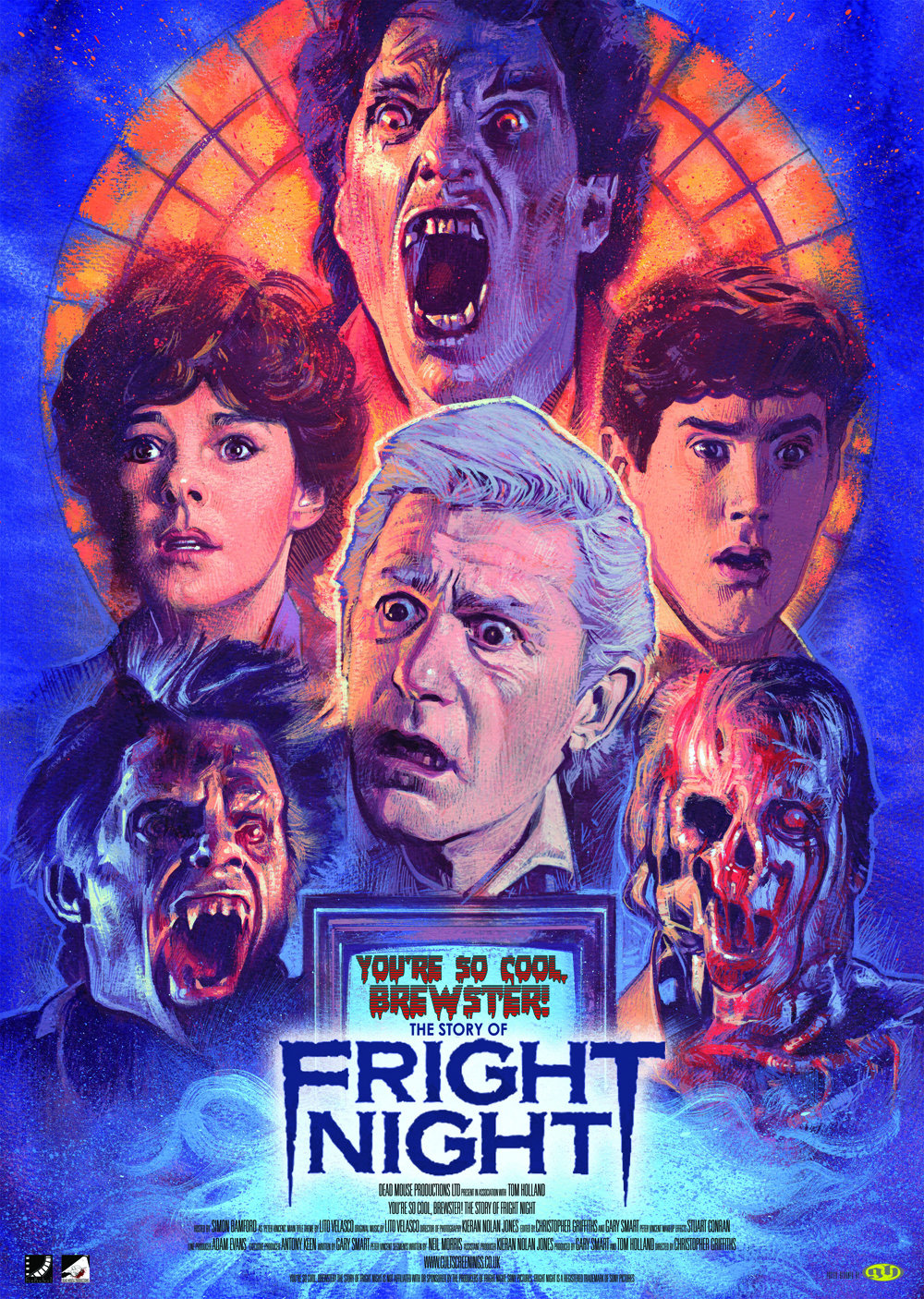
When the original Fright Night came out in August of 1985, I was in my mid-twenties and preparing to move to Seattle to finish my college degree. It was a time when I had virtually no disposable income, so I very seldom saw movies in the theatre. Combine that with the fact that horror movies often give me nightmares (and I’m a sleepwalker, so I would get up in a panic during the dream and find whoever I can in the house, shake them awake and frantically try to convince them there is a killer in the house), I did not see Fright Night that summer. One of my friends did go see it, and his description just convinced me even more that I shouldn’t see it.
Over a year later, I and some friends in Seattle were going to have a movie night. Which at that time involved us pooling some money to go to a video store and rent a both a video player and one or more movies, which we would take back (usually to Club Chaos, which was an apartment share by two of those friends that had an enormous living room) and watch while eating a bunch of junk food. It was often the case that only a subset of the gang would go get the movie, so you were never quite certain what we might be watching.
One of those nights Fright Night was in the mix. At least one of my friends who had seen it before assured me that it was more of a comedy like Ghostbusters than a scary slasher film like Nightmare on Elm Street, so I figured it would be fun.
In the opening minutes, it does indeed seem to be more of a cheesy romp than a serious horror picture… but that’s because the movie begins with a movie within the movie. A cheesy vampire film which are main character is watching on television. The protagonist of the film is Charley Brewster, a teen-ager who loves horror movies, and faithfully watching a weekly show hosted by an actor named Peter Vincent who used to star in a series of vampire hunter movies himself.
Charley lives with his mom in what seems to be a typical 80s movie suburb. And someone has recently moved into the empty house next door. Charley hears strange noises and even a scream coming from the old house, and becomes convinced that the new neighbor, Jerry Dandridge, is a vampire who is luring women to his home before feasting on their blood.
Charley’s best friend is “Evil Ed” who loves those horror movies even more than Charley does. But he doesn’t believe the neighbor is a vampire. Charley’s girlfriend, Amy, breaks up with him because of his obsession with the neighbor. And, of course, Charley’s mom and the police also all fail to believe him.
So Charley tracks down the actor, Peter Vincent (who hosts the aforementioned weekly horror show at one of the local stations, so lives in the same city), and tries to get him to help prove that the neighbor is a vampire. The actor doesn’t believe him either, and points out that he’s just an actor—the vampire hunter he played was fictitious.
Amy, meanwhile, has become concerned about Charley’s mental health, and she hires Vincent to pretend to test the neighbor and then prove to Charley that the neighbor isn’t a vampire. And so the actor (who thinks this is some easy money) puts on his costume and grabs his character’s equipment bag and visits the neighbor. In the course of the discussion, just as he’s leaving, Vincent pulls out his pocket mirror while getting something else out of the pocket, and realizes that Dandridge, standing behind him, has no reflection.
(l to r) “Evil Ed”, Charley, and Amy, as portrayed by Stephen Geoffreys, William Ragsdale, and Amanda Bearse. While there had been a lot of humor in the movie at this point, and not much in the way of gore, the tone was paranoid rather than a laughfest. And that tension ramps up from this point, as the vampire starts stalking Charley, Charley’s mom, and Amy threatening to do terrible things if Charley keeps telling people about him.
This is also where we start getting more of the transformations and start seeing more of the death scenes explicitly.
Dandridge kills and turns Evil Ed and sends Ed to kill Peter Vincent and then Charley. The scene where Dandridge stalks and corners Evil Ed in what has to be the most labyrinthine alleys to ever appear in a movie, is remarkably chilling, even though we never see a hint of blood.
Ed doesn’t succeed in killing Vincent, who burns him with a cross and forces him to flee by leaping out of the apartment’s window. Ed beats Vincent to Charley’s house (Vincent is on his way to warn Charley), and they have a fight during which Evil Ed transforms into a wolf, but he still winds up impaled through the chest with a broken table leg.
Dandridge has, meanwhile, lured Amy to his house and has started the process of turning her into a vampire, trapping Charley in a room with her slumbering body so that she can feed on Charley when she rises. Vincent manages to help Charley escape, and then the two of them have a protracted fight with Dandridge, before eventually killing him and, since Dandridge died before Amy ever drank the blood of another, she reverts to human and all is well (or as well as it can be, given that a number of people have died on screen by this point).
The special effects are all practical effects, this is before the era of CGI, and some of them haven’t aged quite as well as others. Some of the creature effects looked cheesy even in 1986. I don’t think the effects are the reason this movie never gave me serious nightmares.
No, I think that’s because I spent a lot of the movie trying to decide if all the gay subtext was going to come out in the open. And also not feeling free to comment on any of said subtext because, while it is true that two of the people in that friend group were part of a very tiny number of friends who I had come out to only a few months before (though come out is a strong word, since it began with, “I think I’m gay” and quickly morphed into, “Or I’m bi—yeah, that’s it. Not completely gay after all!” which was so not true).
It was clear to me that Charley wasn’t into Amy or even the idea of making out with her as Amy was interested in him. There’s even a moment before Amy breaks up with him where she is angrily trying to get him to stop looking through the binoculars at the neighbor and come have sex with her, for goodness sake.
It was also clear that Evil Ed had the hots for Charley. I’m sorry, totally straight teen-age boys don’t joke about giving their male best friend hickeys and so forth as often as Evil Ed did.
The scene where Dandridge corners Ed in the alley and talks him into giving in without a fight is very much written and acted as a seduction. They never make it completely clear what the difference is, but just being killed by a vampire isn’t enough to make the corpse rise later as undead. The vampire has to choose to do it, and given how he talks Ed into surrendering, it seemed to imply that the other person’s consent was part of the situation. Though the later seduction of Amy seems to involve some sort of vampiric mesmerism, so maybe consent isn’t exactly the right word.
The movie ended with Charley and Amy back together, in Charley’s bedroom, where he looks out the window at the once again deserted house next door. He turns to Amy just as we see a pair of glowing red eyes appear in one of the windows of the house. And as the movie fades to black, the last line of dialogue is spoken in Evil Ed’s voice: “You’re so cool, Brewster!”
Vampires often are metaphors for sex, so it isn’t surprising that scenes where a male vampire is stalking a male victim will be homoerotic. But some of the earlier stuff between Evil Ed and Charley are a bit different.
Most of Fright Night isn’t played for laughs. My friend’s assurance that it wouldn’t be nightmare inducing wasn’t completely wrong… though I personally think that on a scale of Ghostbusters to Nightmare on Elm Street that Fright Night lands smack dab in the middle. It is one of the spooky movies that fairly regularly figures in my Halloween movie marathons, and I have to admit in no small part because I keep thinking how much better things would have gone if Ed had simply declared his love for Charley early on.
Just as I’m sure that the sequel wouldn’t have been the awful mess it was if Evil Ed had been the villain, as been planned. Alas, Stephen Geoffreys, who played Evil Ed, turned down the chance to be in the second movie in order to play the lead in another horror movie that flopped even worse than Fright Night part 2 did. Geoffreys appeared in a couple more movies that didn’t do well, then he spent the next dozen years or so appearing in gay porn films under a couple stage names. Since 2007 he’s been getting work in various horror and action films.
Anyway, with its 80s hair styles, sometimes cheesy effects, and the unresolved gay sub-text, Fright Night makes for a good popcorn movie, and not just at Halloween.
“The charge, my fellow council members, is witchcraft.” (Click to embiggen>I’ve written more than once about the fact that actual scary movies give me nightmares. And I’m the kind of sleepwalker who, when having a nightmare, I will go around the house waking up everyone I can find and tell them very emphatically that we are in danger and need to come up with a plan to defeat the killer/monster/demon/alien that is trying to break into the house. So generally speaking (with some big exceptions) I avoid a lot of horror movies. On the other hand, I love Halloween, and I love spooky movies, particularly funny spooky movies. So this next confession will not surprise some of you: when the cheesy parody horror movie, Elvira: Mistress of the Dark came out in theatres very breifly in 1988… I actually went to a theatre and paid full price and saw it. My (now ex-)wife, and a couple of our friends accompanied me, and we all paid for the experience. One of those friends is a mostly-straight friend who said upfront that 75% of the reason he was willing to go was because he had lusted after the horror host Elvira (played by amazing Cassandra Peterson) since high school.
A few years later, one of the few disputes that I had with (at the time my soon-to-be-ex-wife) Julie while we were splitting assets was who would get to keep the VHS of Elvira: Mistress of the Dark. Of all the things to argue over it was one of the dumbest, I admit… I’m just happy that we got through all that and now, 29 years later, we’re good friends and can laugh together about such things.
As it happened, my first husband, Ray, loved the movie, and we owned it on VHS and upgraded to DVD before he died. And my husband Michael thinks the movie is funny and is more than willing to watch it with me about every other Halloween, so, yay!
But, let’s get to the actual movie. Outside of the movie, Elvira is a horror host (played by Peterson) who had a syndicated sci fi/fantasy/horror movie show on various cables for years. The movie proceeds on the conceit that Elvira is a real person, not just a character which Peterson plays, and when the local California station she appears on gets a new owner who sexually harasses her, she gets fired. But she isn’t upset because she’s about to open a show in Las Vegas… except her agent informs her that the show in Vegas will only go forward if she can put up $50,000 of the production cost.
Right after she says she doesn’t have that kind of money, a studio intern knocks on her dressing room door to tell her she has a telegram. According to the telegram, her Great-Aunt Morgana Talbot, has died and that Elvira is a named as a beneficiary in the will (“I didn’t know I had a good aunt, let alone a great one.”). So Elvira drives across country to the quaint town of Falwell, Massachusetts for the reading of the will.
“Listen sister, if I want your opinion, I’ll beat it out of you.” Elvira’s fist confrontation with Chastity Pariah (Click to embiggen)What follows is a parody of several old horror movies (and a few Lovecraft stories), but even more a parody of all those movies about small minded small town people being against outsiders, et cetera. While there is one scene that is a direct take-off on Flashdance, the majority of the movie is a retelling of Footloose with Elvira in the Kevin Bacon role.
And the movie is funny. I mean, Edie McClurg should have gotten an award for her hilarious turn as Chastity Pariah, hypocritical council member.
Elvira’s great-aunt doesn’t leave her any money, just her house, her book of “recipes”, and her pet poodle named Algonquin.
The kicker is that Morgana was a powerful witch, the book is actually a very old and potent grimoire, and the poodle is actually a familiar. Elvira spends much of the rest of the movie figuring this out, and slowly learning the Morgana’s brother, Vincent, is the evil warlock who killed Elvira’s mother, Divana, and that possession of the book is going to decide the balance of supernatural powers for the next century.
In between, Elvira tries to iniiate a romance with the very hunky but virginal owner of the local movie theatre, becomes a hero for the town’s teen-agers who wish the town was less backwards, and has various misadventures trying to use the mystical book. I know the movie is set in Massachusetts, but some of the more jokes in the sequence where she mistakes a potion to conjure a demon for a casserole recipe resonated extremely deeply with my southern Missouri/Oklahoma soul, okay?
Part of the meta of the movie is that Elvira, despite being played by a cisgendered woman, is essentially a drag queen. And while what little other queer subtext is very, very sub, that 80s drag queen/queer camp vibe is extremely strong in the movie. All of the villains are either defenders of the old Traditional Family Values notions or the even more ancient Toxic Masculinity tropes, while Elvira and her supporters are champions of Everyone Is Valid, and Being True To Your Self is More Important Than Pleasing Societal Expectations.
Which is very queer. So even though the vast majority of the sex and innuendo in the film is quite hetero, there is simultaneously an extremely strong non-hetero message being promulgated throughout.
At the time when the movie came out, I was still trying to pretend I was bisexual, which I very dysfunctionally saw as being half-heterosexual. I was trying to walk an extremely difficult tightrope. And this movie seemed to walk a similar tightrope… but when I re-watched it, I began seeing that the tightrope was as false as Chastity Pariah’s moral superiority.
Eventually, the camp sensibilities and the sex-positive subtext of this movie was one of the many examples that helped convince me to stop trying to compromise my true self.
And years later, it’s just an extremely funny movie to watch during Halloween season. And what more could you ask for?
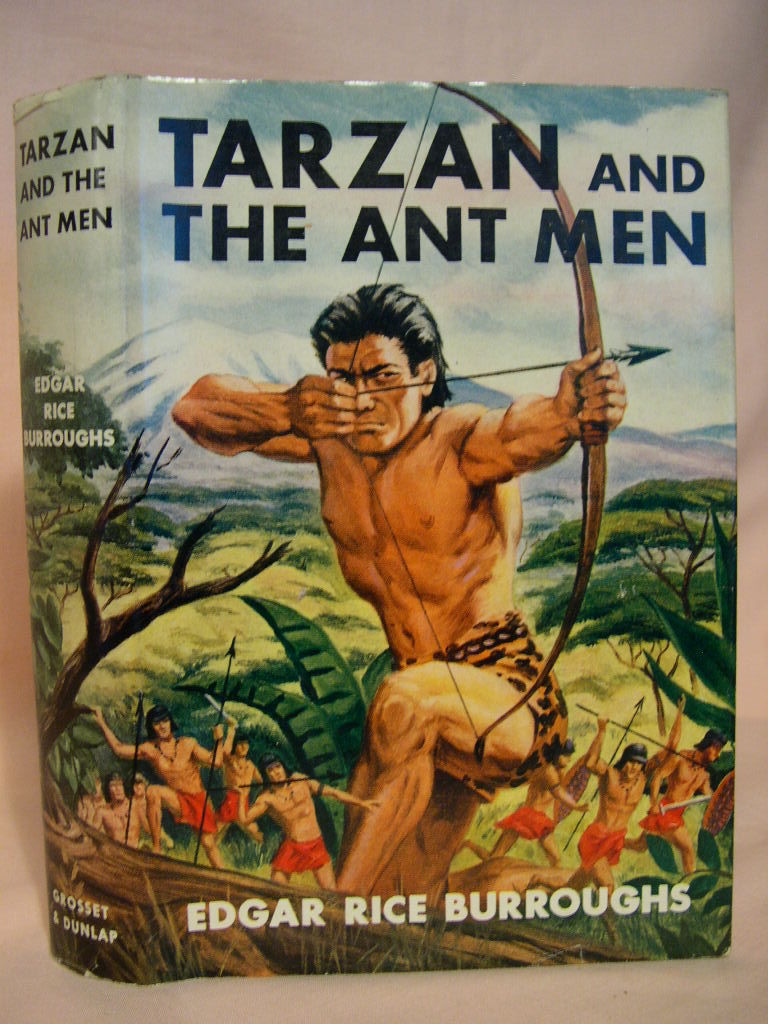
This cover looks very similar to what I remember of the copy that was donated to the public library when I was in middle school…Many, many years ago on a Sunday afternoon 11-year-old me was sitting in the back seat of my grandparent’s gold Ford Galaxie reading the latest copy of Galaxy Science Fiction Magazine. Sunday morning church service has recently ended, and while my grandparents and Mom were mingling in the after service coffee event, I had persuaded Grandma to let me have her car keys so I could go read my magazine in peace. My space adventure was interrupted by someone tapping on the window. I looked up to see Donny, who I knew because his father was the best friend of my grandfather. I rolled down the window, half-expecting him to tease me for not being down at the church social.
Instead, he pointed to my magazine and said, “I didn’t know you were into science fiction! Who are you reading right now?”
I had met another fan. Which was a very rare thing through most of my childhood.
Those years were weird in so many ways. I usually use the shorthand description of “ten elementary schools across four states.” That is an accurate description of what my father’s petroleum industry job did to our life. It elides over that fact that almost all of those elementary schools were in tiny, redneck towns where most people listened to country music, watched Gunsmoke and Hee Haw every week, and went to church every Sunday morning no matter what. In such communities, my mother and an occasional librarian were often the only other people I met who even knew what sf/f was.
It wasn’t just that science fiction and fantasy weren’t popular, there was also that fact that our time in many of those towns was very short. It was complicated! For instance, it was late in fourth grade that we moved to the tenth of those elementary schools, where we remained through the end of sixth grade. Similarly, all of kindergarten, all of first grade, and a couple months of second grade had been at the first elementary school I attended. So eight of those elementary schools were scattered over second, third, and fourth grades.
Anyway, there is another weirdness to that tenth elementary school: the last of fourth, all of fifth, and all of sixth grade were spent living in a small town in Utah that was very close to the Colorado border, and less than an hour drive away from the small Colorado town where I was born—the town where my parents met and married as teen-agers; the town where my paternal grandparents and one set of maternal great-grandparents lived. The same town that we would finally move back to in time for me to attend 7th, 8th, and 9th grades. But the flip side of that is that at many random intervals during my 4th, 5th, and 6th grades (and especially the summers between each) we were visiting said town—which included attending church services at the church my grandparents had been attending for longer than I had been alive.
That two plus years nearish to the town I’d been born contained a number of important turning points in my life. My paternal grandmother bought me a subscription to Galaxy Science Fiction — which she graciously renewed as part of my birthday presents for the next few years. My maternal grandmother a year later got me a subscription to The Magazine of Fantasy & Science Fiction which she also renewed for the next few years. The older brother of one of my classmates realized that I and said younger brother didn’t know what the word “boner” meant, and thus he decided to give us a very unauthorized (and not completely accurate) education in human sexuality. And then puberty hit and that last bit became more relevant (but also mostly useless) than I’d expected.
All of those things will become important to this story eventually, I promise.
My paternal grandmother had “accidentally” set up my subscription so my magazines arrived at her house, so I couldn’t actually read them until I came to visit. Mom had driven herself, my sister, and I over to my grandparents during midday on a particular Saturday, and I had only got a short period of time Saturday night to start reading my latest copy of Galaxy. Which is how I came to be sitting in my grandparents’ car in a church parking lot trying to read my science fiction magazine when Donny tapped on the car window.
Donny was the youngest son of Mr & Mr. G. Mr G had been my Grandpa’s best friend since WWII, and after the war they had both ended up moving their families to the same small town in Colorado. Mr & Mrs G were essentially my dad’s godparents. Southern Baptists absolutely do not believe in baptizing babies, so that don’t have christening ceremonies and they don’t have godparents. But many Southern Baptist churches do “Dedication Services” for newborn babies, and at those services non-family members who are also members of the church agree to be sponsors of the child—which is just godparents and christening with different names, but we won’t worry about that.
Mr & Mrs G were slightly older than my grandparents. Mrs G had been a school teacher in the local school district for many years, and in addition to being my father’s godmother, had also been his teacher for one grade. They had three children who were similar ages as my parents. Their eldest, a daughter, was the Secretary who ran the administrative office at the Middle School. Their middle child, also a daughter, taught at the elementary school. And their youngest, their only son, Donny, was a bus driver and maintenance person for the school district.
Donny was about ten years older than me, so he was 20 or 21 years old at the time of this meeting and therefore an adult. But he was also someone that I had more or less known my entire life. But he had been someone at the outskirts of church events and the few social occasions we’d both attended. I had a vague notion that he had completed some course of study at a nearby Junior College sort of recently, and when he’d come back, he had moved out of his parents’ home and gotten his own place.
I remember that the conversation was quite fun, with him being a fan of several writers I had never heard of, as well as some that I had barely heard of. I specifically remember that he wasn’t much of a Heinlein fan, but understanding why lots of people were. Our mutual nerding out went on until the after service coffee meet broke up and everyone drifted out of church and to their cars.
It was probably two months later that I saw Donny again, since most Sundays we stayed in the small town in Utah and attended church there. We had another conversation, that time on the steps of the church about sf/f books we were each currently reading.
My family was gearing up to move to that town. My folks had bought some property. We started coming over to spend almost every weekend with my grandparents, as Dad, Grandpa, and I would work on various aspects of the plot to get it ready. My tasks over those weeks ranged from things like digging the ditch that the natural gas pipe from the newly installed meter to the house would go, or pulling weeds, or painting pipe pieces with protective sealant. At some point a decision was made to bring my bicycle from home to my grandparents’ place, because Dad and Grandpa found it useful to be able to send me on errands while they continued to work to get the property ready for us to move in.
There came an afternoon during this time when I didn’t have any construction related tasks to do nor errands to run. I was free to goof-off if I wanted. So I got on my bicycle and rode to Donny’s house. Because we were in town almost every weekend at that point, I had been having enthusiastic conversations with Donny about whatever book or story had most recently caught my interest. At some point I had looked Donny up in the local phone book and found his address. I don’t know what I expected, it’s just that Donny was at that point the closest thing I had to a local friend, and we both loved the same kinds of books. He was clearly surprised to find me on his doorstep. He didn’t invite me in. We had a conversation on his front porch where I enthused about some story I had read recently, while he nodded and made the occasional comment.
It was awkward and I wasn’t sure why.
I think it was two Sundays later when Donny came up to me at church and told me that he thought I should try to make some friends my own age. “It’s fun to talk to you about books, but you I think you’d be better off spending more time doing normal things for a boy your age.” And he walked away.
He was certainly not the first adult I had known who had suggested that I should spend less time reading and more time playing with other kids. But I hadn’t thought of Donny as one of those kinds of adults. And it never feels good to have someone tell you that they do not want to be your friend.
As it happened, I had become friends with a couple of guys my age who attended the same church. And when school started that fall, I made a few more friends (but also acquired new bullies). One of the friends I met became a bit more than a friend, as we frequently found ways to fool around together.
When I saw Donny at church, he always seemed to be turning away to talk to someone else or simply walking out of the room. When I saw him at school it was different. Donny greeted and joked with all of the kids. If he saw me, he would call out my name, and make a comment like “Hope you’re reading good stuff!” It wasn’t any different than he acted with any other students, but it was infinitely more friendly than he acted at church.
One day, well more than a year after that “find friends your own age” conversation, as I was walking to school, I saw Mr G backing his truck out of his driveway, turning rapidly with a squeal of tire, and heading up the road. It so happened that Donny’s parents, Mr and Mrs G, lived in a house that was right next to the middle school. You could see their front yard and driveway from the windows in the Science classroom, for instance. Mr G didn’t normally drive that like that, so it stuck out as weird.
Minutes later, as I was talking to some of my classmates before going inside, I learned that there was a problem with one of the school bus routes. A driver hadn’t shown up for work, and the substitute hadn’t known the route. So one of the buses was somewhere out in sticks half loaded with kids while the other drivers on the CB radio attempted to talk him through the route.
Classes got underway, but there was more weirdness. While the guys in my grade were in gym class, the girls were all in social studies, and they had noticed from the social studies room’s windows a county sheriff’s deputy car driving into town much more rapidly than usual (the highway was visible from the school as well), and that he had flashed his lights before driving through a stop light and then turned uphill. Before that class was over, the girls also saw an ambulance, without its lights on, turn up the same road.
As us boys were coming out of gym class, we saw Miss G, Donny’s eldest sister who was the school secretary, hurrying out the main doors. She seemed upset. None of us had ever seen Miss G leave the school grounds while school was in session before that. And when we joined the girls in our next class we heard about the police car and ambulance.
Two class periods later the Principal announced over the PA system that Donny had died in his sleep the night before. Miss G would be taking a few days leave of absence, so some administrative things might not run as smoothly as usual for the next few days.
My memories of the funeral service (held at our church some days later): the family opted for a closed casket service; after the service Mrs G had draped herself over the casket sobbing uncontrollably, with Mr G, her daughters, and a number of others trying to offer condolences; at the reception in the church’s social hall a lot of the adults kept exchanging meaningful looks; there was whispering.
The whispering between the adults continued for some weeks. Any time adults were talking about Donny and noticed me, they would quickly change the subject. I remember several times hearing specific references to the fact that during the previous several summers, he had gone to a town known as a tourist hub elsewhere in state where he worked as a bartender. Lots of school district employees had a summer gig, usually in another town some distance away. At the time I figured that, given Southern Baptists’ feelings about alcohol, the bartending was considered something of a scandal.
The official cause of death eventually announced was a previously undiagnosed heart condition. I had concluded that the reason for all the whispering was some people in town thought Donny had committed suicide, and that the family was trying to cover it up. The whispering died down, eventually.
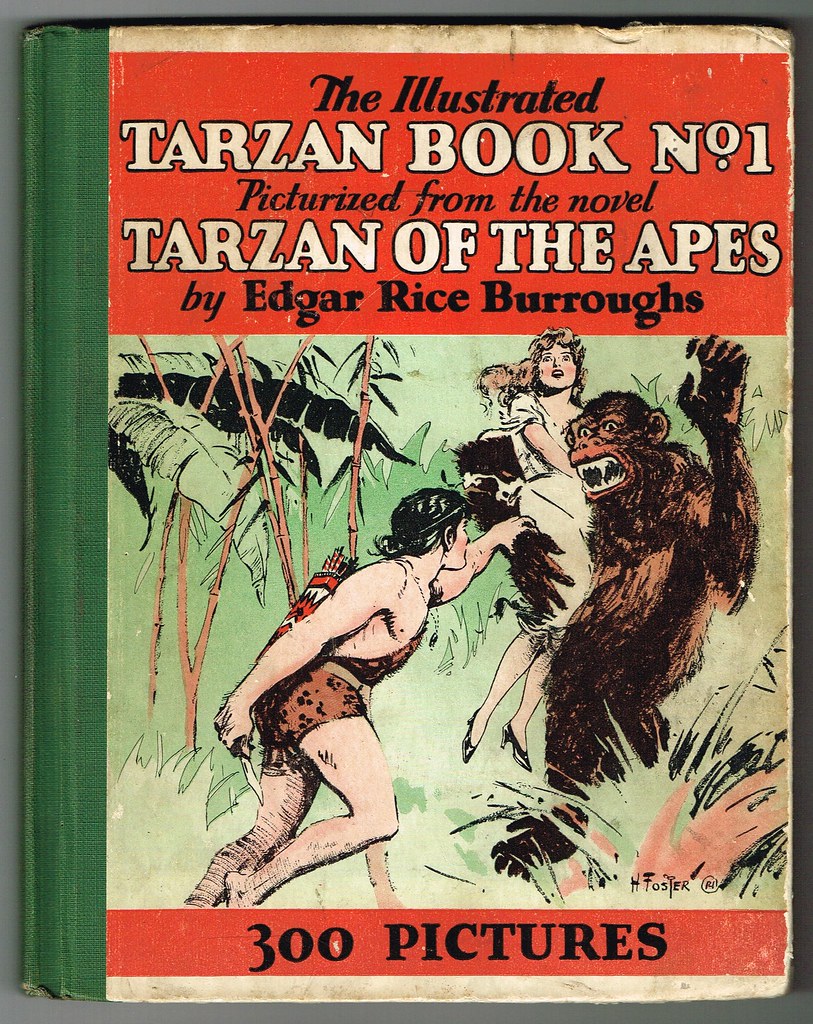
This book was not part of the collection, but it seemed like this long post needed a visual break…Then one day I walked into the public library and at the spot where they usually displayed new arrivals, there was a poster thanking Mr and Mrs G for donating Donny’s entire collection of books to the library. The library staff was still processing the books, but some were available for check out at that point. His collection leaned heavily into fantasy. There were some books that I had read before, and many that I hadn’t. But the thing that really jumped out at me was the collection of Edgar Rice Burroughs books, all in hardback, including all 24 Tarzan novels that Burroughs wrote.
Most of Donny’s books had a book plate (one of those adhesive stickers that says something like, “From the Library of _______”) with Donny’s name written in his own handwriting. The Librarians chose to leave the plates visible, gluing the pocket that held the book’s checkout card to another page. They did stamp “Property of R—— Public Library” underneath each plate.
The Tarzan books stuck out for me because I had only ever managed to find one or two of the books from the middle of the series. I was far more familiar with the movie and television versions of the character. But because Donny had the complete set, I was able to start at the beginning and read them all the way through. Based on the handwriting on the bookplates and the publication dates of the set, Donny had been at most in his early teens when he’d first read those books.
And he occasionally made notes in the margins. The notes were always in pencil and always stayed clear of obscuring any text. It was usually comments and questions about the plot. It made me feel almost as if I was finally having a conversation with Donny about some books he loved with which I was only now becoming familiar.
The Tarzan books are not great literature, but they usually delivered a rousing adventure. They are a good example of early 20th Century pulp adventures. The plots get rather repetitive, especially when one is reading them one after another. For some of the latter books in the series, I think sometimes I was turning the pages more to see if there were more notes from Donny, rather than wondering what would happen in the plot, next.
There were two other things that happened in relationship to Donny’s death which at the time should have given me pause.
The first happened very shortly after Donny’s death. I had a secret boyfriend. A guy my age who I regularly fooled around with (all very furtive with the constant fear of being caught). There was an abandoned shed in the woods where we often met to do what we did (which was actually pretty tame, but you know, guys raised in Bible thumping churches in redneck towns doing any sort of sexual thing together was pretty out there). During one of the classes we had together, I quietly asked him if we were still on for later that day, after each of us finished our sports practice (he was on the basketball team, I was on the wrestling team). He shook his head emphatcally and said. “Nope. Not for a while. No.”
I didn’t get a chance to talk to him more privately for a couple of days. He told me that on the evening after Donny’s funeral, his father had taken him aside and asked him a lot of questions about Donny, and guys at school. Including something along the line of, “You know, boys can get up to a lot of trouble with each other. Sometimes their curiosity and hormones make them do things they oughtn’t with each other. Do you know if any boys at your school are doing that?”
Being asked that freaked him out. So for a couple months he avoided being seen with me at school and just didn’t want to meet up to fool around. Eventually we started doing things again. And his dad never said or asked either of us anything about such topics again.
The other incident happened several months after Mr and Mrs G donated all of Donny’s books to the library. I was at the church potluck, and one of the church ladies that I never got along with (I think she hated children in general, and teen-age boys in particular), so I was a little surprised she walked up to me and started a conversation.
She began with, “I understand you spend a lot of time at the library.” I agreed that I did, and started to explain how much I loved books. But she interrupted to observe what a tragedy Donny’s death had been. Which I could only agree with. Then she said, “I understand that they donated a lot of books he owned to the library. And I hear that you have been reading them. A lot.” I started to explain that his collecting included lots of books I’d heard about, but never been able to read before. But she interrupted to say, “You shouldn’t fill your head with unrealistic fables and superstitious nonsense. You’d be better off reading your Bible than reading all those questionable books!”
I don’t know what I would have said if we hadn’t been interrupted by the pastor’s wife (who also happened to be a librarian at the aforementioned public library). She sort of swooped in and talked about what a serious student I was and managed to mention that a year before when a bunch of church members pledged to read the Bible together in a year, I was one of the few people who came to all 52 weekly meetings and always had interesting things to say about the section we were reading that week.
I don’t know why it wasn’t until literally decades later, when I was telling a friend about how I had wound up reading all 24 Tarzan books over the period of about a month, that I finally put all the pieces together and realized that at least some people in our church thought that Donny was gay. I mean, I knew everyone was always calling me various slurs, but I had never heard anyone refer to him that way.
So it didn’t occur to me back then that maybe the reason Donny suddenly put an end to our conversations at church was because he realized people were speculating about whether he was planning to molest me (since they believed that all gays were also pedophiles). I didn’t realize that the reason my secret boyfriend’s father had talked to him (in veiled terms) about whether any boys at school were engaging in homosexual activity wasn’t because he had suspicions about his son, but because suddenly everyone was whispering about Donny after his death. And why I chalked up the weird church lady’s conversation about fantasy books as merely attack on my personal reading habits, rather than some suspicion that someone thought Donny’s Tarzan collection (or his Jules Verne books, or the Wells, or Bradburys) were recruitment tools for the Secret Homosexual Army™.
It’s probably an extremely good thing I never got a chance to tell the church lady about how I enjoyed finding Donny’s notes in the margins of the books. She probably would have stormed the library and tried to organize a book burning!
While I don’t know why 13-year-old me didn’t connect those dots, I’m glad I didn’t. Because if I had, I would have probably become so self-conscious about what I was reading and who I talked to about what I was reading that I would have missed out of a lot of the wonderful books I read over the next few years.
I’ll never know if Donny actually was gay, or if people just assumed he was. I just know that while he was alive, he loved books that took the reader on flights of fancy about daring adventures in impossible places. And I know that for a little while, he helped me feel a little less alone in the land of the mere, mundanely possible.
“One does not simply return from the library without a book”There is an entirely different sci fi related post I’ve been working on all week, but a lot of the sci fi blogs and such I read have been talking about a topic that gets me a bit worked up. And I’ve already written three blog posts this month that are at least partially related to it. I got into a conversation commenting on this post by Cora Buhlert and I realized there is at least one hero of my personal journey through science fiction and fantasy whose praises I ought to sing.
I’ve mentioned before that because of my father’s work in the petroleum industry my childhood included 10 elementary schools across four states. Toward the end of my elementary school years, my dad got promoted to what was essentially a regional manager type position, and we were able to move back to the tiny town where I was born (And at the time where my paternal grandparents and maternal great-grandparents lived).
In the first week of seventh grade I tried to explore the school library, and found that it was open during limited hours (the librarian worked at the elementary school and the high school as well as the middle school, so was in on only certain days). I also found out that the school library only let you check out one book at a time unless a teacher signed a request that you needed additional books for a class project. The first time I was able to go in and check out a book, I did what I always did when finding a new library: I went looking for my favorite authors. I found an anthology of Ray Bradbury stories.
Which I read all the way through before the next day, but I think I had to wait two days to check it back in and get another. It was while I was checking it in that the librarian asked me how I liked the stories in the book. And then she asked about some other authors I liked, and during the course of the conversation asked if I had ever read anything by Fritz Leiber. I said I thought I had read some of his stories, but wasn’t sure. She led me to a shelf and pulled out a collection of stories about Fafhrd and the Gray Mouser. I think it was the volume Swords Against Death, but I’m not certain.
When I brought back the Fafhrd and Gray Mouser book, she recommended the anthology, Warlocks and Warriors edited by L. Sprague de Camp, which contained one of the Fafhrd and Gray Mouser stories I’d already read, but also contained “The Black God’s Kiss” by C.L. Moore, which introduced me to another great sword & sorcery protagnist, Jirel of Joiry.
Over the course of the next few months, with that librarian’s help, I read every single science fiction and fantasy book in the school library. Which would have left me sad, except that the town had a much more well-stocked public library.
The first visit to that library had been with my mother and younger sister, and Mom had commented on how much bigger and modern looking it was than the same town’s library had been when I was a baby. The library that Mom had checked out all of those Heinlein, Bradbury, Norton, and Christie (mom was a mystery fan as well as a sci fi fan) that she read to me as an infant.
Anyway, the public library had a much larger collection and they acquired books much more often than the school library had. And they allowed you to check out more than one book at a time and were open a lot more hours (having multiple full-time librarians, unlike the school district). That library had a lot to do with the fact that I read at least one book every day throughout seventh and eighth grade.
It was from that library that I read a rather large number of books by Madeleine L’Engle. I’d been a L’Engle fan since I had gotten a copy of A Wrinkle in Time from the Scholastic Book Club in about third grade. But hadn’t found many other books by her until that public library.
One day I came into the library to drop off books I had read intending to browse for new ones, but the librarian at the desk said (with a twinkle in her eye), “You should go check out the new acquisitions display.” They periodically put up the dust covers of recently acquired books along with some extra information about the author or if it was part of a series typed up on an index card. There would also frequently be bright pink cards next to the index card saying, “Currently checked out — ask to be put on the reserve list!”
Anyway, I got to the display and started scanning the books when Madeleine L’Engle’s name jumped out at me. And the title was one I didn’t recognize, A Wind in the Door. The little index card said something like, “The long awaited sequel to -A Wrinkle in Time-!” Joy started to bubble up in me… and then I saw that dreaded pink card.
“Someone’s checked it out already?” I don’t think I actually wailed, but you know, I was only 12 or 13 (I don’t know which month of 1973 the book came out, and now if you didn’t know how much of an old man I am, now you do) and a book I didn’t even know I’d been waiting for had just come out but I couldn’t read it yet!
The librarian didn’t scold me for being too loud. Instead she said, “Oh, yes! One of our best customers has already checked it out!” She made a dramatic show of looking through some papers… and then she read out my name.
The Head Librarian had already checked it out in my name, and she and the other librarians had cooked up the idea of sending me to the display and so forth. I found out later there had been a bet as to which one of them would get to spring that act on me.
So there it was, behind the counter, and I got to be the first one to read it.
Many other librarians helped me discover fabulous science fiction and fantasy works, not just the ones mentioned above. And I owe all of them a ton of gratitude.
And, of course, there’s Martin’s non-apology apology. Which he posted in the comments of someone else’s sci fi blog (File 770 is a fanzine/news site and I rely on it for news about the genre, yes, but it is still technically Mike Glyer’s blog). He hasn’t posted it on his one platform or anything.
I collected many, many, many more links to other people writing about their experiences as a nominee waiting to find out whether they won or lost, or from some of the presents, or as a former nominee watching, et cetera. But I think the collection above covers the majority of the issues (and lots of the linked posts include more links to other posts, so…)
I wanted to write about this not to repeat what others have said, but to comment on a couple aspects of it that I found personally astonishing. I listened to the livestream as it happened. I unfortunately was stuck in an interminable work day, so had the livestream playing on my personal laptop and listening on my airpods while I was working and occasionally looking over at the feed. So it took me at least 45 minutes before I thought, “My god, George, shut up!” because he hadn’t announced any nominees or any winners, yet!
In his non-apology Martin first justifies the extremely long walks down a very specific part of memory lane because New Zealand had never hosted a WorldCon before, therefore most of the local fans probably knew nothing about WorldCons, their history, of the history of the Hugo Awards.
My eyes bugged out. WorldCon didn’t come to New Zealand on its own like an alien invasion! Fans who live in New Zealand and host their own local science fiction conventions organized a bid committee, doing the years of work necessary to make a bid to host a WorldCon. They made a compelling enough case to garner enough votes and got it. They would not have organized a bid committee to try to host WorldCon if they didn’t bloody already know what WorldCon is! And even if somehow they didn’t know, I’m pretty sure all the sci fi fans in New Zealand know how to do a Google search.
What a baffling, patronizing, and condescending thing to say! But if he really thinks that way, that says more about his own hubris and lack of awareness than anything.
Moving on. He also says that all those anecdotes he told are tried and true stories that have always previously managed to get a laugh. I have a few issues with that…
Before I can explain my first objection, I need to give a little background. The purpose of this background is not to pile on GRRM even more, but to provide context. There have been a few times over the course of my life where I have decided that I wanted to have nothing to do with George or his writing. The first was in the mid-80s when I washed my hands of the Wild Cards series. A bit over a decade later some friends tried to get me to read A Song of Ice and Fire, and enough time had passed that I had actually forgotten the name of the guy who organized Wild Cards… but very quickly the same issues that had bounced me out before came up, and I noped-out again. Then there was last year’s Hugo Losers Party and his very tone deaf, whiny, defensive non-apology. The point is, that for 35 years I have actively avoided him. If he’s at conventions I’m attending, I don’t go to his panels. I only ever read his blog if someone I trust links to a specific entry and says it’s worth looking at, and so forth. Not because I hate him, but because I don’t care for his writing or his use of particularly objectionable tropes (and what that says about his personal values).
For 35 years I have actively avoided him, and yet, I have heard nearly every one of the anecdotes he shared at this ceremony several times. I’ve heard the one that includes his head being covered with whipped cream so many times, that I think I could recite it from memory—including all of his pauses and the points where for whatever reason he puts the emphasis on a different syllable than normal.
If I (who tries to avoid him) have heard most of these before, then I can’t help but think a lot of other people in sf/f circles have heard them before, too.
These anecdotes do contain interesting nuggets of information, and they would be appropriate in a panel about the history of sci fi fandom (or at least the part of fandom that attended WorldCons) in the 1970s and 1980s. The anecdotes about the earlier years of the Hugos and the banquet and such would be fine as part of a panel about the history of the awards. But they shouldn’t all be shared during an awards ceremony!
For my third objection, I need to mention that in college I competed in debate and speech competitions, and several times I won trophies in the Toastmaster/After Dinner Speaking Category. One year I was the Western U.S. Regional Champion in that category.
So as someone with some experience in this area, I have to say that all of Martin’s anecdotes are too long and plodding. There is a lot of filler material, so that the punchline, when it arrives, feels more like a band-aid being painfully and torturously peeled off a partially healed wound instead of a sharp delightful surprise. I’m not saying they aren’t completely unfunny at all, it’s just that they could really do with a bit of workshopping and trimming, okay?
The period of WorldCon and sf/f and fandom history he focused on was a fraction—less than 30 years out of the 81 years since the very first WorldCon. And the people he focuses on in those years were a very specific subset of all the authors, artists, and editors contributing to the genre during those years. Yes, he name-checked a couple of women of that era, but there were no stories that any of them figured in. How many times did he refer to Heinlein as the Dean of Science Fiction? Did he even once mention the Queen of Space Opera, Leigh Brackett?
No. He did not. Based on who appears in his anecdotes—and which of the past greats of the genre he feels compelled to lionize—we can safely infer that he thinks they are the only ones who mattered. It’s a very small circle that (to paraphrase Jeanette Ng) was mostly sterile, white, male, and heterosexual.
I’m only 11 years younger that George. I grew up reading all of those same stories by those very writers. They are what made me a fan. They are an important part of why I went on to write sf/f myself, to publish a zine, and to continue writing now. But they weren’t the only ones making science fiction and fantasy at the time, nor were they the only ones reading it.
And we are long past the time when we should be pretending they are the only ones that matter.
The Reading Outlaw has done a super-cut of the ceremony, removing the long rambling stories and including all of the wonderful, heartfelt acceptance speeches. You should take a look: When The Toastmaster Talks Less:
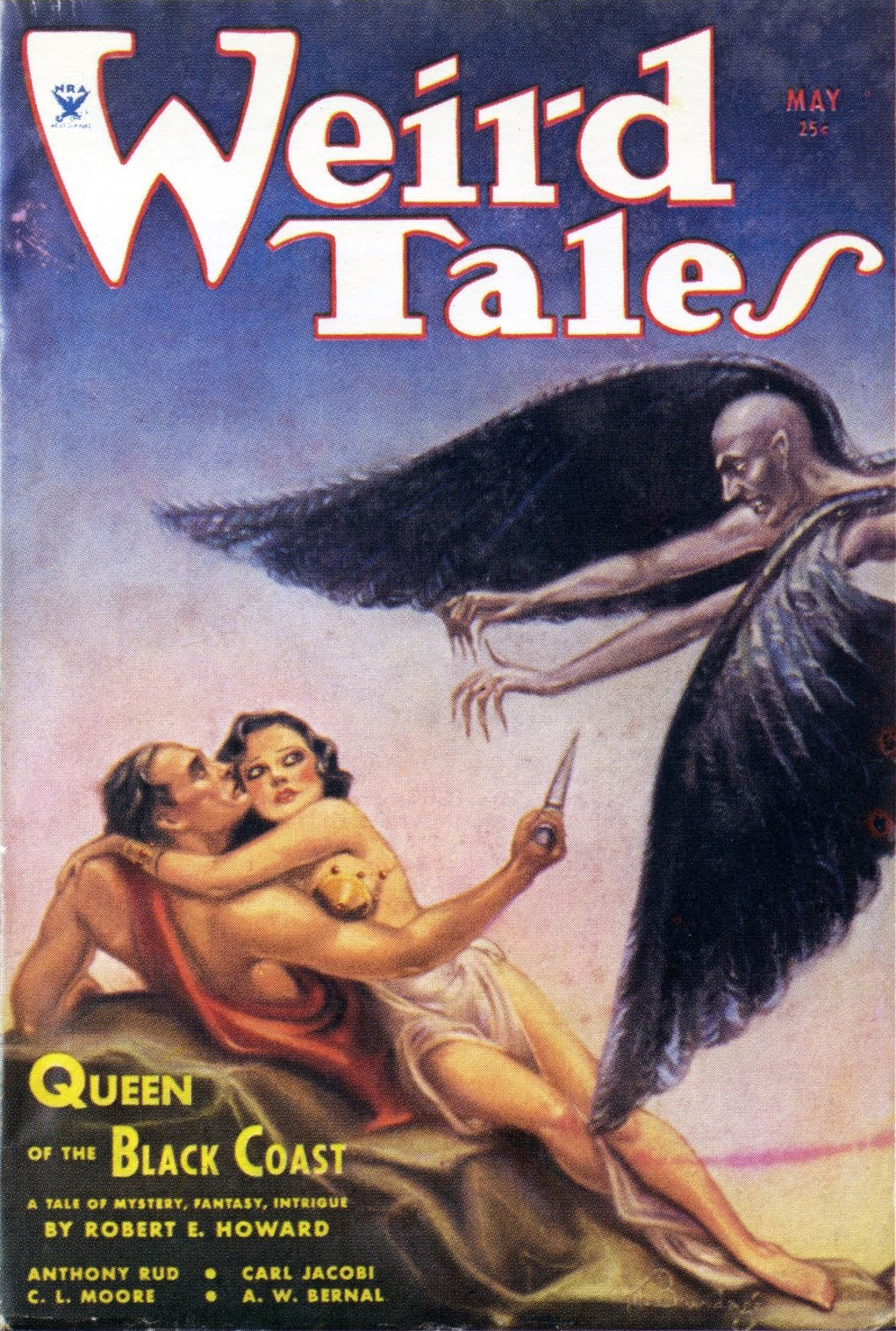
Cover for the May 1934 issue of Weird Tales. Cover story: “Queen of the Black Coast” by Robert E. Howard. Cover art by Margaret Brundage. The male character is Conan the Barbarian. Brundage was the first artist to draw Conan, and continued to do so as more of his storied appeared in Weird Tales, earning her the nickname much later, “The Frank Frazetta of the ’30s and ’40s.” (Click to embiggen)Last week I wrote about some problems with the Retro Hugo awards and why it may be time to end them. I was a bit upset at not just the one winner who I thought was undeserving, but much more irritated by the justifications I saw people making for why he was deserving. Two of those justifications boiled down to people taking other people’s word for what was worth remembering and honoring from the past. Some very cringeworthy versions of both of those arguments comprise the subtext of the debacle of the Hugo Awards ceremony that happened just a couple of days later. Though that is a topic I’ll be posting about later.
I was really pleased that Leigh Brackett won Best Novel for “Shadow Over Mars.” It was the story I placed in slot number one on my ballot, but I didn’t have much hope, because even though her career as a science fiction writer spanned form the mind 1920s until the early 1980s, and despite having been described as “the Queen of the Space Opera” she isn’t talked about one one-hundredth as much as certain so-called great men of science fiction whose careers often were much shorter than hers. Before this Retro Hugo, the only Hugo she had won was awarded some months after her death, as one of the screen writers for The Empire Strikes Back. Only one of her novels, The Long Tomorrow, was nominated during her lifetime and that was 1956. I had been afraid that either the Olaf Stapledon novel (which wasn’t bad) or the one by E. Mayne Hull & A.E. van Vogt (which is quite bad) would win because Stapledon and van Vogt are talked about and their works are included in retrospective anthologies more regularly.
I was equally stoked by Margaret Brundage’s win in Best Professional Artist. For 15 years Brundage was the cover artist for Weird Tales, and she also did a lot of interior illustration. The covers at first glance will remind you of other lurid covers that always seem to have scantily clad damsels in distress on them, but Brundage’s were subtly different. The women on her covers were far less likely to be hysterical or fainting. If the scene called for the woman to be tortured or threatened, Brundage would show that, but she usually showed them fighting back. While there were people who suggest Weird Tales should be banned because some found the covers lewd, Robert E. Howard once admitted in an interview that letters from his fans always mentioned how much they loved Brundage’s art, and he claimed he started adding scenes to his stories which he thought might make Brundage more likely to select his story for a cover. Back to the outcries about the cover: the editors of Weird Tales revealed that M. Brundage was a woman to deflect some of the objections to the covers, and there were a rather large number of people who didn’t believe it was possible for a woman to draw that competently. She definitely is overdue for some recognition!
Theodore Sturgeon’s win in Best Novella for “Killdozer!” is not surprising. “Killdozer!” happens to be a pretty good story and Sturgeon is not a total unknown to modern voters. It was in second place on my ballot (behind Brackett’s “The Jewel of Bas”), which I liked quite a bit more. “A God Named Kroo” by Henry Kuttner (another quite good story) was in third place on my ballot, followed by “Intruders from the Stars” by Ross Rocklynne. So I wasn’t unhappy with this category, but it’s hard to know how many votes for “Killdozer!” were due to name recognition.
A similar problem happens in Best Novelette with Clifford D. Simak’s “City,” because Simak is well-known, and entire City series is popular enough that it is still in print. However, I don’t think this particular story was outstanding compared to the rest of the ballot. I thought “The Children’s Hour”, by Lawrence O’Donnell (pseudonym for C.L. Moore and Henry Kuttner), “No Woman Born”, by C.L. Moore, and “When the Bough Breaks”, by Lewis Padgett (C.L. Moore and Henry Kuttner) were all better stories. The one thing that gives me some hope that Simak didn’t win just because of name recognition is that Asimov was also in this list (with a mediocre story, IMHO), so if name recognition were the only driving force, he probably would have won.
Ray Bradbury’s win in Best Short Story for “I, Rocket” isn’t surprising on its own. I personally thought of the stories on this ballot that it was the third best (behind Simak’s “Desertion” and van Vogt’s “Far Centaurus”). Mind you, “I, Rocket” is a good story. But Bradbury had a few much better short stories published in 1944. I mean, I’m not complaining that much, because even a mediocre Bradbury is more interesting that a lot of other writer’s merely good tales. I just happen to think that Bradbury’s “The Jar” and “The Lake” and much better Bradbury stories.
Leigh Brackett’s win in Best Related Work for “The Science-Fiction Field” is a bit of surprise if for no other reason than that it was one of the nominees that wasn’t available anywhere online. I had forgotten it exists until I saw it in one of the Retro nomination suggestion lists. After reading a summary I had a vague memory of having read it, and had to go by that recollection and some reviews to decide where to put it on my ballot.
Jerry Siegel & Joe Shuster winning Best Graphic Story or Comic with Superman: “The Mysterious Mr. Mxyztplk” can only be explained as name recognition and the fondness for more recent Superman stories. I had this story at dead last on my ballot. Both Flash Gordons and the Donald Duck story were in the top three positions because, well, Alex Raymond and Carl Barks were among the best comic artists of that decade. Full disclosure: when I was a kid one of my Aunts bought me a collection of trade paperback sized collections of reprints of a whole bunch of old Donald Duck comics, and this story happened to be in there! I actually have a physical copy at that nominee in my house! I also thought (once I tracked it down) that the Spirit story was better than this particular Superman comic. It just is not a good example of the series.
Since The Canterville Ghost and The Curse of the Cat People were number 1 and 2 on my ballot, respectively, I’m quite happy that they tied for Best Dramatic Presentation. There isn’t more to say here, other than, even 13-year-old me (who was the biggest diehard fan of the Universal Frankenstein movies) was shocked that such a stinker as House of Frankenstein even made the ballot!
I think the most important thing I can say about the Best Fan Writer category is, that if it hadn’t been for such modern fan-created websites like The 1945 Retro Hugo Awards Spreadsheet, Retro Science Fiction Reviews, and the like, I would have had no idea who to nominate other than the same old white (sexual harasser) guy who tended to always when in this decade. Fritz Leiber won six Hugos in his lifetime for professional stories, but like many pros, he was also extremely active in unpaid fan work. So I’m not at all unhappy with this win.
In my previous post I talked about the Best Editor category, but I want to repeat here that from my reading of scans I could find of old issues of the various zines that were being edited by the nominees in this category, Amazing Stories and Weird Tales (Raymond A. Palmer and Dorothy McIlwraith) published more good stories than Astounding that year. Planet Stories (edited by W. Scott Peacock) seemed to be a tie with Astounding in the ratio of good stories to bad. And I should note that the winner of the Retro Hugo for Fan Writer, that essay by Leigh Brackett? According to that essay, at the time Planet Stories was considered hands-down the superior publisher of accurate science in its science fiction. So all those grouchy old white guys who keep insisting Astounding and Campbell were beloved and revered above all others at the time and were the undisputed champions of science—they can sit on something unpleasant and spin.
Now we come to another category that has a lot of people up in arms: the Cthulhu Mythos winning Best Series. Before I begin, I need to point out that for the last five years I have been running a homebrew Cthulhu-based rollplaying game with a bunch of my friends. I have written stories that were intentionally meant to evoke the Cthulhu Mythos. I own a lot of modern anthologies, novels, and novellas by various people set in that kind of universe.
Despite enjoying the concepts of the Mythos, I put it dead last on my ballot (and considered putting it below No Award) for a number of reasons. The first is that in 1944, when works must be published to be eligible for this award, most of what I consider well-written Cthulhu-mythos stories had not been written. Of the works published in 1944, Captain Future, the Shadow, and Doc Savage were infinitely better. Most of the Jules de Grandin stories were also superior (though the best, IMHO, were published between 1921 and 1930 and I was shocked when I saw it on the ballot because I didn’t realize an eligible entry had been printed in 1944) Burroughs’ Pellucidar series was more than a bit uneven, so kind of a tie, quality-wise in my opinion. And I should disclose that I was irritated that, so far as I could tell, the far superior Monsieur Zenith had no qualifying stories published that year. Another reason not related to Lovecraft’s blatant racism (that is the driving force of many of his stories in this cycle), is that the Mythos was listed as being created by Lovecraft, Derleth “and others.” And honestly, by far most of the good stuff in the series was created by those unnamed others. So even wording this nomination that way makes this an undesirable thing to vote for.
If you read nothing of this post except the previous paragraph, you should be able to infer that I am quite interested in and fond of a whole lot of sci fi, fantasy, weird tales, and mysterious fiction published many, many decades before I was born. I was born in the ’60s, but my mom was a sci fi fan before I was born. From my infancy, she read to me from the sci fi books she had most recently checked out from the library or bought from a used book store. Of course I am familiar with the works of all those problematic guys from the 40s and 50s (and beyond!)1. All those stories shaped my love and curiosity for more fiction of the fantastic. And I think that there is value, for those interested, in having some familiarity with some of those old stories.
But I also think that if those of us who have knowledge of those old stories are going to recommend things to modern fans, they need to be things we have double-checked to make sure they really are as good as we remember. During a previous Retro Hugos ballot, some old stories written by an author who for decades was my favorite were on the ballot. They were stories I had read many, many, many years ago and had very fond memories of. I decided the ballot was a great excuse to re-read these old beloved favorites.
The Suck Fairy had been extremely busy working on those stories. The Suck Fairy had been so busy on those stories, that when I saw more stories from the same series by the same author had been nominated for Retros this year, I decided to just put them in last place on my ballot without re-reading, because I would rather keep the happy, golden versions of those stories that exists in my imperfect memory than see that the tales were not as good as I thought.
Which brings us to some of the many discouraging issues that have embroiled the fandom on the fast few days. There are people who created great work 40, 50, or 60 years ago, who tend to be venerated now, and who are themselves living in the happy golden imperfectly remembered version of sci fi/fantasy stores that were written 70, 80, 90, or more years ago. They only remember the parts that resonated with them. They don’t remember the racism, the sexism, the colonialism, the homophobia, and other bigotries that were sometimes blatant, but almost always present to some degree in those works. So some of them genuinely do not understand why a lot of us are not as enamored with those days as they or in the same way that they are.
There are a lot of diamonds to be found among all that fool’s gold. And I think, if we can keep projects such as the Retro Hugo Awards Spreadsheet and the Retro Science Fiction Reviews up-to-date and available to modern fans, it is possible that through the mechanism of the Retro Hugos, we can bring recognition to many of those who deserve more credit for the foundations of the genre than the simple repeating of received wisdom has made available.
Notes:
1, I want to note, for the record, that while when I was a small child one of Mom’s favorite authors was Heinlein, her current obsession is the Lady Astronaut series by Mary Robinette Kowal2. If my Mom, who is in her late-70s, can evolve with the genre, than 71-year-old GRRM has no excuse.
2. Her next most recent obsession was the work of Ellen Klages, so you can see that Mom has excellent taste!
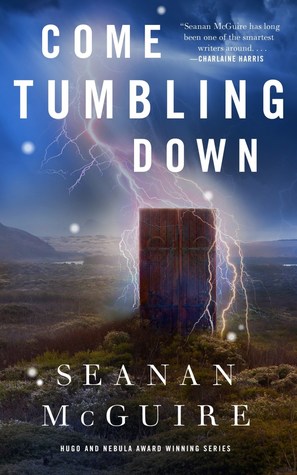 I have been trying to write a review of the sixth book in the Wayward Children series by Seanan McGuire, and realized that I couldn’t really talk about it without talking about the rest of the series, and I had somehow neglected to write about the previous book when I read it last year, so I need to talk about it before I jump into the latest. So, this will be a review of the fifth book. For reference, I wrote about the first three novellas in this series here. And then I wrote about the fourth book (which left me sobbing uncontrollably), here.





 Font Folly