Tag Archives: sci fi

And the rockets have been awarded — let’s celebrate the Hugo winners

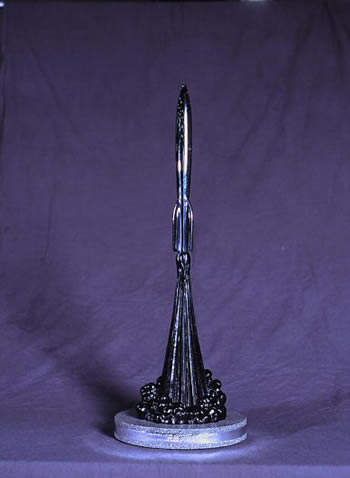
This year's trophy, base designed by John Flower.
This year’s trophy, base designed by John Flower. More pictures and an explanation of the design of the base are here: http://www.thehugoawards.org/hugo-trophies/2020-hugo-award-trophy/ (or click on the picture)

I have a long rambling rant about all of the horrible things that happened during the ceremony (nothing at all to do with any of nominees or winners), which I will condense down with links to other more coherent rants for posting later. More important than that, the winners of the 2020 Hugo Awards, which are nominated by and voted upon by the members of the World Science Fiction Society (aka, people who have a supporting or attending membership to WorldCon, this year held virtually but hosted in New Zealand). As I’ve mentioned before, the Hugo Awards are something I’ve followed since I was a teenage, when I got hold of an anthology called The Hugo Winners.

Since it is an award that is voted on by fans, for a lot of us (particularly those of us who aren’t just fans, but also creators of science fiction and fantasy works), the award carries a lot of emotional weight. If you’ve read my earlier posts about them, you know that once the ballot comes out, I spend a lot of time reading, viewing, or listening to the things nominated, and usually agonize over my ballot until the last minute.

The last two years it wasn’t exactly the last minute — I submitted my final ballot a bit over 24 hours before the deadline.

Anyway, here’s the full list, winners and runners-up. I’ll have comments below.

Best Novel

WINNER: A Memory Called Empire, Arkady Martine (Tor; Tor UK)

The City in the Middle of the Night, Charlie Jane Anders (Tor; Titan)
The Ten Thousand Doors of January, Alix E. Harrow (Redhook; Orbit UK)
The Light Brigade, Kameron Hurley (Saga; Angry Robot UK)
Middlegame, Seanan McGuire (Tor.com Publishing)
Gideon the Ninth, Tamsyn Muir (Tor.com Publishing)

Best Novella

WINNER: This Is How You Lose the Time War, Amal El-Mohtar & Max Gladstone (Saga)

To Be Taught, If Fortunate, Becky Chambers (Harper Voyager; Hodder & Stoughton)
“Anxiety Is the Dizziness of Freedom”, Ted Chiang (Exhalation)
The Haunting of Tram Car 015, P. Djèlí Clark (Tor.com Publishing)
In an Absent Dream, Seanan McGuire (Tor.com Publishing)
The Deep, Rivers Solomon, with Daveed Diggs, William Hutson & Jonathan Snipes (Saga)

Best Novelette

WINNER: “Emergency Skin”, N.K. Jemisin (Forward)

“For He Can Creep”, Siobhan Carroll (Tor.com 7/10/19)
“Omphalos”, Ted Chiang (Exhalation)
“Away with the Wolves”, Sarah Gailey (Uncanny 9-10/19)
“The Blur in the Corner of Your Eye”, Sarah Pinsker (Uncanny 7-8/19)
“The Archronology of Love”, Caroline M. Yoachim (Lightspeed 4/19)

Best Short Story

WINNER: “As the Last I May Know”, S.L. Huang (Tor.com 10/23/19)

“Do Not Look Back, My Lion”, Alix E. Harrow (Beneath Ceaseless Skies 1/31/19)
“And Now His Lordship Is Laughing”, Shiv Ramdas (Strange Horizons 9/9/19)
“Ten Excerpts from an Annotated Bibliography on the Cannibal Women of Ratnabar Island”, Nibedita Sen (Nightmare 5/19)
“Blood Is Another Word for Hunger”, Rivers Solomon (Tor.com 7/24/19)
“A Catalog of Storms”, Fran Wilde (Uncanny 1-2/19)

Best Series

WINNER: The Expanse, James S.A. Corey (Orbit US; Orbit UK)

Winternight, Katherine Arden (Del Rey; Del Rey UK)
Luna, Ian McDonald (Tor; Gollancz)
InCryptid, Seanan McGuire (DAW)
Planetfall, Emma Newman (Ace; Gollancz)
The Wormwood Trilogy, Tade Thompson (Orbit US; Orbit UK)

Best Related Work

WINNER: “2019 John W. Campbell Award Acceptance Speech”, Jeannette Ng (Dublin 2019 — An Irish Worldcon)

Joanna Russ, Gwyneth Jones (University of Illinois Press)
The Pleasant Profession of Robert A Heinlein, Farah Mendlesohn (Unbound)
The Lady from the Black Lagoon: Hollywood Monsters and the Lost Legacy of Milicent Patrick, Mallory O’Meara (Hanover Square)
Becoming Superman: My Journey From Poverty to Hollywood, J. Michael Straczynski (Harper Voyager US)
Worlds of Ursula K. Le Guin

Best Graphic Story or Comic

WINNER: LaGuardia, Nnedi Okorafor, illustrated by Tana Ford, colours by James Devlin (Berger Books/Dark Horse)

Die, Volume 1: Fantasy Heartbreaker, Kieron Gillen, illustrated by Stephanie Hans (Image)
The Wicked + The Divine, Volume 9: “Okay”, Kieron Gillen, illustrated by Jamie McKelvie & Matt Wilson (Image Comics)
Monstress, Volume 4: The Chosen, Marjorie Liu, illustrated by Sana Takeda (Image)
Paper Girls, Volume 6, Brian K. Vaughan, illustrated by Cliff Chiang & Matt Wilson (Image)
Mooncakes, Wendy Xu & Suzanne Walker (Oni Press; Lion Forge)

Best Dramatic Presentation, Long Form

WINNER: Good Omens

Avengers: Endgame
Captain Marvel
Russian Doll, Season One
Star Wars: The Rise of Skywalker
Us

Best Dramatic Presentation, Short Form

WINNER: The Good Place: “The Answer”

Doctor Who: “Resolution”
The Expanse: “Cibola Burn”
The Mandalorian: “Redemption”
Watchmen: “A God Walks into Abar”
Watchmen: “This Extraordinary Being”

Best Editor, Short Form

WINNER: Ellen Datlow

Neil Clarke
C.C. Finlay
Jonathan Strahan
Lynne M. Thomas & Michael Damian Thomas
Sheila Williams

Best Editor, Long Form

WINNER: Navah Wolfe

Sheila Gilbert
Brit Hvide
Diana M. Pho
Devi Pillai
Miriam Weinberg

Best Professional Artist

WINNER: John Picacio

Tommy Arnold
Rovina Cai
Galen Dara
Yuko Shimizu
Alyssa Winans

Best Semiprozine

WINNER: Uncanny

Beneath Ceaseless Skies
Escape Pod
Fireside
FIYAH
Strange Horizons

Best Fanzine

WINNER: The Book Smugglers

Galactic Journey
Journey Planet
nerds of a feather, flock together
Quick Sip Reviews
The Rec Center

Best Fancast

WINNER: Our Opinions Are Correct

Be the Serpent
The Coode Street Podcast
Galactic Suburbia
Claire Rousseau’s YouTube channel
The Skiffy and Fanty Show

Best Fan Writer

WINNER: Bogi Takács

Cora Buhlert
James Davis Nicoll
Alasdair Stuart
Paul Weimer
Adam Whitehead

Best Fan Artist

WINNER: Elise Matthesen

Iain Clark
Sara Felix
Grace P. Fong
Meg Frank
Ariela Housman

Lodestar for Best Young Adult Book (Not a Hugo)

WINNER: Catfishing on CatNet, Naomi Kritzer (Tor Teen)

The Wicked King, Holly Black (Little, Brown; Hot Key)
Deeplight, Frances Hardinge (Macmillan)
Minor Mage, T. Kingfisher (Argyll)
Dragon Pearl, Yoon Ha Lee (Disney/Hyperion)
Riverland, Fran Wilde (Amulet)

Astounding Award for Best New Writer (Not a Hugo)

WINNER: R.F. Kuang

Sam Hawke
Jenn Lyons
Nibedita Sen
Tasha Suri
Emily Tesh

Congratulations to all of the winners!

This year, seven of the winners were entries that I put in first place on my ballot, so obviously I’ve pretty pleased with the outcome. For the fourth year in a row, the Novel that won was in second place on my ballot, again, an outcome I like.

Like last year, Best Novel was a very difficult category for me. Two of the entries were books I nominated. One of the entries I hadn’t nominated was a book which I had purchased before the short list came out, but hadn’t read before the nomination phase. Another was a book that was already on my wishlist. All six were good, but it very different ways. So it was just agony trying to decide how to rank them.

Fan Writer was similar. When the short list was announced (in an online livestream that I watched as it was happening), I literally screamed in glee. Three of the nominees were people I had nominated, and the other three were fan writers whose work I followed and were in contention for my nomination while I was working on that ballot. They are all six wonderful people who write (and in some cases podcast) really helpful and interesting things. As more than one person observed, all six of them are people who spend a lot of time and effort recommending good things for fans to check out. (And the winner, Bogi Takács, used ems acceptance speech to recommend a bunch of other writers and project fans should check out!) And… well, two of those that I nominated are people with whom I regularly interact with on line. So I was sweating bullets ranking that category. I really wanted all six to win!

Neil Gaiman gave an incredibly touching acceptance speech for Best Dramatic Presentation (Long Form) winner Good Omens—informing us that the reason, some years ago, that Terry Pratchett (his co-author of the original book, and whose deathbed request led Neil to make the series) had declined a Discworld novel’s nomination wasn’t because he didn’t want a Hugo, but rather because he knew he couldn’t lose gracefully. He won a lot of other awards, and was sometimes nominated but didn’t win them, so it wasn’t that he was afraid of losing. As Neil said, the Hugos are the Sci Fi fans award, and it was the one award that mattered too much to him. Terry was certain that Hugo voters would never vote for a funny book as Best Novel, and Terry’s novels were always funny. Anyway, Neil closed by thanking everyone for giving Terry a Hugo. Good Omens the series was at number one on my ballot, and I have enthused about it to anyone that will sit still for it for a while.

R.F. Kuang’s speech was particularly good (and since the Astounding Award was early in the ceremony, set a get tone for the night). I thought Jeannette Ng’s speech accepting the Best Related Work Award for her other acceptance speech last year was incredible. And was such a sharp contrast of the shenanigans of the M.C. and one of his cronies. But again, that’s a post for later in the week.

Amal El-Mohtar & Max Gladstone gave an incredible joint acceptance speech (in parallel zoom windows). Their story, This Is How You Lose a Time War has been at the top of my list since June, 2019. I first heard Amal read an excerpt from in at a reading at Locus Awards Weekend that year, I bought a copy the next day and started reading it. And re-read it a few times over the next months. The same story one a Nebula Award and a Locus Award earlier this year, so I’m not the only person who loved the story.

I could keep going forever. I really am extremely pleased with the winners in every category but Dramatic Presentation (Short Form), but I also know a number of people whose opinions I respect who do like it. So I highly recommend all the winners but that one (if you ask my favorite TV series that were nominated this time that didn’t win in order: Watchmen, Mandolorian, Expanse, and Doctor Who). And except for a couple of the Dramatic Presentation entries, I adored, or admired, or at least thought all of the runners-up merited being above No Award. So I would have been quite happy if they had won the award. You should look into them and see if you think they might appeal to you.

This was a great slate of nominees. The winners all deserve a round of a applause, as do the runners up!

Congratulations!


I have a lot of links to stories and posts and threads about what went wrong at the ceremony that will be in that later post. If you don’t know but are curious, Cora Buhlert wrote a very nice explanation from the point of view of a nominee watching the ceremony with family members (and as a nominee, also being able to see the other nominees on the related zoom): Some Reflections on the 2020 Hugo Ceremony a.k.a. Reminiscing with George.
Received wisdom is the mind-killer, or, is it time to end the Retro Hugos?

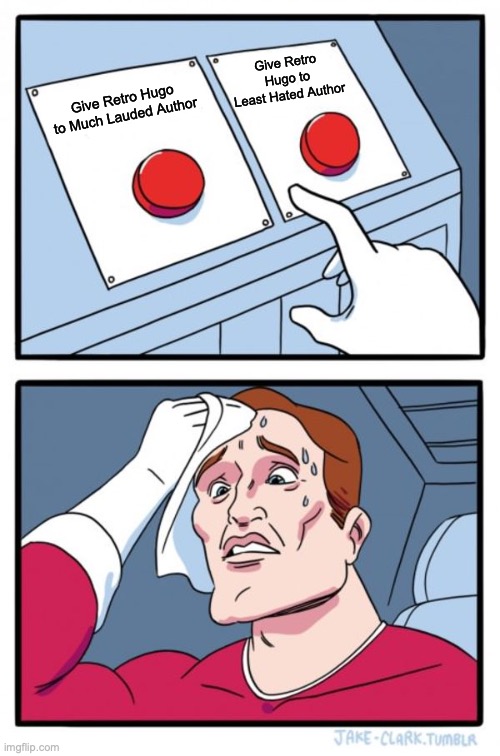
False dichotomies…
The Hugo Awards (though at the time they were called the Science Fiction Achievement Awards) were first awarded at the 1953 WorldCon (PhilCon II, which was the 11th World Science Fiction Convention) in a process much different than the way winners are selected today. The organizers of the 1954 WorldCon did not conduct any sort of award survey or ceremony, but the 1955 organizers did, as did the next few WorldCons. It wasn’t until 1961 that the rules for the awards were codified with the adoption of the World Science Fiction Society constitution, which also made the awards a permanent recurring part of the convention.

In 1994 the World Science Fiction Society approved the awarding of Retrospective Hugos for those years when there had been a WorldCon, but no Hugos. WorldCons aren’t required to award them. Also, Retro Hugos awards are allowed only for specific years: 50, 75, or 100 years before the current Worldcon, and only if another WorldCon hasn’t already awarded Retro Hugos for that year.

The original idea was that the Retro Hugos can only be given out 11 times—for the years 1939, 1940, 1941, 1946, 1947, 1948, 1949, 1950, 1951, 1952, and 1954. Because there was no WorldCon from 1942-1945, due to World War II. A recent rule change now allows for awards for those war years, as well, which is how we got to the ceremony earlier this week at CoNZealand where Retro Hugos for 1945 were handed out.

When I first heard about the idea, I thought it was a good one. People were creating and reading (or viewing) science fiction in those years, and it made sense that the organizations handing out awards for excellence in sf/f should look at award-worthy stuff during that time. It gives fans a chance to read stories with which they are unfamiliar and learn about the history of this genre we love, right? And if gives us, as a community, and opportunity to recognize some works and creators who are less famous today.

In practice, I’m not sure things have exactly worked out that way.

A lot of the Retro Hugos have gone to people who are still famous today (and who often had received plenty of awards while they were still alive). And it isn’t even because those are the best stories that made it to the ballot from that year. Several of the Retro Hugos have gone to rather mediocre stories from early in the careers of people who went on later to write much better stuff.

In other words, it seems that a lot of voters aren’t actually reading the nominated works, but rather picking works that are written by people they have heard of.

It it difficult to track down some of these old stories, I get it. Even though there are wonderful fan blogs out there publishing lists of links to where you can find these tales (since they have often fallen into the public domain many are available for free). As a voter myself, I admit that each time it has been a struggle to read everything nominated from both the regular Hugo ballot and the Retro Hugo ballot during the time between when the ballots are announced and when voting closes.

An even more difficult category is Best Editor, Short Form. Which is, in practical terms, an award for best magazine editor. So in order to do one’s due diligence this year, for instance, you would have to peruse all of the issues published in the eligibility year of the at least the magazines Astounding Stories, Weird Tales, Famous Fantastic Mysteries, Amazing Stories, Thrilling Wonder Stories, and Planet Stories.

That’s a lot of 75-year-old magazines to track down.

And if, like me, you track down scanned versions of the old zines at places like the Internet Archive, probably your first reaction will be a lot of “WTF?” because all the ‘zines from that era printed a lot of stuff which would never pass muster today. A month or so ago it shouldn’t have surprised me at how much WTF-material there was (because this is hardly my first time looking at stories and magazines from the time), yet it did a bit. It’s amazing how quickly we forget the weird stuff, the poorly written stories you couldn’t force yourself to finish, and so on. You remember the stories you thought weren’t bad (and sometimes even quite good) more than the other stuff.

If you aren’t willing to do that, you’re going to fall back (as the voters did this year), and the name you know: John f-ing Campbell, yet again.

I haven’t read every single issue of Astounding (later renamed Analog) Campbell ever edited, but I’ve read enough to draw an opinion of his skills as an editor overall. Looking at the stories he published in the year under questions, to the extent I could in the time frame, I found his selection of stories to be overall, mediocre. Yes, there was good stuff in there, but the was a lot more meh than wow.

I believe strong arguments can be made for at least two of the other nominees to be ranked above Campbell in this particular year. But if you point that out, people come back with basically three counter-arguments:

  • Everyone knows that Astounding was hands-down the best sci fi ‘zine of the time so who else could anyone vote for,
  • Campbell’s influence over the field dwarfs everyone else so who else could anyone vote for,
  • I liked more of the stories in the Astounding issues I sampled than in the others so…

The third of those arguments is the only one with any legitimacy. But let’s deal with the first two before I tackle the third.

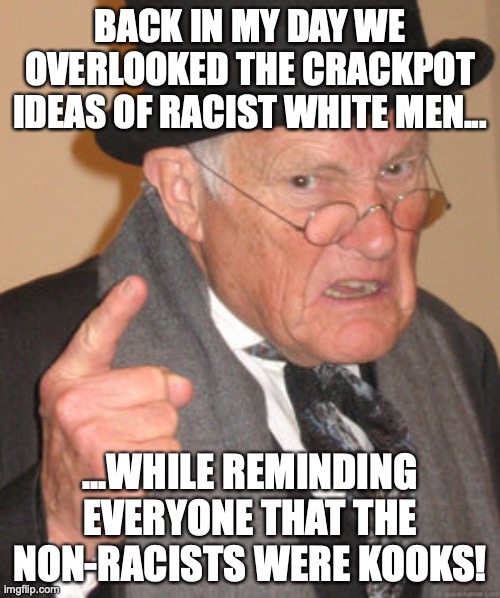
It’s amazing how many people still feel the need to defend the already much lauded racist, fascist misogynist…
“Everyone knows” is simply a really bad reason to make any decision. We’re talking about very subjective things here, for one. And for most people it’s all second-hand knowledge at best. Most contemporary fans weren’t alive 75 years ago, let alone comprehensibly reading everything that was published. And cultural artifacts don’t survive equally. Astounding appealed to a certain demographic who, for a variety of reasons, are much more likely to live and remain active in a particularly hobby for many years than some others. The demographic has also, historically, had its preferences elevated above other groups, whose preferences and activities are often erased from history.

Also, the Suck Fairy has had 75 years to visit those publications. You shouldn’t fall back on the received wisdom without verifying for yourself.

As to the second argument, well, Donald J. Trump’s influence over the United States right now dwarfs everyone else, but it hardly means historians should be handing him a “Best President” trophy. I know that metaphor is a stretch, but the point is that having a lot of influence isn’t the same thing as using that influence well. And again, how much of Campbell’s influence was due to him, and how much is it due to that ability of the demographic he most appealed to to have an outsized impact on how the time period is remembered?

That third argument is a reasonable reason to determine who you vote for, I agree. But at least some of the people I’ve seen making that argument don’t stop at “this is why I voted for him,” they went on and tacked on the “…so who else could anyone vote for?”

Judging the editor categories is always difficult. Most people approach it by voting for the nominee who published the stuff the individual voter liked most.

That’s not the only criteria one ought to consider, in my opinion. Full disclosure: for over twenty years I edited a very small ‘zine that printed science fiction. Our circulation was never over about 300, but we also knew we were aiming at a particular niche. Still, it means I judge editors by more than just whether I like every story they publish. I didn’t limit myself, as an editor, to publishing only stories I thought were award-worthy and would stand the test of time. I picked stories because I thought my readers would like them and were worth their time and attention. Another quality I judge editors on is how well they seem to know their audience. If I have information about how they treat the writers they work with and the staff of their publications, I let that influence me, too.

Because giving your audience things they will enjoy (which isn’t the same thing as fan service, but that’s another discussion), cultivating writers, and managing staff are all also part of the job of an editor.

If I only voted for the editors whose publications I loved (and only stories I loved, et cetera), there would have been a lot more No Awards on my Hugo ballots over the last five years. I can look at something that isn’t to my particular taste and say, “Well, I don’t like that, but I know a lot of people do, and this seems to be a competent execution/exploration of a topic I don’t care for” and go ahead and vote for it. It’ll just be lower on my ballot than other things.

None of this is to say that no one has a right to vote for Campbell in the Retros. The question I raise in the title of this blog post is about whether the Retro Hugos are actually recognizing things that are award-worthy, or merely handing out trophies to nominees based on received wisdom instead of merit.

Unfortunately, the jury is still out.


Edited to add: Not many minutes after this published, one reader pointed out a copy-and-paste blunder that ate one whole sentence and part of a word.

Then another pointed out that my question is sort rhetorical for at least the next year, since the 1946 Retros were given out at LA Con III back in 1996, so it won’t be until 2022 that the question will come up again. To which I say, an amendment to the WSF Constitution has to be passed at two WorldCons before taking effect, though we don’t need a rule change if the organizers of 2022 and later conventions can be convinced that maybe these aren’t a great idea…

ETA 2: As always, Cora Buhlert writes much more informatively and nicely than I do on a fannish subject: Some Thoughts on the 1945 Retro Hugo Winners.

ETA 3: I wrote a rebuttal to this a big later: It shouldn’t require a keymaster to have fun, or, canon and other forms of gatekeeping in sf/f.

And Cora Buhlert wrote more elequantly on the same topic and included a lot links to other people writing on the same topic: Why the Retro Hugos Have Value.

Gentlefolk, Start Your Rockets, er, Hugo Ballots!

The Hugo trophy given out at NolaCon II, New Orleans, 1988. Trophy designed by: Ned Dameron Photo by: Michael Benveniste
The Hugo Online Ballots have finally opened! Which means I have a lot fewer excuses not to start filling mine out. If you are a Hugo voter (i.e., have a membership to this year’s WorldCon) and you haven’t received the email telling you how to log in and vote, you should probably check your spam folder(s). I haven’t posted any reviews of any of the books or stories or otherwise on the ballots, yet. But some other folks have. I am most enthused about a series of blog posts that Camestros Felapton is putting up this week, here’s the overview: It’s Hugo Fan Writer Finalist Week! Each day this week he is posting a “Hugo Fan Writer: Why you should vote for… ” essay. Because each and everyone one of the six nominees in that category this year are just bloody brilliant fan writers. I wanna give all six of them the rocket.

His reviews give a nice overview of what each of the fan writers produce, with helpful links to stuff the many places you can find their work. Even if you aren’t a Hugo voter, but you love sci fi/fantasy, you should check these six writers out. They are all wonderful.

Just as I’m finding it very difficult to rank the six fan writer nominees, I’m having a nearly equally hard time in the Novel category. I may have to write about that some more later.

But for now, if you’re a voter, go vote! If you’re a fan, go check out those fan writers!

Confessions of a rainbow wearing queer geek in quarantine

Queer Geek
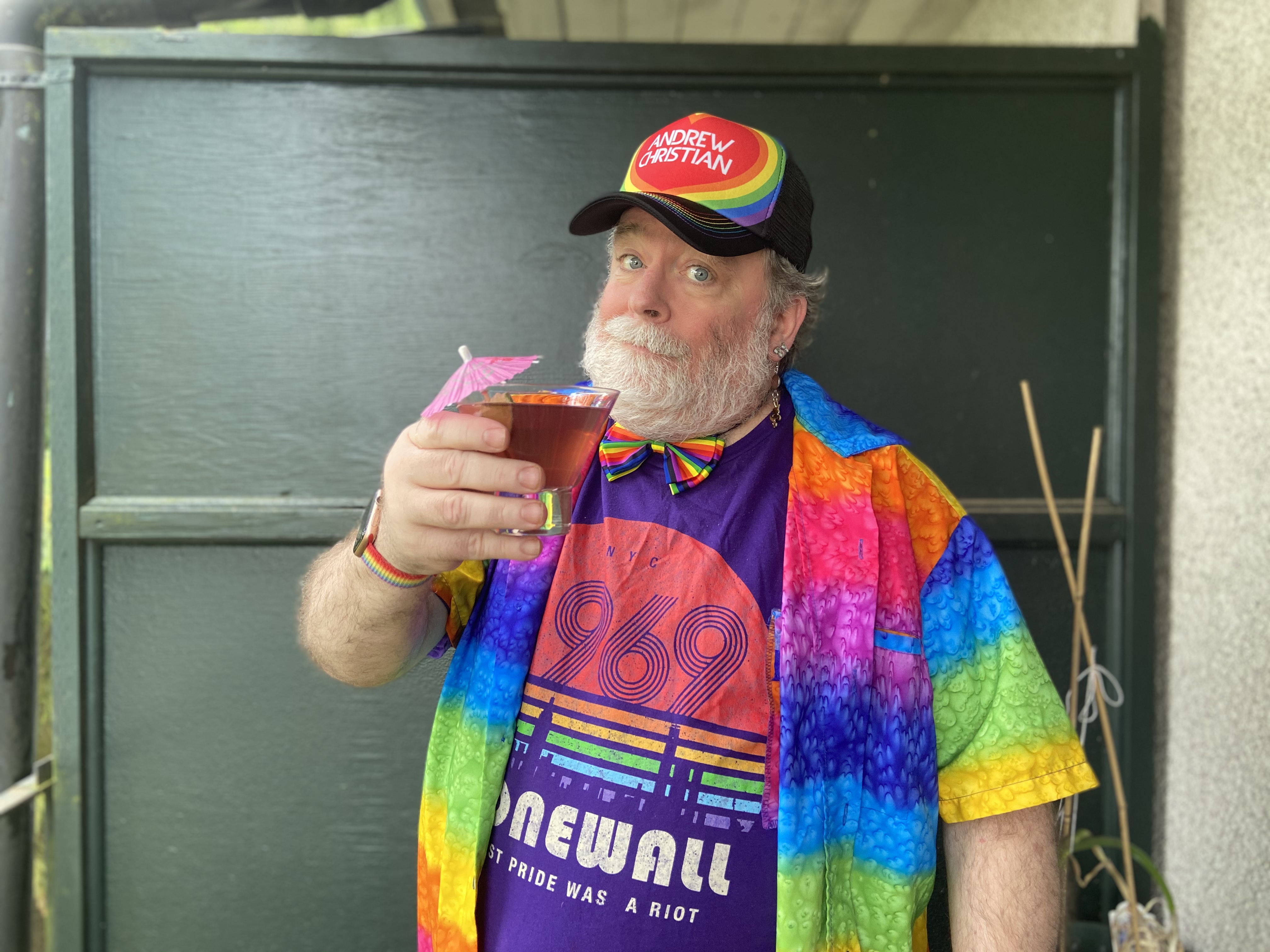
Yep, that’s me!
If this has been a normal year, for this weekend my husband and I would have checked into the hotel where the Locus Awards Weekend is happening on Friday. We would attend the reading and evening events there, then the panels on Saturday morning and the book signing, then the awards banquet…. When on Sunday morning we wouldcheck out, confirm with the hotel we can leave the car in the parking garage until 4pm, and walk two blocks to watch part of the Seattle Pride Parade, then walk a couple more blocks to see the Pride Festival, buy t-shirts or other things that catch our eye, before heading 8 miles north to our home.

Last year the festival put all the booths that were gaming stores, comics shops, and two publishers that specialize in queer comics and such inside one of the air conditioned buildings. It was almost as if there were a mini queer sci fi convention going on within the Pride festival!

When I was much younger, 4pm wouldn’t have been late enough to have free parking on Pride Day, but my knees aren’t what the used to be. Plus, I’ve always had problems when being out in the sun too long, so the 4pm deadline has been fine the last few years.

The in-person version of Locus Awards Weekend, as well as the majority of Pride events everywhere, being canceled due to the pandemic, that didn’t happen this year. I did sign up for the virtual Locus Weekend this time. There were more readings, but they were streamed recordings, so there wasn’t any audience reaction, which I found I missed a lot more than I thought. The panels were as fun as ever, even it was a little weird not to hear and feel the crowd of other fans around you during the con. On the other hand, because the panels were live streamed on Zoom, we did have a text chat to do some interacting with other audience members.

If we wanted to participate in the traditional Donut Salon, we had to provide our own donuts. And there wasn’t a banquet for the awards, obviously. Connie Willis, the MC, was wonderful, as always. There weren’t any acceptance speeches (which would have been very difficult to arrange virtually, I understand). I thought all of the winners were good choices, though in every category there were a bunch of other entries which I would have been just as pleased had they won instead. To see the winners: 2020 Locus Awards Winners.

I was particularly pleased that “This is How You Lose a Time War” won Best Novella, because at this point it is also at number one on my Hugo ballot in that category. I was also extremely happy that Nisi Shawl’s anthology, Different Suns: won Best Anthology.

I’m not the most extroverted person in the world, but I did miss chatting with people that I regularly see at this event, an seeing faces both familiar and new.

One of the things I love about the Locus Awards is that they have several different Novel categories. So three of the books that are on the short list for Best Novel Hugo walked away with Locus Awards this weekend.

Virtual Con was fun. It was certainly better than moping at home sad that I had missed it. And there are some things that we better, IMHO, with the virtual venue:

  • I didn’t have to contend with not always being able to get a seat close enough nor on the side of my fully functional ear in order to hear as well as clearly see faces and facial expressions of the panelists or readers
  • I sincerely doubt that Karen Lord has ever unsheathed that fancy sword in the middle of a panel before
  • CLOSED CAPTIONING – now, I’m pretty sure it was on-the-fly AI closed captioning, so much less accurate that others, but still, YES PLEASE
  • I enjoyed the adorable two-year-old twins and the puppy that all escaped Djèlí Clark’s spouse and briefly joined us in one of the panels
  • You can join the text chat without feeling like you’re disturbing others listening to the panels.
  • No con crud (which is the whole reason we’re virtual now, but y’know, even when there isn’t a deadly pandemic, con crud is no fun!)
  • People who can’t travel to the con (whether because they can’t afford it, or health issues, or other issues) can participate in the events.

There are also disadvantages, of course:

  • Spontaneous hall/bar/room party conversations don’t work in the virtual tools that facilitate the panels and readings and such
  • No dealer’s den (which at Locus Weekend is ALL BOOKS, NOTHING BUT BOOKS, the biggest vendor is University Book Store bringing books by authors nominated for the awards [not just the books/collections nominated—also other stuff they have in stock by said authors]), and while I don’t always buy stuff at the den, it’s fun to browse.
  • While we’re on the subject of books: normally there are piles and piles of books on every table at the banquet and the organizers urge you to take these free books home. I missed coming home with a huge pile of books.
  • You don’t get that amplification of enthusiasm/joy/amusement that happens when other people in the audience laugh, or applaud, or otherwise signal they also agreeing with/laughing at/et cetera something a panelist or audience member said

It was a decent substitute for the in-person event. And I hope that now that we’re doing this for some conventions (WorldCon is going to be all virtual this year, as well), I hope that conventions find ways to make more content available to stream like this for at least supporting members going forward.

An alternate outfit. Though given my sun burn issues, if I had worn a cap like this without the rainbow parasol I would have really regretted it!
The rest of the weekend I spent sampling various streamed Pride events, or watching some queer movies that have been in my to-watch list on various streaming platforms for a while. I also took some time to take some selfies (and play some more with the tripod and related things which I have acquired with the eventual intention to make some more videos to post) so I could have a suitable new rainbow picture to put on yesterday’s post.

I missed the in-person aspects of the convention. And I missed not seeing the fabulousness of the Pride Parade, and hanging out at the festival.

But it’s better than getting sick!

The Cabal That Wasn’t or, SF/F award numbers don’t mean what you think they mean

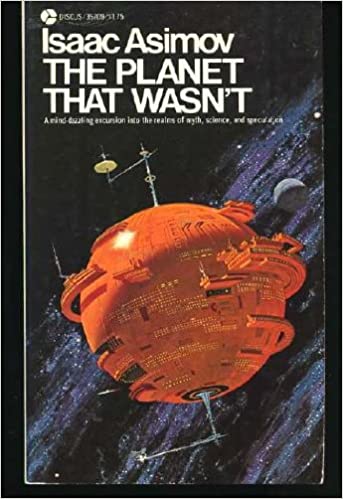
A tangerine-colored spherical space station spinning in the inky blackness of space. This is cover art for the 1977 Discus Editon of Isaac Asimov’s ‘The Planet That Wasn’t’. Art by Dean Ellis
This is cover art for the 1977 Discus Editon of Isaac Asimov’s ‘The Planet That Wasn’t’. Art by Dean Ellis
I’m deep in the middle of reading all the Hugo nominees that I hadn’t previously read so I can fill out my ballot, soon. Plus I’ve been working long hours at the day job while trying to keep up with the shambles that the world seems to be trying to turn itself into. So my attention has been a bit scattered. I was a bit surprised about a week or so ago to see a bunch of references to the “No Men Nominated for Hugos” cross my twitter stream. Which triggered an immediate WTF from me, because without checking the actual list, I thought, “But Ted Chiang, James Corey1, Michael Straczynski, Max Gladstone, and James Nicoll are all on the ballot, aren’t they? And those are just the men I can think of without looking it up!” But seeing so many mentions of it, I started to think that maybe I was confusing the Locus shortlist and/or Nebula shortlist.

I did eventually look up the long list, and confirmed that I was correct that all of those men had, indeed, received nominations23. But then I noticed that all of the books nominated for Best Novel were written by a woman4. And when I followed up to find a blog post from someone commenting on the issue and confirmed that, yes, the anger was about the Best Novel category, and how this is a terrible travesty and more proof that a political conspiracy has taken control of the Hugos, which is more proof of the downfall of civilization, et cetera, et cetera, et cetera.

They try what Asimov5 used to call a Judo Argument: the art of trying to use the enemy’s own strength against him. Asimov was specifically talking about arguments by people of faith to try to use science to prove the existence of god. But it applies to many other endeavors. In fact, the argument that these people who are upset about the Best Novel category of this year’s Hugo awards are using is specifically what Asimov called The Second Judo Argument:

“Suppose something exists, but the chances of it coming into existence due to random processes are so small (as determined by the laws of statistics and probabilities) that it is virtually impossible to suppose that it exists except as the result of some directing influence.”
—Isaac Asimov, The Planet That Wasn’t, essay 17, “The Judo Argument”

So, the argument that is being advanced, here, is that the having all six nominees in the Best Novel category of the Hugo Awards being written by authors of only one gender is so statistically unlikely that the only logical explanation is some kind of shenanigans. The least irrational way I’ve seen this notion expressed is in the form of a rhetorical question, “Are you seriously telling me that no award-worthy book written by a man in the field of science fiction/fantasy was published in 2019?”

Let me dispense with that question, first. There is nothing in the mission statement of the Hugos, nor in the rules, nor in a reasonable description of the awards that says the ballot must feature every single sf/f book which is worthy of a Hugo. Lots of great books fail to make the short list every year.

Since I participate in the awards, earlier this year I nominated five7 books for this award. Only two of the books I nominated made it to the ballot. Now that the ballot has come out, do I suddenly believe that the other three I nominated aren’t Hugo-worthy? Absolutely not! It just so happens that the four books I didn’t nominate that also did make the ballot were all books I hadn’t read8.

The other thing I want to mention about my nominations: when I went back into my emails to check what I had nominated, one of the five books I nominated was by a man. Was I disappointed that book didn’t make the final ballot? Sure! But not because of the gender of the author, just because it was a book I read recently that I really liked.

Let’s move on to numbers10. The other part of the argument is that having a category on the Hugo ballot dominated by one gender is somehow so incredibly unlikely as to prove some sort of cheating is going on. So, let’s look at the numbers, shall we? First, this 2019 article9 gives a lot of numbers: Gender and the Hugo Awards, by the Numbers. Nicoll breaks out more categories than I will recount here. The two most import numbers for our argument are these: how many times in the history of the Hugos has the Best Novel category been only men? And how many times have all but one nominee been a man?

The answers are enlightening. Out of the 66 years that there has been a Best Novel category for the Hugo Awards, 22 times the shortlist has been all men. That’s 33⅓% of all the years. And out of those 66 years the number of times that all but one nominee was a man is 20, which is just a touch more than 30%. So the number of years in which a single gender indisputably dominated is 64%. Which means that having one gender predominate isn’t a statistical anomaly at all.

Let’s be perfectly clear: this year is the first time, in 66 years of Hugo history, that the Best Novel category has only had women as the authors. But by no means is it the first year that any gender has had a disproportionate place on the ballot. While there were 22 years out of that time when the category had only men, which is a subset of the 42 years out of 66 in which one or fewer of the nominated works’ authors was a woman.

So, at this point we have discredited the idea that the ballot invalidates all work by male authors, and we have invalidated the assertion that a single-gender ballot is statistically unlikely. Maybe that’s where I should stop, but there are more problems here. Those problems are implied above, but the people whose arguments I have dismantled have demonstrated a decided inability to understand implications, so I have a bit more to say.

So, despite my dismantling of the arguments above—specifically that statistically there isn’t a problem in this year’s ballot—that doesn’t mean that there is no change worth discussion. For some context, let’s look at this recent essay: The Decade That Women Won. There has been a change in which gender dominates. What can we infer from the data?

Mathematically from the nomination and winning data we can’t conclude much. Having one gender disproportionately represented is the statistical norm for the entire history of the awards. All that’s happened in recent years is which gender of author that is being nominated most often has changed. There are a lot of perfectly reasonable explanations for this that don’t involve any shenanigans:

  • It could be that enough people are making an effort to read outside their comfort zone that they are encountering more books written by women than they used to.
  • It could be that reviewers and compilers of recommended lists are making more of a conscious effort to review a more diverse selection of works.
  • It could be that social media and other modern communication possibilities provide more ways to circumvent gatekeepers11.
  • It could be a slow generational change that’s just hit a tipping point.
  • It could be that a lot of the fans who are women and/or queer who bought their first WorldCon supporting membership in 201512 in order to protect the integrity of the awards from a slate-voting scheme stuck around13 and we tend to read a more diverse selection of sf/f books than the old guard
  • It could be that more women are managing to sell in the sf/f market than in decades past, and their increased presence is starting to have an effect.
  • It could all be statistical noise.

There is another form of the Judo Argument being used by the people unhappy with this year’s Best Novel nominees: “I thought all you people were opposed to discrimination, yet here you are cheering on the discrimination of men.” First, when I cheered when I saw the list I wasn’t thinking “Oh, look! No men!” No, I was cheering because two books I’d nominated had made the list, and two more that I’d heard enough good things about that I was already planning to read had made the list. Second, when we talked about discrimination against women and other marginalized communities in sf/f publishing and such, we had more statistics than just award ballots. We could show the statistical disproportions in who was published, which books were reviewed, which books were on recommendation lists, and many other statistics which all skewed very strongly toward cishet white men. We don’t have any such statistics showing a sudden skewing in the other direction. Even now, all those other numbers still favor cishet white men. And third, for decades the same people who are complaining now have insisted that an all-male or nearly-all-male ballot absolutely wasn’t discrimination, so they don’t now have the moral right to make that argument.

And that’s the crux of it: the people complaining now never cared during any of those years that no women were nominated. They don’t actually have any trouble with disproportionate nominees or wins. They only have a problem when it isn’t men who are being recognized.

In other words, they aren’t arguing in good faith, which is why their arguments fall flat.


Footnotes:

1. James S.A. Corey is actually a pseudonym for Daniel Abraham and Ty Franck… but both of them are men. I just always forget their names, but I know it’s a pen name for two guys, right?

2. Straczynski is nominated in the Best Related Work, and Nicoll in Fan Writer, so if the other people were up in arms about the fiction categories, then I guess we can’t count them, but…

3. Here’s where I pedantically remind myself and the reader that people are not nominated in the fiction categories, but rather specific works of fiction which happen to be written by people.

4. At least one is a trans woman. Which I only mention because at least one of the commentators out there who are angry about no men being nominated in the Best Novel category this year had a side rant about the trans person and how having a trans author on the ballot somehow proof that something untoward has happened in the voting process. The trans woman is a woman, so for the rest of this entry I’m just going to agree that all the authors nominated in the Novel category this year are women, because they are.

5. Asimov was a Grandmaster of Science Fiction and for most of my teens and twenties I thought he was the greatest science fiction author ever. He has considerably tarnished in my eyes since I learned how he treated (and groped and otherwise sexually harassed) women who he encountered at conventions and otherwise. But the notion of a Judo Argument: someone trying to use their opponents’ principals to disprove the opponents’ conclusions, is apt6.

6. For more reasons than one.

7. One of the rules which the World Science Fiction Society adopted recently in order to make Slate Voting Schemes less likely to succeed is that nominators are allowed to nominate no more than 5 titles, while the top 6 nominees will appear on the ballot.

8. Although one of them was a book I had already bought but hadn’t yet read, and one other was in my wishlist, for what it’s worth…

9. Coincidentally written by a man, and even more coincidentally, one of the men I mention earlier who is on this year’s Hugo ballot!

10. In an earlier draft of this post I started to go into statistical theory, because my major at university was mathematics, and if I had gone on to graduate school my plan was to go into statistics, probability, and game theory… but all the math makes some people dizzy. Besides, the people who have asserted the argument I’m refuting clearly don’t understand logic, so…

11. And yes, there have definitely been gatekeepers.

12. My gay self, my bi husband, and a number of others, for example

13. Just as I and my husband have.

We’ve got a lovely bunch of Nebulas!

This year’s Nebula Awards were announced at a live streaming event on Saturday. The Nebulas have been given annually by SFWA, the Science Fiction and Fantasy Writers of America since 1966. They are meant to recognize the best works of science fiction and fantasy published in the previous year. The winners are selected by the members of SFWA.

This year’s winners are:

Novel

A Song for a New Day, Sarah Pinsker (Berkley)

Novella

This Is How You Lose the Time War, Amal El-Mohtar & Max Gladstone (Saga)

Novelette

Carpe Glitter, Cat Rambo (Meerkat)

Short Story

“Give the Family My Love”, A.T. Greenblatt (Clarkesworld 2/19)

The Andre Norton Award for Outstanding Young Adult Science Fiction or Fantasy Book

Riverland, Fran Wilde (Amulet)

Game Writing

The Outer Worlds, Leonard Boyarsky, Megan Starks, Kate Dollarhyde, Chris L’Etoile (Obsidian Entertainment)

The Ray Bradbury Award for Outstanding Dramatic Presentation

Good Omens: “Hard Times”, Neil Gaiman (Amazon Studios/BBC Studios)

The Damon Knight Memorial Grand Master Award

Lois McMaster Bujold

The Kevin O’Donnell, Jr. Service Award

Julia Rios

The Kate Wilhelm Solstice Award

John Picacio
David Gaughran

I’m not a SFWA member so I don’t get a vote in these. But it’s always interesting to see what wins. Since the winning Novella and Novelette are both stories that I including in my nominations for a Hugo, I am clearly happy to see them win. And, of course, I quite love the Good Omens mini series (and I nominated the series as a whole for the Dramatic Presentation, Long From, as well as one episode [but a different one than got the Nebula] in Short Form), so I’m quite happy to see that win. And I’ve long been a fan of Lois McMaster Bujold’s books, so I’m very happy to see her officially recognized as a Grand Master of Science Fiction.

Because I don’t participate in the voting for the Nebulas, I am much less familiar with the rules defining the categories. They don’t have the all the categories that the Hugos do, and while there are a number of times when the same book or story that won a particular category in the Nebulas goes on to also win in the Hugos, it isn’t at all common. The voting pool is a different set for each award (though there is some overlap), so that’s to be expected.

Having the Hugo Voters packed become available the same weekend as the Nebulas were announced–when I am already well into the act to reading as many of the Hugo nominees as I could without the packet (I finished Gideon the Ninth about a half hour before I noticed the email telling me the Hugo Packet was available to download), it was a very science fiction heavy weekend.

Even while the world seemed to be falling down around us.

A round up of Hugo round-ups

(click to embiggen)
I thought that I had tapped the Schedule button on this post last night, so after finishing a somewhat grueling day at work (yes, even when working from home work can be grueling and frustration — but I keep repeating the mantra, “I’m glad I have a job. I’m glad I have a job. I’m glad I have a job…”), making dinner, chatting with my husband, and otherwise winding down from the day, I expected to log in to see how some stats on the blog before I finished a post for Thursday… and here this was not posted. So I decided to re-write the intro to reflect my doofus-ness

So other people have been posting about the Hugo ballot since it came out. This isn’t an exhaustive list, by any means, but I found all of these posts interesting and informative.

Cora Buhlert shares her views on the Retro Hugo nominees: Some Thoughts on the Hugo Award Finalists, Part I: The 1945 Retro Hugo Awards and the 2020 finalists: http://corabuhlert.com/2020/04/10/some-thoughts-on-the-hugo-award-finalists-part-ii-the-2020-hugo-awards/.

Nerds of a Feather have a bit to say: Adri and Joe Talk About Books: The Hugo Awards.

Paul Fraser and SF Magazines has some thoughts: 1945 Retro Hugo Award and 2020 Hugo Award Finalists.

Camestros Felapton has an overview: 2020 Hugo Finalists. And has begun following up with posts on specific categories Dramatic Presentation and Short Stories thus far.

And let’s not forget J.J.’s excellent round-up of where you can find most of the nominees or excerpts thereof, online: Where To Find The 2020 Hugo Award Finalists For Free Online.

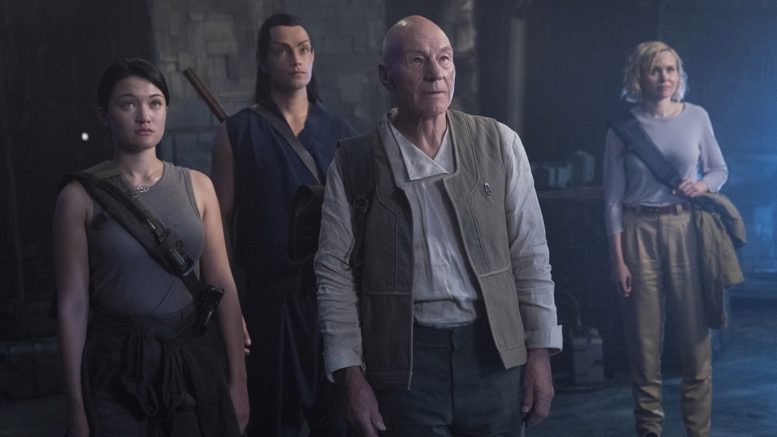
Star Trek: Picard wraps season one in a retro doozy

I have to start this review of the season one finale by paraphrasing Spider Robinson’s famous review of Children of Dune: It’s got plot holes so big you could fly fleets of Borg Cubes through them, but you probably don’t care because it’s such a fun ride. And yes, I think season one as a whole, and the final episode, were fun rides. To quote a friend who is not nearly as hard core of a fan as I am (who binge-watched it at the end and thus didn’t have to wait for any episodes), “Holy shit, that was amazing!”

For all earlier episodes of the series I scheduled my review to publish on the following Monday, in part just so there was some predictability, but there really isn’t a reason to put this off until then.

While there were some groan-worthy moments and several disappointments in the plot, the finale had its amazing moments. And to be perfectly frank, the first season of Star Trek: the Next Generation didn’t hang together half as well as this show has. It’s easy to look back on the old series with rose-colored glasses and only remember the episodes and arcs that we liked and forget the many (or so many) missteps.

Anyway, the rest of this is going to be all spoilers, all the time, so if you don’t want to be spoiled, don’t read on.

.

If you click through, you’re crossing into the former Neutral Zone without backup!
Continue reading Star Trek: Picard wraps season one in a retro doozy

“Et in Arcadia ego” finds Jean-Luc’s motley crew confronting mortality while wrestling moral dilemmas

We are at the penultimate episode of season one of Star Trek: Picard and it is a doozy! The official title is “Et in Arcadia Ego, part 1” and it ends on many more cliffhangers than any of the previous episodes.

Before we do anything else, I want to geek out a bit about the title of the episode, which I can do without any specific spoilers. The title is in Latin, and the phrase has been used as the title of a number of works of art over the years, most famously a painting by 17th Century French Baroque painter, Nicolas Poussin. The phrase is usually translated into English as, “Even in Arcadia, there am I” where the I in question is usually interpretted to be Death. The usual interpretation of the phrase is that Utopias are never perfect, or that Death is a universal fate everyone faces.

In another interpretation, the painting is used by certain conspiracy theorists (who say that the I in the title is Jesus, not Death) to be proof of their claim that a bunch of Kings of France in the Middle Ages were descendants of Christ.

There are other interpretations, of course. There is no way to know which meaning of the title really applies until we see the finale, which we all assume is entitled, “Et in Arcadia Ego, part 2.” Of course, given that Raffi within the show is a conspiracy theorist, while Commodore Oh, Narek, Narissa, and Ramda are all members of a secret conspiracy, we can’t rule anything out.

This was a fun episode. Lots of interesting things happened. We got answers to some outstanding questions. There were a couple of fun reveals, and some teasers for what might happen in the finale.

Which means we’ve reached the point were I can’t make any other comments without revealing major spoilers. So it is time for the cut-tag. Past this point there be plot spoilers. So if you don’t want to be spoiled, don’t read on.

.

If you click through, you’re crossing into the former Neutral Zone without backup!
Continue reading “Et in Arcadia ego” finds Jean-Luc’s motley crew confronting mortality while wrestling moral dilemmas

Picard tries to start mending all the “Broken Pieces”— the new series takes a Lovecraftian turn

My episode-by-episode reviews of Star Trek: Picard continue with the eighth episode, “Broken Pieces,” in which Raffi, Rios, and Jurati finally meet Soji, while Seven of Nine comes to Elnor’s rescue and is faced with a horrific situation.

This was another bloody episode, with a rather lot of deaths, some depicted less graphically than others. And the deaths were hardly the most disturbing things to happen! I think it was an excellent episode. Since we are nearly to the end of the season, most of all the diverse subplot all start to come together.

I can’t say anything more without major spoilers, which means it’s time for the cut-tag. Past this point there be plot spoilers. So if you don’t want to be spoiled, don’t read on.

.

You’re crossing into the former Neutral Zone without backup!

Continue reading Picard tries to start mending all the “Broken Pieces”— the new series takes a Lovecraftian turn