Tag Archives: science fiction

Stark raving nerd

I didn't manage to collect many badge ribbons this year, alas. But then, I forgot to bring my ribbons to hand out, and trading is where I usually get half my ribbons!
I didn’t manage to collect many badge ribbons this year, alas. But then, I forgot to bring my ribbons to hand out, and trading is where I usually get half my ribbons!
My previous NorWesCon post covered Thursday and most of Friday, but there was a lot more to the convention. My husband had had to work the first two days of the con, and didn’t get to the hotel until Friday evening just before we gathered for dinner. He hasn’t been feeling well since his trip to Missouri last week, so he wound up back in the room trying to sleep while I hung out in the bar with Matt kibbitzing on writing until it was time to meet Sheryl and Jon for the Burlesque show. It’s been several years. The last time I attended one at NorWesCon, a friend of mine was friends with several of the performers and had been the seamstress for at least one performers’ costume. I think that might have been more than 10 years ago.

The burlesque show is essentially a series of strip tease acts, often with sci fi/fantasy themes. And usually most of the performers are women, so you might understand why I, as a queer man, don’t attend often.

But they are fun shows, and more about performance and comedy than sex, so I probably ought to go more often. Matt was carded at the door, which was amusing. Jared, who was not attending, happened to text me having just realized I was at NorWesCon and asked me to take pictures. So I teased him about the fact that I was about to watch a strip show where they didn’t allow photography and too bad he wasn’t with us. There was more teasing, of course.

After that I headed back to the room to collapse into bed. Michael was asleep when I got there, but a few hours later when I woke up with a painfully stuffed head because of allergies he was awake. Not voluntarily, by any means. He was feeling even less well. He took another shower, and we commiserated about our various symptoms. After letting some fresh air into the room and waiting for more meds to kick in, I was able to get back to sleep, but apparently Michael didn’t. Before going to breakfast we discussed how to proceed since he was feeling so sick, couldn’t get comfortable in the hotel bed, and the small shower stall wasn’t conducive to soaking (which would have helped his knee which is still recovering for the recent injury).

The upshot was that he headed back home on the train. I tracked him until he was home. He had planned, when he left, to do a long soak in the tub, but he said by the time he was back he just collapsed into bed and sleep the rest of the day.

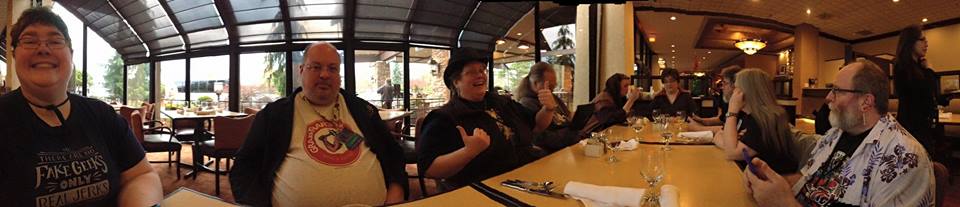
Auntie, Kehf (as Aunt Baru), Keith, Juli-sans-e, me, Jeff, and Geojlc at dinner.
l to r: Auntie, Kehf (as Aunt Baru), Keith, Juli-sans-e, me, Jeff, and Geojlc at dinner. (Click to embiggen)
So he wasn’t there when a big bunch of us had dinner and Julie and Jeff teamed up to take these panaramic pictures of us.

Geojlc, Mike M, Julie avec e, Mark trying to hide behind his hand, Auntie dressed as a Tatoinne Animal Control Officer, Kehf (still as Aunt Baru), Keith, Juli-san-e, and me again.
l to r: Geojlc, Mike M, Julie avec e, Mark trying to hide behind his hand, Auntie dressed as a Tatoinne Animal Control Officer, Kehf (still as Aunt Baru), Keith, Juli-san-e, and me again. (Click to embiggen)

After thoroughly confusing the wait staff multiple times with our orders and requests, I was sent off to my room to get my box of games and meet up and Juli and Keith’s room. We wound up playing four games of Give Me the Brain, none of which I won before deciding to call it a night.

Sunday morning I was a little slow getting up. I always have a hard time packing up the room on my own. It’s not just that two of us pack faster and can carry more per trip, it’s mostly that my husband is really efficient at this sort of thing, and keeps me focused. I have a number of friends who describe their distractabiliy as a super-power (to the point of at least one calling herself Distract-a-Girl!), but I think my brain is an entire horde of distract-a-minions. So even though I had a lot fewer things to pack than usual, it took me about three times as long to get everything out into the car and confirm I hadn’t left anything in the room.

Which made me a couple minutes late for the Why Representation Matters panel. But I’m glad I made it, not just because it was the third or fourth excellent panel that I got to see the fabulous Lisa Bolekaja in, but also because Paul Constant, whose book reviews I have been reading for many, many years was on it, and I finally got to hear his voice to place to the reviews. And it was an excellent panel.

I went to a lot of good panels, and really enjoyed all of them. Our last NorWesCon, a couple of years ago, had been less than fabulous for a variety of reasons, one of them being that, other than Auntie’s Seattle Opera Costume Department Trunk Show panel, none of the panels I went to felt worth my time (which is why I walked out of a couple). This year there were many hours where I had to choose between several panels that looked really interesting. I know the concom has been making efforts the last few years to shake thing up in programming, bring in some new blood, and so on. So that seems to have paid off. It also doesn’t hurt my perspective that I skipped two years. And this year I wasn’t a panelist, I wasn’t running a fan table, nor helping run someone else’s fan table, and otherwise had no obligations at all.

I didn’t even do my usual trick of stealth covering a volunteer shift or two in a department that is run by one of my friends.

I did hang out with my friends, though some of them less often than I would have liked. I introduced Keith to a new cocktail. I had buffalo wings just about every night. I got nicely squiffy at least one night. I did a pretty good job on my blood sugar all weekend. I picked up a pony plush, a set of pony key right charms, a sonic screwdriver earring, an Ash vs Evil Dead t-shirt, and birthday presents for two friends. I was given a Grumpy Cat as Dungeon Master t-shirt.

I met some cool new people, wrote down a lot of links to interesting web sites and have added a bunch of books to my “need to get this” list. Not to mention several new authors to follow.

For many, many years I would always buy our memberships for the next convention before we left. Three years ago, at the end of the con neither of us was certain we wanted to attend the next year, which is what led to us skipping in 2014 and ’15. I had a good time this year, but I had forgotten to ask Michael before he left Saturday what he thought. So Sunday morning I sent him a text (not certain whether he was awake or not). He replied about 20 minutes later that yes, we want to come back next year. So I’ve purchased our memberships for NorWesCon 40, and look forward to attending next year!

This, by the way, was the most awesome thing shown at the Movies and Previews panel Friday morning at the con:

It's a Mad Mad Mad Max Fury Road – Trailer from Monkey Blood on Vimeo.

(If embedding doesn’t work, click here.)
Keymasters and Gatekeepers?

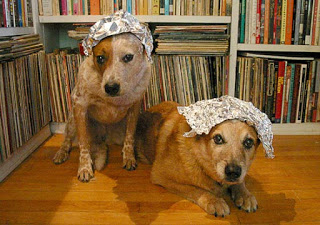
Puppies in tin foil hats
Puppies in tin foil hats (Click to embiggen)
So the Sad Puppies have officially released their recommendation list. Yes, I said list, not slate. Last year’s Sad/Rabid slates were coordinated and encouraged bloc-voting. This year different people are in charge of the Sad Puppy campaign, and they gathered a big list after taking recommendations for months. In all of the fiction categories, at least, there are more than five recommendations, so you can’t slate vote it.

A few other people have written about this year’s list. In sad puppies 4: the… better behaving?, Dara Korra’ti says a lot of what I was thinking when I saw the list. I’m glad that the Sad Puppies have taken a more transparent approach. I’m glad that the list isn’t dominated by stories published in only one very small publication house owned by one of the organizers. I’m really glad that three of the recommendations in a single category are not by the same author. I am willing to give them the benefit of the doubt that the people running it this year are sincerely trying to do no more than get more of the works they like on the ballot, rather than push a political agenda. I’ve never objected to recommendation lists no matter who makes those recommendations. As Dara explains:

What I object to is their conspiracy-theory paranoia, their Not Real Fan bullshittery, their political propaganda, their insistence that people voting for things other than their list has nothing to do with actual enjoyment or quality but a cartoonish parody of a political standard they made up, and – most of all – their ballot-stuffing last year. But I do not object to them making recommendations lists.

I am also still a firm believer that at this year’s World Science Fiction Society business meeting we must ratify E Pluribus Hugo so that the particular hack that the Sad Puppies and Rabid Puppies exploited last year won’t easily happen again. And I remain slightly worried that the only reason the current leaders are being reasonable this time (and the more noxious folks are being quieter) is because they hope the rules change won’t be adopted, so they can do what they did last year again, since any rules change has to be approved in two consecutive annual meetings to take effect. I really hope that isn’t what they’re doing.

Unfortunately, since last year they were crowing that there was no way they could lose because they had taken over a couple of whole categories, then threw a hissy fit when it was pointed out that Hugo voters could No Award those categories, and then they tried to claim that’s what they wanted all along, et cetera, I have no confidence that this isn’t just a tactic to lull some voters into a sense of false security.

Alexandra Erin also shared some thoughts on the topic I found myself nodding in agreement to in Hugo Stuff: Just taking a moment to acknowledge…. The most important bit, I think is:

The fact that a small, self-entitled clique that sought to wrestle control of the award away from fandom at large was able to game the ballot formation so effectively last year came down to how low participation in the nominations historically has been. The fact that this same clique was given a thorough drubbing by fandom at large in the actual awards came down to how high participation was.

Meanwhile, in Sad Puppies Are Up + My Hugo Recs Cisrova wonders:

It may have been a mistake to post a recommended reading list with probably over a million words of content two weeks before nominations close. Unless it was a clever trick to say “aha! Sad Puppies was about the discussion, not the final list!” in which case, well played. That means that those who came over from places like File770 to leave comments and votes are now Sad Puppies.

And Cora Buhlert rounds up a few more comments and facts at Hugo Season 2016: The Return of the Puppies, and asks:

…if your followers heap abuse on everybody who dares to disagree with you, is it any surprise that a lot of people want nothing to do with you?

All that said, I am still happy about a few of the silver linings of last year’s Affair of the Melancholy Canines: lots of fans and small press writers who never participated in the Hugo voting before have joined; I met several cool people (particularly several very interesting queer and feminist writers) because of the discussions surrounding the affair; and the nominees for Dramatic Presentation, Short Form finally had some diversity.

I don’t think enough people give the Puppies credit for that last bit. In the previous nine years, at least two of the options in this category each time were episodes of Doctor Who (or a related show). The last few years the category has been three or four Doctor Who eps and a Game of Thrones episode, and maybe one other show. But last year, five different television series were represented. Now, don’t get me wrong, I’m one of the biggest Doctor Who fans out there, but there are and have been other shows that deserved a nod. Last year the ballot consisted of five different shows, one episode each. Which I think was great.

I have been reluctant to post my list of Hugo recommendations because, as Cisrova observes, with only a few weeks left until the deadline, there isn’t much time for people to actually read all the things I might recommend, and I think you ought only to recommend things you’ve actually read/watched/listened to et cetera. I’ve spent most of my spare time the last two months reading books I bought that were published last year, and reading short stories in on-line zines in order to have more things to nominate. But I figure there is nothing wrong with sharing recommendations, as long as one is clear that it is just a recommendation for things I think you ought to read or check out:

Dramatic Presentation, Short Form
(I decided in the spirit of choices, to limit myself to one episode for each series I nominated)

  • Ash vs Evil Dead: El Jefe
  • Doctor Who: The Zygon Invasion/The Zygon Inversion
  • Orphan Black: Certain Agony of the Battlefield
  • The Expanse: The Big Empty
  • Person of Interest: If. Then. Else.

Novel

  • The Discworld Series, by Terry Pratchett
  • The Shepherd’s Crown, by Terry Pratchett (in case the series as a whole doesn’t make it)
  • The House of Shattered Wings, by Aliette de Bodard
  • The Fifth Season, by N.K. Jemisin
  • Karen Memory, by Elizabeth Bear

Novella
(I’m still working on this… lots of stories I’ve read and liked are shorter than novella length)

  • The Sorcerer of the Wildeeps, by Kai Ashante Wilson
  • The Witches of Lychford, by Paul Cornell
  • Binti, by Nnedi Okorafor

Novelette

  • “The New Mother,” by Eugene Fischer

Short Story

  • “How My Father Became a God” by Dilman Dila
  • “Ashfall,” by Edd Vick and Manny Frisberg
  • “In Libris,” by Elizabeth Bear
  • “The Ways of Walls and Words,” by Sabrina Vourvoulias

Fancast

  • Cabbages & Kings
  • Galactic Suburbia
  • The H.P. Lovecraft Literary Podcast
  • The Geek’s Guide to the Galaxy
  • Flame On!

Fan Writer

  • Vajra Chandrasekera
  • Leslie Light
  • Mark Oshiro
  • Cora Buhlert
  • Alexandra Erin

Dramatic Presentation, Long Form

  • Mad Max: Fury Road
  • The Martian
  • Star Wars: The Force Awakens
  • Ant-Man
  • The Rocky Horror Show Live

Related Work

  • Geek Knits, by Toni Carr
  • Bone Walker, by Crime and the Forces of Evil

Next, I need to go through all the online zines I read and figure out which editors to nominate in short form, and figure out what fan sites (in addition to File 770) that I read regularly count as fanzines.

I’m nominating only things I’ve read/watched/listened to myself. And I plan, just as I did last year, to read everything that makes it to the ballot, no matter who wrote it or who included it on a slate or list. If I don’t like the piece, it goes below No Award; if I like it, it’ll rank above No Award—again regardless of who wrote it or recommended it.

Uniques and Reborns, Computers and Telepaths – more of why I love sf/f

Cover of Arthur C. Clarke's -The City and the Stars- (Click to embiggen)
Cover of Arthur C. Clarke’s -The City and the Stars- (Click to embiggen)
I think I was 16 when I found a battered paperback copy of Arthur C. Clarke’s The City and the Stars in a used bookstore. This was not my first Clarke novel. That had been 2001: A Space Odyssey, which I had found in a library a few years before. I wouldn’t see the movie until many years later. I had also read many of Clarke’s short stories, so I was familiar with his work and his reputation as one of the best.

I had never heard of this particular novel, but the description on the back cover was intriguing, and since he had such a reputation, I felt almost obligated to read more of his work.

The story is set a billion years in the future, in the city of Diaspar, which is the last home of mankind. Humans are effectively immortal. Individuals are “born” nearly full grown in essentially replicators, and they live in the perfect unchanging city creating art and exploring philosophy or literature or poetry for hundreds or even thousands of years, until they decide to rest, at which point their memories are transferred back to the central memory banks and their bodies un-replicated. Until some random interval later when the computer will determine they need to be reborn again.

Into this world is born our protagonist, Alvin, who has no memory of a past life… Continue reading Uniques and Reborns, Computers and Telepaths – more of why I love sf/f

We have always been here, part 2

Cover, Astounding Science Fiction, July 1954.
Cover, Astounding Science Fiction, July 1954. The prevalent belief, at the time, was that the vast majority of readers were men. What does that tell us about the intention of this artwork? (Click to embiggen)
I get tired of having to defend my wish that stories include diverse casts of characters. Not just because I’m a gay man who wishes that my favorites shows, books, and stories would include people like me, but because I remember what it was like being a queer child and having no idea that there was anyone else in the entire universe like me. And therefore, I can empathize with other children who aren’t straight white cis males who never see people like themselves as the heroes of any story, and thus grow up not thinking that they have a place in this world.

But as I’ve said before, it isn’t just about having characters that various readers in your audience can relate to. It is also a matter of portraying a believable world. The real world has people of different genders, races, sexual orientations, and so on. It is simply unrealistic that a random sampling of any fictional world is going to consist solely of white, cisgendered, straight people. Especially the overwhelming majority of them male.

And there’s one other aspect, but award-winning sci fi/fantasy author, Saladin Ahmed explained it in a succinct set of tweets:

https://twitter.com/saladinahmed/status/703399564926193668

Ahmed is referring to the likely fanboy reaction to this article: J.J. Abrams says Star Wars will get an openly gay character. And the word “likely” is wholly unnecessary, as I’ve already seen angry reactions to the article around the net.

https://twitter.com/saladinahmed/status/703401268320952320

https://twitter.com/saladinahmed/status/703402190602440704

https://twitter.com/saladinahmed/status/703403468871081984

https://twitter.com/weirdoanansi/status/703402810914680833

https://twitter.com/saladinahmed/status/703404412522401793

As he said, the people who object when a non-white person is cast in lead role in a movie that isn’t about race issues, or queer characters are included in a story, and so on, always argue that it’s just furthering a political agenda to include any non-white, straight characters. Especially when it comes to queer characters, they angrily ask, “Who cares who is having sex with who?”

Well, obviously, if you’re getting angry, you do.

But let’s go back to the original Star Wars trilogy, for a moment. I was in a very crowded theatre on opening weekend for Empire Strikes Back, and when Leia declared, “I love you!” then Han replied cooly, “I know!” there were whoops and lots of exclamations of, “YES!” from all over that theatre. Three years later, at the first showing of Return of the Jedi, when Leia and Han have their big kiss at the end, there were even louder cheers and clapping. So a lot of people did care about who was in love with who, who was kissing who, and so on.

I want to repeat that: fanboys cheered and applauded a kiss near the end of a special effects-laden space opera adventure story.

So, they did care and they still do care about who is in love with, who is kissing, and yes, who is wanting to have sex with who.

It goes back much further into the history of science fiction and fantasy than Star Wars, of course. The reason that those earlier examples almost never included any same sex relationships is not because there weren’t any queer writers or readers of science fiction, it was because everyone was closeted. They weren’t closeted because they wanted to be, but because they often had to be. Remember, until the Supreme Court ruled in 2003 that intimate consensual sexual conduct was a fundamental freedom protected by the Constitution, same sex activity was a criminal offense in many places.

We have always been here. For instance, in the 1920s and 1930s, Edgar Pangborn wrote a lot of pulp stories in the mystery, fantasy, and sci fi genres which featured very passionate male “friendships.” The relationships were never overtly gay, but clearly were meant to imply it. He wrote those stories under a variety of pen names. He didn’t start publishing stories under his real name until the 1960s.

Jim Kepner was the publisher of one of the first magazines advocating for gay civil rights, ONE Magazine, beginning in 1953. But before that, operating under the fan name, Jike, he was an active member of the Los Angeles Science Fiction Society. During the 1940s he published a sci fi fanzine called Toward Tomorrow. Within that ’zine, and in other fanzines, he was only one of several fans who wrote speculatively of how society might evolve to include greater gender equality, racial equality, and acceptance of various sexual orientations.

A page from a science fiction fan zine from the 1940s, with Tigrina (Lisa Ben); not to mention Ray Bradbury. Courtesy ONE Archives/USC
A page from a science fiction fan zine from the 1940s, with Tigrina (Lisa Ben); not to mention Ray Bradbury. Courtesy ONE Archives/USC. (Click to embiggen)
Another member of the Los Angeles Science Fiction Society back then, Edythe Edye operated under the fan name Tigrina. In 1947, using the pseudonym Lisa Ben, she founded Vice Versa, the first lesbian magazine published in the U.S.

In 1953, when straight author, Theodore Sturgeon, explored gay themes positively in the short story “The World Well Lost,” it caused at least one editor to try to organize a blackball system to prevent it, or anything like it ever being published. The blackball scheme didn’t work. The story was published. Some people liked it, some didn’t. Sturgeon and other writers occasionally returned to the subject over the next couple of decades.

It was far more common, yes, for queer characters to be portrayed negatively. In some works, you could tell how far into the depths of evil a character had plunged by how much bisexual or homosexual activity they engaged in—Dune’s Baron Harkonnen being a prime example. My point is that queer fans and writers and artists have been around for as long as science fiction and fantasy have existed. The argument about whether or not we should be allowed to participate or be portrayed has been around just as long.

Queer people have been around for as long as people have existed. They will exist in every fantasy and science fiction world. Whether they can safely live openly in those societies will vary, just as it does now in the real world, and has varied in different historical periods. If your fictional world doesn’t include us, it is unrealistic. If your fictional world doesn’t include us, you either really suck at world building or you suffer from heterosexism. If you claim you can’t include us until the right storyline comes along, you may be in denial about how much homophobia (subconscious or not) you harbor.

Not every story will include romance, obviously. I have discussed with some folks the fact that in my current series of fantasy novels, while there are several characters I know who are bisexual or pansexual, most of them aren’t obvious. There is at least one clearly identified gay couple, and several clearly identified straight characters, but that’s it2. So, I’m a queer writer who isn’t sure I’m representing queer characters enough. Therefore, I’m not saying that writers who don’t have a lot of obviously gay characters in their work are bad people.

I am saying that if you have absolutely none at all, that is just as much of an “agenda” as anything certain people accuse queer people of pushing when we ask for inclusion. Whether consciously intended it, or not, that’s at the very least enabling an anti-gay agenda.


Footnotes:

1. Yes, that is an anagram of lesbian, and she did it intentionally.

2. There are shapeshifters in my universe, and at least one shapeshifter who has appeared prominently could be interpreted as a trans character. There are other characters in the world that are definitely transgender, but haven’t yet appeared in a story3.

3. I’m not advocating quotas. As Mr Ahmed said above, quotas are bad for art, but so is monotony.

Contagion from space – more of why I love sf/f

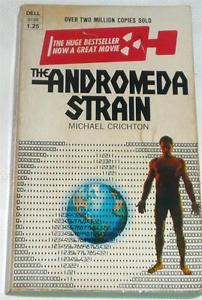
Cover of the first paperback edition of The Andromeda Strain, by Michael Crichton.
Cover of the first paperback edition of The Andromeda Strain, by Michael Crichton. (Click to embiggen)
The first time I remember hearing about The Andromeda Strain was while reading a movie theatre calendar. We were living in a small town in Utah which didn’t have a movie theatre of its own, but we were about an hour drive away from the small Colorado town where I had been born and my grandparents still lived. And often when we visited I would look at the monthly theatre calendar which was distributed free with the local weekly paper. Sometimes I would attempt to talk my parents into letting me come back on a particular weekend to go to the movie.

I think it was the fall of 1971 (I would have been eleven) when I saw the listing, and the name and very short description had me intrigued. Unfortunately, I wasn’t able to convince my parents to let me have the movie trip.

About a year later The Andromeda Strain was broadcast on network TV, probably as a movie of the week (that was a thing back then), and for whatever reason, we didn’t watch the first part of the movie. Probably it conflicted with a show my dad liked, so we watched the other show, first, then switched channels and watched the last half of the movie. So I was a bit confused, but it was still pretty exciting. The last part of the film was very tense and entertaining, even without the beginning.

The following week in school, everyone was talking about the movie. It was one of the few times that I remember kids who usually didn’t know a thing about science fiction talking about a sci fi plot.

Not long afterward, I happened across a battered paperback copy of Michael Crichton’s novel upon which the movie was based. I read it in a single sitting. One of the things that amazed me when I finished was how closely the half of the movie I saw followed the latter portion of the book. My previous experience of comparing movies to the books they were based on was that the movie often bore virtually no resemblance to the book.

The story of the Andromeda Strain is that a space probe is sent into low earth orbit and brought back down. It lands in a small, isolated town, and by the time the retrieval team arrives to pick it up, it seems that every inhabitant of the town has been killed. The retrieval team dies will communicating with their government superiors, and a Wildfire alert is activated. Wildfire is a codename for protocol government scientists have put together to respond to a biological threat from space. A team of scientists are pulled from their regular jobs and rushed to a secret underground facility. Two of the scientists go into the town in hazmat suits, find the satellite, and also find two survivors, an old man and a crying infant. The bulk of the story deals with how the scientists figure out what the infection is, and why those two very different characters are immune.

Before they have quite figured everything out, the extraterrestrial organism (which is neither a virus nor a bacterium) mutates and starts eating the plastics and rubber seals throughout the lab. This sets off an alarm and starts an automatic countdown on a nuclear self-destruct device. One of the things the scientists have determined about the organism is that it is not only immune to radiation, but will actually thrive in the explosion, and probably destroy all life on the planet. Thus we get to the tense ending where the characters are trying to stop the self-destruct and find a way to neutralize the infection.

One of the things that disappointed me about the book was that one of the most interesting characters in the movie, Dr. Ruth Leavitt, was a much less interesting man, Dr. Paul Leavitt, in the novel. I’m not sure if the character in the movie was more interesting because the actress, Kate Reid, played a very believable character, or if the character was just less interesting in the original.

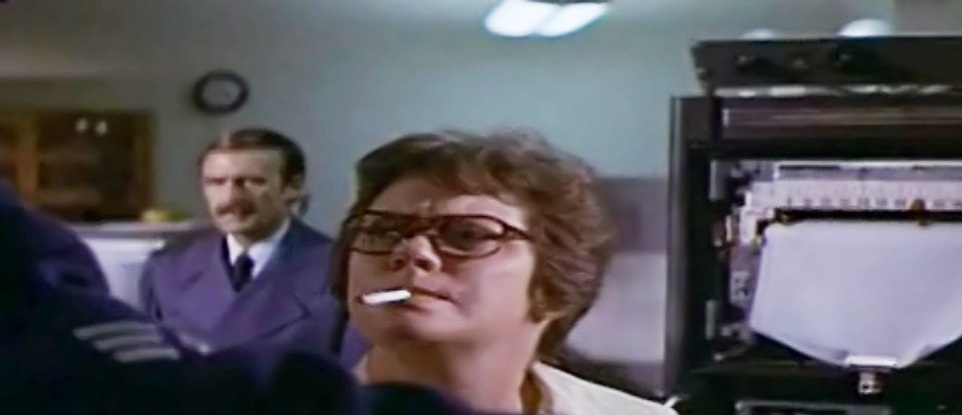
Kate Reid playing clinical microbiologist, Dr. Ruth Leavitt in the Andromeda Strain © Universal Pictures
Some time later, when I got to watch the movie all the way through for the first time, I was even more impressed with Reid’s character and the way the filmmakers used her. It was far more common for the token female character in either thrillers or sci fi films to be played by a young, glamorous actress, who was there more as eye-candy than to actually participate in the story. Leavitt wasn’t like that. There are some, I’m sure, who will argue that the filmmakers went overboard, putting Reid in those large unflattering glasses, and generally looking dowdy. But the filmmakers didn’t dress up any of the male scientists any differently. Even the casual way she smoked her cigarettes, never doing any of those delicate movie star poses that were more common when actresses were shown smoking at the time, just fit with the character’s personality.

I re-read The Andromeda Strain at least once more after seeing the movie all the way through, and I still found Reid’s version of the Leavitt character more interesting. And this was decades before I’d ever heard of the Bechdel Test!

The Andromeda Strain was a bestseller, and set Michael Crichton on the path of future success that would lead to, among other things, Jurassic Park. The movie was only a moderate success, which is too bad, because it was really well done. The science included was, for the most part, plausible at time. In fact, nothing in the film required any sort of advancement of technology beyond what we had available. Exactly how the life form could convert energy to matter was the only bit of dubious handwaving to speak of. It wasn’t the only time that the movie version of a science fiction story was better than the book, but I think it might have been the first time that I noticed it.

He wants to believe – more of why I love sf/f

THE X-FILES: L-R: Mitch Pileggi, David Duchovny, Gillian Anderson and William B. Davis.
THE X-FILES: L-R: Mitch Pileggi, David Duchovny, Gillian Anderson and William B. Davis. ©2015 Fox Broadcasting Co. Cr: Frank Ockenfels/FOX
In September of 1993 I tuned in with some hope, but also some trepidation, to the first episode of The X-Files. A show that was going to be about FBI agents looking into mysterious, unexplained, possibly paranormal happenings. The first episode was framed around Special Agent Dana Scully, who was a medical doctor as well as an FBI agent, who was being assigned as much to investigate Special Agent Fox “Spooky” Mulder as to assist him in handling the strange cases—the so-called X Files.

I enjoyed the show. So did my (now late) husband, Ray. We tuned in faithfully each week, chatting about various aspects of the show as we watched. I’d been such a big fan of Kolchak: The Night Stalker that of course I was interested in this show. Ray, on the other hand, barely remembered the other series (and he wasn’t sure if it was because he was a few years younger than I, or if maybe his family simply hadn’t watched it), but he was a fan of mysteries and sci fi and “spooky stuff” so was just as interested in the concept of the show before we had even seen it.

The show’s mysteries were interesting. Sometimes very creepy, sometimes sad. There was just the right amount of human and pathos in the most serious shows to keep you hooked. And then occasionally there were episodes that were primarily funny.

They avoiding the obvious “she’s always a cold-hearted skeptic”/”he’s a passionate true believer” dynamic that he seemed implied from the beginning. Mulder wasn’t a true believer. He frequently repeated the line, “I want to believe.” As we learned about the childhood disappearance of his sister, and the mysterious circumstances surrounding it, we understood why he needed to believe that there were things happening beyond the simple, rational explanations with which so many mysteries are dismissed. And Scully, of course, wasn’t cold-hearted, and while she remained skeptical, she wasn’t close-minded.

The show did a really good job of portraying different ways that a sense of wonder (and sometimes dread) could manifest when we are confronted with situations that don’t have an obvious, simple, and safe explanation.

I really loved the show in the early seasons. I recall especially being on the edge of my seat at the end of the season two finale, barely able to contain myself waiting to learn what the answer to the cliffhanger would be the next fall. Things started to go awry, for me, during the third season, and by the fifth or sixth I was finding myself irritated by the show more often then entertained. I might have given up if not for a friend who suggested this way of looking at it: “I’ve decided to think of it as two completely separate shows happening in parallel universes. They happen to have identically named characters played by the same actors, but they are other wise unconnected. One is the quirky, cool ‘there are more things than are dreamt of in your philosophy’ mystery of the week show that I adore; and the other is the awful, poorly written, contradictory, batshit alien conspiracy/maybe we’re all crazy show that I hate—and I have to put up with the latter in order to keep watching the former.”

And that helped a lot. Don’t get me wrong, the conspiracy related to aliens was there from the very beginning, and I was onboard with watching them confront and explore that. The problem, from my perspective, was that unlike their monster of the week kinds of episodes, they never seemed to have a clear idea of what was actually happening with the conspiracy. Years later we might call their problem the “Lost syndrome,” because like that more recent show, the writers seemed to be throwing contradictory and confusingly cryptic clues at us without a clear idea of what the “real” explanation was.

I think that the show’s original creator did have an idea of what the explanation was, but either he allowed other writers who didn’t know to go off on misleading tangents that couldn’t be reconciled as simply red herrings, or perhaps he didn’t know how to keep the series going if he ever revealed the answer.

So it was with a bit of trepidation that I watched the first episode of the new mini series a few weeks ago. And I have to admit, that opener left me with a lot more dread than hope. Then the second episode was a bit better, like one of the typical mystery of the week shows I used to love.

And then we got to the third episode, “Scully & Mulder Meet the Were-monster” and I was in heaven. It was funny. And with a lot of Easter Eggs that weren’t annoying. Two actors who played stoned teen-agers who witnessed a mysterious event back in the very first season, returned to play the same characters, no longer teens, who are out in the woods huffing spray paint when they witness another event. There was a homage the Kolchak in the story, an incredible amount of humor, yet it was an incredibly dark commentary on real life at the same time. It was really, really good, and included everything I had loved about the best of the earliest episodes. And I was incredibly happy to see, online over the next several days, the number of review sites and sci fi/fantasy enthusiasts who had enjoyed the episode the same as I had.

At its best, the X-Files was about things in life—sometimes awful, tragic things—that don’t fit neatly into our preconceptions of how the world can be. More importantly, it is about the way we try to understand those things—how we confront mystery, tragedy, disappointment, horror, and betrayal—and how we cling to meaning and hope in spite of it. It’s about finding the human connection, finding the reasons to hope, finding the things to cherish, and never losing our curiosity.

And it’s also, sometimes, about really creepy monsters.

“This nut thinks he’s a vampire!” – more of why I love sf/f

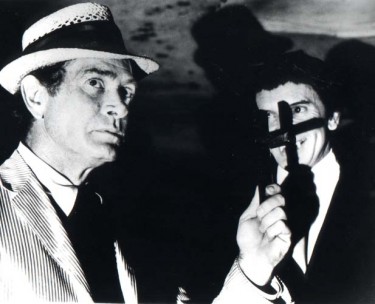
Darren McGavin and Barry Atwater in a still from The Night Stalker television movie © 1972 American Broadcasting Company
Darren McGavin and Barry Atwater in a still from The Night Stalker television movie © 1972 American Broadcasting Company (Click to embiggen)
It was January, 1972 when I first saw Darren McGavin playing reporter Carl Kolchak, dressed in that hat and cheap suit, ranting to his editor and the police about a serial killer. I was in the fifth grade and Dad’s nomadic employment in the petroleum industry had sent us to a small town in Utah. We had been there the just over a year, which was longer than we had stayed in any one town in several years1.

In the movie, The Night Stalker, Darren McGavin plays Kolchak, a reporter working in Las Vegas, dating a showgirl, and covering typical news stories. Until he began being suspicious about a series of deaths that seemed very similar, but which the police insisted were unrelated. First Kolchak was convinced that it was simply a serial killer who was draining all the blood from his victims’ bodies because he was insane and believed he was a vampire. As Kolchak finds more and more evidence of similar crimes going back decades, he begins to worry that the killer really is a vampire.

Which, of course, turns out to be the case. Kolchak witnesses a couple of attempts by the police to capture the killer. The second attempt is such an epic failure, with multiple cops killed and dozens of bullets striking the killer (played creepily by Barry Atwater) to no avail. This convinces at least one FBI agent that it is a vampire. Kolchak and his FBI buddy track down and kill the vampire.

Kolchak writes the full account of the vampire’s long career of murder and eventual destruction, proposes to his girlfriend, and prepares to move to New York City where he expects to be able to write his own ticket. Except the FBI and local police don’t want anyone to know about vampires. They kill the story (getting Kolchak’s boss fired, I believe). They substitute a more mundane tale of a serial killer with Kolchak’s byline. Then they inform him that his girlfriend has already been convinced to leave town, and tell him he’s no longer welcome in Vegas.

The story ends with Kolchak re-dictating the entire tale into his portable tape recorder while sitting alone in a sleazy motel room. He explains how all the evidence is destroyed, and that he’s exhausted his savings trying to find his fiancée, so far to no avail.

It was a sad and creepy end to a film.

The Night Stalker was a made-for-TV movie based on an unsold novel by Jeff Rice, originally titled The Kolchak Papers. Rice’s agent had more luck selling the novel idea to ABC as a movie idea than he’d had selling it to a book publisher. The movie was a surprise hit, drawing in unheard of ratings when it ran. It was so successful that the network commissioned Richard Matheson, who had adapted Rice’s book into script from, to write a sequel. A book publisher was suddenly interested in Rice’s novel, but only if they could also get a deal on the sequel. So Rice wrote a novelization of Matheson’s sequel script, and in 1973 two Kolchak books, along with the sequel TV movie, The Night Strangler were all released.

The Night Strangler came out almost exactly a year after the first movie. In it Kolchak had relocated to Seattle where he stumbled upon an immortal who was living in Underground Seattle2 who every 21 years has to kill several women in order to harvest their blood in a very specific fashion to manufacture his “elixer of life.” The sequel did well enough again that work began on a third movie. Until the network put that all aside and decided to turn Kolchak’s story into a regular weekly TV series, which debuted in September of 1974 and ran for one season.

McGavin returned to play Kolchak. In the series Kolchak, along with his editor from both movies (played by Simon Oakland), have been relocated to Chicago where they work for the Independent News Service. Each week Kolchak stumbles upon a new monster or mystery that winds up having a fantastic explanation. Unlike the original movie, Kolchak never has any credible witnesses survive to corroborate his stories, so no one ever believes.

After the two wildly successful TV movies, the network had high hopes, but the initial ratings weren’t terribly exciting. After four episodes of The Night Stalker had aired, the series went on hiatus for a bit over a month. It came back, re-titled Kolchak: the Night Stalker! with new theme music, though not any changes to the tone, setting, or cast.

Ratings continued a slow, steady decline, causing the network to pull the plug at episode 20, cutting short the original order of 26 episodes.

The series ran during my 7th grade year. We had moved by the Colorado, this time returning to the small town where I’d been born, and where one set of grandparents and one set of great-grandparents still lived. Puberty had hit the year before, and I suddenly knew exactly why I’d always felt out-of-place to the point of wondering if I was a changeling left in place of my parent’s real child by evil elves, or maybe an alien sent to study humans—I was gay. It was during this same period that I started fooling around regularly with one other gay classmate (while having a completely unrequited crush on a different classmate that as far as I know was straight). I lived in a constant state of fear of being found out, terrified of what family, friends, and the rest of the town would do if they had proof I was a fag.

I threw myself even more fervently into reading science fiction and fantasy, so of course I was a faithful viewer tuning in each week to see what Kolchak would uncover next. Kolchak was appealing in part because these incredible, usually awful, things kept happening around him, but no one ever believed him. He was in sort of a reverse closet. He wanted people to know the truth, but everyone else did everything they could to ignore, explain away, and ridicule that truth.

While I did tune in faithfully each week, I have to confess that as the series went on, each episode was a little bit less satisfying. I can’t be certain why, having not re-watched it in years, but something about seeing Kolchak not be believed week after week was much less interesting than seeing it in two movies separated by a year. Maybe it was because Kolchak was seldom heroic. He had a determination to learn the truth, yes, but clearly he would have much rather interviewed people after the fight with the monster, rather than take on the creatures himself. He was always a bit rumbled and always seemed to stumble and fumble his way into a lot of the stories and events in the series, rather than get there through dogged determination. Maybe the series just didn’t know how to walk the tightrope between mystery/horror and comedy.

Some years later Chris Carter would have more success with The X-Files, a series he admitted was inspired by Kolchak. So the week-to-week mysteries the world doesn’t want to admit exist notion could be spun into a successful show. I don’t know what about the collective consciousness of 1974 made Kolchak less appealing than the audience of the 90s would find Scully and Mulder4.

I still look back on The Night Stalker with a lot of fondness. I empathized so much with they guy who knew and believed things no one else would credit. It wasn’t just the parallels to my own queer secret, though. I was also having an ever more difficult time reconciling my love of science and history with the fundamentalist evangelical beliefs of our church and the vast majority of our neighbors. I felt as if people were constantly belittling scientific facts and scientists, blatantly ignoring evidence right in front of them and insisting on a worldview that just didn’t square up with not just my lived experience, but theirs.

Kolchak kept chasing that truth, kept examining the evidence, never letting the naysayers or conventional wisdom stop him. And that was a role model I desperately needed.


Notes:

1. I wound up completing the entirety of 5th and 6th grade, in addition to the half of 4th in that same school. This tied my previous record of Kindergarten, 1st, and part of 2nd in the Ft. Collins, Colorado school district. By contrast, 3rd grade was split between three schools, each in a different state (and if the brief sojourn in Kansas had begun a few weeks earlier than in did, 3rd grade would have been four schools in four states).

2. This movie makes the mistake of most pop culture representations of Underground Seattle do. It portrays it as if some sort of disaster buried part of the city in a single night and the survivors rebuilt on top. A dining room underground that still has dishes, silverware, and petrified food figures in the story, for instance. In actuality, Seattle decided it was tired of the routine flooding and sewer backups that happened in the part of downtown built on swamp land, and they razed a hill at the north end of town to redistribute the dirt to raise the streets in the south end. It took many months. During the transition some of the taller buildings had new doors built into the existing second or third floors at the new street level. Other buildings had additional stories built atop them. Spaces that had originally been ground floors became basements. In only a very small number of cases have any of those old spaces been kept in anything close to their original state3.

3. Many, many years ago a software company I worked for that had offices downtown rented storage space in the basement of the building next door. The basement had originally been a dance hall before the streets were raised. The solid wood dance floor was still there, and some of the fancy woodwork on the walls was still visible, but the building owners and subdivided the space into a bunch of 10 foot by 10 foot cubes with cheep plywood, and rented each out for storage. It wasn’t terribly exotic any longer. And you just walked down ordinary stairs to get to it.

4. A subject I’ll go into much more detail about next week, I think!

It’s Hugo time, again!

"Reading is the creative center of a writer's life...  you cannot hope to sweep someone else away by the force of your writing until it has been done to you." - Stephen King
“Reading is the creative center of a writer’s life… you cannot hope to sweep someone else away by the force of your writing until it has been done to you.” – Stephen King (click to embiggen)
Last week they started emailing the Hugo nominating PINs (personal ID numbers) to those of us who have memberships to WorldCon. Mine arrived Friday night. During last year’s voting period I started a list of stories and such that were being published last year I thought were good enough that I’d want to nominate this time around. It’s a fairly short list because most of the reading I did last year was stuff that had been published in previous years. So I need to do some more research and reading!

George R.R. Martin has a nice post up explaining why it is important for everyone to [n]ominate the stuff that you enjoyed best last year. Let your own individual voice be heard.

To nominate you need to have either an attending or supporting membership to last year’s WorldCon (Sasquan, in Spokane), to this year’s WorldCon (MidAmeriCon II in Kansas City), or to the 2017 WorldCon (to be held in Helsinki). If you already have one of those, your PIN is either coming in email, or will be included in your snail mailed Progress Report II (if you chose that for updates rather than email). Check your spam folders if you think you should have gotten it and it hasn’t arrived. They are still mailing them out, though, so don’t send a panicked message to them, just yet.

A lot of people are putting up their “oh, by the way, I had this stuff published this year that could be nominated, if you happened to have read it and enjoyed it.” I only had one short story published, and in an APAzine at that, last year. But I do blog about science fiction and fantasy here a bit, and I suppose that means technically I could be nominated in the fan writer category. *wink* Hey! A guy can dream, right?

More seriously, as I work on my nominations, I’ll try to put together a list of some things I think folks should check out.


In completely unrelated news: The Ali Forney Center, which provides support, nourishment, and shelter to homeless LGBT youth in New York City, is trying to raise money to purchase the church of anti-gay hate-spouting preacher, David Manning. The church has been ordered into foreclosure for non-payment of over a million dollars in utility bills (on top of other fines and debts). I forgot to mention when I posted this earlier, that Manning’s church has been officially designated a hate group by the Southern Poverty Law Center. Anyway, as of this morning, they had reached 49% of their goal in just three days. The foreclosure auction is later this month. If you can donate to this opportunity to turn hate into love, please do!

Donate to the #HarlemNoHate campaign today!

I is for Imagination – more of why I love sf/f

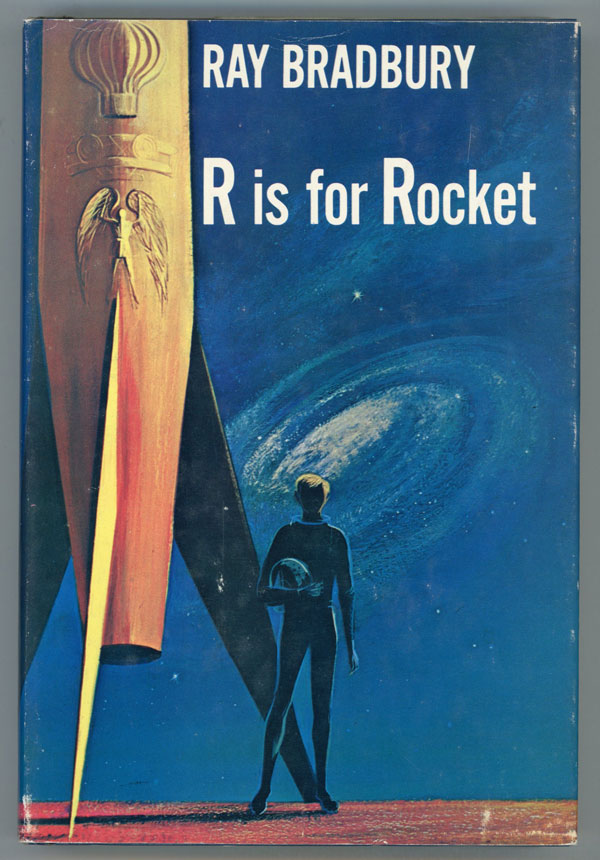
Dust jacker of the first edition of Bradbury's collection, R is for rocket.
Dust jacker of the first edition of Bradbury’s collection, R is for rocket.
I don’t remember when I first read a story by Ray Bradbury.

That’s not quite right. The sentence is true, but it doesn’t convey the full meaning. It’s equally true that I cannot remember a time when I didn’t know about Ray Bradbury’s incredible stories. He isn’t the only author who falls into the category. Since my Mom read to me from her favorite two authors: Agatha Christie and Robert Heinlein, since I was a baby as part of her plan to make sure I learned to talk correctly, I can’t remember a time when I didn’t know about Heinlein or Christie. And it’s more than slightly likely that Mom read some Bradbury in there at one point, so that might account for it… Continue reading I is for Imagination – more of why I love sf/f

Hokey Religions and Ancient Weapons – more of why I love sf/f

"Hokey religions and ancient weapons are no match for a good blaster at your side, kid." Harrison Ford as Han Solo in the original Star Wars.
Harrison Ford as Han Solo in the original Star Wars. (Click to embiggen)
I was a high school student in the small town of Longview when Star Wars first came out. I saw it on opening night, thanks to a couple of older friends who were even bigger science fiction fans. They drove me down to Beaverton, Oregon, (which was the closest place with a full-sized wide screen and Dolby sound at the time) on opening night, insisting that I’d love this film I had never heard of.

They were right. A lot of people loved it.

It wasn’t really original. The movie was a loving homage to the pulp magazine adventure stories and serial movies of the 30s and 40s. It didn’t have anything profoundly new philosophically to say. The special effects were better than we were used to seeing, but otherwise it just told an old-fashioned story. You knew who the good guys and the bad guys were. The heroes were confronted with a series of obstacles to overcome, and they worked hard to win the day.

In that way, it was an oasis in the desert. Over a decade before the movie came out, “legitimate literature” had embraced the modernist school. Narrative (storytelling) was considered “unrealistic” and “naïve.” Modernist writers abandoned plot and character development for style and grand themes. Resolution was replaced with ambiguity.

That listless ambiguity had infected a lot of pop culture. To be fair, in the U.S. at least we had good reason to be despondent. The economy had tanked. Inflation was out of control, lots of people were out of work, and even more were under-employed. We had finally admitted what a pointless quagmire the war in Viet Nam had become, so closely on the heels of the national embarrassment of the Watergate scandal and the ouster of President Nixon (itself following not the long after Vice President Agnew had resigned and pled guilty to tax evasion charges). And victories of the civil rights movement seemed to have produced more backlash than noticeable improvements in the lives of ordinary people.

By 1977 most of popular culture had been tainted by modernist angst. Many of the films and novels of the day accentuated style, mood, and setting, and had endings that left the audience wondering what had happened.
Star Wars brought plot, heroes, and villains back in style. And none too soon, in my opinion. There’s something comforting and satisfying about a story that begins with a problem, builds to a climax, and resolves things in the end.

Not to say that some of the other types of stories aren’t fun from time to time.

Star Wars was the perfect combination of fun, adventure, struggle against a seemingly unbeatable foe, and triumph. With space ships and blasters and energy swords thrown in for good measure. It’s not really science fiction, because the attempts it makes at science are laughably wrong. It follows the conventions of 30s science fiction in that regard. It’s space opera, following the rules of epic fantasy with the accoutrements of science fiction. And there’s nothing wrong with that.

The Empire Strikes Back was a much darker story, and as a middle chapter in a continuing tale, its ending wasn’t triumphant. But it still told a really good tale. There were resolution of some issues, character arcs advanced, and the open issues were daunting problems, but with a hope that they could be resolved. It was a superior movie to Star Wars in every way, but was still firmly built from the foundation laid by the previous movie. Return of the Jedi was fun—flawed, but fun. It wasn’t as good a move as Empire, but it still worked, and it paid off in at least an acceptable way on all of the cliffhangers of the previous films. Don’t get me wrong, some of the pay-offs were fantastic, I’m just admitting that not all were perfect.

Star Wars (which I hate referring to as “Episode IV – A New Hope”) still remains an especially bright shining beacon in my personal firmament. It made me love the idea of science fiction and fantasy in movies, again. It gave me a new celebrity crush (if you were a queer boy watching the first film and didn’t swoon for Han Solo I don’t know what’s wrong with you!). It gave me characters to aspire to be like: Obi Wan, Luke, Leia (yes, Leia! Seriously! Go watch those scenes with Leia and Darth, or the moment she takes the blaster away from one of the men, shoots open a vent cover, and says, “Someone has to save our skins. Into the garbage chute, fly boy!” and tell me she isn’t bad ass!)…

I love Star Wars. I loved it so much that the first summer it was in theatres, I drove to a theatre in another state 13 times to re-watch it. Not to mention seeing it at a local theatre, later watching it on cable, and eventually on tape again and again. It was a life changing experience.

But I must admit that the modernists were right in some ways. The traditional narrative form is seldom the way real life works out. The difference between real life and fiction is that fiction has to make sense. In real life, we don’t always get the clear-cut endings where the heroes defeat the villains and go on to live happily ever after:

  • The friend who drove that night when I first saw Star Wars, 38 years ago, is dead. James Curtis Bruce died from complications of AIDS at the age of 36.
  • Another friend, who drove us down to see the opening of Empire, has also passed away. Lawrence Lee Church died of an anueurysm at the age of 34.

I had admired and looked up to both of them as “big brothers” during a very important part of my life. Jim was a lot like the character of Han Solo, while Larry had more in common with Yoda.

I miss them both.

Sometimes we all wish that life was more like a good, fun movie.