Tag Archives: sleep

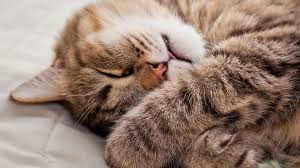
What’s wrong with enjoying sleep?

I'm fine here, thanks. CatsAnimals.com
I’m fine here, thanks. CatsAnimals.com
“There are two kinds of people in the world…” is a setup for a number of jokes. One of the conceits behind that particular setup is that there exist certain almost unbridgeable gaps between people: those who like mayonnaise and those who don’t, for instance. Some years ago I realized that one of those vast chasms of that divided humans are those who are morning people, and then the non-freaks. And I learned this the first time I mentioned just what a wonderful feeling of joy it is to wake up in the morning, roll over to squint at the alarm clock, and see that it’s going to be at least ten more minutes before the alarm goes off.

It really is almost a transcendent joy—that moment when you know that you can safely roll back over and go back to sleep. Even those mornings when I wake up, look at the time, shuffle to the bathroom, then hurry back to the bed to collapse back in it and fall asleep for just eight or nine more minutes is so profoundly delightful as to leave me grinning an hour later.

Years ago, as I alluded to above, I happened to mention my enjoyment of such moments during a conversation with a friend, and her reaction was less than accepting. She could not understand why in the world I would roll over and go back to sleep. “If you get up, you have more time to get ready. You could have a fun, leisurely start to the morning instead of rushing around in a panic.” I pointed out that when I get out of bed when the alarm goes off, I don’t rush around in a panic. Going back to sleep until the alarm sounds is not the same thing as oversleeping. The bliss I was describing is that moment of knowing that I’ve still go time to sleep.

She also expressed a lot of skepticism about whether I actually slept during those few minutes. “You’re just laying there awake with your eyes closed! What’s the point?”

I knew, then, that the chasm between morning people and non-morning people is truly vast, and possibly insurmountable.

She was by no means the last person I found myself in this argument with. And it is an argument. She wasn’t just perplexed at the difference in our perception, she got more than a bit irritated. It really seemed to anger her that I would want to sleep for a bit longer, that I would go back to sleep for as little as a few minutes, that I would enjoy it, and that I would describe it as a wonderful thing. I think she felt that I ought to be ashamed of myself for not leaping out of bed the moment I realized that I had woken up before the alarm went off.

Since finding myself in this particular discrepancy of viewpoint on a number of occasions over the years with various people, I’ve developed my own definition of a true morning person which includes that intense belief that a proper response to waking up early is to embrace the wakefulness and leap into action.

When I say that I fall back to sleep for a few minutes, I mean it. I don’t always fall all the way back to sleep, of course. Sometimes I do lay there with my eyes closed, just enjoying the feel of the blankets. Other mornings I sort of doze, drifting along the edge of wakefulness, not really asleep, but definitely not awake either. But many mornings I do fall back into sleep. I’ve looked at the clock, saw that I had less than four minutes before the alarm goes off, and then fell back into sleep deeply enough that I started dreaming again before the alarm sounds.

Now, not everyone who doesn’t feel as I do about enjoying every last second of my allotted sleep time is a morning person. I’ve met plenty of people who don’t get that same thrill of satisfaction from falling back into bed for a bit longer in the morning who also don’t insist that the only normal or natural reaction to waking up a few minutes before the alarm goes off is to jump up and get an early start on the day.

So I know that there aren’t merely two kinds of people in the world on this particular topic. As with most things, people fall on a spectrum, and we probably all slide up and down that spectrum over time. While there is some science out there about chronotypes (a technical term for classifying people based on their natural circadian rhythm), it’s a mixed bag. A lot of the articles one finds talking about the “science” of morning people vs night owls are simply citing surveys, which isn’t very rigorous. Most of the more scientifically rigorous information is actually from studies of people with insomnia and sleep apnea and the like, which yields a lot of information that may be useful for treating sleep disorders, but doesn’t actually tell us much about healthy sleep patterns. All we can reliably infer from the science we do have is that people do have natural sleep patterns that vary from person to person.

It’s just as natural to be a night owl as not. And it isn’t productive to try to talk someone into being the other sort of person.

Don’t get me wrong: I’m not claiming that I’m physically incapable of getting up early. Some mornings I wake up before the alarm goes off, and I decide to get up rather than roll over and get a little more sleep. Some mornings I sleep like a log right up until the alarm goes off. And yes, some mornings I hit the snooze alarm a time or two (snooze alarms are another source of bewilderment to a True Morning Person).

I like sleep. Even more, I like it when I get enough sleep that I feel rested and ready to work in the morning. As part of my taking-care-of-myself routine for some years, I keep track of bed times and make efforts to keep my sleep schedule from getting too far out of whack on weekends or on vacations. And part of that routine is letting myself enjoy, from time to time, those moments of voluntary sleep before the alarm.

A 70-year nap sounds tempting

We saw Captain America: The Winter Soldier with a bunch of friends Saturday, and it was fun. If you liked the 2011 Captain America movie, or The Avengers you’ll probably like this, as well. I thought it was awesome. I confess I’d been a teeny bit worried because I liked the previous movie a lot, and that one got so much of its appeal from the 1940s setting; I was afraid they’d try to grit Cap up and ruin him. They didn’t. The story has plenty of darkness, but the script and Chris Evans make you believe someone can face that darkness, fight it, and come out with an old-fashioned sense of honor and justice intact.

A major part of Captain America’s story is that he is a man out of his time because survived being frozen for 70 years after crashing that doomsday plane at the end of the first movie to save the world. Lately, I’ve been thinking a 70 year long nap might be a good thing.

I don’t know why it’s taken me so long to figure out why I’ve been tired all the time. When we were both suffering from the Martian Flu it made perfect sense why we were tired, taking frequent naps, and so on. But it’s been about a month since either of us had symptoms, yet almost every week night since, I have to take at least a short nap after getting home. And at least once a week I conk out for several hours, only to wake up just in time for bed time!

Part of it is that with heavy pollen season underway, I frequently have severe enough hay fever that I’m not sleeping very well at night. But the other thing is just that while we were sick I let my sleep schedule go to whatever it wanted. If left to my own devices, my body likes to stay up until about 3am or 4am, then sleep until noon. It’s just the way my diurnal cycle is wired. I haven’t managed to land a job that lets me work that schedule (and still pay the bills plus give me the sorts of mental challenges to keep me from being bored), so once I finally accepted that this is what the neurochemicals are going to try to do, I realized the rest of my professional life would be a battle to keep the sleep schedule from drifting to default.

This means that I can’t let myself stay up as late as I want on weekends, as tempting as it it. And it also means that about once a week I have to take a melatonin tablet at about 10:30 or 11pm, lay down, and trick my brain into sticking to a sleep schedule compatible with work.

I haven’t done that in months. And I’ve been staying up way to late working on writing projects on the weekends.

So, I need to hammer the neuroreceptors with some melatonin. I’ll probably need to do it a couple of nights in a row to make any progress. Unfortunately, that means I have to both remember to do it, and be awake at the right time in the evening to take the pill. Which I haven’t managed to do since having the realization.

I’d like to stop having these random nap attacks. So I need to get this done.

Starting your day right

A few weeks ago I found myself trying to explain to a good friend precisely why it is I forget to eat breakfast on weekends, and more specifically, why “You just need to get into the habit” isn’t helpful to hear. While I agree that it’s never too late to learn knew things, it’s important to recognize that when one has failed for decades to undo a bad habit, it is going to take more than a pep talk to change it.

Which isn’t to say that I’m not still trying. It’s not the only habit I fight with. When I was in my 30s, for instance, was when I first realized that I was no longer capable of staying up to all hours a few nights every week and still put in a full, productive work week. I had to get out of the habit of staying up really late and sleeping in on weekends. And as I started doing a better job of getting up on weekends only a little later than weekdays, I found Mondays no longer felt like such a drudge and disaster.

It’s not easy. I’m not a morning person, and that isn’t just a preference. If given a chance, my natural body clock switches to almost a nocturnal schedule. Some of us are wired that way. So pursuing a career involving a more or less traditional office job is a constant fight.

After my late hubby went through his first round of chemotherapy, he had a very hard time sleeping more than a couple of hours at a time. One of the things we tried was melatonin, which is a natural hormone involved in regulating the sleep cycle. Melatonin tablets are very useful for people who work rotating shifts, or otherwise can’t sleep at the same time each day. It didn’t really help Ray.

Since I’d done a lot of research on it before Ray tried it, it occurred to me that I could use it when my sleep schedule got out of whack. Since it’s the same hormone that causes drowsiness naturally, taking the tablets don’t “dope you up” like other kinds of sleeping pills. Though research indicates we can’t build up much of a tolerance for it (it’s a hormone, after all), there is some concern that over-using might cause your body to produce less of it naturally. The upshot is that it’s advised only to use it the first night or two when you need to change your schedule.

So I tried it one Sunday evening, taking it about an hour before I needed to be asleep to get ready for work, and I laid down with a book. I conked out about a half hour later, and as the cliché says, slept like a baby.

I woke up the next morning about a half hour before my alarm went off, feeling better that I ever remembered having felt on a Monday morning. And the weird thing was, without taking any more pills, I reliably started getting drowsy for the next three or four days right about the time I’d taken the pill on Sunday. My personal natural cycle of not feeling drowsy until well after midnight did start to assert itself after a number of days, but for most of the week, it was great.

So, I decided that I should make it a regular thing to take one tablet every Sunday. And it works great.

When I remember to do it.

The problem is, if I don’t pay close attention to the time on a Sunday evening, it’s easy to miss the time. If you take it later, that defeats the purpose, because you’re setting the sleep cycle wrong.

I first tried it 18 years ago. I go through phases where I get good at remembering to do it, week after week, and it’s easy to get up and get into work on time without doing a lot of rushing, or feeling discombobulated at the beginning of the week.

But then I’ll miss a Sunday. And then I miss another, and pretty soon months have gone by without me remembering.

No amount of setting computer reminders or giving myself pep talks will work. Because no matter how determined I may be when I set the reminder to go do it as soon as the reminder happens, if by chance I’m in the middle of writing something that I’ve been trying to finish for a long time, or working on some other thing, I’ll think, “Yes, I’ll do that in just a minute…” and the next thing I know, it’s 45 minutes later.

But man, when I do remember, those Mondays are awesome!