Tag Archives: tbt

Skillful Men of the Medical and Chirurgical Profession – more of why I love sf/f

Nathaniel Hawthorne wrote The Scarlet Letter in 1850.
Occasionally I find myself in the position of having to defend labeling some books or movies or television shows as being part of the science fiction/fantasy genre. For instance, a few years ago, during the early seasons of Person of Interest, someone said I shouldn’t call it sf because it was just an action adventure with a computer. But the Machine (which is the only name they ever give it) isn’t a computer, it is an artificial intelligent program that runs on many machines and is able to correlation data from many feeds and accurately predict people who are going to be victims or perpetrators of serious crime. That’s science fiction. Particularly when it is discovered the Machine has found ways to bypass some limits imposed on it by it’s designers, and even arranges to have a new cluster of computers set up in a new location and transmits itself there, and then has its old location dismantled so that people who know about it can’t destroy it—well that’s exhibiting freewill and more! (Things get really interesting in later seasons when a second, less benevolent AI is introduced)

Similarly, I’ve seen people argue that The Green Glass Sea by Ellen Klages isn’t really science fiction because it’s a historical novel set in 1943 telling a coming-of-age story of an 11-year-old girl growing up in Los Alamos where her father works on the secret project to build an atomic bomb. Whereas I think the nerdiness of a girl in the 1940s who is building her own radio from parts salvaged at the junk yard, combined with the way the novel explores how the government’s pursuit of this new technological advantage uproots children and disrupts their lives (exploring how new technologies impact society and people in nonmaterial ways has long been a significant part of sf), more than qualifies it.

But the granddaddy of all sf/f novels that people don’t realize is science fiction has got to be Nathaniel Hawthorne’s The Scarlet Letter.

I can hear you protesting, “But the Scarlet Letter is a Gothic morality tale about Puritan scandal and consequences and forgiveness set in the Massachusetts Bay Colony that they made us read in school. It can’t possibly be science fiction!” That just means you aren’t looking at it from the perspective on 1850, when it was written. Your argument that it isn’t sci fi is similar to someone saying, “Twenty-Thousand Leagues Under the Sea isn’t sci fi because supermarines are real!” Submarines didn’t exist when Verne wrote his story of Captain Nemo and his fantastic undersea ship powered by a mysterious electric force.

Similarly, in the Scarlet Letter the character of Chillingsworth (who is secretly the long lost husband of poor Hester Prynne who is saddled with the shame of having had a baby born too long after the presumed death of her husband to be legitimate) is a great example of a science fictional mad scientist. His methods of subtle torture as he secretly experiments on Reverent Dimmesdale (while pretending to be trying to cure his illness) was very science fictional. There are no herbs known that will “corrupt the soul” as the text colorfully describes it. Certainly nothing that would force a man’s greatest fears and secrets to manifest as physical scars that spell out his greatest sins on his flesh!

When described that way, people think of Chillingsworth’s “dark medicine” as some kind of magic, like B-movie depictions of voodoo or the like (complete with colonial cultural misappropriation, but I’ll get to that). But when Hawthorne wrote it, he meant it as what we would today call science fiction. He and many other educated people at the time believed that the sorts of effects he described could be accomplished by the proper application of chemistry and biology, we just didn’t know how, yet!

Just as many scholars refer to Mary Shelley as the either the mother or grandmother of science fiction (never forget: the author of Frankenstein was a teen-age girl who wrote a story which invented sci fi on a dare in 1818), they also sometimes refer to Hawthorne as the grandfather of sci fi. Hawthorne’s more obviously sci fi type stories, such as “Rappacinni’s Daughter,” “The Artist of the Beautiful,” or “Dr Heidegger’s Experiment” usually featured a mad scientist type character, rushing in to the dark corners of the universe where angels and sensible people hesitate to tread. But his more famous bits of gothic tragedy also have these elements. The House of Seven Gables has a hypnotist and posits a notion of inherited sin—that committing particularly heinous acts will warp you in ways that will somehow be passed on to your children. If science had known of the mechanism of DNA at the time when Hawthorne wrote, he surely would have had some learnéd person in the narrative talk about the theory of corrupted chromosomes, for instance.

Which brings us back to The Scarlet Letter, and the medical experiments that Chillingsworth secretly subjects Dimmesdale to as part of a plan to exact revenge on the man.

The Scarlet Letter was unusual in Hawthorne’s time for feature a female protagonist. And even more, for portraying the fallen woman as a sympathetic character, more worthy of the reader’s love and respect than any of those who stand judgment over her (and her child). Especially more worthy that her long missing husband, who instead of proclaiming his identity upon returning, forgiving his wife Hester for doing what she had to do to survive while he was off studying herbs and potions with vaguely described Native Americans, and raising Pearl as his own child, embarked on a truly mad plan to exact revenge on the father of Hester’s child.

I saw movie adaptations of The Scarlet Letter before I read the book. A copy of the book was part of a set of classics that a relative had given me for a Christmas present, but I didn’t try to read it until after watching one of the movies on TV. When I did, I found a lot of the contents had been glossed over in the movie. The movie made Chillingsworth’s actions seem more like just some slow acting poison, whereas the book made it clear Chillingsworth was doing something far more subtle and medically revolutionary.

Meanwhile, Hester refused to give in to the public shaming, but to sew her own scarlet letter A on her clothing and support herself by sewing. She also tends to the sick and destitute in the community, so much so that many begin to say that the A she wears doesn’t stand for Adulterer, but Angel and Able. That was a revolutionary idea: that a woman could take her destiny in her own hands and assert her independence. It was radical in 1850 when Hawthorne wrote it, and it would have been even more revolutionary in the mid-seventeenth century when the action of the novel is set.

The Scarlet Letter painted a portrait of how someone shunned and ostracized by their community–even someone condemned by the religious leaders–could be a noble and good person, contributing to society and ultimately rising above the false morality of that community. That was an important lesson for this queer kid growing up among Baptists and rednecks.
Lost Friends in the Dreamlands – more of why I love sf/f

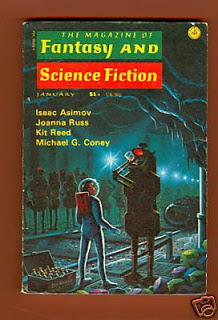
My Boat by Joanna Russ was published in Fantasy And Science Fiction Magazine, January 1976, cover by David Hardy.
“My Boat” by Joanna Russ was published in Fantasy And Science Fiction Magazine, January 1976, cover by David Hardy. (click to embiggen)
By January of 1976, I was midway through my freshman year in high school, living in a tiny town in northwestern Colorado. My parents had been separated for a few months and their divorce was underway. My physically and verbally abusive father wasn’t living with us any more, which was a plus, but everything from our finances to our daily routines were far less certain and predictable. I had had a big break-up of my own that no one knew about—because we were both extremely closeted boys in a very redneck town so of course we had been keeping it a secret. And another boy who had been one of my most consistent bullies throughout middle-school had recently coerced me into an even more covert non-consensual relationship. So to say my life at the time was a bit of a nightmare would not be inaccurate.

I still had a subscription to The Magazine of Fantasy and Science Fiction, thanks to my grandparents, and each time a new issue arrived in the mail, I would retreat to my room with it and stay up way past my bedtime devouring every page. These were the circumstances under which I first read the short story, “My Boat” by Joanna Russ… Continue reading Lost Friends in the Dreamlands – more of why I love sf/f

Asymptotic identities and contradictory infinities – more of why I love sf/f

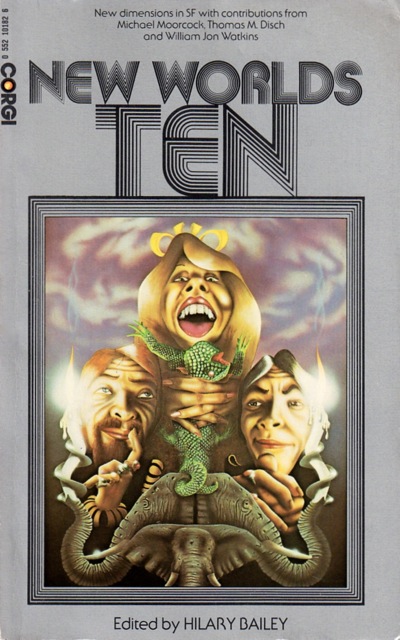
New World Ten, published August 1976. Cover artist not credited and no signature visible.
I first read “The Cabinet of Oliver Naylor” by Barrington J. Bayley in a used paperback copy of the The 1977 Annual World’s Best SF edited by Donald Wolheim that I bought in either late ’77 or early ’78, though it was originally published in New Worlds (sometimes titled New Worlds Quarterly, though they never managed to published more than twice a year), a magazine founded in 1964 by Michael Moorcock, borrowing a name from a sci fi zine that had originally been published in Britain from 1936 through 1963. Moorcock meant the magazine to focus more on experimental writing. It became the birthplace of the New Wave of sf.

None of which I knew when I read Bayley’s story. I was an American high school student whose exposure to sci fi had been dictated by what was available in libraries of various small towns and the pages of U.S. magazines such as Galaxy or The Magazine of Fantasy and Science Fiction.

“The Cabinet of Oliver Naylor” is a novella about a man living in a future where many technologies we would think of as impossible are commonplace. He is flying a personal craft at the velocity of c raised to the 186th power while fiddling with an invention of his own which he hopes will lead to the solution to a problem his society hasn’t yet tackled. He is accompanied by a sort of hitchhiker named Watson-Smythe who is trying to find an artist named Corngold.

Naylor’s invention is a thespitron: a device that constructs stories from all of the possible elements of fiction. Not just stories, it creates virtual worlds inhabited by beings that may be independently intelligent. The problem Naylor is hoping to solve with his experiments is navigation. In Naylor’s time it has been discovered that reality is far bigger than believed in the 20th century: the width of what we think of as the entire universe is simply a unit of measure for this reality. With those distances, the speeds at which advanced civilizations can move, and the fact that reality itself is expanding and changing while they’re zipping around at these impossible speeds means that no form of navigation is reliable. The very fabric of space changes between one’s origin and destination, so from time to time ships become lost.

Naylor has a theory that reality isn’t defined by matter, but by abstract concepts and relationships. He’s convinced if he can truly understand the nature of identity, how objects and beings relate to each other, such as in the structure of stories, that he can create a formula or algorithm to reliable rediscover any unique object one has observed before.

Which is all very cerebral and surreal compared to Watson-Smythe’s quest to find the artist. They do find the artist, his ship seemingly stranded on the edge of a vast stretch of unreality they call a matterless lake. At which point it’s revealed that Watson-Smythe is a government agent out to arrest Corngold, and that Corngold’s model is actually a victim of rape and kidnapping.

What happens next is in some ways far too predictable. When I first read it as a teen-ager I was rather angry that I saw what was going to go horribly wrong before it did, and couldn’t believe an interstellar spy would be stupid enough to fall for it. Even the dippy overly philosophical inventor, Naylor, should have seen it coming, I felt. I was also confused as to why the model/kidnap victim/rape victim seemed completely passive and apparently too afraid, even when essentially a cop arrives ready to rescue her, to do anything against her captor.

Re-reading it more recently, I was even more irritated when I realize that the author gives literally zero lines of dialog to the only woman in the story. Even while she is being abused in front of the officer who supposedly is there to arrest her assailant, the author tells us what she does, but doesn’t let her speak. It’s not that the author says she’s mute. No, the author says that she “responds noncommitally.”

Despite being frustrated with the story, I found a lot of it fascinating. The far future technology, which includes the ability to synthesize any matter one can name from a sort of quantum blob and back again when no longer needed, reminded me a lot of the Culture series by Iain Banks. So when I was reading up on Barrington J. Bayley, I wasn’t surprised to learn that Banks was one of the younger authors who listed Bayley as an influence on his work.

I was also not terribly surprised to find Bayley’s work described as gloomy and downbeat, which this story certainly was. While looking through the list of novels and short stories Bayley had published during his life, I was a bit surprised at how few titles I recognized. I think that this story is the only one of his that I’ve ever read.

While it isn’t a very satisfying read, I can’t say that it’s a bad story. It kept my attention and made me keep turning pages wondering how it would end. Admittedly, part of that was trying to figure out how the author would pull an interesting ending out of this mix of weird characterization and convoluted philosophy and mess of a plot. The story made me want answers, and it made me think about what clues I might have missed.

Is Bayley intentionally making the characters do stupid, and predictable things, to make a point about the reality of Naylor’s world and the unreality of his invention’s constructed worlds? I’m not sure. The intentions of the New Wave writers were to experiment by breaking the established rules of writing and try to find a new way to tell and experience stories. I do have to agree with Donald Wolheim’s comment in the introduction of this story in the anthology: this story crams more science fiction concepts and ideas into it’s novella length than many whole series of novels contain.

And maybe that piling up of ideas without a clear cut answer to any of the questions the central character raises is the point. Sci fi is supposed to be the genre of ideas, after all. And this tales serves up a whole lot!

Advanced Civilizations and Clever Monkeys – more of why I love sf/f

Amazing Science Fiction, June 1976 issue, their 50th Anniversary issue. Cover art by Stephen E. Fabian.
Amazing Science Fiction, June 1976 issue, their 50th Anniversary issue. Cover art by Stephen E. Fabian. (click to embiggen)
I don’t believe I’ve ever actually read a copy of the magazine, Amazing Science Fiction which is a shame, seeing as apparently it was in business for more than fifty years. So I’m fairly certain that I first read Lester Del Rey’s short story, “Natural Advantage” when I bought the paperback of Donald Wolheim’s anothology, The 1977 Annual World’s Best SF in a used bookstore in 1978.

In the very first sentence Del Rey establishes that we are on a starship and that the viewpoint character, the captain, is not human—since he is looking through a set of trinoculars toward a small blue planet. The ship was on a cargo run to a colony world when they encountered a cloud of antimatter moving through deep space. In the course of mapping the cloud, the discovered radio signals coming for a star system they thought uninhabited.

It’s obvious that they are approaching Earth, which has an inhabited space station in orbit around it, so the story was meant to be set a short distance in our future. They establish contact with the strange two-eyed beings who call this world home, and in a few days the two species have managed to figure out how to communicate.

Del Rey gives some explanations for why this is so. The aliens have much larger and more complicated brains than humans. Because they evolved a way to delay signals from the third eye, they perceive time differently than we do. Their language expert is amazed to realize that humans only have a language of few tens of thousand words, since the most uneducated of the aliens has a vocabulary of several million.

All of this learning is just window dressing for the main problem of the tale. That cloud of anti-matter is moving toward the solar system, and when it arrives bad things will happen. Live on Earth will likely be wiped out by the gamma radiation caused by the light smattering that will his the Earth’s atmosphere, but then things will be much worse when the bulk of the antimatter cloud hits the sun.

The aliens came to warn them, but can’t really offer any help. Their ship is too small to carry more than a handful of humans, and it took them many years to get to Earth as it was, no other ships will be able to reach them before disaster hits.

The captain agrees to leave the humans all of the science books he can, even though he explains that his civilization’s technology couldn’t possibly be used to evacuate billions of people. Then the aliens goes on their way.

Fifteen years later, the captain and the cargo ship return to their home world, and are shocked when a high ranking government official is sent up to greet them. And with the government official is a human, the first person they met, the woman who was the Administrator of the space station.

The revelation at the end of the story is that humans figured out that the alien’s natural way of perceiving variable time had limited their ability to understand all of the implications of their warp drive technology. Thus in a few years, the humans had built engines and ships much more powerful than anything the aliens have, and have managed to save themselves.

This particular story didn’t wow me. Maybe it’s because I’ve read too many stories where the twist is that the obviously inferior humans turn out to be more clever than the superior aliens. Legendary editor John W. Campbell, Jr, used to insist that no story published in his ‘zine could ever show humans to be inferior. They always had to be better than the aliens one way or another.

The difference between this one and a typical Campbell-approved tale is that the aliens aren’t malevolent. The aliens want to save the humans, they just don’t believe it is possible to do more than warn them.

Besides the predictability (which might be more my fault because of the types of sci fi I had read during the years before), the other problem is there isn’t really any conflict in the story. Because it is from the point of view of the aliens who don’t believe they can do anything and who go about their business after the warning, all of the drama of a human population finding out impending doom, scientists and engineers struggling to master another race’s physics and engineering, et cetera, happens off screen. It’s all, “Poor monkeys. They seem nice enough, but they’re doomed because they aren’t advanced enough to have already colonized the stars.” Followed by, “Surprise! We’re more clever than you thought!”

That sort of “twist!” story is entertaining the first few times you encounter it, but after you’ve seen a dozen or more, the story needs to do a bit more to really stand out. The most interesting aspect of the story, as it is, is the notion that have a third eye would change the way a species perceives and understand time and temporal relationships. One of the almost throw away lines in the early part of the tale involves the language expert being flabbergasted that human languages only have a few tenses, and even then only the verbs!

That made me stop for a few minutes to think about how adjectives and nouns could work differently in English if we had different versions of the words for past, present, future, and so forth.

As I said a couple of weeks ago, not every story has to be a masterpiece. And even if the story is merely not bad, but it makes you think, that’s a good thing.

Antique Books and Incongruous Pages, more of why I love sf/f

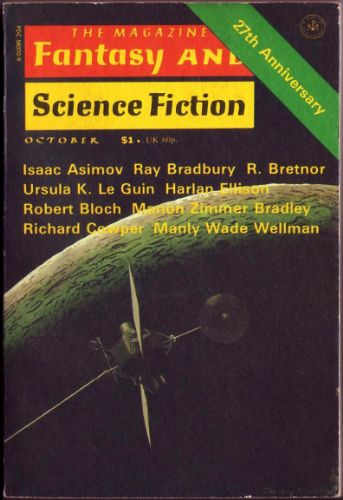
Cover of the October, 1976 issue of the Magazine of Fantasy and Science Fiction, cover by Chesley Bonestell.
Cover of the October, 1976 issue of the Magazine of Fantasy and Science Fiction, cover art by Chesley Bonestell. (click to embiggen)
There are some science fiction stories that you read, enjoy, but when you encounter them again months or years later, you don’t remember them until you have nearly completed re-reading them. Richard Cowper’s “The Hertford Manuscript” is one of those tales for me.

I think that I read it for the first time in the fall of 1976, shortly after my mother, oldest sister, and I had moved to southwest Washington some months after my parents’ divorce was finalized. My subscription to the Magazine of Fantasy & Science Fiction had lapsed not long before we moved, but I had been happy to discover that the public library in our new home town subscribed to the magazine. A couple times a month I spent a couple hours at the library reading the magazine, and I am fairly certain I read the October issue, which contained “The Hertford Manuscript” on one of those visits.

I definitely read the story a subsequent time when I bought the paperback of Donald Wolheim’s anothology, The 1977 Annual World’s Best SF a couple years later at the used bookstore. And since I re-read stories in that collection off and on over the next seven or eight years, I probably read it again several times.

Each time I’ve read the story, I began to suspect that the story was going to be a Lovecraftian tale, even with the hints in a completely different direction. And then each time there’s a point where I say to my self, “Oh! I think I remember this story…” Including when I re-read it this week.

The tale starts slow. Our narrator, Francis Decressie, tells of us of his eccentric Great Aunt Victoria, whose husband died in World War I, leaving her to run a rare books business, which she excelled at for many years. She occasionally told slightly scandalous stories of her youth when she was acquainted with H.G. Wells and Aldous Huxley. When his Great Aunt dies, her will bequeaths on him a 17th Century Registry—specifically a list of the admissions, discharges, and deaths of patients at a Franciscan Charity Hostel/Hospital in London.

In addition to the ordinary 17th century pages covered with small columns of very compact writing, are a number of pages that don’t match the others. The paper is just as old, but it is clearly manufactured using more modern methods, and the handwriting is very different than the rest of the register. And it appears to be a journal.

The narrator then reproduces the journal, and we find ourselves following Dr Robert Pensley, an acquaintance of H.G. Wells, as he recounts how, having completed his journey into the far future, meeting the Eloi and escaping the Morlocks to return to his own time and recount his findings to some friends, had undertaken a journey into the distant past. Except one of the quartz crystals in the mechanism of the machine breaks (he attributes this to damage inflicted by the Morlocks), trapping Pensley in 1665 England—right when the Plague is ravaging the land.

Pensley must find a jeweler or lens maker to create a replacement crystal, and has to deal with all of the problems of a nation in panic over an illness they do not understand. There are increasingly amusing attempts by Pensley to convince various authorities that the illness is spread by fleas on the rats. The lens-maker has difficulty tracking down a large enough piece of quartz, and various other things go wrong over the course of the tale.

The story ends with a few pages of the narrator explaining how he tried to prove that the pages were a hoax, but experts all agree the book has not be taken apart and restitched since the late 1600s, and he does find various bits and pieces of obscure historical evidence to back up some of the minor details the journal recounts.

And that’s it. The story ends with a philosophical observation about tragedy by the narrator.

The tale told in the enclosed journal was very engaging. The descriptions of the time traveler’s experiences in the mid-1600s pull you right into the tale. Cowper’s attention to historical detail is something that is seen in many of his other works, and serves him quite well here. The framing story is written in the style of a 19th century novel, evoking Dickens and Anthony Trollope and even a bit of Bram Stoker. Which is a little out of place given that the narrator is living in the late 20th Century, but is a nice homage to Wells.

As a kind of sequel to The Time Machine the story works well enough. The framing sequence is not quite as good as the time traveler’s journal. Especially the ending, which I found a little flat. I wanted more. I’m not sure how, exactly, but rather than leaving me wondering what happened next, it felt like he left out something.

So it was enjoyable, but not a mind-boggling revelation. Still, each time I read it, I recognize certain minor details that stuck with me, and have resonated with some of the ideas I’ve tried my hand at in my own stories. Every story we read doesn’t have to be a masterpiece. Sometimes merely good is good enough.

Nostalgia for a Time that Never Was – more of why I love sf/f

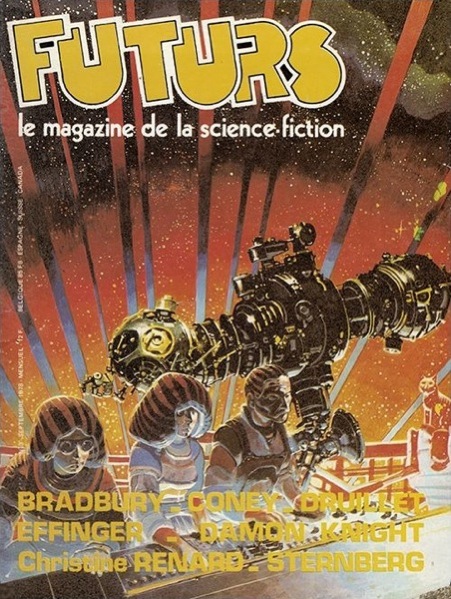
The cover of Futurs No 3, an anthology of translated science fiction published in Paris, September, 1978.
The cover of Futurs No 3, an anthology of translated science fiction published in Paris, September, 1978. (Click to embiggen)
One day, back when I was in high school, I found a paperback copy of The 1977 Annual World’s Best SF edited by Donald Wolheim in the used bookstore I frequented. I already owned several of Wolheim’s earlier annual anthologies, so I knew they usually the contained a lot of good stories. The table of contents of this issue featured several authors I loved, including at least a couple of titles that I remembered reading elsewhere and liking. So, of course, I picked it up.

The third story in that anthology, “Those Good Old Days of Liquid Fuel” by Michael G. Coney did not wow me on the first reading. Honestly, the thing that I found most interesting in the first paragraph was the revelation that it was apparently set in Western Washington state. The story is told by a first person narrator, who is taking a ferry to go to a port to meet a shipment of some sort of alien creature. We never learn much about them, other than that he raises them for their pelts, which he can sell for a profit. Though the way he describes his farm, he is mostly just getting by in this endeavor.

Most of the first two pages of the stories consists of the character describing his ferry trip in such a way that we learn that Earth is part of some kind of Galactic society, that only recently have they replaced rockets with antigrav for vessels that move from ground to orbit, and so on. The hook of the first paragraph is him noticing on his “newspocket” that all the old shuttles at the abandoned Pacific Northwest spaceport are to be scrapped, finally.

He arrives at his destination early, finding himself with five or six hours to kill, and decides to drive up to the old space port. During the drive he rambles some more, dropping hints about what his life was life before, and telling us more about how things have changed since then. It isn’t until halfway through the fifth page that he gets to what appears to be the meat of the story, as he flashes back to junior high school, when he and his best friend used to sneak onto the grounds of the spaceport to watch shuttles land and take off.

The narrator, as a young man, loved everything about the shuttles: the roar of the engines, the sleek shapes of the ships themselves, et cetera. His friends was obsessed with identifying and checking off the shuttles from a book he had of every registers craft that ever landed on Earth. There are a few anecdotes about the mild misadventures the narrator, his friend, and a few other people who liked to sneak onto the grounds of the space port had watching the shuttles land and take off.

Then everything is ruined when his friend gets a crush on a girl. Who just happens to be the same girl that the narrator once got into an altercation with in grade school and of course they hate each other. To say the friendship is strained is an understatement. Then there is a disaster involving the girl’s pet, with is a cat-like animal imported from across the galaxy, which happens to be telepathic, but only with members of its own species.

After the disaster, we flash back to the present, and then the narrator—who has lamented about five dozen times so far in the story how much he misses his old friend, and how astonished his middle-school-aged self would be to know that he doesn’t even know where the friend lives any longer—sees said old friend. The friend, it turns out, owns the wrecking company that is going to tear down the spaceport. But the narrator, of course, doesn’t say hello. He skulks away.

There are a lot of things not to like about this tale. The rambling expository lumps. The lack of characterization. The clichéd use of flashback to tell most of the story. The extremely dated boy vs girl dynamic of the tale. The ludicrous ways that chauvinism pops up and is even defended at one point.

Then in the category of merely cringeworthy, there is the fact that the only female characters who appear in the story all dress and act as if they are characters out of the 1950s. Remember, this was written in 1975—women’s lib had been a thing for many years by then! Even in 1978, when I read this story, that section seemed terribly dated!

I read the story one more time, when I found it in another anthology years later. I didn’t recognize the title, or I might not have read it. The second time I didn’t remember the story until fairly late into it, just about the time of the disaster near the end of the tale. I read it to the end, hoping to have a bit more insight, but still wasn’t impressed.

When I re-read it again last week, I was having the same reaction as before all the way until the end. And then I finally had an epiphany about what the author may have been trying to do. It had never occurred to me during my earlier readings that the narrator was unreliable. The section early on where he defends men’s only clubs and no girls allowed spaces as not being sexist at all should have tipped me off. It was too over the top. And there were several other hints throughout the story where our narrator is being very defensive in describing the events.

That’s when I realized that the ending, where he decides he doesn’t have anything in common with the old friend anymore is supposed to be tragic or ironic (depending). The narrator drives many hours out of his way and spends the entire tale wallowing in a nostalgic lament for the good old days. He goes into inordinate details on fairly minor stuff, is very defensive of himself and goes to pains to describe every other character in the narrative as betraying him or at least not treating him right. He had these great dreams and aspirations, which have all come to naught because the world is just not fair to nice guys like him.

Meanwhile his old friend is now a successful businessman, and is literally in the business of tearing down the obsolete relics of the past so that something new can be built.

Now, finally, the story makes sense when I think of it as a critique of nostalgia and clinging so hard to the past that you can’t move forward. And those expository ramblings sound an awful lot like an old bad way that some sci fi stories in the 30s, 40s, and 50s would do their world building: by having two characters say such unnatural things (while riding a subway or something), “Thank goodness for modern convenience! Can you believe that our ancestors used to have to connect their appliances to receptacles in ways with physical cables to draw power! What a primitive nightmare!”

As an indictment of nostalgia, “Those Good Old Days of Liquid Fuel” isn’t quite so bad. I’m not sure I agree with Wolheim that it was one of the best story published that year, but it did make me think, even before my epiphany. Struggling with a story is good mental exercise.

And I have to admit that the descriptions of the shuttles taking off and landing and the sense of wonder the narrator had as a child was pretty good.

Very Big Questions and Very Small Epiphanies – more of why I love sf/f

A cover of a later paperback reprint of the 1977 Annual World's Best SF anthology edited by Donald A. Wolheim.
A cover of a later paperback reprint of the 1977 Annual World’s Best SF anthology edited by Donald A. Wolheim. (Click to embiggen)

Some opening lines are better than others. “Something very large, something very small: a galactic museum, a dead love affair. They came together under my gaze.” Those are the opening sentences of Brian W. Aldiss’ short story, “Appearance of Life” and they’re one of the better examples. The opening tells you, thematically, where the story is going, without giving anything away.

“Appearance of Life” by Brian W. Aldiss is another story that I first encountered in the pages of the 1977 Annual World’s Best SF anthology edited by Donald A. Wolheim. So I was a junior in high school, 17 or 18 years old, when I discovered it. The story is narrated in first person by a character who is on their way to a museum. The character never gives us their name, identifying them self only as a Seeker, which is either a job title or avocation.

The Seeker tells us first about a long lost alien race, the Korlevalulaw. We don’t know what they looked like and virtually nothing about their culture. Because they had vanished by the time humans reached the worlds they once colonized. And the aliens left behind only empty buildings. But they are vast empty buildings. Our narrator is traveling to one such building, which is a single structure that completely encircles a planet exactly on its equator. The building it over 1600 kilometers long, and at different parts of the equator, it is between 15 and 22 kilometers tall. It is called a museum because humans have decided to start filling the empty space with artifacts they have gathered from around the galaxy. Not artifacts left behind by the Korlevalulaw, but artifacts left behind by previous human civilizations.

The story slowly reveals that by the Seeker’s time humans have changed a lot. The Seeker makes references to both the First Galactic Era and Second Galactic Era as distinct long periods of interstellar civilization. He or she makes references to how much smaller humans were at the time, and to other limitations of human bodies. But the Seeker never describes what humans look like, now. The gender of the Seeker is never given… the narrator does refer to every android they interact with as she. And there is a point when a reference computer points out that current human engineered breeding produces a ratio of ten women to every man, which is why “modern humans” don’t understand the importance more primitive humans placed on being husbands and wives.

The Seeker has been commissioned by several academic institutions to explore the museum and look for evidence to shed light on various questions these academics have. The Seeker spends several days exploring the museum.

The Seeker finds a holocube in one of the exhibits which contains a recording of the personality of a long dead human woman. When activated, she informs him that she is only for use by her husband, and to please put her back on the shelf rightside up. A while later the Seeker finds more holocubes, and one of them contains a male memory recording that says he is only for his ex-wife.

The Seeker notices that the names are similar, and so tries an experiment. Placing the cubes next to each other, the Seeker activates them and observes as the two holograms have a discussion. During the exchange of messages, the Seeker has an epiphany about the place of humans in the galaxy, and what the ancient disappearance of the Korlevalulaw means about the fate of human society.

The Seeker is so disturbed by the epiphany, that they abandon their mission, flee the museum, and find a mostly uninhabited world to hide out on, lest they accidentally reveal the epiphany to others and hasten the end of current civilization.

I was a little bit disappointed in the ending. The epiphany as described by the Seeker didn’t seem that alarming or profound, to me. I had been enjoying the story up to that point. It was very interesting to recognize how my image of the narrator and the situation kept changing as certain details were casually revealed. In the beginning, I was imagining a person much like myself. By the end, my imaginary version of the Seeker was only vaguely humanoid, and neither male nor female. Similarly, at the beginning of the story I assumed the human civilization was a kind of standard space opera interstellar empire, or multiple competing federations, something like that. But by the end I was trying to imagine a civilization that barely understood the idea of nations and political systems and even the concept of ownership.

I don’t know if Aldiss meant for the reader to think the Seeker’s epiphany only made sense because we didn’t, still, fully understand the Seeker’s frame of reference, or something else. I thought the way Aldiss built up the idea of this very alien culture, and how they didn’t really understand us, and therefore how we likely don’t understand previous generations, either, was really well executed. I didn’t realize that’s what was happening until I reached the end and was trying to figure out if I misunderstood the ending.

The story is very cerebral, with the conflict being something that the narrator doesn’t even realize is happening until the end. The Seeker wants the answers to particular questions, and doesn’t realize that he/she lacks the frame of reference to understand most of the evidence being examined. So you could describe the plot as Man vs His Own Ignorance. And the resolution is that the Seeker gains just enough insight to realize that none of the answers are pleasant ones.

And though I have been reminded of this story from time to time while reading other sci fi tale, I never realized until I was writing this post that it has more in common with a classic Lovecraft horror story than a science fiction tale. The Seeker gets a glimpse of a much bigger truth about their place in the universe, and that glimpse destroys their sense of self. It’s just a bit less melodramatic than a typical Lovecraft tale would have been. I don’t know if Aldiss was doing that on purpose, but it’s an interesting question.

The story left me pondering and debating with myself how I might have tried to tell the story better. Except I think the best part of it isn’t the traditional form of a story. The best part of the tale is how the writer made me slowly deconstruct my own assumptions about who the narrator was and what his/her world was like and the way the story made me uncomfortable to give the narrator a gendered pronoun.

It didn’t translate as a big epiphany for me. But it did change the way I viewed many stories afterward. It affirmed my suspicions that much of what we thought we knew about our own history, and about ourselves, was way off. And reminded me that we should never be satisfied with the easy answers.

Out of Body Vacations – more of why I love sf/f

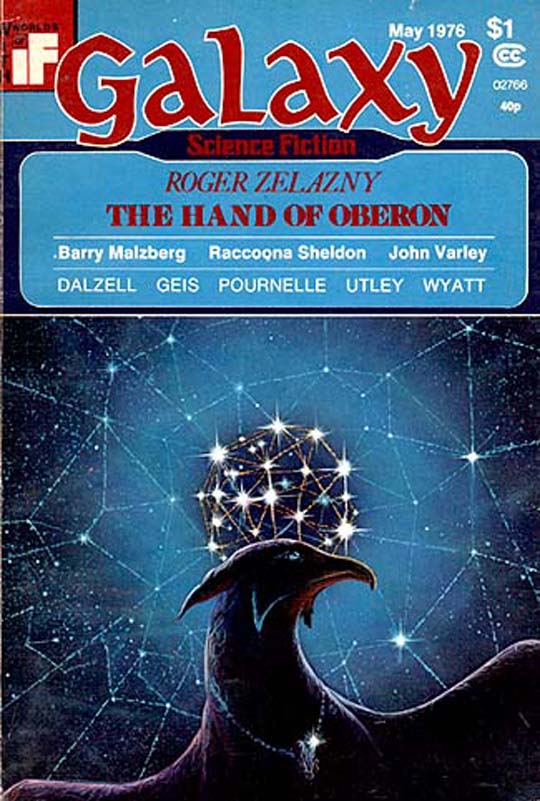
Cover of the May 1976 edition of Galaxy Magazine, which is where I probably first read Varley's “Overdrawn at the Memory Bank.”
Cover of the May 1976 edition of Galaxy Magazine, which is where I probably first read Varley’s “Overdrawn at the Memory Bank.” (Click to embiggen)
In the spring of 1976 I still had a subscription to Galaxy magazine, thanks to my grandparents, though things were not going terrible well in my life at that time, so I didn’t always get all the way through one issue before the next came in. So I might not have read it until some months, after my parents’ divorce was final, and Mom, my sister, and I moved 1200 miles away. I definitely remember owning the magazine with this cover. This issue contained the story, “Overdrawn at the Memory Bank” by John Varley.

Varley was the author of “Picnic on the Near Side” which I wrote about before, and which made quite an impression on me. This story is set in a similar world, with extensive colonies on the moon. It concerns a man named Fingal how has purchased a vacation at one of the “disneylands” which was large lunar caves that have been made to duplicate long lost environments on earth, complete with cloned wildlife. Fingal’s memory and personality are transferred from his brain into a cube, which is then implanted in a lioness so that Fingal can experience the life of a predator on the savannah.

Something goes wrong, and Fingal finds himself back in his own life sooner than expected, and strange things keep happening, such as books rewriting themselves before his eyes to become messages to him. He eventually learns that his body has someone been misplaced, so the memory cube has been put into a safety mode, interfacing with a computer which is creating a simulation of his real life. Messages come to him from a technician named Apollonia Joachim who explains that the simulation is necessary to keep his memories and personality intact until it can be returned to his body.

As the days stretch into weeks, Fingal starts taking classes in the simulation to teach himself new skills to get a better job when he does get back. Strange things happen, as the technician tries to keep him focused. In one incident, Fingal notices strange patterns in the floor tiles in his bathroom, and starts tracing them with his toe, suddenly the bathroom fills up with money. Fingal’s consciousness had somehow gotten into someone’s financial records. Apollonia warns him about losing himself again and again.

Over the months that follow, Fingal finds himself falling in love with Apollonia, and making plans for a future together.

Eventually Fingal is reunited with his body, and then learns that what felt like years to him in the simulation was only six hours, because his thoughts were moving at computer speed while connected. Ms Joachim has only been interfacing with him for a few hours, and doesn’t share his feelings.

The simulated classes he took did result in real learning, so he does have new skills and can pursue a more interesting job. Plus, of course, he gets a refund on the vacation and a lump sum settlement from the company. He’s informed that other people who suffered similar accidents have not always fared so well, and he’s the first person two survive six hours outside the memory cube’s normal limit.

Varley didn’t win an award for this particular story. He did win a Special Locus award the year this was published for having four novelettes, including this story, voted in the top ten in the Locus Reader Awards.

The story was adapted badly into a movie that changed a lot of things for no particular reason. Avoid the movie. The story isn’t action packed, but is more focused on the internal conflicts of a man unhappy with his life who is forced to stay there even if it is simulated. The notion being that if they allow his fantasies to run wild while his personality is in the memory cube, he will go mad and forget who he really is.

I enjoyed the story a lot. The notion that it’s the boring and repetitive parts of our lives that anchor our identities wasn’t terribly revolutionary, but it was interesting to see how this sort of technology might play out without any world-threatening peril giving it at artificial sense of danger. Really, who needs a bigger threat than literally losing your mind to provide a sense of dramatic tension?

One odd side note: I always get this story mixed up with another Varley tale, “The Phantom of Kansas.” They’re both set in the same fictional future world (the Kansas in the title of the second story is an artificial recreation of the midwestern plains of North America in another Lunar cave), and both stories involve stored personalities, but otherwise the plots have nothing to do with each other. The simple fact is that I think the title “Overdrawn at the Memory Bank” would have been better for the second story as it evokes a metaphor for the central plot better than the notion of a phantom. So there has been more than one occasion when I’ve pulled out an anthology, such as my hardcover copy of Wolheim’s 1977 World’s Annual Best Science Fiction, see the title of Varley’s story, turn to it expecting to read the other story, and then as I read the opening paragraphs remember that I always get them mixed up.

Oddly, I own more than one anthology that includes “Overdrawn at the Memory Bank,” but absolutely none that include the other story. I need to fix that.

Robots Aren’t People, Are They? – more of why I love sf/f

Cover for the first edition hardback of <em>The Bicentennial Man and Other Stories</em> by Isaac Asimov.
Cover for the first edition hardback of The Bicentennial Man and Other Stories by Isaac Asimov. (Click to embiggen)
I first heard of “The Bicentennial Man” by Isaac Asimov when I saw the anthology, The Bicentennial Man and Other Stories offered as a selection in the Science Fiction Book Club. I was 16, and still technically a member of the club, but most months I checked off the “Send nothing at this time” box on the card, because even the cheaper prices of the book club were a bit much for my budget. It a bit over a year later when I found a paperback copy of The 1977 Annual World’s Best SF edited by Donald Wolheim in the local used book store when I finally got a chance to read the story.

Asimov wrote a lot of short stories about robots. Most of the stories collected in his anthologies I, Robot and The Rest of the Robots dealt with various logical contradictions that robots would be placed in by various circumstances, and how the robots (and the humans working with them) would work out those conflicts between the Three Laws of Robotics, their other programming, and the situation at hand. Even in his longer novels where robots figured prominently, such as the two sci fi murder mysteries, The Caves of Steel and The Naked Sun, the robots were always motivated by pure logic. The fact that the world is not a purely logical place, and that humans are seldom covered by rationality alone, formed the framework for the conflict in the stories.

“The Bicentennial Man” centered on a single robot, dubbed Andrew by the daughter of its first owner (a Mr. Martin, identified in the story which is told from Andrew’s point of view as simply Sir). Andrew demonstrates an unusual talent with wood carving—his works of art fetching high prices when offered for sale—and develops a desire to became human. Andrew is part of a new series of robots with what Asimov describes “more open-ended architecture” in his positronic brain, which the experts believe is where his apparent artistic talent comes from. Andrew’s stubborn insistence that he can become a human worries the scientists at the world’s largest robotics company, causing them to try to buy Andrew back.

In part because of the pleading of the owner’s daughter (whom Andrew calls Little Miss), Sir refuses to sell Andrew back to the company. Later, Sir helps Andrew gain some form of legal independence as a “free robot” with the legal name of Andrew Martin.

From there the story follows Andrew’s physical and legal journey through several generations of the original family, as Little Miss grows up, grows old, and dies, and her son and grandson found a legal firm which, among other things, fights to secure Andrew’s legal rights. Andrew designs new kinds of prosthetics, which are almost indistinguishable from natural body parts. Andrew’s body is slowly ungraded to first being a more human-looking android body, to an organic one. The proceeds from the patents on the various processes to create the prosthetics (which are used medically to improve the lives of disabled, maimed, and diseased people) providing Andrew’s income and funding the legal fight.

One of his important legal victories happens when he is 150 years old, where at a dinner in his honor (celebrating his medical inventions), he is toasted as the Sesquicentennial Robot.

Eventually, as Andrew realizes that he will never persuade a human legislature to pass a law declaring him, or any robot, a human because the key difference will always be his positronic brain. Which leads Andrew to compel a robotic surgeon to perform an operation on his brain that will cause the brain to slowly decay and die. Andrew’s reasoning is that it’s the immortality that forms the final barrier between him being accepted as a human.

The story really resonated with me. And it was interesting to see Asimov explore the nature of emotions and creativity from the point of view of artificial intelligence. But more interesting was the series of legal barriers that Andrew has to go through. Laws have to be changed to allow a robot to own property, for instance. Laws must be changed to make harming a robot a crime, at another point.

The legal progression to personhood that Asimov takes us through is based on the historical legal fights for woman’s rights and racial equality. For millenia, the legal system treated women as property. Assaulting a woman was a crime, yes, but the penalties imposed always included paying a fine to the woman’s father (if she were unmarried) or her husband, because the man in her life was deemed to have been harmed by the degradation of his property.

Similarly, Andrew discovers, once he is a free robot, that since there is no owner to whom damages would be owed, the legal system doesn’t consider anyone assaulting and damaging him a crime as assault. Vandalism, perhaps, but then, who is the owner who should be compensated for the damage?

It seems ridiculous to us now that some people, simply because of their gender or the color of their skin, had once been in a similar situation: harming them wasn’t inherently a crime, it was only a crime if it caused their “owner” to suffer a loss. And especially frightening to realize that in the matter of sexual assault laws in the U.S., for instance, that as recently as the 1970s the law was still structured this way. A woman couldn’t file rape charges against her husband or sometimes even her ex-husband, because once married her consent was no longer hers to give or withold, in that regard.

Andrew’s struggle for human rights parallels, thus, every oppressed groups struggle for equality. Something that I came to appreciate more some years later, when I finally bought my own hardcover copy of The Bicentennial Man and Other Stories and re-read this particular short story again. There is even a point, during the discussion about the assault laws, where another character makes the same argument at homophobes current make against hate crime laws: they aren’t needed, because the action is already a (minor) crime under existing laws.

Asimov’s story about a robot who wants to be a human might seem, on the surface, to be little more than a retelling of Pinocchio, but we see here one of the Grandmasters of Science Fiction—a sci fi writer who first reached prominence during the “golden age” of sci fi—turning a civil rights argument into a rattling good tale of old-fashioned science fiction. Who would have thought an old, white (okay, jewish, but still) male sci fi writer who made his first professional sale in 1939 would be a social justice warrior? Don’t tell the melancholy canines!

When I read “The Bicentennial Man” I was a very closeted high school student, terrified that people would find out I was queer because I knew that strangers, friends, and even family members would see me as an abomination if they knew. So the story of Andrew, who wanted to be seen and accepted as a person certainly struck a chord. Even if his ultimate solution, dying, seemed like a terrible way to achieve his goal.

A World Full of Sisters – more of why I love sf/f

Cover of the paperback edition of the 1977 Annual World's Best Science Fiction, edited by Donald Wolheim
Cover of the paperback edition of the 1977 Annual World’s Best Science Fiction, edited by Donald Wolheim (click to embiggen)
When I was a junior in high school there was one comic book shop in the town I lived in. It was also a used book store, so I visited there a lot. I didn’t have much money, and I was still reading several comics regularly which took up most of my discretionary spending, so I spent a lot more time there browsing—trying to find the cheapest books—than actually buying.

One day at the store I happened upon a paperback copy of The 1977 Annual World’s Best SF edited by Donald Wolheim. I owned several of his earlier annual anthologies, having gotten several of them as part of my introductory new member shipment from the Science Fiction Book Club a few years previously. The paperback was in pretty good shape, having only been published about six months previous, so it was probably marked at half cover price, which meant it wasn’t in my usual price range, but I had enjoyed the earlier collections, and there was more than one author in the table of contents whose work I really loved, so I bought it.

One of the stories in this particular collection was a novella, “Houston, Houston, Do You Read?” by James Tiptree, Jr. I didn’t know, at the time, that Tiptree was a pseudonym of Alice Sheldon (I think the year I read this was the year that her true identity was revealed, after ten years of being published under the name).

I believe I had read a few of Tiptree’s earlier short stories in the various SF magazines that I followed semi-regularly. I recognized the name, at least, but didn’t have a strong recollection of what kind of stories Tiptree had written before or whether I liked them. So I wasn’t prepared for just how good this story was.

The tale concerns the three-man crew of a NASA mission sent on a polar circuit of the sun. The ship is hit by an unexpectedly strong solar flare and is severely damaged. The crew survives and eventually gets their radio repaired, but are unable to reach Earth. At first it’s because Earth isn’t where they expect it to be in relationship to their position. They eventually figure out that they are further off course than they thought, and start transmitting their distress signal in the correct direction. No answer comes.

Eventually, as they scan more frequencies, they start picking up signals, many of them conversations in English with Australian accents. This is confusing, particularly since many of the signals are coming from various parts of the solar system, indicating a rather large number of space ships. Plus Australia, as far as they knew, didn’t have much of a space program. Also, almost all of the voices on the radio sound like women.

They establish contact with one ship which detected them and has diverted from its course to rescue them. During the radio exchanges before the rescue ship reaches them, they learn that it has been hundreds of years since their mission went up. The world is anxious to meet them, they are told, because they had long been assumed to be dead.

They also learn that there has been some sort of catastrophe on Earth in the intervening years which greatly reduced the population. When the rescue ship finally arrives, the men are surprised that there is only one man in the crew of the ship. Lots of other things surprise them, too. Two of the crewmembers seem to be twins, and both named Judy, but one seems to be several years older than the other. There are several other anomalies and slips of the tongue during the weeks that the ship is returning them to Earth that make the astronauts more suspicious.

Eventually they learn that the catastrophe was even worse than they imagined: it was a plague which only 11,000 women survived; not one single man survived it. The remaining people have been reproducing for several generations by cloning. Children are raised in a communal setting. Some are chosen to receive hormone treatments to give them the musculature and size of men. The story seems to imply that the only reason this is done is for the physical benefits of the muscles and such, and it is unclear if these children choose to became essentially transmen, or if it is imposed by some sort of societal system.

The three astronauts react in very different ways to the discovery. One becomes convinced that god threw them through a wormhole so that they can “rescue” this society and bring men back in charge. Another assumes that since there’s a whole planet of women who have never had sex with a “real man” that he will become sort of a sex god to them all. The last simply hopes that they will be allowed to rejoin society and help repopulate the species (since there are some health problems due to the of lack of genetic diversity).

It turns out, of course, that none of that is to be. The actions of the three men have been being recorded and sent back home. The men were slipped drugs which supposedly made them act out their true natures. The leaders of the world agree that men are simply too dangerous to introduce back into the species. There’s a particularly moving conversation between the captain of the rescue ship and the one man who has remained rational where she points out that most of the heroic behavior the man has tried to cite as proof that men can be good was simply men protecting their own women and children from other men.

The men’s genes are going to be used. Before the three are euthanized, sperm is collected, to diversify the gene pool, but only female babies will be taken to term. Since the entire story is told from the point of view of the one man, the reader never finds out what happens after he and his companions are put to sleep.

I wasn’t the only one who thought the story was good. It won both the Nebula and Hugo award for best novella the year it was published. The story did not kick off much in the way of controversy at the time, in part because people believed Tiptree was simply a feminist-minded man. A man could write a science fiction story decrying generations of misogyny and patriarchal violence and be thought of as open-minded, and a forward thinker. A woman, on the other hand, would (and still often is) branded as a radical man-hater.

I simply thought it was an intriguing story. I was still struggling to accept my own sexual orientation at the time, and I was intimately familiar with how the cruelty of boys toward boys who weren’t manly enough was overlooked, approved, and often encouraged by a sexist society. So the notion that culture might be a better place without all that hypermasculinity was appealing, even if I felt sorry for the reasonable male viewpoint character who was going to be exterminated along with his more brutish companions.

I want to emphasize that Tiptree made the male character sympathetic. She laid out the case for both sides convincingly, and seemed to be inviting the reader to consider (and maybe fight for) solutions to the problems of toxic chauvinism other than simply wiping the men out.

It was another mind-blowing story. Another time that sci fi helped me (as a very closeted queer teen living in a small town among Christian fundamentalists) imagine a better life, particularly the notion of romantic relationships other than opposite-sex pairings. After that story, whenever I saw Tiptree’s name on an anthology or magazine cover, I knew I wanted to read it.