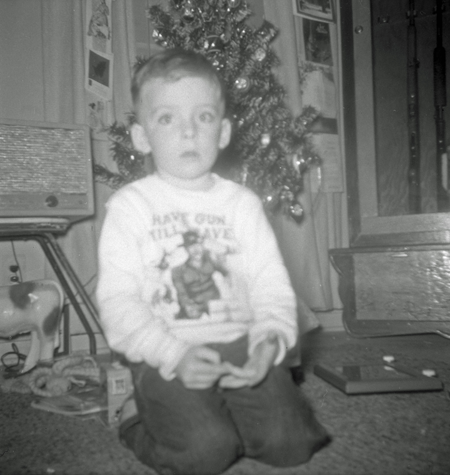
I’m 3 years old in this picture, taken at my maternal grandparents’ house.I mentioned earlier about one set of Christmas pictures showing me with cowboy toys, even though that was apparently the first year I started begging for an Easy Bake Oven. Several of the toys in the pictures are related to the television show, Have Gun, Will Travel, which I was told years later by my grandmother was my favorite show at the time. I don’t remember the program, at all. I only found one picture from that Christmas, which I’ve posted here. This is taken at my maternal grandparents’ house, so I suspect the only presents visible are from those grandparents.
My mom has a picture of me in the same “Have Gun Will Travel” shirt, along with a cap gun and a couple of other cowboy-related toys, taken in front of our Christmas tree in our own living room. But I don’t seem to have a copy of it.
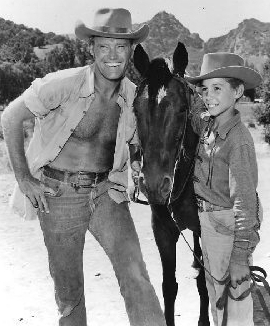
Chuck Connors as the Rifleman and Johnny Crawford as his son in a publicity photo. Chuck was shirtless in a lot of episodes.While I have no recollection of Have Gun Will Travel, the show I do remember, which was on the air those same years (both of them aired their final episode in April of ’63) was The Rifleman. I have a lot of very vivid memories of that show, even though I was only three when it went off the air. I don’t remember the plots of any episodes, but I have a lot of memories of the star, Chuck Connors, and the many times he appeared shirtless on the show.
While there is still some debate about how much genetics play in sexual orientation, the overwhelming evidence has shown for a long time that what arouses us emotionally and sexually is pretty much set in stone by the age of two.
Let me repeat that: by the age of two.
This seems weird and a little creepy, but it makes sense when you remember that we are fundamentally social creatures. We are definitely hard-wired to form various kinds of bonds with the people around us. When a little boy exhibits the signs of having a crush on a girl or woman in his life, we think it’s cute and adorable and a nature precursor to other feelings that will come along later in life. That’s all we’re talking about here, except the fact is that for some of us we developed crushes on males.
Congressman Shock has a great anti-gay voting record, but posts pictures of himself to Instagram like this, has never married, and has lived with a string of similar male “roommates” for over a decade.And if the adults around us noticed, they freaked out and tried in various ways to redirect those impulses. That redirection is doomed to failure. The closest anyone gets to success at that is that some non-heterosexual kids become fairly good at faking it later in life (though most seem to be pretty bad at it, cf Aaron Schock or Marcus Bachmann).
I have wondered why I don’t recall this show that my parents and grandparents all say was my favorite, while I do have memories of the other show. It’s possible that the adults around me noticed that my enthusiasm for Chuck Connors wasn’t the same as the way I talked about the other show, and so they were discouraging my interest. I suspect that it is more likely that Have Gun… was also the favorite show of one of my grandparents or parents, so the shared enthusiasm made it a stand out. I have some vague recollections of Dad commenting disparagingly about Chuck Connors when one of his movies came up on TV a few years later, so maybe I only got to watch the Rifleman occasionally, and it was safer not to talk about it around Dad.
I don’t know when my parents first began worrying that I was queer. The Easy Bake Oven wasn’t the only toy that I got told I couldn’t have because it was a girl’s toy… But I should point out that when I finally did get the oven, I quickly converted it to a device for amateur chemistry experiments. And the toys I most remember loving to play with in those early years were my Tonka trucks—especially my bright yellow steam shovel. So I wasn’t that gender non-conforming.
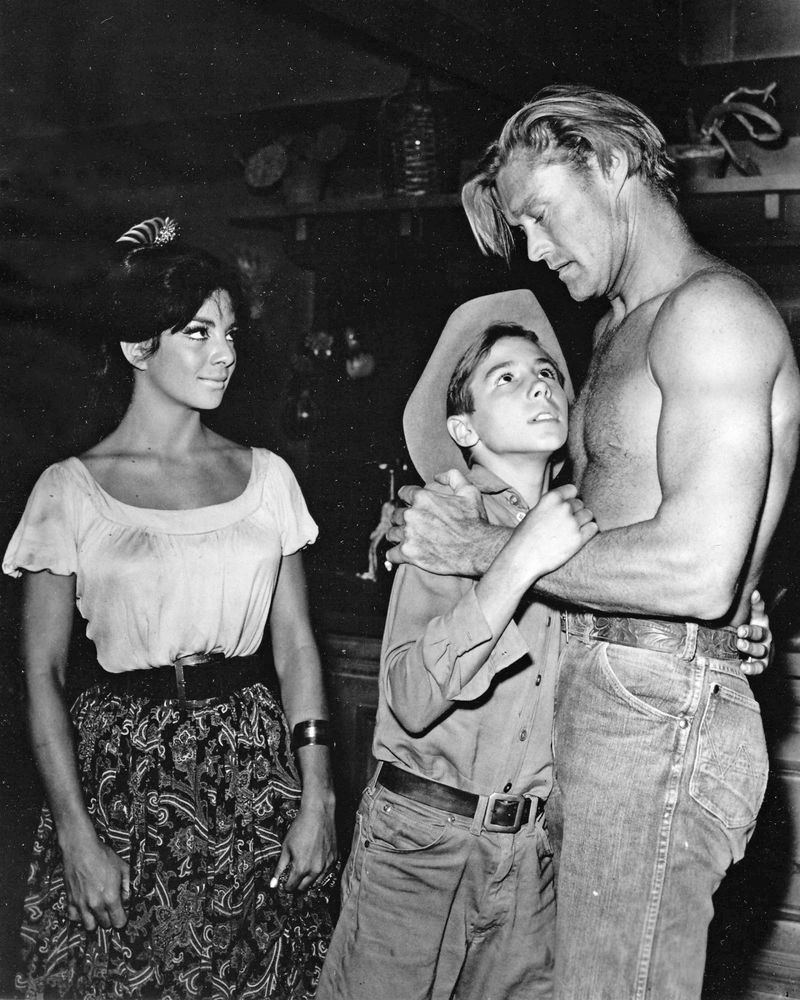
Publicity photo from the television show, the Rifleman.I have previously said that I think my first celebrity crush was Race Banon, a character from the cartoon series Jonny Quest. But I suspect that it was more likely Chuck Connors’ character in The Rifleman.
Real herrings are never this red.When a writer (particularly a mystery or detective story author) places details in a story to distract the characters and/or the readers to a false conclusion, that’s called a “red herring.” For many years, dictionaries and other references claimed that the origin of the phrase was a reference to a technique that used to be used to train hunting dogs to stay on the trail and not be distracted. When certain kinds of fish are preserved by being smoked and/or brined, the flesh of the fish turned a brownish red, and they often had a very pungent odor. Such “red herrings” or kippers supposedly could be used to throw a dog off the scent.
That origin is now generally accepted to be apocryphal, with the actual origin being from a political article written in 1807 in which the author said that he once distracted a dog with a red herring, and then accused other journalists of having been deceived in a similar way by a rumor. There is no indication of any actual hunters or dog trainers making it a practice to regularly use such fish in the training of hunting dogs.
But the apocryphal story remains useful in explaining the figurative meaning: distract the reader by placing a hint that appears to lead to something interesting in her path.
For the red herring to work in any type of story in which the characters are trying to solve a puzzle, it isn’t enough for the red herring to be a distraction. The red herring should point the characters (and the reader) toward a plausible alternative solution. When the trail turns out to be a dead end or a wrong solution, the trail itself still has to be something that plausibly would happen in that world.
It’s been annoying me about a lot of series I’ve been watching lately. Characters have a problem to solve, some information is found that points in a particular direction, when suddenly, blam! a supporting character that is loved one of one of the protagonists is attacked mysteriously. For the rest of the episode, everyone runs around like chickens with their heads cut off accusing people that have absolutely no motive at all for being involved in either problem. Eventually protagonist is confronted by the very person that clues which were seen before the distraction pointed to in the beginning. And here’s the part that’s crazy: either the mysterious attack is never explained, or it was done by some random person completely unrelated to the bad guy who is revealed three episodes later as a new big bad, but no rational explanation for why the new big bad attacked that character three episodes earlier is ever given.
I’m not sure if the problem is that most shows are written by teams where there may not be a clear “coordinator” with a strong artistic vision of what the story line is supposed to do, or if they simply think that throwing random stuff at the reader/viewer is what you’re supposed to do, or if they’re always in a rush without time to think things through. Or maybe they have fallen into that trap of thinking that, since sometimes meaningless things happen in real life, it’s okay for a story teller to do it, too.
It’s not okay. It shows that you are a bad writer. Yes, random things happen in real life. And you can even have some events happen in the story where the explanation in the story is that it was just dumb luck. But you are the story teller, and it’s your story. You have chosen to show this random action happened to your character. You need to have a reason, a reason that furthers the story or reveals something about the characters, for showing the bad luck to the reader/viewer.
It is okay if a red herring occasionally leads to a laugh without furthering the plot. If you have previously established one supporting character as being a bit of a dork or a goofball, for instance, you can one clue that leads to something completely unrelated to the plot that this funny character is doing. But it needs to be something that the readers/viewers will immediately think, “Oh! That’s so like him.”
Let’s say your current puzzle involves someone apparently attempting to kill a teacher by leaving some sort of deadly device for him. While the protagonists are following up clues, they discover that the teacher’s car in the parking lot is sparkling clean, as if someone wiped down the entire exterior. You can have the characters waste time trying to find a bomb of something on the car that never turns out to be there. Eventually, another supporting character finds video showing one obscure supporting character who is a student lurking around the car earlier. Eventually, the protagonists find out that said student, but realize that he’s failing said teacher’s class, and has been trying to curry the teacher’s favor.
It was suspicious behavior, it leads to a dead end, but it also makes sense within the story and is completely believable as something that could happen independently of the real stalker. Good writing.
On the other hand, having two supporting characters shot by a mysterious person off screen, who leaves them huddled together, holding each others wounds while waiting for an ambulance, and then never showing who shot the characters? Not so plausible. Or, showing who shot the characters three episodes later, but the person who did it is someone the audience would expect to want to kill the characters who were shot, and there was absolutely no reason for her not to have finished the job three episodes earlier? Bad writing.
It’s your story, yes. But you need to tell it the best it can be told.
What’s a hater to do?The song, “America, the Beautiful” got an entire day’s lesson in the Colorado State History class I had to pass in ninth grade. Katherine Lee Bates, an English professor from Wellesley College, came to Colorado Springs in 1893 to teach a summer class at Colorado College. As her train rolled across the plains of eastern Colorado, drawing closer to the dramatic front line of the Rocky Mountains spread across the horizon, she wrote in her journal about the landscape she was passing. Colorado Springs is near the base of Pike’s Peak, one of the taller mountains in the Rockies, and one day Bates took an excursion by train and then mule to the peak of the mountain, where she later said she felt as if all the beauty of America was laid before her, and inspired a poem to form in her mind. She eventually submitted the poem, entitled “Pike’s Peak” to a publication called The Congregationalist. When it was published in the July 4th edition in 1895, appeared under the title, “America the Beautiful.”
We learned that and other facts about the subsequent versions of the poem Bates re-published, and how it was eventually set to music by Samuel A. Ward, in class. What the textbook failed to mention is that Katherine Lee Bates was almost certainly lesbian…Continue reading …with brotherhood?→
Obviously not actually me, as there is only one remote in the picture…Several years ago I was reading about the new shows coming out the next season, and one, The Big Bang Theory, sounded like exactly the sort of show that I would hate. So I didn’t make any attempt to watch any episodes. Not very long after the season started, I heard from a few different acquaintances that it was not a good show. The specific comments were that it made fun of nerds by portraying them in completely exaggerated, stereotypical, and unrealistic ways. So I continued to ignore it for all of the first season.
And then another nerdy/geek/fannish friend happened to mention, midway through the second season, that he was strangely addicted to the show. I mentioned the reasons I had assumed I wouldn’t like it, and he said, “Oh, me too!” Then he explained how his wife (a person who has been even more immersed in fannish culture than either her hubby or me) had watched the first season on Netflix. “I tried to ignore, and work on stuff on my computer. But it kept making me laugh… and it usually made me laugh because the characters acted exactly like some of our friends.”
“You’ll never guess what I found carved inside this log!”I’ve been known to plot overly complicated puzzles for my roleplaying group. I’ve been known to plot stories with intricate interrelationships between characters and groups of characters. I worry, while writing some stories, that I have put in too many characters, or too many subplots, or hidden clues too subtly for the reader to follow.
But nothing I have every concocted is one-billionth as elaborate or labyrinthine as the puzzles supposedly concocted by various historical figures in order to hide treasures, warn future generations of impending doom, explain to allies how to defeat evil forces, and so forth as chronicled in the typical suspense/thriller/historical mystery: A strange epitaph carved onto an old tombstone leads to a cryptic phrase engraved on the wall of an old building, which points to the hiding place of an old family Bible, which has more cryptic phrases hidden in invisible ink on certain pages, which leads to the map that can only be seen by finding six antique objects and arranging them in a specific formation, which shows the location of a hidden crypt, which is accessed by recognizing an obscure symbol on a brick, which leads to another hidden map, which points the way to another part of the old family Bible where another cryptic clue is hidden in almost random looking dots on the edge of a page, which shows the location of a hidden room under an old church…Continue reading Everyone likes a puzzle, but…→
Raymond Burr as Chief of Detectives, Robert T. Ironside.Reboots/remakes are tricky things. The current BBC re-imagining of Sherlock Holmes starring Benedict Cumberbatch is altogether awesome, for instance. The remake of the classic Spencer Tracey Father of the Bride with Steve Martin was also pretty darn awesome.
The recent remakes of V and True Grit, on the other hand…
So NBC has launched a remake of the ’70s detective series, Ironside, and they cast Blair Underwood in a role based very loosely on the character originated by Raymond Burr. I’ve watched the pilot, and it wasn’t awful. I’m not even sure I would call it bad. But mediocre certainly springs to mind. Supporting characters completely lacking in anything resembling a personality does as well.
Sometimes series (whether books or television) take a while to find their footing, so I’m going to probably give it a few more episodes. But by the time I finished watching the pilot, I needed something to cleanse my brain, and by chance I’ve had the TiVo recording re-runs of another Raymond Burr iconic series, Perry Mason. It was truly a joy to watch a 1962 episode.
One of the things I loved about the classic Mason television series, as well as the books, was how often Mason would quote specific principles of law. For instance, in the episode I watched that night, Della Street, Mason’s secretary, has been accused of aiding and abetting a felony murder which may have been committed by an old friend. Mason points out to the officer that in order for her to be found guilty, they have to prove that she knew her friend had committed a felony before she acted, that she willingly assisted the friend, and that both she and the friend were doing what they were doing with the intent to avoid arrest for the crime.
Which is true of many of our laws. What you’re thinking and why you’re doing what you are doing determine whether the act is a crime. It is seldom just the action, but also the intent. This is a legal principle that has been with us since at least the times of the Ancient Sumerians…
When I was a kid, just about every metropolitan area in the U.S. had at least one local TV station showing some sort of monster/mystery/sci-fi/horror movie program every week. Many of them ran on Friday nights, after the local evening news ended. A few ran on Saturday evenings, and fewer still on Saturday afternoons. And something that a lot of those shows had in common is that there was a host: a person who usually was dressed up as some sort of monster or other stock character, who would introduce the show, possibly banter with a sidekick, or otherwise provide a bit of color commentary to the proceedings.
Some people operate under the impression that the first horror host was Elvira, Mistress of the Dark (no, she didn’t begin hosting until 1981). Slightly more informed people point to Bob Wilkins, who hosted Creature Features on a couple of different Bay Area channels from 1971 to 1984.
Well-informed people aware that all of them were preceded by some years by Vampira (1954-56), who later tried to sue Elvira for stealing her schtick. [Given that the actress who played Vampira had been working with the station in ’81 and was to be an executive producer of the show that became Elvira’s show, and she left in a dispute over the casting of the host, you can understand.]
A few years after Vampira’s show went off the air (it was aired live, and virtually no footage remains), Screen Gems put together a package of 52 horror films and made them available for syndication. Stations all over the country began showing their own weekly horror shows under titles such as Shock Theatre, Nightmare Theatre, Sinister Cinema, Saturday Chiller, and so on. The shows were usually broadcast on either Friday or Saturday night, after the evening news.
One reason that every station that carried the show had its own host was simply technological. In the late 50s (and for some time after), the way non-network syndication worked involved physically shipping cannisters of film (and later videotape) back and forth. It worked a lot like the non-streaming version of Netflix. A station would subscribe to the show, the syndicator would ship movies out to the subscribing stations. After the station showed the film(s), they would ship them back to the syndicator, who would ship them to another station.
My understanding is that they shipped out four or five movies at a time, and that as long as the station paid their subscription fees, they didn’t wait until the last set had been shipped back before sending the next.
In this case, Screen Gems just provided the movies themselves. Some location stations just ran them with, at most, a voice-over announcer. Other stations came up with their own shows, inspired originally by Vampira.
During the years I was old enough to be allowed to stay up and watch such things, we were living in various small towns in Utah and northwestern Colorado, and one of the stations we got was KCPX channel 4 out of Salt Lake City, where each Friday night brought us Nightmare Theatre.
For a few years it went by the name of The 10:20 Double Nightmare, because it was a double feature and it started at 10:20pm as soon as the evening news ended. I remember that phase only because sometimes my parents would let me stay up late enough to watch the first movie, but I wasn’t supposed to watch the second. By the time I was allowed to stay up as late as I wanted on Fridays, the local evening news went all the way until 10:30, and the show had reverted by to a single movie.
Nightmare Theatre was hosted, during that period, by Dr. Volapuk. Which is to say that a man wearing a vaguely Dracula-like suit and cape, and a really awful rubber ghoul mask, would come out of the shadows, introduce the movie, and make a lot of bad jokes. He would make more bad jokes at the commercial breaks. Occasionally he would impart a bit of trivia related to the movies. At the end of the show, he would give a preview of the next week’s movie, and then end with his traditional sign-off, “I, Dr. Volapuk, have been happy to be your host tonight. Remember, Volapuk spelled backwards is cup-of-love. So in your nightmares tonight, dream of me…” and then he would laugh maniacally.
No, I have no idea what all that cup-of-love business was supposed to mean.
I didn’t know, at the time, that the actor in the mask was also the guy who dressed up as Fireman Frank every morning to host the cartoon show on the same station.
Nightmare Theatre showed a lot of the old Universal Monster movies (Frankenstein Meets the Wolf Man, Son of Dracula, Werewolf of London, The Mummy’s Hand, and so on), but also a lot of the Japanese kaiju genre of moves (Mothra, Godzilla Raids Again, War of the Gargantuas).
A lot of the nerdy interest in such shows got re-focused on newer things when Star Wars came out and kicked off a bunch of higher quality films of the fantastic. Relatively cheap high quality satellite feeds and other cable television technologies replaced the old model of shipping film around, so shows such as Elvira’s Movie Macabre, Mystery Science Theater 3000, or Cinema Insomnia could be produced in one place and seen in the niche of each market. Which has put stake through the heart of most of the local horror hosts.
All those Friday nights that I stayed up to watch those movies is probably why I often still get a hankering on Fridays for some cheesy sci fi or similar films.
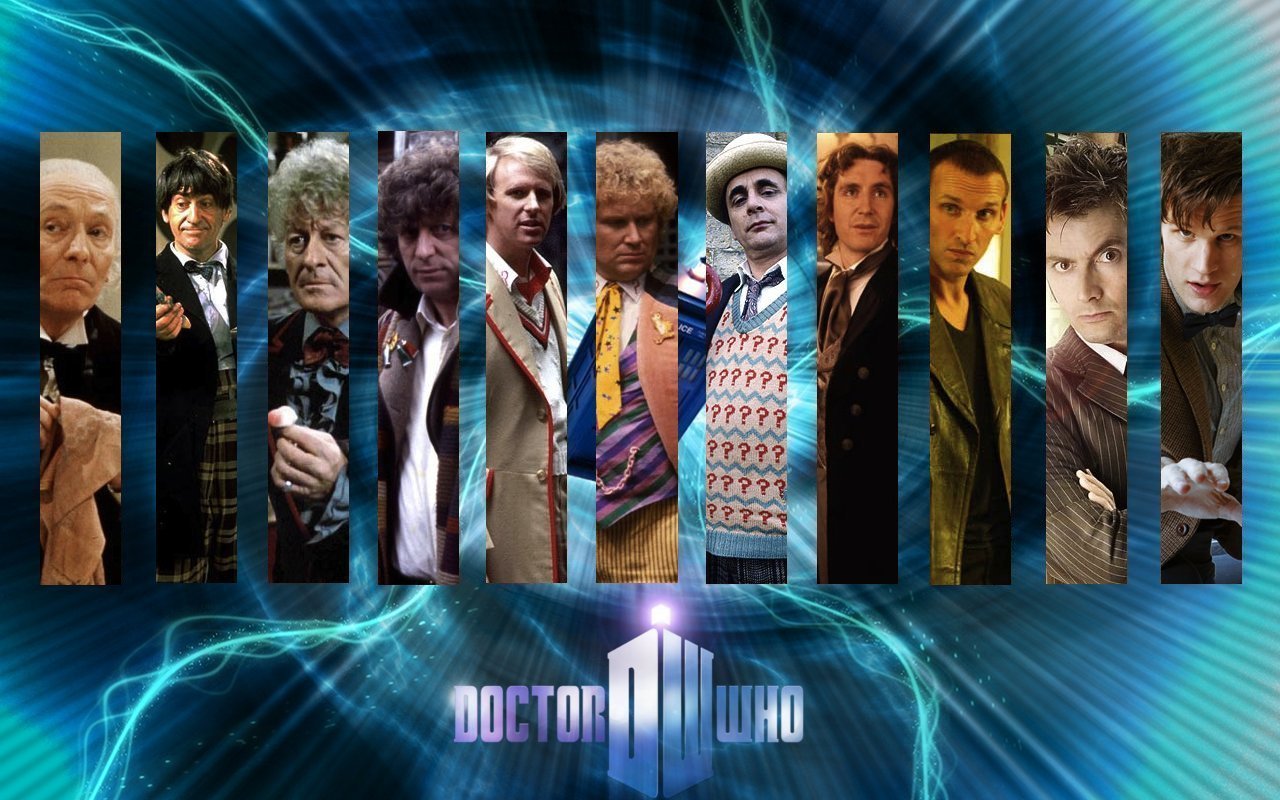
Jon Pertwee was the Third Doctor (1970-74).I’m a big nerd and long-time Doctor Who fan. For years my favorite was Jon Pertwee, and not just because he totally rocked a velvet jacket, ruffled shirt, and opera cloak. I was watching years before the BBC revived the show with Christopher Eccleston playing a decidedly dark and delicious doctor. I’ve got piles of DVDs with at least some of the adventures of all the doctors (William Hartwell, Patrick Troughton, Jon Pertwee, Tom Baker, Peter Davidson, Colin Baker, Sylvester McCoy, Paul McGann, Christopher Eccleston, David Tenant, Matt Smith, and even both of the 60s movies starring Peter Cushing as a Doctor Who that was not a time lord, but traveled in a Tardis and fought Daleks).
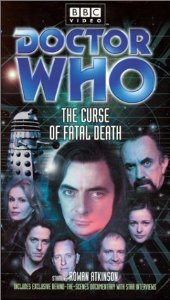
Okay, that’s still not complete. I don’t have a DVD of Doctor Who and the Curse of the Fatal Death,in which the Doctor was protrayed by Rowan Atkinson, Richard E. Grant, Jim Broadbent, Hugh Grant, and Joanna Lumley. I’ve seen it, they’ve just never released this parody special for charity on DVD.
I am an enormous Doctor Who fanboy. In the years since many of the old adventures have become available on disc, I have reached the point where I now frequently say that my favorite Doctor is whichever one I happen to be watching right now.
Despite that, I don’t think every episode or serial has been awesome. There has been more than once that I thought the new actor cast to play the Doctor was a terrible mistake. There have been companions that I wanted to strangle, stories that made me embarrassed on behalf of the actors, endings that made me want to drown the writers (or at least shake them by the throat and yell, “That really insipid, self-indulgent pile of refuse you spewed out there could have been saved with just two lines of dialog!”).
Doctor Who and the Curse of the Fatal Death.So I’m a super fan, but not a blindly-love-anything-they-put-out fan.
I understand why I watched the announcement of the new actor who will take over the role at the end of the 50th anniversary Christmas special. I understand why I, and many other fans, may have been disappointed, or are feeling apprehensive about the new actor chosen.
What I don’t get are the people (and there was more than one being re-tweeted around the internet yesterday) who say they have never watched a single episode, and that they are angry about the actor who was cast.
The eleven official Doctors.(Click to embiggen)“Why do you care?” isn’t really the question, because they have an answer to that. They are upset that the actor cast was a white man. They wanted either an actor of color or an actress cast as the next Doctor. And I understand that, boy do I understand not feeling included when you don’t see actors who look like you in lead roles or even recurring roles.
I was not terribly happy when Matthew Smith’s casting was first announced specifically because I really wanted to see a comedienne cast. Someone like Jennifer Saunders was what I had in mind. I didn’t see any reason the Doctor couldn’t regenerate as a gal instead of a guy. Smith won me over, and I’ve been very sad since learning that he is leaving the show.
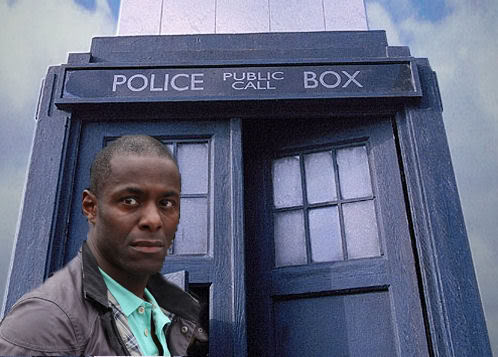
I’ve also wanted to see someone like Idris Elba or Adrian Lester or Paterson Joseph play him, because I like their work in other shows, and I don’t see why, even if the Doctor does regenerate as a dude, he has to be white.
I really do understand the diversity/inclusivity issue. For instance, even though at the time I was amazed that they let Eccleston flirt with and eventually kiss John Barrowman, I’ve grumped a bit since then at how little non-heterosexuality has been allowed (other than as a joke or misunderstanding) in the main Doctor Who show unless Captain Jack is visiting.
Seriously, why couldn’t Paterson Joseph play the Doctor? (Click to embiggen)So while I agree with the point that it’s disappointing that they haven’t gone outside the white dude box in the casting, I don’t understand why someone who has never, ever watched a single episode out of the 798 that have been made during its 50 year run, feels the need to express a public opinion on this casting decision.
What fuels your sense of entitlement? Seriously. I have plenty of friends and acquaintances who share your disappointment or outrage for exactly the same reason, and I sympathize with them. I share, to a lesser extent, their disappointment (not really the outrage, but I understand the outrage). I have absolutely no objection to them posting long screeds about it, tweeting about it, re-tweeting other disappointed fans comment about it, and so on.
But why expend time, effort, and bandwidth (not a lot of bandwidth to post, I know, but every one of your followers and the followers of your re-tweeters have also had to use bandwidth for this) for a show that you have never, ever watched? If you can’t be bothered to watch the show, even once, then please don’t bother those of us who have with your “opinion.”
Someone’s going to respond to this either accusing me of censorship or at the least harassing someone just for expressing an opinion. I’m not in a position to silence them, so the censorship argument doesn’t apply as a matter of definition. This is nothing to do with whether you have a legal right to express yourself. It does have to do with whether you ought to be commenting on something you’ve never seen.
Freedom of expression does not mean freedom from disagreement or from other people expressing the opinion that you are a complete and utter git.
There’s a particular TV show that I like, but don’t watch often. There are certain lazy tendencies in the writing that rub me the wrong way, such as treating technology as magic whenever convenient for the plot. There are other aspects of the show I really enjoy, so I tend to let episodes accumulate on the TiVo, saving them for times when I’m in the mood for some mindless action and adventure.
There’s another show which also uses technology in improbable and impossible ways that I watch faithfully each time a new episode comes out. One of the diffences between the shows is that the second one states its premise upfront, and then tries to stay consistent with that. Yes, what they’re doing is impossible, but it’s the same impossible everytime, and the stories revolve around the question of how people might behave if computers happened to work this way. The first show just plays fast and loose without any thought about whether they’re contradicting something they did in a previous episode.
Neither show is packaged as science fiction. The first one definitely isn’t sci fi. It’s a cop/action show whose writers don’t understand or care about what computers and crime labs really can do and what they can’t.
I have seen discussions on science fictions forums where some fans have objected to the inclusion of the second in a list of sci fi shows currently airing, primarily because the show doesn’t claim to be set in the future, and acts as if all the things they’re doing are possible with our current technology. But the show postulates the existence of a computer that can do things currently impossible, and then it explores what might happen if that were so. That’s the epitome of science fiction.
I can only enjoy the first show if I’m in the right head space. I have to be in the kind of mood where I can give my inner critics the night off, kick back, and just watch a group of interesting characters run from one dangerous situation to another. I have to be in a “I don’t care if it’s wrong” head space.
The second show puts me into its head space. Regardless of whether this is wrong, what might things be like if it were?
That’s not just good science fiction. That’s good fiction. The goal of a story teller should be to draw people into the story. Make this imaginary situation or world so enticing that the reader has to step inside to see what it’s like.
The other kind of story is like mass produced snack food. If it’s there where we happen to be and when we’re hungry (or bored or at least not feeling too full to eat), we’ll pick it up and munch away. But later we may not even remember what it was we ate.
The other kind doesn’t just pull us away from whatever we were doing to check it out, but it leaves us thinking afterward. Like an extremely good meal, we want to linger in the head space of the story after it’s ended.
Beginnings in fiction are very important. If you don’t grab the reader’s attention and engage his/her curiosity at the beginning, they’ll never read the rest of your story. It’s no surprise, then, that numerous books, courses, seminars, and panels on how to write spend a lot of time on beginnings. They also spend time discussing how to develop and advance a plot, how do to characterization, and so forth. But I’ve always felt that endings get short shrift.
Knowing the right place to stop is deceptively harder than it looks. The ending needs to resolve the conflicts (both external and internal) which drove the plot. The ending needs to leave the reader with a sense of closure. Or, if not exactly closure, some indication of where things are headed for the characters the reader has spent the entire story bonding with.
I’ve been thinking about this a lot as I’m working on (what I hope is) the last round of edits on a novel. A couple of my advance-readers have commented that the final chapter is a little long. The climax and crisis action happens before the final chapter in a big dramatic fight, and then I have the final chapter to wrap everything up. In literary circles they call this the denouement: the unraveling of complications, the final resolution of the story.
This is one of the places where my tendency to write stories with lots of characters makes my job harder. The reader has spent a lot of time with many of these characters, and understandably wants to know at least a bit about how each has been affected by the events at the climax. Also, there are one or two running gags in the story which it was inappropriate to resolve during the battle. Those each have to have a pay-off (and judging by the writers’ group reaction when I read the first draft of the final chapter, those work). I don’t want to skip any character that had significant appearances, because each character, no matter how strange, will be the favorite of some readers.
I’m not saying that one needs to perform “fan service.” But, as a writer of a novel-length tale, I’ve asked the reader to come along for all the ups and downs of these characters. If I don’t finish the tale for each, I’ve wasted some of the reader’s time. As a storyteller I’m not obliged to give the reader what they want, but I am obliged to tell the best story I can.
Fortunately, a lot of the characters can appear in denouement scenes together, so the reader can see them one last time and see how they are.
I’ve also been thinking about this a lot lately because two different television series I’ve watched and enjoyed for a number of years are coming to their conclusions. In each case, the creators of the show have been given an opportunity to end things on their own terms. They knew in advance that this was the end, with plenty of time to write the ending they want.
A lot of writers (not just TV writers) don’t get the chance. While it is frustrating for a fan when that happens, trust me, it’s even more frustrating for the writer.
I wish them luck in their endings. As a fan I hope I get something that feels fitting, with maybe a surprise or two.
And as a writer struggling with an ending of my own, I really hope I don’t blow it!






 Font Folly