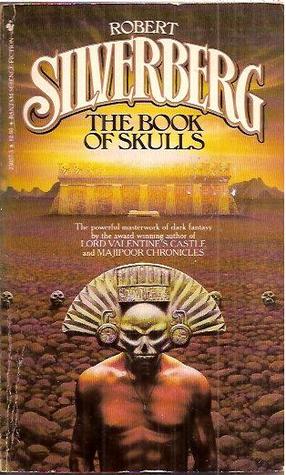
Cover for one of the paperback editions of The Book of Skulls by Robert Silverberg. (Click to embiggen)I was 16 when I found the Book of Skulls in a used book store. The cover blurb talking about four young men on a quest to find a mysterious cult and obtain immortality. I’d read some of Silverberg’s short fiction in both Galaxy magazine and The Magazine of Fantasy & Science Fiction and had generally enjoyed it. Plus it had a cool cover.
The novel is told in rotating first-person viewpoint from each of the four characters: Eli, the Jewish bookworm; Ned, the flaming homosexual; Timothy, the rich boy; and Oliver, the farmboy/jock. They are students at the same college who have formed somewhat unlikely friendships. Eli, who has a gift for languages, found and translated a book about the mysterious Brotherhood of the Skull and their secret of immortality. The book says that four people must present themselves together, and work together to endure the trials of the Brotherhood. Even if they succeed, only two will gain mortality. The other two lives are forfeit: one must willingly commit suicide, and the other must be sacrificed by his fellows…Continue reading Mortality, Im- and Otherwise: more of why I love sf/f→
Lost in Space, 20th Century Fox Television & CBS Broadcasting (Click to embiggen)The first episode of Lost In Space aired on CBS in September of 1965, and I was glued to my set. It debuted less than two weeks before my fifth birthday, so I don’t remember a lot about my feelings about the first episode. If you aren’t familiar, the show follows the adventures of the “space family Robinson” (Professor John Robinson, his wife Dr. Maureen Robinson, their grown daughter Judy, and younger children Penny and Will; their pilot, Major Don West, and their robot called B-9 in the early episodes) who were sent off to be the first colonists of the Alpha Centauri system, except their ship is thrown off course due to the bumbling actions of the stowaway/saboteur Dr. Zachary Smith, who ends up trapped on the ship when it takes off.
Lost In Space is not remembered as being serious science fiction, or even as a serious series. Though this is primarily because of the second and third season. The first season was intended as a serious action adventure series giving a science fictional spin to the early 19th Century novel, The Swiss Family Robinson, which had itself been inspired by the 18th Century novel, Robinson Crusoe. Like those novels, the early episodes focused on the crew as castaways trying to survive in a hostile environment. Some of the sci fi notions of some first season episodes were pretty silly by modern standards, but mostly because they were attempts to adapt the sort of complications that might appear in a western series or a contemporary slice-of-life series and put a spacey spin on it…Continue reading Computerized Clods and Squeamish Scoundrels: more of why I love sf/f→
Hardcover copy of the original version of David Gerrold’s When Harlie Was One.I was thirteen or fourteen years old when I found the copy of When Harlie Was One in the public library. The book jacket described an intelligent machine that has to prove he is a person or be shut down. It sounded really cool. This was during a period in my life where I was literally reading at least one entire book every day. I visited the library constantly, turning in a pile of books I’d finished every few days and checking out more. I read during every free moment. I even read while I was walking to school or while walking home. Yep, I was that kid, walking down the sidewalk with my nose stuck in a book. Books weren’t my only friends, but they were my best friends.
Thinking back, I’m sort of surprised that particular public library in that tiny town had this book. It had only been published a year or two previously. Most of the science fiction they had was stuff that had been around for much longer. Of course, When Harlie Was One had been nominated in the best novel category for both the Nebula Award and the Hugo Award (it won neither) not long before the library acquired it, so maybe that’s why the librarian who ordered new books picked it. I don’t know…Continue reading Thinking Machines and Thoughtless People: more of why I love sf/f→
Another in my series of posts recommending web comics:
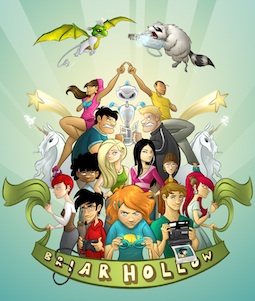
Briar Hollow by Terry Blas & Kimball DavisThis story about a nerd named Molly and her friends at college is a fun blend of romance, nerdy things, cryptozoology, and missed signals. I discovered Briar Hollow by Terry Blas & Kimball Davis because an acquaintance recommended the Gnerd Podcast, and while checking it out, discovered that the guy who does the podcast also does a web comic. Since I only discovered it recently and started reading from the beginning, it wasn’t until I had become completely addicted and reached the most recent page that I saw that he hasn’t updated since November. Eeeek! Maybe if we all write him fan mail there will be a new page soon? Anyway, I think what he’s published so far is entertaining and worth the read, and really hope he continues the story.
This one is a little complicated. See, several years ago I was reading a web comic called Finn and Charlie Are Hitched, which was a three-panel gag strip about Charlie and Finn, a couple of gay guys who are married and their sometimes whacky friends. It was a fun slice-of-life strip and I enjoyed it. But for some reason I stopped reading it (probably something silly like I lost the bookmark and just didn’t go searching for it). Anyway, I was reading another web comic entirely recently based on someone’s recommendation, and they had some links to recommended comics and I saw the name “Charlie and Finn Are Hitched” and I thought, “Hey, didn’t I used to read that?” I got there, and learned that the final strip was published on New Year’s Eve 2013, at which point the artist said that he was closing the strip, but that we could read more about the characters in his new comic, Muddler’s Beat by Tony Breed. And you can! Charlie and Finn are still there, and still hitched, and several other characters from the original series are still there. It’s still humorous, with occasional trips into serious topics (the series of strips about the death of Charlie and Finn’s cat for instance). In his announcement of the new comic, the artist said that the new strip would be more ensemble oriented. I like both strips. It’s a little weird, now that I’m caught up on Muddler’s Beat to go back and look at the earliest years of the original strip, as the artist has improved over time (which one would expect). Anyway, the original strip is also available in dead trees editions.
Some of the comics I’ve previously recommended:
“Mr. Cow,” by Chuck Melville tells the tale of a clueless cow with Walter Cronkite dreams. If the twice-weekly gags about a barnyard of a newsroom aren’t enough excitement for you the same artist also writes and draws (and colors!) some awesome fantasy series: Champions of Katara and Felicia, Sorceress of Katara. If you like Mr. Cow, Felicia, or Flagstaff (the hero of Champions of Katara) you can support the artist by going to his Patreon Page. Also, can I interest you in a Mr. Cow Mug?
“Deer Me,” by Sheryl Schopfer tells the tales from the lives of three friends (and former roommates) who couldn’t be more dissimilar while being surprisingly compatible. If you enjoy Deer Me, you can support the artist by going to her Patreon Page!
And I love this impish girl thief with a tail and her reluctant undead sorcerer/bodyguard: “Unsounded,” by Ashley Cope.
The Young Protectors by Alex Wolfson begins when a young, closeted teen-age superhero who has just snuck into a gay bar for the first time is seen exiting said bar by a not-so-young, very experienced, very powerful, super-villain. Trouble, of course, ensues.
If you want to read a nice, long graphic-novel style story which recently published its conclusion, check-out the not quite accurately named, The Less Than Epic Adventures of T.J. and Amal by E.K. Weaver. I say inaccurate because I found their story quite epic (not to mention engaging, moving, surprising, fulfilling… I could go on). Some sections of the tale are Not Safe For Work, as they say, though she marks them clearly. The complete graphic novels are available for sale in both ebook and paper versions, by the way.
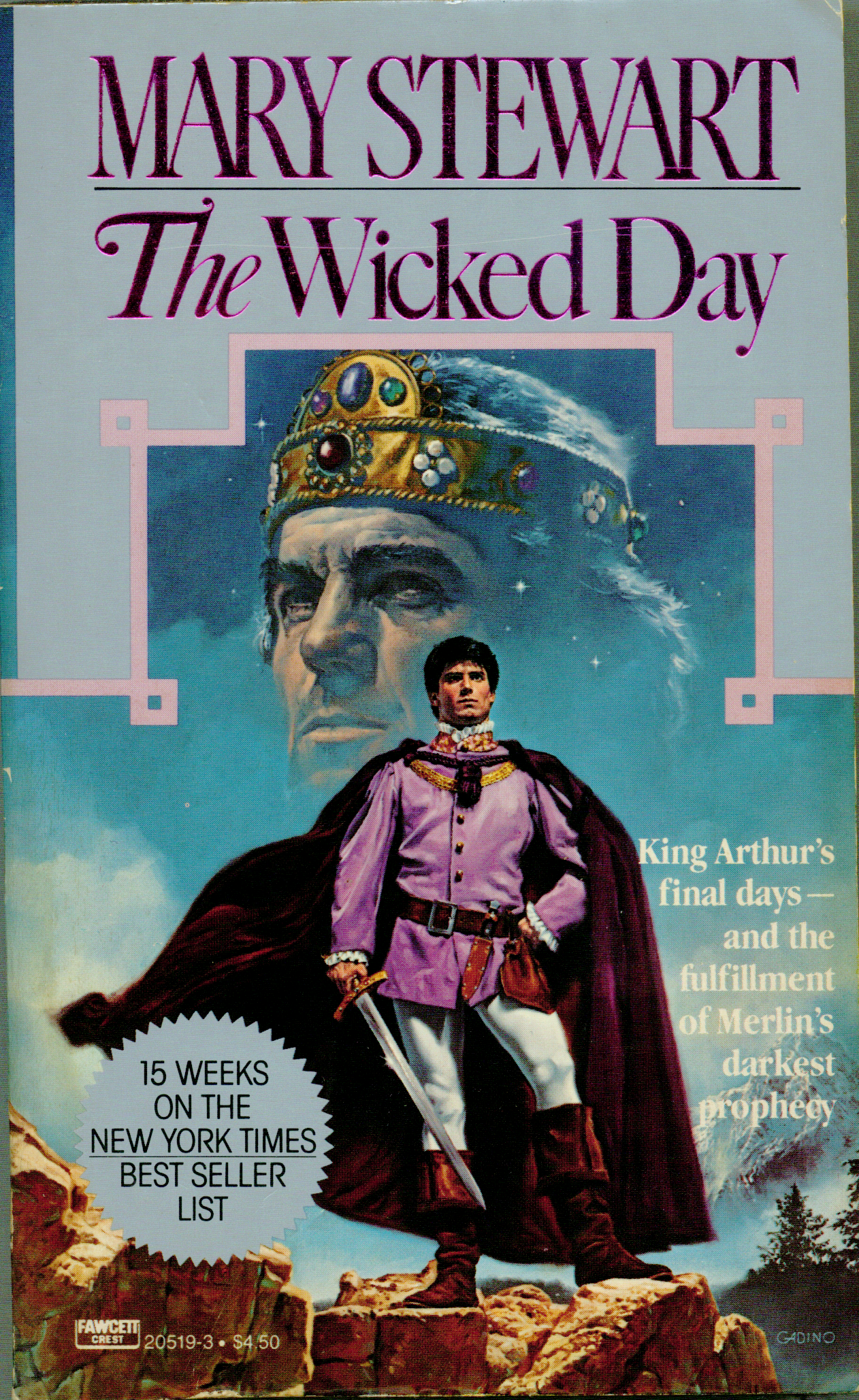
A scan of my own copy of The Wicked Day, by Mary Stewart, purchased back in 1983. (Click to embiggen)In the last two weeks I have written about the first three books in Mary Stewart’s Merlin series. The first three books are first-person narratives told from Merlin’s point of view, while the fourth book is told in third-person, mostly from both Mordred and Arthur’s points of view. Part this choice was necessitate by the fact that the crucial parts of Mordred’s story happen after the death of Merlin, so Merlin can’t narrate it. And if you’re familiar with the classic Arthurian legend, you know that both Mordred and Arthur die at the same time, so neither of them could be the narrator.
Even within the third-person narrative, Stewart shifts perspective. The opening of the book is told in an omniscient viewpoint, the narrator revealing the thoughts and feelings of all the characters. While the bulk of the book is subjective, in some chapters the reader is privy to Mordred thoughts but sees all the other characters through his eyes only. In other chapter’s we are in Arthur’s perspective. Then at the end, she moves t a more objective viewpoint, though not fully omniscient. Anyway, I’m spending so much time talking about this viewpoint stuff, which you might be inclined to think of as the mere mechanics of writing, because in a completely different sense, The Wicked Day is all about viewpoints. Several important plot points turn on the fact that one or more characters is operating on incomplete or completely mistaken understanding. And the theme is about perspectives…Continue reading Dark Prophecies and Evil Half-brothers – more of why I love sf/f→
I couldn’t find a nice large image of the same cover art as my copy on line, so spent a while trying to scan the gold paperback. The best image I got was this one, even though you can see my hands and iPhone reflected in the cover. (Click to embiggen)Last week I wrote about the first two books in Mary Stewart’s Merlin trilogy and how they became the standard against which I measure all Arthurian stories. The third and fourth books in the series came along some time later, and consequently influenced me in very different ways.
Before I get into that, I want to remind you that voting for the Hugo Awards ends tomorrow. If you are a Sasquan (WorldCon 2015) member and haven’t completed your ballot online, do it now before the servers get bogged down with the rush. The ballot is here. If you aren’t a member, you can still buy a supporting membership to become a voter, but since processing a membership might take a while as more traffic hits the servers, time is running out!
Sometimes it feels as if my whole life consists of defending why I like something. When I was a kid, I was frequently called up to justify why I preferred reading books to playing with other kids my age. Even the notion that reading was educational wasn’t enough to satisfy some people (many of them teachers). And heaven forfend that I should mention how many times “playing” with kids my age actually meant being bullied, harassed, and ridiculed non-stop! As I got older, the kind of books I liked became the issue. “Reading too much make-believe is unhealthy!1” or “Aren’t you a little old to believe in all the space hooey?2”
My copy of Bleak House looked a lot like this one.Of course, it wasn’t just the science fiction and fantasy that set people off. If I was caught reading a book about science fact, or the hardcover of Charles Dickens’ Bleak House my grandma bought me at a library sale, or my well-worn paperback of Homer’s The Iliad, it was more proof that I was an “over-educated freak4.”
When I finally escaped to college and met people who valued reading over sports, I thought that I had left all of that behind. Oh, how naive I was! According to these literati wannabes, my tastes were quite low brow. How could I possible understand the meaning of serious art and literature if I actually enjoyed Hitchhiker’s Guide to the Galaxy or The White Dragon or Harpist in the Wind or Midnight at the Well of Souls? Or even worse, I watched television!?
It’s easy to dismiss those latter examples as either snobbery or hipster-ism. Except I can be just as guilty of judging other people for liking things that I don’t.
Who am I kidding? I have been incredibly worse about this. When I think a particular book or series or movie or what-have-you is not just unlikeable, but very badly made, it will completely boggle my mind when someone I know actually likes it. And I seem to be absolutely incapable of hiding my incredulity. I frequently have to remind myself that sometimes what I think of as one of a particular work’s mediocre-but-not-awful parts might be someone else’s fiction kink. And by fiction kink I mean, it’s something they like or identify with so much that it can be a redeeming quality. Such a redeeming quality makes the parts some of us see as glaring shortcomings, merely a small price to pay to get the other thing.
Goodness knows I have my own favorite books, series, and movies that I know are flawed, but I enjoy them anyway because they contain a particular character dynamic, or a type of plot line, or use a particular combination of mythic tropes which appeal to me. I try to make the distinction between something that I don’t like for reasons of taste as opposed to something I don’t like for reasons of actual quality. It is a subjective judgement, but not an impossible one.
I got tired of finding myself having to defend my preferred reading material. Eventually, I was saved by Leo Tolstoy. Tolstoy, the Russian author of such great classic novels as War and Peace and Anna Karenina. I have to confess that I tried to read War and Peace at least a couple of times, and just failed to plough all the way through it. And failing to get through it was one of the things that made me wonder if those people who said my tastes were too low brow to understand great works of art were correct. But then, when a similar sort of discussion happened in one of my college literature classes, the instructor5 quoted a bit from Tolstoy’s nonfiction book, What is Art? I think it was this passage:
The assertion that art may be good art and at the same time incomprehensible to a great number of people is extremely unjust, and its consequences are ruinous to art itself…it is the same as saying some kind of food is good but most people can’t eat it.
—Leo Tolstoy
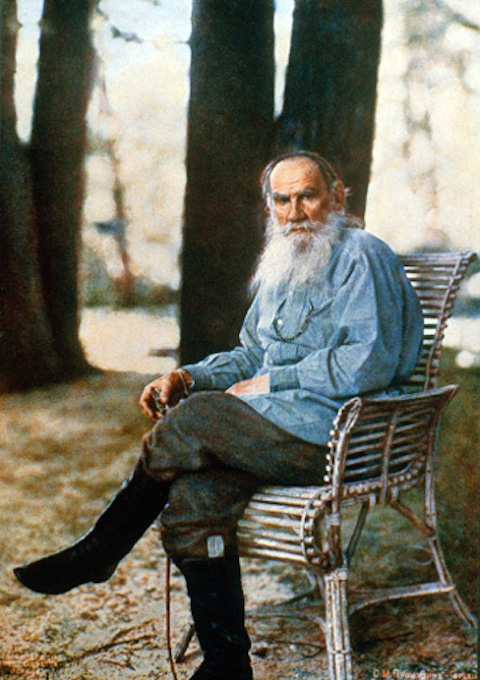
A portrait photograph of Tolstoy taken in 1908 by Sergei Prokudin-Gorsky, who had invented one of the early methods of color photography.Not long after that, I found a copy of the book in the library, which I wound up checking out and reading. There are a lot of Tolstoy’s arguments in the book which I don’t agree with. He had adopted, by the time he wrote it, a rather radical form of Christian anarchy. So he critiqued a lot of specific examples of art as being immoral in content—more often because he thought it promoted capitalism and classism than the sorts of things that get the modern religious right up in arms. He dissed Shakespeare and Dickens, for instance (though with a lot of caveats in Dickens’ case, since much of Dickens’ later work was critical of the dehumanizing effects of the industrial revolution).
Despite those parts of his thesis with which I still disagree, his arguments in favor of accessibility and sincerity in art helped me figure out that those literati wannabes had mistaken obscurity for superiority. They’ve fallen victim to the notion that if “ordinary” people enjoy something, it cannot possibly be high quality. If you define art by its difficulty to be comprehended, you’ve completely misunderstood what art is. That doesn’t mean that art can’t be challenging, but there is a difference between a piece that requires thought, afterthought, and re-visiting to tease out all the layers of meaning and something which hides its meaninglessness under layers of pretension.
Art is a human activity consisting in this, that one man consciously, by means of certain external signs, hands on to others feelings he has lived through, and that other people are infected by these feelings and also experience them.
—Leo Tolstoy
The way I usually try to sum up Tolstoy’s notion is: Art happens when the heart of the artist touches the heart of the audience, and the audience responds. The audience doesn’t have to like it; a piece of art that evokes intense dislike must be doing something right, or you wouldn’t feel so strongly about it. But art should never leave you unmoved.
Footnotes
1. The exact words said both to me (and later to my parents at a parent-teacher conference) by my seventh grade social studies teacher. He was not that only one who said things to that general effect.
2. The exact words said to me by a minister3 of another church who caught me reading during afternoon free time on a rainy day at Bible camp. Again, he was not the only person by any means to make similar comments about my penchant for both science fiction and science fact, particularly NASA.
3. Of course, this was the same preacher who thought it was funny, when teasing or disagreeing with a boy (he never would do such a thing to a girl, oh no!), to grab your pinkie, twist it into a stress position, and keep you there not only until you agreed with whatever he was trying to make you say, but that you cried sufficiently that he thought you had learned your lesson.
4. The favorite phrase one of my uncles like to use to describe me.
5. Several instructors quoted Tolstoy at me around this time. Another literature profession quoted the famous line, “All happy families are alike; each unhappy family is unhappy in its own way” but he completely misunderstood it. On the other hand, one of my mathematics professors quoted the exact same line, and then explained how the line was the perfect example of an important statistics concept. The concept is sometimes referred to as the Anna Karenina principle in honor of the Tolstoy novel from which the line comes. One way to think of the principle is this: in any system, there are a large number of ways that a given process can fail, and the only way to achieve success is to avoid every single possible failure. A successful outcome depends on every single requirement being met, whereas a single shortcoming in only one requirement can cause failure of the entire endeavor.
I’ve mentioned before that it’s my Mom’s fault that I am a fan of both science fiction and mysteries. From the time I was a baby, she would read aloud to me from whatever book she was reading (and when I got to the point I was trying to talk, she would cajole me into repeating back words and phrases and eventually whole sentences, which is how I learned to read at least a year before I was sent off to school). Since her favorite authors were Agathe Christie and Robert Heinlein, they made up a large proportion of what she read. But that’s a slight oversimplification. Because she read other books, too. The Christies and the Heinleins resonated with me in a way that the gothic romances she was also fond of did not. With one exception.
Mary Stewart wrote romances that weren’t always classified as romance. They were mysteries as well, and she integrated the two elements in a way where the solving of the mystery illuminated the character development as the characters fell for each other. So you’ll find some places classify her old books as thrillers, or mysteries, or romances, depending on the whims of the reviewer. Paperbacks my parents each bought tended to get taken back to used book stores to be traded in for store credit unless they were deemed worthy of multiple rereads. So there were only a couple of Stewart’s romances (most originally written in the 50s) that stayed on our bookshelves for years. One particular that I remember reading myself after pulling it off Mom’s shelf several times to look at the cover, was Stewart’s romance/thriller The Moon-Spinners.
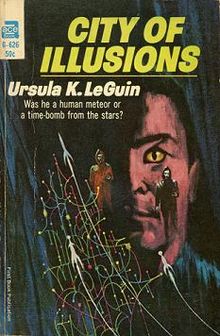
The cover of my paperback version is a bit more tattered than this image I found (Click to embiggen).I think I found my copy of Ursula K. LeGuin’s City of Illusions at the used book store that was in a town thirty miles away from the town I lived in for most of middle school. I know that I owned it before my folks split when I was 15. I don’t recall exactly where I acquired it, but I do know why I wanted to book: the character on the front of the cover had cat’s eyes, which I thought was really cool.
I don’t think this was the first sci fi novel I read that featured such a character. There are are so many sci fi books with characters that look mostly human, but have eyes like a cat or a bird of prey. But it was the eyes that really grabbed me.
The story begins with the man on the cover being found in the woods without any memory, not even a language, no clothes, and no clues as to who he is. The people who find him aren’t certain he’s human, because of the eyes, but they take him in, name him Falk, and teach him. We learn that this is Earth of a distant future, once part of an interstellar federation of some sort, conquered by aliens, and now severely de-populated and isolated from the rest of interstellar society. The aliens technically rule the world, but they keep to themselves in a single massive city.
Falk eventually sets out on a quest to try to discover who he is. This allows the author to show the reader other parts of the world before Falk finally is taken captive by the alien overlords who tell him he’s one of only two survivors of a crashed spaceship from another world. They introduce him to the other survivor, and offer to restore his memory—though it will mean erasing his current personality. Falk agrees, and the novel switches to the point of view of the restored personality, who doesn’t know what Falk knows about how the humans on earth are treated. The aliens want Falk to go back to his own people and tell them how they are running earth as a garden, keeping the humans happy.
Eventually the original personality is able to awaken Falk’s memories, which also means that he winds up with two personalities trying to work together.
I’ve left out an important detail: just about everyone seems to be telepathic, Falk, all the humans he meets, and the aliens. Telepathy was how the old Federation came to be, because no one can tell a lie in psychic communication. Except it turns out the alien invaders can. Falk and the restored original personality realize the aliens aren’t going to let him go if he remembers the truth about Earth, so he has to steal a spaceship and escape to his homeworld where he may be able to convince them to attempt to liberate Earth. There’s a cute telepathic trick that Le Guin uses at a crucial point in the climax, and the story ends on wit Falk on his way to his homeworld, but without the certainty that Earth will be liberated.
The novel straddles several categories of science fiction. The world is a post-apocalyptic world, even if the apocalypse happened a thousand years ago and a new, stable set of societies have developed. There’s also the aliens subjugating humans genre. And the isolated protagonist who has to discover who he is.
The novel is one of three loosely connected books (the others being Rocannon’s World and Planet of Exile) in which Le Guin was working out a single future history, in which humans have been seeded on many worlds, and they have diverged in various ways, but still consider themselves one race. This is where it encompasses another idea that was more popular in Golden Age science fiction: humans aren’t native to Earth, but were seeded there hundreds of thousands of years before our time.
Some of her much more famous later books, The Left Hand of Darkness, The Dispossessed, and The Word for World is Forest are sequels, in a sense, to these books. They all allude to the common history of these three, in any case, so a lot of people lump them all (along with a few others and some short stories) into a single saga called The Hainish Cycle. Le Guin herself has rejected the label, in part simply because the collective works don’t tell a single story. Another reason is that in the first three books she was trying to figure out how to do a future history, rather than having drafted a coherent future history as a grand backstory to it all. So there are contradictions and variances in the histories of all the books.
The City of Illusions is one of those stories that sticks with me in weird ways. I remember Falk, his struggle to discover himself, and especially the way that Le Guin portrays the two people living inside one head phenomenon at the end. I remember the notions and paradox of telepathic lying. But I forget things like what the aliens are like. I forget what any of the other human societies that Falk visits during his adventures are like. That’s not a bad thing. The story is, on one level, about isolation and discovery. And that part really resonated for me at that age. Some of her other ideas from this book I find myself incorporating into my own stories without consciously realizing where they came from. Which I think means that Le Guin conceived them and executed them well: they’ve become part of the fabric of how I think things would actually work.
Years later, I have read many other Le Guin books, and I own her translation of the Tao Te Ching, a holy book that figures in this novel’s plot. Which I think means that once I finish reading this last Hugo novel, I need to add City of Illusions to this year’s queue for a re-read.
Another in my series of posts recommending web comics:
Caterwall by Spain Fischer Caterwall is the story of Pax, who is the orphaned son of a knight who was the hero of the kingdom, and his best friend Gavin, who is the descendant of a line of seers. Pax is a young man who has a reputation for pulling pranks and telling lies, who gets exiled from the kingdom. Gavin joins him in exile. I like the story and really like the artwork. It’s just so cheerful and cute, even when grim things are happening. Caterwall is a graphic novel, the first 25 pages are available on the web site. The first book has recently been published and is available for purchase here.
I have recommended “Mr. Cow,” by Chuck Melville many times before. A clueless cow with Walter Cronkite dreams presides over a barnyard of a newsroom. But I need to update the recommendation because the comic has moved to a new site. The old Web Comics Nation site died without notice (literally), stranding several artists and leaving no way for them to post pointers from their old URLs to their new homes. Chuck has found Mr. Cow a new home on Comic Fury: mrcow.webcomic.ws. His other comics have also been moved to the new host: Champions of Katara and Felicia, Sorceress of Katara. If you like Mr. Cow, Felicia, or Flagstaff (the hero of Champions of Katara) you can support the artist by going to his Patreon Page. Also, can I interest you in a Mr. Cow Mug?
I’m a big fan of (and have previously recommended) “Deer Me,” by Sheryl Schopfer. This artist is also a friend. I have previously described this strip as: “Three roommates who couldn’t be more dissimilar while being surprisingly compatible.” Except in a recent story line Thomas has moved out! Eeek! After a storyline that took us back to the high school days of some of the characters, the storyline has returned to “the present day” where various consequences of the Thomas’s moving out are coming to pass. While checking the links, I realized that my older recommendations for this comic linked to a specific strip on the artist’s art blog, rather than the main comic URL (DeerMe.Net), and she’d moved her blog to a new host, so those links don’t work anymore. So, I’m updating and re-recommending. In any case, if you enjoy Deer Me, you can support the artist by going to her Patreon Page!
Some of the comics I’ve previously recommended:
And I love this impish girl thief with a tail and her reluctant undead sorcerer/bodyguard: “Unsounded,” by Ashley Cope.
The Young Protectors by Alex Wolfson begins when a young, closeted teen-age superhero who has just snuck into a gay bar for the first time is seen exiting said bar by a not-so-young, very experienced, very powerful, super-villain. Trouble, of course, ensues.
If you want to read a nice, long graphic-novel style story which recently published its conclusion, check-out the not quite accurately named, The Less Than Epic Adventures of T.J. and Amal by E.K. Weaver. I say inaccurate because I found their story quite epic (not to mention engaging, moving, surprising, fulfilling… I could go on). Some sections of the tale are Not Safe For Work, as they say, though she marks them clearly. The complete graphic novels are available for sale in both ebook and paper versions, by the way.











 Font Folly