Tag Archives: things I like

Sunday Funnies, part 20

Another in my series of posts recommending web comics that I think more people should read:

© Brian Gordon
© Brian Gordon
Fowl Language by Brian Gordon is a fun strip about parenting, tech, science, and other geeky things. I’m a bit late to come to the Fowl Language party. I first leaned about the strip a couple of years ago, shortly after the artist posted the strip called Princess Costume. People were sharing it on twitter and on their blogs and it was funny and wonderful and sweet. I also like that fact that on the one year anniversary of this particular strip, the artist reposted a like to it saying, “This made a bunch of folks mad last year when I posted it…so here it is again. 😉” The strips are funny, and he also has a bonus panel link to click on under the day’s strip. You should check it out!

And if you like his work and want to support him (and his kids), he has t-shirts and other goodies for sale and a book available at many online sellers.


Some of the comics I’ve previously recommended:

mr_cow_logo
“Mr. Cow,” by Chuck Melville tells the tale of a clueless cow with Walter Cronkite dreams. If the twice-weekly gags about a barnyard of a newsroom aren’t enough excitement for you the same artist also writes and draws (and colors!) some awesome fantasy series: Champions of Katara and Felicia, Sorceress of Katara. If you like Mr. Cow, Felicia, or Flagstaff (the hero of Champions of Katara) you can support the artist by going to his Patreon Page. Also, can I interest you in a Mr. Cow Mug?

dm100x80“Deer Me,” by Sheryl Schopfer tells the tales from the lives of three friends (and former roommates) who couldn’t be more dissimilar while being surprisingly compatible. If you enjoy Deer Me, you can support the artist by going to her Patreon Page!

The logo for Scurry, a web comic by Mac SmithScurry by Mac Smith is the story of a colony of mice trying to survive a long, strange winter in a world where humans have mysteriously vanished, and food is becoming ever more scarce.

title
And I love this impish girl thief with a tail and her reluctant undead sorcerer/bodyguard: “Unsounded,” by Ashley Cope.
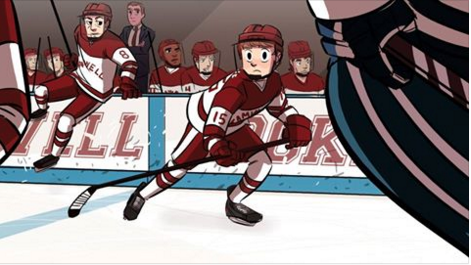
Screen Shot 2016-03-12 at 3.18.45 PMCheck, Please! by Ngozi Ukazu is the story of Eric “Bitty” Biddle, a former junior figure skating champion from a southern state who is attending fictitious Samwell College in Massachusetts, where he plays on the men’s hockey team. Bitty is the smallest guy on the team, and in the early comics is dealing with a phobia of being body-checked in the games. He’s an enthusiastic baker, and a die hard Beyoncé fan.

Screen Shot 2015-08-02 at 5.36.43 PMMuddler’s Beat by Tony Breed is the fun, expanded cast sequel to Finn and Charlie Are Hitched.

The_Young_Protectors_HALF_BANNER_OUTSIDE_234x601The Young Protectors by Alex Wolfson begins when a young, closeted teen-age superhero who has just snuck into a gay bar for the first time is seen exiting said bar by a not-so-young, very experienced, very powerful, super-villain. Trouble, of course, ensues.

Caterwall by Spain FischerCaterwall by Spain Fischer is the story of Pax (the orphaned son of a knight who was the hero of the kingdom) and his best friend Gavin (the descendant of a line of seers). Pax is a young man who has a reputation for pulling pranks and telling lies, who gets exiled from the kingdom.

3Tripping Over You by Suzana Harcum and Owen White is a strip about a pair of friends in school who just happen to fall in love… which eventually necessitates one of them coming out of the closet. Tripping Over You has several books, comics, and prints available for purchase.
The Junior Science Power Hour by Abby Howard logo.The Junior Science Power Hour by Abby Howard. is frequently autobiographical take on the artist’s journey to creating the crazy strip about science, science nerds, why girls are just as good at being science nerds as boys, and so much more. It will definitely appeal to dinosaur nerds, anyone who has ever been enthusiastic about any science topic, and especially to people who has ever felt like a square peg being forced into round holes by society.

12191040If you want to read a nice, long graphic-novel style story which recently published its conclusion, check-out the not quite accurately named, The Less Than Epic Adventures of T.J. and Amal by E.K. Weaver. I say inaccurate because I found their story quite epic (not to mention engaging, moving, surprising, fulfilling… I could go on). Some sections of the tale are Not Safe For Work, as they say, though she marks them clearly. The complete graphic novels are available for sale in both ebook and paper versions, by the way.

NsfwOglaf, by Trudy Cooper and Doug Bayne is a Not Safe For Work web comic about… well, it’s sort a generic “medieval” high fantasy universe, but with adult themes, often sexual. Jokes are based on fantasy story and movie clichés, gaming tropes, and the like. And let me repeat, since I got a startled message from someone in response to a previous posting of this recommendation: Oglaf is Not Safe For Work (NSFW)!

Thank you, Mr. Wilder

Gene Wilder, Gilda Radnor, and Dom DeLuise on the poster for Haunted Honeymoon. The poster art copyright is believed to belong to the distributor of the film, Orion Pictures, the publisher of the film or the graphic artist.
Gene Wilder, Gilda Radnor, and Dom DeLuise on the poster for Haunted Honeymoon. The poster art copyright is believed to belong to the distributor of the film, Orion Pictures, the publisher of the film or the graphic artist. (Click to embiggen)
For many years, Haunted Honeymoon has been my go-to movie for fixing a bad mood. Written, directed, and starring Gene Wilder (along with Gilda Radner, Dom DeLuise, and Jonathan Pryce), it is a silly thrilling tale set in the 1930s. Radio actors Larry Abbott and Vicky Pearle are the stars of the wildly successful Manhattan Mystery Theatre and are engaged to be married, but Larry’s recent erratic behavior has their sponsor ready to cancel the show. Larry’s uncle, Paul Abbott is a “famous psychiatrist” who claims that Larry’s recent engagement had opened a crack in Larry’s mind which can only be cured by forcing Larry to confront his worst fears—to scare him “to death.” Which he’s going to attempt to do while the entire Abbott family is gathered at the country estate of their Great-aunt Katherine.

Aunt Kate (played hilariously by Dom DeLuise in drag), meanwhile, has recently changed her will so that Larry inherits everything. Unless Larry predeceases her, at which point the inheritance goes to all the other Abbotts equally. And someone is stalking Kate’s home in a cheesey werewolf mask, and has already killed one person…

I can’t explain why the show works so well for me. Is it the banter and onscreen chemistry between Gilda and Gene (this was the last movie they made together; mysterious pain she kept feeling during filming was later diagnosed as the ovarian cancer that eventually killed her)? Is it Dom’s hysterical performance as Aunt Kate? Especially the song and dance number Kate and Vicky perform in the music room after dinner? Is it Jonathan Pryce’s delicious performance as the slightly sleazy cousin Charlie? Or Eve Ferret’s vampy turn as Charlie’s girlfriend (and Larry’s ex-) Sylvia?

I don’t know. But I love the movie. My husband always makes certain that we have a copy on more than one of our computers when we go on long trips, in case I wind up in a dismal or vicious mood because things go awry.

Last night I watched it, and I enjoyed it as always. But for the first time I was crying at the end. Because yesterday the world learned that Gene Wilder had died the night before.

I love other movies Gene made. I was ten years old when Willy Wonka and the Chocolate Factory came out. The town we lived in at that time didn’t have a movie theatre. But a mere thirty miles away, just over the border in neighboring Colorado, my grandparents lived in a town that did have a theatre. And I and my sister and Mom all went to see the movie along with my paternal grandmother one summer evening. I loved it, of course. I had read book, Charlie and the Chocolate Factory a couple of years previously. I remember early on in the movie thinking that they weren’t following the book very faithfully. But once Wilder came out and started playing the mad, bewildering Willy Wonka, I decided that the movie got it right.

I don’t watch this movie as often. Although many people love Wilders’ Willy Wonka even more than I do, my husband had a very different reaction to the film as a child. It gave him nightmares—severe enough that he just can’t watch the show even now as an adult.

And of course I re-watch Young Frankenstein at least once a year. Quoting along and laughing throughout. It’s a brilliant comedy and parody.

The only other of his films I currently own is Blazing Saddles which I hadn’t watched in a long while, so I watched it as well, last night. Gene was good in that, though with not nearly as much screen time as I’d have liked.

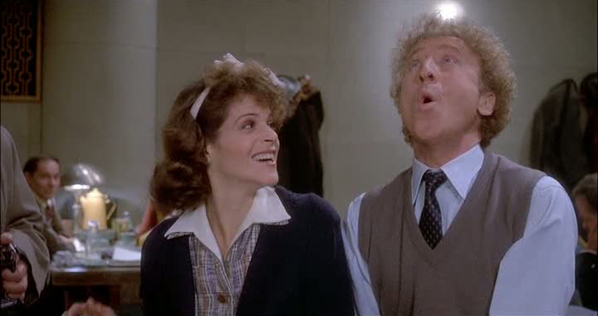
Gilda and Gene from a scene early in Haunted Honeymoon. Gene is literally "awoo"-ing in this one.
Gilda and Gene from a scene early in Haunted Honeymoon. Gene is literally “awoo”-ing in this one.
I love Gene isn so many of his roles: Willy, Dr. FRON-ken-STEEN, Larry, the Waco Kid… We have his movies to enjoy again and again. And we need to remember the sentiment his family expressed in their official announcement, along with the explanation for why Gene didn’t publicly reveal his health problem: he couldn’t stand the thought of even one less smile in the world. He put many smiles into the world. And yes, many of us shed some tears yesterday, but I know re-watching his movies will bring smiles and laughs instead of tears again. Just not today.

Metallic Rodents and Secret Agencies: more of why I love sf/f

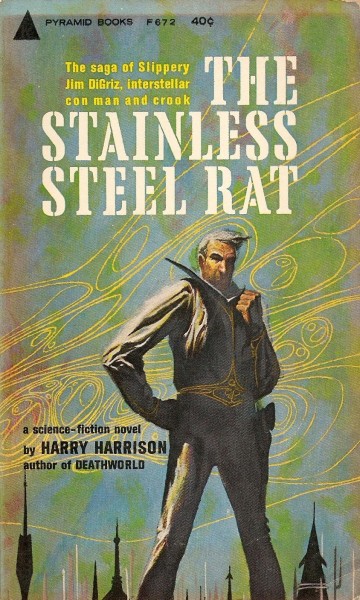
The 1961 paperback edition of The Stainless Steel Rat, cover art by John Schoenherr
The 1961 paperback edition of The Stainless Steel Rat, cover art by John Schoenherr (click to embiggen)
I was in middle school when I found a copy of Harry Harrison’s The Stainless Steel Rat in a pile of cheap used books for sale. It was missing the front cover, which I didn’t know at the time probably meant it had been stripped. When a bookstore decides that a book has been sitting on the shelf too long and isn’t going to sell, their distribution contract usually allows them to destroy the book without selling it and get a refund from the publisher. To prove that they’ve destroyed the unsold copies, the store is required to send back the covers from each book destroyed. Shipping back just the cover was cheaper than shipping entire books. This is why many books carry a warning on one of the opening pages that if the book is sold without a cover, it is considered stolen property. (Hardbacks usually are not destroyed, as they will be remaindered, specifically sold at super cheap prices at certain chain stores.)

I didn’t know that at the time. I just knew that whenever damaged books showed up at the used book store, they were sold for a lot cheaper than the others.

If my first copy of The Stainless Steel Rat was a stripped copy, it is highly appropriate, because the star of the book (and its many sequel), was Slippery Jim DiGriz, the slickest conman and thief of the 346th Century.

DiGriz lived in an interstellar society with very high technology that made it nearly impossible for petty criminals to escape prison and “psycho surgery” for long. It took a special kind of criminal to thrive in that society. As the blurb on most of the paperback versions said:

“We must be as stealthy as rats in the wainscoting of their society. It was easier in the old days, of course, and society had more rats when the rules were looser, just as old wooden buildings have more rats than concrete buildings. But there are rats in the building now as well. Now that society is all ferrocrete and stainless steel there are fewer gaps in the joints. It takes a very smart rat indeed to find these openings. Only a stainless steel rat can be at home in this environment.”

The book’s written from first person narrative, beginning while Jim is in the middle of yet another insanely daring robbery. Things start going wrong, of course, and it isn’t too many pages in before Jim realizes that the dreaded Special Corps is onto him. The Special Corps is a shadowy agency that was responsible for catching one of the greats, a thief DiGriz admired from affair, Inskipp the Uncatchable… so, of course, when Special Corps hauls DiGriz in to be interrogated by the head of operations, it turns out it’s Inskipp himself. And he has a deal for DiGriz, the same deal Inskipp was offered years ago when he was captured: join the Corps and help catch dangerous criminals, or have his brain altered…

DiGriz was chosen, just as Inskipp was, because DiGriz always planned his heists to very carefully avoid causing and physical harm to any people involved. A few of his previous operations he had even abandoned the heist when it became clear that complications had put people in danger. DiGiz’s first assignment (and the rest of the book) is to try to catch a serial killer.

But this isn’t like a gritty modern bloody serial killer story. The book is written as a light caper, with comedic bits. So the book was a romping adventure story, and far more concerned with the puzzle aspects. The character arcs and interaction are the focus, along with some humor.

It wasn’t just humor. The story explored issues of identity, free will, and what does it mean to be a member of a social species. Jim had always been careful not just to avoid hurting people, but he also always picked targets that were fully insured. He rationalized his existence as providing entertainment or spectacle. He kept security people and police on their toes and in practice. At least that’s what he told himself. Buried in that, along with his eventual confrontation with the killer, were also serious questions about privacy vs security, and control vs freedom.

So it made me think about many things. At different times in the narrative, I found myself agreeing with Jim more than I thought I would. And as I read the book again and again (because it was yet another one that I re-read many times), I found my sympathies seesawing back and forth as I considered the questions. The Special Corps protecting people from sometimes quite serious threats, but they operated in almost complete secrecy, and apparently answered only to themselves.

On the other hand, they had a number of agents like Slippery Jim, who broke ranks from time to time, and demonstrated a willingness to take down the agency if it went too far. Was that enough of to balance things out? In a real world, probably not. And it’s the kind of question still very relevant today.

In my later teens I found the sequels, and after I enthused about them to friends, someone bought me a shiny new copy of the first book for my birthday. The first few sequels cover the next several years in the life of Special Corps (occasionally rogue) Agent DiGriz… and his wife, and their eventual children. Then in 80s Harrison wrote some prequels, showing us events in the life of young Slippery Jim, how he learned his craft and became a legendary thief.

Harrison returned to the older DiGriz for the rest of the series, writing 12 Stainless Steel Rat books total before his death (the last one published posthumously). The Stainless Steel Rat wasn’t the only multibook series the Harrison wrote, but Slippery Jim was the first of his books that I remember reading, and the likable, extremely smart, and capably rogue is a character type that I became very fond of.

The book gave me another way to wrestle with the idea of my own identity. Harrison argued colorfully but persuasively for the idea that the law and customs aren’t always right. Morality and ethics have to come from a sense of empathy and a willingness to do right by people. And those were notions that gave me some more hope, as a closeted queer kid growing up among fundamentalists.

Skillful Men of the Medical and Chirurgical Profession – more of why I love sf/f

Nathaniel Hawthorne wrote The Scarlet Letter in 1850.
Occasionally I find myself in the position of having to defend labeling some books or movies or television shows as being part of the science fiction/fantasy genre. For instance, a few years ago, during the early seasons of Person of Interest, someone said I shouldn’t call it sf because it was just an action adventure with a computer. But the Machine (which is the only name they ever give it) isn’t a computer, it is an artificial intelligent program that runs on many machines and is able to correlation data from many feeds and accurately predict people who are going to be victims or perpetrators of serious crime. That’s science fiction. Particularly when it is discovered the Machine has found ways to bypass some limits imposed on it by it’s designers, and even arranges to have a new cluster of computers set up in a new location and transmits itself there, and then has its old location dismantled so that people who know about it can’t destroy it—well that’s exhibiting freewill and more! (Things get really interesting in later seasons when a second, less benevolent AI is introduced)

Similarly, I’ve seen people argue that The Green Glass Sea by Ellen Klages isn’t really science fiction because it’s a historical novel set in 1943 telling a coming-of-age story of an 11-year-old girl growing up in Los Alamos where her father works on the secret project to build an atomic bomb. Whereas I think the nerdiness of a girl in the 1940s who is building her own radio from parts salvaged at the junk yard, combined with the way the novel explores how the government’s pursuit of this new technological advantage uproots children and disrupts their lives (exploring how new technologies impact society and people in nonmaterial ways has long been a significant part of sf), more than qualifies it.

But the granddaddy of all sf/f novels that people don’t realize is science fiction has got to be Nathaniel Hawthorne’s The Scarlet Letter.

I can hear you protesting, “But the Scarlet Letter is a Gothic morality tale about Puritan scandal and consequences and forgiveness set in the Massachusetts Bay Colony that they made us read in school. It can’t possibly be science fiction!” That just means you aren’t looking at it from the perspective on 1850, when it was written. Your argument that it isn’t sci fi is similar to someone saying, “Twenty-Thousand Leagues Under the Sea isn’t sci fi because supermarines are real!” Submarines didn’t exist when Verne wrote his story of Captain Nemo and his fantastic undersea ship powered by a mysterious electric force.

Similarly, in the Scarlet Letter the character of Chillingsworth (who is secretly the long lost husband of poor Hester Prynne who is saddled with the shame of having had a baby born too long after the presumed death of her husband to be legitimate) is a great example of a science fictional mad scientist. His methods of subtle torture as he secretly experiments on Reverent Dimmesdale (while pretending to be trying to cure his illness) was very science fictional. There are no herbs known that will “corrupt the soul” as the text colorfully describes it. Certainly nothing that would force a man’s greatest fears and secrets to manifest as physical scars that spell out his greatest sins on his flesh!

When described that way, people think of Chillingsworth’s “dark medicine” as some kind of magic, like B-movie depictions of voodoo or the like (complete with colonial cultural misappropriation, but I’ll get to that). But when Hawthorne wrote it, he meant it as what we would today call science fiction. He and many other educated people at the time believed that the sorts of effects he described could be accomplished by the proper application of chemistry and biology, we just didn’t know how, yet!

Just as many scholars refer to Mary Shelley as the either the mother or grandmother of science fiction (never forget: the author of Frankenstein was a teen-age girl who wrote a story which invented sci fi on a dare in 1818), they also sometimes refer to Hawthorne as the grandfather of sci fi. Hawthorne’s more obviously sci fi type stories, such as “Rappacinni’s Daughter,” “The Artist of the Beautiful,” or “Dr Heidegger’s Experiment” usually featured a mad scientist type character, rushing in to the dark corners of the universe where angels and sensible people hesitate to tread. But his more famous bits of gothic tragedy also have these elements. The House of Seven Gables has a hypnotist and posits a notion of inherited sin—that committing particularly heinous acts will warp you in ways that will somehow be passed on to your children. If science had known of the mechanism of DNA at the time when Hawthorne wrote, he surely would have had some learnéd person in the narrative talk about the theory of corrupted chromosomes, for instance.

Which brings us back to The Scarlet Letter, and the medical experiments that Chillingsworth secretly subjects Dimmesdale to as part of a plan to exact revenge on the man.

The Scarlet Letter was unusual in Hawthorne’s time for feature a female protagonist. And even more, for portraying the fallen woman as a sympathetic character, more worthy of the reader’s love and respect than any of those who stand judgment over her (and her child). Especially more worthy that her long missing husband, who instead of proclaiming his identity upon returning, forgiving his wife Hester for doing what she had to do to survive while he was off studying herbs and potions with vaguely described Native Americans, and raising Pearl as his own child, embarked on a truly mad plan to exact revenge on the father of Hester’s child.

I saw movie adaptations of The Scarlet Letter before I read the book. A copy of the book was part of a set of classics that a relative had given me for a Christmas present, but I didn’t try to read it until after watching one of the movies on TV. When I did, I found a lot of the contents had been glossed over in the movie. The movie made Chillingsworth’s actions seem more like just some slow acting poison, whereas the book made it clear Chillingsworth was doing something far more subtle and medically revolutionary.

Meanwhile, Hester refused to give in to the public shaming, but to sew her own scarlet letter A on her clothing and support herself by sewing. She also tends to the sick and destitute in the community, so much so that many begin to say that the A she wears doesn’t stand for Adulterer, but Angel and Able. That was a revolutionary idea: that a woman could take her destiny in her own hands and assert her independence. It was radical in 1850 when Hawthorne wrote it, and it would have been even more revolutionary in the mid-seventeenth century when the action of the novel is set.

The Scarlet Letter painted a portrait of how someone shunned and ostracized by their community–even someone condemned by the religious leaders–could be a noble and good person, contributing to society and ultimately rising above the false morality of that community. That was an important lesson for this queer kid growing up among Baptists and rednecks.

Lost Friends in the Dreamlands – more of why I love sf/f

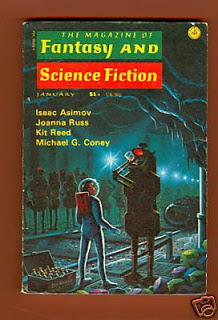
My Boat by Joanna Russ was published in Fantasy And Science Fiction Magazine, January 1976, cover by David Hardy.
“My Boat” by Joanna Russ was published in Fantasy And Science Fiction Magazine, January 1976, cover by David Hardy. (click to embiggen)
By January of 1976, I was midway through my freshman year in high school, living in a tiny town in northwestern Colorado. My parents had been separated for a few months and their divorce was underway. My physically and verbally abusive father wasn’t living with us any more, which was a plus, but everything from our finances to our daily routines were far less certain and predictable. I had had a big break-up of my own that no one knew about—because we were both extremely closeted boys in a very redneck town so of course we had been keeping it a secret. And another boy who had been one of my most consistent bullies throughout middle-school had recently coerced me into an even more covert non-consensual relationship. So to say my life at the time was a bit of a nightmare would not be inaccurate.

I still had a subscription to The Magazine of Fantasy and Science Fiction, thanks to my grandparents, and each time a new issue arrived in the mail, I would retreat to my room with it and stay up way past my bedtime devouring every page. These were the circumstances under which I first read the short story, “My Boat” by Joanna Russ… Continue reading Lost Friends in the Dreamlands – more of why I love sf/f

Asymptotic identities and contradictory infinities – more of why I love sf/f

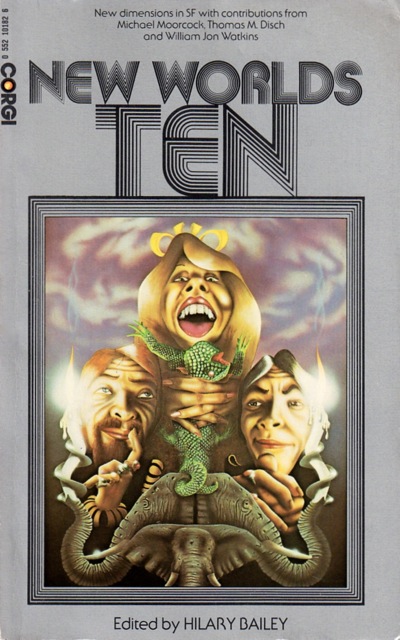
New World Ten, published August 1976. Cover artist not credited and no signature visible.
I first read “The Cabinet of Oliver Naylor” by Barrington J. Bayley in a used paperback copy of the The 1977 Annual World’s Best SF edited by Donald Wolheim that I bought in either late ’77 or early ’78, though it was originally published in New Worlds (sometimes titled New Worlds Quarterly, though they never managed to published more than twice a year), a magazine founded in 1964 by Michael Moorcock, borrowing a name from a sci fi zine that had originally been published in Britain from 1936 through 1963. Moorcock meant the magazine to focus more on experimental writing. It became the birthplace of the New Wave of sf.

None of which I knew when I read Bayley’s story. I was an American high school student whose exposure to sci fi had been dictated by what was available in libraries of various small towns and the pages of U.S. magazines such as Galaxy or The Magazine of Fantasy and Science Fiction.

“The Cabinet of Oliver Naylor” is a novella about a man living in a future where many technologies we would think of as impossible are commonplace. He is flying a personal craft at the velocity of c raised to the 186th power while fiddling with an invention of his own which he hopes will lead to the solution to a problem his society hasn’t yet tackled. He is accompanied by a sort of hitchhiker named Watson-Smythe who is trying to find an artist named Corngold.

Naylor’s invention is a thespitron: a device that constructs stories from all of the possible elements of fiction. Not just stories, it creates virtual worlds inhabited by beings that may be independently intelligent. The problem Naylor is hoping to solve with his experiments is navigation. In Naylor’s time it has been discovered that reality is far bigger than believed in the 20th century: the width of what we think of as the entire universe is simply a unit of measure for this reality. With those distances, the speeds at which advanced civilizations can move, and the fact that reality itself is expanding and changing while they’re zipping around at these impossible speeds means that no form of navigation is reliable. The very fabric of space changes between one’s origin and destination, so from time to time ships become lost.

Naylor has a theory that reality isn’t defined by matter, but by abstract concepts and relationships. He’s convinced if he can truly understand the nature of identity, how objects and beings relate to each other, such as in the structure of stories, that he can create a formula or algorithm to reliable rediscover any unique object one has observed before.

Which is all very cerebral and surreal compared to Watson-Smythe’s quest to find the artist. They do find the artist, his ship seemingly stranded on the edge of a vast stretch of unreality they call a matterless lake. At which point it’s revealed that Watson-Smythe is a government agent out to arrest Corngold, and that Corngold’s model is actually a victim of rape and kidnapping.

What happens next is in some ways far too predictable. When I first read it as a teen-ager I was rather angry that I saw what was going to go horribly wrong before it did, and couldn’t believe an interstellar spy would be stupid enough to fall for it. Even the dippy overly philosophical inventor, Naylor, should have seen it coming, I felt. I was also confused as to why the model/kidnap victim/rape victim seemed completely passive and apparently too afraid, even when essentially a cop arrives ready to rescue her, to do anything against her captor.

Re-reading it more recently, I was even more irritated when I realize that the author gives literally zero lines of dialog to the only woman in the story. Even while she is being abused in front of the officer who supposedly is there to arrest her assailant, the author tells us what she does, but doesn’t let her speak. It’s not that the author says she’s mute. No, the author says that she “responds noncommitally.”

Despite being frustrated with the story, I found a lot of it fascinating. The far future technology, which includes the ability to synthesize any matter one can name from a sort of quantum blob and back again when no longer needed, reminded me a lot of the Culture series by Iain Banks. So when I was reading up on Barrington J. Bayley, I wasn’t surprised to learn that Banks was one of the younger authors who listed Bayley as an influence on his work.

I was also not terribly surprised to find Bayley’s work described as gloomy and downbeat, which this story certainly was. While looking through the list of novels and short stories Bayley had published during his life, I was a bit surprised at how few titles I recognized. I think that this story is the only one of his that I’ve ever read.

While it isn’t a very satisfying read, I can’t say that it’s a bad story. It kept my attention and made me keep turning pages wondering how it would end. Admittedly, part of that was trying to figure out how the author would pull an interesting ending out of this mix of weird characterization and convoluted philosophy and mess of a plot. The story made me want answers, and it made me think about what clues I might have missed.

Is Bayley intentionally making the characters do stupid, and predictable things, to make a point about the reality of Naylor’s world and the unreality of his invention’s constructed worlds? I’m not sure. The intentions of the New Wave writers were to experiment by breaking the established rules of writing and try to find a new way to tell and experience stories. I do have to agree with Donald Wolheim’s comment in the introduction of this story in the anthology: this story crams more science fiction concepts and ideas into it’s novella length than many whole series of novels contain.

And maybe that piling up of ideas without a clear cut answer to any of the questions the central character raises is the point. Sci fi is supposed to be the genre of ideas, after all. And this tales serves up a whole lot!

Sunday Funnies, part 19

Another in my series of posts recommending web comics that I think more people should read:

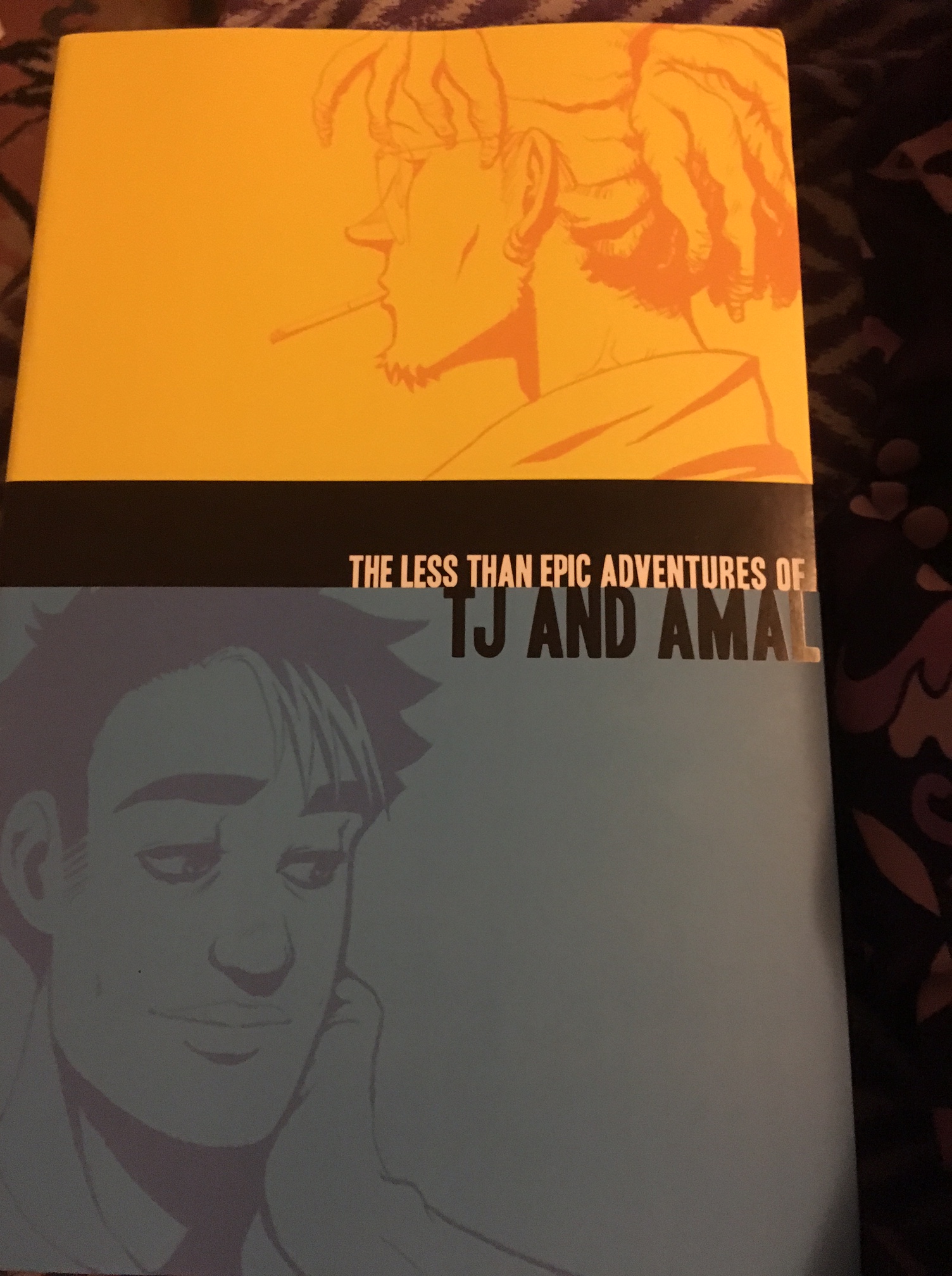
My copy of the paper book collecting the entirety of TJ & Amal's adventure that is, despite the title, quite epic!
My copy of the paper book collecting the entirety of TJ & Amal’s adventure that is, despite the title, quite epic!
First, I have recommended many times The Less Than Epic Adventures of T.J. and Amal by E.K. Weaver, which is a long and completed story that is extremely good. The artwork is amazing, the characters are engaging, and the story is just wonderful. I mean seriously, just go look at the first several comics on the website and see how much she conveys without a single word of dialog or narration!

I am writing about this great comic again because just last month there was some awesome news about it that I totally missed. The paper version of the complete The Less Than Epic Adventures of T.J. and Amal won the Lamba Literary Award for best LGBT graphic novel! Congratulations to E.K. Weaver! Your story totally deserved it!

The first panel of the http://chainsawsuit.com/comic/2016/07/07/all-houses-matter-the-extended-cut/ comic. You should go read it!
In less wonderful news, because of yet more deaths of black men at the hands of police in circumstances that anyone who watches the video and has an ounce of sense would agree would get the gunman convicted of murder in a rational society, a lot of people are trotting out angry arguments against the Black Lives Matters groups that really make no sense if you have any context at all. Fortunately, Kris Staub explains why All Lives Matter doesn’t mean what they think it means in cartoon from: all houses matter: the extended cut. Political commentary aside, Chain Saw Suit by Kris Staub is another one of these comics that I don’t have to remember to go check, because a few times a month someone shares a link on social media, I go read the linked comic, and then I read the others that have been published since I last read one. They’re usually not political, but just funny commentary on the eccentricities of being human.


Some of the comics I’ve previously recommended:

mr_cow_logo
“Mr. Cow,” by Chuck Melville tells the tale of a clueless cow with Walter Cronkite dreams. If the twice-weekly gags about a barnyard of a newsroom aren’t enough excitement for you the same artist also writes and draws (and colors!) some awesome fantasy series: Champions of Katara and Felicia, Sorceress of Katara. If you like Mr. Cow, Felicia, or Flagstaff (the hero of Champions of Katara) you can support the artist by going to his Patreon Page. Also, can I interest you in a Mr. Cow Mug?

dm100x80“Deer Me,” by Sheryl Schopfer tells the tales from the lives of three friends (and former roommates) who couldn’t be more dissimilar while being surprisingly compatible. If you enjoy Deer Me, you can support the artist by going to her Patreon Page!

The logo for Scurry, a web comic by Mac SmithScurry by Mac Smith is the story of a colony of mice trying to survive a long, strange winter in a world where humans have mysteriously vanished, and food is becoming ever more scarce.

title
And I love this impish girl thief with a tail and her reluctant undead sorcerer/bodyguard: “Unsounded,” by Ashley Cope.

Screen Shot 2016-03-12 at 3.18.45 PMCheck, Please! by Ngozi Ukazu is the story of Eric “Bitty” Biddle, a former junior figure skating champion from a southern state who is attending fictitious Samwell College in Massachusetts, where he plays on the men’s hockey team. Bitty is the smallest guy on the team, and in the early comics is dealing with a phobia of being body-checked in the games. He’s an enthusiastic baker, and a die hard Beyoncé fan.

Screen Shot 2015-08-02 at 5.36.43 PMMuddler’s Beat by Tony Breed is the fun, expanded cast sequel to Finn and Charlie Are Hitched.

The_Young_Protectors_HALF_BANNER_OUTSIDE_234x601The Young Protectors by Alex Wolfson begins when a young, closeted teen-age superhero who has just snuck into a gay bar for the first time is seen exiting said bar by a not-so-young, very experienced, very powerful, super-villain. Trouble, of course, ensues.

Caterwall by Spain FischerCaterwall by Spain Fischer is the story of Pax (the orphaned son of a knight who was the hero of the kingdom) and his best friend Gavin (the descendant of a line of seers). Pax is a young man who has a reputation for pulling pranks and telling lies, who gets exiled from the kingdom.

3Tripping Over You by Suzana Harcum and Owen White is a strip about a pair of friends in school who just happen to fall in love… which eventually necessitates one of them coming out of the closet. Tripping Over You has several books, comics, and prints available for purchase.

The Junior Science Power Hour by Abby Howard logo.The Junior Science Power Hour by Abby Howard. is frequently autobiographical take on the artist’s journey to creating the crazy strip about science, science nerds, why girls are just as good at being science nerds as boys, and so much more. It will definitely appeal to dinosaur nerds, anyone who has ever been enthusiastic about any science topic, and especially to people who has ever felt like a square peg being forced into round holes by society.

12191040If you want to read a nice, long graphic-novel style story which recently published its conclusion, check-out the not quite accurately named, The Less Than Epic Adventures of T.J. and Amal by E.K. Weaver. I say inaccurate because I found their story quite epic (not to mention engaging, moving, surprising, fulfilling… I could go on). Some sections of the tale are Not Safe For Work, as they say, though she marks them clearly. The complete graphic novels are available for sale in both ebook and paper versions, by the way.

NsfwOglaf, by Trudy Cooper and Doug Bayne is a Not Safe For Work web comic about… well, it’s sort a generic “medieval” high fantasy universe, but with adult themes, often sexual. Jokes are based on fantasy story and movie clichés, gaming tropes, and the like. And let me repeat, since I got a startled message from someone in response to a previous posting of this recommendation: Oglaf is Not Safe For Work (NSFW)!
Advanced Civilizations and Clever Monkeys – more of why I love sf/f

Amazing Science Fiction, June 1976 issue, their 50th Anniversary issue. Cover art by Stephen E. Fabian.
Amazing Science Fiction, June 1976 issue, their 50th Anniversary issue. Cover art by Stephen E. Fabian. (click to embiggen)
I don’t believe I’ve ever actually read a copy of the magazine, Amazing Science Fiction which is a shame, seeing as apparently it was in business for more than fifty years. So I’m fairly certain that I first read Lester Del Rey’s short story, “Natural Advantage” when I bought the paperback of Donald Wolheim’s anothology, The 1977 Annual World’s Best SF in a used bookstore in 1978.

In the very first sentence Del Rey establishes that we are on a starship and that the viewpoint character, the captain, is not human—since he is looking through a set of trinoculars toward a small blue planet. The ship was on a cargo run to a colony world when they encountered a cloud of antimatter moving through deep space. In the course of mapping the cloud, the discovered radio signals coming for a star system they thought uninhabited.

It’s obvious that they are approaching Earth, which has an inhabited space station in orbit around it, so the story was meant to be set a short distance in our future. They establish contact with the strange two-eyed beings who call this world home, and in a few days the two species have managed to figure out how to communicate.

Del Rey gives some explanations for why this is so. The aliens have much larger and more complicated brains than humans. Because they evolved a way to delay signals from the third eye, they perceive time differently than we do. Their language expert is amazed to realize that humans only have a language of few tens of thousand words, since the most uneducated of the aliens has a vocabulary of several million.

All of this learning is just window dressing for the main problem of the tale. That cloud of anti-matter is moving toward the solar system, and when it arrives bad things will happen. Live on Earth will likely be wiped out by the gamma radiation caused by the light smattering that will his the Earth’s atmosphere, but then things will be much worse when the bulk of the antimatter cloud hits the sun.

The aliens came to warn them, but can’t really offer any help. Their ship is too small to carry more than a handful of humans, and it took them many years to get to Earth as it was, no other ships will be able to reach them before disaster hits.

The captain agrees to leave the humans all of the science books he can, even though he explains that his civilization’s technology couldn’t possibly be used to evacuate billions of people. Then the aliens goes on their way.

Fifteen years later, the captain and the cargo ship return to their home world, and are shocked when a high ranking government official is sent up to greet them. And with the government official is a human, the first person they met, the woman who was the Administrator of the space station.

The revelation at the end of the story is that humans figured out that the alien’s natural way of perceiving variable time had limited their ability to understand all of the implications of their warp drive technology. Thus in a few years, the humans had built engines and ships much more powerful than anything the aliens have, and have managed to save themselves.

This particular story didn’t wow me. Maybe it’s because I’ve read too many stories where the twist is that the obviously inferior humans turn out to be more clever than the superior aliens. Legendary editor John W. Campbell, Jr, used to insist that no story published in his ‘zine could ever show humans to be inferior. They always had to be better than the aliens one way or another.

The difference between this one and a typical Campbell-approved tale is that the aliens aren’t malevolent. The aliens want to save the humans, they just don’t believe it is possible to do more than warn them.

Besides the predictability (which might be more my fault because of the types of sci fi I had read during the years before), the other problem is there isn’t really any conflict in the story. Because it is from the point of view of the aliens who don’t believe they can do anything and who go about their business after the warning, all of the drama of a human population finding out impending doom, scientists and engineers struggling to master another race’s physics and engineering, et cetera, happens off screen. It’s all, “Poor monkeys. They seem nice enough, but they’re doomed because they aren’t advanced enough to have already colonized the stars.” Followed by, “Surprise! We’re more clever than you thought!”

That sort of “twist!” story is entertaining the first few times you encounter it, but after you’ve seen a dozen or more, the story needs to do a bit more to really stand out. The most interesting aspect of the story, as it is, is the notion that have a third eye would change the way a species perceives and understand time and temporal relationships. One of the almost throw away lines in the early part of the tale involves the language expert being flabbergasted that human languages only have a few tenses, and even then only the verbs!

That made me stop for a few minutes to think about how adjectives and nouns could work differently in English if we had different versions of the words for past, present, future, and so forth.

As I said a couple of weeks ago, not every story has to be a masterpiece. And even if the story is merely not bad, but it makes you think, that’s a good thing.

Antique Books and Incongruous Pages, more of why I love sf/f

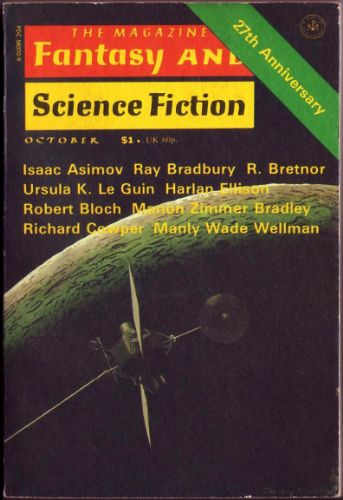
Cover of the October, 1976 issue of the Magazine of Fantasy and Science Fiction, cover by Chesley Bonestell.
Cover of the October, 1976 issue of the Magazine of Fantasy and Science Fiction, cover art by Chesley Bonestell. (click to embiggen)
There are some science fiction stories that you read, enjoy, but when you encounter them again months or years later, you don’t remember them until you have nearly completed re-reading them. Richard Cowper’s “The Hertford Manuscript” is one of those tales for me.

I think that I read it for the first time in the fall of 1976, shortly after my mother, oldest sister, and I had moved to southwest Washington some months after my parents’ divorce was finalized. My subscription to the Magazine of Fantasy & Science Fiction had lapsed not long before we moved, but I had been happy to discover that the public library in our new home town subscribed to the magazine. A couple times a month I spent a couple hours at the library reading the magazine, and I am fairly certain I read the October issue, which contained “The Hertford Manuscript” on one of those visits.

I definitely read the story a subsequent time when I bought the paperback of Donald Wolheim’s anothology, The 1977 Annual World’s Best SF a couple years later at the used bookstore. And since I re-read stories in that collection off and on over the next seven or eight years, I probably read it again several times.

Each time I’ve read the story, I began to suspect that the story was going to be a Lovecraftian tale, even with the hints in a completely different direction. And then each time there’s a point where I say to my self, “Oh! I think I remember this story…” Including when I re-read it this week.

The tale starts slow. Our narrator, Francis Decressie, tells of us of his eccentric Great Aunt Victoria, whose husband died in World War I, leaving her to run a rare books business, which she excelled at for many years. She occasionally told slightly scandalous stories of her youth when she was acquainted with H.G. Wells and Aldous Huxley. When his Great Aunt dies, her will bequeaths on him a 17th Century Registry—specifically a list of the admissions, discharges, and deaths of patients at a Franciscan Charity Hostel/Hospital in London.

In addition to the ordinary 17th century pages covered with small columns of very compact writing, are a number of pages that don’t match the others. The paper is just as old, but it is clearly manufactured using more modern methods, and the handwriting is very different than the rest of the register. And it appears to be a journal.

The narrator then reproduces the journal, and we find ourselves following Dr Robert Pensley, an acquaintance of H.G. Wells, as he recounts how, having completed his journey into the far future, meeting the Eloi and escaping the Morlocks to return to his own time and recount his findings to some friends, had undertaken a journey into the distant past. Except one of the quartz crystals in the mechanism of the machine breaks (he attributes this to damage inflicted by the Morlocks), trapping Pensley in 1665 England—right when the Plague is ravaging the land.

Pensley must find a jeweler or lens maker to create a replacement crystal, and has to deal with all of the problems of a nation in panic over an illness they do not understand. There are increasingly amusing attempts by Pensley to convince various authorities that the illness is spread by fleas on the rats. The lens-maker has difficulty tracking down a large enough piece of quartz, and various other things go wrong over the course of the tale.

The story ends with a few pages of the narrator explaining how he tried to prove that the pages were a hoax, but experts all agree the book has not be taken apart and restitched since the late 1600s, and he does find various bits and pieces of obscure historical evidence to back up some of the minor details the journal recounts.

And that’s it. The story ends with a philosophical observation about tragedy by the narrator.

The tale told in the enclosed journal was very engaging. The descriptions of the time traveler’s experiences in the mid-1600s pull you right into the tale. Cowper’s attention to historical detail is something that is seen in many of his other works, and serves him quite well here. The framing story is written in the style of a 19th century novel, evoking Dickens and Anthony Trollope and even a bit of Bram Stoker. Which is a little out of place given that the narrator is living in the late 20th Century, but is a nice homage to Wells.

As a kind of sequel to The Time Machine the story works well enough. The framing sequence is not quite as good as the time traveler’s journal. Especially the ending, which I found a little flat. I wanted more. I’m not sure how, exactly, but rather than leaving me wondering what happened next, it felt like he left out something.

So it was enjoyable, but not a mind-boggling revelation. Still, each time I read it, I recognize certain minor details that stuck with me, and have resonated with some of the ideas I’ve tried my hand at in my own stories. Every story we read doesn’t have to be a masterpiece. Sometimes merely good is good enough.

Sunday Funnies, part 18

It’s been a couple of months since I did one of these posts about web comics I love. For various reasons I’m doing it a little differently this time.

XKCD: Guide to Figuring out the Age of an Undated World Map
XKCD: Guide to Figuring out the Age of an Undated World Map (Permanent link to this comic: http://xkcd.com/1688/) {Click to embiggen}

xkcd.com by Randall Munroe is one of those comics that I don’t ever have to remember to check my bookmark, because at least once a week someone I know shares a recent comic on Twitter, or Facebook, or their blog, which leads me to click on the link, then use the Previous button to catch up on the two or three strips that have been posted since the last time someone linked to it. I love this particular recent one because it’s useful, but also because I have frequently, when finding a world map or globe somewhere, spent many minutes looking at which countries are included and how they are labeled to try to guess when it was made.

Part of the first page of Superman and the Jumper
Part of the first page of Superman and the Jumper (http://imgur.com/gallery/Ijdxh). Follow the link and read the whole thing.

Called “Superman and the Jumper” this is a several page excerpt from the graphic novel Superman: Grounded Vol. 2 written by J. Michael Straczynski and Chris Roberson, and illustrated by a bunch of people. I’ll be honest, most of this particular graphic novel is mediocre, at best. Stracynzki and Roberson seem to be arguing about the nature of heroism, rather than telling a story, but this sequence is absolutely perfect. This is my Superman: a compassionate hero who is just trying to save one more life.


Some of the comics I’ve previously recommended:

mr_cow_logo
“Mr. Cow,” by Chuck Melville tells the tale of a clueless cow with Walter Cronkite dreams. If the twice-weekly gags about a barnyard of a newsroom aren’t enough excitement for you the same artist also writes and draws (and colors!) some awesome fantasy series: Champions of Katara and Felicia, Sorceress of Katara. If you like Mr. Cow, Felicia, or Flagstaff (the hero of Champions of Katara) you can support the artist by going to his Patreon Page. Also, can I interest you in a Mr. Cow Mug?

dm100x80“Deer Me,” by Sheryl Schopfer tells the tales from the lives of three friends (and former roommates) who couldn’t be more dissimilar while being surprisingly compatible. If you enjoy Deer Me, you can support the artist by going to her Patreon Page!

The logo for Scurry, a web comic by Mac SmithScurry by Mac Smith is the story of a colony of mice trying to survive a long, strange winter in a world where humans have mysteriously vanished, and food is becoming ever more scarce.

title
And I love this impish girl thief with a tail and her reluctant undead sorcerer/bodyguard: “Unsounded,” by Ashley Cope.

Screen Shot 2016-03-12 at 3.18.45 PMCheck, Please! by Ngozi Ukazu is the story of Eric “Bitty” Biddle, a former junior figure skating champion from a southern state who is attending fictitious Samwell College in Massachusetts, where he plays on the men’s hockey team. Bitty is the smallest guy on the team, and in the early comics is dealing with a phobia of being body-checked in the games. He’s an enthusiastic baker, and a die hard Beyoncé fan.

Screen Shot 2015-08-02 at 5.36.43 PMMuddler’s Beat by Tony Breed is the fun, expanded cast sequel to Finn and Charlie Are Hitched.

The_Young_Protectors_HALF_BANNER_OUTSIDE_234x601The Young Protectors by Alex Wolfson begins when a young, closeted teen-age superhero who has just snuck into a gay bar for the first time is seen exiting said bar by a not-so-young, very experienced, very powerful, super-villain. Trouble, of course, ensues.

Caterwall by Spain FischerCaterwall by Spain Fischer is the story of Pax (the orphaned son of a knight who was the hero of the kingdom) and his best friend Gavin (the descendant of a line of seers). Pax is a young man who has a reputation for pulling pranks and telling lies, who gets exiled from the kingdom.

3Tripping Over You by Suzana Harcum and Owen White is a strip about a pair of friends in school who just happen to fall in love… which eventually necessitates one of them coming out of the closet. Tripping Over You has several books, comics, and prints available for purchase.

The Junior Science Power Hour by Abby Howard logo.The Junior Science Power Hour by Abby Howard. is frequently autobiographical take on the artist’s journey to creating the crazy strip about science, science nerds, why girls are just as good at being science nerds as boys, and so much more. It will definitely appeal to dinosaur nerds, anyone who has ever been enthusiastic about any science topic, and especially to people who has ever felt like a square peg being forced into round holes by society.

12191040If you want to read a nice, long graphic-novel style story which recently published its conclusion, check-out the not quite accurately named, The Less Than Epic Adventures of T.J. and Amal by E.K. Weaver. I say inaccurate because I found their story quite epic (not to mention engaging, moving, surprising, fulfilling… I could go on). Some sections of the tale are Not Safe For Work, as they say, though she marks them clearly. The complete graphic novels are available for sale in both ebook and paper versions, by the way.

NsfwOglaf, by Trudy Cooper and Doug Bayne is a Not Safe For Work web comic about… well, it’s sort a generic “medieval” high fantasy universe, but with adult themes, often sexual.