“Still Here, Still Queer, Still Dancing!” (click to embiggen)I make a lot of playlists. I buy new music, I listen to it a few times, then I start picking out other songs from my library that I think go well with the new music for one reasons or another, and soon I have a playlist or three. Or I’ll be having a conversation with someone, and some turn of phrase someone uses will sound like it ought to be the name of an album or band or something, and the next thing I know I’m constructing a playlist of songs that fit the title. Not to mention the many playlists I put together to help with my writing. I have playlists for specific recurring characters in my stories, and playlists for particular stories, and more importantly playlists for particular plot/character arcs within a story.
And every year during May I start constructing a Pride playlist. It’ll be a mix of new songs and old. What they usually all have in common is that they are songs I like to dance to, and resonate in some way with the celebratory side of being out and proud but especially loud. Or, as Miss Coco Peru might said, a life lived out, proud, loud and just a little bit ridiculous.
Some years I feel like putting in songs that are a bit more dirty and flirty, while other years my include some ballads and either more serious or slightly darker in tone. I also throw in songs that are by artists I’ve been thinking about a lot this year. Which is at least part of the reason you’ll see both Prince and David Bowie make an appearance.
Not all of these songs will mean the same thing to you or even evoke the same feelings, of course. And you may see some familiar titles that make you ask, “How can he dance to that?” Don’t just look at the title, but try to find the exact remix by the same artist. You may find that the cover version of an old pop song you think you know has been transformed into something completely different in the particular track I’ve listed.
Anyway, this is my 2016 Pride Playlist:
“Let’s Go Crazy (Special Dance Mix)” – Prince & The Revolution
“Feelin’ Free” – Sirpaul
“Spectrum (feat. Jo Lampert & Gyasi Ross)” – Ryan Amador
“Rebel Rebel” – David Bowie
“Reach out for the Stars” – Yehonathan
“Revolution (feat. Levi Kreis)” – Matthew David
“What’s It Gonna Be?” – Shura
“Genghis Khan” – Miike Snow
“Get Your Sexy On” – Lovestarrs
“I Wanna Boi” – PWR BTTM
“The Boy Who Couldn’t Keep His Clothes On” – Pet Shop Boys
“Just Stand Up!” – Beyoncé, Mary J. Blige, Rihanna, Fergie, Sheryl Crow, Melissa Etheridge, Natasha Bedingfield, Miley Cyrus, Leona Lewis, Carrie Underwood, Keyshia Cole, LeAnn Rimes, Ashanti, Ciara & Mariah Carey
“How Deep Is Your Love” – Calvin Harris & Disciples
“For You” – Quentin Elias
“The Good, the Bad and the Dirty” – Panic! At the Disco
“Desire” – Years & Years
“We Don’t Have to Dance” – Andy Black
“Feel So Good [Orignal Edit]” – Sean Ensign
“Eddie Baez Donna Summer She Works Hard for the Money” – Eddie Baez Presents
“Only Love Survives (Timothy Allan & Mark Loverush Remix)” – Ryan Dolan
“You’re So Beautiful (White Party Version) [feat. Jussie Smollett]” – Empire Cast
“Breathe Life” – Brian Kent
“Try Everything” – Shakira
“Halo (Gomi Club Remix)” – Beyoncé
“You Are Unstoppable (7th Heaven Remix)” – Conchita Wurst
Whatever music you prefer, never forget: dance with joy, dance with abandon, dance without worrying what anyone thinks, because life is too short to waste time sitting still!
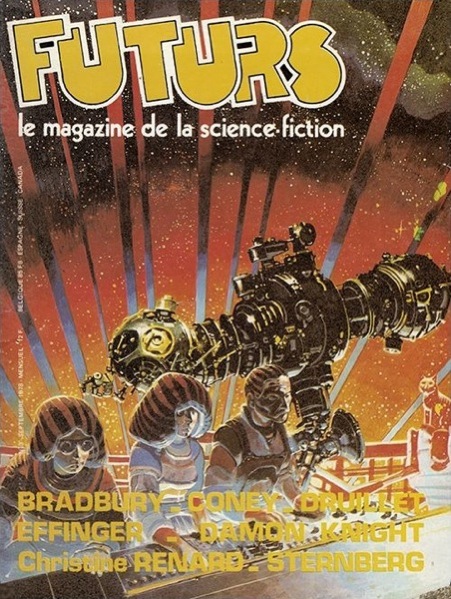
The cover of Futurs No 3, an anthology of translated science fiction published in Paris, September, 1978. (Click to embiggen)One day, back when I was in high school, I found a paperback copy of The 1977 Annual World’s Best SF edited by Donald Wolheim in the used bookstore I frequented. I already owned several of Wolheim’s earlier annual anthologies, so I knew they usually the contained a lot of good stories. The table of contents of this issue featured several authors I loved, including at least a couple of titles that I remembered reading elsewhere and liking. So, of course, I picked it up.
The third story in that anthology, “Those Good Old Days of Liquid Fuel” by Michael G. Coney did not wow me on the first reading. Honestly, the thing that I found most interesting in the first paragraph was the revelation that it was apparently set in Western Washington state. The story is told by a first person narrator, who is taking a ferry to go to a port to meet a shipment of some sort of alien creature. We never learn much about them, other than that he raises them for their pelts, which he can sell for a profit. Though the way he describes his farm, he is mostly just getting by in this endeavor.
Most of the first two pages of the stories consists of the character describing his ferry trip in such a way that we learn that Earth is part of some kind of Galactic society, that only recently have they replaced rockets with antigrav for vessels that move from ground to orbit, and so on. The hook of the first paragraph is him noticing on his “newspocket” that all the old shuttles at the abandoned Pacific Northwest spaceport are to be scrapped, finally.
He arrives at his destination early, finding himself with five or six hours to kill, and decides to drive up to the old space port. During the drive he rambles some more, dropping hints about what his life was life before, and telling us more about how things have changed since then. It isn’t until halfway through the fifth page that he gets to what appears to be the meat of the story, as he flashes back to junior high school, when he and his best friend used to sneak onto the grounds of the spaceport to watch shuttles land and take off.
The narrator, as a young man, loved everything about the shuttles: the roar of the engines, the sleek shapes of the ships themselves, et cetera. His friends was obsessed with identifying and checking off the shuttles from a book he had of every registers craft that ever landed on Earth. There are a few anecdotes about the mild misadventures the narrator, his friend, and a few other people who liked to sneak onto the grounds of the space port had watching the shuttles land and take off.
Then everything is ruined when his friend gets a crush on a girl. Who just happens to be the same girl that the narrator once got into an altercation with in grade school and of course they hate each other. To say the friendship is strained is an understatement. Then there is a disaster involving the girl’s pet, with is a cat-like animal imported from across the galaxy, which happens to be telepathic, but only with members of its own species.
After the disaster, we flash back to the present, and then the narrator—who has lamented about five dozen times so far in the story how much he misses his old friend, and how astonished his middle-school-aged self would be to know that he doesn’t even know where the friend lives any longer—sees said old friend. The friend, it turns out, owns the wrecking company that is going to tear down the spaceport. But the narrator, of course, doesn’t say hello. He skulks away.
There are a lot of things not to like about this tale. The rambling expository lumps. The lack of characterization. The clichéd use of flashback to tell most of the story. The extremely dated boy vs girl dynamic of the tale. The ludicrous ways that chauvinism pops up and is even defended at one point.
Then in the category of merely cringeworthy, there is the fact that the only female characters who appear in the story all dress and act as if they are characters out of the 1950s. Remember, this was written in 1975—women’s lib had been a thing for many years by then! Even in 1978, when I read this story, that section seemed terribly dated!
I read the story one more time, when I found it in another anthology years later. I didn’t recognize the title, or I might not have read it. The second time I didn’t remember the story until fairly late into it, just about the time of the disaster near the end of the tale. I read it to the end, hoping to have a bit more insight, but still wasn’t impressed.
When I re-read it again last week, I was having the same reaction as before all the way until the end. And then I finally had an epiphany about what the author may have been trying to do. It had never occurred to me during my earlier readings that the narrator was unreliable. The section early on where he defends men’s only clubs and no girls allowed spaces as not being sexist at all should have tipped me off. It was too over the top. And there were several other hints throughout the story where our narrator is being very defensive in describing the events.
That’s when I realized that the ending, where he decides he doesn’t have anything in common with the old friend anymore is supposed to be tragic or ironic (depending). The narrator drives many hours out of his way and spends the entire tale wallowing in a nostalgic lament for the good old days. He goes into inordinate details on fairly minor stuff, is very defensive of himself and goes to pains to describe every other character in the narrative as betraying him or at least not treating him right. He had these great dreams and aspirations, which have all come to naught because the world is just not fair to nice guys like him.
Meanwhile his old friend is now a successful businessman, and is literally in the business of tearing down the obsolete relics of the past so that something new can be built.
Now, finally, the story makes sense when I think of it as a critique of nostalgia and clinging so hard to the past that you can’t move forward. And those expository ramblings sound an awful lot like an old bad way that some sci fi stories in the 30s, 40s, and 50s would do their world building: by having two characters say such unnatural things (while riding a subway or something), “Thank goodness for modern convenience! Can you believe that our ancestors used to have to connect their appliances to receptacles in ways with physical cables to draw power! What a primitive nightmare!”
As an indictment of nostalgia, “Those Good Old Days of Liquid Fuel” isn’t quite so bad. I’m not sure I agree with Wolheim that it was one of the best story published that year, but it did make me think, even before my epiphany. Struggling with a story is good mental exercise.
And I have to admit that the descriptions of the shuttles taking off and landing and the sense of wonder the narrator had as a child was pretty good.
A cover of a later paperback reprint of the 1977 Annual World’s Best SF anthology edited by Donald A. Wolheim. (Click to embiggen)
Some opening lines are better than others. “Something very large, something very small: a galactic museum, a dead love affair. They came together under my gaze.” Those are the opening sentences of Brian W. Aldiss’ short story, “Appearance of Life” and they’re one of the better examples. The opening tells you, thematically, where the story is going, without giving anything away.
“Appearance of Life” by Brian W. Aldiss is another story that I first encountered in the pages of the 1977 Annual World’s Best SF anthology edited by Donald A. Wolheim. So I was a junior in high school, 17 or 18 years old, when I discovered it. The story is narrated in first person by a character who is on their way to a museum. The character never gives us their name, identifying them self only as a Seeker, which is either a job title or avocation.
The Seeker tells us first about a long lost alien race, the Korlevalulaw. We don’t know what they looked like and virtually nothing about their culture. Because they had vanished by the time humans reached the worlds they once colonized. And the aliens left behind only empty buildings. But they are vast empty buildings. Our narrator is traveling to one such building, which is a single structure that completely encircles a planet exactly on its equator. The building it over 1600 kilometers long, and at different parts of the equator, it is between 15 and 22 kilometers tall. It is called a museum because humans have decided to start filling the empty space with artifacts they have gathered from around the galaxy. Not artifacts left behind by the Korlevalulaw, but artifacts left behind by previous human civilizations.
The story slowly reveals that by the Seeker’s time humans have changed a lot. The Seeker makes references to both the First Galactic Era and Second Galactic Era as distinct long periods of interstellar civilization. He or she makes references to how much smaller humans were at the time, and to other limitations of human bodies. But the Seeker never describes what humans look like, now. The gender of the Seeker is never given… the narrator does refer to every android they interact with as she. And there is a point when a reference computer points out that current human engineered breeding produces a ratio of ten women to every man, which is why “modern humans” don’t understand the importance more primitive humans placed on being husbands and wives.
The Seeker has been commissioned by several academic institutions to explore the museum and look for evidence to shed light on various questions these academics have. The Seeker spends several days exploring the museum.
The Seeker finds a holocube in one of the exhibits which contains a recording of the personality of a long dead human woman. When activated, she informs him that she is only for use by her husband, and to please put her back on the shelf rightside up. A while later the Seeker finds more holocubes, and one of them contains a male memory recording that says he is only for his ex-wife.
The Seeker notices that the names are similar, and so tries an experiment. Placing the cubes next to each other, the Seeker activates them and observes as the two holograms have a discussion. During the exchange of messages, the Seeker has an epiphany about the place of humans in the galaxy, and what the ancient disappearance of the Korlevalulaw means about the fate of human society.
The Seeker is so disturbed by the epiphany, that they abandon their mission, flee the museum, and find a mostly uninhabited world to hide out on, lest they accidentally reveal the epiphany to others and hasten the end of current civilization.
I was a little bit disappointed in the ending. The epiphany as described by the Seeker didn’t seem that alarming or profound, to me. I had been enjoying the story up to that point. It was very interesting to recognize how my image of the narrator and the situation kept changing as certain details were casually revealed. In the beginning, I was imagining a person much like myself. By the end, my imaginary version of the Seeker was only vaguely humanoid, and neither male nor female. Similarly, at the beginning of the story I assumed the human civilization was a kind of standard space opera interstellar empire, or multiple competing federations, something like that. But by the end I was trying to imagine a civilization that barely understood the idea of nations and political systems and even the concept of ownership.
I don’t know if Aldiss meant for the reader to think the Seeker’s epiphany only made sense because we didn’t, still, fully understand the Seeker’s frame of reference, or something else. I thought the way Aldiss built up the idea of this very alien culture, and how they didn’t really understand us, and therefore how we likely don’t understand previous generations, either, was really well executed. I didn’t realize that’s what was happening until I reached the end and was trying to figure out if I misunderstood the ending.
The story is very cerebral, with the conflict being something that the narrator doesn’t even realize is happening until the end. The Seeker wants the answers to particular questions, and doesn’t realize that he/she lacks the frame of reference to understand most of the evidence being examined. So you could describe the plot as Man vs His Own Ignorance. And the resolution is that the Seeker gains just enough insight to realize that none of the answers are pleasant ones.
And though I have been reminded of this story from time to time while reading other sci fi tale, I never realized until I was writing this post that it has more in common with a classic Lovecraft horror story than a science fiction tale. The Seeker gets a glimpse of a much bigger truth about their place in the universe, and that glimpse destroys their sense of self. It’s just a bit less melodramatic than a typical Lovecraft tale would have been. I don’t know if Aldiss was doing that on purpose, but it’s an interesting question.
The story left me pondering and debating with myself how I might have tried to tell the story better. Except I think the best part of it isn’t the traditional form of a story. The best part of the tale is how the writer made me slowly deconstruct my own assumptions about who the narrator was and what his/her world was like and the way the story made me uncomfortable to give the narrator a gendered pronoun.
It didn’t translate as a big epiphany for me. But it did change the way I viewed many stories afterward. It affirmed my suspicions that much of what we thought we knew about our own history, and about ourselves, was way off. And reminded me that we should never be satisfied with the easy answers.
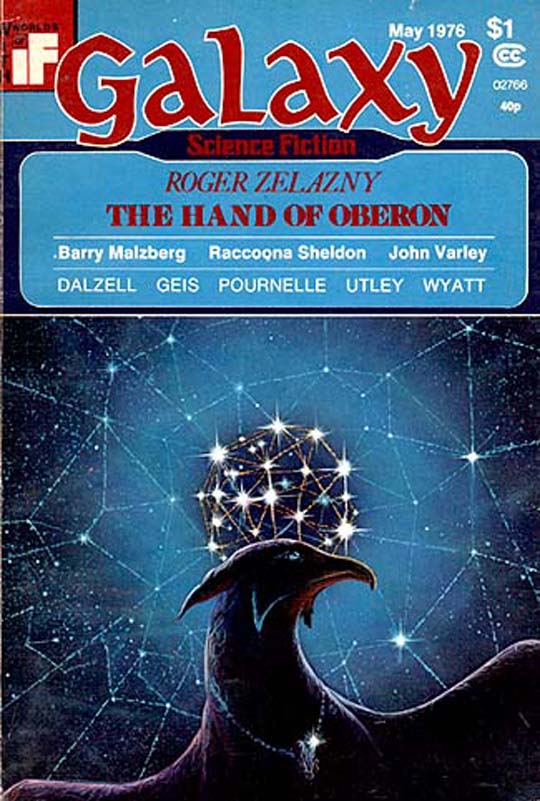
Cover of the May 1976 edition of Galaxy Magazine, which is where I probably first read Varley’s “Overdrawn at the Memory Bank.” (Click to embiggen)In the spring of 1976 I still had a subscription to Galaxy magazine, thanks to my grandparents, though things were not going terrible well in my life at that time, so I didn’t always get all the way through one issue before the next came in. So I might not have read it until some months, after my parents’ divorce was final, and Mom, my sister, and I moved 1200 miles away. I definitely remember owning the magazine with this cover. This issue contained the story, “Overdrawn at the Memory Bank” by John Varley.
Varley was the author of “Picnic on the Near Side” which I wrote about before, and which made quite an impression on me. This story is set in a similar world, with extensive colonies on the moon. It concerns a man named Fingal how has purchased a vacation at one of the “disneylands” which was large lunar caves that have been made to duplicate long lost environments on earth, complete with cloned wildlife. Fingal’s memory and personality are transferred from his brain into a cube, which is then implanted in a lioness so that Fingal can experience the life of a predator on the savannah.
Something goes wrong, and Fingal finds himself back in his own life sooner than expected, and strange things keep happening, such as books rewriting themselves before his eyes to become messages to him. He eventually learns that his body has someone been misplaced, so the memory cube has been put into a safety mode, interfacing with a computer which is creating a simulation of his real life. Messages come to him from a technician named Apollonia Joachim who explains that the simulation is necessary to keep his memories and personality intact until it can be returned to his body.
As the days stretch into weeks, Fingal starts taking classes in the simulation to teach himself new skills to get a better job when he does get back. Strange things happen, as the technician tries to keep him focused. In one incident, Fingal notices strange patterns in the floor tiles in his bathroom, and starts tracing them with his toe, suddenly the bathroom fills up with money. Fingal’s consciousness had somehow gotten into someone’s financial records. Apollonia warns him about losing himself again and again.
Over the months that follow, Fingal finds himself falling in love with Apollonia, and making plans for a future together.
Eventually Fingal is reunited with his body, and then learns that what felt like years to him in the simulation was only six hours, because his thoughts were moving at computer speed while connected. Ms Joachim has only been interfacing with him for a few hours, and doesn’t share his feelings.
The simulated classes he took did result in real learning, so he does have new skills and can pursue a more interesting job. Plus, of course, he gets a refund on the vacation and a lump sum settlement from the company. He’s informed that other people who suffered similar accidents have not always fared so well, and he’s the first person two survive six hours outside the memory cube’s normal limit.
Varley didn’t win an award for this particular story. He did win a Special Locus award the year this was published for having four novelettes, including this story, voted in the top ten in the Locus Reader Awards.
The story was adapted badly into a movie that changed a lot of things for no particular reason. Avoid the movie. The story isn’t action packed, but is more focused on the internal conflicts of a man unhappy with his life who is forced to stay there even if it is simulated. The notion being that if they allow his fantasies to run wild while his personality is in the memory cube, he will go mad and forget who he really is.
I enjoyed the story a lot. The notion that it’s the boring and repetitive parts of our lives that anchor our identities wasn’t terribly revolutionary, but it was interesting to see how this sort of technology might play out without any world-threatening peril giving it at artificial sense of danger. Really, who needs a bigger threat than literally losing your mind to provide a sense of dramatic tension?
One odd side note: I always get this story mixed up with another Varley tale, “The Phantom of Kansas.” They’re both set in the same fictional future world (the Kansas in the title of the second story is an artificial recreation of the midwestern plains of North America in another Lunar cave), and both stories involve stored personalities, but otherwise the plots have nothing to do with each other. The simple fact is that I think the title “Overdrawn at the Memory Bank” would have been better for the second story as it evokes a metaphor for the central plot better than the notion of a phantom. So there has been more than one occasion when I’ve pulled out an anthology, such as my hardcover copy of Wolheim’s 1977 World’s Annual Best Science Fiction, see the title of Varley’s story, turn to it expecting to read the other story, and then as I read the opening paragraphs remember that I always get them mixed up.
Oddly, I own more than one anthology that includes “Overdrawn at the Memory Bank,” but absolutely none that include the other story. I need to fix that.
So years ago I was a faithful viewer of the comedy series “My Name Is Earl,” the story of a not terribly bright petty criminal who became convinced that because of all of the awful things he’d done in his life, he was destined to try to make up for them or karma was going to keep punishing him. So he made a list of all the bad things he’d done, and with the assistance of his brother, Randy, and Randy’s sometimes girlfriend Catalina set out to make amends. Earl and Randy are also frequently both helped and hindered in their quest by Earl’s ex-wife, Joy. Everyone is frequently helped and oddly rescued from various situations by Joy’s current husband, Darnell aka “the Crabman.”
The series was a silly look at life in the fictitious Camden County, which was inhabited by a strange assortment of characters. It wasn’t everyone’s cup of tea, though I was always amused by the fact that the one person I knew who most disliked it said he hated it because it was completely unbelievable, yet he himself is always telling stories about his ridiculous in-laws and the unbelievably stupid problems they got themselves into. Which made me decide that either a) he had a really big blind spot, or b) all those stories he liked to regale people with of his supposed true family misadventures might have been more than slightly exaggerated.
Regardless, I really enjoyed the not-cynical way that “My Name Is Earl” demonstrated in its storylines again and again that most humans are muddling along as best as they can, seldom realizing just how much our lives are interconnected, and how much we contribute (in both good and bad ways) to the lives of others.
Cover for the first edition hardback of The Bicentennial Man and Other Stories by Isaac Asimov. (Click to embiggen)I first heard of “The Bicentennial Man” by Isaac Asimov when I saw the anthology, The Bicentennial Man and Other Stories offered as a selection in the Science Fiction Book Club. I was 16, and still technically a member of the club, but most months I checked off the “Send nothing at this time” box on the card, because even the cheaper prices of the book club were a bit much for my budget. It a bit over a year later when I found a paperback copy of The 1977 Annual World’s Best SF edited by Donald Wolheim in the local used book store when I finally got a chance to read the story.
Asimov wrote a lot of short stories about robots. Most of the stories collected in his anthologies I, Robot and The Rest of the Robots dealt with various logical contradictions that robots would be placed in by various circumstances, and how the robots (and the humans working with them) would work out those conflicts between the Three Laws of Robotics, their other programming, and the situation at hand. Even in his longer novels where robots figured prominently, such as the two sci fi murder mysteries, The Caves of Steel and The Naked Sun, the robots were always motivated by pure logic. The fact that the world is not a purely logical place, and that humans are seldom covered by rationality alone, formed the framework for the conflict in the stories.
“The Bicentennial Man” centered on a single robot, dubbed Andrew by the daughter of its first owner (a Mr. Martin, identified in the story which is told from Andrew’s point of view as simply Sir). Andrew demonstrates an unusual talent with wood carving—his works of art fetching high prices when offered for sale—and develops a desire to became human. Andrew is part of a new series of robots with what Asimov describes “more open-ended architecture” in his positronic brain, which the experts believe is where his apparent artistic talent comes from. Andrew’s stubborn insistence that he can become a human worries the scientists at the world’s largest robotics company, causing them to try to buy Andrew back.
In part because of the pleading of the owner’s daughter (whom Andrew calls Little Miss), Sir refuses to sell Andrew back to the company. Later, Sir helps Andrew gain some form of legal independence as a “free robot” with the legal name of Andrew Martin.
From there the story follows Andrew’s physical and legal journey through several generations of the original family, as Little Miss grows up, grows old, and dies, and her son and grandson found a legal firm which, among other things, fights to secure Andrew’s legal rights. Andrew designs new kinds of prosthetics, which are almost indistinguishable from natural body parts. Andrew’s body is slowly ungraded to first being a more human-looking android body, to an organic one. The proceeds from the patents on the various processes to create the prosthetics (which are used medically to improve the lives of disabled, maimed, and diseased people) providing Andrew’s income and funding the legal fight.
One of his important legal victories happens when he is 150 years old, where at a dinner in his honor (celebrating his medical inventions), he is toasted as the Sesquicentennial Robot.
Eventually, as Andrew realizes that he will never persuade a human legislature to pass a law declaring him, or any robot, a human because the key difference will always be his positronic brain. Which leads Andrew to compel a robotic surgeon to perform an operation on his brain that will cause the brain to slowly decay and die. Andrew’s reasoning is that it’s the immortality that forms the final barrier between him being accepted as a human.
The story really resonated with me. And it was interesting to see Asimov explore the nature of emotions and creativity from the point of view of artificial intelligence. But more interesting was the series of legal barriers that Andrew has to go through. Laws have to be changed to allow a robot to own property, for instance. Laws must be changed to make harming a robot a crime, at another point.
The legal progression to personhood that Asimov takes us through is based on the historical legal fights for woman’s rights and racial equality. For millenia, the legal system treated women as property. Assaulting a woman was a crime, yes, but the penalties imposed always included paying a fine to the woman’s father (if she were unmarried) or her husband, because the man in her life was deemed to have been harmed by the degradation of his property.
Similarly, Andrew discovers, once he is a free robot, that since there is no owner to whom damages would be owed, the legal system doesn’t consider anyone assaulting and damaging him a crime as assault. Vandalism, perhaps, but then, who is the owner who should be compensated for the damage?
It seems ridiculous to us now that some people, simply because of their gender or the color of their skin, had once been in a similar situation: harming them wasn’t inherently a crime, it was only a crime if it caused their “owner” to suffer a loss. And especially frightening to realize that in the matter of sexual assault laws in the U.S., for instance, that as recently as the 1970s the law was still structured this way. A woman couldn’t file rape charges against her husband or sometimes even her ex-husband, because once married her consent was no longer hers to give or withold, in that regard.
Andrew’s struggle for human rights parallels, thus, every oppressed groups struggle for equality. Something that I came to appreciate more some years later, when I finally bought my own hardcover copy of The Bicentennial Man and Other Stories and re-read this particular short story again. There is even a point, during the discussion about the assault laws, where another character makes the same argument at homophobes current make against hate crime laws: they aren’t needed, because the action is already a (minor) crime under existing laws.
Asimov’s story about a robot who wants to be a human might seem, on the surface, to be little more than a retelling of Pinocchio, but we see here one of the Grandmasters of Science Fiction—a sci fi writer who first reached prominence during the “golden age” of sci fi—turning a civil rights argument into a rattling good tale of old-fashioned science fiction. Who would have thought an old, white (okay, jewish, but still) male sci fi writer who made his first professional sale in 1939 would be a social justice warrior? Don’t tell the melancholy canines!
When I read “The Bicentennial Man” I was a very closeted high school student, terrified that people would find out I was queer because I knew that strangers, friends, and even family members would see me as an abomination if they knew. So the story of Andrew, who wanted to be seen and accepted as a person certainly struck a chord. Even if his ultimate solution, dying, seemed like a terrible way to achieve his goal.
Cover of the paperback edition of the 1977 Annual World’s Best Science Fiction, edited by Donald Wolheim (click to embiggen)When I was a junior in high school there was one comic book shop in the town I lived in. It was also a used book store, so I visited there a lot. I didn’t have much money, and I was still reading several comics regularly which took up most of my discretionary spending, so I spent a lot more time there browsing—trying to find the cheapest books—than actually buying.
One day at the store I happened upon a paperback copy of The 1977 Annual World’s Best SF edited by Donald Wolheim. I owned several of his earlier annual anthologies, having gotten several of them as part of my introductory new member shipment from the Science Fiction Book Club a few years previously. The paperback was in pretty good shape, having only been published about six months previous, so it was probably marked at half cover price, which meant it wasn’t in my usual price range, but I had enjoyed the earlier collections, and there was more than one author in the table of contents whose work I really loved, so I bought it.
One of the stories in this particular collection was a novella, “Houston, Houston, Do You Read?” by James Tiptree, Jr. I didn’t know, at the time, that Tiptree was a pseudonym of Alice Sheldon (I think the year I read this was the year that her true identity was revealed, after ten years of being published under the name).
I believe I had read a few of Tiptree’s earlier short stories in the various SF magazines that I followed semi-regularly. I recognized the name, at least, but didn’t have a strong recollection of what kind of stories Tiptree had written before or whether I liked them. So I wasn’t prepared for just how good this story was.
The tale concerns the three-man crew of a NASA mission sent on a polar circuit of the sun. The ship is hit by an unexpectedly strong solar flare and is severely damaged. The crew survives and eventually gets their radio repaired, but are unable to reach Earth. At first it’s because Earth isn’t where they expect it to be in relationship to their position. They eventually figure out that they are further off course than they thought, and start transmitting their distress signal in the correct direction. No answer comes.
Eventually, as they scan more frequencies, they start picking up signals, many of them conversations in English with Australian accents. This is confusing, particularly since many of the signals are coming from various parts of the solar system, indicating a rather large number of space ships. Plus Australia, as far as they knew, didn’t have much of a space program. Also, almost all of the voices on the radio sound like women.
They establish contact with one ship which detected them and has diverted from its course to rescue them. During the radio exchanges before the rescue ship reaches them, they learn that it has been hundreds of years since their mission went up. The world is anxious to meet them, they are told, because they had long been assumed to be dead.
They also learn that there has been some sort of catastrophe on Earth in the intervening years which greatly reduced the population. When the rescue ship finally arrives, the men are surprised that there is only one man in the crew of the ship. Lots of other things surprise them, too. Two of the crewmembers seem to be twins, and both named Judy, but one seems to be several years older than the other. There are several other anomalies and slips of the tongue during the weeks that the ship is returning them to Earth that make the astronauts more suspicious.
Eventually they learn that the catastrophe was even worse than they imagined: it was a plague which only 11,000 women survived; not one single man survived it. The remaining people have been reproducing for several generations by cloning. Children are raised in a communal setting. Some are chosen to receive hormone treatments to give them the musculature and size of men. The story seems to imply that the only reason this is done is for the physical benefits of the muscles and such, and it is unclear if these children choose to became essentially transmen, or if it is imposed by some sort of societal system.
The three astronauts react in very different ways to the discovery. One becomes convinced that god threw them through a wormhole so that they can “rescue” this society and bring men back in charge. Another assumes that since there’s a whole planet of women who have never had sex with a “real man” that he will become sort of a sex god to them all. The last simply hopes that they will be allowed to rejoin society and help repopulate the species (since there are some health problems due to the of lack of genetic diversity).
It turns out, of course, that none of that is to be. The actions of the three men have been being recorded and sent back home. The men were slipped drugs which supposedly made them act out their true natures. The leaders of the world agree that men are simply too dangerous to introduce back into the species. There’s a particularly moving conversation between the captain of the rescue ship and the one man who has remained rational where she points out that most of the heroic behavior the man has tried to cite as proof that men can be good was simply men protecting their own women and children from other men.
The men’s genes are going to be used. Before the three are euthanized, sperm is collected, to diversify the gene pool, but only female babies will be taken to term. Since the entire story is told from the point of view of the one man, the reader never finds out what happens after he and his companions are put to sleep.
I wasn’t the only one who thought the story was good. It won both the Nebula and Hugo award for best novella the year it was published. The story did not kick off much in the way of controversy at the time, in part because people believed Tiptree was simply a feminist-minded man. A man could write a science fiction story decrying generations of misogyny and patriarchal violence and be thought of as open-minded, and a forward thinker. A woman, on the other hand, would (and still often is) branded as a radical man-hater.
I simply thought it was an intriguing story. I was still struggling to accept my own sexual orientation at the time, and I was intimately familiar with how the cruelty of boys toward boys who weren’t manly enough was overlooked, approved, and often encouraged by a sexist society. So the notion that culture might be a better place without all that hypermasculinity was appealing, even if I felt sorry for the reasonable male viewpoint character who was going to be exterminated along with his more brutish companions.
I want to emphasize that Tiptree made the male character sympathetic. She laid out the case for both sides convincingly, and seemed to be inviting the reader to consider (and maybe fight for) solutions to the problems of toxic chauvinism other than simply wiping the men out.
It was another mind-blowing story. Another time that sci fi helped me (as a very closeted queer teen living in a small town among Christian fundamentalists) imagine a better life, particularly the notion of romantic relationships other than opposite-sex pairings. After that story, whenever I saw Tiptree’s name on an anthology or magazine cover, I knew I wanted to read it.
(Click to embiggen)I want to be very clear that I love ebooks and audiobooks. Being able to carry around a whole shelf full of books in my pocket is one of my favorite parts of living in the future. Not having to decide (quite so often) which old books to relegate to a back shelf, or get rid of altogether just because we’ve brought a bunch of new books home is a good thing, too. We both still buy hardcopy books, and there are currently a few piles of them in the bedroom that haven’t found a home on the shelves somewhere in the house, but it’s a slower process since both of us buy a lot of books digitally, now.
One thing I miss, now that smart phones are ubiquitous, is seeing what other people are reading on the bus. Seattle is a city of bibliophiles and other literary people, and for most of the 30+ years I’ve been riding public transports in Seattle, I could always count on seeing interesting books on my commute. Sometimes I might see someone reading a book I love, and I’d find myself grinning—hoping they were having as much fun with the book as I did. Other times I would see a title I had never heard of, and find it intriguing enough to look up more information on the book when I had a chance. Other times I would see someone reading a book that I despised, and I would wonder what sort of person would read that.
There are still people reading hard copy books on the bus, of course, just nowhere near as many as there used to be. Now instead of seeing a dozen books or so on my morning commute, there are a dozen or so people staring at their phones or iPads or Kindles.
Which still warms the cockles of my heart, because I love reading, no matter what form it takes.
And I’m certainly not going to give up reading (and some mornings writing) on my iPhone. Among the downsides of reading a hardcopy book on the bus is the time spent digging it out of my backpack, and then later needing to stop reading far enough before my stop to put the book away and get my pack zipped up and situated. There was also the need to decide whether to pull out my book or my notebook and a writing implement. And the frustration after I chose when I discovered I didn’t seem to be in the right headspace to concentrate on that book, or to write.
With the phone, I can slip it out, fire up a book, and start reading. If I want to make a note, or get another idea I want to write down, it’s just a couple of swipes and taps with my thumb to switch to a writing app, write it down, then get back to the book.
Of course, there is a bit of the paradox of choice that the phone amplifies. Occasionally I just can’t decide which of the many choices that are on the phone to read. Which of the several books (because I’m always in the middle of more than one) to pick up, or should I open one of my news apps and catch up on the world?
Having all those choices doesn’t usually paralyze me, but I do often dither for at least a few minutes. So maybe I’m only kidding myself when I say I get a bit more reading time in now that I’m not fumbling with getting the book out and putting it away again.
But I don’t think so. For one thing, with the phone, I can become obliviously lost in the book right up to my stop, then jump up, slip the phone into my pocket as I’m moving to the exit, and get off the bus.
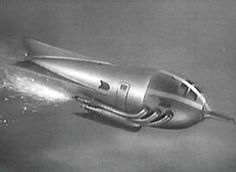
A silver rocket from the classic Flash Gordon serials.It’s that time of year, again, where I’m waiting for the Hugo Packet to arrive so I can start reading things that have been nominated for the award. And while several categories have again been piddled by the Rabid Puppies, I am still looking forward to the experience. Particularly since I learned an important lesson last time: the point of the awards is to recognize excellence. I’m not obligated to read stories to the end—as I always have as a small-press editor, where part of my mission is to help the writer improve the story if necessary. These stories have been nominated because, allegedly, they are great stories. So, this year I’ll give each story three pages to hook me. If by that point I’m not feeling interested enough to keep reading—regardless of whether the story was on anyone’s slate—then it goes under No Award on my ballot.
If I am enjoying it, I’ll keep reading. The only stories that will go above No Award will be the ones that kept me hooked until the end. Then I’ll rank those and move on to the next category.
It may be a very busy few months, since only one of the novels that were nominated is one I’ve already read. It’s easy enough to read five each of short stories, novellas, and novelletes in the time frame, and graphic novels usually go relatively quickly, but the novels take a bit more time!
With this new rule, I suspect that I’m going to enjoy the process this year a bit more than last year. Because the reason I care about any of the awards is because I love science fiction and fantasy. I don’t just love it, I frikkin’ love it. I have written before about how I can’t remember a time when sf/f was part of my life, because even when I was a small baby my mom read aloud to me from whatever book she was reading at the time, and she is one of the world’s geekiest Agatha Christie and Robert Heinlein fans.
Thanks to her, my childhood was full of a lot of science fiction. For a few years we faithfully watched episodes of Flash Gordon on channel two every morning, for instance. And our regular trips to the library (and used book store, when we lived in towns big enough to have one) usually resulted in several fantasy or science fiction books coming home with us.
It was one of those used bookstore runs when Mom found a copy of Dune in paperback. That book always sticks out in my memory because it was the first time that Mom was reluctant to tell me details about the book while she was reading it. It was also the first book that Mom told me I would have to wait until I was older. I know she really liked it, because it never once went into the pile of books she was thinking of trading in when we were preparing to visit a used book store. The fact that it was forbidden but also apparently really good instilled more than a bit of longing.
But it was rare for her to restrict my access to books. She never seemed to worry that I might not understand most books. If I asked to read one of her books, she’d let me, and she was always willing to discuss the story. There were times when I would try one of her books and I’d call it boring, though sometimes it was probably more because I actually was a bit too young to be tackling that particular book.
I loved browsing in the science fiction sections of the library or bookstores. Looking at the cover art, which was sometimes a bit weird and confusing, but always otherworldly. Each one seemed to beckon, promising strange and wondrous adventures if I would brave those pages.
Science fiction was always about possibilities, to me. I never felt that some sci fi wasn’t for me. I always felt welcome. Science fiction, particularly the way Mom enthused about it, was about making the world a better place. About going to new worlds, or creating new inventions, or learning what it would be like to live with aliens—or elves, or dragons. Do I wish more of the sf/f available in the 60s and early 70s had been more inclusive? Yes. Just as I wish more of present day sf/f was inclusive of people of color, queer people, et cetera. We’re getting better, but still have a ways to go before the representation matches the real world.
Whenever I pick up a new science fiction book, especially if it’s one that’s been recommended by a friend, I get a flash of that feeling of wonder and anticipation; the sense of strange adventures beckoning. For a moment, I’m that little boy in the bookstore, clutching a story, and about to plunge into something wondrous!
The previous two places we had lived had not had any sort of yard. They were like the archetypical city apartment, in that regard. So when we’d found a place with a small lawn and a couple of flower beds that would be ours, Ray had been ecstatic. Particularly since there was already a rose bush in one of the beds.
The rose had clearly been there a for many years, with the thickest canes being nearly three inches thick. When we moved in in February, the rose was just leafing out, with no sign of buds, yet. But it wasn’t long before enormous red roses were appearing on it. We took some pictures and shared with friends who knew a bit more about roses. More than one person guessed it was a Mr. Lincoln, a fairly well-known red rose. Later that summer, when I was digging down deep around the roots of the red rose (we were trying to excise wild deadly nightshade, which grows as a weed up here), that I found the original stamped metal tag that had come with the rose whenever it had been planted, which identified it as a Patrician. It’s a red rose that was specifically bred to emulate a Mr. Lincoln, though it is supposed to be a bit hardier.
That same spring Ray came home from a shopping trip one day with a new rose to plant at the other end of the same bed. It was labeled a Maid of Honor, which was not a rose I had heard of. I learned much later that the name Maid of Honor does not represent a recognized cultivar of a rose, but is rather a name that sounds like it ought to be a real rose breed which gets slapped on various pink or yellow roses sold by, shall we say, less than scrupulous distributors.
We didn’t know that, at the time. We planted it, took care of it, and we were both a little shocked at just how quickly it sent canes shooting up for the sky. We would get these enormous pink blooms, often in clusters above the eaves. The next spring I remember quite clearly one Friday finding a new cane that had grown to about 8 inches in length. By the next Friday, that same cane was more than 6 feet tall.
To say that it was an aggressive climbing rose might be an understatement.
So I have learned that I have to be a bit aggressive in trimming our pink rose. Not just in the fall, but throughout the growing season, as side branches soon block off the walkway, and the tall branches hang down into the driveway.
Ray died before our Maid of Honor reached its third spring. Another rose that we found that same year, a pale lavender rose whose labeled breed I have forgotten, lived only a couple more years after Ray did. But the Maid of Honor, and the original Patrician, continued to go strong.
A couple of years ago, I apparently got too aggressive at trimming the Maid of Honor, because the root stock started sending even more rapidly growing canes up. Roses don’t breed true via seed, so when you buy one at a nursery, what you get are several canes grafted off of an original (or more likely, a graft of a graft of a graft… et cetera… of an original) and onto a hardier breed of rose. Usually a wild rose or tea rose. So if you get new shoots from the root ball, they are a different kind of rose, altogether.
The root’s flowers on mine are very tiny white blossoms that almost don’t look like roses once they open all the way. It’s branches grow even fast than the pink ones, but they never get quite as thick as a pencil, so while they are very long, they droop and wind around the thicker, stronger pink branches (and anything else they can reach).
Our building is getting painted right now, and I’ve been having to trim both the white and pink branches multiple times because the rose keeps getting up around the eaves or into the porch railing. Late last week I trimmed a new tall branch, and it had a single bud near the end. So I trimmed it some more and stuck in in the vase where I had some flowers (some that I had bought myself, and some that friends brought over when they heard the news about my dad).
Sometime while I was sleeping last night, the bud began to open. So I took a picture.
Every time I stop and look at any of the buds from the Maid of Honor, I think about of Ray. Who loved to smell those pink blooms, give me a goofy grin, and ask me if I agreed that it was pretty.





 Font Folly