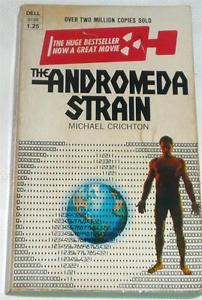
I think it was the fall of 1971 (I would have been eleven) when I saw the listing, and the name and very short description had me intrigued. Unfortunately, I wasn’t able to convince my parents to let me have the movie trip.
About a year later The Andromeda Strain was broadcast on network TV, probably as a movie of the week (that was a thing back then), and for whatever reason, we didn’t watch the first part of the movie. Probably it conflicted with a show my dad liked, so we watched the other show, first, then switched channels and watched the last half of the movie. So I was a bit confused, but it was still pretty exciting. The last part of the film was very tense and entertaining, even without the beginning.
The following week in school, everyone was talking about the movie. It was one of the few times that I remember kids who usually didn’t know a thing about science fiction talking about a sci fi plot.
Not long afterward, I happened across a battered paperback copy of Michael Crichton’s novel upon which the movie was based. I read it in a single sitting. One of the things that amazed me when I finished was how closely the half of the movie I saw followed the latter portion of the book. My previous experience of comparing movies to the books they were based on was that the movie often bore virtually no resemblance to the book.
The story of the Andromeda Strain is that a space probe is sent into low earth orbit and brought back down. It lands in a small, isolated town, and by the time the retrieval team arrives to pick it up, it seems that every inhabitant of the town has been killed. The retrieval team dies will communicating with their government superiors, and a Wildfire alert is activated. Wildfire is a codename for protocol government scientists have put together to respond to a biological threat from space. A team of scientists are pulled from their regular jobs and rushed to a secret underground facility. Two of the scientists go into the town in hazmat suits, find the satellite, and also find two survivors, an old man and a crying infant. The bulk of the story deals with how the scientists figure out what the infection is, and why those two very different characters are immune.
Before they have quite figured everything out, the extraterrestrial organism (which is neither a virus nor a bacterium) mutates and starts eating the plastics and rubber seals throughout the lab. This sets off an alarm and starts an automatic countdown on a nuclear self-destruct device. One of the things the scientists have determined about the organism is that it is not only immune to radiation, but will actually thrive in the explosion, and probably destroy all life on the planet. Thus we get to the tense ending where the characters are trying to stop the self-destruct and find a way to neutralize the infection.
One of the things that disappointed me about the book was that one of the most interesting characters in the movie, Dr. Ruth Leavitt, was a much less interesting man, Dr. Paul Leavitt, in the novel. I’m not sure if the character in the movie was more interesting because the actress, Kate Reid, played a very believable character, or if the character was just less interesting in the original.
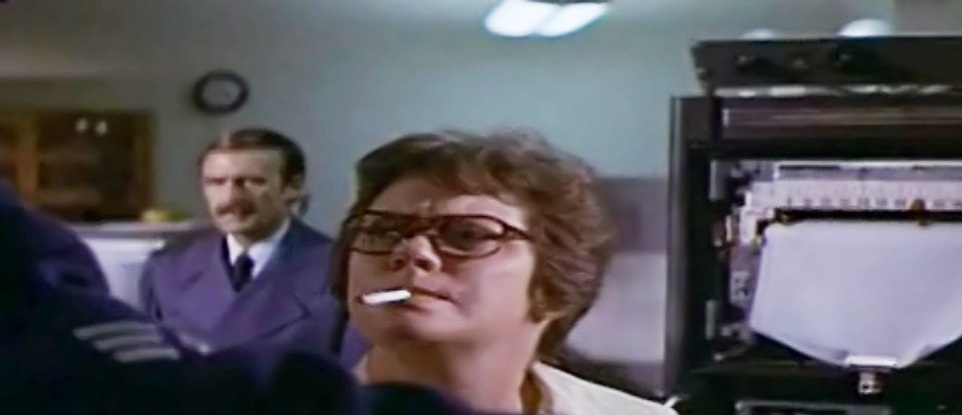
I re-read The Andromeda Strain at least once more after seeing the movie all the way through, and I still found Reid’s version of the Leavitt character more interesting. And this was decades before I’d ever heard of the Bechdel Test!
The Andromeda Strain was a bestseller, and set Michael Crichton on the path of future success that would lead to, among other things, Jurassic Park. The movie was only a moderate success, which is too bad, because it was really well done. The science included was, for the most part, plausible at time. In fact, nothing in the film required any sort of advancement of technology beyond what we had available. Exactly how the life form could convert energy to matter was the only bit of dubious handwaving to speak of. It wasn’t the only time that the movie version of a science fiction story was better than the book, but I think it might have been the first time that I noticed it.
 Font Folly