Like a lot of other genre-related shows, The Munsters went into syndication fairly quickly after being canceled, and promptly gained loyal audiences outside of primetime. I suspect most of my memories of the show are from this era…Continue reading Monsters Are People, Too – more of why I love sf/f→
Cover of the 1980 paperback re-release of Dread Companion.I can’t narrow it down more than to say that I found Andre Norton’s Dread Companion on a library shelf during middle school. The cover blurb told me it was a tale of a woman living on another planet far in the future who was hired to take care of two children who had an “imaginary” friend that was something far more sinister.
I didn’t expect that it would be about faeries in space.
The blurb was a fairly accurate description of the set-up: Kilda is a young woman trying to find her place in the world. Her father was a spacer who had no interest in settling down with the woman who got pregnant during their brief political marriage. And her mother didn’t want to be saddled with a child like Kilda who was more interested in exploring and learning science and so forth than she was in being pretty and having babies of her own…Continue reading Changelings on Distant Worlds – more of why I love sf/f→
Original hardback cover of A Wizard of Earthsea by Ursula K. Le Guin, art by Ruth Robbins (click to embiggen).I think I was 14 years old when I found a copy of A Wizard of Earthsea on a library shelf. The novel tells the story of a boy named Sparrowhawk who lives on the island of Gont which is situated in an archipelago called Earthsea. Sparrowhawk’s aunt is the village witch, and she recognizes his innate magical talents when he is very young, so she teaches him as much as she can. When he is twelve he nearly dies saving his village from marauders using magic. Which attracts the attention of an older mage named Ogion. Ogion heals Sparrowhawk and takes him on as a student. Ogion is the person who gives Sparrowhawk his true name, Ged. Knowing someone’s true name gives one power over them in the magic of Earthsea, so people have to guard their true name. When it becomes obvious that Ged’s talents and impatience are more than the mage can handle, Ogion sends him to the island of Roke to see if he can join the school of mages, there…Continue reading The Original Wizard School – more of why I love sf/f→
Cover of the 1958 hardcover edition of Mr. Bass’s Planetoid by Eleanor Cameron, just like the one I found in the school library (click to embiggen).In 1970 (I was in the Fourth Grade) the oil company my dad worked for transferred us to a tiny town in eastern Utah. When my sister and I were enrolled in the public school there, we exactly doubled the number of children in the school district who were not members of the Church of Latter Day Saints. Over the next 10 months or so, as many more families (mostly from the south) were transferred to the town by various oil companies, the elementary school’s enrollment went from about 350 children to nearly 500 hundred. I’m not going to talk about the culture shock that occurred during that time, on both sides of the religious divide. But that incredible influx of unexpected kids to the school caused a lot of upheaval, including causing the school to pack up most of the books from the library to convert the library space into four classrooms. For a while, most of the library books were in storage, and a subset was rotated into the tiny old classroom which had been converted into the new library.
It was during one of those rotations that I first found a copy of Eleanor Cameron’s Mr. Bass’s Planetoid. Of course I had to check out right away because it had “planetoid” in the title! It was clear from nearly the first page that this was a sequel. Two best friends, Chuck and David, are friends with an eccentric scientist, Mr. Tyco Bass, who helped them with their homemade rocket previously. Another scientist, Prewytt Brumblydge, has stolen a sample of a mysterious metal Mr. Bass had discovered in a meteorite, and soon he is using this metal to power a machine with which he hopes to solve two of the world’s problems: the lack of safe drinking water in some parts of the world, and the need for electricity. Unfortunately, the machine has dangerous side effects that could destroy the entire planet. The boy’s learn this part from yet another scientist who happens to be Brumblydge’s former teacher, who is convinced the student is looking for the source of Mr. Bass’s mysterious metal.
Cover of the first edition paperback, World’s Best Science Fiction 1969 edited by Donald A. Wollheim and Terry Carr.I was either 13 or 14 years old when I acquired my copy of the 1969 edition of the World’s Best Science Fiction. As was so often the case, I picked up my copy at a used bookstore. I recognized several of the authors in the table of contents, though I don’t believe I had read any of the stories. That was the point! One book, a whole bunch of stories! Brilliant!
Once I got the book home, I read through the titles in the table of contents again, and one jumped out at me: “Time Considered as a Helix of Semi-Precious Stones.” It was just an interesting image: a helix of gemstones and the like as some sort of analogy or metaphor for time. And the author’s name, Samuel R. Delaney, seemed familiar, though I couldn’t think of any stories I had read by him.
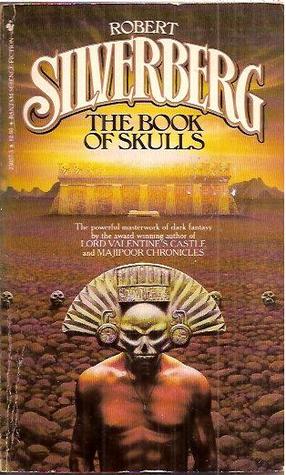
Cover for one of the paperback editions of The Book of Skulls by Robert Silverberg. (Click to embiggen)I was 16 when I found the Book of Skulls in a used book store. The cover blurb talking about four young men on a quest to find a mysterious cult and obtain immortality. I’d read some of Silverberg’s short fiction in both Galaxy magazine and The Magazine of Fantasy & Science Fiction and had generally enjoyed it. Plus it had a cool cover.
The novel is told in rotating first-person viewpoint from each of the four characters: Eli, the Jewish bookworm; Ned, the flaming homosexual; Timothy, the rich boy; and Oliver, the farmboy/jock. They are students at the same college who have formed somewhat unlikely friendships. Eli, who has a gift for languages, found and translated a book about the mysterious Brotherhood of the Skull and their secret of immortality. The book says that four people must present themselves together, and work together to endure the trials of the Brotherhood. Even if they succeed, only two will gain mortality. The other two lives are forfeit: one must willingly commit suicide, and the other must be sacrificed by his fellows…Continue reading Mortality, Im- and Otherwise: more of why I love sf/f→
Lost in Space, 20th Century Fox Television & CBS Broadcasting (Click to embiggen)The first episode of Lost In Space aired on CBS in September of 1965, and I was glued to my set. It debuted less than two weeks before my fifth birthday, so I don’t remember a lot about my feelings about the first episode. If you aren’t familiar, the show follows the adventures of the “space family Robinson” (Professor John Robinson, his wife Dr. Maureen Robinson, their grown daughter Judy, and younger children Penny and Will; their pilot, Major Don West, and their robot called B-9 in the early episodes) who were sent off to be the first colonists of the Alpha Centauri system, except their ship is thrown off course due to the bumbling actions of the stowaway/saboteur Dr. Zachary Smith, who ends up trapped on the ship when it takes off.
Lost In Space is not remembered as being serious science fiction, or even as a serious series. Though this is primarily because of the second and third season. The first season was intended as a serious action adventure series giving a science fictional spin to the early 19th Century novel, The Swiss Family Robinson, which had itself been inspired by the 18th Century novel, Robinson Crusoe. Like those novels, the early episodes focused on the crew as castaways trying to survive in a hostile environment. Some of the sci fi notions of some first season episodes were pretty silly by modern standards, but mostly because they were attempts to adapt the sort of complications that might appear in a western series or a contemporary slice-of-life series and put a spacey spin on it…Continue reading Computerized Clods and Squeamish Scoundrels: more of why I love sf/f→
Hardcover copy of the original version of David Gerrold’s When Harlie Was One.I was thirteen or fourteen years old when I found the copy of When Harlie Was One in the public library. The book jacket described an intelligent machine that has to prove he is a person or be shut down. It sounded really cool. This was during a period in my life where I was literally reading at least one entire book every day. I visited the library constantly, turning in a pile of books I’d finished every few days and checking out more. I read during every free moment. I even read while I was walking to school or while walking home. Yep, I was that kid, walking down the sidewalk with my nose stuck in a book. Books weren’t my only friends, but they were my best friends.
Thinking back, I’m sort of surprised that particular public library in that tiny town had this book. It had only been published a year or two previously. Most of the science fiction they had was stuff that had been around for much longer. Of course, When Harlie Was One had been nominated in the best novel category for both the Nebula Award and the Hugo Award (it won neither) not long before the library acquired it, so maybe that’s why the librarian who ordered new books picked it. I don’t know…Continue reading Thinking Machines and Thoughtless People: more of why I love sf/f→
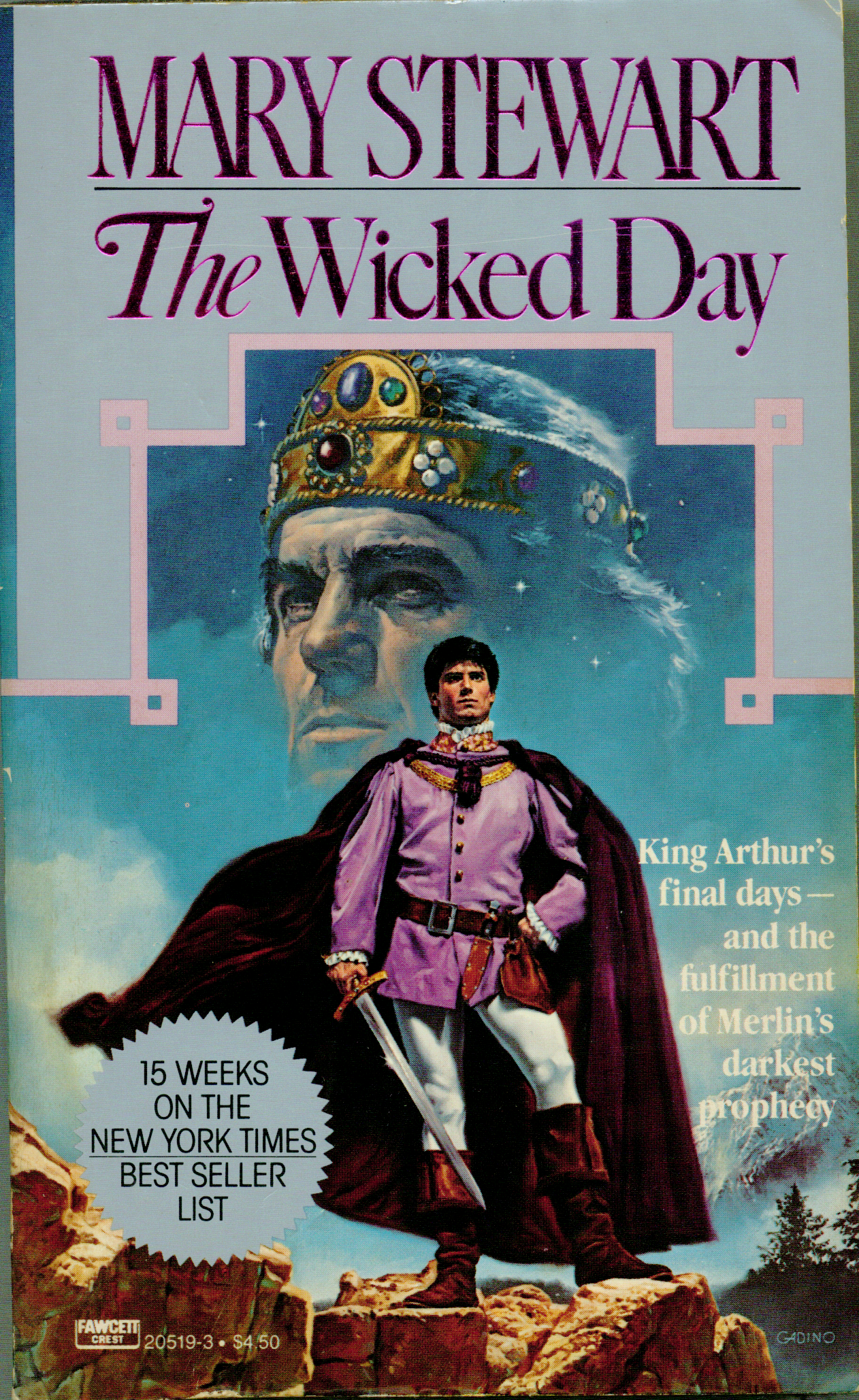
A scan of my own copy of The Wicked Day, by Mary Stewart, purchased back in 1983. (Click to embiggen)In the last two weeks I have written about the first three books in Mary Stewart’s Merlin series. The first three books are first-person narratives told from Merlin’s point of view, while the fourth book is told in third-person, mostly from both Mordred and Arthur’s points of view. Part this choice was necessitate by the fact that the crucial parts of Mordred’s story happen after the death of Merlin, so Merlin can’t narrate it. And if you’re familiar with the classic Arthurian legend, you know that both Mordred and Arthur die at the same time, so neither of them could be the narrator.
Even within the third-person narrative, Stewart shifts perspective. The opening of the book is told in an omniscient viewpoint, the narrator revealing the thoughts and feelings of all the characters. While the bulk of the book is subjective, in some chapters the reader is privy to Mordred thoughts but sees all the other characters through his eyes only. In other chapter’s we are in Arthur’s perspective. Then at the end, she moves t a more objective viewpoint, though not fully omniscient. Anyway, I’m spending so much time talking about this viewpoint stuff, which you might be inclined to think of as the mere mechanics of writing, because in a completely different sense, The Wicked Day is all about viewpoints. Several important plot points turn on the fact that one or more characters is operating on incomplete or completely mistaken understanding. And the theme is about perspectives…Continue reading Dark Prophecies and Evil Half-brothers – more of why I love sf/f→
I couldn’t find a nice large image of the same cover art as my copy on line, so spent a while trying to scan the gold paperback. The best image I got was this one, even though you can see my hands and iPhone reflected in the cover. (Click to embiggen)Last week I wrote about the first two books in Mary Stewart’s Merlin trilogy and how they became the standard against which I measure all Arthurian stories. The third and fourth books in the series came along some time later, and consequently influenced me in very different ways.
Before I get into that, I want to remind you that voting for the Hugo Awards ends tomorrow. If you are a Sasquan (WorldCon 2015) member and haven’t completed your ballot online, do it now before the servers get bogged down with the rush. The ballot is here. If you aren’t a member, you can still buy a supporting membership to become a voter, but since processing a membership might take a while as more traffic hits the servers, time is running out!






 Font Folly