I’ve had several partially drafted blog posts about protagonists and heroes and characters I love reading/watching and characters I love to hate and characters that disappoint and how my feelings as a writer are sometimes different than my reactions as a reader. Which I never seem to be able to finish.
One reason I have trouble finishing any of them is that in many ways it’s one great big nuanced topic in my head, which is impossible to condense into a thousands words, but is just as difficult to break up into meaningful sub-parts without wanting to cross-reference all the other sub-parts. And while the crazy info architect inside me thinks it would be awesome to compose a dozen blog posts each with a dozen footnotes and cross-references to the other, the practical side of me knows that way lies madness.
And then Watts Martin quoted Glen Weldon from NPR’s Pop Culture Happy Hour podcast, and this quote covers one of the big concepts in my nuanced ball in far less than a thousand words:
“We tell ourselves we embrace the antihero because we think it’s more sophisticated. We recognize that the world isn’t black and white, and that moral ambiguity and ambivalence is ‘more real.’ We tell ourselves that, and we’re awfully smug about it, but the real reason we’re doing that—that we embrace the antihero—is because we just don’t have the guts to embrace the hero. We’re too cowardly, we’re too cynical to believe in heroes. We distrust ideals because they’re too hopeful and sincere. If we believed in the heroes that embodied them, it means we’d actually have to risk something, put ourselves out there, be hopeful and sincere and look hokey and uncool. The default reflexive cynicism risks nothing.”
—Glen Weldon
Weldon is talking about anti-heroes, which is a protagonist with the opposite of the usual attributes of a hero (idealism, courage, selflessness), but that doesn’t mean that there are only two types of protagonist possible: hero and anti-hero. An anti-hero is different than an imperfect person being heroic. People rationalize the reflexive cynicism Weldon describes by pointing out that no one is perfect, therefore heroes don’t exist. While it is true that no one is perfect, a person doesn’t have to be absolutely perfect in order to be good.
As a reader, I love rooting for a character who isn’t perfect but is trying to do the right thing, any way. Dan Savage likes to say that a successful relationship is a myth two people build together. You each pretend that the other person is their best self—that best-foot-forward version of yourself you presented on your first date. As time goes on, you each try to do a better job of being that better self. It’s not simply a matter of overlooking imperfections, there is also a process of real change, of transforming yourself into someone who deserves the love of the person you love.
That isn’t just true of romantic relationship. A successful friendship is a similar jointly-created myth. And yes, a good relationship between a reader and a beloved character has some elements of that as well.
As a writer, I want readers to identify with my characters. I want them to root for the characters when the characters struggle. I want them to be disappointed when a character makes a mistake. But just as in real life when a good friend disappoints us, I want my reader to still cheer the character on when the character struggles to make amends. I want my character to be that kind of a hero: an imperfect person striving to be their better self.
It’s sincere and it’s hokey and it’s uncool, yes. But that doesn’t make it unrealistic.
“The worst thing you write is better than the best thing you did not write.”Camp NaNoWriMo starts on Friday, and once again I’m participating. National Novel Writing Month (NaNoWriMo) is the annual event in November where millions of crazy people attempt to write a novel (or at least a work of fiction 50,000 words long). Camp NaNoWriMo happens twice a year as a month to either finish a story you started in NaNoWriMo, or to practice writing a smaller amount to get in the habit of writing every day, or just to work on any writing or writing-related project that strikes your fancy.
You set your own goal and if you achieve it, hurrah! You win. The Camp website has a couple of different features that aren’t part of the regular NaNoWriMo, chief among these are virtual cabins. You can set your account be randomly assigned to a cabin, or you can form one of your own and invite your friends to join. Or not do it at all. The cabin is simply a small chat forum that only members of the cabin can post to and see. So it’s a place you can check in for encouragement or to ask questions, or simply report on your progress.
I’ve enjoyed myself every time I’ve participated. I haven’t always hit my goal during Camp. But I do a better job of staying on target for the month than I do at other times. It helps having a goal and people encouraging me.
Every time that I try to recruit folks I know, there are always some who are reluctant because either they tried it before and it didn’t work, or they don’t think they’ll hit any goal, or the like. And I get it, I do. But missing a goal isn’t failure, it’s just missing the goal. We’re too focused on never making mistakes, and forget that the way you learn is to try, and when you don’t succeed the first time, try again. The analogy I’ve used before is a toddler learning to walk. We don’t remember how many times as toddlers we fell down attempting to walk. But we didn’t give up, we kept trying. And now we do it without even thinking.
Learning anything works that way. Maybe you won’t hit your word count goal. Or maybe the story’s plot won’t go in quite the direction you planned. But that’s okay. You tried, and if you let yourself learn from it—and most importantly, try again— you’ll get better next time.
So, wanna join me at Camp NaNoWriMo? If you’re still in doubt, may I suggest this video to help you decide?
My husband and I had a disagreement the other day on a topic that surprised me. He made the comment that a particular story which won some awards a few years ago shouldn’t have, because it was, as far as he was concerned, a piece of fan fiction, rather than an original tale. I thought it was going to turn into a much more spirited debate, because I have rather strong feelings on the subject. But I barely got a few sentences of my first point out, when he smiled, shrugged, and said, “Okay, I see your point. But I still don’t think the story deserved an award.” And I laughed and replied, “Maybe it didn’t, but that’s a different point than saying it should never have been considered for one.” And he said, “Yeah, I guess.”
And that was it.
Which wasn’t much of a debate. And I have to admit, I was a little disappointed that we wrapped that topic up so quickly, because I think it’s one that deserves more consideration. Which means I’m going to blog about it. Lucky you!
Fan fiction, according to Professor Rebecca Black, “is writing in which fans use media narratives and pop cultural icons as inspiration for creating their own texts.” A lot of people look down on fan fiction, characterizing it as not real writing, often arguing that it is just retelling existing stories, rather than someone telling their own. My first disagreement on that is that all human story telling can be characterized as retelling of existing narratives. Humans have been telling each other stories for tens of thousands of years, and there is no such thing as a wholly original story idea, any longer…Continue reading Confessions of a fan fiction fan→
I was voting in the Locus Awards (annual sci fi/fantasy award poll held by Locus Magazine, which is open to anyone who wants to vote), and was completing the survey portion at the end, when I got to the question, “Do you own a computer? If so, how many?” and I paused for only a moment. See, I personally own three right now: my 7-year-old Mac Pro tower (gigantic thing that was way more powerful than I needed when I bought it because I wanted to be happy with it for years), my Macbook Pro laptop (also known as Hello, Sweetie!), and a 6-year old Windows 7 ultrabook (aka Macbook Air knock-off) for those few old programs I have that I can’t find equivalents of for Mac. Those are my personal computers.
Then there is my iPad Air 2, which I use for several laptop functions, particularly at work, because it is better at them than the clunky old Dell laptops that my employer provided (though we are finally, finally starting to get upgrades this year!). It is clearly a computing device, and a lot more powerful than many computers I’ve owned in the past. And I’m always pointing out that iPhones and high-end smartphones in general are actually pocket computers that obviate a phone, not merely phones themselves…
And then there’s another way to look at it. I’m married, and we’re living in a community property state, so technically my computers also belong to Michael, but more importantly for this survey, his belong to me and… well, I have no clue how many he owns. I mean, he has his older Macbook Air that he carries back and forth to work, and then there is his much nicer Macbook Pro that he uses for more serious portable computing, and then there are, if I just peek at his desk, four PC towers and mini-towers, and I see at least one laptop, and counting how many things are plugged into his giant KVM switch (that allows all of his desk computers to share his monitors, keyboard, and mouse)…. well, if I’m counting those right, there is at least one more computer in that desk somewhere that I can’t see. Plus the Mac Mini in another room that we use as a media server, and I know there are at least two laptops in his pile of “machines I could make usable if someone we know has a complete computer failure and needs something now” pile…
You can see why I have no clue how many computers he owns. So I asked him, “Honey, how many computers do you own?” To which he frowned, looked at me a little bit sheepishly, and said, “I have no idea. Why?”
I decided since he can vote in the Locus Awards himself, that I could just answer 3 for me, and not worry about the rest. Particularly since I could see that a subsequent question asked whether we owned any of the following: smartphone, tablet, iPod, e-book reading device. So I could count some of my other computing devices there.
Thank goodness they didn’t ask how many of those!
I only own the one iPad, myself. But since I have never gotten around to re-selling my old iPhone when I upgraded to the new one, I technically have more than one of those. And then there are iPods other than my phone: one for the car, one that I use as a watch, one that plugs onto my alarm clock and helps wake me up each morning, and I think four spares for the car (because we’ve had more than one stolen from the car over the years). The spares are squirreled away on my desk, so it would take me a bit to find them.
And my husband is worse, because he has more than one iPad he uses regularly (one lives more or less permanently in his bicycle bag. It’s an older one that he salvaged form a junk bin at work where it had a shattered screen and a slightly bent body; he straightened the body, installed a new screen, and may have done some other repairs to it to make it fully functional again).
So I should clarify, for people that don’t know, that one of the reasons we are over-supplied in this technology department is because he works for a computer recycler/refurbisher, and he frequently acquires dead or damaged computers, iPods, et cetera, and cobbles together working devices by scavenging parts out of them. And, truth be told, he did that sort of thing before he started working at this place, he just has a slightly more ready supply of the damaged tech to choose from.
But none of that explains my headphone collection. Because I have a bunch of those. Way more than I could reasonably use. I mean, I can only use one pair at a time, right? Well, it’s just easier to have one pair of wireless headphones that I wear for riding the bus to work, walking home, and so forth, and a wired pair kept with my desktop computer. And a wired pair with a good boom microphone for my laptop… and then there were those gorgeous purple headphones I originally bought for the laptop, but their microphone has degraded a bit, and they’re no longer really good for conference calls to work on my work-from-home days, or skype calls with friends; so I had to get the newer pair mentioned previously, but the sound quality for listening is still awesome, and they’re gorgeous purple, so I can’t throw them out!
And there’s a pair of wired headphones that live in my personal backpack so I have a set of noise cancelling headphones at conventions and such in case I need them. And a backup set of wireless headphones (or four or five, if I’m honest and look in that place on the desk where I keep them) for those moments (which happen with every pair of wireless headphones eventually), when you turn them on and prepare for your commute and you hear that dreaded crackle in one side… or no sound at all from one side. And there’s at least one backup set of headphones in my office bag, in case the wireless ones die while I’m out and about. And another set of wired noise-cancelling headphones that stay at the office so I can deploy them when co-workers (such as certain meetings that happen regularly in the conference room nearest my desk) get too loud and distracting for me to work. And, of course, a backup pair in my “computer things we regularly take to conventions” bag…
See, my headphone addiction is much, much worse than my iPod problem!
And then there are word processing programs! When I counted recently, I had nine or ten on my iPhone, a similar number on my iPad (but they aren’t all the same, because a couple of them are iPad-only, and some that are on the iPhone aren’t on the iPad for one reason or another), and there are way, way, way more on my laptop… Because some of them are better for some kinds of writing than others, and most of them can read each others’ files, anyway, so why not?
And let’s not talk about how many are installed on the desktop computer that aren’t on the laptop, nor why my Windows machine that I almost never use because it’s a backup, really, but it has more than one…
…and there is at least one licensed copy of a word processor that I prefer on my husband’s Macbook Air that I purchased and put on there so I could use his laptop if mine wasn’t available.
At least not all of my addictions are entirely digital. Most of the dictionaries I own are the old-fashioned printed on paper type…
Once again, I’m going to participate in Camp Nanowrimo. Camp is similar to the full-fledged National Novel Writing Month, except they’re much looser on the rules (not that the full rules are that restrictive). Camp Nanowrimo is for doing things such as editing/revising a novel (which you may have written during a previous NaNoWriMo, for instance), or working on a smaller project as perhaps a way to practice for trying to write a full 50,000+ word story in 30 days at a subsequent NaNoWriMo.
I’ve used it in the past to do editing, plotting, and revising. Currently, I’m planning to finish off an editing project, which I have described rather facetiously. Though I’ve been so unproductive working on my novel in progress, that I’ve also been thinking of knocking out a few very short stories I’ve been noodling on for a long time first. We’ll see how I feel after work tomorrow!
Why do this as part of Camp Nanowrimo? It’s helpful to me to have a defined goal, with a clear end date and some mechanism for measuring progress. More importantly, a mechanism for reporting progress so I have motivation not to goof off. In most of my previous Camps and Nanos, I’ve managed to remain focused and accomplish at least most of my goal more quickly than when I’m just trying to meet my own monthly tasks.
I enjoy bantering with my writing buddies, including cheering them on when they make progress, or racing with someone to see who can hit a higher word count on a particular day.
So, I’ve invited a bunch of my past writing buddies to be cabin mates (a cabin is a group of participants who share a private message forum and can easily keep track of each others’ progress on the cabin web page). I think we’ve got a good group.
I was catching up on some podcasts last week, specifically going back through episodes that I had started but not finished. I was listening to Cabbages & Kings, which is a sci fi/fantasy podcast that focuses on books and other written stories, with a focus on the things readers love about the experience of reading. In that specific episode the host, Jonah Sutton-Moore, was discussing queer romance in sf/f with Carl Engle-Laird who is an editor at Tor Books and is bisexual. It was a good episode, but I was shocked when Engle-Laird said that he had only recently learned about the Tragic Queer Trope/Cliché, and specifically that he had learned about it after he had already selected two books for publication in which the only queer character in the story dies. He says something along the lines, “I had just learned about this cliché and the pain it causes so many people, and I was about to publish two books that fit it and realize there’s trouble coming my way.”
The host of the podcast shared a similar story, about how he had reviewed a book in which the two main characters, who happen to be lesbian, overcome the obstacles of the plot and apparently live happily ever after. In the review he had expressed some surprise at how many rave reviews he’d read of the book before reading it himself. Not because the book wasn’t good, he didn’t see that it was a breakout book as so many reviews described. People reading his blog had to tell him that what felt groundbreaking about the book was the fact that the queer characters not only lived to the end of the book, but actually got a happy ending.
I’m not shocked that the straight host of a sci fi podcast was unaware of the prevalence of the phenomena described at TV Tropes as Bury Your Gays and Gayngst, or a bit more honestly explicitly at places like Another Dead Lesbian or The Curse of the Tragic Lesbian Ending and so on. I was disappointed, but not shocked.
It was the queer editor not knowing about this cliché that shocked me.
And I want to be clear, this isn’t meant to be a slam at either the podcast host nor his interviewee. I’ve been listening to this podcast for months, I like it (heck, I nominated it in the fancast category for the Hugos this year!), I listened to several more episodes after the shocking moment (and I’m all caught up again!), and will continue to recommend it.
But I’m still always disappointed when people in the business are unaware of just how unwelcoming to queer people most pop culture is in general, and sci fi/fantasy is in particular.
I realize that it is hard for non-queer people to grasp this, since they are so used to seeing themselves reflected in every show. Any time I’ve talked about a specific instance of “Bury Your Gays” with non-queer friends, their first reaction is always to explain to me that other people die in the book/movie/series. It isn’t that queer characters should never die. The problem is that nearly every queer character depicted in a relationship in pop culture either dies, or is left alone, bereft, and grieving over the death of the only other queer character in the story at the end.
All. The. Time.
That’s on the rare occasions that queer characters in relationships are included at all. Most often, queer characters simply aren’t in the stories. In those rare cases where queers are included, they are unattached romantically without any plot line other than to be the funny/eccentric sidekick to a straight character, or they die. And quite often it is a senseless death that exists for no reason other than to shock the viewer and give one of the surviving characters a reason to grieve and motivation to accomplish their goal.
One of several infographics at jcwelker.com/post/141225630214/vandelrio-nonadraws-this-is-my-final-projectIf you think I’m exaggerating, here’s a couple of statistics for you. According to GLAAD, out of the 881 regular characters appearing in all of the primetime network shows during the fall of 2015, 35 of them were lesbian or bisexual women. We are now just a bit over 80 days into 2016, and since January 1, eight of those fictional women who love women have been killed on screen. That’s nearly one quarter (22.85%) of all the women who love women that have been allowed to appear on television screens this year killed.
Imagine, for a moment, if in the last three months 22% of all the regular characters on every single show on network TV had been killed off on screen. That’s 194 characters, almost 2.5 a night. Seriously, if regular characters were being killed off on every television show at that rate, people would be up in arms. They would be sending angry messages to networks executives asking why there is so much more violence in every show. The Daily Show and/or John Oliver would have some epic comedic rants about the murderous spree that all of the network producers had gone on, and those rants would be viral on Youtube.
Right?
If one quarter of all regular characters on network television shows were killed off every 80 days, then every show would have effectively a complete cast turnover every television season. And that makes no sense for a continuing story over multiple seasons, so no show-runners in their right minds would do that.
Fictional murders, senseless deaths on screen, et cetera are not random acts of violence. They are decisions that show runners and writers and network executives make. People are making the decision to kill off queer characters at a much higher rate than any other category of fictional character. Just as a lot of us have called bullshit on writers, producers, and executives who claim they can’t add a queer character to an existing series or franchise until the “right story” comes along, it is at best self-delusion when the decision-makers try to claim that it is just a coincidence that they kill off queer characters at such a high rate.
It is sometimes argued that the only reason that we notice when queer characters are killed off is because there are so few of them to begin with, therefore each loss is especially keenly felt. But that ignores the disproportionate rate of the deaths. Yes, if a quarter of all characters appearing in regular recurring roles in all shows were killed every 80 days, we could argue that the only problem is how few queer characters there are. Even if that were the only reason, the lack of representation itself would still be a problem, as I’ve argued before: Invisible no more: rooting out exclusion as a storyteller.
The truth is that both the lack of representation, and the excessive rate of disposal of the few examples of representation we ever get are symptoms of a deeper problem. Author Junot Diaz summed up the real issue best:
You guys know about vampires? You know, vampires have no reflections in a mirror? There’s this idea that monsters don’t have reflections in a mirror. And what I’ve always thought isn’t that monsters don’t have reflections in a mirror. It’s that if you want to make a human being into a monster, deny them, at the cultural level, any reflection of themselves. And growing up, I felt like a monster in some ways. I didn’t see myself reflected at all. I was like, “Yo, is something wrong with me? That the whole society seems to think that people like me don’t exist?”
There is an agenda to deny us representation—to pretend we don’t exist at all if possible, or to make certain we are perceived as monsters, freaks, or tragedies if we must be acknowledged. Whether a particular storyteller consciously agrees with that agenda or not, whenever you leave us out, or kill us off without thinking about the message it sends, or sit by silently while someone else does those things, you are serving that agenda.
I learned to type on my mom’s Easter pink Smith-Corona Silent-Super typewriter. I was ten years old, when Mom decided that I since I couldn’t keep my hands off it, she should teach me the proper way to use it. So she set me up with her old How to Type book it wasn’t long before I was whizzing along, hitting about 60 words per minute on the little mechanical wonder.
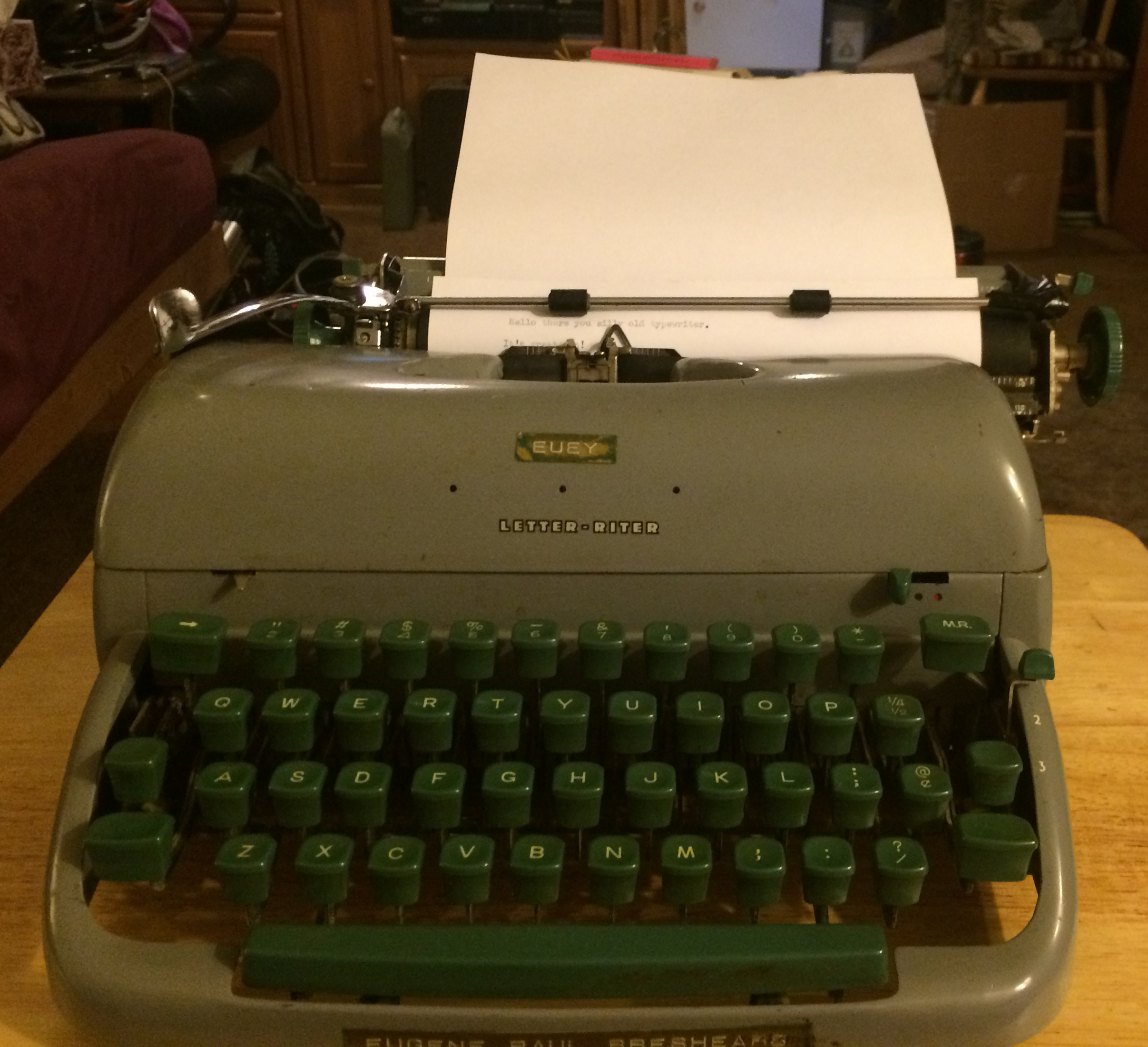
When I was twelve, my paternal grandmother gave me her 1952 Remington Letter-Riter. It was a much heavier typewriter than the Silent-Super in every way. Pushing the keys took more effort, and the typewriter was built like a tank. It also had a slightly different keyboard arrangement, more traditional than the Silent-Super. Older mechanical typewriters didn’t have a 1 (one) key. If you needed to type a 1, you’d use a lowercase l (el) instead. There also wasn’t an exclamation point. To type !, you would type a period, then backspace and type an apostrophe. There was no + (plus) sign or = (equals) sign, though it did have a key for ½ (half) and ¼ (quarter).
This is the 1952 Remington that once belonged to my grandmother, and then has been mine since about 1973 (click to embiggen).If you click on the image, you might also notice that the symbols on the top of the number keys are different than a modern computer keyboard, as well. You got quotation marks by pressing shift-2 instead of being on its own key, while the apostrophe was shift-8, and underscore was shift-6. The @ symbol and ¢ (cents) sign were on their own key, over where modern computer keyboards usually put the quotation and apostrophe key.
This is not the Silent-Super I learned on, as Mom’s was lost under less than pleasant circumstances. This is one my hubby bought me for my birthday that I’m still restoring. (Click to embiggen)The Silent-Super had a 1-key and exclamation point. The arrangement was otherwise the same, though the size and shapes of the keys—particularly the tab, backspace, and shift—were different. My grandmother had a newer typewriter that had a lot of special keys, such as a £ (pound currency) symbol, a ÷ (division) symbol, + and =, (greater-than) and even a \ (backslash). She was an accountant and that typewriter was aimed at financial offices. Anyway, I also occasionally typed on her machine, with its own slightly different layout, and I could got just as fast on any of them.
In high school I finally took an actual typing class, which was the first time I typed on an IBM Selectric keyboard. It wasn’t a manual typewrite. It was still mechanical in that a physical object had to strike an inked ribbon and sheet of paper to make the letters, but the force was delivered by an electric motor instead of my fingers. It was much more like a computer keyboard in that way. The amount of force to press the key was practically nothing compared to the manual typewriter. It is still the funniest thing to see when I run a Writers Round Robin event at a convention: people too young to have used a typewriter really freak out at how hard you have to press the keys to make the letters appear.
I didn’t need the typing class to learn to type, I was already proficient at touch typing, but back in the 70s you actually had to have passed a typing class to get into some journalism programs and the like when you moved on to university, so I took the class for the credit. The teacher was a little shocked with I did more than 100 words per minute on the first speed test. Since it was early in the course, I wasn’t typing real words, I was just typing groups of four letters from the home row from a slide she was showing us, something like: “jfjfj kkkk dddd jkjkj fdfd jkl; fdsa”
I told her I already knew how to type, so she grabbed a sample letter to copy and made me take the test again, this time reading the letter and transcribing it. I still was over 100 words per minute.
Over the years I’ve gotten used to various computer keyboards. The old clack-clack IBM Model M that many people still love, being just one of many. And many of them have some keys in unusual places. Some have keys that others don’t. And I take to all of them pretty quickly. I would be slightly surprised when some people complained about a couple of moved keys. It usually took me only a few minutes to acclimate to a new layout.
I was a little surprised, when my husband finally got me to use an iPod Touch, at how quickly I adapted to thumb-typing on a small keyboard where I couldn’t feel the keys at all. My favorite app for a long time was WriteRoom for iOS (it had its own automatic cloud sync back before services like Dropbox were around), and I would write scenes on the bus on my way to work each morning. One time while I was doing that, a bunch of the bus passengers all started turning around and staring at me. So much that I noticed and looked up.
It took me a couple of minutes to figure out what had happened. Somehow the settings had changed, and the iPod was making key noises through its speaker. I had my headphones on playing musc (also from the iPod), and couldn’t hear the keyclicks. I found the setting and turned it off. I said, “Sorry about that” sheepishly. One of the other passengers chuckled and said, “I just never heard anyone text that fast and that long before!” So I explained that I was actually writing a book. “On your phone?” And then I had to explain that it wasn’t even a phone.
It shouldn’t have surprised me, some years later, at how quickly I took to the iPad’s virtual keyboard. When Michael and I bought our first iPad (the iPad 2, we waited for the second model), we weren’t certain we would actually use it and not treat it as a temporary toy. So we only bought one to share. I would take it to work one day, he would take it the next, and so on. It wasn’t long before it was clear that both of us needed our own.
At the time, my employer-provided Dell laptop had become a faux laptop. The battery wouldn’t hold a charge for more than about 10 minutes (we never did get new batteries as promised, of course). So it was useless for taking to meetings. And I frequently need to take notes at meetings or look things up to answer questions, so that was a bummer. Except I started taking the iPad, instead, and I could look up some work things without even logging in a VM. But the part that surprised me was how easy I switched to typing long, detailed notes during the meeting on the virtual keyboard. I do find it slightly annoying switching between numbers, other symbols, and back to letters. Mostly because the key to move from numbers to symbols is not in the same location as the key to move from letters to numbers. But otherwise, I’m okay typing on the virtual keyboard.
I do have a bluetooth keyboard that I use if I know I’m going to do a really long typing session. My hubby gave me a nice solar-powered one a few years ago. It is really nice, but it requires me carrying around a bag, since it is bigger than the iPad.
So I’ve been looking at keyboard cases off and on. My husband has had a couple of them. I think his favorite is a fairly high end Logitech. I’ve tried his, and they’re pretty good.
My new keyboard case. Yes, the fact that the backlight could be set to purple was a selling point.But I wasn’t convinced that I should spend the money on one for myself. But I keep wishing when I’m at conventions and similar events, that I had a more portable version of my Bluetooth keyboard. Then last week, I noticed that one of the models I’ve had in my private wishlist had come down in price a bit, and NorWesCon is coming up, so I bought it. It isn’t bad. Several reviews of it complained about the backspace being so tiny and the placement of a few other keys, but it only took me three tweets before I was hitting it correctly.
The keyboard itself feels fairly solid, but the case as a whole is a little flimsy. I suspect that if I carried it back and forth to the office in my backpack with this case that the keyboard would get enough wear and tear to account for the small number of reviews complaining about the keyboard dying after only a few months. I don’t currently plan to carry the iPad in the case most of the time. I can do the type of typing/note taking I do on the iPad at work just as easily with the virtual keyboard. It is definitely easier to type on than the virtual keyboard, and the keys feel nice enough. Not as good as my solar Logitech, but perfectly usuable.
It’s not as if I don’t already have multiple keyboards for just about every device. Because I am a keyboard addict.
Cover, Astounding Science Fiction, July 1954. The prevalent belief, at the time, was that the vast majority of readers were men. What does that tell us about the intention of this artwork? (Click to embiggen)I get tired of having to defend my wish that stories include diverse casts of characters. Not just because I’m a gay man who wishes that my favorites shows, books, and stories would include people like me, but because I remember what it was like being a queer child and having no idea that there was anyone else in the entire universe like me. And therefore, I can empathize with other children who aren’t straight white cis males who never see people like themselves as the heroes of any story, and thus grow up not thinking that they have a place in this world.
But as I’ve said before, it isn’t just about having characters that various readers in your audience can relate to. It is also a matter of portraying a believable world. The real world has people of different genders, races, sexual orientations, and so on. It is simply unrealistic that a random sampling of any fictional world is going to consist solely of white, cisgendered, straight people. Especially the overwhelming majority of them male.
And there’s one other aspect, but award-winning sci fi/fantasy author, Saladin Ahmed explained it in a succinct set of tweets:
Ahmed is referring to the likely fanboy reaction to this article: J.J. Abrams says Star Wars will get an openly gay character. And the word “likely” is wholly unnecessary, as I’ve already seen angry reactions to the article around the net.
As he said, the people who object when a non-white person is cast in lead role in a movie that isn’t about race issues, or queer characters are included in a story, and so on, always argue that it’s just furthering a political agenda to include any non-white, straight characters. Especially when it comes to queer characters, they angrily ask, “Who cares who is having sex with who?”
Well, obviously, if you’re getting angry, you do.
But let’s go back to the original Star Wars trilogy, for a moment. I was in a very crowded theatre on opening weekend for Empire Strikes Back, and when Leia declared, “I love you!” then Han replied cooly, “I know!” there were whoops and lots of exclamations of, “YES!” from all over that theatre. Three years later, at the first showing of Return of the Jedi, when Leia and Han have their big kiss at the end, there were even louder cheers and clapping. So a lot of people did care about who was in love with who, who was kissing who, and so on.
I want to repeat that: fanboys cheered and applauded a kiss near the end of a special effects-laden space opera adventure story.
So, they did care and they still do care about who is in love with, who is kissing, and yes, who is wanting to have sex with who.
It goes back much further into the history of science fiction and fantasy than Star Wars, of course. The reason that those earlier examples almost never included any same sex relationships is not because there weren’t any queer writers or readers of science fiction, it was because everyone was closeted. They weren’t closeted because they wanted to be, but because they often had to be. Remember, until the Supreme Court ruled in 2003 that intimate consensual sexual conduct was a fundamental freedom protected by the Constitution, same sex activity was a criminal offense in many places.
We have always been here. For instance, in the 1920s and 1930s, Edgar Pangborn wrote a lot of pulp stories in the mystery, fantasy, and sci fi genres which featured very passionate male “friendships.” The relationships were never overtly gay, but clearly were meant to imply it. He wrote those stories under a variety of pen names. He didn’t start publishing stories under his real name until the 1960s.
Jim Kepner was the publisher of one of the first magazines advocating for gay civil rights, ONE Magazine, beginning in 1953. But before that, operating under the fan name, Jike, he was an active member of the Los Angeles Science Fiction Society. During the 1940s he published a sci fi fanzine called Toward Tomorrow. Within that ’zine, and in other fanzines, he was only one of several fans who wrote speculatively of how society might evolve to include greater gender equality, racial equality, and acceptance of various sexual orientations.
A page from a science fiction fan zine from the 1940s, with Tigrina (Lisa Ben); not to mention Ray Bradbury. Courtesy ONE Archives/USC. (Click to embiggen)Another member of the Los Angeles Science Fiction Society back then, Edythe Edye operated under the fan name Tigrina. In 1947, using the pseudonym Lisa Ben, she founded Vice Versa, the first lesbian magazine published in the U.S.
In 1953, when straight author, Theodore Sturgeon, explored gay themes positively in the short story “The World Well Lost,” it caused at least one editor to try to organize a blackball system to prevent it, or anything like it ever being published. The blackball scheme didn’t work. The story was published. Some people liked it, some didn’t. Sturgeon and other writers occasionally returned to the subject over the next couple of decades.
It was far more common, yes, for queer characters to be portrayed negatively. In some works, you could tell how far into the depths of evil a character had plunged by how much bisexual or homosexual activity they engaged in—Dune’s Baron Harkonnen being a prime example. My point is that queer fans and writers and artists have been around for as long as science fiction and fantasy have existed. The argument about whether or not we should be allowed to participate or be portrayed has been around just as long.
Queer people have been around for as long as people have existed. They will exist in every fantasy and science fiction world. Whether they can safely live openly in those societies will vary, just as it does now in the real world, and has varied in different historical periods. If your fictional world doesn’t include us, it is unrealistic. If your fictional world doesn’t include us, you either really suck at world building or you suffer from heterosexism. If you claim you can’t include us until the right storyline comes along, you may be in denial about how much homophobia (subconscious or not) you harbor.
Not every story will include romance, obviously. I have discussed with some folks the fact that in my current series of fantasy novels, while there are several characters I know who are bisexual or pansexual, most of them aren’t obvious. There is at least one clearly identified gay couple, and several clearly identified straight characters, but that’s it2. So, I’m a queer writer who isn’t sure I’m representing queer characters enough. Therefore, I’m not saying that writers who don’t have a lot of obviously gay characters in their work are bad people.
I am saying that if you have absolutely none at all, that is just as much of an “agenda” as anything certain people accuse queer people of pushing when we ask for inclusion. Whether consciously intended it, or not, that’s at the very least enabling an anti-gay agenda.
Footnotes:
1. Yes, that is an anagram of lesbian, and she did it intentionally.
2. There are shapeshifters in my universe, and at least one shapeshifter who has appeared prominently could be interpreted as a trans character. There are other characters in the world that are definitely transgender, but haven’t yet appeared in a story3.
3. I’m not advocating quotas. As Mr Ahmed said above, quotas are bad for art, but so is monotony.
Click to embiggen.There’s a lot of really good advice out there about beginnings in fiction: how to write a good opening line, common traps to avoid, and so on. Unfortunately most of those articles and blog posts focus on the actual first sentence or paragraph, rather than the bigger question of where to begin the story. Because life seldom has clear-cut beginnings and endings, authors have to decide where to start and where to stop.
Years ago a friend shared an article from Writer’s Digest that referenced the old Krazy Kat newspaper comic strip, which had a running gag involving one of the characters getting hit in the head with a brick. The article said that the place to begin your story is the moment your protagonist his hit in the head metaphorically by the problem or conflict or riddle which forms the basis of the plot. The moment when the character realizes this is a big problem. The moment when the character discovers that this isn’t just going to be another day in her life.
I read a lot of amateur fiction, fan fiction, and rough drafts of other people’s work. And I’ve noticed that lots of people don’t understand that. They start the story long before the brick. They may still start the story when something disruptive happens in the character’s life, but it’s more like a moment that they character stumbled on a door step, days or weeks or months before the brick.
The worst are stories that end with the brick. We meet a character who is in a difficult situation. We meet some of the other characters in the protagonist’s life. Things happen and the situation gets worse. We see the character struggle with the issue, trying to figure out what’s really happening. The character attempts to get out of the bad situation a few ways, and either fails entirely or achieves a temporary relief that leads to a worse situation. And then there’s a big dramatic, shocking moment… and the story just stops. We’ve finally reach a point where the story has gotten really interesting, and the writing snaps the book closed and snatches the story, metaphorically, from our hands.
I just finished a story like that, where the character suffers through a lot, persevering through an unjust imprisonment and enduring various indignities, making a teeny bit of headway with one of the other prisoners, and then finally learning a little bit about one (and only one) of the mysteries the writer had been teasing us with for the entire story, and then that was it—an previously unseen character whose existence had been hinted at appears, causes a lot of damage, rescues the other prisoner and leaves. We get a denouement in which the protagonist is released, receives an apology of sorts from some of the authorities and goes. We never know what happened to any of the specific people responsible for the imprisonment, we never learn why a lot of the things that happened to the character happened, et cetera.
That’s not an ending, that’s an abandonment!
I know that someone will defend the author’s decisions by saying that we don’t always get all the answers in real life, and that bad people don’t always get what we think they deserve, and so on. But this isn’t real life. It’s fiction. The difference between real life and fiction is that fiction has the make sense. The author is free to tell and omit what he or she wants, yes, but never forget that it is a sin to waste the reader’s time. You may not want to tell the story about the mysterious character who rescues one of the others in the end for whatever reason. But by structuring the rest of the story this way, the author has teased the reader. Worse than that, the author has misled the reader. The author has laid out a lot of intriguing questions, sprinkle in some enticing tidbits, clearly implying that those breadcrumbs would lead to something interesting. And then the author didn’t deliver.
It’s a bait and switch.
Don’t get me wrong: leaving some things open-ended for the reader to debate and wrestle with is all right. But the conflict introduced the beginning needs to be resolved (by the protagonist’s own actions) at the end. Not solved, necessarily, but resolved. I failure to solve the problem is a resolution, after all.
This particular “story” isn’t actually a story, it’s the backstory to a story the author didn’t write. At least the way it is structured. It’s like. Sci fi story I read a long time ago in which a journalist is approached by a crackpot claiming people are being replaced by robots. The journalist doesn’t believe the guy at first, then various things happen that make it seem there might be something sinister going on, then the crackpot suddenly changes his tune, insisting he was mistaken and off his meds. The story ends with the journalist laying in bed, unable to sleep, something makes him check his wife for a heartbeat. And the final line of the story is that he can’t hear a heart beat in her chest, just a mechanical whirring!
It might have even ended with more than one exclamation point.
That wasn’t an ending, that was a beginning. Because the interesting tale isn’t that people don’t believe dangerous things are happening around them. The most interesting conflict is: what do you do when you find out your loved one has been replaced by an android?
Go back to the brick. Crackpots spout nonsense at people all the time. You don’t have to be a journalist to have some stranger come up to you and make extraordinary claims. Just stand at a bus stop on a busy bus line for a few hours and it will happen a lot. If you are a journalist, it must be even more common place. So that wasn’t a brick, it wasn’t even a stumble. It was business as usual. The brick was finding out the crackpot was correct. The story scould have begun with, “Everything fell apart night John discovered his wife had no heart. He had been chuckling to himself just before hand. A crazy man had contacted him, insisting he had proof of a conspiracy. John had known it had to be a delusion, despite all the evidence and the strange incidents that happened with the cars with darkened windows and mysterious sounds behind closed doors. He had only checked as a joke. It would make a funny story to share at the next cocktail party. But then he put the stenthoscope to her sleeping chest…”
And then you go from there. You don’t need all the back story. You can fill in details later, if needed. Fit the facts the reader needs to understand in dialog, that sort of thing.
Find the brick. Hit your character in the head. And then show us what she does about it!
“The writer cannot make the seas of distraction stand still, but he [or she] can at times come between the madly distracted and the distractions.” – Saul Bellow via AzQuotes.com (Click to embiggen)Any time I pause to do something which I think will only take a few minutes, I run the danger of the one thing leads to another curse. It happens to me all the time! Most especially when I’m trying to write. I’ll stare at the scene that I’m trying to finish, for instance, pause to reach for my coffee or tea and as likely as not the cup isn’t there where I expect it be.
So I’ll get up and go looking for the cup. Which may simply be sitting on the kitchen counter, where I left it while I was refilling it from the coffee maker, and was distracted by something else. Or it might be up in the bathroom, because right as I was refilling it I decided I should make a pit stop, and I carried the cup with me where I sat it beside the sink and then forgot about once I was done. Or maybe it’s in the microwave, because an hour previously my nearly full beverage had been too cold to be appetizing, so I took heated it up, and then forgot about it.
If it is in the microwave, it has probably cooled back down, so I’ll hit the button to reheat it, and head back to my computer determined that this time I will notice when the microwave dings and come right back. Which means that I’ll sit at the computer staring at the screen, but I’m not really thinking about writing, I’m listening for the ding of the microwave. And I’ll go retrieve the drink this time…Continue reading Confessions of the badly, madly distracted→
 I’ve had several partially drafted blog posts about protagonists and heroes and characters I love reading/watching and characters I love to hate and characters that disappoint and how my feelings as a writer are sometimes different than my reactions as a reader. Which I never seem to be able to finish.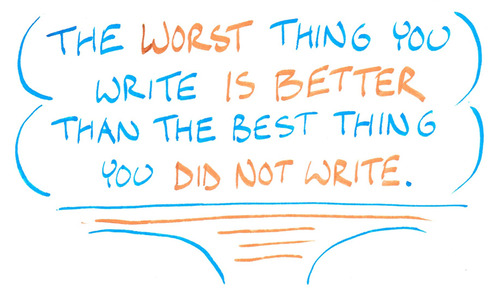





!["The writer cannot make the seas of distraction stand still, but he [or she] can at times come between the madly distracted and the distractions." - Saul Bellow](https://fontfolly.net/wp-content/uploads/2016/01/quote-the-writer-cannot-make-the-seas-of-distraction-stand-still-but-he-or-she-can-at-times-saul-bellow-74-24-32.jpg)
 Font Folly