Tag Archives: writing

Struggling with meaning

I wrote yesterday about why I believe storytelling shouldn’t be preaching. I’ve also written about how author’s values inform stories, usually not in the ways you think.

Sometimes stories come about because the author is trying to figure something out. We write the tale hoping to find that answer. I wrote a story set in my Trickster universe that was one of those. I’d had the bare bones of the conflict in my head for a long time, a kind of just-so story to answer a question about how one of the characters got into a particular vocation. But while I had an opening problem, I didn’t know how it ended, so it sat in my big list of story ideas on the hard disk for a couple of years.

Completely unrelated, I had been struggling for a long time to understand a particular zen koan. And it occurred to me, one day, that this character’s struggle might be something like the koan.

The next thing I knew, I was writing a story… And what came out was something called “The Luminous Pearl, or the Second Tail of Sora.”

Go give it a read, and tell me what you think.

Storytelling should not be preaching

Brandon Ambrosino, writing for Vox, asks, “Why are Christian movies so painfully bad?” He’s writing specifically about the recently released movie, “Old Fashioned,” though he mentions a few other recent examples. The full article is worth a read, but I want to focus on a couple of points:

As Daniel Siedell, Art Historian in Residence at The King’s College in New York City, notes, “For [Evangelical Christians], culture is a tool, a more effective way of getting at political realities, or winning the battle of ideas in the public arena.”

Siedell uses the following analogy with his students to explain what he means.

Imagine a gorgeously wrapped gift sitting under a beautifully decorated Christmas tree. The presentation of the package, while pretty, is nowhere near as valuable as what’s inside.

Now, he says, extend that idea to Christian art. The artistic qualities of a work become the unnecessary wrapping paper. As such, it doesn’t really matter how good or bad they are.

That’s why it doesn’t matter that Old Fashioned is often very boring. It doesn’t matter that the script bursts at the seams with overwrought dialogue, or that the actors (outside of lead actress Elizabeth Roberts) offer phoned-in performances.

Ambrosino eventually disagrees with this point, but I don’t think he does so as vehemently as he should. Quality is not just the packaging. Quality is an inherent property of the entire work of art. When you think you can make a work of art and treat the artistic qualities of the work as superfluous, you are not making art. Period. I understand the mind set of the evangelicals, believe me! I was raised in that sub-culture, and once people noticed I had what they considered Talent, everything I wrote and did was evaluated through that lens of whether they felt it was proclaiming the message of Christ.

I tried to make one of Ambrosino’s points at the time: if the quality of what we produce is a turn-off, it doesn’t matter how important the message is. People will never listen to your message if they are bored by your story/movie/what have you. But it always fell on deaf ears.

Part of the problem with both my argument then and Ambrosino’s now is that we’re conceding something that we know is wrong. In order to try to make the argument that they should try to be better at making art in order to get their message across, we are buying into the fallacy that art is merely a means to deliver a message. It’s their argument:

Brian Godawa, Christian screenwriter, thinks it’s important to note that Christian films aren’t the only ones that are explicitly preachy. All films, says Godawa, “have messages to some degree or another, and writers and directors know full well they’re embodying those messages in their storytelling.”

I’ve written before that it is impossible to create art that is true to yourself without your values informing the work. That’s not the same thing as a message. I know that I’m a big believer in hope, so my stories, even when I write things I considered very dark, always have some hint of a glimmer of hope. But that isn’t the same as a message. I don’t write a story because I wish it will make other people feel the same way about hope as I do. I write stories because the stories want to be told. My own perspective will always be to look for that glimmer of hope, so I see the stories that way.

But each reader will have his or her own perspective, as well. And even though I am the storyteller, it’s their story, too. Their interpretation of what the story means (to them) is just as valid as mine.

And while I often have very strong opinions about the stories, art, and music I love; I understand that they are my opinions. I may think that your opinion about that particular piece of art is utterly wrong, but I will defend your right to express it. I may debate you about it, but I expect you to argue back.

That’s the difference between trying to send a message and letting your belief inform your artistic endeavors. I don’t consider it a failure if a reader doesn’t agree with me at the end. I don’t even consider it a failure if some readers don’t like the story at all. I especially don’t consider it a failure if a reader feels compelled to tell me just how much they hated one of the characters, or that they are angry at me about how the story ended.

Because in order to hate a character, you have to believe in the character. In order to be angry about how the story ended, you have to become invested in how it ends.

Don’t get me wrong, I love hearing from readers who tell me they liked something, or that they found a particular character adorable. Someone told me that recently about a pair of characters in one of my stories, and I just about died from pure happiness. But you know what? A few years ago when one reader wrote to tell me, in regards to a particularly ruthless character I had written about, “I don’t trust him at all!” and others wrote to tell me how much they loved the same character, I just about died from glee.

The people who are delivering messages want one and only one reaction to their story. You must agree with them. If you don’t agree with them, you have failed to learn the lesson they are so desperate to teach you.

And that’s completely backwards from how it ought to me.

Runaway hits

http://endsexualexploitation.org/fiftyshadesgrey/ (Click to embiggen)
I was working on a post about one-hit wonders of various kinds—both the pop song phenomenon and the runaway bestselling book version of that. The impetus, of course, was the upcoming release of the movie Fifty Shades of Grey based on the book of the same name that should be more accurately titled Fifty Shades of Converted Fanfic of Predatory Domestic Abuse because it started out as a literal fanfic of the Twilight series which is a collection of godawful books with a heroine who is actually nothing more than a stalking victim suffering history’s worst case of Stockholm Syndrome.

Not that I have any strong feelings about it

Anyway, I had this post in progress, and then I took a break to skim through Tumblr where I saw a pair of short posts by Neil Gaiman that made all of the points I was making, only much more succinctly.

So I abandoned the post. But then comes news of a new Harper Lee novel-fifty-four years after the publication of her first novel, the Pulitzer Prize-winning To Kill a Mockingbird. And that made me think about the idea of a one time runaway hit in a new way… Continue reading Runaway hits

The serialist’s dilemma

My lynx plushy seated at my laptop.
I wish I looked as cute sitting at my laptop as my lynx plushie does.

When we experience a story we enjoy—whether it’s a novel, movie, episode in a television series, comic book, whatever—it’s natural to want to feel that enjoyment again. This need can often be satisfied by re-reading or re-watching, but sometimes that isn’t enough. Maybe there was a supporting character that we become particularly enamored with and we just wish more of the story had focused on them. Or perhaps it was a subplot that really intrigued us and we’d like to see more of that particular dynamic. Or it could be a single line of dialog that alluded to a past event that sounds very interesting and we’d like to know more about what happened. Or it could just be that we want to know what happened next. None of those desires can be satisfied merely by repeating the original story.

In any case, we wind up clamoring, “More! More! Give me more!”

When you’re the storyteller, this is a very flattering thing to hear. The audience liked your story! They love your characters! They want more…. Continue reading The serialist’s dilemma

Saving the world once a week

© and ™ Turner Entertainment Network, Inc.
A lot of TV shows could be summed up (jokingly or not) as being about Saving the world every week. Some of my favorite shows of all time (Buffy the Vampire Slayer, for instance), could be described that way. One such show this winter was The Librarians, where they embraced the idea so much that there was a running gag of different characters sometimes making a reference to saving the world every week.

A few weeks back my husband came into the room while I was in the middle of an episode, and after watching less than a minute, he asked if it was a Warehouse 13 knock-off. I had to point out that the series was a continuation of a set of movies which pre-dated Warehouse 13 by several years. The first movie, The Librarian: Quest for the Spear was broadcast in 2004, five years before Warehouse 13 (the entire trilogy of Librarian movies were made and released before the first episode of Warehouse 13). Both the Librarian and Warehouse stories owed a big debt to Raiders of the Lost Ark and the other Indiana Jones properties, of course… Continue reading Saving the world once a week

The idea of ideas, part 3

I’ve written about how having an “idea” is not as important to storytelling as many think, and why specific questions about “ideas” can be so misleading as well as off-putting. As at least one commenter pointed out that while those posts show that focusing on ideas is the wrong thing to do, I don’t explain what the right thing to do is.

Except I did.

I know you’ve heard it a thousand times before. But it’s true – hard work pays off. If you want to be good, you have to practice, practice, practice. If you don’t love something, then don’t do it.
—Ray Bradbury

In the first post I said that focusing on ideas is like a carpenter obsessing over a single nail instead of getting on with the task of building a house. And that analogy has the answer, if you just stop and ask, how does a carpenter learn how to build an entire house from scratch? The answer is that there isn’t a short simple answer. You have to learn about how the tools work. You have to learn about which building materials go where. You have to learn about foundations and framing and supports and seals and scores of other things. You have to practice. You have to have someone look over your work from time-to-time during your practice and tell you whether it seems to be working. You have to build little projects and then put them to the test—see if they do the job you intended them to do and how they hold up against the elements.

It’s not a simple process. No one, not even someone as awesome as Neil Gaiman nor as wise as Ray Bradbury, can tell you in only one or two sentences exactly, step-by-step, how to be a successful storyteller. We can tell you things that work for us. We can point you in the correct direction. We can offer encouragement.

We can give you truths in a nutshell, such as, “The way to be a writer is simply this: write.” But you have to understand that those sorts of truths are like zen koans. The answers come from you struggling with the simple statement and the unspoken complications within.

We can write articles and blog posts about our process. We can point you to excellent books on writing (Building Fiction by Jesse Lee Kercheval, The Art of Fiction by John Gardner, Zen in the Art of Writing by Ray Bradbury, On Writing: A Memoir Of The Craft by Stephen King, How to Write a Sentence: And How to Read One by Stanley Fish, to name but a few). We can try to answer specific questions. But there are two very important things to remember about that. First, we’re humans trying to get along in life just like you, and time we spend giving advice to you is time that we aren’t writing or otherwise earning our own keep. Second, what any of us know took us years of trying, failing, trying again, and slowly learning how to fail less often, and you’re asking us to give you this hard-earned knowledge for free.

I got in trouble several years ago on a writer’s forum for stating one very important truth underlying all of this process. I haven’t mentioned it in a long time. That probably means its about time to bring it up: if there has never been a time in your life when you read voraciously—when getting to the end of a particular book was more important than sleeping or eating, when you rushed to get to the end of one book so you can start another, or when you read multiple dozens of books and even more short stories in a single year—then you can’t be a writer. You don’t have to read like that all of the time, but in order to understand stories you have to have been consumed by them, been enthralled by them, been so caught up with them that they seemed more real than you yourself.

There’s even neuroscience to back that up. Certain areas of the brain simply don’t fully develop if you don’t spend a lot of time reading for pleasure.

You also have to spend some time looking at some of the stories you love and analyzing how the author did it. You need to spend time looking at some stories you hate and analyzing why they don’t work for you.

You have to write. Get one word down after the other until you reach the end of the tale. Then you either set it aside (and start writing something else) for a while until you can pick it up, look at it objectively, see both the flaws and the good parts, and figure out how to do better. Doing better might by re-writing that story. Doing better might mean tossing that tale and moving on to others. You have to let readers read your stuff every now and then and find out whether it works. You have to learn which reader advice to ignore, and which to take to heart. You have to keep writing and trying to get better.

And by the way, when I said look at your work objectively, seeing both flaws and virtues, I mean exactly that. Too many look at their own work and see only flaws, and despair. Others look at their work and see no flaws at all, and think they have nothing to improve. Every work has some flaws, but every work has something in it that isn’t bad. If you can’t find both, you aren’t being objective.

This is as succinctly as I can put it without sounding like a platitude. And there is so much more I could say about each point. But all of this is really just me trying to unpack, just a little, a profound truth that that late, great Ray Bradbury like to say:

Jump, and you will find out how to unfold your wings as you fall.
—Ray Bradbury

The idea of ideas, part 2

So, I wrote about ideas in writing as building blocks of a story on a par with nails. Which was a slight oversimplification, for purposes of setting perspective. Some ideas are more important to a particular story than others, so some of them might be boards, others major support beams, and others cornerstones. The main point is that it is the entire assemble of the structure that constitutes a story.

I admit that questions about ideas are one of my pet peeves. For example, in the late 1980s I started writing a series of hard science fiction short stories about a group of scientists and grad students following up on a tremendous interstellar tragedy caused by a small-ish black hole moving at a significant fraction of the speed of light. I got asked several times, “Where did you get the idea of a black hole moving so fast? That is so cool.”

Each person that asked seemed to be quite let down when I replied, quite truthfully, “There’s a small globular cluster orbiting the Milky Way Galaxy that has jets of hydrogen shooting out of it at a significant fraction of the speed of light. The total mass of those jets is the equivalent of thousands of stars. If a small globular cluster apparently made of ordinary stars could have an event that did that, what might be happening in the hearts of large galaxies?”

Astronomers have since discovered much more dramatic things shooting out of the center of big galaxies than those hydrogen jets that originally gave me the idea. So now the idea seems even less unusual.

And they were even more disappointed if I explained that the first story was to answer a request from the editor of the shared universe fanzine where the story originally appeared. For reasons way more complicated to go into, she needed me to destroy an entire inhabited star system with certain preconditions.

To me, the story isn’t about the black hole, nor even is it about the death and destruction caused by it. The first story is about the scientific method, and the kind of people who can’t observe an unexplained thing (in this case, a gravity lensing effect where one isn’t expected) without trying to figure out what caused it.

The subsequent stories are about curiosity, and different ways people react to it. One of the recurring conflicts is between some people who are obsessed with finding answers at almost any cost, and others who don’t feel that way. If you want to engage me in a conversation about the stories, that’s what I want to discuss, not the black hole. Nor the method someone might use to attempt to protect records are artifacts from a nuclear (or worse) attack. Nor how someone would engineer a biological weapon to effect a species from an alien ecosystem which you have almost no knowledge of. All of those are just gimmicks—things I concocted to put the characters into a series of situations where I could explore questions about the pursuit of knowledge, the morality of such pursuits, and so forth.

Those concoctions are interesting, and yes, I spent a lot of time researching various odd corners of science to come up with those building blocks, but that was all in service of the story.

And in the end, it’s the story that matters. If I don’t tell the story the best I can, I have failed. Even if I come up with a lot of “cool” ideas along the way.

Stuff your eyes with wonder, live as if you’d drop dead in ten seconds. See the world. It’s more fantastic than any dream made or paid for in factories.
-Ray Bradbury

The idea of ideas

Certain questions come up again and again at writing panels, on writing forums, and in writing discussion groups. A lot of those questions are about “ideas.” Where does a writer get ideas? How do you know an idea is worth writing? How do you translate your idea into a story? And so on.

I put the word “ideas” in quotes in that first mention because I believe the people who ask these questions have a profound misunderstanding of the meaning of the word. All words have different meanings depending on the context, of course, but I’m talking about something more than that. Because not only do the people who ask these questions misunderstand the word idea, they misunderstand the entire notion of story.

A story is not a collection of unique notions and eccentric characters presented in a series of shocking situations leading to a surprising ending. Some things we call stories contain all of those things, and in very rare occasions some good stories contain those elements, but that isn’t what a story is. If you want to turn to the dictionary, you might think of a story as a narrative designed to entertain the reader or listener—but that’s at best a mechanical definition of certain types of prose.

A story is a means to transfer a dream from the imagination of the storyteller to the imagination of the reader. Another way of putting it, a story is an incantation for evoking an experience in the mind of the listener.

Specific situations, characters, confrontations, and so forth are part of the arsenal of the storyteller, but they are building materials, not tools. And they are basic building materials, at that. Think of them as nails. Does a carpenter spend a lot of time agonizing over whether a specific nail is worthwhile for this project? No, unless a specific nail is obviously damaged in some manner. Does a carpenter spend a lot of time worrying about where he will find his next nail? No, nails are the kind of supplies a construction company buys in bulk. Does a carpenter spend a lot of time worrying about how to translate his bag of nails into a finished building? No, because nailing boards together is just one tiny part of the entire process of building something, and how to do that is a fundamental skill one should master long, long before attempting to build a house.

The sorts of things that people usually mean when they ask, “Where do you get your ideas” really are as fundamental and individually unimportant as a nail. Yes, if you’re building a house you will need good nails, and they’ll need to be used properly, but no single nail being slightly imperfect, or slightly out of place should ruin the entire structure.

The true skill of storytelling is the process of assembling all of those things together. And as you learn to do that, you start to realize that the parts you were focused on so intently when you were learning the craft are not the most important part of the story. It’s not where your nails came from, or how perfect each nail is.

It’s how you use them.

Don’t think. Thinking is the enemy of creativity. It’s self-conscious, and anything self-conscious is lousy. You can’t try to do things. You simply must do things.
—Ray Bradbury

NaNoWriMo achievement unlocked again!

Winner-2014-Web-Banner
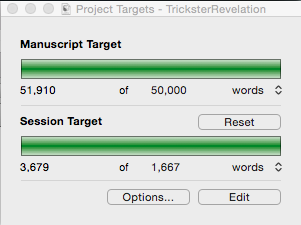
I’m not finished with the novel. In fact, I figured that 50,000 words would be about half of the total novel. But I have a good, solid start on it. I will need to shift much of my attention over to the final edits to the first novel so I can publish it, not to mention a Christmas Ghost story that must be ready to read in just three weeks (eeek!).

I love this little project targets widget in Scrivener!
But right now, I’m very happy with how much I’ve written and how far the first draft of the third novel in this series has moved. Yay!

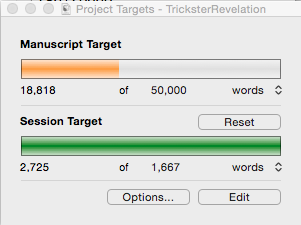
This is the first time I’ve used Scrivener’s Project Targets widget. It’s very cool. You set the word count target for the entire project, and Scrivener keeps track of it in the top bar. When you only have a few words written, the bar is red. As the bar grows, it changes to orange, then yellow, then yellow-green, turning a darker and darker green until you reach the goal. The lower bar is for shorter term goals you set. You can reset that bar any time you like, except that it always resets at midnight. Which works nicely with National Novel Writing Month (NaNoWriMo), since writing every day and trying to average 1667 word a day is the goal.

Screen Shot 2014-11-01 at 6.22.05 PMI tweeted screenshots of my project targets over the course of the month, so here’s one of the earliest ones, when the upper bar representing the whole month was still in the red, and that particular day I was just getting into the orange.

November isn’t quite over, yet, and I haven’t reached the end of the novel, so I plan one continuing to work on this for a another day before I switch to the Christmas ghost story.

I also need to post an update on my yearly goals. I haven’t since early October, because everything was focused on NaNoWriMo this month. But I have not forgotten them!

Right now, I’m feeling very happy about the writing.

Writing, writing, don’t stop!

My progress just before midnight, the 11th day of NaNoWriMo.
When I started this year’s NaNoWriMo (National Novel Writing Month), I knew there would be days where I made very little progress. Events on our schedule included an all-day editorial work party, hosting Writers’ Night, an all-day roleplaying game session, and the Thanksgiving holiday, which involves an overnight trip out of town.

Last year had a similar schedule, so I made an effort on those weekend days that we didn’t have anything planned to me extra productive. And it worked out. I exceeded the goal by about 8500 words. I didn’t reach the end of the story, but I got of writing in.

This year, the first being on a Saturday (and with us having no conflicts), I was at 6,595 words by the end of the first weekend. That’s nearly double the number of words number you’d have at the average words per day necessary to hit the target of 50,000, so I felt that was a good start. I only got a few hundred in on the next day, but Tuesday through Thursday, I exceeded the daily goal each time.

Friday evening was when the gout and hay fever had both taken a significant turn for the worst. I wound up taking a long nap after finishing my work day, and was in a bad head space after, so hardly got any writing done.

Then the weekend was full, and as mentioned in yesterday’s post, I was battling pain in my foot all weekend, so I my productivity continued to suffer.

But, Monday night I managed to exceed the daily goal a little bit, and last night (as you can see in the graphic) I blew past it by more than a thousand words.

So, I’m still on track to hit 50,000 by the end of the month. Even though I have a few days with very little writing time available.

Still, I feel good. Wish me luck!