Monthly Archives: May 2013

Book Review: The Last Policeman

Book cover of The Last Policeman
The Last Policeman, by Ben H. Winters
This book came out last year, but I just finished it recently. The Last Policeman, by Ben H. Winters, poses the question: what’s the point of solving a murder when the world is about to end?

The book is set in the very near future. The set up is that there’s a previously unknown asteroid on an eccentric orbit aimed at earth. It’s too big for any technology we have to do anything about in the time remaining. Society is slowly deteriorating as people abandon jobs to go do things they always wanted (I’m particularly fond of the sample list the narrator makes: dangerous sport, sexual fantasy, or track down that fourth-grade bully and punch him in the nose), or join religious cults, or just go on a rampage.

Our narrator, Hank Palace, is a detective in Concord, New Hampshire. He grew up in Concord (his mother worked as a dispatcher for the Concord Police when he was a child), and had dreamed of being a cop. Just barely not a rookie patrolman when the asteroid strike became inevitable, he’s been promoted to Detective as much through attrition as merit. And he’s confronted with a suspicious death that everyone wants to write off as a suicide. Hank isn’t so sure.

The author describes it as an existential detective novel. I think of it more as mid-apocalyptic noir, as Hank’s world certainly has plenty of disorder and disaffection to qualify as noir on its own. Hank walks that shadowy line charted by such characters as Sam Spade and Philip Marlowe: he knows the world is falling apart, but he’s self-destructively determined that justice will be done.

The decay of society depicted feels very real, and the characters are all well defined. The complications and red herrings never seem forced or out of place. There are mysteries within mysteries. You’ll see some of the solutions coming, though not so obviously as to be boring. And even the most surprising one, to me, when it was revealed, had that sense of, “Oh, of course! Why didn’t I realize that’s what those things meant?”

It’s also nice to see a detective story set in a smaller city, like Concord. The setting is just big enough to be a city, without the clichés or over familiarity of places like New York or LA. I also enjoyed the fact that Hank isn’t the only character determined to do the right thing, despite the futility of it all, and that those characters who get to know aren’t all doing it for exactly the same reasons.

I really enjoyed the book a lot, and highly recommend it. Since the Mystery Writers of America awarded it the 2012 Edgar award for Best Original Paperback, I must not be the only one to like it.

Which isn’t to say that it is perfect. One rather trivial set of imperfections I have to mention. It’s pretty obvious that at least some of this book was dictated using some kind of speech to text software, which left some confusing errors that didn’t get caught by an editor (assuming there was one).

For example, there’s a point when Hank is describing an emotionally stiff person. The sentence included the phrase, “like a peace offense.” I actually had to mutter it to myself before I finally realized it was supposed to be “a piece of fence.” A copy editor would have corrected the homonym, but a developmental editor would have said, “I think the word you’re looking for is ‘fencepost’.” At another point Hank is listing off some observatories, “Arecibo, Canberra, and Gold’s tone.” That last one should have been Goldstone, for the Goldstone Deep Space Communications Complex in the Mojave Desert.

But as prone to typos as I am, I can’t fault it too much on that account.

The other imperfection is external to the book. I can’t explain it without talking about the ending. I’m not going to give anything specific away, but if you don’t want even a few indications about the end, stop now.

Otherwise, click “Continue reading…”
Continue reading Book Review: The Last Policeman

That isn’t what wrong means

During my lunch break at work I use a news reader to browse articles, and I regularly tweet links to the more interesting ones. One such article I tweeted recently explained how a formerly notorious Holocaust denier had changed his name and hid out in California for about twenty years, being very active in a group called the Republican Party Animals.

His true identity was uncovered recenty, and he’s admitted it’s true, the article said, and his RPA friends have been quick to distance themselves from him, to say he was no longer welcome at their events, and so on.

Some total stranger sent me a message, insisting that the story I had linked got a lot of things wrong, and sent me a link to a story on a right-wing “news” site.

I read the second story and learned that this Holocaust denier had changed his name, moved to California, and became involved in the RPA until his real identity was discovered and they kicked him out.

In other words, every single fact, every one, that was in the article I originally linked was repeated and confirmed as a fact in the second article. The second article did not dispute anything at all in the first.

Which isn’t to say that the articles are identitical. The first article focused on the imposter himself, explaining in some detail his activities before changing his name, then explaining in some detail how he cultivated friendships among the California Conservatives until they learned who he was.

The second article left out a lot of those details, sticking to the broadest facts, and spent most of its words saying again, and again, and again, “but none of us agree with his objectionable opinions.” In other words, it isn’t really a news article, it’s a defensive denial.

It is true that the first article does not explicitly say that none of the others agree with the Holocaust denier. It says that they have all disavowed his views. Which is not really a contradiction. The “disavowal” is a verifiable fact. The other version is at best difficult to prove, since we don’t have mind-reading technology. I suspect that the second one is also a lie: I would be surprised if there weren’t at the very least one or two who secretly holds some of those views, because such people are everywhere, even in liberal organizations.

People throw that word “wrong” around when what they really mean is, “it doesn’t espouse my worldview and priorities” often without regard to any factual content.

For several years I’ve been the editor of a very small science fiction zine, and in every issue I write a short editorial. For many years those editorials were simply essays on some aspect of science fiction or fantasy writing history. Once, in an essay on Nathaniel Hawthorne’s contributions to the genre, I mentioned that Hawthorne, Edgar Allen Poe, and Mary Shelley are sometimes referred to as the “grandparents of science fiction.” That’s the only thing I said about Poe.

One reader wrote in, very upset about the gross inaccuracies I wrote about Poe, and he included an article he had xeroxed out of some magazine. The article was some conspiracy theory nonsense about Poe being involved in some secret behind the scenes war of espionage against some shadowy organization out to destroy democracy. Only one sentence in the entire article even mentioned that Poe was a writer of any sort. Nothing in the article contradicted the one and only thing I had said about Poe. My mention of one fact about Poe’s writing did not, in any imaginable way, disagree with anything in the article.

My mention of Poe was “wrong” because I didn’t make any mention of the insane conspiracy theory. I happened to mention someone that this person had some pretty whacko beliefs about, without furthering the whacko agenda.

That’s the case here. These folks are afraid that people will believe that many of them are Holocaust deniers because one of their buddies has been one. And anyone who doesn’t bend over backward to tell everyone multiple times that none of them feel that way is “getting things wrong.”

No. We’re just not helping you with your damage control. Damage control that would be a lot easier to believe if some of you hadn’t financed a couple of his more recent documentaries that don’t completely deny the Holocaust, but give equal time to the deniers.

But I’m sure you just went along with that because you believe in making things fair and balanced. Right?

A good day to die

Readers can be like addicts. Once they fall in love with a fictional character, they want to read more, and more, and more about the character. A good-selling series of books can set a writer for life.

But it can be something of a gilded cage.

When Arthur Conan Doyle was a struggling young physician, he found himself sitting for rather long stretches between patients. So he started writing stories during his down time, and would sell them to various magazines of the time. He soon found that he had a knack for mysteries, not always crime stories, but stories in which there was a puzzle for the characters (and the readers) to solve. One day Conan Doyle started writing a long story about an independent detective. He based this detective on one of his medical school teachers, Dr Joseph Bell.

Bell was an early advocate of what would now be called forensic diagnosis. He told his students to pay more attention to physical clues about a patient’s illness. Close observation and deduction he said, were more important that what the patient told you. To demonstrate his method, he would have people pick out strangers in a crowd or on the street, and just by looking at the person (how they were dressed, wear patterns on their clothing, the presence or absence of callouses on various portions of hands, and so forth) deduce their occupation and recent activities.

Sherlock Holmes was a man who used Bell’s methods to solve crimes. A Study in Scarlet was published first as part of a Christmas Special (though it has no Christmas theme) in 1887. It was republished as a standalone book the next year. Sales were good enough to justify a second edition, more expensively bound, to be produced the next year. Conan Doyle was commissioned to write a second novel, The Sign of the Four (he was republished the next year in various journals throughout the empire, often with the slightly modified title The Sign of Four), which became an even bigger hit.

Conan Doyle was commissioned to write a series of short stories starring Sherlock Holmes for The Strand magazine, and they were published monthly from June 1891 through July 1892. As he neared the end of the series of 12 tales, Conan Doyle was finding himself growing tired of Sherlock. So he planned to kill him in the twelfth tale. Conan Doyle made the mistake of mentioning this fact at a dinner party at his mother’s home. His mother was upset, not so much about her son killing the character, but she felt the way he planned for Holmes to die (mauled to death by a vicious guard dog as Holmes and Watson rescued a young woman from a particularly disturbed couple) was entirely too ignoble for such a hero. She made him promise that Holmes would not die in the story. So, Conan Doyle changed the ending of the “The Adventure of the Copper Beeches.”

The stories were so popular, that people were literally lining up outside the offices of the Strand on publication day to get a copy. Holmes was not the first literary character to evoke this response. Many years earlier (1841) people had lined up in anticipation of the final chapters of Dickens’ The Old Curiosity Shop. The Strand commissioned more stories. Conan Doyle couldn’t really turn down the money, but he was getting even more tired of Holmes. So he kept completely mum about “The Final Problem,” in which Holmes is killed by Moriarty. Moriarty dies along with him.

“The Final Problem” has a lot of problems. Its internal logic is laughable (Holmes must disguise himself lest the killers find him, but he travels with Watson who is completely undisguised, and Watson booked their train, boat, and second train passages in his own name). Moriarty had never appeared in any story before this one, and there is absolutely no hint of his existence. That later prompted the producers of at least one television series that tried to follow the stories faithfully to insert Moriarty as the mastermind who supplied the plan to the robber in “The Red-Headed League,” just to get the character on the scene and in the viewers’ minds.

Conan Doyle never thought of his Holmes stories as serious literature, or of much importance. Which is why at different times he has Dr Watson refer to himself as “James” instead of “John.” In the original Moriarty story, the Professor’s first name is not mentioned, though the Professor’s brother, Colonel James Moriarty is mentioned by name. Later stories to feature Moriarty refer to him as James Moriarty. There are many other contradictions.

When Holmes was killed, the public was shocked. Some people dressed in full mourning clothes. People wrote Conan Doyle, pleading with him to bring back Holmes, and so on.

For years Conan Doyle ignored the pleas. Then, while visiting friends in the country, when one friend told about a local legend of a ghostly dog, Conan Doyle said it would make a wonderful basis of a Holmes story, but he could never write it since he’d killed Holmes. One of the other friends suggested the idea that the story could begin with Watson explaining that he had sworn never to tell this tale while certain innocent persons were alive, but now he could. So the story would be set before Holmes’ death in 1892, but could be published in 1902. And thus The Hound of the Baskervilles came to be.

The pressure to bring back Holmes increased (and the amount of money both American and British publishers were willing to offer for new Holmes stories skyrocketed), so in 1905 he relented. In “The Adventure of the Empty House” Watson is shocked (in 1894) to discover that Holmes is alive, having faked his own death in order to lure Moriarty’s confederates into mistakes so that the rest of the criminal organization can be dismantled. Thirteen stories are included along with “The Adventure of the Empty House” in The Return of Sherlock Holmes, featuring adventures that supposedly occurred after the time of Holmes’ faked death, but before the publication of his return.

Conan Doyle wrote a fourth Holmes novel, which marked the return of Moriarty, though this story is set in time before “The Final Problem.” Conan Doyle remained adamant that Moriarty’s death in “The Final Problem” was not faked. He wrote another 26 short stories about Holmes until his death in 1930.

Readers always wanted more.

So I wasn’t terribly surprised to read that the author of the Sookie Sackhouse/True Blood series is getting a lot of grief for announcing that the next novel is the finale, ending the series once and for all. I have never read the stories, nor seen the insanely popular HBO series. So I wasn’t aware that she had originally planned to kill one of the main characters and end the series in the ninth book some years ago.

Sometimes a story has run its course. Sometimes it’s time to tell a beloved character good-bye.

Even though I sympathize with her fans, I hope Charlaine Harris is happy with how she’s ended things, and goes on to tell whatever other stories she likes.

Is it worth the outrage, part 2

Saturday was the 43rd anniversary of Kent State Massacre, when members of the Ohio National Guard fired 67 rounds into a crowd of student protestors, killing four and wounding nine others.

May 4 for some years now has been recognized in some circles as Star Wars Day, because of the silly pun, “May the fourth be with you.”

On Saturday the hashtag #StarWarsDay was trending much higher than #RememberKentState and other variants on Twitter. Some people were upset about this. They were so upset, that by midday all sorts of people were posting apologies, some of them rather abject, for desecrating the memory of the four students killed at Kent State.

I was flabbergasted. So I took to twitter myself and posted the following:

How dare you people talk about either Star Wars or Kent State while totally ignoring the assassination of Engelbrekt Engelbrektsson! Not to mention the deaths of the Haymarket Square Riot. Or those twenty sailors killed on HMS Sheffield! (In other words, can we please tone down the outrage? Please?)

If you aren’t familiar, HMS Sheffield was a British warship involved in the Falklands War, which was struck by missiles fired by the Argentineans on May 4, 1983. The initial strike disabled several ship systems, including fire suppression systems. The excess rocket fuel in each missile ignited, and the ship’s diesel stores burned for days after the crew had been evacuated. The ship sank while it was being towed in for repairs. And as I mentioned above, 20 members of the crew died in service to their country.

The Haymarket Square Riot broke out near the end of a long labor demonstration in Chicago on May 4, 1886, when police marched in on demonstrators, someone threw a bomb, the police started shooting indiscriminately. Seven police officers were killed (almost all by bullets fired by other policemen, by the way), four demonstrators were killed, well over a hundred people were wounded by either gunfire or shrapnel from the bomb. The demonstration itself had been called to support an ongoing strike at the McCormick Harvesting Machine Company, which had escalated to the point on May 3 of police and Pinkerton guards firing into the crowd of striking workers, killing two, and wounding many more. Eight anarchists were later arrested and convicted of throwing the bomb, though everyone agrees now that none of them actually threw the bomb, and only one of them was probably involved in the making of bombs. Reaction to the incident kicked off a renewed series of police repression of labor activists and anarchists that many historians refer to as the first Red Scare. While May Day parades and demonstrations by labor had been occurring for a few years before this occurred, this event is often credited as solidifying the significance of May Day as a Worker’s Rights commemoration.

Engelbrekt Engelbrektsson was a Swedish nobleman who led a rebellion against the King of the Kalmar Union, an event which eventually led to Sweden becoming a kingdom of its own. Englebrektsson was assassinated on May 4, 1436 by a rival. Englebrektsson is considered a national hero of Sweden because his actions gave peasants a voice in government for the first time, creating a Riksdag (a deliberative assembly or parliament) structured so that peasants and laborers would have a number of representatives equal to the number of nobles. The Riksdag continued in the form Engelbrektsson instigated for nearly 400 years.

Some will argue that it is unfair for me to compare the assassination of a Swedish rebel leader from the 15th Century with a massacre of peace demonstrators in modern times. One seems lost in the mists of time, while Kent State is a current event, right?

Except Kent State isn’t a current event. It occurred 43 years ago. I personally think that the Guantanamo Bay detention camp is a much more relevant (and shameful) example of the abuse of power by the U.S. government than Kent State, yet when was the last time #GuantanamoBay was trending at all on Twitter?

And let’s be brutally honest here. Less than half of the Americans living today were even alive when Kent State happened. The median age of people living in the U.S. is 37 years old. That means more than half of the people alive today in the U.S. were born at some time after Kent State. Yes, it was a tragedy. Yes, we should remember instances where our own government has used its power to harm citizens rather than to protect them. But it is ludicrous to demand people treat its anniversary as a day so sacrosanct that no non-serious topics can be discussed.

Not only that, “May the fourth be with you” is a pun that is understandable by the vast majority of the English speaking world, whereas Kent State was an American tragedy. If you quizzed an Englishman less than middle aged living about Kent State, they’re likely to think you’re talking about something happening in the county of Kent in Southeast England, rather than a Vietnam Era event at an American University.

Two friends who saw my posting on Twitter spoke up to agree. By very odd coincidence, both of them are children of sets of parents who both were students at Kent State when the Kent State Massacre occurred. Yes, both parents of both of these unrelated friends were there. Each of them expressed surprise that anyone thought you couldn’t keep both meanings of May 4 in the same mind at the same time.

I get outraged about things all the time. Outrage over something like a troops firing on unarmed civilians is certainly justified. Outrage over people sharing a completely unrelated joke on the forty-third anniversary of merely one such event which is hardly the worst that this government has ever perpetrated?

That’s just silly!

Artistic license

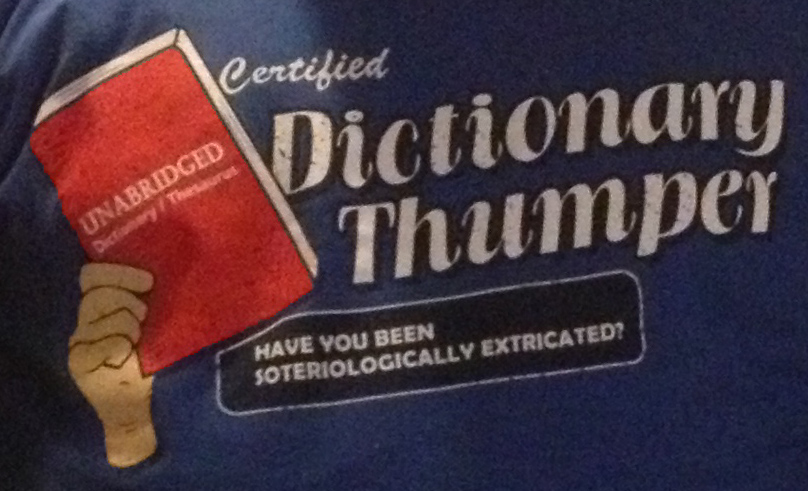
Certified Dictionary Thumper t-shirt.
A close up of the t-shirt.
Recently a couple of different friends sent me a link to that day’s Shirt-Woot. A t-shirt with a dictionary joke. Of course it’s the perfect thing for Gene.

It is rare to find a t-shirt with a dictionary joke, so of course I ordered it. But I commented to one of the friends who had sent me the link that there was one problem. There is no way that the dictionary pictured is unabridged. Look at how easily the person is holding it with only one hand. It would need to be a fairly thin dictionary to be held that way.

Seriously, look at the picture on the t-shirt. He’s not even using all four fingers! The pinkie, at least, is curled under.

Trying to hold the dictionary
Trying to hold it one-handed
I own four unabridged dictionaries. I got out the smallest of them, and tried to hold it as they are in the picture. I can hold it with one hand for a short time, but notice that I have to cup my hand under it, to support all the weight. Three fingers are on the front, but the pinkie is still helping, by stabilizing the dictionary’s weight. You can’t tell in the picture, but it was hard to hold it still, because it’s too heavy and awkward.

The friend thought I was being silly to point this out. And it is a silly t-shirt, which I was delighted to order. I’m going to wear it and let people laugh at the joke. And it’s true, it would be extremely painful to be literally thumped with a hardback book the size of one of these unabridged dictionaries.

Labeling myself a dictionary thumper is not inaccurate. I can be pedantic about the meanings and usage of words. I also get that way about syntax, which would make me more of a style guide thumper, but that joke wouldn’t work as well. People know what a dictionary is, but a style guide, not so much.

I’m nowhere near as pedantic about grammar as people expect. And I’m not pedantic about words in the way that people expect, either. Being a technical writer by profession for over two decades, I can’t begin to count how many times co-workers and other colleagues have come to me with questions about spelling and usage that fall on the fringes of what I think the heart of language is. See, folks think of grammar and usage in very stiff and absolute terms. They believe that there is always one and only one correct way to use a specific word. I’ve always assumed this comes from having been admonished in school for doing something incorrectly, so that they think of grammar as a long list of prohibitions: “Thou shalt not dangle thy participles” and so forth.

Holding the dictionary two-handed
It really takes two hands.
But there are no official lists of rules handed down from on high. Language has rules that have evolved as we’ve used it. Word meanings change over time. New social, cultural, and technological situations require new ways of describing or discussing what’s going on. And the beauty of English is that there are thousands of correct ways to construct a sentence to convey a particular meaning. “The man walked down the road” means the same thing as “He walked down the road.” Structurally those things are nearly identical, so they barely count as two ways, but we could also say “He plodded along the street.” Or we can add more details, “The man, stoop-shouldered and sun-burned, trudged beside the highway.” We can turn the structure around, “The crumbling road guided his footsteps to his destination.”

All of those are correct ways of explaining the same basic situation. But they all evoke different moods and details. What makes a particular version of each of those right or wrong is the context, which is not a matter of grammar at all.

Besides saying “Certified Dictionary Thumper,” the t-shirt includes a slogan. “Have you been soteriologically extricated?” Soteriology is a synonym for salvation, deliverance, or liberation. Extricated means to be disentangled, rescued, or released. So the slogan literally means “Have you been rescued in a liberating way?” Or more simply, “Have you been saved saved?” Which is redundant. If I were feeling the need to use the multisyllabic soteriologically, I would have chosen the slogan, “Have you been soteriologically explicated?” Since to explicate is to define something to have had something defined or explained to you.

I strongly suspect that that was the original joke, probably told to the artist by someone else, and somewhere along the line someone misheard. Explicated and extricated sounding quite similar when spoken aloud.

Of course, that just gives me more to explain if someone asks what the shirt says. Which, for someone like me, makes it even more of a win-win.

Just us guys

How upset some guys get about sharing locker rooms and showers with gay guys would be funny if it didnt lead so often to harassment and assault.

I just want to ask them a simple pair of related questions: are mobs of women you don’t know throwing themselves at you, trying to jump your bones? If not, why do you assume that every gay man is going to be trying to force themselves on you?

There’s an answer, but it isn’t a very pretty one. The truth is that the kinds of straight guys who are weirded out/uncomfortable/angry1 at the thought of having to share a locker room, shower, or even a gym with gay guys know how they treat women they are attracted to. They assume that all straight men think that way about women, so they also assume that all gay men will think that way about them.

And they don’t like it2.

That’s not the only source of their discomfort. There’s also the loss of the “just us guys” environment—a space where guys are safe to be guys. A place where they can scratch where it itches, can make inappropriate jokes, and generally be uncivilized. It would be easy to point out how a little less uncivilized behavior, along with less affirmation of a lot of sexist attitudes, would be a good thing in the long run. And I think it will be a good thing over time.

But there is also some value to that safe place. Just as it is valuable for women to have safe places to talk about their issues without guys like me saying, “Hey! We’re not all like that” or other guys “man-splaining3.” And it’s valuable for gay people to have safe places to talk about our issues without other people insisting they’re “not all like that” or trying to “str8-splain.”

Guys need places where they can be guys.

Now, I’m the first to say that a lot of what currently is presumed to be “guys just being guys” is awful and needs to change. Even when I was participating in several sports back in middle school, there was a certain amount of dread that fell on me whenever it was time to go to the locker room, or go out on the field. Any time you screwed up or failed to be as good at something as another guy, you were called a faggot, or queer, or pussy.

And that was only the nicer coaches5.

The mean coaches and the other kids called you c*cksucker, bitch, and c*nt—in various combinations. One of my middle school tormenters was fond of “c*cksucking, sh*teating fag.”

Guys of all sexual orientations and abilities are harmed by those notions that equate masculinity with athleticism, sexuality, and competitiveness. This notion enforces the hierarchy that equates the amount of respect one is entitled to is determined by the degree to which one possesses those masculine traits (which means that women will automatically never be able to expect as much respect as a man). Even the guys who have found success by embracing this notion have done so by contorting their personality in various ways, cutting themselves out of a lot of what’s great about being a person along the way.

So shaking up that definition is a good thing.

But it doesn’t have to mean that all distinctions between masculine and feminine are going to go away. It doesn’t mean that those of us in the LGBT community think they should6. It just means that there are a lot of different kinds of guys—lots of different ways to be a man. And all those different kinds of guy can hang out and be one of the guys, and all of the guys can be okay with it.

At least I hope so. Because my husband hates it when I start talkin’ about football, and I just need somewhere that I can…


1. Angry in this case is just code for afraid. Guys aren’t allowed to be afraid, so our subconscious transforms the fear into anger.

2. One would hope that this discomfort would help some of them to see that maybe they should start thinking of women a little differently, no?

3. mansplaining: condescending, inaccurate explanations delivered with a rock solid confidence of rightness and that slimy certainty that of course he is right, because he is the man in this conversation4.

4. Some people define mansplaining exclusively as that sort of condescending explanation by a man to a woman, especially about topics related to women’s rights, and so on. But a lot of mansplaining is guy-on-guy. And none of us are immune. Guys are socialized to be confident and assertive, no matter what.

5. The coach who taught Sunday school and who made you put a quarter in the swearing jar on his desk if he heard you say “hell” or “damn” used “fag” so much, you began to wonder if he thought it was a punctuation mark. And don’t get me started on the teacher who was also a pastor.

6. I suspect some trans people have more to say about that than I possibly could.

Regret is the mind killer

I read this great post, “The Reading Police of the Young,” and found myself remembering the weirdly inconsistent way my reading habits were monitored when I was a kid.

For example, I remember longing to read my mom’s copy of Dune, the paperback sitting squeezed between a bunch of her Agathe Christies and Robert Heinleins. Mom had told me I wasn’t old enough after she finished it. When she realized I kept looking at the book–not reading it, not even opening it, just looking at the cover–she moved it to the small shelf in the bedroom, the one that had Dad’s books that I wasn’t allowed to read (mostly Matt Helm and James Bond books, whose sexual situations were considered pornographic back in the day, but are rather quaint and downright prudish when compared to modern prime time fare).

And so I wondered what forbidden topics were hidden within. When I finally did read it, some time in my teens, I was a bit disappointed. Not at the book, I found the story quite interesting. I was disappointed because there didn’t seem to be anything in it that should have been forbidden.

I mean, yes, it is clear that the Baron has a thing for pretty young men, but there is nothing about the way it is described that anyone could call erotic. And Herbert’s unconcealed homophobia, manifested primarily with the old cliche that the more gay a character is, the more evil they are, should have resonated quite nicely with Mom’s evangelical sensibilities.

Those evangelical sensibilities waxed and waned throughout my childhood. At one point she was encouraging me to read Asimov (both his fiction and nonfiction), Tolkein, LeGuin, and Bradbury. At another point we had the first book-burning incident–when under the influence of a new pastor, she decided that the astronomy books I’d checked out from the library were astrology books, and since astrology is the same as satanism, the books needed to be destroyed.

(I still occasionally have bad dreams that include a reenactment of my tearful explanation to the librarians about why I couldn’t bring the books back. When they called Mom to ask for the books, she harangued them for letting children check out satanic books. The library set up a special spot for my books from then on. I could check out books and read them in the library, but couldn’t take them home.)

The second book-burning had been Dad. Dad’s reasons weren’t overtly religious, my dad is the kind of atheist who is angry at god for not existing (think about that for a bit). No, he decided that I was getting bullied at school so much because I spent too much time “living in a fantasy world.” His book burning was worse because he forced me to pile up the books, pour the accellerant on, light the match, and watch it burn. With random slaps and punches because I was crying while doing it.

Then a year or so later, he bought me an encyclopedia set and told me that I was going to go to college and “make something of yourself” or else.

For the longest time I attributed those mixed messages to the ebb and flow of Dad’s alcoholism and abusive behavior. The worse Dad got, the more intense Mom’s fundamentalism got. When Dad appeared to be changing for the better, Mom loosened up and re-embraced her inner sci fi and comics fangirl.

Those were definitely major factors in the dysfunction in our family, but I wonder how much of the inconsistency was also due to their youth. My parents were both 16 years old when they married, then I was born 6 days before my dad’s 18th birthday. Current brain research indicates that the prefontal cortext (the part of the brain responsible for impulse control, foreseeing consequences, emotional modulation, et cetera) doesn’t fully develop until around the age of 25.

That couldn’t have helped.

While both of them were readers who believed in the value of education, I know both of them felt they hadn’t done as much with their own lives as they could have or ought to have. So while hope for their kids drove some of their decisions, regret played a very big role, as well. Regret drove them to push me to do better in school, which is a good goal. But regret also drove them to micromanage my behavior on all levels, which isn’t just impractical, but if they had been successful would have had the opposite of the desired effect.

We can’t learn how to do anything correctly without learning from our mistakes as well as our successes. That’s just as true for thinking and imagining as it is for basketball or playing the piano. And while there is value in studying what other people have done, it isn’t sufficient. You have to try, fail, and improve on your own. Avoiding someone else’s mistake is no guarantee you won’t make new mistakes. Trying to duplicate someone else’s success may help you find a good way to do something, but it should also lead you to new directions they couldn’t explore.

And when you are buried in your own frustrations and regrets, you’re least likely to possess the objectivitely required to identity just which if your own past actions were mistakes, and which weren’t.

Regret, in that case, becomes both the mind-killer and dream-destroyer. You can’t wallow in the regret. Face it, yes. Let it serve its purpose of motivating you to do better. But then, let go. And become the better you.

Even a young earth is older than you think

So, a few days ago I posted about one of my pet peeves in fantasy world-building, the writer who thinks 600-years ago is the dawn of time. A friend who read my post raised an interesting point. “If the series you’re talking about is the one I think it is, I understand that the author comes from a conservative Baptist background. Maybe she built her world, consciously or not, on the assumption of a Young Earth.”

We are talking about fantasy world-building, and an author is free to choose any premise they wish to build from. Terry Pratchett’s Discworld series assumes that the world is a disc balanced on the backs of four giant elephants who stand atop a gigantic sea turtle that swims through space, for instance. It’s one of my favorite series of books, so I certainly can’t say a writer isn’t free to use some notions of Fundamentalist Creationism as the basis for their fantasy world.

However…

If the premise is that the Literalistic1 Interpretation of the Bible describes the physical origin of your fantasy world, it is absolutely impossible for the “first witch ever to exist” to have been born a mere 600 or so years ago.

In the book of First Samuel, chapter 28, one finds the story of the Witch of Endor. The Prophet Samuel has recently died, and things are going extremely badly for King Saul. Eventually, Saul goes to a famous witch in Endor, who raises the ghost of Samuel. Samuel’s spirit proceeds to tell Saul that God is tired of Saul’s disobedience, and that Saul will lose the battle the very next day, and that Saul and his sons will be joining Samuel in the land of the dead shortly thereafter. Saul leaves, understandably dismayed and devastated. He loses the battle the next day and kills himself.

So right there, in the Bible, we see a witch who has actual magic powers to raise the dead thousands of years ago, rather than 600 years ago.

Not only that, before Saul goes to this witch, he tried turning to prophets, to a couple of scrying devices the priests kept, and to dream interpreters to find out what he should do. In an earlier incident, while the Prophet Samuel was still alive, Saul drove all the magicians and necromancers from the kingdom of Isreal, clearly implying that there were a lot of them already in existence, so even the Witch of Endor isn’t the first witch ever on the Young Earth.


1. My Old Testament Professor at University insisted (and could quickly demonstrate) that none of the people who say they take the Bible literally actually do so. Instead, he argued, they use a form of filtered literalism, where some passages are taken literally, contradictory ones are ignored2, and other sections have imposed upon them notions that are not evident anywhere in the text.

2. The story of Samuel and King Saul is a particularly amusing example of this. Later passages refer to Saul as God’s chosen leader of Israel, but in the beginning of Saul’s story, the people of Israel keep asking Samuel to ask God to give them a king. Samuel keeps telling them that God doesn’t want them to have a king. Eventually, apparently tired of being pestered, God appears to relent (though the original text makes it unclear whether it is really God who relents, or if Samuel just picks someone and tells them that God has relented), and proclaims Saul King. Then, when a foreign power assembles an army and marches toward Israel, Samuel tells Saul to gather his own army, go to a specific spot, and wait seven days, at which point Samuel would arrive (presumably with God’s battle plans), and they could begin. Seven days came and went, Samuel didn’t arrive. More days passed, no Samuel. The army was growing restless, so Saul decided something must have happened to Samuel, and he ordered the army to make prayers and sacrifices, then prepare for battle. As soon as Saul had completed the sacrifice, Samuel suddenly appeared3, admonished Saul for taking on the role of the priest, and tells him God doesn’t want him to be king any longer. But, in the very next chapter King Saul is leading the battle, Samuel is giving him instructions, Saul wins, everyone (including Samuel) rejoice in the king’s victory. Samuel tells Saul that God wants him to slaughter not just the defeated soldiers, but every man, woman, child, and even the livestock of the defeated Amalekites. While doing so, Saul decides to spare some another tribe of people living among the Amalekites4 and doesn’t slaughter every woman and child of the Kenites. Samuel throws another hissy fit, and says God regrets making Saul King, and that Saul’s kingdom will soon be torn apart. Except in the previous chapter Samuel had already said Saul was no longer king, so nothing in this chapter should even have happened, least of all Samuel advising Saul, et cetera5.

3. My professor said, “As if he had been hiding in the bushes watching and waiting for Saul to screw up.”

4. God said “kill the Amalekites,” he didn’t say to kill the Amelekites and Kenites. Seems like a reasonable distinction, right? Certainly if you think that it’s reasonable for the same God who said “Thou shall not kill” without any qualifications, turns around and orders you to murder babies.

5. Reading the entire saga of Saul and Samuel, and taking every passage literally, it is hard to interpret the whole thing as anything other than either God or Samuel thinking of new ways to dick Saul around, giving him contradictory orders, impossible orders, and downright evil orders. Saul tries to follow all of them, and gets yelled at for disobedience again and again. On the other hand, David (the shepherd who defeats Goliath in battle and eventually becomes king after Saul dies), as King never obeys anything that God’s messengers tell him to do. He blatantly disregards commandments and instructions, but again and again the priests and prophets proclaim him beloved of God and a good king.