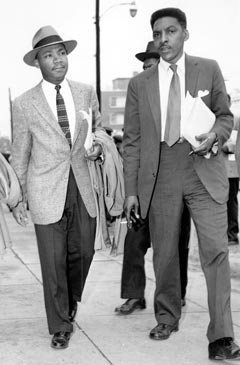
Bayard Rustin is probably most famous as the man who handled all the organizational details of Dr. King’s 1963 March On Washington. Rustin took care of everything from the transportation, to making sure there were enough porta potties for the crowd, to insuring that no one brought weapons and the march stayed nonviolent, to convincing Dr. King that King’s speech should the be at the very end of the program. Rustin was convinced that the “I Have a Dream” message that King had been writing and rehearsing would work best as the dramatic crescendo at the end of the day, rather than as an opening whose sentiment might be overshadowed and diluted by other speakers and performances afterward.
And Bayard Rustin was gay. He was not closeted and secretly gay—Bayard Rustin was openly gay in an era far more homophobic than today. Despite having been arrested, beaten, and several times fired for being homosexual, Rustin remained open and candid about his sexuality. Throughout the years of their association, Dr. King was frequently urged (and begged and ordered) to push Rustin out of the Southern Christian Leadership Conference, to distance himself from Rustin and denounce him as a “pervert” and “immoral influence.” Again and again, Dr. King refused to do that, and continued to rely on both Rustin’s organizational and debate skills.
Dr. King was assassinated before the Stonewall Riots, therefore before the modern gay rights movement began to be noticed by the press and the public at large. We don’t know what he might have said or done at that time. We do know that he fought as much against factionalism within his own movement as the enemies without, trying to keep everyone focused on the cause of racial equality and economic equality. As more than one historian or political scientists have pointed out, if he had been anti-gay, there would surely have been a sermon delivered on the topic, or some negative comments about Rustin or other homosexuals he met among the hours and hours of FBI wiretap tapes.
And there isn’t.
Nor is there any indication he ever asked Rustin to try to hide his sexuality.
Rustin had deep religious convictions about the importance of nonviolently fighting against racial and economic equality. While he was open about his sexuality, he didn’t start publicly fighting for gay rights until the 1970s, when he referred to the treatment of gays and lesbians as the new barometer for measuring social justice.
And he wasn’t the only one.
“If you are gay, lesbian, bisexual or transgender, you do not have the same rights as other Americans, you cannot marry, …you still face discrimination in the workplace, and in our armed forces. For a nation that prides itself on liberty, justice and equality for all, this is totally unacceptable.” — Yolanda Denise King, Dr. King’s eldest daughter.
Today, several white leaders of anti-gay organizations have tried to wrap their hatred in King’s legacy. They do this by quoting King’s niece, Dr. Alveda King, a rabid anti-abortion and anti-gay rights activist. I suppose it is petty of me to point out that the supposedly pro-traditional marriage, pro-life Alveda King has been divorced three times, had two abortions, and the only reason she didn’t have a third abortion is that she could not convince her father or grandfather to pay for it, and that she didn’t appear to become anti-abortion until she started being a paid speaker for various archconservative groups.
But I think Dr. King’s widow might have more accurate insight into Dr. King’s beliefs:
“I still hear people say that I should not be talking about the rights of lesbian and gay people. … But I hasten to remind them that Martin Luther King Jr. said, ‘Injustice anywhere is a threat to justice everywhere.’ I appeal to everyone who believes in Martin Luther King Jr.’s dream, to make room at the table of brotherhood and sisterhood for lesbian and gay people.” — Coretta Scott King, Dr. King’s widow.

Dr. King did none of those things. When Life magazine interviewed King about the March, Dr. King credited Rustin and A. Philip Randolph as the organizers, which led to Ruston and Randolph appearing on the cover photograph of the magazine.
I could include many more quotes from members of Dr. King’s family and other leaders of the movement, but I think Dr. King’s actions toward Rustin tell the story.
 Font Folly