Monthly Archives: May 2015

Weekend Update: 5/16/2015

A few bits of news came in after I had scheduled yesterday’s Friday Links to post, but before they actually posted:

Legendary Blues guitarist B.B. King passed away Thursday night. He was 89 years old but just a few months ago still touring and charming audiences with his velvety voice. B.B. King: A Tribute to Blues Brotherhood.

Screen Shot 2015-05-16 at 10.03.01 AMWilliam Zinsser, writer, editor, and author (and frequent updater) of the legendary On Writing Well, died this week. He was 92 years old. William Zinsser, Author of ‘On Writing Well,’ Dies at 92. He is less famous for another book he wrote, in the early days of personal computing, when a lot of professional writers were up in arms about how word processors would destroy the craft of writing and make literature robotic (seriously), Zinsser wrote Writing With a Word Processor, extolling the virtues of the tool.

At least one of the virulent anti-gay bills the Texas legislature has been cooking up as fast as they can in anticipation of a summer Supreme Court ruling on marriage equality is dead for the moment: Same-sex marriage license ban bill dies in Texas legislature. On the other hand, 93 of the 98 Texas House Republicans Sign Shameful Anti-Gay Letter Pledging to Defy Supreme Court on Marriage.

And this pair of tweets went across my timeline yesterday afternoon. If you don’t know who Vox Day is, you’re lucky. Let’s just say he’s a virulent bigot who hates just about everyone:

Anyway, I thought it was a good thought to remember: holding people responsible for their hate speech is merely that, holding them responsible.

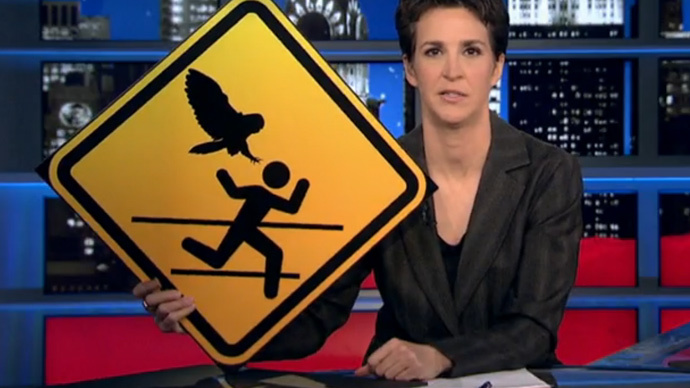
Friday Links (angry owl edition)

Screenshot from msnbc video.
It’s Friday! The third Friday in May. My how the time files.

Anyway, here is a collection of some of the things that I ran across over the course of the week which struck me as worthy of being shared. Sorted into categories with headings so you can skip more easily:

Science!

Scientists Crack A 50-Year-Old Mystery About The Measles Vaccine.

Images: Uncovering the Colossal Dreadnoughtus Dinosaur.

Left-handed cosmic magnetic field could explain missing antimatter.

Writing and speaking come from different parts of the brain, study shows.

Early European may have had Neanderthal great-great-grandparent.

Our Galaxy Could be Mixing With Andromeda’s Supersized Halo.

5 Roman Inventions You Probably Take For Granted.

Weird political news:

Idiot Tennessee Rep Knows All The Christians Are Being Holocausted, Just Can’t Say Where.

Warning, Austin: Your Female City Councilors Will Talk a Lot, Hate Math.

Jon Stewart destroys Fox News scrooge Varney: ‘How f*cking removed from reality’ are you?

Texas Lawmakers Are Getting Ready To Defy The Supreme Court On Marriage.

Anti-Gay Activist Admits Her Testimony To Senators On Texas Anti-Gay Bill Was False.

Democrats demand probe into discrimination against Jews, gays on Middle Eastern airlines.

Evangelicals’ claims of conservative supremacy are overstated — and misread America’s religious landscape.

News for queers and our allies:

In Elementary School, I Was an Effeminate ‘Honey child’.

The Queer Cripple and the Body Conundrum.

Rush Limbaugh Tells Businesses To Blame Anti-Gay Bigotry On Muslims.

Dell Urges Texas Lawmakers To Stop Anti-Gay Marriage Bill.

NUMBER OF ANTI-LGBT HATE GROUPS INCREASES 10 PERCENT.

High School Wrestling Champ Quells Bi Rumors: “I’m Not Bisexual…I’m Gay.

Some LGBT residents critical of Utah’s new anti-discrimination law. When half the law is exemptions, it ought to be everyone who is unhappy… (except the bigots, of course)

LGBT’s: Don’t Forget Riots Are What Got Us Here.

Gay couples are facing pressure to get married from their employers.

Yes, There Are A Lot More Gay Christians Than You Probably Think.

Gay rights supporters score two victories in conservative Arkansas.

Why Tim Cook Should Threaten to Shut Down Apple Campus Amid Texas Anti-Gay Crusade.

The obligatory Sad Puppies/Hugo Awards update:

In which I waste time and annoy Puppies. “Obeying the rules doesn’t mean you played fair. It might just mean you’re a very successful weasel.”

Statistics of Gender on the Hugo Writing Nominees: Probabilities and Standard Deviations.

The Barker and the Big Tent.

Sad Puppies Review Books: IF YOU GIVE A MOUSE A COOKIE. Not all of these satirical reviews are funny, but I liked this one.

And other news:

OED appeals: can you help us find earlier evidence of the word jackalope?

Life Is “Triggering.” The Best Literature Should Be, Too.

Dr. Lepore’s Lament. Cheeky response to a New Yorker columnist’s clueless review of a feminist comic book.

Pleasure and self-care should not be luxuries.

Things I wrote:

Marooned off Vesta: more of why I love sf/f.

The stories we have to tell.

About disliking a ‘classic’ novel.

Happy News!

Angry owl signs fund new playground improvements.

California judge: Abstinence-only sex education isn’t sex education at all.

Videos!

Why the Daily Show had to change:

(If embedding doesn’t work, click here.)

The Carbonite Maneuver (1985):

(If embedding doesn’t work, click here.)

Scientists just captured stunning images of deep sea creatures off the coast of Puerto Rico:

(If embedding doesn’t work, click here.)

Bertha, Mayor Murray and the Viaduct Doom Portal:

(If embedding doesn’t work, click here.)

ABC The Muppets First Look:

(If embedding doesn’t work, click here.)

Faith No More – Superhero:

(If embedding doesn’t work, click here.)

The Avener, Phoebe Killdeer – Fade Out Lines:

(If embedding doesn’t work, click here.)

Marooned off Vesta: more of why I love sf/f

125aMy dad’s idea of a vacation was to go camping and catch fish. Unfortunately, these trips not only never involved a camper, they also never included tents. We slept in sleeping bags under the stars gathered around the dying embers of the fire we’d cooked dinner on. If it was raining, the whole family would crowd inside the cab of Dad’s pickup and try to sleep sitting up all squeezed together.

I wasn’t terribly good at any “outdoorsman” sorts of skills, and Dad never missed an opportunity to tell me just what a clumsy, stupid, sissy I was whenever I did anything incorrectly. Though, for the record, he never called me anything as nice as “sissy.”

So I didn’t much enjoy those vacations.

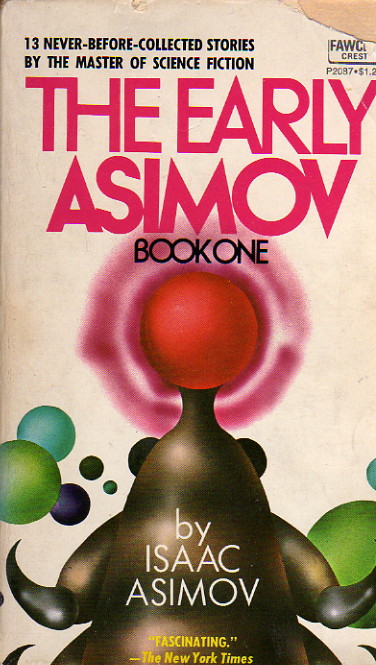
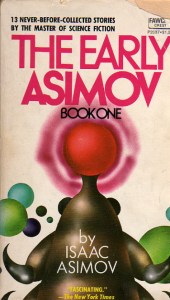
The last one we took, before my parents’ marriage took its final turn for the worse, was when I was 13 or 14 years old. Shortly before we had left on the trip, I had acquired a paperback copy of The Early Asimov, Volume 1, and had packed it along. I’m not sure why that particular book had jumped out at me in the small bookstore that we had visited with my Great-grandma on a weekend trip to a nearby town that was large enough to have an actual bookstore. My best guess is that, since Asimov was at that time the author of a monthly science essay that appeared in each issue of The Magazine of Fantasy & Science Fiction that I had recognized his name.

I remember waking up early in the morning several times on that camping trip, my parents and sister still asleep, and going to the pickup to retrieve the paperback book from my bag. Then I sat and read until Dad woke up. Just looking at the cover of my worn old copy of the book brings back memories of the early morning light, the sounds of wind in the leaves overhead, and the nearby creek.

The Early Asimov was first released as a hardcover, single volume book a couple of years before I found the paperback. It is a collection of a bunch of Isaac Asimov’s short stories from the first nine or ten years of his career; specifically stories that had not already been included in any other anthologies. But the book isn’t merely an anthology—in between each story, Asimov wrote about how he came to write the story, along with describing other stories he wrote at the time that either had never been published, or had been and were in other collections. These interludes were much more than mere introductions to the story, they amounted to an autobiography. And the story this autobiography told was how a Russian-Jewish kid from Brooklyn discovered science fiction in the magazine rack of his family’s candy store, and became a published professional sci if writer before he exited his teens.

Isaac’s personal story gave me at least as much hope and wonder about the possibilities of the future as his science fiction did. The stories themselves were entertaining and thought-provoking. Asimov clearly loved science, and he was perpetually optimistic that great things could be accomplished with the proper application of knowledge.

And he wrote good stories.

Not just a few stories. He published over 300 books. He wrote science fiction novels, of course, and collected his short stories into anthologies, but he also wrote science fact books, history books, books on literature, and so much more. I mentioned his monthly science column—he wrote 399 of those from 1958 until his death in 1992. About every year and a half he collected the last 15 to 17 of them into a book, wrote additional introductory information, and published them (Janet Todd Rubin gives a great explanation of the importance of Isaac’s science columns here: (Almost) Everything I learned about science I learned from Isaac Asimov). And then there were the many limerick collections…

But back to the sci fi:

His Foundation series, besides being the first collection of novels to be awarded a Hugo as a collection, established the concept of psychohistory: a science of applying mathematical formulas to the actions of large populations to predict various outcomes. His Robot stories were the first to posit artificial intelligences that did not turn on their masters, and he was the first person to coin the word “robotics” which has become the name of the real engineering discipline he described in the books.

And then there were his mysteries. Science fiction mysteries at first (including the Wendell Urth science fictional science mysteries), but also a series of mystery short stories set in contemporary setting (Tales of the Black Widowers, and sequels), and two straight murder novels. Though my favorite of those, Murder at the ABA which was set at a booksellers convention, isn’t entirely serious. One of the supporting characters in that one is Asimov himself, and he portrayed himself very self-deprecatingly, making his character the comic relief of an otherwise serious murder investigation.

I didn’t really know all of that at the time, but reading that book over the course of several mornings on that vacation, Isaac Asimov gave me hope that I could write science fiction and get it published, too. Hope not only that I could write and get published, but that there were people out there interested in the things I was interested in. I didn’t have to remain trapped, like the protagonists of “Marooned off Vesta” stuck with no propulsion, no radio, a limited amount of air, and a year’s supply of water. I could rig up a propulsion system from the things I had, and get to a safer place.

His writing style was described as unadorned. Some people complained that he very seldom described his characters or the settings. I think that was a strength. His stories focused on the plot. His characters were defined by their words and deeds. He described only those things that needed to be described to understand the story, leaving the rest to the reader’s imagination. Allowing the reader to imagine characters who weren’t always white, for instance.

He raised questions, and answered them with a mix of science and humor that made the future seem like a very inviting place. And his willingness in many anthologies and essays to share anecdotes of his encounters with other writers (not to mention the many stories of the times he was Toastmaster at a Hugo Award ceremony) made the world of science fiction writers and fandom seem an even more welcoming place.

He was quick to laugh, and quicker to make others laugh. Sometimes too quick. He had to have thyroid surgery at one point in his life, and when they gave him the tranquilizer before they move the patient into the operating room, he began singing and joking with everyone. When the surgeon came into the operating room, Isaac sat up, grabbed the doctor’s scrubs in both hands, and blurted out, “Doctor! Doctor! In green coat! Doctor, won’t you cut my throat? And when you’re finished, Doctor, then, Won’t you sew it up again?”

The nurses got him back down and the anesthesiologist put him under. The nurses later told Isaac’s wife that the doctor couldn’t stop laughing for nearly five minutes. When he included this story in one of his essays, he noted, “They say I’ll do anything for a laugh, but I think that making a surgeon about to take a scalpel to me laugh so hard he can’t hold an instrument may have been a step too far.”

I could easily ramble on and on about Asimov, the awards he won, the records he set, the serious science circles he moved in, and the many, many bookshelves in our house filled with his books. He loved knowledge and he loved explaining things (two traits that I know more than a little about), and he wrote in a way that encouraged you to think, to be curious, and to meet challenges with confidence and a smile.

The stories we have to tell

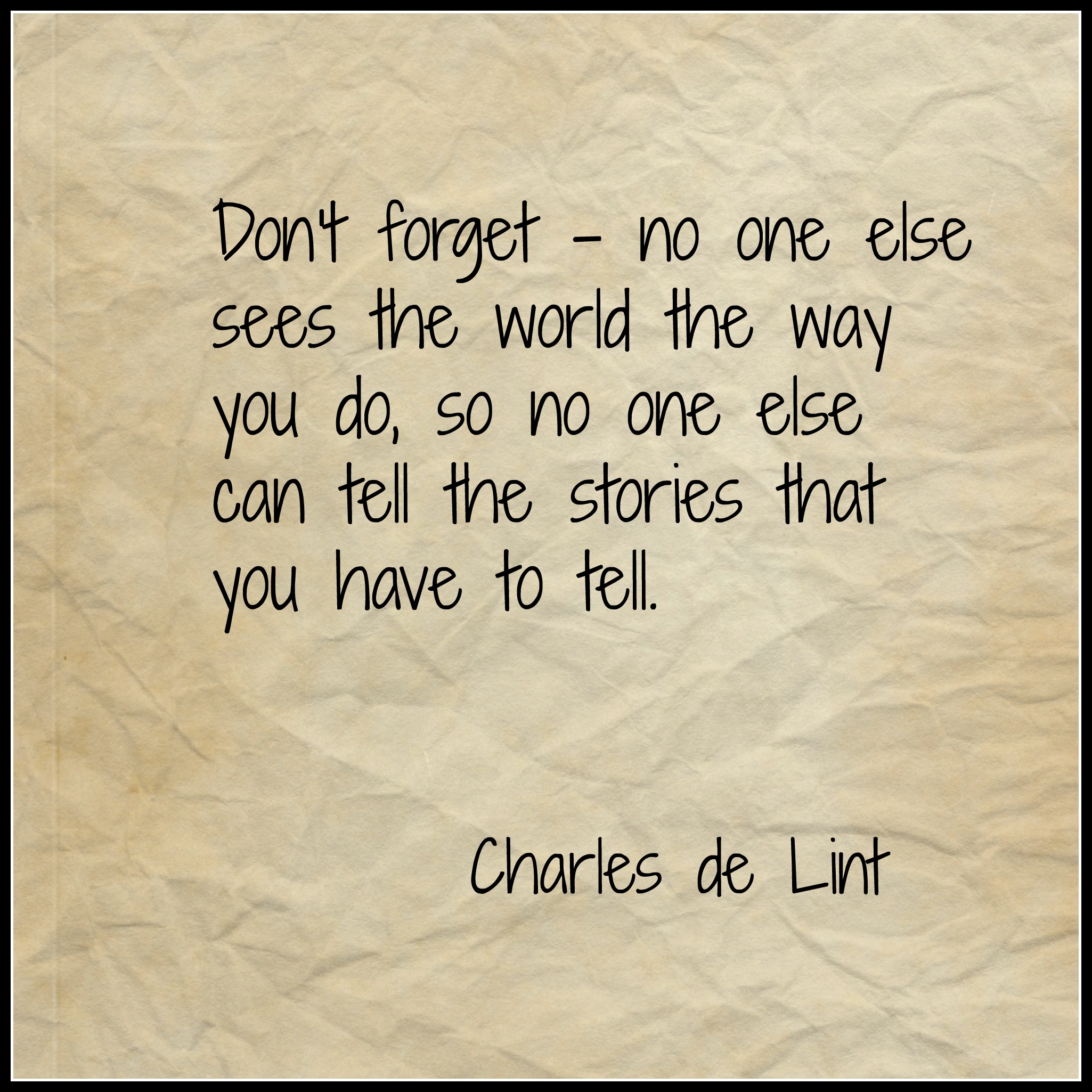
"Don't forget, no one else sees the world they way you do, so no one else can tell the stories that you have to tell." - Charles de Lint“Researcher Dale Spender in Australia used audio and video tape to independently evaluate who talked the most in mixed-gender university classroom discussions. Regardless of the gender ratio of the students, whether the instructor was deliberately trying to encourage female participation or not, men always talked more—whether the metric was minutes of talking or number of words spoken.

“Moreover, men literally have no clue how much they talk. When Spencer asked students to evaluate their perception of who talked more in a given discussion, women were pretty accurate; but men perceived the discussion as being “equal” when women talked only 15% of the time, and the discussion as being dominated by women if they talked only 30% of the time.”

My conclusion: men think women talk too much because they think women should be silent.

This perception problem isn’t limited to gender issues. Any person in a position of power or privilege thinks that any time someone outside their group talks or is recognized more than a tiny fraction of the time that the others are dominating the situation.

  • It is part of the reason that someone like Senator Cotton of Arizona can go on a national news program and say, with a straight face, that lesbians and gay men should stop demanding full equality and simply be grateful that we aren’t being publicly executed by the government.
  • It’s part of the reason the GamerGate goons start screaming that women are taking away their fun simply by suggesting that maybe a few games might be made that don’t treat woman as objects to be destroyed and avenged or taken as a prize.
  • It’s the reason that rightwing politicians and the like can claim that Christians are being oppressed despite the fact that: Christian holy days are observed as both state and federal holidays; two-thirds of the justices on the Supreme Court are Catholic; the President, Vice-President, Speaker of the House, Senate Majority Leader, Senate Minority Leader, House Minority Leader (heck, 92 percent of the members of Congress) are Christian; where many states have laws that explicitly exempt Christians from anti-bullying laws and policies at schools (in other words, Christians can bully anyone they want, as long as they claim it is due to their sincerely held belief); and where not one single state has enacted laws banning Christians from getting married, or adopting children, or being teachers.
  • And yes, it’s part of the reason that someone like Larry Correia and his cohorts—Brad Torgerson, Theodore Beale (aka Vox Day), and John C. Wright—can see more than one or two women or people of color nominated in a single category for the Hugo Awards and start screaming that science fiction is being taken away from people like them.

A bit over a year ago, Laurie Penny wrote Whose wankfest is this anyway? The BBC’s Sherlock doesn’t just engage with fan fiction – it is fan fiction for The New Statesmen which included this brilliant observation:

“What is significant about fan fiction is that it often spins the kind of stories that showrunners wouldn’t think to tell, because fanficcers often come from a different demographic. The discomfort seems to be not that the shows are being reinterpreted by fans, but that they are being reinterpreted by the wrong sorts of fans – women, people of colour, queer kids, horny teenagers, people who are not professional writers, people who actually care about continuity (sorry). The proper way for cultural mythmaking to progress, it is implied, is for privileged men to recreate the works of privileged men from previous generations whilst everyone else listens quietly.”

Laurie Penny is talking about the BBC series, Sherlock, and quite rightly pointing out that the series itself is fan fiction. It is being produced and broadcast on a prestigious network, and very few people would say that it isn’t real story telling, but the series is a re-imagining of stories written more than a hundred years ago by Arthur Conan Doyle. It isn’t sneered upon the same way that Buffy fanfic or ElfQuest fanfic or Teen Wolf fanfic or Supernatural fanfic is in part because the source material for Sherlock is in the public domain, but also in no small part because the people writing it are a pair of middle-aged University-educated white male British citizens.

Her insight doesn’t apply only to fan fiction.

Stories—whether they be fiction or the narrative of our existence or history—shouldn’t come from only privileged voices. They need to come from all voices, including women, people of color, queers, young people, old people, prudes, libertines, people who aren’t (yet) professional, and most definitely people who actually care about continuity. That’s why those of us who aren’t part of the dominant demographic need to tell our stories. And we need to make room for others to tell theirs.

About disliking a ‘classic’ novel

When we don’t like something that a friend likes a great deal, they may be surprised—even shocked. I know I’m often surprised when I share a book or movie or series that I think is the coolest thing I’ve experienced in years with a friend and they can’t stand it. How can they not see how amazing it is? I ask. And sometimes I ask far too emphatically and make them feel defensive.

It’s one thing when a single friend is disappointed that we don’t like something they’ve shared with us. It’s quite another when it seems the entire world thinks some book is one of the greatest novels ever written, but you think it’s mediocre at best. You wind up feeling more than just defensive. Especially when the people going on about how good it is are writers whose work you love, or teachers that you admire. You wonder if something is wrong with you. Did you miss something when you read it? Are you not quite discerning enough to recognize its nuances? Are you simply not smart enough to understand it?

Sure, we all understand that people have differing tastes. But when a specific book evokes labels like “great” and “a classic” from the sorts of people who should be good at spotting greatness, we expect to at least be able to recognize why the other people liked it more than we did. Part of the problem is, of course, that significant doesn’t always also mean engaging.

For instance, I was in middle school and high school in the 1970s, when The Catcher in the Rye was one of the most-banned books in the U.S. I read and listened to a lot of arguments about why it should or shouldn’t be banned, including descriptions of the subject matter of the novel, with debates about what it meant. When it first came to my attention, I remember trying to find a copy in both the school’s library and my local library, and coming up empty handed. The book had been described so vehemently as immoral by a teacher who happened to be the husband of one of the librarians at the public library, I decided not to put in an inter-library loan request. I didn’t want to deal with awkward questions. Being anti-censorship from a young age, this left me with the feeling that someday, when I was no longer trapped in the boonies, I would read the book for myself.

I didn’t actually get around to reading it until my mid-twenties. I was a bit underwhelmed. It isn’t a badly written book, by any means, but I’d been led to expect something mind-blowingly good and life-changing. I found it fell far short in both respects. Maybe the subject matter and style, which had been innovative and edgy when it was published in 1951 was simply too quaint by the mid-80s. Or maybe I had read too many books and stories and seen too many movies and plays that had been influenced by it.

The “Tales of Passing Time” blog posted a great description of the phenomenon:

A classic novel isn’t good because it’s a classic, rather it is a classic because it was important to the development of the art. And that certainly doesn’t mean that any given person, on any given day, will enjoy reading it. It means that, as a writer, I should be aware of what the classic novel changed in the historical progression of novel story telling. Some classics are pretty terrible, even unreadable, but they are still important.

I would rephrase that just slightly: sometimes a classic novel isn’t called a classic because it was good, but rather because it had a significant influence on the development of the art.

Sometimes a novel was the first one to introduce a particular idea, and that idea was mind-blowing and life-changing. It was so life-changing, that hundreds of novels since have taken the idea and developed it in different ways; each author putting their own spin on it. The idea becomes part of the fabric of literature after that, so that a reader born decades later will have encountered that once mind-blowing notion hundreds or even thousands of times. By which point, if we read the original, which might have contained no redeeming qualities other than this one idea, it feels derivative of all this other stuff we’ve experienced. We may intellectually know that the “classic” inspired all the other instances or variants of the idea we encountered. Emotionally, however, it strikes us the other way around, because we have already internalized the once mind-blowing idea.

The fact that the idea has become ubiquitous is a testament to the significance of the classic in question to literature and the culture in general. It doesn’t mean that everyone is going to love it’s original package.

Assessments, plans, and implementations: a metapost

Click to embiggen.

Some parts of this post may fall too far into the “what I had for breakfast” zone for some of you, but it helps me to stick to plans if I share them with people. Not that I get nagged often by my readers, I just am more motivated to do things I have said I would do than to follow through on plans that I keep to myself.

So I’ve been making some changes to my routines in an attempt to improve my writing productivity, and I’m thinking about some changes for this blog…
Continue reading Assessments, plans, and implementations: a metapost

Friday Links (insane lawsuit edition!)

32613-equal-protection-20130326202918It’s Friday! Another not very pleasant week of work is very nearly over! Last weekend I had a fabulous date night with my very sexy husband, then we had a fun movie excursion with 8 of the coolest nerds in the Puget Sound, and then we had a great time journeying to the year 1877 and meddling with the Russo-Turkish War (though by this session of the game it was all down to treaty negotions and shopping trips). This weekend we’re gaming with other friends in a land of candy-colored ponies and cosmic forces no pony was meant to understand. Some months, the weekends are the only thing that make life bearable, no?

Anyway, here is a collection of some of the things that I ran across over the course of the week which struck me as worthy of being shared. I’ve decided to do the links a little differently this time, and make it easier for people to skip the sorts of things they aren’t interested in. But first up, the silliest story of the week, perhaps of the entire year:

This Woman Is Suing All Gay People On Earth On God’s Behalf. Yes, Really. I’m linking to several versions of the story, mostly because I love the headlines. You really don’t need to click on more than one of them…

God Sues Homosexuals In Nebraska. God Has Terrible Grammar.

Woman Sues Homosexuals in Federal Court—All Homosexuals.

Nebraska Woman Sues All Homosexuals. I love that this site posted all seven pages of the woman’s poorly spelled handwritten brief.

Ambitiously Homophobic Nebraska Woman Sues Every Gay on Earth.

Totally Normal Nebraska Lady Would Like To See ALL GAYS In Court Right Now!

But the fun couldn’t last through the week: Judge Tosses Lawsuit By Nebraska Woman Suing ‘All Homosexuals’ On Behalf Of Jesus.

That’s more than enough about that. Meanwhile, some cool things happened in science:

UW tracks undersea volcano erupting off Washington coast.

Honey Bunches of Lies: Why eating local honey won’t cure your allergies.

Ladybirds are widely adored for their spotty bodies, but these cute beetles often eat each other and are infested with blood-sucking mites.

Meet Loki, your closest-known prokaryote relative.

The ‘other’ red meat on the ‘real’ palaeodiet.

The Rök Stone – Riddles and answers.

10 Real-Life Animal Husbandry Techniques That Alien Zoos Will Use On Us.

CRAZY CAMOUFLAGE: LET’S PLAY SPOT THE SNOW LEOPARD.

That was fun! Now the weird political news:

A Couple Quick Thoughts on Geller in Texas.

Republicans Admit Hobby Lobby Ruling Is Religious Tyranny Meant to Control Women.

“We need to talk about this as terrorism”: The war against abortion providers.

Wonder Why The American Right Is So Dumb? Read Fox Nation vs. Reality: The Fox News Cult Of Ignorance.

Ben Carson Enters GOP Race with “A Glory Hallelujah Star-Spangled Jesus Frenzy”.

Death for Drug Dealers and Quarantines for AIDS Victims: The Mike Huckabee You May Not Remember.

Jon Stewart Mocks ‘Lone Star Lunatics’ Who Believe Obama Is Trying To Invade Texas (Video).

The ludicrous myth of Republican fiscal responsibility: A history lesson for the modern GOP.

Americans Far More Comfortable With Gay Presidential Candidate Than Evangelical Christian.

Carly Fiorina Is Running to Be 2016’s Sarah Palin.

Now the news relevant to queer people, and those who love us

How to count how many people are gay. Another take on the very tricky statistical question.

WHAT MARRIAGE EQUALITY WOULD MEAN FOR THE ECONOMY.

Mom, Dad, I’m Not a Lesbian.

How big business in Texas is rallying to defend gay rights.

Why the Boycott Against Ted Cruz’s Gay Hosts Is a Watershed Moment.

Oregon bill to ban conversion therapy for LGBT youth sent to governor’s desk.

ANTI-LGBT ACTIVIST WHO ONCE TRIED TO BURN KORAN SUES FORT WORTH OVER TREATMENT AT GAY PRIDE: VIDEO.

CECIL BALDWIN, DYLAN MARRON, AND KEVIN WADA SLATED TO JOIN NYC’S FIRST LGBTQ-CENTIC COMIC CONVENTION ‘FLAME CON’.

This Gay Couple Shows How Love Can Overcome Bigotry.

And I wrote about, among other things, how I became a fan of the sci fi tales of John Varley: Picnic on the Queer Side: more of why I love sf/f.

People we lost:

Errol Brown, ‘You Sexy Thing’ vocalist, dead at 71.

Grace Lee Whitney, Yeoman Rand on ‘Star Trek,’ dead at 85.

Jayne Meadows Dies at 95; Widow of Steve Allen Was Nominated for 3 Emmys.

The obligatory Sad Puppies/Hugo Awards update:

How conservatives took over sci-fi’s most prestigious award.

An open letter to Chief Warrant Officer Brad R. Torgersen.

Change, Reaction and Pain – Coping With Cultural Backlash.

I wrote about why I love science fiction and why this situation bothers me: Visions and Ventures: why I love sf/f.

And a follow up about why I said what I meant and meant what I said and will not be lectured by people who don’t know the situation as well as I do: Adventures in being straightsplained.

And other news:

Preschool rallies after little free library is torched. What kind of scumbag sets fire to a little free library? WARNING: video plays automatically.

3 Things No Estranged Child Needs To Hear On Mother’s Day.

Video shows four parole officers detained by gun-wielding police for Driving While Black.

The Price of Nice Nails.

Today Is the 151st Birthday of All-Around Feminist Badass Nellie Bly.

Hostage saves herself via Pizza Hut app: “Please help. Get 911 to me.”

Abstinence-Only Texas High School Hit By Chlamydia Outbreak; 1 In 15 Students Affected.

Why Are the Star Wars Prequels Hated So Much? Besides the fact that they mostly sucked, you mean?

U.S. top court rejects challenge to New Jersey ‘gay conversion therapy’ ban.

Videos!

MIKA – Talk About You:

(If embedding doesn’t work, click here.)

Hot Chocolate – You sexy thing 1975:

(If embedding doesn’t work, click here.)

Beauty And The Beat Boots by Todrick Hall:

(If embedding doesn’t work, click here.)

Brandon Flowers – I Can Change (Audio):

(If embedding doesn’t work, click here.)

Magic Mike XXL – Official Trailer [HD]:

(If embedding doesn’t work, click here.)

“Vacation” Red Band Trailer – I’m not really interested in a sequel/reboot (the head of the family is supposed to be a grown up Rusty Griswald) but then I heard about the R-rated final bit in the trailer with Chris Hemsworth and decided I could at least watch the trailer:

(If embedding doesn’t work, click here.)

Bright Light Bright Light & Ana Matronic – Good Luck (Remix) – Official Video:

(If embedding doesn’t work, click here.)

The Last Word with Lawrence O’Donnell 5/6/15 Dodgers fans cheer for gay couple on Kiss Cam:

(If embedding doesn’t work, click here.)

Adventures in being straightsplained

Click to embiggen.
Click to embiggen.
Earlier this week I posted about how much I love fantasy and science fiction and one of the reasons why. Specifically that sf/f had been a refuge from some of the cruelties a homophobic society heaps upon queer kids while they’re growing up. Much of sf/f is about escaping oppression of one sort or another. Science fiction in particular is often about the triumph of the light of reason over the darkness of ignorance. That gave me hope, as a kid. Sometimes it was the only hope I had. Which is why it feels like a double betrayal when I encounter homophobia in sf/f circles. One phrase I used to describe the homophobes in question was, “whose ultimate goal is to erase us.”

Which led one commenter to tsk at me and insist that, while the people in question are decidedly anti-gay, there was no evidence they want to erase us.

Oh, goodie! Straightsplaining! Homophobia isn’t what I think it is, at all! How foolish of me to think that my 50+ years of surviving the slings and arrows of homophobia gave me any expertise in the meaning or aims of homophobia!

It’s possible the commenter has a reading comprehension problem and thinks that erasure must always literally imply extermination and is trying to claim that the people in question don’t want all queers dead. So, on the slight possibility that that’s the case, let me just explain that when I say “erase us” I mean “wish that we were invisible and that all or nearly all evidence of our existence was removed from stories, books, movies, television series, and society in general.”

And you know what? Every single homophobe in existence wishes that we were, in the least, invisible. It is part of the definition of being a homophobe! It’s a common lie they tell themselves and us all the time: “I don’t hate gay people, just why do they have to shove it in my face all the time?” Or “I wish they wouldn’t flaunt it all the time!” Or “I don’t want my children seeing that!”

And in the cases of the Sad Puppies, making us invisible is exactly what they’ve been talking about:

  • When they lament the fact that they can’t always be sure when they pick up a “book with a rocket on it” that they aren’t going to encounter gay characters inside? That’s wishing we were invisible.
  • When they insist (in the comments thread of the post linked in the first bullet) that it is deceptive that another book’s back cover blurb didn’t mention prominently enough that the protagonist is gay? That’s wishing we were invisible.
  • When they insist that in a novel about a young person’s quest for self-discovery the fact that the young person is gay isn’t revealed until nearly midway through the book (when the character finally admits it to himself) is some form of malicious deception? That’s wishing we were invisible.
  • And when a pair of artists/writers reveal in the final scenes of the finale of their cartoon series that the female lead and her female companion are in love, and a homophobic sci fi writer compares those artist to termites that need exterminating simply because they included queer characters in their story? That’s wishing we were invisibile.

And while we’re on the subject of John C. Wright: when he says that the “instinctive reaction of men” to “fags” is “beating them to death with axhandles and tire-irons,” that’s beyond wishing we were invisible, it’s an explicit statement that they wish we were exterminated.

To the commenter who kicked this off: I don’t know how you could have been paying close enough attention to the Bad Puppies to notice that they were anti-gay, yet missed the many times they have alluded to the bashing (and worse) of queers. Just as I don’t know how you could have been paying close enough attention to these guys to describe Vox Day/Theodore Beale as “vile” and have missed all the times he’s said that homosexuality is an existential threat to civilization that must be either cured or eradicated. Because all of that is also evidence that even more than wishing we were invisible, they wish we didn’t exist.

So please, don’t tell me or any other queer person that we don’t understand our own oppression. To paraphrase bunnika : when you were watching our lifestyles and checking out the homophobes’ web sites, we have been living our lives and experiencing actual homophobia that you have no right to ‘splain.

Thanks for your comment, though. And bless your heart.


Note: Comments on this entire blog have always been moderated. Specific commenters have been whitelisted, but everyone else’s comments sit in a queue until I approve them. And I don’t see any point in approving comments that are insulting, or obviously coming from sock puppets (there have been a lot of those this week) or—such as the comment alluded to here—indicate the person isn’t interested in listening.

Picnic on the Queer Side: more of why I love sf/f

We're queer, we're nerds, get used to it!
We’re queer, we’re nerds, get used to it!
I was 13 years old and had been a semi-faithful reader of the Magazine of Fantasy and Science Fiction for a few years. I think I found my first copy in a magazine rack in a drug store sometime during fourth grade. I had pleaded and begged for a subscription of my own, and one of my grandparents had bought me a subscription for my twelfth birthday—except they got me a subscription to Galaxy Science Fiction instead. Which wasn’t bad, it meant I got a magazine about the size of a paperbook every month filled with short stories, novelletes, and sometimes serialized novels. But my adventures in the pages of Galaxy magazine is a story for another blog post.

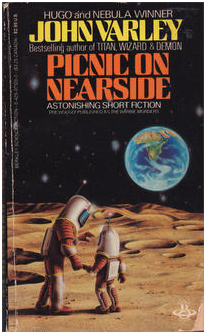
It was summer, just months before my 14th birthday, when I got hold of the new copy of the Magazine of Fantasy & Science Fiction and found inside it a story called “Picnic on the Nearside” written by John Varley. In it, the narrator, Fox, who was 12 years old and lived on a colony of the moon sometime in the future, had been in an epic argument with his mother, because he wanted a Change. He didn’t explain right away what the change was, but before that reveal, we learned that people in his society could easily alter their bodies (his mother exchanged her feet for peds/hands before going out to a party; and Fox mentioned a time he had assembled an eight-legged cat). Then Fox’s best friend, Halo, shows up as a nude woman, which finally explained what the change was. Fox and Halo had been best buds for years, and Fox worried that now that Halo was a woman, it would ruin their friendship.

Cover of the paperback edition of on of Varley's anthologies which included the story in question.
Cover of the paperback edition of one of Varley’s anthologies which included the story in question.
There are many other interesting things that happen in the story: Fox and Halo take Fox’s parents’ vehicle out on the surface without permission and get into a misadventure. But the really mind-bending part of the tale was the setting: a society where changing genders was only slightly more complicated than changing one’s clothes, and where everyone was okay with it. That was just mind-boggling!

I have to make a couple of digressions here. The first is that not all queer people are transgender, transsexual, nor transvestite. Gay boys don’t want to become women, we’re guys who are attracted to and fall in love with other guys. The proper answer to the clueless question, “Which one is the woman” is “Neither, that’s the point!” But one of the reasons young gay boys often idolize female characters in their favorite movies, books, and so forth is because the female characters are the objects of desire of the male characters. Similarly, young lesbian girls often idolize male characters in works of fiction. Young bisexuals may find themselves idolizing both, and so on.

Because there were no openly gay characters in any of movies, TV shows, books, short stories, et cetera which made up our cultural landscape growing up, one of the only ways to imagine ourselves in the worlds we longed to live in was to identify with the female characters. So on one level, “Picnic on the Nearside” offered me a more explicit way of projecting myself into that world. It was as if one of my subconscious coping mechanisms had been made manifest in the plot! Therefore, this story so intrigued me not because its imagined future would afford me an opportunity to change genders (which wasn’t what I wanted), but because it offered an escape from the expectations that boys were only allowed to do boy things, and only allowed to be friends with other boys, and only allowed to be boyfriends with girls.

The other digression is about the difference between a gender fluid milieu and a gay/lesbian culture. Varley has written a lot of stories set in the same world as “Picnic on the Nearside,” including several with the same character, Fox, as the protagonist (though the stories starring Detective Anna-Louise Bach {for example, “The Barbie Murders”} may be a bit more famous). Many of his characters change genders and have love affairs with people who have also swapped genders, but many times his imaginary gender fluid society is still very heterosexual. Fox never thinks of Halo as a potential sexual partner until they are opposite gender, for instance. Some of the couples who appear in the various stories seem to be just friends when they happen to be the same gender, then become lovers only when they happen to be opposite.

Many psychologists and sociologists now theorize that men who like to dress up as women and have sex with other men while thus dressed up are actually exploring an exaggerated heterosexuality. Having, in the online world, been sometimes emphatically propositioned by guys like that, and found myself turned off by their “flirting” that consists of trying to get me to say I will treat them the way an extremely selfish chauvinist man might treat a “slut,” I see their point. The men pursuing those scenarios are so into their fantasy of what heterosex could be that sometimes they want to experience it from the girls’ side. They aren’t turned on by the other man as a man, they are turned on by the situation of a woman submitting to a man in very specific ways.

Looking back on some of Varley’s stories, they can feel more like a mostly hetero exploration of gender roles, rather than a pan-gender exploration of sexual orientations.

There’s nothing wrong with that, and there’s a lot right with it.

A lot of the pain, fear, and bigotry directed toward LGBTQ people is grounded in very narrow and strict views of gender. It’s why homophobic men are almost always also misogynist (or at least very chauvinist). So anything that makes us question those assumptions about intrinsic differences between men and women, what roles men and women are each allowed to take in society, and the morality of those gender binaries is a good thing. And there’s no question that Varley’s tales exposed many of hypocrisies at the heart of all those assumptions.

I became a Varley fan that summer. Even more so, I became a fan of the protagonist, Fox, who went on to appear in the short story “The Phantom of Kansas” and the novel Steel Beach. Questions of gender and sexuality are at most a minor consideration in most of his stories, and I’ve come to appreciate his ability to take seemingly any speculative notion (no matter how weird) to its logical conclusion, and still tell a cracking good yarn along the way. What grabbed me that summer, while re-reading Fox and Halo’s misadventure again and again, was that there was at least one writer willing to tell stories that didn’t exclude a queer viewpoint. And there were editors who would print it, and by implication, readers other than me who wanted to read it.

And that was an amazing epiphany for a 13-year-old gay boy in the rural and very redneck Rocky Mountains.

Visions and Ventures: why I love sf/f

tumblr_nkryuujLIC1sndzdgo2_540I don’t remember a time when I wasn’t a fan of fantasy and science fiction. Which is not surprising, since my mother accidentally taught me how to read at an early age by reading to me from her favorite authors (Agathe Christie and Robert Heinlein) and making me repeat back entire sentences. Tales of the fantastic by Heinlein, Andre Norton, J. R. R. Tolkien, Edgar Eager, Edith Nesbit, Isaac Asimov, Ursula K. Le Guin, Leigh Brackett, Gordon R. Dickson, Lin Carter, and so many others fed my imagination, encouraged my curiosity, fueled my thirst for science and math, and provided a refuge from the cruelties and contradictions of life.

One might wonder how cruel an existence growing up as a white boy in mid-twentieth century America could be. When you have a physically abusive alcoholic father heading up your working class rural evangelical fundamentalist family, real life can be quite unpleasant—especially for a gay, nerdy kid who talked to himself and was more comfortable with books than kids his own age. Science fiction and fantasy promised worlds where all you needed to defeat evil was a bit of courage, a lot of cleverness, and people you could count on. Every time my dad’s job transferred us to a new town, I would quickly ingratiate myself with the local librarians and proceed to devour every science fiction and fantasy book I could find on the shelves. Not to mention mysteries and science non-fiction books.

It wasn’t just the imaginary worlds of the various stories I read that provided a refuge, but from the introductions and interstitial texts of anthologies such as The Hugo Winners, Volume n, Best Science Fiction of the Year XXXX, and so forth, I also learned of conventions, where the creators and fans of these fantastic worlds gathered to talk about their favorite books and stories, encourage each other to write more stories, collaborate in various ways, and maybe even have a fun party or banquet where awards were handed out. And that sounded so amazing. Before middle school I knew about the Nebula Awards and the Hugo Awards. I knew that the Nebulas were voted on by members of the Science Fiction Writers of America, and that you had to be a professionally published SF writer to get in. But the Hugos were voted on by the attendees of WorldCon—by fans and professionals alike. So in theory, at least, I didn’t have to wait until I’d been published to participate in those.

I’d decided to become a writer sometime around the age of five or six. I’d been making my own books out of whatever notebooks or paper I could get my hands on since before I could write. I started writing my own stories as soon as I could assemble my sloppily-drawn letters into words. I was determined to be a writer. And I hoped that someday I might be a member of that community of writers vying for a Hugo.

As an adult, I’ve been attending sci fi conventions for decades. I’ve even been a staff member at a few. I’ve had some of my own tales of the fantastic published, even though most of my published stories have been in fanzines and other small semi-pro publications. I’ve had the good fortune to be the editor of a fanzine with a not insignificant subscriber base. I count among my friends and friendly acquaintances people who have been published in more professional venues, people who have run those conventions, people who have won awards for their sf/f stories and art, even people who have designed some of the trophies. Not to mention many, many fans. I have even occasionally referred to that conglomeration of fans, writers, artists, editors, and so forth as my tribe.

All of that only begins to scratch the surface of why I find the entire Sad Puppies/Rabid Puppies mess so heart-wrenching. Yes, part of the reason the situation infuriates me is because the perpetrators are all so unabashedly anti-queer. For this queer kid, sf/f and its promise of better worlds and a better future was how I survived the bullying, bashing, hatred, and rejection of my childhood. To find out that there are fans and writers who so despise people like me that they have orchestrated a scheme whose ultimate goal is to erase us goes beyond infuriating.

But it’s worse and so much more than a bloc-voting scheme.

This is hardly the first time I’ve encountered homophobia, misogyny, and racism in the fandom. It’s certainly not the first time I’ve encountered it among the professionals! While it’s disheartening to have people sneer and make denigrating comments; and it’s chilling to be told people like me deserve extermination. The worst part is to be told that even putting characters that are like me into stories about space battles or post-apocalyptic worlds or bio-engineered futures makes those stores cease to be “real science fiction.”

If your imagination is so small that you can’t conceive of a future where gay people and women and non-white people actually exist and do interesting things—that those people can sometimes be the heroes of the tale—then I just don’t see how your speculative fiction can be very creative. If you can’t conceive of a world with gays and straights, women and men (trans* or cis), and people of all races, living and working together, you’re hardly a visionary. If you’re so afraid to share imaginary worlds with such people, you’re the exact opposite of an intrepid adventurer.


Update: Some of the Sad Puppy supporters have decided to send me messages, accusing me of blindly believing propaganda. The implication seems to be that the various organizers of the Sad Puppies have never said the things alluded to here.

Let me be clear: I’ve been reading the blogs and other postings of John C. Wright, Brad R. Torgersen, Larry Correia, and Vox Day/Theodore Beale for years, because they’ve been on their anti-SJW and anti-gay kick for a while. Everything I’ve mentioned in this post and previously I have seen myself, from their own words. That they have deleted and revised many of their old posts to obfuscate that doesn’t change anything. They can claim they didn’t say what they said, but we have screen captures and Google caches and Wayback Machine caches that say otherwise.

And even the revised posts are still clearly anti-gay: [The unraveling of an unreliable field | Brad R. Torgersen]